Presented by:
David B. Solomon
Levenfeld Pearlstein, LLC
2 N. LaSalle Street, Suite 1300, Chicago, IL 60602
Phone: (312) 476-4526 Email: dsolomon@lplegal.com
Ronald J. Gilbert
ESOP Services, Inc.
251 Albevanna Lane, Scottsville, VA 24590
Phone: (434) 286-3130 Email: esop@esopservices.com
Robin Jaffe Goebel
Chemonics International
1717 H Street, NW
Washington, DC 20006
Phone: (202) 955-3454 Email: rgoebel@chemonics.com
ESOPs for Professional Service Firms
Employee Ownership Conference
1
Types of Equity Compensation Programs
• Stock Options
• Stock option plans enable a company to grant employees an option to buy a
stated number of shares at a defined grant price.
• Restricted Stock
• Restricted stock is an outright grant of shares to an employee that limits the
right to sell, transfer, and/or pledge such stock until the lapse of a vesting
period as provided for in the grant agreement.
• Phantom Stock
• Phantom stock provides a cash or stock bonus based on the value of a
stated number of shares to be paid out at the end of a specified vesting
period.
• Stock Appreciation Rights (SARs)
• Stock appreciation rights (SARs) typically provide the employee with a cash
or stock payment based on the increase in the value of a stated number of
shares over a specific period of time.
• Equity Value Units (EVUs)
• “First Cousin” of a SAR
• Employee Stock Ownership Plan (ESOP)
• Qualified retirement plan which holds company stock
2
Issues with Various Equity Compensation
Programs
• Phantom stock grants, SAR grants and ESOPs generally do
not require the employee to make an out-of-pocket
investment to obtain the benefits of the equity compensation
award.
• For restricted stock, phantom stock grants and ESOPs, the
employee is generally insulated against the risk of fluctuation
in the stock market since they will receive a benefit
regardless of the underlying market value of the company’s
stock.
• Stock options (particularly incentive stock options) have
favorable tax results for the employees, but may create a
less favorable tax result for the company.
• Stock options, restricted stock, phantom stock, SARs and
ESOP benefits settled by giving shares of actual stock to the
employees may create governance and other issues.
3
Why An ESOP as Opposed to Other Equity-
Based Incentive Plans?
• Employer-funded benefits (not require personal
investment).
• Designed to provide benefits to all employees (not just
management).
• Allows employees to defer recognition of taxes on
benefits provide by employer.
• Provides employees with a source of funding for
retirement.
• Tax benefits to company sponsoring the plan.
• Rules governing vesting and limits on distributions
provide a better long-term incentive.
• Fiduciary oversight of investment and encourages
better corporate governance practices.
4
Other Reasons Why ESOPs Work Well for
Service Firms
• No attractive 3rd party offers
• Management buyout notice possible
• No assets to secure senior bank loan
• Culture matters
• Desire to perpetuate the company and reward loyal
employees
• ESOP transaction may net more to selling
shareholders
5
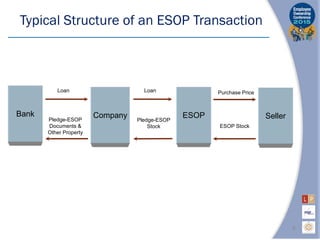
Typical Structure of an ESOP Transaction
SellerESOPBank Company
Loan Loan Purchase Price
Pledge-ESOP
Documents &
Other Property
Pledge-ESOP
Stock ESOP Stock
6
• “Tax-Free” Rollover of Stock Sold to the ESOP
• Shareholders of a closely-held C corporation may sell their stock
to the ESOP and if eligible pay no capital gains tax.
• The proceeds must be reinvested in the securities of operating
domestic, public or private corporations.
• In order to qualify, the stock sold must be held for a three-year
period prior to the sale to the ESOP. At death, under current tax
law, the shareholders estate receives “stepped up” bases and
the capital gains tax is extinguished. The securities portfolio
may be monetized”.
• Tax-Deductible Contributions
• Corporate contributions used to purchase company stock or
make ESOP loan principal payments are tax deductible to the
corporation.
ESOP Tax Shields
7
• Tax-Free S Corporation Income
• Income attributable to stock owned by an S corporation ESOP is
not subject to federal tax. This benefit may not be available for
smaller companies, due to IRC 409(p).
• Tax-Deductible Dividends When Paid Through the ESOP
• Dividends on C corporation ESOP stock that are “passed
through” the ESOP to participants or used to repay ESOP loans
may be tax deductible to the corporation. These dividends are
not counted in the normal contribution limit of 25% of payroll.
• Allowable and Reimbursable Cost
• Allowable and reimbursable ESOP contributions for Federal
Government contractors.
• Depending on contract type, ESOP contributions are an
allowable fringe benefit cost fully reimbursable if “room in the
rates”
ESOP Tax Shields
8
Issues for Service Company ESOP
Transactions
Because Service Companies are “Asset
Light” may need:
• Pledge of personal assets
• Personal guarantee
• Extended Release formula
• Subordinated seller financing
• With warrants attached?
9
Warrants
• Stock option cousin
• Approximates private equity group
mezzanine debt 12%-18% return
• 10% to 15% target return
• Often worth 1/3 of transaction price in
approximately 5 years
10
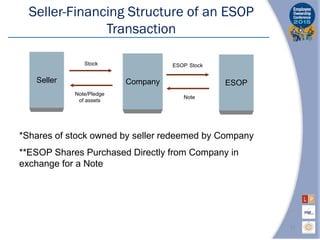
Seller-Financing Structure of an ESOP
Transaction
ESOPSeller Company
Stock ESOP Stock
Note/Pledge
of assets
Note
*Shares of stock owned by seller redeemed by Company
**ESOP Shares Purchased Directly from Company in
exchange for a Note
11
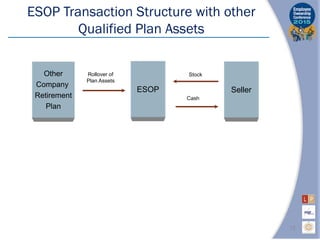
ESOP Transaction Structure with other
Qualified Plan Assets
SellerESOP
Cash
StockOther
Company
Retirement
Plan
Rollover of
Plan Assets
12
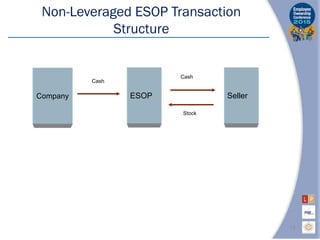
Non-Leveraged ESOP Transaction
Structure
SellerESOP
Stock
Cash
Company
Cash
13
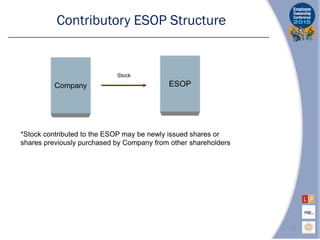
Contributory ESOP Structure
ESOP
*Stock contributed to the ESOP may be newly issued shares or
shares previously purchased by Company from other shareholders
Company
Stock
14
• ESOP costs can be included as a cost of
performing a government contract and reimbursed
by the governmental entity
• The contractor’s cost for an ESOP shall be
measured by the contractor’s contribution,
including interest and C corporation dividends, if
applicable, to the ESOP
• Contributions made in company stock shall be
based on the market value of the stock at the time
of contribution
Additional Benefits of ESOPs for Government
Contractors
15
Government Contractors (cont.)
Challengers of Cost Reimburse Ability
• Calibration of expected cost
reimbursement with ESOP loan
amortization
• Projecting reimbursable ESOP costs,
assigning them to contracts, and keeping
competitive rates
• It is important to communicate with the
agency’s contracting officer about the ESOP
16
Issue for Certain ESOP-Owned Service
Companies
Maintaining SBA 8(a) Status
• Disadvantaged owner must retain a 51%
ownership interest in the company
• ESOP can acquire up to a 49% in the
company and future ESOP stock sales can
be planned as the company graduates
from the 8(a) program
17
History of Chemonics ESOP
1987 Our founder begins to explore the idea of an ESOP
• As a way to benefit employees
• To create long-term sustainability
2001 Developed the legal frame work and Summary Plan
Description
2005 Board agrees to fund the ESOP
2009 Our ESOP has 10.24% ownership of the company
2011 Become 100% ESOP
2012 Funded an International ESOP
2015 Received groundbreaking IRS Private Letter Ruling for
an International ESOP
18
International ESOP
Who?
17 Countries : Afghanistan, Bangladesh, Bolivia, Bosnia &
Herzegovina, Botswana, Egypt, El Salvador, Ethiopia, Haiti,
Jordan, Mongolia, Nepal, Nigeria, Peru, Uganda, West Bank
& Gaza, and Zambia
1,100 plus employees
What?
25% of payroll which equals a contribution of ~6-8% of salary
Why?
One global company
Sustainability of our long term local national staff
Sharing in the value and growth of company
Recruitment and retention of talented local staff
Overall cost savings
19
What Does the ESOP Mean to the
Company?
• Cost savings through fringe & employees
being fiscally smart
• Staying true to the ideals of our founder
• Learning to navigate our new norm of
being a leveraged company
• Increased staff satisfaction
• Not just another government contractor in a
sea of contractors
20
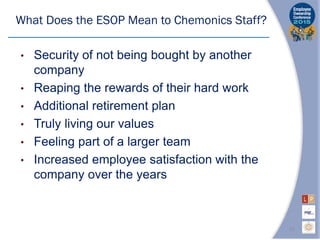
What Does the ESOP Mean to Chemonics Staff?
• Security of not being bought by another
company
• Reaping the rewards of their hard work
• Additional retirement plan
• Truly living our values
• Feeling part of a larger team
• Increased employee satisfaction with the
company over the years
21
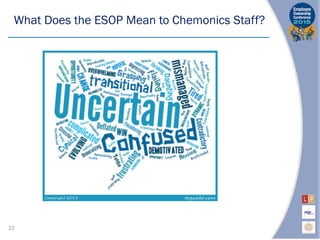
What Does the ESOP Mean to Chemonics Staff?
22
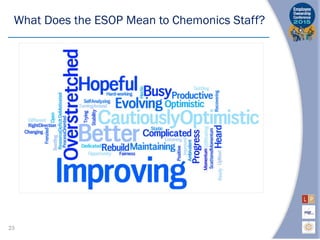
What Does the ESOP Mean to Chemonics Staff?
23
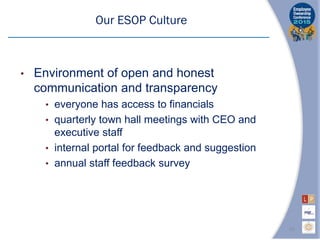
Our ESOP Culture
• Environment of open and honest
communication and transparency
• everyone has access to financials
• quarterly town hall meetings with CEO and
executive staff
• internal portal for feedback and suggestion
• annual staff feedback survey
24
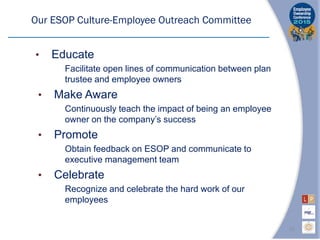
Our ESOP Culture-Employee Outreach Committee
• Educate
Facilitate open lines of communication between plan
trustee and employee owners
• Make Aware
Continuously teach the impact of being an employee
owner on the company’s success
• Promote
Obtain feedback on ESOP and communicate to
executive management team
• Celebrate
Recognize and celebrate the hard work of our
employees
25
David B. Solomon
Levenfeld Pearlstein, LLC
2 N. LaSalle Street, Suite 1300, Chicago, Illinois 60602
Phone: (312) 476-4526 Email: dsolomon@lplegal.com
Ronald J. Gilbert
ESOP Services, Inc.
251 Albevanna Lane, Scottsville, VA 24590
Phone: (434) 286-3130 Email: esop@esopservices.com
Robin Jaffe Goebel
Chemonics International
1717 H Street, NW
Washington, DC 20006
Phone: (202) 955-3454 Email: rgoebel@chemonics.com
Questions
26

ESOPs for Professional Service Firms

  • 1.
    Presented by: David B.Solomon Levenfeld Pearlstein, LLC 2 N. LaSalle Street, Suite 1300, Chicago, IL 60602 Phone: (312) 476-4526 Email: dsolomon@lplegal.com Ronald J. Gilbert ESOP Services, Inc. 251 Albevanna Lane, Scottsville, VA 24590 Phone: (434) 286-3130 Email: esop@esopservices.com Robin Jaffe Goebel Chemonics International 1717 H Street, NW Washington, DC 20006 Phone: (202) 955-3454 Email: rgoebel@chemonics.com ESOPs for Professional Service Firms Employee Ownership Conference 1
  • 2.
    Types of EquityCompensation Programs • Stock Options • Stock option plans enable a company to grant employees an option to buy a stated number of shares at a defined grant price. • Restricted Stock • Restricted stock is an outright grant of shares to an employee that limits the right to sell, transfer, and/or pledge such stock until the lapse of a vesting period as provided for in the grant agreement. • Phantom Stock • Phantom stock provides a cash or stock bonus based on the value of a stated number of shares to be paid out at the end of a specified vesting period. • Stock Appreciation Rights (SARs) • Stock appreciation rights (SARs) typically provide the employee with a cash or stock payment based on the increase in the value of a stated number of shares over a specific period of time. • Equity Value Units (EVUs) • “First Cousin” of a SAR • Employee Stock Ownership Plan (ESOP) • Qualified retirement plan which holds company stock 2
  • 3.
    Issues with VariousEquity Compensation Programs • Phantom stock grants, SAR grants and ESOPs generally do not require the employee to make an out-of-pocket investment to obtain the benefits of the equity compensation award. • For restricted stock, phantom stock grants and ESOPs, the employee is generally insulated against the risk of fluctuation in the stock market since they will receive a benefit regardless of the underlying market value of the company’s stock. • Stock options (particularly incentive stock options) have favorable tax results for the employees, but may create a less favorable tax result for the company. • Stock options, restricted stock, phantom stock, SARs and ESOP benefits settled by giving shares of actual stock to the employees may create governance and other issues. 3
  • 4.
    Why An ESOPas Opposed to Other Equity- Based Incentive Plans? • Employer-funded benefits (not require personal investment). • Designed to provide benefits to all employees (not just management). • Allows employees to defer recognition of taxes on benefits provide by employer. • Provides employees with a source of funding for retirement. • Tax benefits to company sponsoring the plan. • Rules governing vesting and limits on distributions provide a better long-term incentive. • Fiduciary oversight of investment and encourages better corporate governance practices. 4
  • 5.
    Other Reasons WhyESOPs Work Well for Service Firms • No attractive 3rd party offers • Management buyout notice possible • No assets to secure senior bank loan • Culture matters • Desire to perpetuate the company and reward loyal employees • ESOP transaction may net more to selling shareholders 5
  • 6.
    Typical Structure ofan ESOP Transaction SellerESOPBank Company Loan Loan Purchase Price Pledge-ESOP Documents & Other Property Pledge-ESOP Stock ESOP Stock 6
  • 7.
    • “Tax-Free” Rolloverof Stock Sold to the ESOP • Shareholders of a closely-held C corporation may sell their stock to the ESOP and if eligible pay no capital gains tax. • The proceeds must be reinvested in the securities of operating domestic, public or private corporations. • In order to qualify, the stock sold must be held for a three-year period prior to the sale to the ESOP. At death, under current tax law, the shareholders estate receives “stepped up” bases and the capital gains tax is extinguished. The securities portfolio may be monetized”. • Tax-Deductible Contributions • Corporate contributions used to purchase company stock or make ESOP loan principal payments are tax deductible to the corporation. ESOP Tax Shields 7
  • 8.
    • Tax-Free SCorporation Income • Income attributable to stock owned by an S corporation ESOP is not subject to federal tax. This benefit may not be available for smaller companies, due to IRC 409(p). • Tax-Deductible Dividends When Paid Through the ESOP • Dividends on C corporation ESOP stock that are “passed through” the ESOP to participants or used to repay ESOP loans may be tax deductible to the corporation. These dividends are not counted in the normal contribution limit of 25% of payroll. • Allowable and Reimbursable Cost • Allowable and reimbursable ESOP contributions for Federal Government contractors. • Depending on contract type, ESOP contributions are an allowable fringe benefit cost fully reimbursable if “room in the rates” ESOP Tax Shields 8
  • 9.
    Issues for ServiceCompany ESOP Transactions Because Service Companies are “Asset Light” may need: • Pledge of personal assets • Personal guarantee • Extended Release formula • Subordinated seller financing • With warrants attached? 9
  • 10.
    Warrants • Stock optioncousin • Approximates private equity group mezzanine debt 12%-18% return • 10% to 15% target return • Often worth 1/3 of transaction price in approximately 5 years 10
  • 11.
    Seller-Financing Structure ofan ESOP Transaction ESOPSeller Company Stock ESOP Stock Note/Pledge of assets Note *Shares of stock owned by seller redeemed by Company **ESOP Shares Purchased Directly from Company in exchange for a Note 11
  • 12.
    ESOP Transaction Structurewith other Qualified Plan Assets SellerESOP Cash StockOther Company Retirement Plan Rollover of Plan Assets 12
  • 13.
  • 14.
    Contributory ESOP Structure ESOP *Stockcontributed to the ESOP may be newly issued shares or shares previously purchased by Company from other shareholders Company Stock 14
  • 15.
    • ESOP costscan be included as a cost of performing a government contract and reimbursed by the governmental entity • The contractor’s cost for an ESOP shall be measured by the contractor’s contribution, including interest and C corporation dividends, if applicable, to the ESOP • Contributions made in company stock shall be based on the market value of the stock at the time of contribution Additional Benefits of ESOPs for Government Contractors 15
  • 16.
    Government Contractors (cont.) Challengersof Cost Reimburse Ability • Calibration of expected cost reimbursement with ESOP loan amortization • Projecting reimbursable ESOP costs, assigning them to contracts, and keeping competitive rates • It is important to communicate with the agency’s contracting officer about the ESOP 16
  • 17.
    Issue for CertainESOP-Owned Service Companies Maintaining SBA 8(a) Status • Disadvantaged owner must retain a 51% ownership interest in the company • ESOP can acquire up to a 49% in the company and future ESOP stock sales can be planned as the company graduates from the 8(a) program 17
  • 18.
    History of ChemonicsESOP 1987 Our founder begins to explore the idea of an ESOP • As a way to benefit employees • To create long-term sustainability 2001 Developed the legal frame work and Summary Plan Description 2005 Board agrees to fund the ESOP 2009 Our ESOP has 10.24% ownership of the company 2011 Become 100% ESOP 2012 Funded an International ESOP 2015 Received groundbreaking IRS Private Letter Ruling for an International ESOP 18
  • 19.
    International ESOP Who? 17 Countries: Afghanistan, Bangladesh, Bolivia, Bosnia & Herzegovina, Botswana, Egypt, El Salvador, Ethiopia, Haiti, Jordan, Mongolia, Nepal, Nigeria, Peru, Uganda, West Bank & Gaza, and Zambia 1,100 plus employees What? 25% of payroll which equals a contribution of ~6-8% of salary Why? One global company Sustainability of our long term local national staff Sharing in the value and growth of company Recruitment and retention of talented local staff Overall cost savings 19
  • 20.
    What Does theESOP Mean to the Company? • Cost savings through fringe & employees being fiscally smart • Staying true to the ideals of our founder • Learning to navigate our new norm of being a leveraged company • Increased staff satisfaction • Not just another government contractor in a sea of contractors 20
  • 21.
    What Does theESOP Mean to Chemonics Staff? • Security of not being bought by another company • Reaping the rewards of their hard work • Additional retirement plan • Truly living our values • Feeling part of a larger team • Increased employee satisfaction with the company over the years 21
  • 22.
    What Does theESOP Mean to Chemonics Staff? 22
  • 23.
    What Does theESOP Mean to Chemonics Staff? 23
  • 24.
    Our ESOP Culture •Environment of open and honest communication and transparency • everyone has access to financials • quarterly town hall meetings with CEO and executive staff • internal portal for feedback and suggestion • annual staff feedback survey 24
  • 25.
    Our ESOP Culture-EmployeeOutreach Committee • Educate Facilitate open lines of communication between plan trustee and employee owners • Make Aware Continuously teach the impact of being an employee owner on the company’s success • Promote Obtain feedback on ESOP and communicate to executive management team • Celebrate Recognize and celebrate the hard work of our employees 25
  • 26.
    David B. Solomon LevenfeldPearlstein, LLC 2 N. LaSalle Street, Suite 1300, Chicago, Illinois 60602 Phone: (312) 476-4526 Email: dsolomon@lplegal.com Ronald J. Gilbert ESOP Services, Inc. 251 Albevanna Lane, Scottsville, VA 24590 Phone: (434) 286-3130 Email: esop@esopservices.com Robin Jaffe Goebel Chemonics International 1717 H Street, NW Washington, DC 20006 Phone: (202) 955-3454 Email: rgoebel@chemonics.com Questions 26