Top Five Employment Law Issues for
Accounting Firms
Laura Friedel
Levenfeld Pearlstein, LLC
June 9, 2014
1
Five Issues:
1. Transition Planning While Avoiding Age
Discrimination Claims
2. Technology in the Workplace
3. Independent Contractor or Employee
4. Restrictive Covenants – Recent Developments
5. Compensating Employees Legally
Transition Planning
Two Topics:
1. When is a partner protected by age
discrimination laws?
2. What are you getting yourself into with
transition agreements?
Transition Planning:
When are Partners Protected by ADEA?
Key Points:
• ADEA doesn’t have a “partner exception”
• ADEA only sees two groups – employers
(owners) and employees
• If partner is to be considered outside
ADEA’s protections, the firm has to
establish that he’s an owner rather than an
employee
Transition Planning:
When are Partners Protected by ADEA?
As the Supreme Court explained in 2003:
“an [owner]is the person, or group of persons, who
owns and manages the enterprise. The [owner]
can hire and fire employees, can assign tasks to
employees and supervise their performance, and
can decide how the profits and losses of the
business are to be distributed. The mere fact that a
person has a particular title – such as partner …
should not necessarily be used to determine
whether he or she is an employee of a proprietor.”
Transition Planning:
When are Partners Protected by the ADEA?
Key questions to ask:
1. Can the firm hire or fire the individual or set the rules
and regulations relating to his work?
2. Does the firm supervise the individual’s work, and to
what extent?
3. Does the individual report to someone higher in the
organization?
4. Is the individual able to influence the firm, and to what
extent?
5. Was the intent that the individual be an employee (as
expressed in written agreements and contracts)?
6. Does the individual share in the profits, losses, and
liabilities of the organization?
Transition Planning:
When are Partners Protected by the ADEA?
Look at structure of firm AND the role
individual partners have in managing (as
opposed to an executive or management
committee)
Transition Planning:
When are Partners Protected by the ADEA?
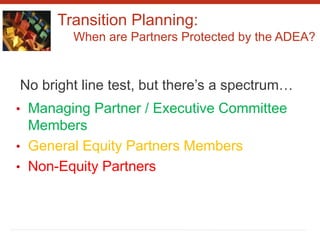
No bright line test, but there’s a spectrum…
• Managing Partner / Executive Committee
Members
• General Equity Partners Members
• Non-Equity Partners
Transition Planning:
When are Partners Protected by the ADEA?
For General Equity Partners:
• How autonomous?
• How much control over own career?
• How much control over firm?
• Financial stake in firm?
Transition Planning:
The Transition Trap
What about “senior” or “retired” partners?
They aren’t on your list…
Transition Planning:
The Transition Trap
Even if a partner was legitimately an
owner previously, if his compensation or
responsibilities change as part of a
transition to retirement, his “owner”
status likely will as well…..
Transition Planning:
The Transition Trap
Tips for Transition Agreements that’s don’t
violate the ADEA:
1. Don’t think of them as extensions to
partnership agreement – think of them as
employment agreements
2. Consider contracts with set end point to control
expectations
3. Don’t apply age-based cut offs or requirements
4. Tie benchmarks or triggers to facts and
circumstances (hours of work, client
responsibility, etc.) rather than age
Technology in the Workplace
Two Topics:
1. Social Media
2. Bring Your Own Device (“B.Y.O.D.”)
Technology in the Workplace:
Social Media
Why should we care about social media in
the workplace?
• National Labor Relations Board (NLRB):
- employees have right disparage the firm, coworkers
and supervisors
- employees have right to discuss compensation
- employees have right to take photos in workplace
- employees have right to share information about other
employees (even if you consider it to be confidential)
Technology in the Workplace:
Social Media
• Critical to client relationship development BUT
makes it easier for individuals to take firm
information and relationships
- LinkedIn as a virtual Rolodex
• may render prohibitions on taking/using client information obsolete
- No need to announce departure
• The fine line between monitoring and violating
privacy
- Civil and Criminal liability for accessing without authorization
- Other exposure for violating privacy rights
• Blurring of line between professional and personal
Technology in the Workplace:
Social Media
….but mostly, because your
employees – especially millennials –
are making it part of your workplace
whether you like it or not.
In a recent study, 75% of employees admitted to
accessing social media on their mobile devices while
at work and 67% do so more than twice a day
Technology in the Workplace:
Social Media
Key action point: Make sure you have a strong
but compliant social media policy in place
• No expectation of privacy / right to monitor
• All company policies apply on social media
• Clearly provide for ownership of social media accounts,
handles and followers/friends/links
• Prohibit statements on behalf of company without
authorization
• Where permitted, consider requiring privacy settings
Technology in the Workplace:
Social Media
Social Media Policy Don’ts….
• Don’t prohibit disparaging comments about supervisors,
compensation, workplace or other working conditions
• Don’t prohibit work-related posts
• Don’t prohibit employees from “friending” one another
• Don’t require that complaints/concerns first be brought to
management
• Don’t forget to review your policy annually to incorporate
any new legal standards and reflect new social media
opportunities
Technology in the Workplace
Do you B.Y.O.D.?
Technology in the Workplace
B.Y.O.D.
Things to think about in allowing
individuals to B.Y.O.D.….
1. Further blurs personal/professional lines
• off the clock work
• personal activity infringing on work time
• personal activity known to employer
• who pays and for what?
Technology in the Workplace:
B.Y.O.D.
2. Confidentiality of Information
• Apps & Cloud based backups
• Use by family/friends
• Security requirements more difficult to implement
and enforce
- Passwords
- Virus and Malware protection
- Lost device protocols
- 3rd party technical support
Technology in the Workplace:
B.Y.O.D.
3. Right to Access Device
• Just because employer is paying for service, doesn’t
mean can access device
• Need employee’s authorization (in advance or at
time of review) to review, even if legitimate reason to
need review -- CFAA / SCA
- Litigation or investigation
- Repairs, updates
- Backups and keeping data accessible
• Practical issue of how to respect privacy while
reviewing
Technology in the Workplace:
B.Y.O.D.
4. Post-Separation Issues
• Who keeps the device and the information on it
- Client contact info may ONLY be on device
- Can’t wipe without authorization or violate CFAA/SCA
• Who keeps the #?
- Just because pay for service, doesn’t give company the
right to the number
- What happens when clients call?
- Even if have policy saying company keeps number, difficult
to implement because all personal contacts have it too (and
for many, it’s only phone #)
Technology in the Workplace:
B.Y.O.D.
To B.Y.O.D. or not to B.Y.O.D.….
a VERY firm-specific decision
Key = consider whether cost savings and personal
preferences outweigh the risks we’ve discussed.
Technology in the Workplace:
B.Y.O.D.
If you decide to allow B.Y.O.D., make
sure you have those using personal
devices sign an agreement.
Technology in the Workplace:
B.Y.O.D.
Key provisions for the agreement include…
• Ownership of device, information and number
• Application of all company policies
(harassment/discrimination)
• Employer’s authorization to access/wipe and to obtain info
from 3rd parties
- Security requirements
- Passwords
- Firewalls
• Lost device requirements
Technology in the Workplace:
B.Y.O.D.
• Limitations on use
- Friends & family
- Cloud backups
- Apps that allow access
- Technical support obligations
• Reimbursement policy
• Off the clock work policy
• Expectations on separation
- what happens to phone number
- wiping
- receipt of calls
- requirement to provide phone records
Independent Contractors
IRS 20-factor or 3 Category test isn’t
the only one out there.
• Different tests apply on the particular statute at issue
• Perhaps most different is “ABC” Test
Independent Contractors
“ABC” Test used by many states:
A. The individual is free from control or direction over the
performance of the services, both under his/her contract
and in fact.
B. The service is either:
- Outside the usual course of business for the company; or
- Performed outside the place of business.
C. The worker is engaged in an independently established
trade, occupation, profession or business.
Note: Must establish A, B and C to establish independent
contractor status
Independent Contractors
Some states are particularly focused on
independent contractor status.
Independent Contractors
Why should accounting firms care?
• If you have any independent contractors, make sure
you’re considering whether they’re properly classified
under applicable tests
• Misclassification opens your firm to overtime and
exempt status claims, among others
• If you’re advising clients, it doesn’t hurt to point out
that just because they are ok under IRS test, doesn’t
mean there’s no risk
Restrictive Covenant Agreements
Law varies
significantly
from state
to state.
Here are
some
recent
highlights…
Restrictive Covenant Agreements
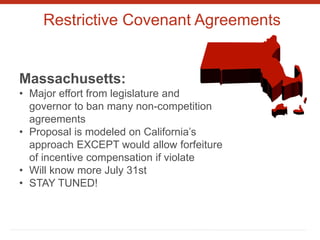
Massachusetts:
• Major effort from legislature and
governor to ban many non-competition
agreements
• Proposal is modeled on California’s
approach EXCEPT would allow forfeiture
of incentive compensation if violate
• Will know more July 31st
• STAY TUNED!
Restrictive Covenant Agreements
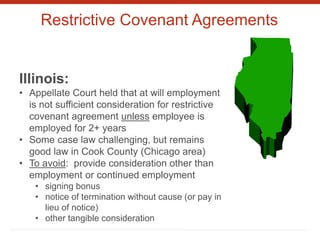
Illinois:
• Appellate Court held that at will employment
is not sufficient consideration for restrictive
covenant agreement unless employee is
employed for 2+ years
• Some case law challenging, but remains
good law in Cook County (Chicago area)
• To avoid: provide consideration other than
employment or continued employment
• signing bonus
• notice of termination without cause (or pay in
lieu of notice)
• other tangible consideration
Restrictive Covenant Agreements
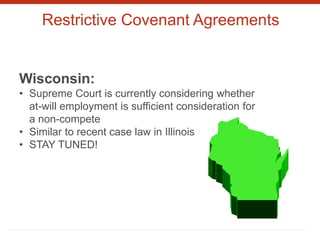
Wisconsin:
• Supreme Court is currently considering whether
at-will employment is sufficient consideration for
a non-compete
• Similar to recent case law in Illinois
• STAY TUNED!
Restrictive Covenant Agreements
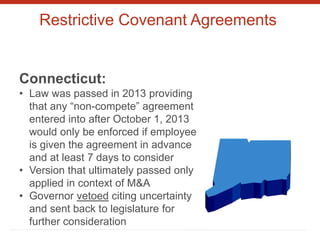
Connecticut:
• Law was passed in 2013 providing
that any “non-compete” agreement
entered into after October 1, 2013
would only be enforced if employee
is given the agreement in advance
and at least 7 days to consider
• Version that ultimately passed only
applied in context of M&A
• Governor vetoed citing uncertainty
and sent back to legislature for
further consideration
Restrictive Covenant Agreements
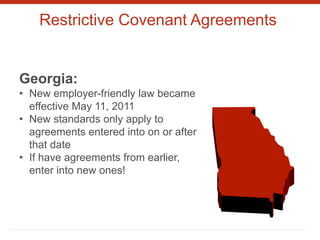
Georgia:
• New employer-friendly law became
effective May 11, 2011
• New standards only apply to
agreements entered into on or after
that date
• If have agreements from earlier,
enter into new ones!
Restrictive Covenant Agreements
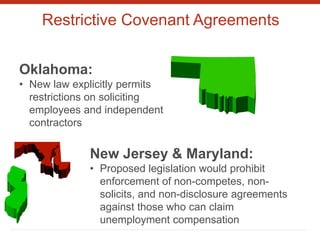
Oklahoma:
• New law explicitly permits
restrictions on soliciting
employees and independent
contractors
New Jersey & Maryland:
• Proposed legislation would prohibit
enforcement of non-competes, non-
solicits, and non-disclosure agreements
against those who can claim
unemployment compensation
Compensating Your Team Legally
Two areas to highlight:
1. Exempt status (overtime eligibility)
2. Compensation for hours worked
Compensating Your Team Legally
Exempt Status High-Risk Areas for
Accounting Firms:
• Staff accountants
- junior level, non-CPAs who are heavily supervised or whose duties
don’t actually require advanced, academic knowledge
- some good case law, but still unclear
• Administrative Staff
- key = discretion & independent judgment with regard to matters of
significance
Compensating Your Team Legally:
Exempt Status
Accountants:
Certified public accountants generally meet the
duties requirements for the learned professional
exemption. In addition, many other accountants
who are not certified public accountants but
perform similar job duties may qualify as exempt
learned professionals. However, accounting
clerks, bookkeepers and other employees who
normally perform a great deal of routine work
generally will not qualify as exempt
professionals.
Compensating Your Team Legally:
Exempt Status
A few notes on staff accountant cases:
• limitations imposed by accounting rules and internal
policies procedures can suggest lack of discretion and
independent judgment
• these are very expensive and distracting cases
• reality is that Staff Accountant cases are starting to turn in
firms’ favor, but that doesn’t mean they won’t keep
coming….
Compensating Your Team Legally:
Overtime
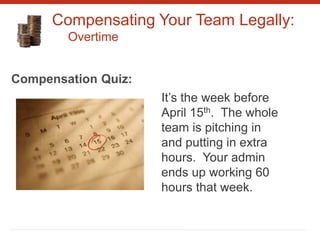
It’s the week before
April 15th. The whole
team is pitching in
and putting in extra
hours. Your admin
ends up working 60
hours that week.
Compensation Quiz:
Compensating Your Team Legally:
Overtime
What are ok ways to compensate your admin
for this added time?
A. Give her a day or two off the following week
B. Pay her time and a half for 20 of those hours
C. Give her a gift card as a thank you
D. Give her a bonus as a thank you
E. Nothing’s required, there are plenty of weeks during the
year when she only works 25 or 30 hours
Compensating Your Team Legally:
Overtime
B. The only way to compensate non-
exempt employees for overtime is to
pay them for it.
General requirement is 1 ½ time for all hours over 40
hours a week, but some states have additional
requirements.
Compensating Your Team Legally
Why should accounting firm management care
about exempt status and overtime?
• These are HUGE cases
- losses on technicalities are the norm
- concepts of fairness don’t apply
- a real cottage industry for plaintiffs’ lawyers
- very expensive to litigate
- enormous damages
• Change in this area has large impact on culture, so needs
to be managed and led from the top
Questions?
(your free employment law advice opportunity)
Thank You!
Laura B. Friedel
Levenfeld Pearlstein, LLC
lfriedel@lplegal.com / 312.476.7510
http://lpemploymentlaw.com

Employment Presentation

  • 1.
    Top Five EmploymentLaw Issues for Accounting Firms Laura Friedel Levenfeld Pearlstein, LLC June 9, 2014 1
  • 2.
    Five Issues: 1. TransitionPlanning While Avoiding Age Discrimination Claims 2. Technology in the Workplace 3. Independent Contractor or Employee 4. Restrictive Covenants – Recent Developments 5. Compensating Employees Legally
  • 3.
    Transition Planning Two Topics: 1.When is a partner protected by age discrimination laws? 2. What are you getting yourself into with transition agreements?
  • 4.
    Transition Planning: When arePartners Protected by ADEA? Key Points: • ADEA doesn’t have a “partner exception” • ADEA only sees two groups – employers (owners) and employees • If partner is to be considered outside ADEA’s protections, the firm has to establish that he’s an owner rather than an employee
  • 5.
    Transition Planning: When arePartners Protected by ADEA? As the Supreme Court explained in 2003: “an [owner]is the person, or group of persons, who owns and manages the enterprise. The [owner] can hire and fire employees, can assign tasks to employees and supervise their performance, and can decide how the profits and losses of the business are to be distributed. The mere fact that a person has a particular title – such as partner … should not necessarily be used to determine whether he or she is an employee of a proprietor.”
  • 6.
    Transition Planning: When arePartners Protected by the ADEA? Key questions to ask: 1. Can the firm hire or fire the individual or set the rules and regulations relating to his work? 2. Does the firm supervise the individual’s work, and to what extent? 3. Does the individual report to someone higher in the organization? 4. Is the individual able to influence the firm, and to what extent? 5. Was the intent that the individual be an employee (as expressed in written agreements and contracts)? 6. Does the individual share in the profits, losses, and liabilities of the organization?
  • 7.
    Transition Planning: When arePartners Protected by the ADEA? Look at structure of firm AND the role individual partners have in managing (as opposed to an executive or management committee)
  • 8.
    Transition Planning: When arePartners Protected by the ADEA? No bright line test, but there’s a spectrum… • Managing Partner / Executive Committee Members • General Equity Partners Members • Non-Equity Partners
  • 9.
    Transition Planning: When arePartners Protected by the ADEA? For General Equity Partners: • How autonomous? • How much control over own career? • How much control over firm? • Financial stake in firm?
  • 10.
    Transition Planning: The TransitionTrap What about “senior” or “retired” partners? They aren’t on your list…
  • 11.
    Transition Planning: The TransitionTrap Even if a partner was legitimately an owner previously, if his compensation or responsibilities change as part of a transition to retirement, his “owner” status likely will as well…..
  • 12.
    Transition Planning: The TransitionTrap Tips for Transition Agreements that’s don’t violate the ADEA: 1. Don’t think of them as extensions to partnership agreement – think of them as employment agreements 2. Consider contracts with set end point to control expectations 3. Don’t apply age-based cut offs or requirements 4. Tie benchmarks or triggers to facts and circumstances (hours of work, client responsibility, etc.) rather than age
  • 13.
    Technology in theWorkplace Two Topics: 1. Social Media 2. Bring Your Own Device (“B.Y.O.D.”)
  • 14.
    Technology in theWorkplace: Social Media Why should we care about social media in the workplace? • National Labor Relations Board (NLRB): - employees have right disparage the firm, coworkers and supervisors - employees have right to discuss compensation - employees have right to take photos in workplace - employees have right to share information about other employees (even if you consider it to be confidential)
  • 15.
    Technology in theWorkplace: Social Media • Critical to client relationship development BUT makes it easier for individuals to take firm information and relationships - LinkedIn as a virtual Rolodex • may render prohibitions on taking/using client information obsolete - No need to announce departure • The fine line between monitoring and violating privacy - Civil and Criminal liability for accessing without authorization - Other exposure for violating privacy rights • Blurring of line between professional and personal
  • 16.
    Technology in theWorkplace: Social Media ….but mostly, because your employees – especially millennials – are making it part of your workplace whether you like it or not. In a recent study, 75% of employees admitted to accessing social media on their mobile devices while at work and 67% do so more than twice a day
  • 17.
    Technology in theWorkplace: Social Media Key action point: Make sure you have a strong but compliant social media policy in place • No expectation of privacy / right to monitor • All company policies apply on social media • Clearly provide for ownership of social media accounts, handles and followers/friends/links • Prohibit statements on behalf of company without authorization • Where permitted, consider requiring privacy settings
  • 18.
    Technology in theWorkplace: Social Media Social Media Policy Don’ts…. • Don’t prohibit disparaging comments about supervisors, compensation, workplace or other working conditions • Don’t prohibit work-related posts • Don’t prohibit employees from “friending” one another • Don’t require that complaints/concerns first be brought to management • Don’t forget to review your policy annually to incorporate any new legal standards and reflect new social media opportunities
  • 19.
    Technology in theWorkplace Do you B.Y.O.D.?
  • 20.
    Technology in theWorkplace B.Y.O.D. Things to think about in allowing individuals to B.Y.O.D.…. 1. Further blurs personal/professional lines • off the clock work • personal activity infringing on work time • personal activity known to employer • who pays and for what?
  • 21.
    Technology in theWorkplace: B.Y.O.D. 2. Confidentiality of Information • Apps & Cloud based backups • Use by family/friends • Security requirements more difficult to implement and enforce - Passwords - Virus and Malware protection - Lost device protocols - 3rd party technical support
  • 22.
    Technology in theWorkplace: B.Y.O.D. 3. Right to Access Device • Just because employer is paying for service, doesn’t mean can access device • Need employee’s authorization (in advance or at time of review) to review, even if legitimate reason to need review -- CFAA / SCA - Litigation or investigation - Repairs, updates - Backups and keeping data accessible • Practical issue of how to respect privacy while reviewing
  • 23.
    Technology in theWorkplace: B.Y.O.D. 4. Post-Separation Issues • Who keeps the device and the information on it - Client contact info may ONLY be on device - Can’t wipe without authorization or violate CFAA/SCA • Who keeps the #? - Just because pay for service, doesn’t give company the right to the number - What happens when clients call? - Even if have policy saying company keeps number, difficult to implement because all personal contacts have it too (and for many, it’s only phone #)
  • 24.
    Technology in theWorkplace: B.Y.O.D. To B.Y.O.D. or not to B.Y.O.D.…. a VERY firm-specific decision Key = consider whether cost savings and personal preferences outweigh the risks we’ve discussed.
  • 25.
    Technology in theWorkplace: B.Y.O.D. If you decide to allow B.Y.O.D., make sure you have those using personal devices sign an agreement.
  • 26.
    Technology in theWorkplace: B.Y.O.D. Key provisions for the agreement include… • Ownership of device, information and number • Application of all company policies (harassment/discrimination) • Employer’s authorization to access/wipe and to obtain info from 3rd parties - Security requirements - Passwords - Firewalls • Lost device requirements
  • 27.
    Technology in theWorkplace: B.Y.O.D. • Limitations on use - Friends & family - Cloud backups - Apps that allow access - Technical support obligations • Reimbursement policy • Off the clock work policy • Expectations on separation - what happens to phone number - wiping - receipt of calls - requirement to provide phone records
  • 28.
    Independent Contractors IRS 20-factoror 3 Category test isn’t the only one out there. • Different tests apply on the particular statute at issue • Perhaps most different is “ABC” Test
  • 29.
    Independent Contractors “ABC” Testused by many states: A. The individual is free from control or direction over the performance of the services, both under his/her contract and in fact. B. The service is either: - Outside the usual course of business for the company; or - Performed outside the place of business. C. The worker is engaged in an independently established trade, occupation, profession or business. Note: Must establish A, B and C to establish independent contractor status
  • 30.
    Independent Contractors Some statesare particularly focused on independent contractor status.
  • 31.
    Independent Contractors Why shouldaccounting firms care? • If you have any independent contractors, make sure you’re considering whether they’re properly classified under applicable tests • Misclassification opens your firm to overtime and exempt status claims, among others • If you’re advising clients, it doesn’t hurt to point out that just because they are ok under IRS test, doesn’t mean there’s no risk
  • 32.
    Restrictive Covenant Agreements Lawvaries significantly from state to state. Here are some recent highlights…
  • 33.
    Restrictive Covenant Agreements Massachusetts: •Major effort from legislature and governor to ban many non-competition agreements • Proposal is modeled on California’s approach EXCEPT would allow forfeiture of incentive compensation if violate • Will know more July 31st • STAY TUNED!
  • 34.
    Restrictive Covenant Agreements Illinois: •Appellate Court held that at will employment is not sufficient consideration for restrictive covenant agreement unless employee is employed for 2+ years • Some case law challenging, but remains good law in Cook County (Chicago area) • To avoid: provide consideration other than employment or continued employment • signing bonus • notice of termination without cause (or pay in lieu of notice) • other tangible consideration
  • 35.
    Restrictive Covenant Agreements Wisconsin: •Supreme Court is currently considering whether at-will employment is sufficient consideration for a non-compete • Similar to recent case law in Illinois • STAY TUNED!
  • 36.
    Restrictive Covenant Agreements Connecticut: •Law was passed in 2013 providing that any “non-compete” agreement entered into after October 1, 2013 would only be enforced if employee is given the agreement in advance and at least 7 days to consider • Version that ultimately passed only applied in context of M&A • Governor vetoed citing uncertainty and sent back to legislature for further consideration
  • 37.
    Restrictive Covenant Agreements Georgia: •New employer-friendly law became effective May 11, 2011 • New standards only apply to agreements entered into on or after that date • If have agreements from earlier, enter into new ones!
  • 38.
    Restrictive Covenant Agreements Oklahoma: •New law explicitly permits restrictions on soliciting employees and independent contractors New Jersey & Maryland: • Proposed legislation would prohibit enforcement of non-competes, non- solicits, and non-disclosure agreements against those who can claim unemployment compensation
  • 39.
    Compensating Your TeamLegally Two areas to highlight: 1. Exempt status (overtime eligibility) 2. Compensation for hours worked
  • 40.
    Compensating Your TeamLegally Exempt Status High-Risk Areas for Accounting Firms: • Staff accountants - junior level, non-CPAs who are heavily supervised or whose duties don’t actually require advanced, academic knowledge - some good case law, but still unclear • Administrative Staff - key = discretion & independent judgment with regard to matters of significance
  • 41.
    Compensating Your TeamLegally: Exempt Status Accountants: Certified public accountants generally meet the duties requirements for the learned professional exemption. In addition, many other accountants who are not certified public accountants but perform similar job duties may qualify as exempt learned professionals. However, accounting clerks, bookkeepers and other employees who normally perform a great deal of routine work generally will not qualify as exempt professionals.
  • 42.
    Compensating Your TeamLegally: Exempt Status A few notes on staff accountant cases: • limitations imposed by accounting rules and internal policies procedures can suggest lack of discretion and independent judgment • these are very expensive and distracting cases • reality is that Staff Accountant cases are starting to turn in firms’ favor, but that doesn’t mean they won’t keep coming….
  • 44.
    Compensating Your TeamLegally: Overtime It’s the week before April 15th. The whole team is pitching in and putting in extra hours. Your admin ends up working 60 hours that week. Compensation Quiz:
  • 45.
    Compensating Your TeamLegally: Overtime What are ok ways to compensate your admin for this added time? A. Give her a day or two off the following week B. Pay her time and a half for 20 of those hours C. Give her a gift card as a thank you D. Give her a bonus as a thank you E. Nothing’s required, there are plenty of weeks during the year when she only works 25 or 30 hours
  • 46.
    Compensating Your TeamLegally: Overtime B. The only way to compensate non- exempt employees for overtime is to pay them for it. General requirement is 1 ½ time for all hours over 40 hours a week, but some states have additional requirements.
  • 47.
    Compensating Your TeamLegally Why should accounting firm management care about exempt status and overtime? • These are HUGE cases - losses on technicalities are the norm - concepts of fairness don’t apply - a real cottage industry for plaintiffs’ lawyers - very expensive to litigate - enormous damages • Change in this area has large impact on culture, so needs to be managed and led from the top
  • 48.
    Questions? (your free employmentlaw advice opportunity)
  • 49.
    Thank You! Laura B.Friedel Levenfeld Pearlstein, LLC lfriedel@lplegal.com / 312.476.7510 http://lpemploymentlaw.com