SOLID MODELLING
Why solid modeling?
• Recall weakness of wireframe and surface
modeling
– Ambiguous geometric description
– incomplete geometric description
– lack topological information
– Tedious modeling process
– Awkward user interface
Solid model
• Solid modeling is based on complete, valid
and unambiguous geometric representation
of physical object.
– Complete  points in space can be classified.
(inside/ outside)
– Valid vertices, edges, faces are connected
properly.
– Unambiguous  there can only be one
interpretation of object
Solid model representation
schemes
1. Constructive solid geometry (CSG)
2. Boundary representation (B-rep)
3. Spatial enumeration
4. Instantiation.
Constructive solid geometry
(CSG)
• Objects are represented as a combination of
simpler solid objects (primitives).
• The primitives are such as cube, cylinder, cone,
torus, sphere etc.
• Copies or “instances” of these primitive shapes are
created and positioned.
• A complete solid model is constructed by
combining these “instances” using set specific,
logic operations (Boolean)
• Boolean operation
– each primitive solid is assumed to be a set of
points, a boolean operation is performed on
point sets and the result is a solid model.
– Boolean operation  union, intersection and
difference
– The relative location and orientation of the two
primitives have to be defined before the
boolean operation can be performed.
– Boolean operation can be applied to two solids
other than the primitives.
Constructive solid geometry
(CSG)
Constructive solid geometry
(CSG)- boolean operation
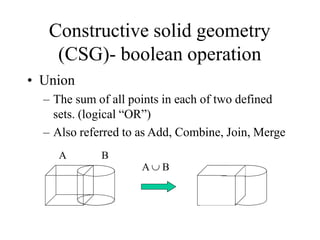
• Union
– The sum of all points in each of two defined
sets. (logical “OR”)
– Also referred to as Add, Combine, Join, Merge
A B
A  B
• Difference
– The points in a source set minus the points
common to a second set. (logical “NOT”)
– Set must share common volume
– Also referred to as subtraction, remove, cut
Constructive solid geometry
(CSG)- boolean operation
A - B
A B
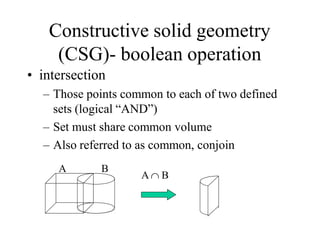
• intersection
– Those points common to each of two defined
sets (logical “AND”)
– Set must share common volume
– Also referred to as common, conjoin
Constructive solid geometry
(CSG)- boolean operation
A  B
A B
• When using boolean operation, be careful to
avoid situation that do not result in a valid
solid
Constructive solid geometry
(CSG)- boolean operation
A  B
A B

solidmodeling-181117053627.pptx

  • 1.
  • 2.
    Why solid modeling? •Recall weakness of wireframe and surface modeling – Ambiguous geometric description – incomplete geometric description – lack topological information – Tedious modeling process – Awkward user interface
  • 3.
    Solid model • Solidmodeling is based on complete, valid and unambiguous geometric representation of physical object. – Complete  points in space can be classified. (inside/ outside) – Valid vertices, edges, faces are connected properly. – Unambiguous  there can only be one interpretation of object
  • 4.
    Solid model representation schemes 1.Constructive solid geometry (CSG) 2. Boundary representation (B-rep) 3. Spatial enumeration 4. Instantiation.
  • 5.
    Constructive solid geometry (CSG) •Objects are represented as a combination of simpler solid objects (primitives). • The primitives are such as cube, cylinder, cone, torus, sphere etc. • Copies or “instances” of these primitive shapes are created and positioned. • A complete solid model is constructed by combining these “instances” using set specific, logic operations (Boolean)
  • 6.
    • Boolean operation –each primitive solid is assumed to be a set of points, a boolean operation is performed on point sets and the result is a solid model. – Boolean operation  union, intersection and difference – The relative location and orientation of the two primitives have to be defined before the boolean operation can be performed. – Boolean operation can be applied to two solids other than the primitives. Constructive solid geometry (CSG)
  • 7.
    Constructive solid geometry (CSG)-boolean operation • Union – The sum of all points in each of two defined sets. (logical “OR”) – Also referred to as Add, Combine, Join, Merge A B A  B
  • 8.
    • Difference – Thepoints in a source set minus the points common to a second set. (logical “NOT”) – Set must share common volume – Also referred to as subtraction, remove, cut Constructive solid geometry (CSG)- boolean operation A - B A B
  • 9.
    • intersection – Thosepoints common to each of two defined sets (logical “AND”) – Set must share common volume – Also referred to as common, conjoin Constructive solid geometry (CSG)- boolean operation A  B A B
  • 10.
    • When usingboolean operation, be careful to avoid situation that do not result in a valid solid Constructive solid geometry (CSG)- boolean operation A  B A B