By: VITTAL S BAJANTRI
M. Tech. Semester I
Environmental Engineering
BMS College of Engineering
1
Introduction
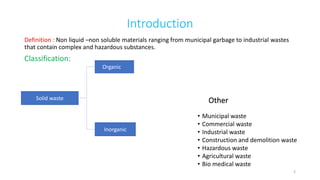
Definition : Non liquid –non soluble materials ranging from municipal garbage to industrial wastes
that contain complex and hazardous substances.
Classification:
Organic
Inorganic
• Municipal waste
• Commercial waste
• Industrial waste
• Construction and demolition waste
• Hazardous waste
• Agricultural waste
• Bio medical waste
Solid waste Other
2
Switzerland is a Country in a Europe
Capital city: Bern
Population: 87 lakhs(2021)
Ministry: Federal Department of Environment, Transport, Energy and Communications.
Agency: Federal office for the Environment (FOEN)
Types of solid waste generating in Switzerland
• Green Waste
• Food waste
• Agricultural waste
• Effluent sludge
• Wood waste
• Organic waste from industry and commerce
• Hazardous wastes
3
Green waste
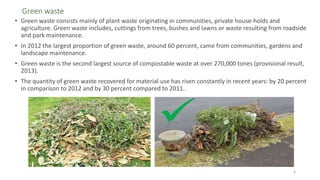
• Green waste consists mainly of plant waste originating in communities, private house-holds and
agriculture. Green waste includes, cuttings from trees, bushes and lawns or waste resulting from roadside
and park maintenance.
• In 2012 the largest proportion of green waste, around 60 percent, came from communities, gardens and
landscape maintenance.
• Green waste is the second largest source of compostable waste at over 270,000 tones (provisional result,
2013).
• The quantity of green waste recovered for material use has risen constantly in recent years: by 20 percent
in comparison to 2012 and by 30 percent compared to 2011..
4
Food waste
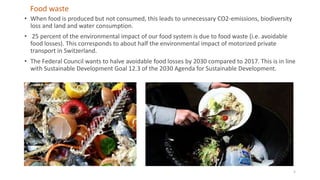
• When food is produced but not consumed, this leads to unnecessary CO2-emissions, biodiversity
loss and land and water consumption.
• 25 percent of the environmental impact of our food system is due to food waste (i.e. avoidable
food losses). This corresponds to about half the environmental impact of motorized private
transport in Switzerland.
• The Federal Council wants to halve avoidable food losses by 2030 compared to 2017. This is in line
with Sustainable Development Goal 12.3 of the 2030 Agenda for Sustainable Development.
5
Avoidable and unavoidable food losses
• Food losses and food waste refer to all food intended for human consumption that is not consumed by
humans.
• Food waste is the term used to describe avoidable food loss. These are the edible portions of food that
are produced for human consumption, but end up not being consumed by humans.
• Unavoidable food losses are, parts of food that are not edible or are considered inedible in our culture.
Swiss food losses from the field to the plate
• Around one third of all edible food is lost or wasted between the field and the plate.
• According to a study by ETH Zurich by Beretta and Hellweg (2019) on food waste, this amounts to around
2.8 million tones of wasted food per year in Switzerland and abroad as a result of Switzerland's food
consumption (consumer perspective).
• This corresponds to about 330 kg of avoidable food loss per person per year. Of the 2.8 million tones,
around 360,000 tones of food loss occur abroad, in the production of food that is imported into
Switzerland.
• In addition, around 240,000 tones of avoidable food losses occur in Switzerland in the production of food
for export. 6
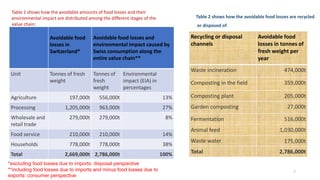
Table 2 shows how the avoidable food losses are recycled
or disposed of:
Recycling or disposal
channels
Avoidable food
losses in tonnes of
fresh weight per
year
Waste incineration 474,000t
Composting in the field 359,000t
Composting plant 205,000t
Garden composting 27,000t
Fermentation 516,000t
Animal feed 1,030,000t
Waste water 175,000t
Total 2,786,000t
Table 1 shows how the avoidable amounts of food losses and their
environmental impact are distributed among the different stages of the
value chain:
Avoidable food
losses in
Switzerland*
Avoidable food losses and
environmental impact caused by
Swiss consumption along the
entire value chain**
Unit Tonnes of fresh
weight
Tonnes of
fresh
weight
Environmental
impact (EIA) in
percentages
Agriculture 197,000t 556,000t 13%
Processing 1,205,000t 963,000t 27%
Wholesale and
retail trade
279,000t 279,000t 8%
Food service 210,000t 210,000t 14%
Households 778,000t 778,000t 38%
Total 2,669,000t 2,786,000t 100%
*excluding food losses due to imports: disposal perspective
**including food losses due to imports and minus food losses due to
exports: consumer perspective
7
• The food system amounts to around 28% of Switzerland's total food print. A quarter of this is the
result of avoidable food losses.
• The implementation of the halving target in Switzerland would reduce the environmental impact
and greenhouse gas emissions of food by 10-15%.
• The food categories with the greatest environmental impact per kilogram of food loss are meat,
coffee and cocoa beans, butter, eggs, products imported by air, and oils and fats, fish and cheese.
• The losses of fruits and vegetables (including in particular potatoes) as well as breads and baked
goods are also environmentally relevant, despite a lower environmental impact per kilogram,
because they occur in large quantities.
• The environmental impact of a food product also increases with each stage of processing and/or
transport, as these processes involve resource consumption and produce emissions
Environmental impact due to avoidable food losses
8
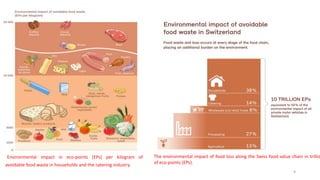
Environmental impact in eco-points (EPs) per kilogram of
avoidable food waste in households and the catering industry.
The environmental impact of food loss along the Swiss food value chain in trillio
of eco-points (EPs).
9
Action plan to reduce food waste
• On 6 April 2022, the Federal Council adopted an action plan against food waste, in response to
the Chevalley Postulate 18.3829 (available in German, French and Italian).
• Food waste has three objectives:
1. Halving the amount of avoidable food losses in Switzerland by 2030 compared to 2017.
2. Defining industry-specific reduction targets together with the industries.
3. Reducing the environmental impact of avoidable food losses as much as possible through the
appropriate formulation and prioritization of measures.
• The action plan is divided into two phases.
• The first phase (2022-2025) comprises seven self-regulatory measures for the economy, five
measures for the public sector and two measures on information and education.
10
Agricultural waste
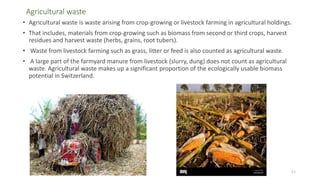
• Agricultural waste is waste arising from crop-growing or livestock farming in agricultural holdings.
• That includes, materials from crop-growing such as biomass from second or third crops, harvest
residues and harvest waste (herbs, grains, root tubers).
• Waste from livestock farming such as grass, litter or feed is also counted as agricultural waste.
• A large part of the farmyard manure from livestock (slurry, dung) does not count as agricultural
waste. Agricultural waste makes up a significant proportion of the ecologically usable biomass
potential in Switzerland.
11
Effluent sludge
• Effluent sludge is produced during the treatment of waste water in waste water treatment plants. Effluent
sludge contains plant nutrients such as phosphorus and nitrogen, but also some heavy metals such as lead,
cadmium, copper and zinc.
• Moreover, organic compounds that are not easily degradable can accumulate in the effluent sludge, from
cleaning agents, body care products or medicines.
• In Switzerland effluent sludge is thermally disposed of in municipal household waste incinerators, sludge
incineration plants and cement works.
• Before incineration, organic compounds and water are removed from the raw sludge in several treatment
stages. This is done to improve its stability, transportability and recoverability.
• The first step is to subject the raw sludge to fermentation or digestion processes. This produces biogas, which
can be used as a renewable energy source.
• In 2012 around 195,000 tonnes of effluent sludge were produced.
Of this 43 percent was disposed of in SVAs and 27 percent each in
KVAs and cement works. The other 3 percent were exported.
• The main treatment for effluent sludge today is therefore thermal.
12
• Dehydrated effluent sludge contains approximately 1% phosphorus and effluent sludge ash over
6%.
• If phosphorus has not first been recovered, thermal disposal of the effluent sludge will cause the
irreversible loss of the nutrient phosphorus.
• According to a FOEN study around 90 percent of the phosphorus could be recovered from the
effluent sludge and its ash.
• This would correspond to around 6000 tonnes of phosphorus per year.
• The aim is therefore to establish phosphorus recycling on a long-term basis so that this
high-quality nutrient can be used for fertilizer production.
Recovery of phosphorus from effluent sludge
13
Wood waste
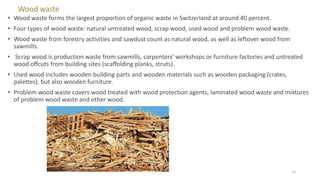
• Wood waste forms the largest proportion of organic waste in Switzerland at around 40 percent.
• Four types of wood waste: natural untreated wood, scrap wood, used wood and problem wood waste.
• Wood waste from forestry activities and sawdust count as natural wood, as well as leftover wood from
sawmills.
• Scrap wood is production waste from sawmills, carpenters' workshops or furniture factories and untreated
wood offcuts from building sites (scaffolding planks, struts).
• Used wood includes wooden building parts and wooden materials such as wooden packaging (crates,
palettes), but also wooden furniture.
• Problem wood waste covers wood treated with wood protection agents, laminated wood waste and mixtures
of problem wood waste and other wood.
14
Organic waste from industry and commerce
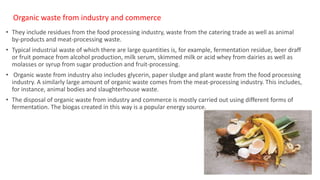
• They include residues from the food processing industry, waste from the catering trade as well as animal
by-products and meat-processing waste.
• Typical industrial waste of which there are large quantities is, for example, fermentation residue, beer draff
or fruit pomace from alcohol production, milk serum, skimmed milk or acid whey from dairies as well as
molasses or syrup from sugar production and fruit-processing.
• Organic waste from industry also includes glycerin, paper sludge and plant waste from the food processing
industry. A similarly large amount of organic waste comes from the meat-processing industry. This includes,
for instance, animal bodies and slaughterhouse waste.
• The disposal of organic waste from industry and commerce is mostly carried out using different forms of
fermentation. The biogas created in this way is a popular energy source.
15
Hazardous waste
• Hazardous waste is the waste whose collection, treatment, and disposal when improperly
handled, can cause substantial harm to human health and safety or to the environment.
• Includes medical waste, chemicals, radio active waste etc.,
Medical waste
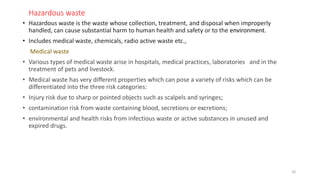
• Various types of medical waste arise in hospitals, medical practices, laboratories and in the
treatment of pets and livestock.
• Medical waste has very different properties which can pose a variety of risks which can be
differentiated into the three risk categories:
• Injury risk due to sharp or pointed objects such as scalpels and syringes;
• contamination risk from waste containing blood, secretions or excretions;
• environmental and health risks from infectious waste or active substances in unused and
expired drugs.
16
Collection
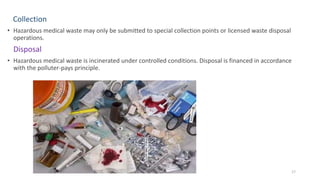
• Hazardous medical waste may only be submitted to special collection points or licensed waste disposal
operations.
Disposal
• Hazardous medical waste is incinerated under controlled conditions. Disposal is financed in accordance
with the polluter-pays principle.
17
Chemical
• Paint, cleaning agents, fertilizers, plant protection products, acids and bases are some categories of chemicals
that are frequently used in private, commercial and industrial contexts. In addition to being useful, many
substances also have hazardous properties.
collection
• Most chemical waste is classified as hazardous waste and can only be submitted to authorized waste disposal
companies.
• Households can return chemicals to specialist retailers, collection points or on special collection days organized
by communes or cantons.
Disposal/recycling
• The disposal process used depends on the nature of the waste. Large volumes of waste of uniform composition
can be recycled in part: metals can be recovered from electroplating baths, solvents, acids and bases can be
regenerated. Other processes aim to remove hazardous substances, e.g. to enable the recycling of metal
packaging (aerosol cans, paint pots etc.).
• In the case of hazardous substances and preparations, in accordance with the Chemicals Act, retailers musttake
back small volumes of such waste from private individuals free of charge. Disposal at collection points and
communal or cantonal collections is also usually free of charge.
• The disposal of used chemicals from industrial operations is financed in accordance with the polluter-pays
principle.
18
Waste management in Switzerland
• The waste management in Switzerland is based on the polluter pays principle.
• Bin bags are taxed with pay-per-bag fees in three quarters of the communes.
• The recycling rate doubled in 20 years due to this strategy.
• The recycling rate for municipal solid waste exceeds 50 percent (with an objective of 60 percent in 2020).
Recycling
• In Switzerland, the following common household waste materials are recycled: aluminum and tin cans, old
batteries, light bulbs, glass, paper, PET bottles, textiles, electrical and electronic equipment, and other.
• The disposal of recyclable waste is mostly free of charge, though not always operated as door-to-door
collection. Some waste must be brought to collection spots (e.g. glass, metal, textiles), some is collected in
supermarkets or retail shops (e.g. batteries, PET bottles, old electrical and electronic equipment).
19
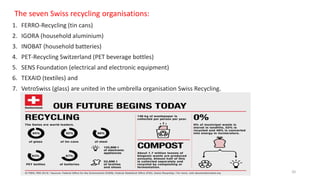
The seven Swiss recycling organisations:
1. FERRO-Recycling (tin cans)
2. IGORA (household aluminium)
3. INOBAT (household batteries)
4. PET-Recycling Switzerland (PET beverage bottles)
5. SENS Foundation (electrical and electronic equipment)
6. TEXAID (textiles) and
7. VetroSwiss (glass) are united in the umbrella organisation Swiss Recycling.
20
• Switzerland has one of the highest municipal solid waste volumes in the world per head of
population.
• As the economy grew, so too did the amount of waste which Switzerland generated. Volumes
more than doubled after 1970, going from 309kg per person to 715kg per person in 2016.
Public-private partnership
• Public and private stakeholders are involved in Switzerland's waste management system.
• The country has a series of legal provisions in place to encourage waste disposal.
• This system is an integral part of a sustainable and comprehensive resource management policy.
21
Protecting the environment
• Switzerland earmarks around 1.8% of its GDP for environmental protection efforts.
• The lion’s share goes on waste and wastewater management. The largest impact on the
environment comes from food, energy consumption and mobility.
Circular economy
• The circular economy is an integrated approach that takes account of the entire life cycle of a
material or product, right up to and including the recovery and recycling phase.
• The circular model is now widely adopted by the waste management sector.
• Federal measures to promote the circular economy are based on the precautionary and polluter-
pays principles, technological advances and innovation, as well as cooperation with industry in
accordance with the Environmental Protection Act.
22
Reference
• Federal Office for the Environment - Homepage (admin.ch)
23
THANK YOU
24

solid waste management in switzerland.pptx

  • 1.
    By: VITTAL SBAJANTRI M. Tech. Semester I Environmental Engineering BMS College of Engineering 1
  • 2.
    Introduction Definition : Nonliquid –non soluble materials ranging from municipal garbage to industrial wastes that contain complex and hazardous substances. Classification: Organic Inorganic • Municipal waste • Commercial waste • Industrial waste • Construction and demolition waste • Hazardous waste • Agricultural waste • Bio medical waste Solid waste Other 2
  • 3.
    Switzerland is aCountry in a Europe Capital city: Bern Population: 87 lakhs(2021) Ministry: Federal Department of Environment, Transport, Energy and Communications. Agency: Federal office for the Environment (FOEN) Types of solid waste generating in Switzerland • Green Waste • Food waste • Agricultural waste • Effluent sludge • Wood waste • Organic waste from industry and commerce • Hazardous wastes 3
  • 4.
    Green waste • Greenwaste consists mainly of plant waste originating in communities, private house-holds and agriculture. Green waste includes, cuttings from trees, bushes and lawns or waste resulting from roadside and park maintenance. • In 2012 the largest proportion of green waste, around 60 percent, came from communities, gardens and landscape maintenance. • Green waste is the second largest source of compostable waste at over 270,000 tones (provisional result, 2013). • The quantity of green waste recovered for material use has risen constantly in recent years: by 20 percent in comparison to 2012 and by 30 percent compared to 2011.. 4
  • 5.
    Food waste • Whenfood is produced but not consumed, this leads to unnecessary CO2-emissions, biodiversity loss and land and water consumption. • 25 percent of the environmental impact of our food system is due to food waste (i.e. avoidable food losses). This corresponds to about half the environmental impact of motorized private transport in Switzerland. • The Federal Council wants to halve avoidable food losses by 2030 compared to 2017. This is in line with Sustainable Development Goal 12.3 of the 2030 Agenda for Sustainable Development. 5
  • 6.
    Avoidable and unavoidablefood losses • Food losses and food waste refer to all food intended for human consumption that is not consumed by humans. • Food waste is the term used to describe avoidable food loss. These are the edible portions of food that are produced for human consumption, but end up not being consumed by humans. • Unavoidable food losses are, parts of food that are not edible or are considered inedible in our culture. Swiss food losses from the field to the plate • Around one third of all edible food is lost or wasted between the field and the plate. • According to a study by ETH Zurich by Beretta and Hellweg (2019) on food waste, this amounts to around 2.8 million tones of wasted food per year in Switzerland and abroad as a result of Switzerland's food consumption (consumer perspective). • This corresponds to about 330 kg of avoidable food loss per person per year. Of the 2.8 million tones, around 360,000 tones of food loss occur abroad, in the production of food that is imported into Switzerland. • In addition, around 240,000 tones of avoidable food losses occur in Switzerland in the production of food for export. 6
  • 7.
    Table 2 showshow the avoidable food losses are recycled or disposed of: Recycling or disposal channels Avoidable food losses in tonnes of fresh weight per year Waste incineration 474,000t Composting in the field 359,000t Composting plant 205,000t Garden composting 27,000t Fermentation 516,000t Animal feed 1,030,000t Waste water 175,000t Total 2,786,000t Table 1 shows how the avoidable amounts of food losses and their environmental impact are distributed among the different stages of the value chain: Avoidable food losses in Switzerland* Avoidable food losses and environmental impact caused by Swiss consumption along the entire value chain** Unit Tonnes of fresh weight Tonnes of fresh weight Environmental impact (EIA) in percentages Agriculture 197,000t 556,000t 13% Processing 1,205,000t 963,000t 27% Wholesale and retail trade 279,000t 279,000t 8% Food service 210,000t 210,000t 14% Households 778,000t 778,000t 38% Total 2,669,000t 2,786,000t 100% *excluding food losses due to imports: disposal perspective **including food losses due to imports and minus food losses due to exports: consumer perspective 7
  • 8.
    • The foodsystem amounts to around 28% of Switzerland's total food print. A quarter of this is the result of avoidable food losses. • The implementation of the halving target in Switzerland would reduce the environmental impact and greenhouse gas emissions of food by 10-15%. • The food categories with the greatest environmental impact per kilogram of food loss are meat, coffee and cocoa beans, butter, eggs, products imported by air, and oils and fats, fish and cheese. • The losses of fruits and vegetables (including in particular potatoes) as well as breads and baked goods are also environmentally relevant, despite a lower environmental impact per kilogram, because they occur in large quantities. • The environmental impact of a food product also increases with each stage of processing and/or transport, as these processes involve resource consumption and produce emissions Environmental impact due to avoidable food losses 8
  • 9.
    Environmental impact ineco-points (EPs) per kilogram of avoidable food waste in households and the catering industry. The environmental impact of food loss along the Swiss food value chain in trillio of eco-points (EPs). 9
  • 10.
    Action plan toreduce food waste • On 6 April 2022, the Federal Council adopted an action plan against food waste, in response to the Chevalley Postulate 18.3829 (available in German, French and Italian). • Food waste has three objectives: 1. Halving the amount of avoidable food losses in Switzerland by 2030 compared to 2017. 2. Defining industry-specific reduction targets together with the industries. 3. Reducing the environmental impact of avoidable food losses as much as possible through the appropriate formulation and prioritization of measures. • The action plan is divided into two phases. • The first phase (2022-2025) comprises seven self-regulatory measures for the economy, five measures for the public sector and two measures on information and education. 10
  • 11.
    Agricultural waste • Agriculturalwaste is waste arising from crop-growing or livestock farming in agricultural holdings. • That includes, materials from crop-growing such as biomass from second or third crops, harvest residues and harvest waste (herbs, grains, root tubers). • Waste from livestock farming such as grass, litter or feed is also counted as agricultural waste. • A large part of the farmyard manure from livestock (slurry, dung) does not count as agricultural waste. Agricultural waste makes up a significant proportion of the ecologically usable biomass potential in Switzerland. 11
  • 12.
    Effluent sludge • Effluentsludge is produced during the treatment of waste water in waste water treatment plants. Effluent sludge contains plant nutrients such as phosphorus and nitrogen, but also some heavy metals such as lead, cadmium, copper and zinc. • Moreover, organic compounds that are not easily degradable can accumulate in the effluent sludge, from cleaning agents, body care products or medicines. • In Switzerland effluent sludge is thermally disposed of in municipal household waste incinerators, sludge incineration plants and cement works. • Before incineration, organic compounds and water are removed from the raw sludge in several treatment stages. This is done to improve its stability, transportability and recoverability. • The first step is to subject the raw sludge to fermentation or digestion processes. This produces biogas, which can be used as a renewable energy source. • In 2012 around 195,000 tonnes of effluent sludge were produced. Of this 43 percent was disposed of in SVAs and 27 percent each in KVAs and cement works. The other 3 percent were exported. • The main treatment for effluent sludge today is therefore thermal. 12
  • 13.
    • Dehydrated effluentsludge contains approximately 1% phosphorus and effluent sludge ash over 6%. • If phosphorus has not first been recovered, thermal disposal of the effluent sludge will cause the irreversible loss of the nutrient phosphorus. • According to a FOEN study around 90 percent of the phosphorus could be recovered from the effluent sludge and its ash. • This would correspond to around 6000 tonnes of phosphorus per year. • The aim is therefore to establish phosphorus recycling on a long-term basis so that this high-quality nutrient can be used for fertilizer production. Recovery of phosphorus from effluent sludge 13
  • 14.
    Wood waste • Woodwaste forms the largest proportion of organic waste in Switzerland at around 40 percent. • Four types of wood waste: natural untreated wood, scrap wood, used wood and problem wood waste. • Wood waste from forestry activities and sawdust count as natural wood, as well as leftover wood from sawmills. • Scrap wood is production waste from sawmills, carpenters' workshops or furniture factories and untreated wood offcuts from building sites (scaffolding planks, struts). • Used wood includes wooden building parts and wooden materials such as wooden packaging (crates, palettes), but also wooden furniture. • Problem wood waste covers wood treated with wood protection agents, laminated wood waste and mixtures of problem wood waste and other wood. 14
  • 15.
    Organic waste fromindustry and commerce • They include residues from the food processing industry, waste from the catering trade as well as animal by-products and meat-processing waste. • Typical industrial waste of which there are large quantities is, for example, fermentation residue, beer draff or fruit pomace from alcohol production, milk serum, skimmed milk or acid whey from dairies as well as molasses or syrup from sugar production and fruit-processing. • Organic waste from industry also includes glycerin, paper sludge and plant waste from the food processing industry. A similarly large amount of organic waste comes from the meat-processing industry. This includes, for instance, animal bodies and slaughterhouse waste. • The disposal of organic waste from industry and commerce is mostly carried out using different forms of fermentation. The biogas created in this way is a popular energy source. 15
  • 16.
    Hazardous waste • Hazardouswaste is the waste whose collection, treatment, and disposal when improperly handled, can cause substantial harm to human health and safety or to the environment. • Includes medical waste, chemicals, radio active waste etc., Medical waste • Various types of medical waste arise in hospitals, medical practices, laboratories and in the treatment of pets and livestock. • Medical waste has very different properties which can pose a variety of risks which can be differentiated into the three risk categories: • Injury risk due to sharp or pointed objects such as scalpels and syringes; • contamination risk from waste containing blood, secretions or excretions; • environmental and health risks from infectious waste or active substances in unused and expired drugs. 16
  • 17.
    Collection • Hazardous medicalwaste may only be submitted to special collection points or licensed waste disposal operations. Disposal • Hazardous medical waste is incinerated under controlled conditions. Disposal is financed in accordance with the polluter-pays principle. 17
  • 18.
    Chemical • Paint, cleaningagents, fertilizers, plant protection products, acids and bases are some categories of chemicals that are frequently used in private, commercial and industrial contexts. In addition to being useful, many substances also have hazardous properties. collection • Most chemical waste is classified as hazardous waste and can only be submitted to authorized waste disposal companies. • Households can return chemicals to specialist retailers, collection points or on special collection days organized by communes or cantons. Disposal/recycling • The disposal process used depends on the nature of the waste. Large volumes of waste of uniform composition can be recycled in part: metals can be recovered from electroplating baths, solvents, acids and bases can be regenerated. Other processes aim to remove hazardous substances, e.g. to enable the recycling of metal packaging (aerosol cans, paint pots etc.). • In the case of hazardous substances and preparations, in accordance with the Chemicals Act, retailers musttake back small volumes of such waste from private individuals free of charge. Disposal at collection points and communal or cantonal collections is also usually free of charge. • The disposal of used chemicals from industrial operations is financed in accordance with the polluter-pays principle. 18
  • 19.
    Waste management inSwitzerland • The waste management in Switzerland is based on the polluter pays principle. • Bin bags are taxed with pay-per-bag fees in three quarters of the communes. • The recycling rate doubled in 20 years due to this strategy. • The recycling rate for municipal solid waste exceeds 50 percent (with an objective of 60 percent in 2020). Recycling • In Switzerland, the following common household waste materials are recycled: aluminum and tin cans, old batteries, light bulbs, glass, paper, PET bottles, textiles, electrical and electronic equipment, and other. • The disposal of recyclable waste is mostly free of charge, though not always operated as door-to-door collection. Some waste must be brought to collection spots (e.g. glass, metal, textiles), some is collected in supermarkets or retail shops (e.g. batteries, PET bottles, old electrical and electronic equipment). 19
  • 20.
    The seven Swissrecycling organisations: 1. FERRO-Recycling (tin cans) 2. IGORA (household aluminium) 3. INOBAT (household batteries) 4. PET-Recycling Switzerland (PET beverage bottles) 5. SENS Foundation (electrical and electronic equipment) 6. TEXAID (textiles) and 7. VetroSwiss (glass) are united in the umbrella organisation Swiss Recycling. 20
  • 21.
    • Switzerland hasone of the highest municipal solid waste volumes in the world per head of population. • As the economy grew, so too did the amount of waste which Switzerland generated. Volumes more than doubled after 1970, going from 309kg per person to 715kg per person in 2016. Public-private partnership • Public and private stakeholders are involved in Switzerland's waste management system. • The country has a series of legal provisions in place to encourage waste disposal. • This system is an integral part of a sustainable and comprehensive resource management policy. 21
  • 22.
    Protecting the environment •Switzerland earmarks around 1.8% of its GDP for environmental protection efforts. • The lion’s share goes on waste and wastewater management. The largest impact on the environment comes from food, energy consumption and mobility. Circular economy • The circular economy is an integrated approach that takes account of the entire life cycle of a material or product, right up to and including the recovery and recycling phase. • The circular model is now widely adopted by the waste management sector. • Federal measures to promote the circular economy are based on the precautionary and polluter- pays principles, technological advances and innovation, as well as cooperation with industry in accordance with the Environmental Protection Act. 22
  • 23.
    Reference • Federal Officefor the Environment - Homepage (admin.ch) 23
  • 24.