Solar Energy
A Natural, Renewable
Resource
Facts:
 Within the next 40 minutes, the U.S. will receive
more energy in the form of sunlight than it
burns in a full year from fossil fuels.
 The Sun delivers 17,000 million MW of energy
to the earth each year.
 Solar architecture dates back to 2500 BCE
and was used by many civilizations.
 Da Vinci predicted a solar industrialization as far
back as 1447.
So why don‟t we use it?
 Solar-powered life requires sacrificing
modern conveniences.
 Solar-powered homes have all the appliances
that other homes have.
ex. washers, dryers, computers, television
sets, refrigerators , etc.
So why don‟t we use it?
Common myths:
 You need storage for solar power for
power at night.
 There is a net metering system that allows the
utility companies to "absorb" the energy your
system would generate, and then credit you
for the energy you need supplied.
 Consumption of energy is supplied from the
power grid at any time during the day or
night. First the credits are used up, and you
pay only for the excess usage.
So why don‟t we use it?
Common myths:
 Electricity from solar power is
expensive.
 Nothing is cheap in these days.
 It‟s still found to be less expensive to install a
solar system than connect to the grid if you
are more than about 500 yards from a utility
connection.
So why don‟t we use it?
Common myths:
 Solar power isn’t entirely developed.
 No technology is ever „finished.‟ Solar energy
generation is a fairly mature technology at
present, but research and development
continues, of course.
What percentage of world energy
consumption and electricity generation
comes from renewable energy?
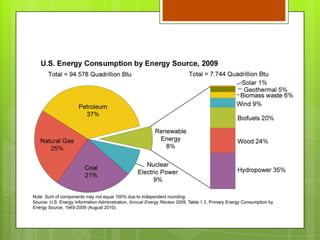
 In 2008, the EIA estimated that the world
consumed 504.7 quadrillion Btu of
energy, where 10% was renewable
energy.
 By 2035, it‟s forecasted that consumption
of renewable energy will be about 14% of
total world energy consumption.
How much energy does a
person use in a year?
 In 2010, total energy use per person in the
U.S. was 317 million British thermal units
(Btu).
Why Don't We Use More
Renewable Energy?
 Renewable Energy Technologies Are
Capital-Intensive.
 generally more expensive to build and to
operate than coal and natural gas plants.
 Renewable Resources Are Often
Geographically Remote.
 building transmission lines to deliver power to
large metropolitan areas is expensive.
Solar Energy Can Be Used for
Both Heat and Electricity.
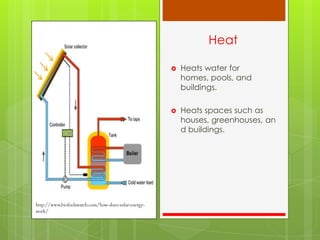
Heat
 Heats water for
homes, pools, and
buildings.
 Heats spaces such as
houses, greenhouses, an
d buildings.
http://www.biofuelswatch.com/how-does-solar-energy-
work/
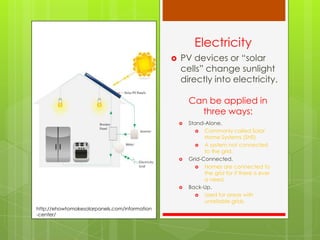
Electricity
 PV devices or “solar
cells” change sunlight
directly into electricity.
Can be applied in
three ways:
 Stand-Alone.
 Commonly called Solar
Home Systems (SHS)
 A system not connected
to the grid.
 Grid-Connected.
 Homes are connected to
the grid for if there is ever
a need.
 Back-Up.
 Used for areas with
unreliable grids.
http://ehowtomakesolarpanels.com/information
-center/
How do solar panels work?
 1.) Sunlight hits the solar panels (also know
as a photovoltaic/ PV) and are absorbed
by semi-conducting materials such as
silicone.
 2.) Electrons are knocked loose from their
atoms, which allow them to flow through
the material to produce electricity.
 Also called the photovoltaic (PV) effect.
How do solar panels
work, cont.
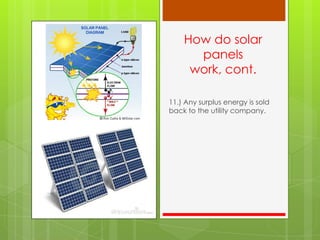
 3.) An array of solar panels converts solar
energy into DC (direct current) electricity.
 4.) The DC electricity then enters an inverter.
 5.) The inverter turns DC electricity into 120-
volt AC (alternating current) electricity
needed by home appliances.
 6.) The AC power enters the utility panel in the
house.
How do solar panels
work, cont.
 7.) The electricity is then distributed to appliances or lights in
the house.
 8.) When more solar energy is generated that what you're
using - it can be stored in a battery as DC electricity. The
battery will continue to supply your home with electricity in
the event of a power blackout or at nighttime.
 9.) When the battery is full the excess electricity can be
exported back into the utility grid, if your system is
connected to it.
 10.) Utility supplied electricity can also be drawn form the
grid when not enough solar energy is produced and no
excess energy is stored in the battery, i.e. at night or on
cloudy days.
How do solar
panels
work, cont.
11.) Any surplus energy is sold
back to the utility company.
Facts about Solar Energy
Usage:
 Solar Energy is measured in kilowatt-hour. 1 kilowatt =
1000 watts.
 1 kilowatt-hour (kWh) = the amount of electricity
required to burn a 100 watt light bulb for 10 hours.
 According to the US Department of Energy, an
average American household used approximately
866-kilowatt hours per month in 1999 costing them
$70.68.
 About 30% of our total energy consumption is used to
heat water.
Facts about Solar Energy
Systems:
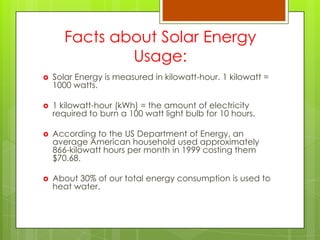
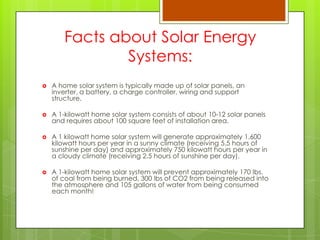
 A home solar system is typically made up of solar panels, an
inverter, a battery, a charge controller, wiring and support
structure.
 A 1-kilowatt home solar system consists of about 10-12 solar panels
and requires about 100 square feet of installation area.
 A 1 kilowatt home solar system will generate approximately 1,600
kilowatt hours per year in a sunny climate (receiving 5.5 hours of
sunshine per day) and approximately 750 kilowatt hours per year in
a cloudy climate (receiving 2.5 hours of sunshine per day).
 A 1-kilowatt home solar system will prevent approximately 170 lbs.
of coal from being burned, 300 lbs of CO2 from being released into
the atmosphere and 105 gallons of water from being consumed
each month!
Pros and Cons of Solar Energy
Pros
 Environmentally
friendly.
 Low to no
maintenance.
 Saves you money in
the long run.
Cons
 High installation costs.
 The production of solar
energy is influenced by
the presence of clouds
or pollution in the air.
 Solar panels require
quite a large area for
installation to achieve
a good level of
efficiency.
Why Should I Convert to
Renewable Energies?
 Incentives are available form state, federal
and local governments, as well as some utility
companies.
 Go to the DSIRE website to find out what‟s
available in your area (USA only).
 Solar energy systems do not produce air
pollutants or carbon-dioxide.
 When located on buildings, they have
minimal impact on the environment.
Just how much does solar
energy cost to acquire?
 It varies on:
 Size of your household.
 Amount of electricity you use.
 How much sun your area receives.
 Available Government funding.
Rough Estimates:
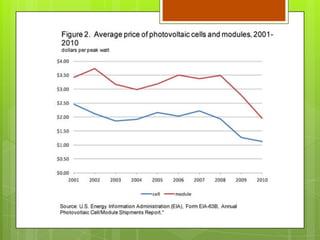
 A solar hot water system will cost between
US $2,000 and $4,000.
 A photovoltaic system will cost between
US $8,000 and $10,000 for a 1kW system.
(or $8 - $10 /Watt)
 PLEASE NOTE that these prices are only estimates and will
vary depending on many different factors that needs to be
taken into account for each specific installation.
An average American family, living
in a 3-bedroom home will require a
1.5 - 3kW system, which will cost
between US $13,000 and US
$27,000, before rebates.
Solarenergy 120624120912-phpapp01

Solarenergy 120624120912-phpapp01

  • 1.
    Solar Energy A Natural,Renewable Resource
  • 2.
    Facts:  Within thenext 40 minutes, the U.S. will receive more energy in the form of sunlight than it burns in a full year from fossil fuels.  The Sun delivers 17,000 million MW of energy to the earth each year.  Solar architecture dates back to 2500 BCE and was used by many civilizations.  Da Vinci predicted a solar industrialization as far back as 1447.
  • 3.
    So why don‟twe use it?  Solar-powered life requires sacrificing modern conveniences.  Solar-powered homes have all the appliances that other homes have. ex. washers, dryers, computers, television sets, refrigerators , etc.
  • 4.
    So why don‟twe use it? Common myths:  You need storage for solar power for power at night.  There is a net metering system that allows the utility companies to "absorb" the energy your system would generate, and then credit you for the energy you need supplied.  Consumption of energy is supplied from the power grid at any time during the day or night. First the credits are used up, and you pay only for the excess usage.
  • 5.
    So why don‟twe use it? Common myths:  Electricity from solar power is expensive.  Nothing is cheap in these days.  It‟s still found to be less expensive to install a solar system than connect to the grid if you are more than about 500 yards from a utility connection.
  • 6.
    So why don‟twe use it? Common myths:  Solar power isn’t entirely developed.  No technology is ever „finished.‟ Solar energy generation is a fairly mature technology at present, but research and development continues, of course.
  • 7.
    What percentage ofworld energy consumption and electricity generation comes from renewable energy?  In 2008, the EIA estimated that the world consumed 504.7 quadrillion Btu of energy, where 10% was renewable energy.  By 2035, it‟s forecasted that consumption of renewable energy will be about 14% of total world energy consumption.
  • 9.
    How much energydoes a person use in a year?  In 2010, total energy use per person in the U.S. was 317 million British thermal units (Btu).
  • 10.
    Why Don't WeUse More Renewable Energy?  Renewable Energy Technologies Are Capital-Intensive.  generally more expensive to build and to operate than coal and natural gas plants.  Renewable Resources Are Often Geographically Remote.  building transmission lines to deliver power to large metropolitan areas is expensive.
  • 11.
    Solar Energy CanBe Used for Both Heat and Electricity.
  • 12.
    Heat  Heats waterfor homes, pools, and buildings.  Heats spaces such as houses, greenhouses, an d buildings. http://www.biofuelswatch.com/how-does-solar-energy- work/
  • 13.
    Electricity  PV devicesor “solar cells” change sunlight directly into electricity. Can be applied in three ways:  Stand-Alone.  Commonly called Solar Home Systems (SHS)  A system not connected to the grid.  Grid-Connected.  Homes are connected to the grid for if there is ever a need.  Back-Up.  Used for areas with unreliable grids. http://ehowtomakesolarpanels.com/information -center/
  • 14.
    How do solarpanels work?  1.) Sunlight hits the solar panels (also know as a photovoltaic/ PV) and are absorbed by semi-conducting materials such as silicone.  2.) Electrons are knocked loose from their atoms, which allow them to flow through the material to produce electricity.  Also called the photovoltaic (PV) effect.
  • 15.
    How do solarpanels work, cont.  3.) An array of solar panels converts solar energy into DC (direct current) electricity.  4.) The DC electricity then enters an inverter.  5.) The inverter turns DC electricity into 120- volt AC (alternating current) electricity needed by home appliances.  6.) The AC power enters the utility panel in the house.
  • 16.
    How do solarpanels work, cont.  7.) The electricity is then distributed to appliances or lights in the house.  8.) When more solar energy is generated that what you're using - it can be stored in a battery as DC electricity. The battery will continue to supply your home with electricity in the event of a power blackout or at nighttime.  9.) When the battery is full the excess electricity can be exported back into the utility grid, if your system is connected to it.  10.) Utility supplied electricity can also be drawn form the grid when not enough solar energy is produced and no excess energy is stored in the battery, i.e. at night or on cloudy days.
  • 17.
    How do solar panels work,cont. 11.) Any surplus energy is sold back to the utility company.
  • 18.
    Facts about SolarEnergy Usage:  Solar Energy is measured in kilowatt-hour. 1 kilowatt = 1000 watts.  1 kilowatt-hour (kWh) = the amount of electricity required to burn a 100 watt light bulb for 10 hours.  According to the US Department of Energy, an average American household used approximately 866-kilowatt hours per month in 1999 costing them $70.68.  About 30% of our total energy consumption is used to heat water.
  • 19.
    Facts about SolarEnergy Systems:  A home solar system is typically made up of solar panels, an inverter, a battery, a charge controller, wiring and support structure.  A 1-kilowatt home solar system consists of about 10-12 solar panels and requires about 100 square feet of installation area.  A 1 kilowatt home solar system will generate approximately 1,600 kilowatt hours per year in a sunny climate (receiving 5.5 hours of sunshine per day) and approximately 750 kilowatt hours per year in a cloudy climate (receiving 2.5 hours of sunshine per day).  A 1-kilowatt home solar system will prevent approximately 170 lbs. of coal from being burned, 300 lbs of CO2 from being released into the atmosphere and 105 gallons of water from being consumed each month!
  • 20.
    Pros and Consof Solar Energy Pros  Environmentally friendly.  Low to no maintenance.  Saves you money in the long run. Cons  High installation costs.  The production of solar energy is influenced by the presence of clouds or pollution in the air.  Solar panels require quite a large area for installation to achieve a good level of efficiency.
  • 21.
    Why Should IConvert to Renewable Energies?  Incentives are available form state, federal and local governments, as well as some utility companies.  Go to the DSIRE website to find out what‟s available in your area (USA only).  Solar energy systems do not produce air pollutants or carbon-dioxide.  When located on buildings, they have minimal impact on the environment.
  • 22.
    Just how muchdoes solar energy cost to acquire?  It varies on:  Size of your household.  Amount of electricity you use.  How much sun your area receives.  Available Government funding.
  • 23.
    Rough Estimates:  Asolar hot water system will cost between US $2,000 and $4,000.  A photovoltaic system will cost between US $8,000 and $10,000 for a 1kW system. (or $8 - $10 /Watt)  PLEASE NOTE that these prices are only estimates and will vary depending on many different factors that needs to be taken into account for each specific installation.
  • 24.
    An average Americanfamily, living in a 3-bedroom home will require a 1.5 - 3kW system, which will cost between US $13,000 and US $27,000, before rebates.