Application of solar energy for
sterling engine
Group members:
Anoop S. Singh
Rohan M. Homkar
9664346434
Rahul N. Kekan
Rajesh A. Narlawar
Sunil O. Bambal
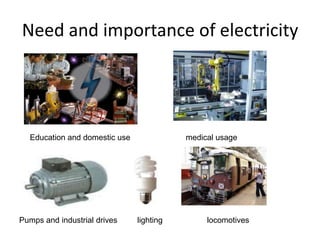
Need and importance of electricity

Education and domestic use

Pumps and industrial drives

medical usage

lighting

locomotives
Conventional energy
sources
 Thermal power plant
•Coal fired
•Oil fired

Non- conventional
energy sources
 Solar energy
 Wind Energy
 Tidal Energy

 Gas turbine power plant

 Geothermal

 Captive power plant

 Biomass
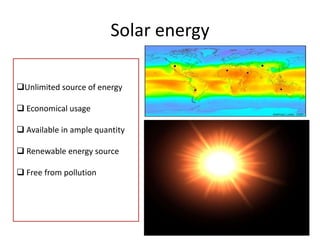
Solar energy
Unlimited source of energy
 Economical usage
 Available in ample quantity
 Renewable energy source
 Free from pollution
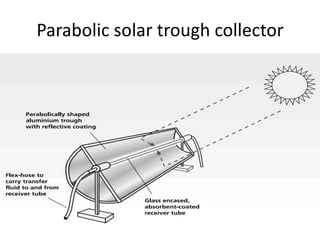
Parabolic solar trough collector
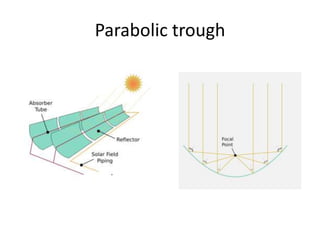
Parabolic trough
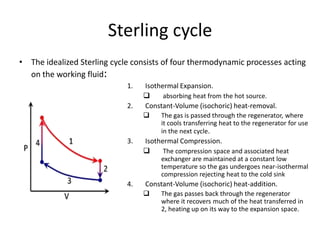
Sterling cycle
• The idealized Sterling cycle consists of four thermodynamic processes acting
on the working fluid:
1.
2.

Isothermal Expansion.

absorbing heat from the hot source.
Constant-Volume (isochoric) heat-removal.


3.

The gas is passed through the regenerator, where
it cools transferring heat to the regenerator for use
in the next cycle.

Isothermal Compression.

The compression space and associated heat
exchanger are maintained at a constant low
temperature so the gas undergoes near-isothermal
compression rejecting heat to the cold sink

4.

Constant-Volume (isochoric) heat-addition.


The gas passes back through the regenerator
where it recovers much of the heat transferred in
2, heating up on its way to the expansion space.
Selection of sterling engine
construction
A Sterling engine is a heat engine
external combustion engine,

cyclic compression and expansion of air
Can be used as prime mover
Low differential temperature requirements
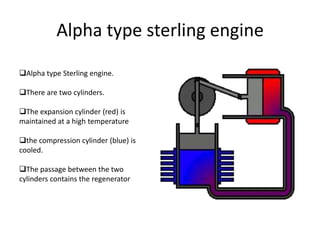
Alpha type sterling engine
Alpha type Sterling engine.
There are two cylinders.
The expansion cylinder (red) is
maintained at a high temperature
the compression cylinder (blue) is
cooled.
The passage between the two
cylinders contains the regenerator
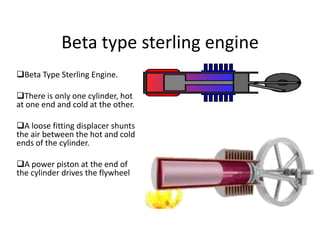
Beta type sterling engine
Beta Type Sterling Engine.
There is only one cylinder, hot
at one end and cold at the other.
A loose fitting displacer shunts
the air between the hot and cold
ends of the cylinder.
A power piston at the end of
the cylinder drives the flywheel
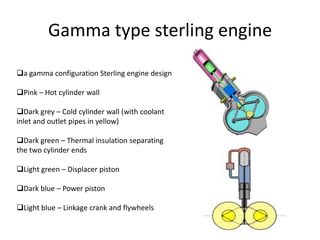
Gamma type sterling engine
a gamma configuration Sterling engine design
Pink – Hot cylinder wall
Dark grey – Cold cylinder wall (with coolant
inlet and outlet pipes in yellow)
Dark green – Thermal insulation separating
the two cylinder ends
Light green – Displacer piston

Dark blue – Power piston
Light blue – Linkage crank and flywheels
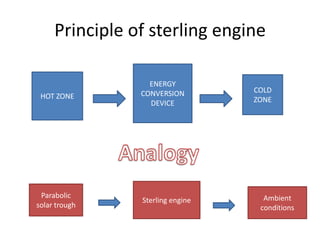
Principle of sterling engine

HOT ZONE

Parabolic
solar trough

ENERGY
CONVERSION
DEVICE

Sterling engine

COLD
ZONE

Ambient
conditions
Key activities in project
1.

Selection of energy conversion methodology

2.

Selection of solar collector

3.

Design of solar parabolic collector

4.

Selection of sterling engine

5.

Design of sterling engine components

6.

Feasibility study about designs and project

7.

Manufacturing and commissioning of engine components

8.

Trial run of engine and conclusion
Conclusion

 Application of eco-friendly solar energy

 Use of beta type construction of sterling engine
 scheduling and planning to complete project in time
Thank you