Physics 320: Introduction to
the Solar System (Lecture 1)
Dale Gary
NJIT Physics Department
September 4, 2018
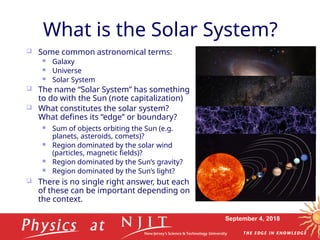
What is the Solar System?
 Some common astronomical terms:
 Galaxy
 Universe
 Solar System
 The name “Solar System” has something
to do with the Sun (note capitalization)
 What constitutes the solar system?
What defines its “edge” or boundary?
 Sum of objects orbiting the Sun (e.g.
planets, asteroids, comets)?
 Region dominated by the solar wind
(particles, magnetic fields)?
 Region dominated by the Sun’s gravity?
 Region dominated by the Sun’s light?
 There is no single right answer, but each
of these can be important depending on
the context.
September 4, 2018
What is the
Solar System Made of?
 The Sun
 The Planets
 The Asteroid Belt
 Other Asteroids
 Comets
 Meteroids
 Dust
 Elementary Particles
 Magnetic Fields
September 4, 2018
Solar and Planetary System
Astrophysics
 The language of physics is mathematics:
 We will be using the somewhat more advanced language of
algebra, trigonometry, calculus, and even a bit of simple
differential equations. I hope and expect that you have
learned this language well, although we will go over some of it
in review as we go along.
Philosophy is written in this grand book, the universe, which stands
continually open to our gaze. But the book cannot be understood
unless one first learns to comprehend the language and to read the
alphabet in which it is composed. It is written in the language of
mathematics, and its characters are triangles, circles, and other
geometric figures, without which it is humanly impossible
to understand a single word of it; without these, one wanders about
in a dark labyrinth.
Galileo in The Assayer.
September 4, 2018
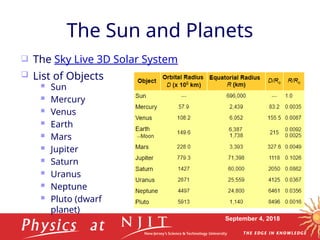
The Sun and Planets
 The Sky Live 3D Solar System
 List of Objects
 Sun
 Mercury
 Venus
 Earth
 Mars
 Jupiter
 Saturn
 Uranus
 Neptune
 Pluto (dwarf
planet)
September 4, 2018
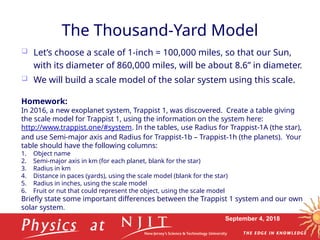
The Thousand-Yard Model
 Let’s choose a scale of 1-inch = 100,000 miles, so that our Sun,
with its diameter of 860,000 miles, will be about 8.6” in diameter.
 We will build a scale model of the solar system using this scale.
Homework:
In 2016, a new exoplanet system, Trappist 1, was discovered. Create a table giving
the scale model for Trappist 1, using the information on the system here:
http://www.trappist.one/#system. In the tables, use Radius for Trappist-1A (the star),
and use Semi-major axis and Radius for Trappist-1b – Trappist-1h (the planets). Your
table should have the following columns:
1. Object name
2. Semi-major axis in km (for each planet, blank for the star)
3. Radius in km
4. Distance in paces (yards), using the scale model (blank for the star)
5. Radius in inches, using the scale model
6. Fruit or nut that could represent the object, using the scale model
Briefly state some important differences between the Trappist 1 system and our own
solar system.

Solar System Presentation for school students

  • 1.
    Physics 320: Introductionto the Solar System (Lecture 1) Dale Gary NJIT Physics Department
  • 2.
    September 4, 2018 Whatis the Solar System?  Some common astronomical terms:  Galaxy  Universe  Solar System  The name “Solar System” has something to do with the Sun (note capitalization)  What constitutes the solar system? What defines its “edge” or boundary?  Sum of objects orbiting the Sun (e.g. planets, asteroids, comets)?  Region dominated by the solar wind (particles, magnetic fields)?  Region dominated by the Sun’s gravity?  Region dominated by the Sun’s light?  There is no single right answer, but each of these can be important depending on the context.
  • 3.
    September 4, 2018 Whatis the Solar System Made of?  The Sun  The Planets  The Asteroid Belt  Other Asteroids  Comets  Meteroids  Dust  Elementary Particles  Magnetic Fields
  • 4.
    September 4, 2018 Solarand Planetary System Astrophysics  The language of physics is mathematics:  We will be using the somewhat more advanced language of algebra, trigonometry, calculus, and even a bit of simple differential equations. I hope and expect that you have learned this language well, although we will go over some of it in review as we go along. Philosophy is written in this grand book, the universe, which stands continually open to our gaze. But the book cannot be understood unless one first learns to comprehend the language and to read the alphabet in which it is composed. It is written in the language of mathematics, and its characters are triangles, circles, and other geometric figures, without which it is humanly impossible to understand a single word of it; without these, one wanders about in a dark labyrinth. Galileo in The Assayer.
  • 5.
    September 4, 2018 TheSun and Planets  The Sky Live 3D Solar System  List of Objects  Sun  Mercury  Venus  Earth  Mars  Jupiter  Saturn  Uranus  Neptune  Pluto (dwarf planet)
  • 6.
    September 4, 2018 TheThousand-Yard Model  Let’s choose a scale of 1-inch = 100,000 miles, so that our Sun, with its diameter of 860,000 miles, will be about 8.6” in diameter.  We will build a scale model of the solar system using this scale. Homework: In 2016, a new exoplanet system, Trappist 1, was discovered. Create a table giving the scale model for Trappist 1, using the information on the system here: http://www.trappist.one/#system. In the tables, use Radius for Trappist-1A (the star), and use Semi-major axis and Radius for Trappist-1b – Trappist-1h (the planets). Your table should have the following columns: 1. Object name 2. Semi-major axis in km (for each planet, blank for the star) 3. Radius in km 4. Distance in paces (yards), using the scale model (blank for the star) 5. Radius in inches, using the scale model 6. Fruit or nut that could represent the object, using the scale model Briefly state some important differences between the Trappist 1 system and our own solar system.