NEW GENERATION INNOVATION AND
ENTREPRENEURSHIP DEVELOPMENT CENTER
(NewGen IEDC)
College of Technology and Engineering
Maharana Pratap University of Agriculture and Technology
Udaipur-313001 Rajasthan
Sponsored by
National Science & Technology
Entrepreneurship Development Board
(NSTEDB), Department of Science &
Technology; New Delhi
Implemented by
Entrepreneurship Development Institute
of India (EDII), Ahmadabad
Guided By
Dr Chitranjan Agarwal
Associate Professor
(DME)
Dr Trilok Gupta
Associate Professor
(HOD, DCE)
Dr N.L. Panwar
Associate Professor
(HOD, DREE)
Submitted By
Harsh Vardhan Swami
IV Year (B.Tech M.E.)
Harsh Kothari
III Year (B.Tech M.E.)
Presentation on design and
fabrication of solar powered
Quadrotor UAV
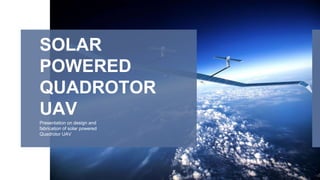
SOLAR
POWERED
QUADROTOR
UAV
TABLE
OF
CONTENTS
Brief introduction about solar
power and its efficiency
SOLAR POWER
03
ABOUT THE PROJECT
Introduction to the idea of
implementation of solar power
with drones
01
WHY QUADCOPTERS?
Why quadcopters were chosen
for this particular project?
02
PROJECT OBJECTIVES
AND GOALS
What are the objectives
behind pursuing this project.
What goals are to be achieved
through this project
04
PROJECT STAGES
Road map to completion of
the project.
05
ABOUT THE PROJECT
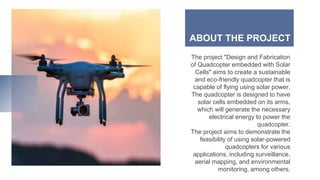
The project "Design and Fabrication
of Quadcopter embedded with Solar
Cells" aims to create a sustainable
and eco-friendly quadcopter that is
capable of flying using solar power.
The quadcopter is designed to have
solar cells embedded on its arms,
which will generate the necessary
electrical energy to power the
quadcopter.
The project aims to demonstrate the
feasibility of using solar-powered
quadcopters for various
applications, including surveillance,
aerial mapping, and environmental
monitoring, among others.
WHY
QUADCOPTERS?
Usually involving a fixed frame
made of any strong and light
material of choice that can be
constructed with ease.
These drones are perfect for
filming, aerial mapping or
infrastructure monitoring
SUSTAINABILITY IN
PRECISE MISSIONS
HIGH
MANEUVERABILITY
SIMPLICITY IN
MECHANICAL DESIGN
HIGH LOAD
CAPACITY
Due to the presence of several
motors, the multirotors usually
have more payload capacity than
other UAV types.
Since quadcopters by design do
not have a front facing direction,
they are capable of moving in any
direction in any orientation
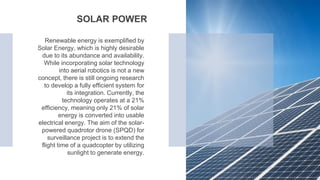
Renewable energy is exemplified by
Solar Energy, which is highly desirable
due to its abundance and availability.
While incorporating solar technology
into aerial robotics is not a new
concept, there is still ongoing research
to develop a fully efficient system for
its integration. Currently, the
technology operates at a 21%
efficiency, meaning only 21% of solar
energy is converted into usable
electrical energy. The aim of the solar-
powered quadrotor drone (SPQD) for
surveillance project is to extend the
flight time of a quadcopter by utilizing
sunlight to generate energy.
SOLAR POWER
PROJECT
OBJECTIVES
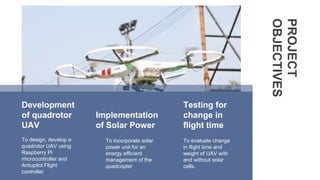
To evaluate change
in flight time and
weight of UAV with
and without solar
cells.
To design, develop a
quadrotor UAV using
Raspberry Pi
microcontroller and
Ardupilot Flight
controller
Development
of quadrotor
UAV
Testing for
change in
flight time
Implementation
of Solar Power
To incorporate solar
power unit for an
energy efficient
management of the
quadcopter
PROJECT
GOALS
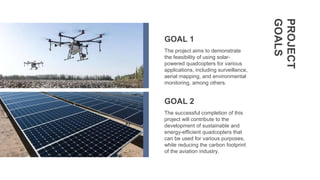
The project aims to demonstrate
the feasibility of using solar-
powered quadcopters for various
applications, including surveillance,
aerial mapping, and environmental
monitoring, among others.
The successful completion of this
project will contribute to the
development of sustainable and
energy-efficient quadcopters that
can be used for various purposes,
while reducing the carbon footprint
of the aviation industry.
GOAL 1
GOAL 2
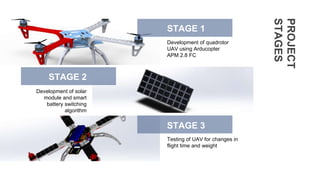
Development of solar
module and smart
battery switching
algorithm
PROJECT
STAGES
STAGE 2
Development of quadrotor
UAV using Arducopter
APM 2.8 FC
STAGE 1
Testing of UAV for changes in
flight time and weight
STAGE 3
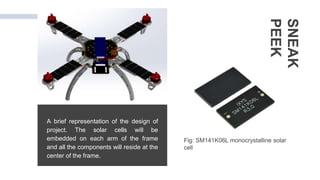
A brief representation of the design of
project. The solar cells will be
embedded on each arm of the frame
and all the components will reside at the
center of the frame.
SNEAK
PEEK
Fig: SM141K06L monocrystalline solar
cell
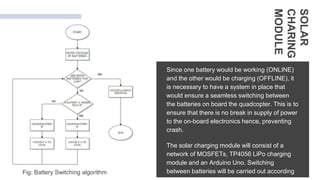
Since one battery would be working (ONLINE)
and the other would be charging (OFFLINE), it
is necessary to have a system in place that
would ensure a seamless switching between
the batteries on board the quadcopter. This is to
ensure that there is no break in supply of power
to the on-board electronics hence, preventing
crash.
The solar charging module will consist of a
network of MOSFETs, TP4056 LiPo charging
module and an Arduino Uno. Switching
between batteries will be carried out according
SOLAR
CHARING
MODULE
Fig: Battery Switching algorithm
BUDGET
ESTIMATION
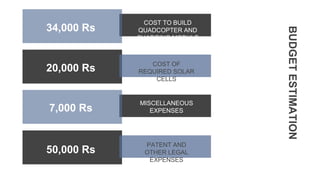
COST TO BUILD
QUADCOPTER AND
CHARGING MODULE
20,000 Rs COST OF
REQUIRED SOLAR
CELLS
MISCELLANEOUS
EXPENSES
34,000 Rs
7,000 Rs
PATENT AND
OTHER LEGAL
EXPENSES
50,000 Rs
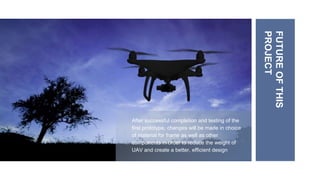
After successful completion and testing of the
first prototype, changes will be made in choice
of material for frame as well as other
components in order to reduce the weight of
UAV and create a better, efficient design
FUTURE
OF
THIS
PROJECT
THANK
YOU

SOLAR POWERED QUADROTOR UAV.pptx

  • 1.
    NEW GENERATION INNOVATIONAND ENTREPRENEURSHIP DEVELOPMENT CENTER (NewGen IEDC) College of Technology and Engineering Maharana Pratap University of Agriculture and Technology Udaipur-313001 Rajasthan Sponsored by National Science & Technology Entrepreneurship Development Board (NSTEDB), Department of Science & Technology; New Delhi Implemented by Entrepreneurship Development Institute of India (EDII), Ahmadabad
  • 2.
    Guided By Dr ChitranjanAgarwal Associate Professor (DME) Dr Trilok Gupta Associate Professor (HOD, DCE) Dr N.L. Panwar Associate Professor (HOD, DREE) Submitted By Harsh Vardhan Swami IV Year (B.Tech M.E.) Harsh Kothari III Year (B.Tech M.E.)
  • 3.
    Presentation on designand fabrication of solar powered Quadrotor UAV SOLAR POWERED QUADROTOR UAV
  • 4.
    TABLE OF CONTENTS Brief introduction aboutsolar power and its efficiency SOLAR POWER 03 ABOUT THE PROJECT Introduction to the idea of implementation of solar power with drones 01 WHY QUADCOPTERS? Why quadcopters were chosen for this particular project? 02 PROJECT OBJECTIVES AND GOALS What are the objectives behind pursuing this project. What goals are to be achieved through this project 04 PROJECT STAGES Road map to completion of the project. 05
  • 5.
    ABOUT THE PROJECT Theproject "Design and Fabrication of Quadcopter embedded with Solar Cells" aims to create a sustainable and eco-friendly quadcopter that is capable of flying using solar power. The quadcopter is designed to have solar cells embedded on its arms, which will generate the necessary electrical energy to power the quadcopter. The project aims to demonstrate the feasibility of using solar-powered quadcopters for various applications, including surveillance, aerial mapping, and environmental monitoring, among others.
  • 6.
    WHY QUADCOPTERS? Usually involving afixed frame made of any strong and light material of choice that can be constructed with ease. These drones are perfect for filming, aerial mapping or infrastructure monitoring SUSTAINABILITY IN PRECISE MISSIONS HIGH MANEUVERABILITY SIMPLICITY IN MECHANICAL DESIGN HIGH LOAD CAPACITY Due to the presence of several motors, the multirotors usually have more payload capacity than other UAV types. Since quadcopters by design do not have a front facing direction, they are capable of moving in any direction in any orientation
  • 7.
    Renewable energy isexemplified by Solar Energy, which is highly desirable due to its abundance and availability. While incorporating solar technology into aerial robotics is not a new concept, there is still ongoing research to develop a fully efficient system for its integration. Currently, the technology operates at a 21% efficiency, meaning only 21% of solar energy is converted into usable electrical energy. The aim of the solar- powered quadrotor drone (SPQD) for surveillance project is to extend the flight time of a quadcopter by utilizing sunlight to generate energy. SOLAR POWER
  • 8.
    PROJECT OBJECTIVES To evaluate change inflight time and weight of UAV with and without solar cells. To design, develop a quadrotor UAV using Raspberry Pi microcontroller and Ardupilot Flight controller Development of quadrotor UAV Testing for change in flight time Implementation of Solar Power To incorporate solar power unit for an energy efficient management of the quadcopter
  • 9.
    PROJECT GOALS The project aimsto demonstrate the feasibility of using solar- powered quadcopters for various applications, including surveillance, aerial mapping, and environmental monitoring, among others. The successful completion of this project will contribute to the development of sustainable and energy-efficient quadcopters that can be used for various purposes, while reducing the carbon footprint of the aviation industry. GOAL 1 GOAL 2
  • 10.
    Development of solar moduleand smart battery switching algorithm PROJECT STAGES STAGE 2 Development of quadrotor UAV using Arducopter APM 2.8 FC STAGE 1 Testing of UAV for changes in flight time and weight STAGE 3
  • 11.
    A brief representationof the design of project. The solar cells will be embedded on each arm of the frame and all the components will reside at the center of the frame. SNEAK PEEK Fig: SM141K06L monocrystalline solar cell
  • 12.
    Since one batterywould be working (ONLINE) and the other would be charging (OFFLINE), it is necessary to have a system in place that would ensure a seamless switching between the batteries on board the quadcopter. This is to ensure that there is no break in supply of power to the on-board electronics hence, preventing crash. The solar charging module will consist of a network of MOSFETs, TP4056 LiPo charging module and an Arduino Uno. Switching between batteries will be carried out according SOLAR CHARING MODULE Fig: Battery Switching algorithm
  • 13.
    BUDGET ESTIMATION COST TO BUILD QUADCOPTERAND CHARGING MODULE 20,000 Rs COST OF REQUIRED SOLAR CELLS MISCELLANEOUS EXPENSES 34,000 Rs 7,000 Rs PATENT AND OTHER LEGAL EXPENSES 50,000 Rs
  • 14.
    After successful completionand testing of the first prototype, changes will be made in choice of material for frame as well as other components in order to reduce the weight of UAV and create a better, efficient design FUTURE OF THIS PROJECT
  • 15.