Solar Ponds
• A solar ponds is a body of water that collects and stores solar energy.
• Water warmed by the sun expands and rises as it becomes less dense.
• Its design reduces convection in order to store heat collected by
pond.
• Salinity gradient prevents convection current.
• Solar radiations reaches the lower layer which contains conc. salt
solution.
• Temperature in this layer rises but heat is unable to move to surface
by convection. Solar heat is thus stored in the lower layer of the pond.
Working of Solar pond:
• The Solar pond works on a very simple principle. It is well-known that
water or air is heated they become lighter and rise upward.
• Similarly, in an ordinary pond, the sun’s rays heat the water and the
heated water from within the pond rises and reaches the top but
loses the heat into the atmosphere. The net result is that the pond
water remains at the atmospheric temperature.
• The solar pond restricts this tendency by dissolving salt in the bottom
layer of the pond making it to heavy to rise.
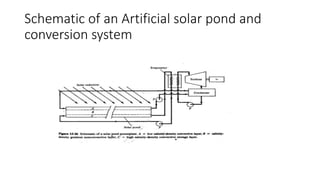
Schematic of an Artificial solar pond and
conversion system
PHOTOVOLTAIC-ENERGY CONVERSION
 Photovoltaic energy conversion is a direct conversion technology that
produces electricity directly from sunlight without the use of a
working fluid.
 The working fluid is either steam or gas.
 It is very simple and convenient.
 In addition, they are modular.
 The basic Unit of a photovoltaic system is a solar cell.
Solar Cell
• Solar cells are made from semiconductor material.
• Converts sunlight into electricity according to the principle of
photovoltaic effect.
• Photovoltaic cells use p-n junction to generates electron-hole pairs
which in turn constitutes electric current.
• Light shinning on the solar cell produces both a current and a voltage
to generate electric power.
• The most common solar cells are made up of highly refined silicon.
Why Silicon?
• Non Toxic
• Abundant
• Relatively Cheap
• Mature infrastructure from computer industry
• solar cells are typically circular wafers, about 3 in (7.6 cm) in diameter
and 300 µm thick, although square or rectangular wafers are being
developed to increase the useful fraction of the total area exposed to
sunlight when the cells are assembled side by side.
• A single cell typically produces a power of 1 W at a voltage of 0.5 V.
They are then connected electrically in series-parallel arrangement,
called a module, to produce the required current and voltage.
• A module is typically 4x4 ft.(1.2 x 1.2 m). Several modules make up a
panel.
• A panel is the design unit for assembling large photovoltaic arrays to
meet the required power generation.
Factor Effecting Photovoltaic Panel:
• Dusting
• Temp rise Effect
• Poor sunlight absorption
Solid state principle
Solid Phenomena
• A metallic crystalline solid contains atoms that have nuclei surrounded by
electrons that are tightly bound to them (the shell model) and by outer
electrons that are weakly bound to them. The latter are called valence, or
conduction, electron.
• They are free to migrate in the interior of the metal because there are no
net forces on them because of the other free electrons or the ionized
nuclei and their bound electrons. They thus move in an essentially
equipotential field, each having a constant electrostatic potential energy E,
that is independent of its location inside the crystal, and they are
considered to belong to the entire crystalline solid rather than to any one
particular atom.
• These valence electrons constitute primary mechanism of electric and heat
conduction in a metal. At the surface, however, there are no positive ions on
one side to give them equal attractive forces. Thus, while they are easily
moved by electric fields within the metal, they encounter an energy barrier at
the surface and require considerably more energy to get them out of the
metal.
• One therefore has an electron gas that is confined within the metal. It is not,
however, equivalent to an ordinary gas whose energy distribution given by the
Maxwell-Boltzmann law. Electrons, instead, exist in states restricted by the so-
called Pauli exclusion principle (which specifies that no two electrons in the
same atom can exist in the same state at the same time), and their energy
distribution is given by the Fermi-Dirac distribution law, given for temperatures
that are not too high (not greater than 3000 K) by [128]
• n(E)dE is the no of electrons per unit volume in the energy range dE.
• Quantity inside bracket is constant:
• h is plank’s constant (6.625*10-34)
• me is the mass of electron (9.13*10-28 g)
• k is the Boltzmann constant
• EF is the Fermi energy. Which is constant for many cases of interest, and
independent of temperature.
Band Theory
• In isolated atoms the energy levels of electrons are discrete.
• When N number of electron interact with each other, the discrete
energy levels of electrons in the solid are split up.
• The Last completely filled band is called valence band.
• The next band with higher energy is the conduction band
The conduction band can be empty or partially filled
• The Energy difference between the bottom of CB and the top of the
VB is called the Band Gap or Forbidden gap.
Solar Ponds.pptx

Solar Ponds.pptx

  • 1.
    Solar Ponds • Asolar ponds is a body of water that collects and stores solar energy. • Water warmed by the sun expands and rises as it becomes less dense. • Its design reduces convection in order to store heat collected by pond. • Salinity gradient prevents convection current. • Solar radiations reaches the lower layer which contains conc. salt solution. • Temperature in this layer rises but heat is unable to move to surface by convection. Solar heat is thus stored in the lower layer of the pond.
  • 2.
    Working of Solarpond: • The Solar pond works on a very simple principle. It is well-known that water or air is heated they become lighter and rise upward. • Similarly, in an ordinary pond, the sun’s rays heat the water and the heated water from within the pond rises and reaches the top but loses the heat into the atmosphere. The net result is that the pond water remains at the atmospheric temperature. • The solar pond restricts this tendency by dissolving salt in the bottom layer of the pond making it to heavy to rise.
  • 4.
    Schematic of anArtificial solar pond and conversion system
  • 5.
    PHOTOVOLTAIC-ENERGY CONVERSION  Photovoltaicenergy conversion is a direct conversion technology that produces electricity directly from sunlight without the use of a working fluid.  The working fluid is either steam or gas.  It is very simple and convenient.  In addition, they are modular.  The basic Unit of a photovoltaic system is a solar cell.
  • 6.
    Solar Cell • Solarcells are made from semiconductor material. • Converts sunlight into electricity according to the principle of photovoltaic effect. • Photovoltaic cells use p-n junction to generates electron-hole pairs which in turn constitutes electric current. • Light shinning on the solar cell produces both a current and a voltage to generate electric power.
  • 7.
    • The mostcommon solar cells are made up of highly refined silicon. Why Silicon? • Non Toxic • Abundant • Relatively Cheap • Mature infrastructure from computer industry
  • 8.
    • solar cellsare typically circular wafers, about 3 in (7.6 cm) in diameter and 300 µm thick, although square or rectangular wafers are being developed to increase the useful fraction of the total area exposed to sunlight when the cells are assembled side by side. • A single cell typically produces a power of 1 W at a voltage of 0.5 V. They are then connected electrically in series-parallel arrangement, called a module, to produce the required current and voltage. • A module is typically 4x4 ft.(1.2 x 1.2 m). Several modules make up a panel. • A panel is the design unit for assembling large photovoltaic arrays to meet the required power generation.
  • 9.
    Factor Effecting PhotovoltaicPanel: • Dusting • Temp rise Effect • Poor sunlight absorption
  • 10.
    Solid state principle SolidPhenomena • A metallic crystalline solid contains atoms that have nuclei surrounded by electrons that are tightly bound to them (the shell model) and by outer electrons that are weakly bound to them. The latter are called valence, or conduction, electron. • They are free to migrate in the interior of the metal because there are no net forces on them because of the other free electrons or the ionized nuclei and their bound electrons. They thus move in an essentially equipotential field, each having a constant electrostatic potential energy E, that is independent of its location inside the crystal, and they are considered to belong to the entire crystalline solid rather than to any one particular atom.
  • 11.
    • These valenceelectrons constitute primary mechanism of electric and heat conduction in a metal. At the surface, however, there are no positive ions on one side to give them equal attractive forces. Thus, while they are easily moved by electric fields within the metal, they encounter an energy barrier at the surface and require considerably more energy to get them out of the metal. • One therefore has an electron gas that is confined within the metal. It is not, however, equivalent to an ordinary gas whose energy distribution given by the Maxwell-Boltzmann law. Electrons, instead, exist in states restricted by the so- called Pauli exclusion principle (which specifies that no two electrons in the same atom can exist in the same state at the same time), and their energy distribution is given by the Fermi-Dirac distribution law, given for temperatures that are not too high (not greater than 3000 K) by [128]
  • 12.
    • n(E)dE isthe no of electrons per unit volume in the energy range dE. • Quantity inside bracket is constant: • h is plank’s constant (6.625*10-34) • me is the mass of electron (9.13*10-28 g) • k is the Boltzmann constant • EF is the Fermi energy. Which is constant for many cases of interest, and independent of temperature.
  • 14.
    Band Theory • Inisolated atoms the energy levels of electrons are discrete. • When N number of electron interact with each other, the discrete energy levels of electrons in the solid are split up. • The Last completely filled band is called valence band. • The next band with higher energy is the conduction band The conduction band can be empty or partially filled • The Energy difference between the bottom of CB and the top of the VB is called the Band Gap or Forbidden gap.