 Content
1. Introduction
2. History
3. Types
4. Working
5. User
6. Uses
7. Advantages
8. Disadvantages
*
*
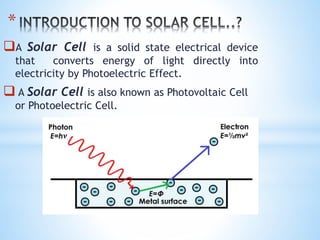
A Solar Cell is a solid state electrical device
that converts energy of light directly into
electricity by Photoelectric Effect.
 A Solar Cell is also known as Photovoltaic Cell
or Photoelectric Cell.
*
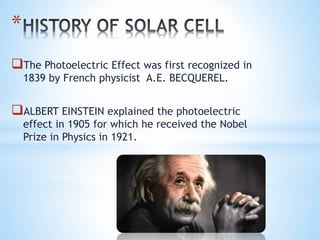
The Photoelectric Effect was first recognized in
1839 by French physicist A.E. BECQUEREL.
ALBERT EINSTEIN explained the photoelectric
effect in 1905 for which he received the Nobel
Prize in Physics in 1921.
The modern photovoltaic cell was developed in
1954 at BELL LABORATORIES
Solar Cells were first used in Vanguard I satellite,
launched in1958.
*
 There are basically 3 types of Solar
Cell technology:
I. Discrete Cell Technology.
II. Integrated Thin Film Technology.
III.Multi crystalline silicon Technology.
*
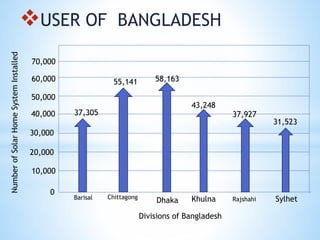
USER OF BANGLADESH
0
10,000
20,000
30,000
40,000
50,000
60,000
70,000
37,305
55,141 58,163
43,248
37,927
31,523
Barisal Chittagong
Dhaka Khulna Rajshahi Sylhet
Divisions of Bangladesh
NumberofSolarHomeSystemInstalled
*
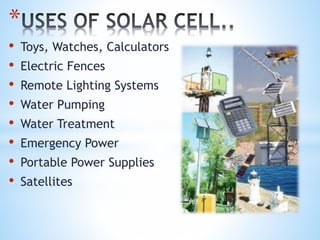
• Toys, Watches, Calculators
• Electric Fences
• Remote Lighting Systems
• Water Pumping
• Water Treatment
• Emergency Power
• Portable Power Supplies
• Satellites
*
• Consumes no fuel.
• No pollution.
• Wide power-handling
capabilities.
• High power-to-weight ratio.
• Life of 20-30 years with low
running costs.
*
• The main disadvantage of Solar Cell is
the initial cost. Most types of solar cell
require large areas of land to achieve
average efficiency.
• Air pollution and weather can also have
a large effect on the efficiency of the
cells.
• The silicon used is also very expensive
and the solar cells can only ever
generate electricity during the
daytime.
Solar Cell Presentation By "RAYHAN AHMED"

Solar Cell Presentation By "RAYHAN AHMED"

  • 1.
     Content 1. Introduction 2.History 3. Types 4. Working 5. User 6. Uses 7. Advantages 8. Disadvantages *
  • 2.
    * A Solar Cellis a solid state electrical device that converts energy of light directly into electricity by Photoelectric Effect.  A Solar Cell is also known as Photovoltaic Cell or Photoelectric Cell.
  • 3.
    * The Photoelectric Effectwas first recognized in 1839 by French physicist A.E. BECQUEREL. ALBERT EINSTEIN explained the photoelectric effect in 1905 for which he received the Nobel Prize in Physics in 1921.
  • 4.
    The modern photovoltaiccell was developed in 1954 at BELL LABORATORIES Solar Cells were first used in Vanguard I satellite, launched in1958.
  • 5.
    *  There arebasically 3 types of Solar Cell technology: I. Discrete Cell Technology. II. Integrated Thin Film Technology. III.Multi crystalline silicon Technology.
  • 6.
  • 7.
    USER OF BANGLADESH 0 10,000 20,000 30,000 40,000 50,000 60,000 70,000 37,305 55,14158,163 43,248 37,927 31,523 Barisal Chittagong Dhaka Khulna Rajshahi Sylhet Divisions of Bangladesh NumberofSolarHomeSystemInstalled
  • 8.
    * • Toys, Watches,Calculators • Electric Fences • Remote Lighting Systems • Water Pumping • Water Treatment • Emergency Power • Portable Power Supplies • Satellites
  • 9.
    * • Consumes nofuel. • No pollution. • Wide power-handling capabilities. • High power-to-weight ratio. • Life of 20-30 years with low running costs.
  • 10.
    * • The maindisadvantage of Solar Cell is the initial cost. Most types of solar cell require large areas of land to achieve average efficiency. • Air pollution and weather can also have a large effect on the efficiency of the cells. • The silicon used is also very expensive and the solar cells can only ever generate electricity during the daytime.