1. Introduction
1.1. Definition and Concepts of Soil
1.1.1. Definition of soil
Soils are very complex natural formations which make up the
surface of the earth.
 The following definitions are the most widely used:
 Soil is the unconsolidated mineral and organic material on the
immediate surface of the earth that serves as a natural medium for
the growth of land plant.
 Soil is the unconsolidated mineral matter on the surface of the
earth that has been subjected to and influenced by genetic and
environmental factors of parent material, climate, macro-and
microorganisms, and topography, all acting over a period of time.
1.1.2. Concepts of soil
 Human beings have had different concepts of soil.
 There are three different concepts of soil.
Concept 1: Soil a as medium for plant growth.
 This is the earliest concept of soil.
 Man used soil for food long before he understood the natural and origin
of it .
 Man, just after commencing agriculture, understood that the potential
for plant growth lies in the soil .
 Consequently, he started classifying soil based on their production
potentials
Concept 2: Soil as weathered rock
 Geologists, engineers and oceanographers share this concept they
believe character of source rock determine the nature of the soil .
 Soil by this concept includes all the loose or unconsolidated rock and
mineral mater on the surface of the earth.
1.1.2. Concepts of soil (cont…)
Concept 3: Soil as a natural body.
 This concept considered soil as a product of the environment
under which it develops.
 An individual soil is a three dimensional dynamic natural body.
 By this concept soil is a unique being formed through
Pedogenic processes and is different from underlying rock and
minerals.
 The characteristics of this unique being is determined by the soil
forming factors identified by Dookuchacv and his team, who
earn the biggest recognition in developing this very concept.
 This concept is the most widely maintained concept by soil
scientists
1.2. Approaches in Soil study
• There are two basic approach to soil study
Pedological Approach
Edaphological Approach
1.2.1. Pedological Approach
 Soil as a natural entity, a bio-chemically weathered and synthesized
product of nature, i.e., the pedological approach.
 A pedologist considers the soil as a natural body and places minor
emphasis on its immediate practical utilization.
1.2.2. Edaphological Approach
• Soil as a natural habitual for plants and justifies studies primarily
on that basis, i.e., the Edaphological approach.
• An edaphologist considers the various properties of soil as they are
related to plant production.
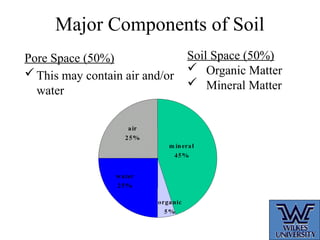
1.3. Major components of soil
o Mineral soils consist of four major components:
Mineral materials,
Organic matter,
Water and Air.
o These components of soil are existing in a fine state of
subdivision and are very intimately mixed.
o Take a representative silt loam soil at optimum condition for
plant growth. This very soil consists of:
 50% Solid State (45% mineral and 5% organic material)
 50% pore space (25% water and 25% air)
o The proportion varies greatly, e.g. with depth, location, texture,
and other factors. Subsoil has higher percentage of minerals
and water and lower content of organic matter and air.
Major Components of Soil
Pore Space (50%)
This may contain air and/or
water
Soil Space (50%)
 Organic Matter
 Mineral Matter
1.3.1 The solid component of soil
1. Mineral (inorganic) Constituent:
 The inorganic portion of the soil is variable in size.
 It is normally composed of small rock fragments and minerals of
various kinds.
 The rock fragments are quite coarse and are the remnants of the
regolith from which the soil is derive.
 The minerals, on the other hand, are partly as large as the rock
fragments and can be seen with a naked eye while others are colloidal
clay particles visible only by the aid magnifying equipment.
 Some minerals, e.g. quartz, have persisted with little change in
composition from original material, i.e. primary minerals.
 The weathering of less resistant minerals has formed other minerals,
e.g. the silicate clays, as the regolith developed and soil formation
progressed.
1.3.1 The solid component of soil
2. Soil Organic Matter (SOM):
 SOM represents an accumulation of partially decayed and
partially synthesized plant and animal residues.
 It is a transitory soil constituent as it is continuously broken down
by the work of micro-organisms.
 The organic matter content of a soil is small (3-5% by weight) but
its influence on soil properties and plant growth, however, is far
greater than the low percentage would indicate.
 SOM consists of two general groups:
 original tissue and
 its partially decomposed equivalent, the humus.
 The later has dark or brown color that some soils depict.
1.3.2.The Water and Air component of soil
1. Soil Water:
Soil water, a dynamic solution, is important in relation to plant
growth for reasons.
Water is held within the soil pores with varying degrees of
tenacity depending on the amount of water present.
Soil water makes up soil solution, together with its dissolved
salts, which is important as a medium for supplying nutrients to
growing plants.
Water is held in soil pores.
Those in large pores are quickly drained by gravity while those in
small pores are strongly held to the soil particles still some are
lost through evaporation.
Thus, plants do not make use of all the water available in the soil.
1.3.2.The Water and Air component of soil (cont…)
2. Soil Air:
Soil air, also a changeable constituent, differs from
atmospheric air in many aspects.
Soil air is not continuous in its appearance.
It generally contains high relative humidity as compared to
atmospheric air.
Besides, its content of Carbon dioxide is usually much higher.
Soil air also occupies the pore space of the soil that is left from
water.
Consequently, its amount relate inversely to the amount of
water in the soil.
As soils with fine pores drain slowly and the water held
strongly to the soil particles, they are poorly aerated.
1.4. Functions of soil
In any ecosystem, soils have five key roles to play or
have five functions:
1. Medium for plant growth
 Soils provide physical support, air, water, nutrients,
protections from toxins and it regulates temperature.
 Gives physical support, anchorage to the root
system so that the plant does not fall over, and
 Serve as a store house for water and nutrients
essential for plant growth and development.
 Properties of the soil often determine the nature of
the vegetation present and, indirectly, the number
and types of animals that the vegetation can support.
1.4. Functions of soil (cont.)
2. Regulate water supply
 Soil as soil-plant-atmosphere continuum is part of the
hydrologic cycle.
 Water loss, utilization, contamination, and purification are all
affected by the soil.
 For instance: If a heavy rain falls on the surface of shallow
and impermeable soils, much of its portion will travel as
run off (over flow).
 However, if it falls on the surface of soils which are
relatively deep and have high water holding capacity, it
will be retained in the soil and be available to plants.
 When contaminated water travels through the soil it will be
purified and cleaned by soil process that remove many
impurities.
1.4. Functions of soil (cont.)
3. Recycler of raw materials
 The soil system plays crucial role in the major
geochemical cycles.
 Soils have the capacity to assimilate great quantities of
organic waste, turning it in to beneficial humus.
 Within the soil, waste products and dead bodies of
plants, animals, and people are assimilated, and their
basic elements are made available for reuse by the next
generation of life.
1.4. Functions of soil (cont.)
4. Habitat for soil micro organisms
 Soils provide habitats for a numerous of living
organisms, from small mammals and reptiles to tiny
insects to microscopic cells of unimaginable numbers
and diversity.
 For instance a handful of soil may be home to billions
of organisms, belonging thousands of species.
1.4. Functions of soil (cont.)
5. Engineering medium
• In human-built ecosystems, soil plays an important
role as an engineering medium.
• Soil is not only an important building material in the
form of earth fill and bricks (baked soil material),
 but provides the foundation for virtually every
road, airport, and house we build.
Chapter 2
2. Soil Formations and Profile Development
2.1. weathering processes
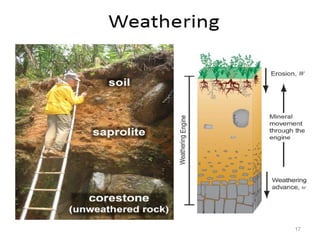
Rocks and minerals exposed at the earth’s surface are
constantly being altered by water, air, changing
temperature, and other environmental factors, through the
process of weathering.
 Weathering is a group of natural processes, which
change the physical and chemical characteristics of rocks
and minerals.
Weathering processes can be classified into two namely
physical and chemical based on the nature of the end
product of the weathering process.
16
17
2.1. Weathering (Cont.)
• Weathering is basically a combination of destruction
and syntheses.
 In destruction, rocks are broken down into small pieces,
which are later on further disintegrated into individual rock
minerals.
 The minerals are attacked by bio-chemical reactions to
produce new minerals (synthesis).
 The new minerals are formed by modification (alteration)
in their physical features or by complete chemical changes.
 The synthesized minerals can be silicate clays or the most
resistant iron and aluminium oxides.
18
2.1.1 Physical Weathering
 Physical Weathering is the breakdown of rocks and
minerals / or organic matter/ into smaller particles by
natural mechanical means.
 Physical weathering is more common in dry and/or
cold regions.
 Physical weathering accelerates chemical weathering
(by decreasing particle size and increasing surface
area).
 During this process there is little or no change in the
chemical properties of the original material.
 Major agents of physical weathering are: water, wind,
ice, temperature, salts, plants and animals, etc
19
Examples of Physical Weathering
1. Heating and cooling
• Seasonal and daily variations of temperature:
Causes alternating expansion and contraction, which
in turn create a differential stress cracking rocks and
minerals.
Breakage occurs when the stress due to the expansion
and contraction exceeds the rock’s elastic limit.
This is known as Exfoliation: peeling away of the
outer layers of rocks due to differential heating.
20
2.1 Physical Weathering (Cont.)
2. Freezing and thawing
• It is the formation of ice in between cracks of rocks and
minerals.
• When water freezes increase in volume takes place
– up to 9-10 % increase in volume due to a change in the
structure of water molecules into hexagonal rigid
structures,
3. Wetting and drying
– Contraction and expansion due to wetting and drying cracks
rocks and minerals.
21
2.1 Physical Weathering (Cont.)
4. Abrasion (collision)
 The grinding away of rocks by friction impact
during transportation (collision).
 The abrasive action of water, wind, and ice
physically erode rocks and minerals.
5. Organisms
Plant roots penetrating into cracks and
the digging, burrowing and grinding action of animals
also contribute to the physical breakdown of rocks
and minerals.
22
2.1.2. Chemical Weathering
It is a chemical decomposition of rocks, minerals, and
organic matter through the action of different chemical
processes.
Rocks and minerals undergo chemical reactions until they
reach in equilibrium with the surrounding environment.
Unlike physical weathering, the original composition of
the rocks and minerals are highly altered and new
compounds are synthesized.
Chemical weathering reactions require warm and humid
environmental conditions.
23
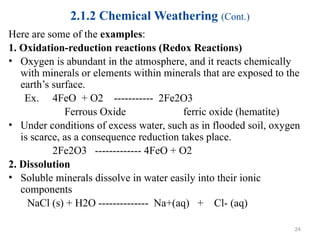
2.1.2 Chemical Weathering (Cont.)
Here are some of the examples:
1. Oxidation-reduction reactions (Redox Reactions)
• Oxygen is abundant in the atmosphere, and it reacts chemically
with minerals or elements within minerals that are exposed to the
earth’s surface.
Ex. 4FeO + O2 ----------- 2Fe2O3
Ferrous Oxide ferric oxide (hematite)
• Under conditions of excess water, such as in flooded soil, oxygen
is scarce, as a consequence reduction takes place.
2Fe2O3 ------------- 4FeO + O2
2. Dissolution
• Soluble minerals dissolve in water easily into their ionic
components
NaCl (s) + H2O -------------- Na+(aq) + Cl- (aq)
24
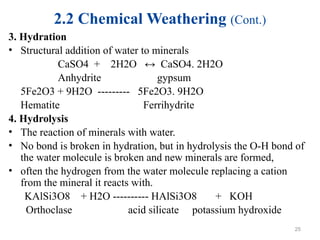
2.2 Chemical Weathering (Cont.)
3. Hydration
• Structural addition of water to minerals
CaSO4 + 2H2O ↔ CaSO4. 2H2O
Anhydrite gypsum
5Fe2O3 + 9H2O --------- 5Fe2O3. 9H2O
Hematite Ferrihydrite
4. Hydrolysis
• The reaction of minerals with water.
• No bond is broken in hydration, but in hydrolysis the O-H bond of
the water molecule is broken and new minerals are formed,
• often the hydrogen from the water molecule replacing a cation
from the mineral it reacts with.
KAlSi3O8 + H2O ---------- HAlSi3O8 + KOH
Orthoclase acid silicate potassium hydroxide
25
2.2 Chemical Weathering (Cont.)
5. Carbonation and Other Acid reactions
• Acids are chemical compounds that give off hydrogen ions (H+)
when they dissociate in water.
• Weathering is accelerated by the presence of acids, which
increase the activity of H ions.
• Acids are the most effective agent for chemical weathering.
 Hydrogen ions are small in size and positively charged, and
most of the times replace positive cations from mineral
structures.
 The most common acid is carbonic acid, but there are also
some strong acids in nature such as sulfuric and hydrochloric
acids which result from volcanoes.
• The reaction of CO2 in aqueous solution with minerals is called
carbonation.
26
2.2. Chemical Weathering (Cont.)
 Solution of carbon dioxide in water forms a weak acid, carbonic
acid.
 CO2 comes partly from the atmosphere but mainly from the
respiration of organisms and liberated from the decomposition of
organic deposits.
 Carbonic acid dissolves mineral solids more easily than water
does alone and forms soluble bicarbonate ions
CO2(g) + H2O (l) H2CO3 (aq)
Carbonic acid
CaCO3+ H2CO3 Ca(HCO3)2 + Ca2+ HCO3-
Calcite (slightly soluble) calcium bicarbonate (readily soluble)
27
2.2. Soil Forming Processes / Pedogenic Processes
Soils formed when a group of natural soil forming
processes /pedogenic processes/ operate on parent
materials deposited by weathering actions.
Pedogenic processes change soil parent materials into
true soils which can support plant growth. This process
in particular is called soil development.
After the parent material has been deposited,
differentiation of layers takes place because of the soil
forming (pedogenic) processes that act upon the
regolith. The subdivisions of the layers are called
horizons.
28
2.2 Soil Forming Processes / Pedogenic Processes (Cont.)
The soil forming processes responsible for horizon
differentiation are :
1. Additions:
– It is the addition of organic and inorganic materials into the
parent material or soil.
– Good example is addition of organic matter that creates black
layer at the soil surface; mineral matter may also be added.
2. Losses:
– Losses of organic and inorganic substances from the parent
material/ soil.
– This may be explained by losses of salts from the soil by
drainage or leaching.
– It also includes losses by surface erosion.
29
2.2 Soil Forming Processes / Pedogenic Processes (Cont.)
3. Transformations:
• Soil constituents organic and inorganic are chemically
and physically altered and new products are
synthesized.
• Transformation of primary minerals into secondary
minerals.
• The decomposition of organic materials and synthesis of
organic acids and humus.
• Organic to inorganic nutrient transformation and the
vise versa.
30
2.2 Soil Forming Processes / Pedogenic Processes (Cont.)
4. Translocations:
 Translocation is the movement of organic and inorganic
materials both laterally and vertically (both gravitational
downward and capillary upward movement).
 Water is the most common translocation agent in parent
materials and soils.
 Some soil organisms could also translocate organic and
inorganic compounds within soils.
 Fine clay particles, dissolved salts and dissolved organics
are the materials being transported.
e.g. movement of clay particles, organic matter, ions, etc from A to
B-horizon.
 It can also be movement of materials from subsoil
upwards. 31
2.3. Soil Forming Factors
• Soil formation is the net balance of gains, losses,
translocations and transformations.
• All soils on earth are formed through the same weathering
and four pedogenic processes.
– But why do soils vary?
 Soils vary because the degree and rates of the four soil
forming processes is influenced by natural factors called soil
forming factors.
 A Soil Forming Factor is an agent, force, condition,
relationship or a combination of two or more of these which
influence the process of soil formation.
 Soil forming factors govern the four fundamental soil
forming processes.
32
2.3. Soil Forming Factors (Cont.)
• There are five major soil forming factors which influence the
formation and development of soils and determine the nature and
type of soil formed.
S = f (cl, o, p, r, t) mt
Where S= soil, cl = climate, o = organisms, p = parent
material, r = relief, t = time, mt = human management
• Climate and biota are called the active soil forming factors,
whereas the others are called the passive factors.
• Soil forming factors do not act in isolation but always together and
in combinations.
• In short, a soil is formed by the action of climate and biota on
parent material over a certain period of time modified by
topography.
33
2.3. Soil Forming Factors (Cont.)
1. Climate
 Climate is the most important soil forming factor which highly
control soil formation processes and determine the nature and
properties of soils formed.
 The type of climate determines the nature and intensity of
weathering taking place in a given locality.
 The principal climatic variables influencing soil formation are
temperature and precipitation, both of which affect the rates of
chemical, physical, and biological processes.
34
35
2.3. Soil Forming Factors (Cont.)
Rainfall (precipitation):
• water is extremely important in almost all chemical weathering
reactions
• percolating water helps in deeper weathering and horizon
differentiation (distributing soluble organic and inorganic materials
within soils)
• Example soils with similar temperature, parent material,
topography, and age but with different amounts of rainfall,
a region with high rainfall will have soil with high organic
matter, high acidity, high clay content, and more secondary
minerals.
• Lack of water slows down weathering, soil development, and
result in accumulation of salts in arid regions.
36
2.3. Soil Forming Factors (Cont.)
Temperature:
 The main effect of temperature on soils is to influence the rate of
soil formation, since for every 10o
rise in temperature the speed of a
chemical reaction increases by a factor of two.
This principally applies to the weathering of minerals.
The rate of both biological activity within the soil and the
breakdown of organic matter are also increased by a rise in
temperature.
Together with available moisture soil formation is accelerated in
warmer areas than cold areas. Weakly developed profiles of cold
regions vs the very deeply weathered soils of the tropics is a
good example for this effect of climate.
37
2.3. Soil Forming Factors (Cont.)
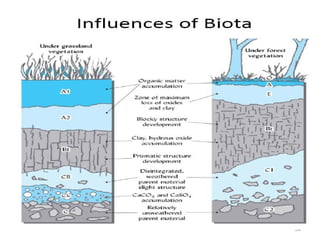
2. BIOTA: Living Organisms
• The biota is composed of two elements, namely flora or the
plant kingdom and fauna or the animal kingdom.
The role of Flora
 The most influential aspect of higher plants is the role of roots, the
addition of organic matter, the extraction of water and nutrients
from the soil.
 Plant roots:
– Act as binders and prevent soil from erosion.
– They grow into the cracks of rocks forcing the rocks to break
apart.
– Besides, the die and decompose there adding organic matter to
the interior of the soil.
38
39
2.3. Soil Forming Factors (Cont.)
• Addition of organic matter:
– Litter fall, from leaves and trunks, also contribute significant
amount of organic matter to the soil surface thereby changing
the properties of the soil.
• Extraction of water and nutrients
– Plants extract water and nutrients from the soil body.
– This leads to the loss of ions from the soil and rapid loss of
water from the soil.
– The losses in turn affect the physical and the bio-chemical
properties of the soil.
40
2.3. Soil Forming Factors (Cont.)
The role of Fauna
Macro Fauna
 Few mammals, vertebrates, including rabbits, moles dig down into
the soil mixing the profile considerably.
 Uncontrolled grazing by animals also leads to susceptibility of the
soil to erosion.
 The addition of organic matter as waste products and dead bodies
from animals should not be ignored as well.
 Recently, human influence on soils is stepping up rapidly because
of industrialization and intensive agriculture.
– Human beings influence soil to the extent that a different soil
type is the result.
41
2.3. Soil Forming Factors (Cont.)
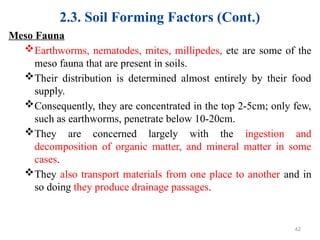
Meso Fauna
Earthworms, nematodes, mites, millipedes, etc are some of the
meso fauna that are present in soils.
Their distribution is determined almost entirely by their food
supply.
Consequently, they are concentrated in the top 2-5cm; only few,
such as earthworms, penetrate below 10-20cm.
They are concerned largely with the ingestion and
decomposition of organic matter, and mineral matter in some
cases.
They also transport materials from one place to another and in
so doing they produce drainage passages.
42
2.3. Soil Forming Factors (Cont.)
Micro organisms
The predominant micro organisms in the soil are bacteria,
fungi, actinomycetes, algae and viruses.
The distribution of these micro organisms in soils is
determined largely by the presence of food supply.
Consequently, their number is greatest in the surface horizons.
Micro organisms play considerable role in the decomposition
of organic matter and other bio-chemical reactions.
43
2.3. Soil Forming Factors (Cont.)
Nearly every organism living on the surface of the earth or in
the soil affects the development of soils in one way or another.
The actions of living organisms include,
Organic matter accumulation,
Profile mixing by animals,
Nutrient cycling by all,
Structural stability of soils, etc.
An indirect effect of vegetation in soil formation is through its
effect on modifying the microclimate.
 Cooler temperature, humid, reduced evaporation, and
increased precipitation
44
2.3. Soil Forming Factors (Cont.)
3. Parent Material
The mineralogical composition of the parent material
(physical structure, chemical composition, etc) determines
the magnitude of SFP, and the nature of the soil formed.
High silica content, slower decomposition, and coarser
soil material, which is most likely going to be a less fertile
soil. And the reverse holds true as well.
Different kinds of parent materials may give rise more or
less identical soil when the climate and vegetation of an
area remain the same, or
The same kind of rock can give different soils depending
up on the other factors specially climate.
It should be stressed that the most important aspect of
parent material in soil formation is the mineralogical and
chemical properties. 45
2.3. Soil Forming Factors (Cont.)
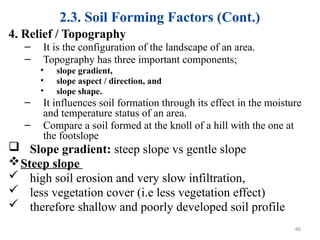
4. Relief / Topography
– It is the configuration of the landscape of an area.
– Topography has three important components;
• slope gradient,
• slope aspect / direction, and
• slope shape.
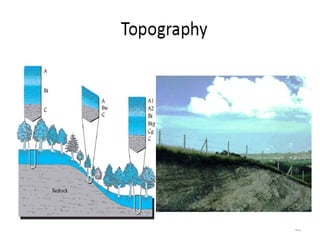
– It influences soil formation through its effect in the moisture
and temperature status of an area.
– Compare a soil formed at the knoll of a hill with the one at
the footslope
 Slope gradient: steep slope vs gentle slope
Steep slope
 high soil erosion and very slow infiltration,
 less vegetation cover (i.e less vegetation effect)
 therefore shallow and poorly developed soil profile
46
2.3. Soil Forming Factors (Cont.)
 Level slope
soil accumulation
more vegetation effect
therefore deep and developed profile
Slope aspect/ direction:
In the northern hemisphere south-west facing slopes receive
relative direct sun radiation, therefore are warmer and dryer
than north-east facing slopes.
This is less applicable for tropical regions.
Slope shape:
Concave, convex, and level plane slopes are the commonly
known slope shape.
The redistribution of materials in these different shapes is
different.
47
48
2.3. Soil Forming Factors (Cont.)
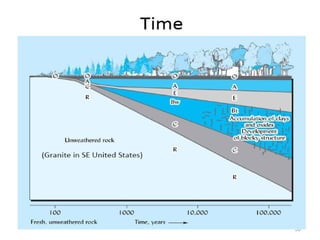
5. Time:
 Soil-forming process takes time to show their effects.
 The clock of soil formation starts ticking:
 When a land slide exposes new rock to the weathering
environment at the surface,
 when a flooding river deposits a new layer of sediment
on its floodplain, or
 when a bulldozer cuts and fills a landscape to level a
construction or mine-reclamation site.
 The length of time required for a soil to develop the distinct
layers called genetic horizons depends upon many interrelated
factors of climate, nature of the parent material, the
organisms, and topography.
49
50
2.3. Soil Forming Factors (Cont.)
Young or matured soil refers to the stage of soil
development irrespective of the time taken
Young soil:
 shallow,
 slightly weathered,
 rich in primary minerals and coarser particles,
 weak structure development,
 depicts very weak horizon development
Matured soil:
 deep,
 highly weathered,
 rich in secondary minerals and clay particles,
 strongly developed structure,
 shows a very distinct developed horizons
51
2.3. Soil Forming Factors (Cont.)
 In a most ideal case a recognizable soil profile may develop
within 200 years, unless otherwise it may take extended
several thousand years.
Ideal condition for soil formation:
Warm and humid,
gentle sloping topography,
good source of organic matter, etc
52
53
2.4. Soil Profile Development and Horizon
Differentiation (Cont.)
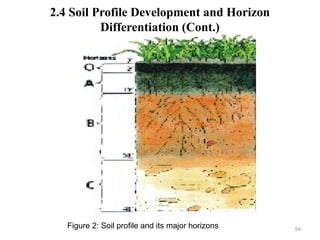
 Soil Profile: it is the vertical section of the soil through all its
horizons and extending into the parent material.
 Horizon: a layer of soil approximately parallel to the soil surface,
differing in properties from adjacent layers below or above.
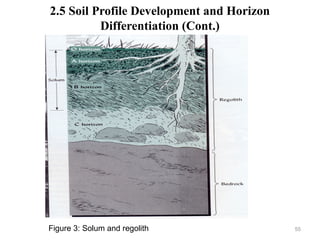
 Regolith: part of a profile above the bedrock
 Solum: all horizons above the parent material
 Surface Soil: the top few centimeters of a soil profile usually
moved by tillage (0-15/30 cm)
 Lithological Discontinuity: a significant change in particle size
distribution or mineralogy that indicates a difference in the material
from which the horizons have been formed.
54
2.4 Soil Profile Development and Horizon
Differentiation (Cont.)
Figure 2: Soil profile and its major horizons
55
2.5 Soil Profile Development and Horizon
Differentiation (Cont.)
Figure 3: Solum and regolith
56
2.5 Soil Profile Development and Horizon
Differentiation (Cont.)
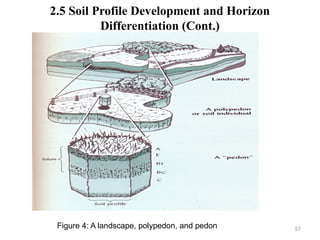
• Pedon: is the smallest volume that can be called a
soil.
It has three dimensions.
It extends downward to the depth of plant roots or to the lower
limit of the genetic horizons.
Its lateral cross section is roughly hexagonal and ranges from 1
to 10 m2
in size, depending on the variability in soil horizons.
57
2.5 Soil Profile Development and Horizon
Differentiation (Cont.)
Figure 4: A landscape, polypedon, and pedon
58
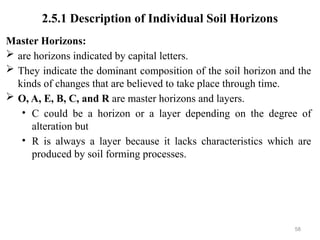
2.5.1 Description of Individual Soil Horizons
Master Horizons:
 are horizons indicated by capital letters.
 They indicate the dominant composition of the soil horizon and the
kinds of changes that are believed to take place through time.
 O, A, E, B, C, and R are master horizons and layers.
• C could be a horizon or a layer depending on the degree of
alteration but
• R is always a layer because it lacks characteristics which are
produced by soil forming processes.
59
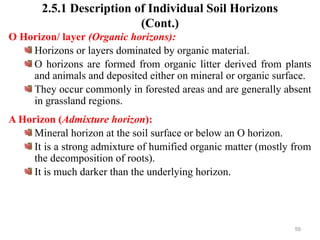
2.5.1 Description of Individual Soil Horizons
(Cont.)
O Horizon/ layer (Organic horizons):
Horizons or layers dominated by organic material.
O horizons are formed from organic litter derived from plants
and animals and deposited either on mineral or organic surface.
They occur commonly in forested areas and are generally absent
in grassland regions.
A Horizon (Admixture horizon):
Mineral horizon at the soil surface or below an O horizon.
It is a strong admixture of humified organic matter (mostly from
the decomposition of roots).
It is much darker than the underlying horizon.
60
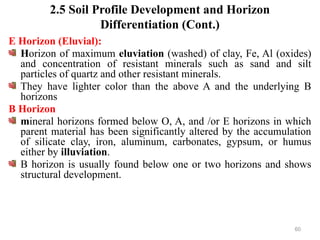
2.5 Soil Profile Development and Horizon
Differentiation (Cont.)
E Horizon (Eluvial):
Horizon of maximum eluviation (washed) of clay, Fe, Al (oxides)
and concentration of resistant minerals such as sand and silt
particles of quartz and other resistant minerals.
They have lighter color than the above A and the underlying B
horizons
B Horizon
mineral horizons formed below O, A, and /or E horizons in which
parent material has been significantly altered by the accumulation
of silicate clay, iron, aluminum, carbonates, gypsum, or humus
either by illuviation.
B horizon is usually found below one or two horizons and shows
structural development.
61
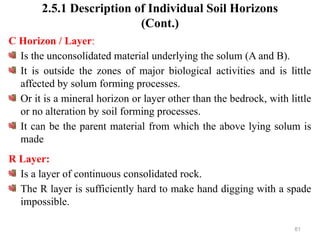
2.5.1 Description of Individual Soil Horizons
(Cont.)
C Horizon / Layer:
Is the unconsolidated material underlying the solum (A and B).
It is outside the zones of major biological activities and is little
affected by solum forming processes.
Or it is a mineral horizon or layer other than the bedrock, with little
or no alteration by soil forming processes.
It can be the parent material from which the above lying solum is
made
R Layer:
Is a layer of continuous consolidated rock.
The R layer is sufficiently hard to make hand digging with a spade
impossible.
62
2.5.1 Description of Individual Soil Horizons
(Cont.)
 A soil profile may not show all those horizons.
There are cases where the surface horizons are eroded and the
subsurface ones are exposed.
Usually B-horizon comes up to the surface. In such cases, the
profile is called truncated (shortened).
Besides, due to haploidization some soil profiles may show only
two or three horizons.
63
2.5.2 Transitional and Mixed Horizons
• When there is a significant thickness between two adjacent
horizons, a transitional or a mixed horizon might be present in
addition to master horizons.
• Transitional Horizon:
– horizon which is dominated by one master horizon while having
some properties of an adjacent master horizon.
– Transitional horizons are designated by two capital letters of the
master horizons, and
• The dominating master horizon is written first.
Exemple AE, EB, BC, CB, AC, etc.
– A transitional horizon AE means a horizon which has more
properties of A horizon and some features of the E horizon.
64
2.5.2 Transitional and Mixed Horizons (Cont.)
Mixed Horizon:
 Soil horizons that consist of combined parts, each of which are
identifiable with different master horizons.
 They are designated by two capital letters separated by a diagonal
stroke.
Example E/B, B/C, A/B, etc. The first letter marks the master
horizon that dominates.
Chapter3
3. Physical Properties of Soils
Soil is characterized by its physical, chemical and biological properties.
Physically, a mineral soil is a porous mixture of inorganic particles,
decaying organic matter, air and water.
Soil physical fertility can have as large an impact on plant growth as
chemical fertility.
3.1. Soil Texture
The texture of a soil refers to the size composition of elementary grains
in a soil.
Texture is the proportion of three mineral particles,
 sand (2.00 – 0.05 mm),
 silt (0.05 – 0.002 mm) and
 clay (< 0.002 mm), in a soil.
3.1. Soil texture (cont…)
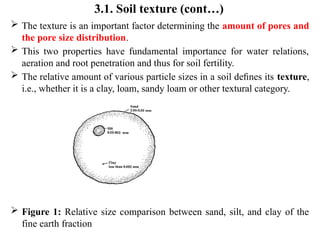
 The texture is an important factor determining the amount of pores and
the pore size distribution.
 This two properties have fundamental importance for water relations,
aeration and root penetration and thus for soil fertility.
 The relative amount of various particle sizes in a soil defines its texture,
i.e., whether it is a clay, loam, sandy loam or other textural category.
 Figure 1: Relative size comparison between sand, silt, and clay of the
fine earth fraction
3.1. Soil texture (cont…)
 Texture is the result of ‘weathering,’ the physical and chemical
breakdown of rocks and minerals.
 Because of differences in composition and structure, materials
will be weathered at different rates, affecting a soil’s texture.
 Most soils and sediments are mixtures of particles of various
sizes.
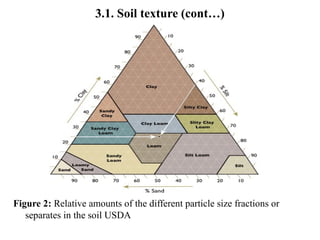
 To facilitate the description of these mixtures, classes have been
defined according to relative proportions of sand, silt, and clay.
 The most common set of classes used by American Soil Scientists
are given by the USDA texture triangle (Soil Survey Staff, 1993),
as shown in Fig 2.
3.1. Soil texture (cont…)
Figure 2: Relative amounts of the different particle size fractions or
separates in the soil USDA
 These classes were defined for their practical value in agriculture.
 For instance:
 Clays are more difficult to plow and prepare for crops than
loams.
 A texture class in the system is called loam, which refers to soil
material with certain proportions of sand, silt, and clay.
 Sandy soils have large pores so that infiltration rates and
permeability to water are high, and they retain little water.
 In contrast, clays have low infiltration rates, low permeability,
retain much water, and may be poorly drained.
 Roots penetrate sands more easily than clays.
 Soils of intermediate textures such as loams are also
intermediate in porosity, water retention, and drainage.
 Soil texture test for determination of the percentage of sand, silt,
and clay can be done in laboratory using either the pipette method
(most accurate) or the hydrometer method (less accurate but
quicker).
 Soil texture can be also estimated in the field by observing its
physical characteristics.
3.2. Soil structure
 Soil structure is the arrangement and binding together of soil
particles into larger clusters, called aggregates or ‘peds.’
 Aggregation is important for increasing stability against erosion,
for maintaining porosity and soil water movement, and for
improving fertility status of the soil.
 In combination with texture, governs water movement, heat
transfer, aeration, bulk density and porosity of the soil and thus
affects water relations, aeration, root penetration, and the
metabolic activities of soil flora and fauna.
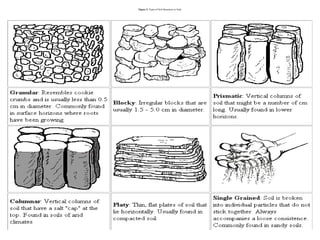
 Shape: several basic shapes of structural units are recognized in
soils.
 The following terms describe the basic shapes and related
arrangements:
Figure 3: Types of Soil Structures in Soils
 Size : five classes are employed: very fine, fine, medium, coarse,
and very coarse.
 Grade: grade describes the distinctness of units.
 Criteria are the ease of separation into discrete units and the
proportion of units that hold together when the soil is handled.
 Three classes are used; weak, moderate and strong.
 The sequence followed in combining the three terms to form
compound names is first the grade, then the size/class/, and finally
the type/shape/.
 Examples:
"strong fine granular."
“weak course blocky’’
‘’Moderate medium prismatic’’
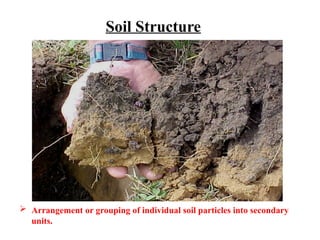
Soil Structure
 Arrangement or grouping of individual soil particles into secondary
units.
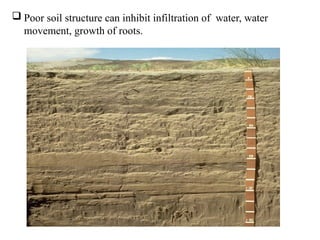
 Poor soil structure can inhibit infiltration of water, water
movement, growth of roots.
Mechanisms of formation of soil structure
 Soil microorganisms excrete substances that act as cementing
agents and bind soil particles together.
 Fungi have filaments, called hyphae, which extend into the soil
and tie soil particles together.
 Roots also excrete sugars into the soil that help bind minerals.
 Oxides also act as glue and join particles together. This
aggregation process is very common to many highly weathered
tropical soils.
 Finally, soil particles may naturally be attracted one another
through electrostatic forces, much like the attraction between hair
and a balloon.
3.3. Particle and Bulk Densities
Density of a material is the mass of a unit volume of that
material.
The density of mineral soil is expressed in two different
forms (particle and bulk density).
Particle Density:
Particle Density is the mass of a unit volume of soil solids
(g/cm3
) or it is the density of the solid particles that
collectively make up a soil sample.
Particle Density depends on the type of the mineral that
constitutes the soil and the organic matter content of the
soil.
Bulk Density:
Bulk density can be defined as the mass (weight) of a
unit volume of dry soil.
 The volume with which bulk density is concerned is
that of the solid particles and pore space.
The volume in this case is the sum of the volume of the
soil solids and the volume of the pore spaces.
Bulk density of a soil depends on the Porosity and
organic matter content of the soil.
All other factors that affect the porosity of the soil do
affect the bulk density of the soil.
The value is commonly expressed in g/cm3
. Usually its
value for mineral soils falls in the range between 2.6
and 2.75 g/cm3
for quartz, feldspar and colloidal
silicates.
However, if heavier minerals (magnetite, garnet, zircon,
etc) are present, it may exceed 2.75 g/cm3
.
For topsoil, the particle density may be as low as 2.4
g/cm3 due to its organic matter content.
Pure organic matter has particle density of 1.2
–1.5g/cm3
.
The common range among soils is 2.55 to 2.70 g cm–3
.
Information on particle density is needed for estimates
of porosity.
The higher the porosity, the lower is the bulk density.
Similar relation is true for organic matter content as
well.
 E.g. soil densities: Let’s say a block of moist soil has
a volume of 1cm3
and it weighs 1.33g after drying it
in an oven.
The bulk density of this soil is, thus,
1.33g/1cm3=1.33g/cm3
. Assume that 50% of the
volume of the soil is occupied by pore spaces. Now
assume that the soil is compressed and all the pore
spaces are removed. What remains is only 0.5cm3
.
The particle density of this soil is therefore,
1.33g/0.5cm3
= 2.66g/cm3
.
3.4. Pores Space
 Pore space is that portion of a soil occupied by air and water. The
arrangement of the solid particles determines the pore space.
 Its volume is the difference between the total volume and the
volume of soil solids.
%Solid space = (bulk density/Particle density) * 100
%Pore space = 100 - %solid space = 100- (BD/PD) * 100
 Porosity of a soil depends upon particle size, depth, organic
matter content and management.
 The higher the organic matter contents of the soil, the higher its
porosity.
 This is attributed to the granulation and aggregate stability of the
soil, which create pores in between the aggregates.
 As depth increases, porosity decreases because organic matter
content decreases, and force of compaction increases due to the
weight of the soil above it.
3.5. Soil Color
Color is one of the most obvious soil characteristics.
Soil color is an indication of soil conditions.
Color is a passive soil property, it is a consequence of
soil-forming processes and not an agent affecting soil
behavior.
It does not greatly affect the soil. However, several
inferences can be made as a result of observing the color
of the soil.
Significance of soil color
I. Brown to black color: results from organic matter or dark
parent material.
II. White to Light grey: results when organic matter has been
leached down of sandy soils and E-horizons.It can also be
caused by the accumulation of lime, gypsum and other light
materials.
III. Yellow to Red: Is due to iron oxides most commonly in warm
areas. Red color is from iron (Fe+3
) oxides where there is good
drainage for the aeration (oxygen supply). Yellow color results
from an iron oxide that includes some water (limonite), i.e.
slightly less well drained.
IV. Bluish grey: results from unoxidized (reduced) iron, indicates
lack of oxygen.
84
Determination of Soil Color
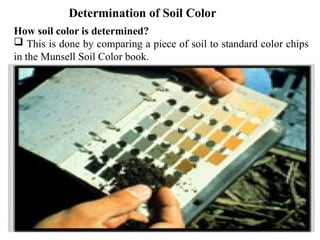
How soil color is determined?
 This is done by comparing a piece of soil to standard color chips
in the Munsell Soil Color book.
3.6. Soil Temperature
 Soil temperature is important because it influences the
availability of nutrients, absorption and transport of water,
enzymatic activities of plants and micro organisms`` and other
metabolic processes.
 There are a number of factors that determine soil temperature.
These are:
The net amount of heat the soil absorbs
The heat energy required to bring a given change in the
temperature of a soil.
The energy required for changes such as evaporation.
 Solar radiation depends fundamentally upon climate. But the
amount of energy entering the soil in addition affected by other
factors such as soil colour, slope and vegetation cover of the site.
86
3.6. Soil Temperature (Cont.)
Management of Soil Temperature
1. Organic mulching: use of organic residues on soil
surface.
It acts as a buffer zone moderating extremes of soil
temperature.
Mulched soils are cooler and warmer when outside
temperature is very high or low, respectively.
2. Plastic mulching: unlike organic mulches, plastic
mulches are meant to increase soil temperature.
In temperate zones plastic mulches are used to hasten
maturity.
In tropics mulching is mainly practiced for soil
solarisation, moisture conservation or weed control.
3. Shading: use of live vegetation or artificial shade in
nurseries is a common practice in optimizing soil and
atmospheric temperature.
87
3.7 Soil Air
 Soil aeration is defined as the ventilation of the soil with gases
moving both into and out of the soil.
 It determines:
• The rate of gas exchange with the atmosphere
• The proportion of the pore space occupied by air
• The composition of the soil air
• Oxidation/reduction status of the soil
88
3.7 Soil Air (Cont.)
3.7.1. Factors that affect Soil Aeration
1. Soil type: any factor that affect the pore size distribution
(texture, density, structure, organic matter content, depth, etc )
2. Moisture content: in water logged soils almost all macro and
micro pores are filled with water.
– Too much water leaves no space for air and also blocks the
pathway for air circulation.
3. Abundance and activity of soil organisms: the roots of higher
plants and aerobic soil organisms continuously consume O2 and
release CO2 through respiration.
– Other gases are also released as a result of microbial
decomposition processes, especially under anaerobic
conditions.
– Some soil organisms such as earthworms enhance soil
aeration because of the biopores channels created by them
4. Seasonal variation: during dry and rainy seasons, the amount of
soil moisture fluctuate, and so do the soil aeration
5. Soil management practices: conventional tillage practices are
known to enhance soil aeration over the short term.
89
3.7 Soil Air (Cont.)
3.7.2. Mechanisms of gas exchange
• There are two ways of gas exchange between the atmosphere and
the soil air
1. Diffusion: gas flow along the diffusion gradient, which is the
partial pressure of each individual gas in the atmosphere and the
soil.
– The partial pressure of oxygen is higher in the atmosphere than
in the soil air.
– Therefore, there is always the diffusion of oxygen from the
atmosphere to the soil. The reverse is true for CO2
2. Mass flow: the bulk movement of air into the soil regardless of
the diffusion gradient with the mass flow of water or wind to the
soil.
– Minor contribution to the soil aeration.
90
3.7 Soil Air (Cont.)
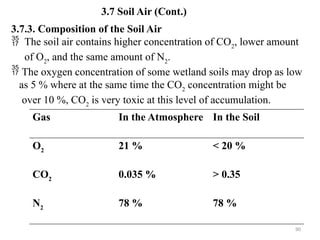
3.7.3. Composition of the Soil Air
 The soil air contains higher concentration of CO2
, lower amount
of O2
, and the same amount of N2
.
 The oxygen concentration of some wetland soils may drop as low
as 5 % where at the same time the CO2
concentration might be
over 10 %, CO2
is very toxic at this level of accumulation.
Gas In the Atmosphere In the Soil
O2
21 % < 20 %
CO2
0.035 % > 0.35
N2
78 % 78 %
CHAPTER 4
4. Chemical Properties of Soils
4.1. Soil Colloids
 A colloid is any solid substance whose particles are very small.
General properties of soil colloids:
I. Size: smaller than 2 µm (most are smaller than 2 million of a
meter - micrometer/µm in diameter).
II. Surface area: Because of their small size; all colloids expose a
large external surface per unit mass.
 The external surface area of 1 gm of colloidal clay is at least 1000
times that of one gram of coarse sand.
III. Surface charges: They could be negative or positive charges.
 The presence and intensity of the particle charges influence the
attraction and repulsion of the particles toward each other.
Note: main properties of colloids are related to
adsorption of cations and water.
Types of Soil Colloids
The predominant soil colloids are:
Inorganic (clays & oxides)
Organic (humus).
4.1.1. Inorganic Colloids
i) Silicate clays
ii) Iron and aluminum oxide clays
iii) Allophane and associated clays
i. Silicate clays
Silicate clay minerals are the dominant inorganic
colloids in almost all soils.
Their most important properties are their layer-like,
crystalline structures and their negative charges.
The layers are comprised of planes of closely packed
oxygen atoms held together by silicon, aluminum,
magnesium, hydrogen, and/or iron atoms that occupy
spaces between the oxygen.
For example; the formula one of these clays, kaolinite –
Si2Al2O5 (OH)4
Mineral Organization of Silicate Clays
Basic Units:
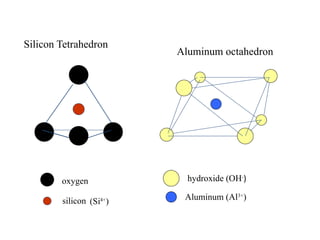
The tetrahedral structure combines four O2-
with one Si4+
resulting in a partial neutralization of the negative charges of
oxygen.
The octahedral structure consists of six OH-
surrounding a
central cation, usually Al3+
, Mg2+
, or Fe2+
.
On the basis of the number and arrangement of tetrahedral
(silica) and octahedral (alumina) layers contained in the
crystal units, silicate clays may be classified into four
groups:
1:1-type minerals
2:1-type expanding minerals
2:1 non-expanding minerals
2:2 type minerals
oxygen
silicon (Si4+
)
hydroxide (OH-
)
Aluminum (Al3+
)
Silicon Tetrahedron
Aluminum octahedron
a) 1:1 Type Minerals:
The layers of 1:1-minerals are made up of one tetrahedral
(silica) sheet and one octahedral (alumina) sheet.
 E.g., kaolinite, halloysite, dickite, etc.).
Typically, Si+4
occurs in four-fold and Al+3
in six-fold
(tetrahedral and octahedral combination, respectively).
Tetrahedra and Octahedra
Sharing the Oxygens
Linkage of thousands of silica tetrahedra and aluminum octahedra
O
Si
O, OH
Al
OH
Tetrahedra
octahedra
{
{
1:1 Mineral
b) 2:1 type expanding/swelling minerals:
(E.g. montimorillonite and vermiculite).
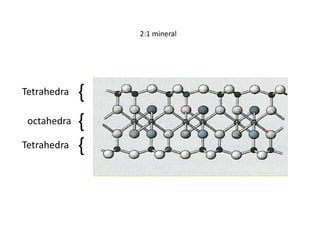
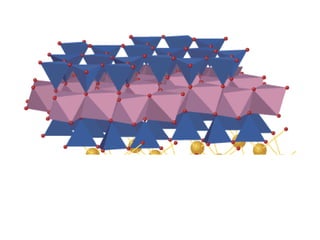
The crystal units (layers) of these minerals are characterized by
an octahedral sheet sandwiched between two tetrahedral sheets.
The sheets are held together by shared oxygen or OH atoms.
The lattices are held together by weak oxygen to oxygen
linkages.
They:
have expansion of crystals by H2O entering in between
have internal surface area
have high CEC (high negative charges)
have high plasticity, cohesion, swelling-shrinkage
are small in size.
c) 2:1 Non-expanding/swelling minerals:
(e. g. the hydrous micas, mainly the illite).
These are similar to the above group but K ion fits
between the crystal lattice resulting in no expansion.
Most of its properties lie between that of kaolinite and
montimorillonite.
Tetrahedra
octahedra
{
{
Tetrahedra {
2:1 mineral
d) 2:2 type minerals:
• (e.g. chlorite, silicates of Mg with some Fe and
Al).
Here two silica and two Mg make up the unit as a
result of substitution.
In most of its properties it is similar to illite.
ii) Iron and aluminum oxide clays:
These clays occur in greater quantities in the highly
weathered Ultisols and Oxisols of the tropics and
subtropics but are also present in Alfisols and Inceptisols
of temperate regions.
E.g. of iron and aluminum oxide clays are: goethite –
FeOOH, hematite – Fe2O3, and gibbsite – Al(OH)3.
iii) Allophane and associated clays:
The minerals are poorly defined aluminum silicates with
a general composition Al2O3.2SiO2H2O.
They are the most prevalent in soils developed from
volcanic ash/Andisols.
E.g. Allophane and imogolite, (the poorly crystallized
silicate clays).
Utilization of Clays by Humans
Industrial applications:
Bricks, ceramics, paints, paper.
Environmental and agricultural applications:
Insulation (fillings) of landfills.
Sorbent (adsorb) of nutrient from water
reservoirs.
Clay as an amendment to reduce water
repellency.
Supplement in the diet of domestic animals.
4.1.2 Organic Colloids: Humus
Humus is a mixture of residues left after partial
decay of organic substance in and on top of soils.
Humus has about 50% carbon, and has a cation
exchange capacity greater than clay colloids.
The humus colloids are not crystalline. They are
complex chains of carbon bonded to hydrogen,
oxygen and nitrogen.
The negative charges of humus are associated with
partially dissociated enolic (OH), carboxyl
(COOH) and phenolic groups.
Most cultivated soils contain 1-5% organic matter
in the top 25 cm of soil.
4.2.Cation exchange and Cation Exchange
Capacity
Soil colloids (clays and humus) are the most
chemically active portion of soil, because they
contain various surface locations that have
unneutralized negative charges.
Positive ions (cations) are absorbed at theses
negatively charged sites.
These absorbed cations resist removal by leaching
water but can be replaced (exchanged) by other
cations in the soil solution. This exchange of one
positive ion by other is called Cation Exchange
Capacity (CEC).
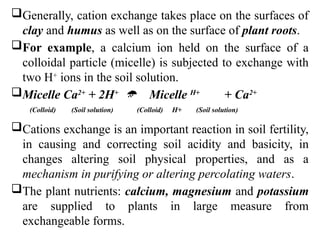
Generally, cation exchange takes place on the surfaces of
clay and humus as well as on the surface of plant roots.
For example, a calcium ion held on the surface of a
colloidal particle (micelle) is subjected to exchange with
two H+
ions in the soil solution.
Micelle Ca2+
+ 2H+
 Micelle H+
+ Ca2+
(Colloid) (Soil solution) (Colloid) H+ (Soil solution)
Cations exchange is an important reaction in soil fertility,
in causing and correcting soil acidity and basicity, in
changes altering soil physical properties, and as a
mechanism in purifying or altering percolating waters.
The plant nutrients: calcium, magnesium and potassium
are supplied to plants in large measure from
exchangeable forms.
Cation exchange is an important reaction in soils because
of the following relationships:
The exchangeable K is a major source of plant K.
The exchangeable Mg is often a major source of plant Mg.
The amount of lime required to raise the pH of an acid soil is
greater as the CEC is greater.
Cation exchange sites hold Ca2+
, Mg2
+, K+
, Na+
and slow their
losses by leaching.
Cation exchange sites hold fertilizer K+
and NH4+
ions greatly
reduce their mobility in soils.
Cation exchange sites adsorb many metals (Cd2+
, Zn2+
, Ni2+
,
Pb2+
) that might be present in wastewaters. Adsorption removes
them from the percolation water, thereby cleansing the water
that drains into ground waters or surface waters.
The amounts of cations in the soil solution are
closely related to the exchangeable ions.
Any change in concentration of a cation in the
solution forces a change in proportions of all
exchangeable ions.
4.3. Soil Reaction (pH):
 The pH is a measure of acidity or alkalinity.
 The degree of acidity and alkalinity (i.e., the soil reaction) is a
major variable that affects all soil properties – chemical, physical
and biological.
 Soil reaction expressed as soil pH, this variable largely controls
plant nutrient availability and microbial reaction in soils.
 The pH of a soil helps to determine the numbers and kinds of soil
organisms that change plant residues into valuable soil organic
matter.
 Measuring soil PH
1. Electrometer method(using PH meter): very accurate.
2. Dye method ( using litmus paper) – easy, simple, and less accurate.
Factors Influencing Soil Reaction/pH
I. Climate:
 Climate tends to stimulate either acidity or alkalinity in soils.
 In humid regions, soils tend to be quite acid because there is sufficient
rainfall to leach out much of the base-forming cations (Ca2+
, Mg2+
, K+
and
Na+
), leaving the exchange complex dominated by Al3+
and H+
ions.
 In low-rainfall areas the base-forming cations are left to dominate the
exchange complex in the place of Al3+
and H+
, leading to a neutral or even
alkaline condition.
II. Human activities:
 For example, certain chemical fertilizers and organic wastes react in the
soil to form strong inorganic acids, such as HNO3 and H2SO4.
 These lead to increased soil acidity.
 These two acids are also found in acid rain, which originates from gases
emitted into the atmosphere primarily by the combustion of fossil fuel
(power plants, automobiles, etc.) and the burning of trees and other
biomass.
 Whether a soil is acid, neutral, or alkaline is determined by the comparative
concentrations of H+
and OH-
ions.
4.4. Soil Acidity
Sources of H+
ions
 Two adsorbed cations (aluminum and hydrogen) are largely
responsible for soil acidity.
 Strongly Acid Soils: Under very acid soil conditions (pH  5)
much aluminum becomes soluble and is either tightly bound by
organic matter or is present in the form of aluminum or aluminum
hydroxy cations.
 These exchangeable ions are adsorbed in preference to other
cations by the negative charges of soil colloids.
 Al3+
+ H20  AlOH2+
+ H+
 This hydrolysis lowers the pH of the soil solution and is the major
source of H+
ions in very acid soils.
 N.B: Strongly acid soils are undesirable because soluble
aluminum and manganese can reach toxic level and microbial
activity is greatly reduced.
 Moderately Acid Soils: Aluminum and hydrogen compounds also
account for soil solution H+ ions in moderately acid soils (pH
values between 5.0 and 6.5) but by different mechanisms.
 At these pH levels, the aluminum can no longer exist as Al3+ ion
but converted to aluminum hydroxy ion.
Al3+
+ OH-
 AlOH2+
AlOH2+
+ OH-
 Al(OH)2
+
(Aluminum hydroxy ions)
 Much of the aluminum hydroxy ions are adsorbed and act as
exchangeable cations.
 They are in equilibrium with similar cations in the soil solution,
where they produce hydrogen ions by the following hydrolysis
reactions.
 Al(OH)+
+ H2O  Al(OH)2
+
+ H+
 Al(OH)2+
+ H2O  Al(OH)3
+
+ H+
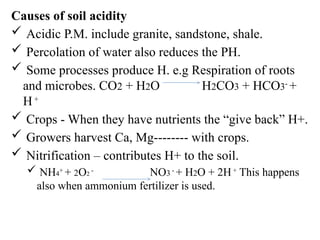
Causes of soil acidity
 Acidic P.M. include granite, sandstone, shale.
 Percolation of water also reduces the PH.
 Some processes produce H. e.g Respiration of roots
and microbes. CO2 + H2O H2CO3 + HCO3-
+
H+
 Crops - When they have nutrients the “give back” H+.
 Growers harvest Ca, Mg-------- with crops.
 Nitrification – contributes H+ to the soil.
 NH4+
+ 2O2
-
NO3 -
+ H2O + 2H+
This happens
also when ammonium fertilizer is used.
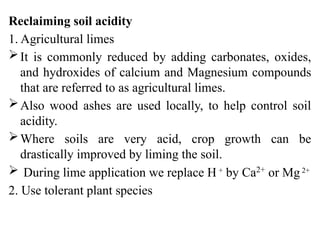
Reclaiming soil acidity
1. Agricultural limes
It is commonly reduced by adding carbonates, oxides,
and hydroxides of calcium and Magnesium compounds
that are referred to as agricultural limes.
Also wood ashes are used locally, to help control soil
acidity.
Where soils are very acid, crop growth can be
drastically improved by liming the soil.
 During lime application we replace H +
by Ca2+
or Mg2+
2. Use tolerant plant species
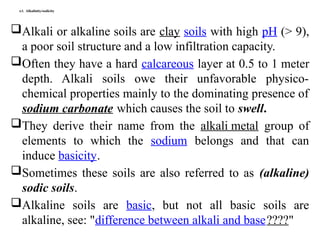
4.5. Alkalinity/sodicity
Alkali or alkaline soils are clay soils with high pH (> 9),
a poor soil structure and a low infiltration capacity.
Often they have a hard calcareous layer at 0.5 to 1 meter
depth. Alkali soils owe their unfavorable physico-
chemical properties mainly to the dominating presence of
sodium carbonate which causes the soil to swell.
They derive their name from the alkali metal group of
elements to which the sodium belongs and that can
induce basicity.
Sometimes these soils are also referred to as (alkaline)
sodic soils.
Alkaline soils are basic, but not all basic soils are
alkaline, see: "difference between alkali and base????"
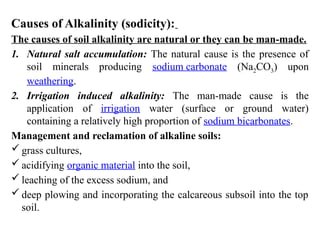
Causes of Alkalinity (sodicity):
The causes of soil alkalinity are natural or they can be man-made.
1. Natural salt accumulation: The natural cause is the presence of
soil minerals producing sodium carbonate (Na2CO3) upon
weathering.
2. Irrigation induced alkalinity: The man-made cause is the
application of irrigation water (surface or ground water)
containing a relatively high proportion of sodium bicarbonates.
Management and reclamation of alkaline soils:
 grass cultures,
 acidifying organic material into the soil,
 leaching of the excess sodium, and
 deep plowing and incorporating the calcareous subsoil into the top
soil.
4.6. Salinity
Salt-affected soils are caused by excess accumulation of
salts, typically most pronounced at the soil surface.
Salts can be transported to the soil surface by capillary
transport from a salt loaded ground water table and then
accumulate due to evaporation.
They can also be concentrated in soils due to human
activity, for example the use of potassium as fertilizer,
which can form sylvite, a naturally occurring salt.
As soil salinity increases, salt effects can result in
degradation of soils and vegetation.
Natural occurrence:
 Salt is a natural element of soils and water.
 The ions responsible for salinization are: Na+
, K+
, Ca2+
, Mg2+
and
Cl-
.
 As the Na+
(sodium) predominates, soils can become sodic.
Causes of saline soils
1.Mineral weathering
2. In addition to mineral weathering, salts are also deposited via dust
and precipitation. In dry regions salts may accumulate, leading to
naturally saline soils.
3. Human practices can increase the salinity of soils by the addition of
salts in irrigation water.
Management and reclamation of saline soils
The removal of excess salts from saline soils requires
access or ample irrigation water with low Na and
 An effective soil drainage system that quickly removes
the salt loaded water once it leaches down through the
soil.
If the natural soil drainage is not adequate to
accommodate the leaching water, an artificial drainage
network must be installed.
CHAPTER 5
5. SOIL ORGANIC MATER (SOM)
5.1 Introduction
 Soil organic matter is by definition the organic fraction derived from
living organisms.
 It includes the partly decomposed and decomposed plant and animal
residues as well as the living organisms of the soil (micro organisms
and plant roots).
 The soil organic matter can be broadly classified into biomass,
detritus, and humus
1. Biomass: the living organisms (the fauna and flora)
2. Detritus: the recognizable dead tissues of plants and animals at
different stages of decomposition
5.1 Introduction
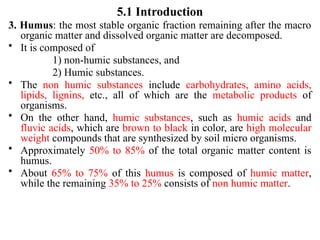
3. Humus: the most stable organic fraction remaining after the macro
organic matter and dissolved organic matter are decomposed.
• It is composed of
1) non-humic substances, and
2) Humic substances.
• The non humic substances include carbohydrates, amino acids,
lipids, lignins, etc., all of which are the metabolic products of
organisms.
• On the other hand, humic substances, such as humic acids and
fluvic acids, which are brown to black in color, are high molecular
weight compounds that are synthesized by soil micro organisms.
• Approximately 50% to 85% of the total organic matter content is
humus.
• About 65% to 75% of this humus is composed of humic matter,
while the remaining 35% to 25% consists of non humic matter.
5.2 Sources and Composition of SOM
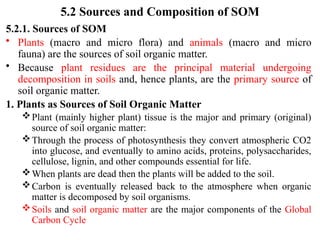
5.2.1. Sources of SOM
• Plants (macro and micro flora) and animals (macro and micro
fauna) are the sources of soil organic matter.
• Because plant residues are the principal material undergoing
decomposition in soils and, hence plants, are the primary source of
soil organic matter.
1. Plants as Sources of Soil Organic Matter
Plant (mainly higher plant) tissue is the major and primary (original)
source of soil organic matter:
Through the process of photosynthesis they convert atmospheric CO2
into glucose, and eventually to amino acids, proteins, polysaccharides,
cellulose, lignin, and other compounds essential for life.
When plants are dead then the plants will be added to the soil.
Carbon is eventually released back to the atmosphere when organic
matter is decomposed by soil organisms.
Soils and soil organic matter are the major components of the Global
Carbon Cycle
5.2 Sources and Composition of SOM (Cont.)
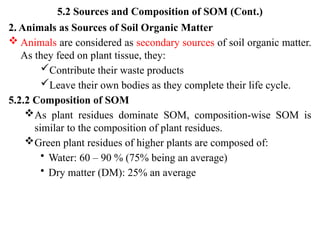
2. Animals as Sources of Soil Organic Matter
 Animals are considered as secondary sources of soil organic matter.
As they feed on plant tissue, they:
Contribute their waste products
Leave their own bodies as they complete their life cycle.
5.2.2 Composition of SOM
As plant residues dominate SOM, composition-wise SOM is
similar to the composition of plant residues.
Green plant residues of higher plants are composed of:
• Water: 60 – 90 % (75% being an average)
• Dry matter (DM): 25% an average
5.2 Sources and Composition of SOM (Cont.)
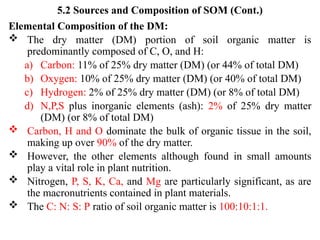
Elemental Composition of the DM:
 The dry matter (DM) portion of soil organic matter is
predominantly composed of C, O, and H:
a) Carbon: 11% of 25% dry matter (DM) (or 44% of total DM)
b) Oxygen: 10% of 25% dry matter (DM) (or 40% of total DM)
c) Hydrogen: 2% of 25% dry matter (DM) (or 8% of total DM)
d) N,P,S plus inorganic elements (ash): 2% of 25% dry matter
(DM) (or 8% of total DM)
 Carbon, H and O dominate the bulk of organic tissue in the soil,
making up over 90% of the dry matter.
 However, the other elements although found in small amounts
play a vital role in plant nutrition.
 Nitrogen, P, S, K, Ca, and Mg are particularly significant, as are
the macronutrients contained in plant materials.
 The C: N: S: P ratio of soil organic matter is 100:10:1:1.
5.2 Sources and Composition of SOM (Cont.)
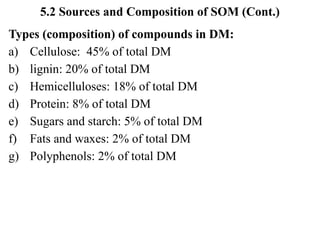
Types (composition) of compounds in DM:
a) Cellulose: 45% of total DM
b) lignin: 20% of total DM
c) Hemicelluloses: 18% of total DM
d) Protein: 8% of total DM
e) Sugars and starch: 5% of total DM
f) Fats and waxes: 2% of total DM
g) Polyphenols: 2% of total DM
5.3 Soil Organic Matter Decomposition
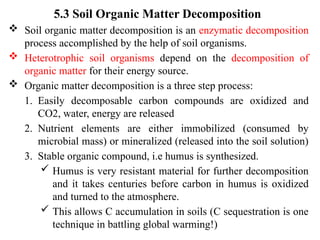
 Soil organic matter decomposition is an enzymatic decomposition
process accomplished by the help of soil organisms.
 Heterotrophic soil organisms depend on the decomposition of
organic matter for their energy source.
 Organic matter decomposition is a three step process:
1. Easily decomposable carbon compounds are oxidized and
CO2, water, energy are released
2. Nutrient elements are either immobilized (consumed by
microbial mass) or mineralized (released into the soil solution)
3. Stable organic compound, i.e humus is synthesized.
 Humus is very resistant material for further decomposition
and it takes centuries before carbon in humus is oxidized
and turned to the atmosphere.
 This allows C accumulation in soils (C sequestration is one
technique in battling global warming!)
5.3 Soil Organic Matter Decomposition (Cont.)
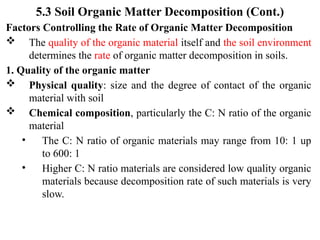
Factors Controlling the Rate of Organic Matter Decomposition
 The quality of the organic material itself and the soil environment
determines the rate of organic matter decomposition in soils.
1. Quality of the organic matter
 Physical quality: size and the degree of contact of the organic
material with soil
 Chemical composition, particularly the C: N ratio of the organic
material
• The C: N ratio of organic materials may range from 10: 1 up
to 600: 1
• Higher C: N ratio materials are considered low quality organic
materials because decomposition rate of such materials is very
slow.
5.3 Soil Organic Matter Decomposition (Cont.)
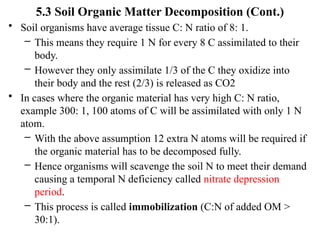
• Soil organisms have average tissue C: N ratio of 8: 1.
– This means they require 1 N for every 8 C assimilated to their
body.
– However they only assimilate 1/3 of the C they oxidize into
their body and the rest (2/3) is released as CO2
• In cases where the organic material has very high C: N ratio,
example 300: 1, 100 atoms of C will be assimilated with only 1 N
atom.
– With the above assumption 12 extra N atoms will be required if
the organic material has to be decomposed fully.
– Hence organisms will scavenge the soil N to meet their demand
causing a temporal N deficiency called nitrate depression
period.
– This process is called immobilization (C:N of added OM >
30:1).
5.3 Soil Organic Matter Decomposition (Cont.)
 High quality organic material provides N in excess of what is
needed by the decomposers, decomposition will be fast, and
eventually the excess N will be released to the soil.
– This is mineralization (C:N of added OM < 30:1).
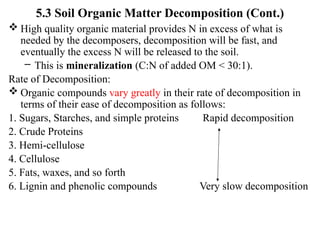
Rate of Decomposition:
 Organic compounds vary greatly in their rate of decomposition in
terms of their ease of decomposition as follows:
1. Sugars, Starches, and simple proteins Rapid decomposition
2. Crude Proteins
3. Hemi-cellulose
4. Cellulose
5. Fats, waxes, and so forth
6. Lignin and phenolic compounds Very slow decomposition
5.3 Soil Organic Matter Decomposition (Cont.)
2. The Soil Environment
• The soil environment affects the decomposition rate of organic
matter both directly or indirectly.
• Soil properties which influence soil organisms positively or
negatively will directly affect the decomposition rate of organic
matter.
• The soil environment indirectly affects decomposition rate by
determining the supply of organic matter in the locality.
5.3 Soil Organic Matter Decomposition (Cont.)
A. Soil aeration
• Most decomposers are aerobic organism which require oxygen to
decompose organic matter
• In the absence of abundant oxygen, such as in poorly drained soils,
only anaerobic decomposers are active,
– hence organic matter decomposition is very slow.
– Because of this wetlands usually contain high level of organic
matter.
• Anaerobic decomposition of organic matter releases large amount
of CH4 and other partially decomposed organic compounds
(alcohols and organic acids) which are mostly toxic to the
environment.
B. Soil pH
• Most soil organisms are active in neutral soil pH.
• Extremes of soil pH, highly reduce the abundance, activity and
biomass of soil organisms
5.3 Soil Organic Matter Decomposition (Cont.)
C. Soil Moisture
– Moisture is needed for normal biochemical activity of
organisms.
– Under very dry or flooded conditions the activity of soil
organisms is restricted and so is organic matter decomposition
D. Soil Temperature
– Warm soil temperature hastens soil organic matter
decomposition since the activity of soil organisms is the highest
under that condition.
– Whereas under too cold or too hot climatic conditions
decomposition rate is slower.
5.4. Functions of the Soil Organic Matter
 The soil organic matter accounts only for a small fraction of the soil
solid.
 Most cultivated tropical soils have less than 5 % organic matter
content.
 However, it has a profound influence over so many physical,
chemical and biological properties of soils.
 In general, the quality and quantity of the soil organic matter
somehow determine the quality of soils.
Some of the functions of the soil organic matter are:
1. Energy source for soil organisms
– Heterotrophic macro and micro organisms are dependent on the
soil organic matter for their energy requirement
5.4. Functions of the Soil Organic Matter (Cont.)
2. Source of plant nutrient elements
• Organic matter enhances soil fertility.
• Upon decomposition, nutrient elements trapped in organic
compounds of the organic material are recycled to the soil system
and used by plants.
– Easily replaceable cations are present
– N, P,S and micronutrients held in organic forms are slowly
released
– Release of elements from minerals by acid humus, and
– Provide N, S and over half of soil p through decay.
• Some organic compounds released from organic matter breakdown
are growth promoters and are directly taken by plants
5.4. Functions of the Soil Organic Matter (Cont.)
3. Effect on soil physical properties:
– Soil color becomes brown to black
– Granulation encouraged
– Aggregate (structure) stability assisted
– Plasticity and cohesion reduced
– Water holding capacity increased
4. Cation Exchange Capacity:
– Humus is an organic colloid.
– It has extremely high surface area and electrical charge and
contribute much of the colloidal property of surface soils
• Provide high CEC, increase the pH-dependent CEC of soils
• Accounts for 30-90% of the absorbing power of mineral soils
5.4. Functions of the Soil Organic Matter (Cont.)
5. Complexation of inorganic ions
– Organic compounds have the capability of complexing
inorganic ions and form complex compounds called
chelates
– Chelates are more mobile and bioavailable for plants
– Therefore, complexation reactions enhance the
weathering of rocks and minerals and also increase
nutrient availability for higher plants.
5.5. Factors affecting SOM
1. Climate:
– mainly temperature and rainfall.
– Organic matter content increases with moisture but
decrease with temperature.
2. Natural vegetation:
– higher organic matter content is recorded under
grassland areas as compared to forest areas.
– In fact, in most cases, these two vegetation types are
found under different climatic conditions.
5.5. Factors affecting SOM (Cont.)
3. Texture and other factors:
– A sandy soil contains less organic matter and N than
finer textured soil, other things being equal because of
ready oxidation in the lighter soils and natural
addition of residues is less in the lighter soil.
– Besides, poorly drained soils contain high organic
matter and N than their better-drained equivalents.
4. Cropping:
– Cultivation reduces the organic matter content of the
soil through the encouragement of the decomposition
process and the removal of the organic material.
5.6. Management of Soil Organic Matter
• Maintenance of high level of soil organic matter is maintenance of
both soil and environmental quality
• The loss of CO2 from organic matter decomposition is one major
contributor for the global warming problem
• By practicing different management options one can increase the
organic matter level of agricultural soils and at the same time will
contribute to environmental safety
• Some of the practices known for maintaining high level of soil
organic matter are:
• Conservation tillage
• Replantation of degraded lands
• Conserving natural grassland areas
• Organic amendments (farmyard manure, compost, residue,
etc)
141
CHAPTER- Six
6. SOIL CLASSIFICATION
6.1. Introduction
• Soil classification is the categorization of soil into groups at
varying levels of generalization according to their physical,
mineralogical and chemical properties.
• It is a technique whereby soils are grouped together in various ways
and according to various criteria to form categories or classes,
– Where these classes are defined in such a way as to be useful in
understanding the formation, properties and uses of soil.
• Its main objective includes:
– organization of knowledge,
– ease in remembering properties,
– clearer understanding of the relationship, and
– ease of technology transfer and communication.
142
6.2. History of soil classification
• People have the tendency to classify or sort things around them.
• The same is true concerning soils.
• From the time crops were cultivated, human noticed differences in
soils, but classification was totally dependent on recognized
differences in the soils capacity to grow specific crops or suitability
for specific uses.
– Examples would be “good soil” or “bad soil” or “cotton soil”,
“maize soil”, “teff soil” etc.
• Until very recently soils have also been classified in terms of
geological parent materials from which they are assumed to form
such as sandy soils, clay soils, limestone soils, alluvial soils, etc.
• It is long ago that people started to classify soil. The earliest
attempt, in the recorded history, is a 4000 years old Chinese system.
– The Chinese, better said, classified their land into nine groups
mainly based on the productivity of the land.
– The purpose of their classification was for tax imposition.
• Another recorded history of soil classification is that of the Romans
about 2000 years ago.
143
6.2. History of soil classification (Cont.)
• It is important to try to remember and appreciate the different traditional
soil classification systems in Ethiopia.
• Modern classification systems are, however, based on the overall
understanding of pedogenesis (soil formation) and accurate interpretation
of soil properties as the result of the different soil forming processes.
• Currently there are several classification systems world wide which differ
mainly because of differences on the major criteria set for the
classification and levels of organization (hierarchy) they follow.
– Examples are: Australian, Brazilian, Canadian, Chinese, Japanese,
French, Russian systems of soil classification, etc.
• The two most common classification systems used by many countries
including Ethiopia are the USDA Soil Taxonomy and World Reference
Base for Soil Resources (WRB) systems of soil classifications.
• Both systems have been revised a number of times based on latest
findings.
• These two systems of classification are unique in a way that they are
comprehensive and address the different soil types around the world than
specific regions.
144
7.3. USDA System of Soil Classification
• Since the late 1950s the American pedologists revised and
developed a new system of soil classification which relies on soil
properties,
– as a result of the major pedogenic processes that the soil has gone
through, that are determined quantitatively and
– as well as their seasonally dynamic soil temperature and moisture
regimes.
– Some of the most important soil properties used in the classification
are: soil depth, color, texture, bulk density, structure, organic matter
content, pH, EC, BS, CEC, Fe/Al oxides, etc
• Soil Taxonomy, contains six levels of organization:
– order,
– suborder,
– great group,
– subgroup,
– family, and
– series.
145
6.3. USDA System of Soil Classification (Cont.)
• Diagnostic Horizons: soil horizons that combines a set of
properties which are used for identifying certain classes of soils.
• Epipedons: diagnostic horizons at the soil surface (surface
horizon/s)
• Endopedons: diagnostic horizons below the soil surface
(Subsurface horizon/s)
Key characteristics of diagnostic Epipedons
– Mollic: thick, dark colored, high base saturation, strong structural
development
– Umbric: same as mollic but low base saturation
– Ochric: too light colored, low organic content or thin to be called
mollic, may be hard and massive when dry
– Melanic: thick, black, high in organic matter (> 6% organic carbon),
common in volcanic ash soils
– Histic: very high organic content, wet during some part of the year
– Anthropic: human-modified mollic like horizon, high in available
phosphorous
– Plaggen: human-made horizon created by years of manuring
146
6.3. USDA System of Soil Classification (Cont.)
• Key characteristics of diagnostic endopedons
– Argillic (Bt): silicate clay accumulation
– Natric (Btn): argillic, high in sodium, columnar or prismatic
structure
– Spodic (Bh, Bs): organic matter, Fe and Al oxide accumulation
– Cambic (Bw): altered by physical movement or by chemical
reactions, generally non illuvial
– Agric (A or B): organic and clay accumulation just below plow
layer resulting from cultivation
– Oxic (B): highly weathered, primary mixture of Fe, Al oxides
and non sticky type silicate clays
– Duripan (Bqm): hardpan, strongly cemented by silica
– Fragipan (Bx): brittle pan, usually loamy textured, dense
– Albic (E): light-colored, clay and Fe/Al oxides mostly removed
147
6.3. USDA System of Soil Classification (Cont.)
– Calcic (Bk): accumulation of calcium carbonate
– Gypsic (By): accumulation of gypsum
– Salic (Bz): accumulation of salts
– Kandic (Bt): accumulation of low-activity clay
– Petrocalcic (Ckm): cemented calcic horizon
– Petrogypsic (Cym): cemented gypsic horizon
– Plasic (Csm): thin pan cemented with iron alone or
with manganese or organic matter
– Sombric (Bh): organic matter accumulation
– Sulfuric (Cj): highly acid with Jarosite mottles
148
7.3. USDA System of Soil Classification (Cont.)
• Simplified Key to the Soil Orders
1. Gelisols: Soils with permafrost or gelic material within 100 cm
2. Histosols: Soils with more than 30 % organic matter content to a
depth of 40 cm
3. Spodosols: Soils with spodic horizon within a depth of 200 cm
4. Andisols: Soils from volcanic ejecta with andic properties (due to
the presence of significant amounts of allophone, imogolite, or Al-
humus complexes)
5. Oxisols: Soils with oxic horizon, containing more than 40% clay in
the surface 18 cm and a kandic horizon
6. Vertisols: Soils containing more than 30 % clay in all horizons and
cracks that open and close periodically
149
7.3. USDA System of Soil Classification (Cont.)
7. Aridisols: Soils of arid regions, dry soils with ochric epipedon,
sometimes argillic or natric horizon
8. Ultisols: Soils with argillic, natric or kandic horizon and base
saturation percentage less than 35 % at a depth of 180 cm
9. Alfisols: Soils with argillic, natric or kandic horizon and base
saturation higher than 35 % at a depth of 180 cm
10. Mollisols: Soils with mollic epipedon and base saturation of 50 %
or more in all depths above 180 cm
11. Inceptisols: Embryonic soils with few diagnostic features, ochric
or umbric epipedon, cambic horizon
12. Entisols: Young soils with little (if any) profile development,
ochric epipedon common
150
7.4. World Reference Base for Soil Resources (WRB)
WRB has replaced the FAO legend for the soil map of the world.
– The structure, concepts and definitions of the WRB are
strongly influenced by the legend of the FAO-Unesco
1/5,000,000 Soil Map of the World,
– which in turn borrowed the diagnostic horizons and properties
approach from USDA Soil Taxonomy (Soil Survey Staff,
1999).
Structure of the WRB
• The WRB is a two-level classification:
1. Reference Soil Groups (33)
Examples: Histols, Fluvisols, Luvisols
2. Second-level subdivisions
• Using any defined combination of 121 qualifiers.
• It is possible to use either a single qualifier (the most
important) or all relevant qualifiers, depending on the
degree of detail needed.
Examples: Leptic Umbrisols, Chromi-Vertic Luvisols.
151
7.4. World Reference Base for Soil Resources (Cont.)
Key to the Reference Soil Groups (RSGs)
• The Key to the RSGs in the WRB stems from the Legend
of the Soil Map of the World.
• The sequence of the Major Soil Units was come out
almost automatically by specifying briefly a limited
number of diagnostic horizons, properties or materials.
• Table 1 provides an overview and logic for the sequence
of the RSGs in the WRB Key.
• The RSGs are allocated to sets on the basis of dominant
identifiers, i.e.
– the soil forming factors or processes that most clearly
condition the soil formation.
152
7.4. World Reference Base for Soil Resources (Cont.)
• The sequencing of the groups is done according to the following
principles:
Table 1. Rationalized Key to the WRB Reference Soil Groups
Reference Soil
Groups
1. Soils with thick organic layers:
Histosols
2. Soils with strong human influence
– Soils with long and intensive agricultural use:
Anthrosols
– Soils containing many artifact (manufactured article): Technosols
3. Soils with limited rooting due to shallow permafrost or stoniness
– Ice-affected soils:
Cryosols
– Shallow or extremely gravelly soils:
Leptosols
4. Soils influenced by water
– Alternating wet-dry conditions, rich in swelling clays:
Vertisols
– Floodplains, tidal marshes:
153
6.4. World Reference Base for Soil Resources (Cont.)
5. Soils set by Fe/Al chemistry
– Allophanes or Al-humus complexes: Andosols
– Cheluviation and chilluviation: Podzols
– Accumulation of Fe under hydromorphic conditions:Plinthosols
– Low-activity clay, P fixation, strongly structured: Nitisols
– Dominance of kaolinite and sesquioxides: Ferralsols
6. Soils with stagnating water
– Abrupt textural discontinuity:
Planosols
– Structural or moderate textural discontinuity:
Stagnosols
7. Accumulation of organic matter, high base status
– Typically mollic: Chernozems
– Transition to drier climate: Kastanozems
– Transition to more humid climate: Phaeozems
154
6.4. World Reference Base for Soil Resources (Cont.)
8. Accumulation of less soluble salts or non-saline substances
– Gypsum: Gypsisols
– Silica: Durisols
– Calcium carbonate: Calcisols
9. Soils with a clay-enriched subsoil
– Albeluvic tonguing: Albeluvisols
– Low base status, high-activity clay: Alisols
– Low base status, low-activity clay: Acrisols
– High base status, high-activity clay: Luvisols
– High base status, low-activity clay: Lixisols
10. Relatively young soils or soils with little or no profile
development
– With an acidic dark topsoil: Umbrisols
– Sandy soils: Arenosols
– Moderately developed soils: Cambisols
– Soils with no significant profile development: Regosols
155
6.5. Major soils of Ethiopia
• Few soil survey works have been conducted in the country.
• The exact characteristics and distribution of Ethiopian soils are still
not fully understood.
• Classification system is not developed; hence the WRB and the
USDA- Soil Taxonomy are in common use in the country.
• Farmers use morphological properties for classification, Eg. Black
vs red soil, Heavy vs Light soil.
• Soils in tropical regions, including Ethiopia, so diverse and almost
includes all soil orders in the world because of very diverse
topography, climate, vegetation, parent material vary highly.
• According to exploratory soil mapping carried out in 1970s, about
19 soil groupings (defined according to FAO/Unesco, 1974) were
identified.
• The most important groupings based on aerial extent are Lithosols,
Nitosols, Cambisols, Regosols, Vertisols and Fluvisols (Table 2).
However, in terms of agricultural use, the most important groupings
are Vertisols, Nitosols, Acrisols, Luvisols, Fluvisols and Cambisols.
156
6.6. Major soils of Ethiopia (Cont.)
Table 2. Major soil types occurring in Ethiopia and their extent
Soil Groupings
(FAO/Unesco,
1974)
Area Soil Groupings
(FAO/Unesco,
1974)
Area
Km2
% Km2
%
Lithosol 208245 17.0 Phaeozem 33451 2.7
Nitosol 150089 12.2 Xerosol 30861 2.5
Cambisol 144438 11.6 Rendzina 16348 1.3
Regosol 135596 10.9 Andosol 13556 1.0
Vertisol 76785 10.0 Arenosol 9024 0.7
Fluvisol 103152 8.3 Gleysol 5273 0.5
Luvisol 69763 5.7 Histosol 4719 0.3
Yermosol 63499 5.1 Chernozem 814 0.07
Solonchak 59257 4.8 Solonetz 495 0.04
Acrisol 55726 4.5
157
6.7. Major soils of Ethiopia (Cont.)
Major Soil Types:
1. Lithosols (17%)…. ( Entisols, Inceptisosls)
– soils less than 10 cm deep, due to a lithic contact
– very young or result of sever erosion; also common on steep
slopes;
– Mainly found in Northern Ethiopia: Tigraye, Wollo, Gonder,
Northern Shewa, Ogaden
2. Nitosols ( 12.5%) ….. (Some Ultisols and Alfisols )
– Very deep, strongly weathered next to Acrisols
– In humid and warm parts of the country
– High potential productivity if properly fertilized (Particularly P
fertilizers).
– Western and Southern highland regions: Wellega, Illibabore,
Keffa, Sidamo, etc
158
(Cont.)
3. Vertisols (10%)
– Heavy clay black or gray cracking soils
– Economically very important and highly cultivated
– Very fertile, high water holding capacity
– But mostly occur in flat or depressional areas, hence
poorly drained
– Mainly found in the central plateau of the country:
Gojam, Shewa, Arsi, Bale, Harerege Highlands and
Gambella region.
4. Cambisols, (~ 12%) ….( Inceptisols )
– Young, little profile development,
– Brownish cambic B-horizon on slopes and shallow
surfaces. Little importance to Agriculture
159
7.5. Major soils of Ethiopia (Cont.)
5. Fluvisols, Xerosols, Yermisols (~15%) … ( Aridsols,
Entisols, Inceptisols)
– Soils of the northern and eastern arid regions of the country
– Often very weakly developed, calcareous or saline soils
– Naturally infertile and also faces high moisture deficit problem
– Abundant in Afar and eastern Ethiopian Somali region
– Mainly under natural grasslands and utilized for grazing.
6. Acrisols (4.5%) …(Ultisols)
– Extensively weathered, deep and sometimes acidic soils
– Infertile ,and extremely low organic matter content
– Well drained and physically suitable for mechanization
– Humid western and southern regions.
160
7.5. Major soils of Ethiopia (Cont.)
7. Andosols (1%) …(Andisols)
– Volcanic ash soils in Rift valley regions
– Fertile and high moisture holding capacity, but have high P-
fixation and erosion problems
– In central and south central Rift valley regions.
Others: Regosols, Luvisols, Histisols, etc
Major Problems of Ethiopian Soils
– Nutrient depletion (fertility loss )
- Residue harvest
- Low fertilizer and manure use
– Erosion: - Deforestation, Overgrazing and Population pressure
– Poor drainage
– Salinity/ acidity
Introduction to soils science Hand out.pptx

  • 1.
    1. Introduction 1.1. Definitionand Concepts of Soil 1.1.1. Definition of soil Soils are very complex natural formations which make up the surface of the earth.  The following definitions are the most widely used:  Soil is the unconsolidated mineral and organic material on the immediate surface of the earth that serves as a natural medium for the growth of land plant.  Soil is the unconsolidated mineral matter on the surface of the earth that has been subjected to and influenced by genetic and environmental factors of parent material, climate, macro-and microorganisms, and topography, all acting over a period of time.
  • 2.
    1.1.2. Concepts ofsoil  Human beings have had different concepts of soil.  There are three different concepts of soil. Concept 1: Soil a as medium for plant growth.  This is the earliest concept of soil.  Man used soil for food long before he understood the natural and origin of it .  Man, just after commencing agriculture, understood that the potential for plant growth lies in the soil .  Consequently, he started classifying soil based on their production potentials Concept 2: Soil as weathered rock  Geologists, engineers and oceanographers share this concept they believe character of source rock determine the nature of the soil .  Soil by this concept includes all the loose or unconsolidated rock and mineral mater on the surface of the earth.
  • 3.
    1.1.2. Concepts ofsoil (cont…) Concept 3: Soil as a natural body.  This concept considered soil as a product of the environment under which it develops.  An individual soil is a three dimensional dynamic natural body.  By this concept soil is a unique being formed through Pedogenic processes and is different from underlying rock and minerals.  The characteristics of this unique being is determined by the soil forming factors identified by Dookuchacv and his team, who earn the biggest recognition in developing this very concept.  This concept is the most widely maintained concept by soil scientists
  • 4.
    1.2. Approaches inSoil study • There are two basic approach to soil study Pedological Approach Edaphological Approach 1.2.1. Pedological Approach  Soil as a natural entity, a bio-chemically weathered and synthesized product of nature, i.e., the pedological approach.  A pedologist considers the soil as a natural body and places minor emphasis on its immediate practical utilization. 1.2.2. Edaphological Approach • Soil as a natural habitual for plants and justifies studies primarily on that basis, i.e., the Edaphological approach. • An edaphologist considers the various properties of soil as they are related to plant production.
  • 5.
    1.3. Major componentsof soil o Mineral soils consist of four major components: Mineral materials, Organic matter, Water and Air. o These components of soil are existing in a fine state of subdivision and are very intimately mixed. o Take a representative silt loam soil at optimum condition for plant growth. This very soil consists of:  50% Solid State (45% mineral and 5% organic material)  50% pore space (25% water and 25% air) o The proportion varies greatly, e.g. with depth, location, texture, and other factors. Subsoil has higher percentage of minerals and water and lower content of organic matter and air.
  • 6.
    Major Components ofSoil Pore Space (50%) This may contain air and/or water Soil Space (50%)  Organic Matter  Mineral Matter
  • 7.
    1.3.1 The solidcomponent of soil 1. Mineral (inorganic) Constituent:  The inorganic portion of the soil is variable in size.  It is normally composed of small rock fragments and minerals of various kinds.  The rock fragments are quite coarse and are the remnants of the regolith from which the soil is derive.  The minerals, on the other hand, are partly as large as the rock fragments and can be seen with a naked eye while others are colloidal clay particles visible only by the aid magnifying equipment.  Some minerals, e.g. quartz, have persisted with little change in composition from original material, i.e. primary minerals.  The weathering of less resistant minerals has formed other minerals, e.g. the silicate clays, as the regolith developed and soil formation progressed.
  • 8.
    1.3.1 The solidcomponent of soil 2. Soil Organic Matter (SOM):  SOM represents an accumulation of partially decayed and partially synthesized plant and animal residues.  It is a transitory soil constituent as it is continuously broken down by the work of micro-organisms.  The organic matter content of a soil is small (3-5% by weight) but its influence on soil properties and plant growth, however, is far greater than the low percentage would indicate.  SOM consists of two general groups:  original tissue and  its partially decomposed equivalent, the humus.  The later has dark or brown color that some soils depict.
  • 9.
    1.3.2.The Water andAir component of soil 1. Soil Water: Soil water, a dynamic solution, is important in relation to plant growth for reasons. Water is held within the soil pores with varying degrees of tenacity depending on the amount of water present. Soil water makes up soil solution, together with its dissolved salts, which is important as a medium for supplying nutrients to growing plants. Water is held in soil pores. Those in large pores are quickly drained by gravity while those in small pores are strongly held to the soil particles still some are lost through evaporation. Thus, plants do not make use of all the water available in the soil.
  • 10.
    1.3.2.The Water andAir component of soil (cont…) 2. Soil Air: Soil air, also a changeable constituent, differs from atmospheric air in many aspects. Soil air is not continuous in its appearance. It generally contains high relative humidity as compared to atmospheric air. Besides, its content of Carbon dioxide is usually much higher. Soil air also occupies the pore space of the soil that is left from water. Consequently, its amount relate inversely to the amount of water in the soil. As soils with fine pores drain slowly and the water held strongly to the soil particles, they are poorly aerated.
  • 11.
    1.4. Functions ofsoil In any ecosystem, soils have five key roles to play or have five functions: 1. Medium for plant growth  Soils provide physical support, air, water, nutrients, protections from toxins and it regulates temperature.  Gives physical support, anchorage to the root system so that the plant does not fall over, and  Serve as a store house for water and nutrients essential for plant growth and development.  Properties of the soil often determine the nature of the vegetation present and, indirectly, the number and types of animals that the vegetation can support.
  • 12.
    1.4. Functions ofsoil (cont.) 2. Regulate water supply  Soil as soil-plant-atmosphere continuum is part of the hydrologic cycle.  Water loss, utilization, contamination, and purification are all affected by the soil.  For instance: If a heavy rain falls on the surface of shallow and impermeable soils, much of its portion will travel as run off (over flow).  However, if it falls on the surface of soils which are relatively deep and have high water holding capacity, it will be retained in the soil and be available to plants.  When contaminated water travels through the soil it will be purified and cleaned by soil process that remove many impurities.
  • 13.
    1.4. Functions ofsoil (cont.) 3. Recycler of raw materials  The soil system plays crucial role in the major geochemical cycles.  Soils have the capacity to assimilate great quantities of organic waste, turning it in to beneficial humus.  Within the soil, waste products and dead bodies of plants, animals, and people are assimilated, and their basic elements are made available for reuse by the next generation of life.
  • 14.
    1.4. Functions ofsoil (cont.) 4. Habitat for soil micro organisms  Soils provide habitats for a numerous of living organisms, from small mammals and reptiles to tiny insects to microscopic cells of unimaginable numbers and diversity.  For instance a handful of soil may be home to billions of organisms, belonging thousands of species.
  • 15.
    1.4. Functions ofsoil (cont.) 5. Engineering medium • In human-built ecosystems, soil plays an important role as an engineering medium. • Soil is not only an important building material in the form of earth fill and bricks (baked soil material),  but provides the foundation for virtually every road, airport, and house we build.
  • 16.
    Chapter 2 2. SoilFormations and Profile Development 2.1. weathering processes Rocks and minerals exposed at the earth’s surface are constantly being altered by water, air, changing temperature, and other environmental factors, through the process of weathering.  Weathering is a group of natural processes, which change the physical and chemical characteristics of rocks and minerals. Weathering processes can be classified into two namely physical and chemical based on the nature of the end product of the weathering process. 16
  • 17.
  • 18.
    2.1. Weathering (Cont.) •Weathering is basically a combination of destruction and syntheses.  In destruction, rocks are broken down into small pieces, which are later on further disintegrated into individual rock minerals.  The minerals are attacked by bio-chemical reactions to produce new minerals (synthesis).  The new minerals are formed by modification (alteration) in their physical features or by complete chemical changes.  The synthesized minerals can be silicate clays or the most resistant iron and aluminium oxides. 18
  • 19.
    2.1.1 Physical Weathering Physical Weathering is the breakdown of rocks and minerals / or organic matter/ into smaller particles by natural mechanical means.  Physical weathering is more common in dry and/or cold regions.  Physical weathering accelerates chemical weathering (by decreasing particle size and increasing surface area).  During this process there is little or no change in the chemical properties of the original material.  Major agents of physical weathering are: water, wind, ice, temperature, salts, plants and animals, etc 19
  • 20.
    Examples of PhysicalWeathering 1. Heating and cooling • Seasonal and daily variations of temperature: Causes alternating expansion and contraction, which in turn create a differential stress cracking rocks and minerals. Breakage occurs when the stress due to the expansion and contraction exceeds the rock’s elastic limit. This is known as Exfoliation: peeling away of the outer layers of rocks due to differential heating. 20
  • 21.
    2.1 Physical Weathering(Cont.) 2. Freezing and thawing • It is the formation of ice in between cracks of rocks and minerals. • When water freezes increase in volume takes place – up to 9-10 % increase in volume due to a change in the structure of water molecules into hexagonal rigid structures, 3. Wetting and drying – Contraction and expansion due to wetting and drying cracks rocks and minerals. 21
  • 22.
    2.1 Physical Weathering(Cont.) 4. Abrasion (collision)  The grinding away of rocks by friction impact during transportation (collision).  The abrasive action of water, wind, and ice physically erode rocks and minerals. 5. Organisms Plant roots penetrating into cracks and the digging, burrowing and grinding action of animals also contribute to the physical breakdown of rocks and minerals. 22
  • 23.
    2.1.2. Chemical Weathering Itis a chemical decomposition of rocks, minerals, and organic matter through the action of different chemical processes. Rocks and minerals undergo chemical reactions until they reach in equilibrium with the surrounding environment. Unlike physical weathering, the original composition of the rocks and minerals are highly altered and new compounds are synthesized. Chemical weathering reactions require warm and humid environmental conditions. 23
  • 24.
    2.1.2 Chemical Weathering(Cont.) Here are some of the examples: 1. Oxidation-reduction reactions (Redox Reactions) • Oxygen is abundant in the atmosphere, and it reacts chemically with minerals or elements within minerals that are exposed to the earth’s surface. Ex. 4FeO + O2 ----------- 2Fe2O3 Ferrous Oxide ferric oxide (hematite) • Under conditions of excess water, such as in flooded soil, oxygen is scarce, as a consequence reduction takes place. 2Fe2O3 ------------- 4FeO + O2 2. Dissolution • Soluble minerals dissolve in water easily into their ionic components NaCl (s) + H2O -------------- Na+(aq) + Cl- (aq) 24
  • 25.
    2.2 Chemical Weathering(Cont.) 3. Hydration • Structural addition of water to minerals CaSO4 + 2H2O ↔ CaSO4. 2H2O Anhydrite gypsum 5Fe2O3 + 9H2O --------- 5Fe2O3. 9H2O Hematite Ferrihydrite 4. Hydrolysis • The reaction of minerals with water. • No bond is broken in hydration, but in hydrolysis the O-H bond of the water molecule is broken and new minerals are formed, • often the hydrogen from the water molecule replacing a cation from the mineral it reacts with. KAlSi3O8 + H2O ---------- HAlSi3O8 + KOH Orthoclase acid silicate potassium hydroxide 25
  • 26.
    2.2 Chemical Weathering(Cont.) 5. Carbonation and Other Acid reactions • Acids are chemical compounds that give off hydrogen ions (H+) when they dissociate in water. • Weathering is accelerated by the presence of acids, which increase the activity of H ions. • Acids are the most effective agent for chemical weathering.  Hydrogen ions are small in size and positively charged, and most of the times replace positive cations from mineral structures.  The most common acid is carbonic acid, but there are also some strong acids in nature such as sulfuric and hydrochloric acids which result from volcanoes. • The reaction of CO2 in aqueous solution with minerals is called carbonation. 26
  • 27.
    2.2. Chemical Weathering(Cont.)  Solution of carbon dioxide in water forms a weak acid, carbonic acid.  CO2 comes partly from the atmosphere but mainly from the respiration of organisms and liberated from the decomposition of organic deposits.  Carbonic acid dissolves mineral solids more easily than water does alone and forms soluble bicarbonate ions CO2(g) + H2O (l) H2CO3 (aq) Carbonic acid CaCO3+ H2CO3 Ca(HCO3)2 + Ca2+ HCO3- Calcite (slightly soluble) calcium bicarbonate (readily soluble) 27
  • 28.
    2.2. Soil FormingProcesses / Pedogenic Processes Soils formed when a group of natural soil forming processes /pedogenic processes/ operate on parent materials deposited by weathering actions. Pedogenic processes change soil parent materials into true soils which can support plant growth. This process in particular is called soil development. After the parent material has been deposited, differentiation of layers takes place because of the soil forming (pedogenic) processes that act upon the regolith. The subdivisions of the layers are called horizons. 28
  • 29.
    2.2 Soil FormingProcesses / Pedogenic Processes (Cont.) The soil forming processes responsible for horizon differentiation are : 1. Additions: – It is the addition of organic and inorganic materials into the parent material or soil. – Good example is addition of organic matter that creates black layer at the soil surface; mineral matter may also be added. 2. Losses: – Losses of organic and inorganic substances from the parent material/ soil. – This may be explained by losses of salts from the soil by drainage or leaching. – It also includes losses by surface erosion. 29
  • 30.
    2.2 Soil FormingProcesses / Pedogenic Processes (Cont.) 3. Transformations: • Soil constituents organic and inorganic are chemically and physically altered and new products are synthesized. • Transformation of primary minerals into secondary minerals. • The decomposition of organic materials and synthesis of organic acids and humus. • Organic to inorganic nutrient transformation and the vise versa. 30
  • 31.
    2.2 Soil FormingProcesses / Pedogenic Processes (Cont.) 4. Translocations:  Translocation is the movement of organic and inorganic materials both laterally and vertically (both gravitational downward and capillary upward movement).  Water is the most common translocation agent in parent materials and soils.  Some soil organisms could also translocate organic and inorganic compounds within soils.  Fine clay particles, dissolved salts and dissolved organics are the materials being transported. e.g. movement of clay particles, organic matter, ions, etc from A to B-horizon.  It can also be movement of materials from subsoil upwards. 31
  • 32.
    2.3. Soil FormingFactors • Soil formation is the net balance of gains, losses, translocations and transformations. • All soils on earth are formed through the same weathering and four pedogenic processes. – But why do soils vary?  Soils vary because the degree and rates of the four soil forming processes is influenced by natural factors called soil forming factors.  A Soil Forming Factor is an agent, force, condition, relationship or a combination of two or more of these which influence the process of soil formation.  Soil forming factors govern the four fundamental soil forming processes. 32
  • 33.
    2.3. Soil FormingFactors (Cont.) • There are five major soil forming factors which influence the formation and development of soils and determine the nature and type of soil formed. S = f (cl, o, p, r, t) mt Where S= soil, cl = climate, o = organisms, p = parent material, r = relief, t = time, mt = human management • Climate and biota are called the active soil forming factors, whereas the others are called the passive factors. • Soil forming factors do not act in isolation but always together and in combinations. • In short, a soil is formed by the action of climate and biota on parent material over a certain period of time modified by topography. 33
  • 34.
    2.3. Soil FormingFactors (Cont.) 1. Climate  Climate is the most important soil forming factor which highly control soil formation processes and determine the nature and properties of soils formed.  The type of climate determines the nature and intensity of weathering taking place in a given locality.  The principal climatic variables influencing soil formation are temperature and precipitation, both of which affect the rates of chemical, physical, and biological processes. 34
  • 35.
  • 36.
    2.3. Soil FormingFactors (Cont.) Rainfall (precipitation): • water is extremely important in almost all chemical weathering reactions • percolating water helps in deeper weathering and horizon differentiation (distributing soluble organic and inorganic materials within soils) • Example soils with similar temperature, parent material, topography, and age but with different amounts of rainfall, a region with high rainfall will have soil with high organic matter, high acidity, high clay content, and more secondary minerals. • Lack of water slows down weathering, soil development, and result in accumulation of salts in arid regions. 36
  • 37.
    2.3. Soil FormingFactors (Cont.) Temperature:  The main effect of temperature on soils is to influence the rate of soil formation, since for every 10o rise in temperature the speed of a chemical reaction increases by a factor of two. This principally applies to the weathering of minerals. The rate of both biological activity within the soil and the breakdown of organic matter are also increased by a rise in temperature. Together with available moisture soil formation is accelerated in warmer areas than cold areas. Weakly developed profiles of cold regions vs the very deeply weathered soils of the tropics is a good example for this effect of climate. 37
  • 38.
    2.3. Soil FormingFactors (Cont.) 2. BIOTA: Living Organisms • The biota is composed of two elements, namely flora or the plant kingdom and fauna or the animal kingdom. The role of Flora  The most influential aspect of higher plants is the role of roots, the addition of organic matter, the extraction of water and nutrients from the soil.  Plant roots: – Act as binders and prevent soil from erosion. – They grow into the cracks of rocks forcing the rocks to break apart. – Besides, the die and decompose there adding organic matter to the interior of the soil. 38
  • 39.
  • 40.
    2.3. Soil FormingFactors (Cont.) • Addition of organic matter: – Litter fall, from leaves and trunks, also contribute significant amount of organic matter to the soil surface thereby changing the properties of the soil. • Extraction of water and nutrients – Plants extract water and nutrients from the soil body. – This leads to the loss of ions from the soil and rapid loss of water from the soil. – The losses in turn affect the physical and the bio-chemical properties of the soil. 40
  • 41.
    2.3. Soil FormingFactors (Cont.) The role of Fauna Macro Fauna  Few mammals, vertebrates, including rabbits, moles dig down into the soil mixing the profile considerably.  Uncontrolled grazing by animals also leads to susceptibility of the soil to erosion.  The addition of organic matter as waste products and dead bodies from animals should not be ignored as well.  Recently, human influence on soils is stepping up rapidly because of industrialization and intensive agriculture. – Human beings influence soil to the extent that a different soil type is the result. 41
  • 42.
    2.3. Soil FormingFactors (Cont.) Meso Fauna Earthworms, nematodes, mites, millipedes, etc are some of the meso fauna that are present in soils. Their distribution is determined almost entirely by their food supply. Consequently, they are concentrated in the top 2-5cm; only few, such as earthworms, penetrate below 10-20cm. They are concerned largely with the ingestion and decomposition of organic matter, and mineral matter in some cases. They also transport materials from one place to another and in so doing they produce drainage passages. 42
  • 43.
    2.3. Soil FormingFactors (Cont.) Micro organisms The predominant micro organisms in the soil are bacteria, fungi, actinomycetes, algae and viruses. The distribution of these micro organisms in soils is determined largely by the presence of food supply. Consequently, their number is greatest in the surface horizons. Micro organisms play considerable role in the decomposition of organic matter and other bio-chemical reactions. 43
  • 44.
    2.3. Soil FormingFactors (Cont.) Nearly every organism living on the surface of the earth or in the soil affects the development of soils in one way or another. The actions of living organisms include, Organic matter accumulation, Profile mixing by animals, Nutrient cycling by all, Structural stability of soils, etc. An indirect effect of vegetation in soil formation is through its effect on modifying the microclimate.  Cooler temperature, humid, reduced evaporation, and increased precipitation 44
  • 45.
    2.3. Soil FormingFactors (Cont.) 3. Parent Material The mineralogical composition of the parent material (physical structure, chemical composition, etc) determines the magnitude of SFP, and the nature of the soil formed. High silica content, slower decomposition, and coarser soil material, which is most likely going to be a less fertile soil. And the reverse holds true as well. Different kinds of parent materials may give rise more or less identical soil when the climate and vegetation of an area remain the same, or The same kind of rock can give different soils depending up on the other factors specially climate. It should be stressed that the most important aspect of parent material in soil formation is the mineralogical and chemical properties. 45
  • 46.
    2.3. Soil FormingFactors (Cont.) 4. Relief / Topography – It is the configuration of the landscape of an area. – Topography has three important components; • slope gradient, • slope aspect / direction, and • slope shape. – It influences soil formation through its effect in the moisture and temperature status of an area. – Compare a soil formed at the knoll of a hill with the one at the footslope  Slope gradient: steep slope vs gentle slope Steep slope  high soil erosion and very slow infiltration,  less vegetation cover (i.e less vegetation effect)  therefore shallow and poorly developed soil profile 46
  • 47.
    2.3. Soil FormingFactors (Cont.)  Level slope soil accumulation more vegetation effect therefore deep and developed profile Slope aspect/ direction: In the northern hemisphere south-west facing slopes receive relative direct sun radiation, therefore are warmer and dryer than north-east facing slopes. This is less applicable for tropical regions. Slope shape: Concave, convex, and level plane slopes are the commonly known slope shape. The redistribution of materials in these different shapes is different. 47
  • 48.
  • 49.
    2.3. Soil FormingFactors (Cont.) 5. Time:  Soil-forming process takes time to show their effects.  The clock of soil formation starts ticking:  When a land slide exposes new rock to the weathering environment at the surface,  when a flooding river deposits a new layer of sediment on its floodplain, or  when a bulldozer cuts and fills a landscape to level a construction or mine-reclamation site.  The length of time required for a soil to develop the distinct layers called genetic horizons depends upon many interrelated factors of climate, nature of the parent material, the organisms, and topography. 49
  • 50.
  • 51.
    2.3. Soil FormingFactors (Cont.) Young or matured soil refers to the stage of soil development irrespective of the time taken Young soil:  shallow,  slightly weathered,  rich in primary minerals and coarser particles,  weak structure development,  depicts very weak horizon development Matured soil:  deep,  highly weathered,  rich in secondary minerals and clay particles,  strongly developed structure,  shows a very distinct developed horizons 51
  • 52.
    2.3. Soil FormingFactors (Cont.)  In a most ideal case a recognizable soil profile may develop within 200 years, unless otherwise it may take extended several thousand years. Ideal condition for soil formation: Warm and humid, gentle sloping topography, good source of organic matter, etc 52
  • 53.
    53 2.4. Soil ProfileDevelopment and Horizon Differentiation (Cont.)  Soil Profile: it is the vertical section of the soil through all its horizons and extending into the parent material.  Horizon: a layer of soil approximately parallel to the soil surface, differing in properties from adjacent layers below or above.  Regolith: part of a profile above the bedrock  Solum: all horizons above the parent material  Surface Soil: the top few centimeters of a soil profile usually moved by tillage (0-15/30 cm)  Lithological Discontinuity: a significant change in particle size distribution or mineralogy that indicates a difference in the material from which the horizons have been formed.
  • 54.
    54 2.4 Soil ProfileDevelopment and Horizon Differentiation (Cont.) Figure 2: Soil profile and its major horizons
  • 55.
    55 2.5 Soil ProfileDevelopment and Horizon Differentiation (Cont.) Figure 3: Solum and regolith
  • 56.
    56 2.5 Soil ProfileDevelopment and Horizon Differentiation (Cont.) • Pedon: is the smallest volume that can be called a soil. It has three dimensions. It extends downward to the depth of plant roots or to the lower limit of the genetic horizons. Its lateral cross section is roughly hexagonal and ranges from 1 to 10 m2 in size, depending on the variability in soil horizons.
  • 57.
    57 2.5 Soil ProfileDevelopment and Horizon Differentiation (Cont.) Figure 4: A landscape, polypedon, and pedon
  • 58.
    58 2.5.1 Description ofIndividual Soil Horizons Master Horizons:  are horizons indicated by capital letters.  They indicate the dominant composition of the soil horizon and the kinds of changes that are believed to take place through time.  O, A, E, B, C, and R are master horizons and layers. • C could be a horizon or a layer depending on the degree of alteration but • R is always a layer because it lacks characteristics which are produced by soil forming processes.
  • 59.
    59 2.5.1 Description ofIndividual Soil Horizons (Cont.) O Horizon/ layer (Organic horizons): Horizons or layers dominated by organic material. O horizons are formed from organic litter derived from plants and animals and deposited either on mineral or organic surface. They occur commonly in forested areas and are generally absent in grassland regions. A Horizon (Admixture horizon): Mineral horizon at the soil surface or below an O horizon. It is a strong admixture of humified organic matter (mostly from the decomposition of roots). It is much darker than the underlying horizon.
  • 60.
    60 2.5 Soil ProfileDevelopment and Horizon Differentiation (Cont.) E Horizon (Eluvial): Horizon of maximum eluviation (washed) of clay, Fe, Al (oxides) and concentration of resistant minerals such as sand and silt particles of quartz and other resistant minerals. They have lighter color than the above A and the underlying B horizons B Horizon mineral horizons formed below O, A, and /or E horizons in which parent material has been significantly altered by the accumulation of silicate clay, iron, aluminum, carbonates, gypsum, or humus either by illuviation. B horizon is usually found below one or two horizons and shows structural development.
  • 61.
    61 2.5.1 Description ofIndividual Soil Horizons (Cont.) C Horizon / Layer: Is the unconsolidated material underlying the solum (A and B). It is outside the zones of major biological activities and is little affected by solum forming processes. Or it is a mineral horizon or layer other than the bedrock, with little or no alteration by soil forming processes. It can be the parent material from which the above lying solum is made R Layer: Is a layer of continuous consolidated rock. The R layer is sufficiently hard to make hand digging with a spade impossible.
  • 62.
    62 2.5.1 Description ofIndividual Soil Horizons (Cont.)  A soil profile may not show all those horizons. There are cases where the surface horizons are eroded and the subsurface ones are exposed. Usually B-horizon comes up to the surface. In such cases, the profile is called truncated (shortened). Besides, due to haploidization some soil profiles may show only two or three horizons.
  • 63.
    63 2.5.2 Transitional andMixed Horizons • When there is a significant thickness between two adjacent horizons, a transitional or a mixed horizon might be present in addition to master horizons. • Transitional Horizon: – horizon which is dominated by one master horizon while having some properties of an adjacent master horizon. – Transitional horizons are designated by two capital letters of the master horizons, and • The dominating master horizon is written first. Exemple AE, EB, BC, CB, AC, etc. – A transitional horizon AE means a horizon which has more properties of A horizon and some features of the E horizon.
  • 64.
    64 2.5.2 Transitional andMixed Horizons (Cont.) Mixed Horizon:  Soil horizons that consist of combined parts, each of which are identifiable with different master horizons.  They are designated by two capital letters separated by a diagonal stroke. Example E/B, B/C, A/B, etc. The first letter marks the master horizon that dominates.
  • 65.
    Chapter3 3. Physical Propertiesof Soils Soil is characterized by its physical, chemical and biological properties. Physically, a mineral soil is a porous mixture of inorganic particles, decaying organic matter, air and water. Soil physical fertility can have as large an impact on plant growth as chemical fertility. 3.1. Soil Texture The texture of a soil refers to the size composition of elementary grains in a soil. Texture is the proportion of three mineral particles,  sand (2.00 – 0.05 mm),  silt (0.05 – 0.002 mm) and  clay (< 0.002 mm), in a soil.
  • 66.
    3.1. Soil texture(cont…)  The texture is an important factor determining the amount of pores and the pore size distribution.  This two properties have fundamental importance for water relations, aeration and root penetration and thus for soil fertility.  The relative amount of various particle sizes in a soil defines its texture, i.e., whether it is a clay, loam, sandy loam or other textural category.  Figure 1: Relative size comparison between sand, silt, and clay of the fine earth fraction
  • 67.
    3.1. Soil texture(cont…)  Texture is the result of ‘weathering,’ the physical and chemical breakdown of rocks and minerals.  Because of differences in composition and structure, materials will be weathered at different rates, affecting a soil’s texture.  Most soils and sediments are mixtures of particles of various sizes.  To facilitate the description of these mixtures, classes have been defined according to relative proportions of sand, silt, and clay.  The most common set of classes used by American Soil Scientists are given by the USDA texture triangle (Soil Survey Staff, 1993), as shown in Fig 2.
  • 68.
    3.1. Soil texture(cont…) Figure 2: Relative amounts of the different particle size fractions or separates in the soil USDA
  • 69.
     These classeswere defined for their practical value in agriculture.  For instance:  Clays are more difficult to plow and prepare for crops than loams.  A texture class in the system is called loam, which refers to soil material with certain proportions of sand, silt, and clay.  Sandy soils have large pores so that infiltration rates and permeability to water are high, and they retain little water.  In contrast, clays have low infiltration rates, low permeability, retain much water, and may be poorly drained.  Roots penetrate sands more easily than clays.
  • 70.
     Soils ofintermediate textures such as loams are also intermediate in porosity, water retention, and drainage.  Soil texture test for determination of the percentage of sand, silt, and clay can be done in laboratory using either the pipette method (most accurate) or the hydrometer method (less accurate but quicker).  Soil texture can be also estimated in the field by observing its physical characteristics.
  • 71.
    3.2. Soil structure Soil structure is the arrangement and binding together of soil particles into larger clusters, called aggregates or ‘peds.’  Aggregation is important for increasing stability against erosion, for maintaining porosity and soil water movement, and for improving fertility status of the soil.  In combination with texture, governs water movement, heat transfer, aeration, bulk density and porosity of the soil and thus affects water relations, aeration, root penetration, and the metabolic activities of soil flora and fauna.  Shape: several basic shapes of structural units are recognized in soils.  The following terms describe the basic shapes and related arrangements:
  • 72.
    Figure 3: Typesof Soil Structures in Soils
  • 73.
     Size :five classes are employed: very fine, fine, medium, coarse, and very coarse.  Grade: grade describes the distinctness of units.  Criteria are the ease of separation into discrete units and the proportion of units that hold together when the soil is handled.  Three classes are used; weak, moderate and strong.  The sequence followed in combining the three terms to form compound names is first the grade, then the size/class/, and finally the type/shape/.  Examples: "strong fine granular." “weak course blocky’’ ‘’Moderate medium prismatic’’
  • 74.
    Soil Structure  Arrangementor grouping of individual soil particles into secondary units.
  • 75.
     Poor soilstructure can inhibit infiltration of water, water movement, growth of roots.
  • 76.
    Mechanisms of formationof soil structure  Soil microorganisms excrete substances that act as cementing agents and bind soil particles together.  Fungi have filaments, called hyphae, which extend into the soil and tie soil particles together.  Roots also excrete sugars into the soil that help bind minerals.  Oxides also act as glue and join particles together. This aggregation process is very common to many highly weathered tropical soils.  Finally, soil particles may naturally be attracted one another through electrostatic forces, much like the attraction between hair and a balloon.
  • 77.
    3.3. Particle andBulk Densities Density of a material is the mass of a unit volume of that material. The density of mineral soil is expressed in two different forms (particle and bulk density). Particle Density: Particle Density is the mass of a unit volume of soil solids (g/cm3 ) or it is the density of the solid particles that collectively make up a soil sample. Particle Density depends on the type of the mineral that constitutes the soil and the organic matter content of the soil.
  • 78.
    Bulk Density: Bulk densitycan be defined as the mass (weight) of a unit volume of dry soil.  The volume with which bulk density is concerned is that of the solid particles and pore space. The volume in this case is the sum of the volume of the soil solids and the volume of the pore spaces. Bulk density of a soil depends on the Porosity and organic matter content of the soil. All other factors that affect the porosity of the soil do affect the bulk density of the soil.
  • 79.
    The value iscommonly expressed in g/cm3 . Usually its value for mineral soils falls in the range between 2.6 and 2.75 g/cm3 for quartz, feldspar and colloidal silicates. However, if heavier minerals (magnetite, garnet, zircon, etc) are present, it may exceed 2.75 g/cm3 . For topsoil, the particle density may be as low as 2.4 g/cm3 due to its organic matter content. Pure organic matter has particle density of 1.2 –1.5g/cm3 . The common range among soils is 2.55 to 2.70 g cm–3 . Information on particle density is needed for estimates of porosity.
  • 80.
    The higher theporosity, the lower is the bulk density. Similar relation is true for organic matter content as well.  E.g. soil densities: Let’s say a block of moist soil has a volume of 1cm3 and it weighs 1.33g after drying it in an oven. The bulk density of this soil is, thus, 1.33g/1cm3=1.33g/cm3 . Assume that 50% of the volume of the soil is occupied by pore spaces. Now assume that the soil is compressed and all the pore spaces are removed. What remains is only 0.5cm3 . The particle density of this soil is therefore, 1.33g/0.5cm3 = 2.66g/cm3 .
  • 81.
    3.4. Pores Space Pore space is that portion of a soil occupied by air and water. The arrangement of the solid particles determines the pore space.  Its volume is the difference between the total volume and the volume of soil solids. %Solid space = (bulk density/Particle density) * 100 %Pore space = 100 - %solid space = 100- (BD/PD) * 100  Porosity of a soil depends upon particle size, depth, organic matter content and management.  The higher the organic matter contents of the soil, the higher its porosity.  This is attributed to the granulation and aggregate stability of the soil, which create pores in between the aggregates.  As depth increases, porosity decreases because organic matter content decreases, and force of compaction increases due to the weight of the soil above it.
  • 82.
    3.5. Soil Color Coloris one of the most obvious soil characteristics. Soil color is an indication of soil conditions. Color is a passive soil property, it is a consequence of soil-forming processes and not an agent affecting soil behavior. It does not greatly affect the soil. However, several inferences can be made as a result of observing the color of the soil.
  • 83.
    Significance of soilcolor I. Brown to black color: results from organic matter or dark parent material. II. White to Light grey: results when organic matter has been leached down of sandy soils and E-horizons.It can also be caused by the accumulation of lime, gypsum and other light materials. III. Yellow to Red: Is due to iron oxides most commonly in warm areas. Red color is from iron (Fe+3 ) oxides where there is good drainage for the aeration (oxygen supply). Yellow color results from an iron oxide that includes some water (limonite), i.e. slightly less well drained. IV. Bluish grey: results from unoxidized (reduced) iron, indicates lack of oxygen.
  • 84.
    84 Determination of SoilColor How soil color is determined?  This is done by comparing a piece of soil to standard color chips in the Munsell Soil Color book.
  • 85.
    3.6. Soil Temperature Soil temperature is important because it influences the availability of nutrients, absorption and transport of water, enzymatic activities of plants and micro organisms`` and other metabolic processes.  There are a number of factors that determine soil temperature. These are: The net amount of heat the soil absorbs The heat energy required to bring a given change in the temperature of a soil. The energy required for changes such as evaporation.  Solar radiation depends fundamentally upon climate. But the amount of energy entering the soil in addition affected by other factors such as soil colour, slope and vegetation cover of the site.
  • 86.
    86 3.6. Soil Temperature(Cont.) Management of Soil Temperature 1. Organic mulching: use of organic residues on soil surface. It acts as a buffer zone moderating extremes of soil temperature. Mulched soils are cooler and warmer when outside temperature is very high or low, respectively. 2. Plastic mulching: unlike organic mulches, plastic mulches are meant to increase soil temperature. In temperate zones plastic mulches are used to hasten maturity. In tropics mulching is mainly practiced for soil solarisation, moisture conservation or weed control. 3. Shading: use of live vegetation or artificial shade in nurseries is a common practice in optimizing soil and atmospheric temperature.
  • 87.
    87 3.7 Soil Air Soil aeration is defined as the ventilation of the soil with gases moving both into and out of the soil.  It determines: • The rate of gas exchange with the atmosphere • The proportion of the pore space occupied by air • The composition of the soil air • Oxidation/reduction status of the soil
  • 88.
    88 3.7 Soil Air(Cont.) 3.7.1. Factors that affect Soil Aeration 1. Soil type: any factor that affect the pore size distribution (texture, density, structure, organic matter content, depth, etc ) 2. Moisture content: in water logged soils almost all macro and micro pores are filled with water. – Too much water leaves no space for air and also blocks the pathway for air circulation. 3. Abundance and activity of soil organisms: the roots of higher plants and aerobic soil organisms continuously consume O2 and release CO2 through respiration. – Other gases are also released as a result of microbial decomposition processes, especially under anaerobic conditions. – Some soil organisms such as earthworms enhance soil aeration because of the biopores channels created by them 4. Seasonal variation: during dry and rainy seasons, the amount of soil moisture fluctuate, and so do the soil aeration 5. Soil management practices: conventional tillage practices are known to enhance soil aeration over the short term.
  • 89.
    89 3.7 Soil Air(Cont.) 3.7.2. Mechanisms of gas exchange • There are two ways of gas exchange between the atmosphere and the soil air 1. Diffusion: gas flow along the diffusion gradient, which is the partial pressure of each individual gas in the atmosphere and the soil. – The partial pressure of oxygen is higher in the atmosphere than in the soil air. – Therefore, there is always the diffusion of oxygen from the atmosphere to the soil. The reverse is true for CO2 2. Mass flow: the bulk movement of air into the soil regardless of the diffusion gradient with the mass flow of water or wind to the soil. – Minor contribution to the soil aeration.
  • 90.
    90 3.7 Soil Air(Cont.) 3.7.3. Composition of the Soil Air  The soil air contains higher concentration of CO2 , lower amount of O2 , and the same amount of N2 .  The oxygen concentration of some wetland soils may drop as low as 5 % where at the same time the CO2 concentration might be over 10 %, CO2 is very toxic at this level of accumulation. Gas In the Atmosphere In the Soil O2 21 % < 20 % CO2 0.035 % > 0.35 N2 78 % 78 %
  • 91.
    CHAPTER 4 4. ChemicalProperties of Soils 4.1. Soil Colloids  A colloid is any solid substance whose particles are very small. General properties of soil colloids: I. Size: smaller than 2 µm (most are smaller than 2 million of a meter - micrometer/µm in diameter). II. Surface area: Because of their small size; all colloids expose a large external surface per unit mass.  The external surface area of 1 gm of colloidal clay is at least 1000 times that of one gram of coarse sand. III. Surface charges: They could be negative or positive charges.  The presence and intensity of the particle charges influence the attraction and repulsion of the particles toward each other.
  • 92.
    Note: main propertiesof colloids are related to adsorption of cations and water. Types of Soil Colloids The predominant soil colloids are: Inorganic (clays & oxides) Organic (humus). 4.1.1. Inorganic Colloids i) Silicate clays ii) Iron and aluminum oxide clays iii) Allophane and associated clays
  • 93.
    i. Silicate clays Silicateclay minerals are the dominant inorganic colloids in almost all soils. Their most important properties are their layer-like, crystalline structures and their negative charges. The layers are comprised of planes of closely packed oxygen atoms held together by silicon, aluminum, magnesium, hydrogen, and/or iron atoms that occupy spaces between the oxygen. For example; the formula one of these clays, kaolinite – Si2Al2O5 (OH)4
  • 94.
    Mineral Organization ofSilicate Clays Basic Units: The tetrahedral structure combines four O2- with one Si4+ resulting in a partial neutralization of the negative charges of oxygen. The octahedral structure consists of six OH- surrounding a central cation, usually Al3+ , Mg2+ , or Fe2+ . On the basis of the number and arrangement of tetrahedral (silica) and octahedral (alumina) layers contained in the crystal units, silicate clays may be classified into four groups: 1:1-type minerals 2:1-type expanding minerals 2:1 non-expanding minerals 2:2 type minerals
  • 95.
    oxygen silicon (Si4+ ) hydroxide (OH- ) Aluminum(Al3+ ) Silicon Tetrahedron Aluminum octahedron
  • 96.
    a) 1:1 TypeMinerals: The layers of 1:1-minerals are made up of one tetrahedral (silica) sheet and one octahedral (alumina) sheet.  E.g., kaolinite, halloysite, dickite, etc.). Typically, Si+4 occurs in four-fold and Al+3 in six-fold (tetrahedral and octahedral combination, respectively).
  • 97.
    Tetrahedra and Octahedra Sharingthe Oxygens Linkage of thousands of silica tetrahedra and aluminum octahedra O Si O, OH Al OH Tetrahedra octahedra { { 1:1 Mineral
  • 98.
    b) 2:1 typeexpanding/swelling minerals: (E.g. montimorillonite and vermiculite). The crystal units (layers) of these minerals are characterized by an octahedral sheet sandwiched between two tetrahedral sheets. The sheets are held together by shared oxygen or OH atoms. The lattices are held together by weak oxygen to oxygen linkages. They: have expansion of crystals by H2O entering in between have internal surface area have high CEC (high negative charges) have high plasticity, cohesion, swelling-shrinkage are small in size.
  • 99.
    c) 2:1 Non-expanding/swellingminerals: (e. g. the hydrous micas, mainly the illite). These are similar to the above group but K ion fits between the crystal lattice resulting in no expansion. Most of its properties lie between that of kaolinite and montimorillonite.
  • 100.
  • 102.
    d) 2:2 typeminerals: • (e.g. chlorite, silicates of Mg with some Fe and Al). Here two silica and two Mg make up the unit as a result of substitution. In most of its properties it is similar to illite.
  • 103.
    ii) Iron andaluminum oxide clays: These clays occur in greater quantities in the highly weathered Ultisols and Oxisols of the tropics and subtropics but are also present in Alfisols and Inceptisols of temperate regions. E.g. of iron and aluminum oxide clays are: goethite – FeOOH, hematite – Fe2O3, and gibbsite – Al(OH)3. iii) Allophane and associated clays: The minerals are poorly defined aluminum silicates with a general composition Al2O3.2SiO2H2O. They are the most prevalent in soils developed from volcanic ash/Andisols. E.g. Allophane and imogolite, (the poorly crystallized silicate clays).
  • 104.
    Utilization of Claysby Humans Industrial applications: Bricks, ceramics, paints, paper. Environmental and agricultural applications: Insulation (fillings) of landfills. Sorbent (adsorb) of nutrient from water reservoirs. Clay as an amendment to reduce water repellency. Supplement in the diet of domestic animals.
  • 105.
    4.1.2 Organic Colloids:Humus Humus is a mixture of residues left after partial decay of organic substance in and on top of soils. Humus has about 50% carbon, and has a cation exchange capacity greater than clay colloids. The humus colloids are not crystalline. They are complex chains of carbon bonded to hydrogen, oxygen and nitrogen. The negative charges of humus are associated with partially dissociated enolic (OH), carboxyl (COOH) and phenolic groups. Most cultivated soils contain 1-5% organic matter in the top 25 cm of soil.
  • 106.
    4.2.Cation exchange andCation Exchange Capacity Soil colloids (clays and humus) are the most chemically active portion of soil, because they contain various surface locations that have unneutralized negative charges. Positive ions (cations) are absorbed at theses negatively charged sites. These absorbed cations resist removal by leaching water but can be replaced (exchanged) by other cations in the soil solution. This exchange of one positive ion by other is called Cation Exchange Capacity (CEC).
  • 107.
    Generally, cation exchangetakes place on the surfaces of clay and humus as well as on the surface of plant roots. For example, a calcium ion held on the surface of a colloidal particle (micelle) is subjected to exchange with two H+ ions in the soil solution. Micelle Ca2+ + 2H+  Micelle H+ + Ca2+ (Colloid) (Soil solution) (Colloid) H+ (Soil solution) Cations exchange is an important reaction in soil fertility, in causing and correcting soil acidity and basicity, in changes altering soil physical properties, and as a mechanism in purifying or altering percolating waters. The plant nutrients: calcium, magnesium and potassium are supplied to plants in large measure from exchangeable forms.
  • 108.
    Cation exchange isan important reaction in soils because of the following relationships: The exchangeable K is a major source of plant K. The exchangeable Mg is often a major source of plant Mg. The amount of lime required to raise the pH of an acid soil is greater as the CEC is greater. Cation exchange sites hold Ca2+ , Mg2 +, K+ , Na+ and slow their losses by leaching. Cation exchange sites hold fertilizer K+ and NH4+ ions greatly reduce their mobility in soils. Cation exchange sites adsorb many metals (Cd2+ , Zn2+ , Ni2+ , Pb2+ ) that might be present in wastewaters. Adsorption removes them from the percolation water, thereby cleansing the water that drains into ground waters or surface waters.
  • 109.
    The amounts ofcations in the soil solution are closely related to the exchangeable ions. Any change in concentration of a cation in the solution forces a change in proportions of all exchangeable ions.
  • 110.
    4.3. Soil Reaction(pH):  The pH is a measure of acidity or alkalinity.  The degree of acidity and alkalinity (i.e., the soil reaction) is a major variable that affects all soil properties – chemical, physical and biological.  Soil reaction expressed as soil pH, this variable largely controls plant nutrient availability and microbial reaction in soils.  The pH of a soil helps to determine the numbers and kinds of soil organisms that change plant residues into valuable soil organic matter.  Measuring soil PH 1. Electrometer method(using PH meter): very accurate. 2. Dye method ( using litmus paper) – easy, simple, and less accurate.
  • 111.
    Factors Influencing SoilReaction/pH I. Climate:  Climate tends to stimulate either acidity or alkalinity in soils.  In humid regions, soils tend to be quite acid because there is sufficient rainfall to leach out much of the base-forming cations (Ca2+ , Mg2+ , K+ and Na+ ), leaving the exchange complex dominated by Al3+ and H+ ions.  In low-rainfall areas the base-forming cations are left to dominate the exchange complex in the place of Al3+ and H+ , leading to a neutral or even alkaline condition. II. Human activities:  For example, certain chemical fertilizers and organic wastes react in the soil to form strong inorganic acids, such as HNO3 and H2SO4.  These lead to increased soil acidity.  These two acids are also found in acid rain, which originates from gases emitted into the atmosphere primarily by the combustion of fossil fuel (power plants, automobiles, etc.) and the burning of trees and other biomass.  Whether a soil is acid, neutral, or alkaline is determined by the comparative concentrations of H+ and OH- ions.
  • 112.
    4.4. Soil Acidity Sourcesof H+ ions  Two adsorbed cations (aluminum and hydrogen) are largely responsible for soil acidity.  Strongly Acid Soils: Under very acid soil conditions (pH  5) much aluminum becomes soluble and is either tightly bound by organic matter or is present in the form of aluminum or aluminum hydroxy cations.  These exchangeable ions are adsorbed in preference to other cations by the negative charges of soil colloids.  Al3+ + H20  AlOH2+ + H+  This hydrolysis lowers the pH of the soil solution and is the major source of H+ ions in very acid soils.  N.B: Strongly acid soils are undesirable because soluble aluminum and manganese can reach toxic level and microbial activity is greatly reduced.
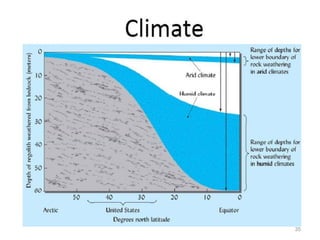
  • 113.
     Moderately AcidSoils: Aluminum and hydrogen compounds also account for soil solution H+ ions in moderately acid soils (pH values between 5.0 and 6.5) but by different mechanisms.  At these pH levels, the aluminum can no longer exist as Al3+ ion but converted to aluminum hydroxy ion. Al3+ + OH-  AlOH2+ AlOH2+ + OH-  Al(OH)2 + (Aluminum hydroxy ions)  Much of the aluminum hydroxy ions are adsorbed and act as exchangeable cations.  They are in equilibrium with similar cations in the soil solution, where they produce hydrogen ions by the following hydrolysis reactions.  Al(OH)+ + H2O  Al(OH)2 + + H+  Al(OH)2+ + H2O  Al(OH)3 + + H+
  • 114.
    Causes of soilacidity  Acidic P.M. include granite, sandstone, shale.  Percolation of water also reduces the PH.  Some processes produce H. e.g Respiration of roots and microbes. CO2 + H2O H2CO3 + HCO3- + H+  Crops - When they have nutrients the “give back” H+.  Growers harvest Ca, Mg-------- with crops.  Nitrification – contributes H+ to the soil.  NH4+ + 2O2 - NO3 - + H2O + 2H+ This happens also when ammonium fertilizer is used.
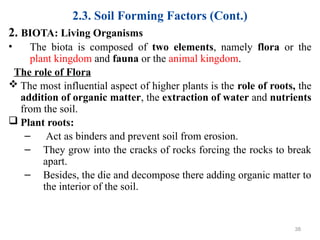
  • 115.
    Reclaiming soil acidity 1.Agricultural limes It is commonly reduced by adding carbonates, oxides, and hydroxides of calcium and Magnesium compounds that are referred to as agricultural limes. Also wood ashes are used locally, to help control soil acidity. Where soils are very acid, crop growth can be drastically improved by liming the soil.  During lime application we replace H + by Ca2+ or Mg2+ 2. Use tolerant plant species
  • 116.
    4.5. Alkalinity/sodicity Alkali oralkaline soils are clay soils with high pH (> 9), a poor soil structure and a low infiltration capacity. Often they have a hard calcareous layer at 0.5 to 1 meter depth. Alkali soils owe their unfavorable physico- chemical properties mainly to the dominating presence of sodium carbonate which causes the soil to swell. They derive their name from the alkali metal group of elements to which the sodium belongs and that can induce basicity. Sometimes these soils are also referred to as (alkaline) sodic soils. Alkaline soils are basic, but not all basic soils are alkaline, see: "difference between alkali and base????"
  • 117.
    Causes of Alkalinity(sodicity): The causes of soil alkalinity are natural or they can be man-made. 1. Natural salt accumulation: The natural cause is the presence of soil minerals producing sodium carbonate (Na2CO3) upon weathering. 2. Irrigation induced alkalinity: The man-made cause is the application of irrigation water (surface or ground water) containing a relatively high proportion of sodium bicarbonates. Management and reclamation of alkaline soils:  grass cultures,  acidifying organic material into the soil,  leaching of the excess sodium, and  deep plowing and incorporating the calcareous subsoil into the top soil.
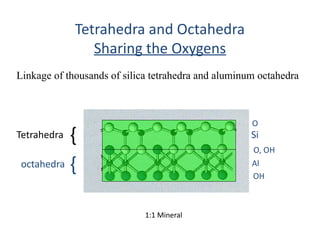
  • 118.
    4.6. Salinity Salt-affected soilsare caused by excess accumulation of salts, typically most pronounced at the soil surface. Salts can be transported to the soil surface by capillary transport from a salt loaded ground water table and then accumulate due to evaporation. They can also be concentrated in soils due to human activity, for example the use of potassium as fertilizer, which can form sylvite, a naturally occurring salt. As soil salinity increases, salt effects can result in degradation of soils and vegetation.
  • 119.
    Natural occurrence:  Saltis a natural element of soils and water.  The ions responsible for salinization are: Na+ , K+ , Ca2+ , Mg2+ and Cl- .  As the Na+ (sodium) predominates, soils can become sodic. Causes of saline soils 1.Mineral weathering 2. In addition to mineral weathering, salts are also deposited via dust and precipitation. In dry regions salts may accumulate, leading to naturally saline soils. 3. Human practices can increase the salinity of soils by the addition of salts in irrigation water.
  • 120.
    Management and reclamationof saline soils The removal of excess salts from saline soils requires access or ample irrigation water with low Na and  An effective soil drainage system that quickly removes the salt loaded water once it leaches down through the soil. If the natural soil drainage is not adequate to accommodate the leaching water, an artificial drainage network must be installed.
  • 121.
    CHAPTER 5 5. SOILORGANIC MATER (SOM) 5.1 Introduction  Soil organic matter is by definition the organic fraction derived from living organisms.  It includes the partly decomposed and decomposed plant and animal residues as well as the living organisms of the soil (micro organisms and plant roots).  The soil organic matter can be broadly classified into biomass, detritus, and humus 1. Biomass: the living organisms (the fauna and flora) 2. Detritus: the recognizable dead tissues of plants and animals at different stages of decomposition
  • 122.
    5.1 Introduction 3. Humus:the most stable organic fraction remaining after the macro organic matter and dissolved organic matter are decomposed. • It is composed of 1) non-humic substances, and 2) Humic substances. • The non humic substances include carbohydrates, amino acids, lipids, lignins, etc., all of which are the metabolic products of organisms. • On the other hand, humic substances, such as humic acids and fluvic acids, which are brown to black in color, are high molecular weight compounds that are synthesized by soil micro organisms. • Approximately 50% to 85% of the total organic matter content is humus. • About 65% to 75% of this humus is composed of humic matter, while the remaining 35% to 25% consists of non humic matter.
  • 123.
    5.2 Sources andComposition of SOM 5.2.1. Sources of SOM • Plants (macro and micro flora) and animals (macro and micro fauna) are the sources of soil organic matter. • Because plant residues are the principal material undergoing decomposition in soils and, hence plants, are the primary source of soil organic matter. 1. Plants as Sources of Soil Organic Matter Plant (mainly higher plant) tissue is the major and primary (original) source of soil organic matter: Through the process of photosynthesis they convert atmospheric CO2 into glucose, and eventually to amino acids, proteins, polysaccharides, cellulose, lignin, and other compounds essential for life. When plants are dead then the plants will be added to the soil. Carbon is eventually released back to the atmosphere when organic matter is decomposed by soil organisms. Soils and soil organic matter are the major components of the Global Carbon Cycle
  • 124.
    5.2 Sources andComposition of SOM (Cont.) 2. Animals as Sources of Soil Organic Matter  Animals are considered as secondary sources of soil organic matter. As they feed on plant tissue, they: Contribute their waste products Leave their own bodies as they complete their life cycle. 5.2.2 Composition of SOM As plant residues dominate SOM, composition-wise SOM is similar to the composition of plant residues. Green plant residues of higher plants are composed of: • Water: 60 – 90 % (75% being an average) • Dry matter (DM): 25% an average
  • 125.
    5.2 Sources andComposition of SOM (Cont.) Elemental Composition of the DM:  The dry matter (DM) portion of soil organic matter is predominantly composed of C, O, and H: a) Carbon: 11% of 25% dry matter (DM) (or 44% of total DM) b) Oxygen: 10% of 25% dry matter (DM) (or 40% of total DM) c) Hydrogen: 2% of 25% dry matter (DM) (or 8% of total DM) d) N,P,S plus inorganic elements (ash): 2% of 25% dry matter (DM) (or 8% of total DM)  Carbon, H and O dominate the bulk of organic tissue in the soil, making up over 90% of the dry matter.  However, the other elements although found in small amounts play a vital role in plant nutrition.  Nitrogen, P, S, K, Ca, and Mg are particularly significant, as are the macronutrients contained in plant materials.  The C: N: S: P ratio of soil organic matter is 100:10:1:1.
  • 126.
    5.2 Sources andComposition of SOM (Cont.) Types (composition) of compounds in DM: a) Cellulose: 45% of total DM b) lignin: 20% of total DM c) Hemicelluloses: 18% of total DM d) Protein: 8% of total DM e) Sugars and starch: 5% of total DM f) Fats and waxes: 2% of total DM g) Polyphenols: 2% of total DM
  • 127.
    5.3 Soil OrganicMatter Decomposition  Soil organic matter decomposition is an enzymatic decomposition process accomplished by the help of soil organisms.  Heterotrophic soil organisms depend on the decomposition of organic matter for their energy source.  Organic matter decomposition is a three step process: 1. Easily decomposable carbon compounds are oxidized and CO2, water, energy are released 2. Nutrient elements are either immobilized (consumed by microbial mass) or mineralized (released into the soil solution) 3. Stable organic compound, i.e humus is synthesized.  Humus is very resistant material for further decomposition and it takes centuries before carbon in humus is oxidized and turned to the atmosphere.  This allows C accumulation in soils (C sequestration is one technique in battling global warming!)
  • 128.
    5.3 Soil OrganicMatter Decomposition (Cont.) Factors Controlling the Rate of Organic Matter Decomposition  The quality of the organic material itself and the soil environment determines the rate of organic matter decomposition in soils. 1. Quality of the organic matter  Physical quality: size and the degree of contact of the organic material with soil  Chemical composition, particularly the C: N ratio of the organic material • The C: N ratio of organic materials may range from 10: 1 up to 600: 1 • Higher C: N ratio materials are considered low quality organic materials because decomposition rate of such materials is very slow.
  • 129.
    5.3 Soil OrganicMatter Decomposition (Cont.) • Soil organisms have average tissue C: N ratio of 8: 1. – This means they require 1 N for every 8 C assimilated to their body. – However they only assimilate 1/3 of the C they oxidize into their body and the rest (2/3) is released as CO2 • In cases where the organic material has very high C: N ratio, example 300: 1, 100 atoms of C will be assimilated with only 1 N atom. – With the above assumption 12 extra N atoms will be required if the organic material has to be decomposed fully. – Hence organisms will scavenge the soil N to meet their demand causing a temporal N deficiency called nitrate depression period. – This process is called immobilization (C:N of added OM > 30:1).
  • 130.
    5.3 Soil OrganicMatter Decomposition (Cont.)  High quality organic material provides N in excess of what is needed by the decomposers, decomposition will be fast, and eventually the excess N will be released to the soil. – This is mineralization (C:N of added OM < 30:1). Rate of Decomposition:  Organic compounds vary greatly in their rate of decomposition in terms of their ease of decomposition as follows: 1. Sugars, Starches, and simple proteins Rapid decomposition 2. Crude Proteins 3. Hemi-cellulose 4. Cellulose 5. Fats, waxes, and so forth 6. Lignin and phenolic compounds Very slow decomposition
  • 131.
    5.3 Soil OrganicMatter Decomposition (Cont.) 2. The Soil Environment • The soil environment affects the decomposition rate of organic matter both directly or indirectly. • Soil properties which influence soil organisms positively or negatively will directly affect the decomposition rate of organic matter. • The soil environment indirectly affects decomposition rate by determining the supply of organic matter in the locality.
  • 132.
    5.3 Soil OrganicMatter Decomposition (Cont.) A. Soil aeration • Most decomposers are aerobic organism which require oxygen to decompose organic matter • In the absence of abundant oxygen, such as in poorly drained soils, only anaerobic decomposers are active, – hence organic matter decomposition is very slow. – Because of this wetlands usually contain high level of organic matter. • Anaerobic decomposition of organic matter releases large amount of CH4 and other partially decomposed organic compounds (alcohols and organic acids) which are mostly toxic to the environment. B. Soil pH • Most soil organisms are active in neutral soil pH. • Extremes of soil pH, highly reduce the abundance, activity and biomass of soil organisms
  • 133.
    5.3 Soil OrganicMatter Decomposition (Cont.) C. Soil Moisture – Moisture is needed for normal biochemical activity of organisms. – Under very dry or flooded conditions the activity of soil organisms is restricted and so is organic matter decomposition D. Soil Temperature – Warm soil temperature hastens soil organic matter decomposition since the activity of soil organisms is the highest under that condition. – Whereas under too cold or too hot climatic conditions decomposition rate is slower.
  • 134.
    5.4. Functions ofthe Soil Organic Matter  The soil organic matter accounts only for a small fraction of the soil solid.  Most cultivated tropical soils have less than 5 % organic matter content.  However, it has a profound influence over so many physical, chemical and biological properties of soils.  In general, the quality and quantity of the soil organic matter somehow determine the quality of soils. Some of the functions of the soil organic matter are: 1. Energy source for soil organisms – Heterotrophic macro and micro organisms are dependent on the soil organic matter for their energy requirement
  • 135.
    5.4. Functions ofthe Soil Organic Matter (Cont.) 2. Source of plant nutrient elements • Organic matter enhances soil fertility. • Upon decomposition, nutrient elements trapped in organic compounds of the organic material are recycled to the soil system and used by plants. – Easily replaceable cations are present – N, P,S and micronutrients held in organic forms are slowly released – Release of elements from minerals by acid humus, and – Provide N, S and over half of soil p through decay. • Some organic compounds released from organic matter breakdown are growth promoters and are directly taken by plants
  • 136.
    5.4. Functions ofthe Soil Organic Matter (Cont.) 3. Effect on soil physical properties: – Soil color becomes brown to black – Granulation encouraged – Aggregate (structure) stability assisted – Plasticity and cohesion reduced – Water holding capacity increased 4. Cation Exchange Capacity: – Humus is an organic colloid. – It has extremely high surface area and electrical charge and contribute much of the colloidal property of surface soils • Provide high CEC, increase the pH-dependent CEC of soils • Accounts for 30-90% of the absorbing power of mineral soils
  • 137.
    5.4. Functions ofthe Soil Organic Matter (Cont.) 5. Complexation of inorganic ions – Organic compounds have the capability of complexing inorganic ions and form complex compounds called chelates – Chelates are more mobile and bioavailable for plants – Therefore, complexation reactions enhance the weathering of rocks and minerals and also increase nutrient availability for higher plants.
  • 138.
    5.5. Factors affectingSOM 1. Climate: – mainly temperature and rainfall. – Organic matter content increases with moisture but decrease with temperature. 2. Natural vegetation: – higher organic matter content is recorded under grassland areas as compared to forest areas. – In fact, in most cases, these two vegetation types are found under different climatic conditions.
  • 139.
    5.5. Factors affectingSOM (Cont.) 3. Texture and other factors: – A sandy soil contains less organic matter and N than finer textured soil, other things being equal because of ready oxidation in the lighter soils and natural addition of residues is less in the lighter soil. – Besides, poorly drained soils contain high organic matter and N than their better-drained equivalents. 4. Cropping: – Cultivation reduces the organic matter content of the soil through the encouragement of the decomposition process and the removal of the organic material.
  • 140.
    5.6. Management ofSoil Organic Matter • Maintenance of high level of soil organic matter is maintenance of both soil and environmental quality • The loss of CO2 from organic matter decomposition is one major contributor for the global warming problem • By practicing different management options one can increase the organic matter level of agricultural soils and at the same time will contribute to environmental safety • Some of the practices known for maintaining high level of soil organic matter are: • Conservation tillage • Replantation of degraded lands • Conserving natural grassland areas • Organic amendments (farmyard manure, compost, residue, etc)
  • 141.
    141 CHAPTER- Six 6. SOILCLASSIFICATION 6.1. Introduction • Soil classification is the categorization of soil into groups at varying levels of generalization according to their physical, mineralogical and chemical properties. • It is a technique whereby soils are grouped together in various ways and according to various criteria to form categories or classes, – Where these classes are defined in such a way as to be useful in understanding the formation, properties and uses of soil. • Its main objective includes: – organization of knowledge, – ease in remembering properties, – clearer understanding of the relationship, and – ease of technology transfer and communication.
  • 142.
    142 6.2. History ofsoil classification • People have the tendency to classify or sort things around them. • The same is true concerning soils. • From the time crops were cultivated, human noticed differences in soils, but classification was totally dependent on recognized differences in the soils capacity to grow specific crops or suitability for specific uses. – Examples would be “good soil” or “bad soil” or “cotton soil”, “maize soil”, “teff soil” etc. • Until very recently soils have also been classified in terms of geological parent materials from which they are assumed to form such as sandy soils, clay soils, limestone soils, alluvial soils, etc. • It is long ago that people started to classify soil. The earliest attempt, in the recorded history, is a 4000 years old Chinese system. – The Chinese, better said, classified their land into nine groups mainly based on the productivity of the land. – The purpose of their classification was for tax imposition. • Another recorded history of soil classification is that of the Romans about 2000 years ago.
  • 143.
    143 6.2. History ofsoil classification (Cont.) • It is important to try to remember and appreciate the different traditional soil classification systems in Ethiopia. • Modern classification systems are, however, based on the overall understanding of pedogenesis (soil formation) and accurate interpretation of soil properties as the result of the different soil forming processes. • Currently there are several classification systems world wide which differ mainly because of differences on the major criteria set for the classification and levels of organization (hierarchy) they follow. – Examples are: Australian, Brazilian, Canadian, Chinese, Japanese, French, Russian systems of soil classification, etc. • The two most common classification systems used by many countries including Ethiopia are the USDA Soil Taxonomy and World Reference Base for Soil Resources (WRB) systems of soil classifications. • Both systems have been revised a number of times based on latest findings. • These two systems of classification are unique in a way that they are comprehensive and address the different soil types around the world than specific regions.
  • 144.
    144 7.3. USDA Systemof Soil Classification • Since the late 1950s the American pedologists revised and developed a new system of soil classification which relies on soil properties, – as a result of the major pedogenic processes that the soil has gone through, that are determined quantitatively and – as well as their seasonally dynamic soil temperature and moisture regimes. – Some of the most important soil properties used in the classification are: soil depth, color, texture, bulk density, structure, organic matter content, pH, EC, BS, CEC, Fe/Al oxides, etc • Soil Taxonomy, contains six levels of organization: – order, – suborder, – great group, – subgroup, – family, and – series.
  • 145.
    145 6.3. USDA Systemof Soil Classification (Cont.) • Diagnostic Horizons: soil horizons that combines a set of properties which are used for identifying certain classes of soils. • Epipedons: diagnostic horizons at the soil surface (surface horizon/s) • Endopedons: diagnostic horizons below the soil surface (Subsurface horizon/s) Key characteristics of diagnostic Epipedons – Mollic: thick, dark colored, high base saturation, strong structural development – Umbric: same as mollic but low base saturation – Ochric: too light colored, low organic content or thin to be called mollic, may be hard and massive when dry – Melanic: thick, black, high in organic matter (> 6% organic carbon), common in volcanic ash soils – Histic: very high organic content, wet during some part of the year – Anthropic: human-modified mollic like horizon, high in available phosphorous – Plaggen: human-made horizon created by years of manuring
  • 146.
    146 6.3. USDA Systemof Soil Classification (Cont.) • Key characteristics of diagnostic endopedons – Argillic (Bt): silicate clay accumulation – Natric (Btn): argillic, high in sodium, columnar or prismatic structure – Spodic (Bh, Bs): organic matter, Fe and Al oxide accumulation – Cambic (Bw): altered by physical movement or by chemical reactions, generally non illuvial – Agric (A or B): organic and clay accumulation just below plow layer resulting from cultivation – Oxic (B): highly weathered, primary mixture of Fe, Al oxides and non sticky type silicate clays – Duripan (Bqm): hardpan, strongly cemented by silica – Fragipan (Bx): brittle pan, usually loamy textured, dense – Albic (E): light-colored, clay and Fe/Al oxides mostly removed
  • 147.
    147 6.3. USDA Systemof Soil Classification (Cont.) – Calcic (Bk): accumulation of calcium carbonate – Gypsic (By): accumulation of gypsum – Salic (Bz): accumulation of salts – Kandic (Bt): accumulation of low-activity clay – Petrocalcic (Ckm): cemented calcic horizon – Petrogypsic (Cym): cemented gypsic horizon – Plasic (Csm): thin pan cemented with iron alone or with manganese or organic matter – Sombric (Bh): organic matter accumulation – Sulfuric (Cj): highly acid with Jarosite mottles
  • 148.
    148 7.3. USDA Systemof Soil Classification (Cont.) • Simplified Key to the Soil Orders 1. Gelisols: Soils with permafrost or gelic material within 100 cm 2. Histosols: Soils with more than 30 % organic matter content to a depth of 40 cm 3. Spodosols: Soils with spodic horizon within a depth of 200 cm 4. Andisols: Soils from volcanic ejecta with andic properties (due to the presence of significant amounts of allophone, imogolite, or Al- humus complexes) 5. Oxisols: Soils with oxic horizon, containing more than 40% clay in the surface 18 cm and a kandic horizon 6. Vertisols: Soils containing more than 30 % clay in all horizons and cracks that open and close periodically
  • 149.
    149 7.3. USDA Systemof Soil Classification (Cont.) 7. Aridisols: Soils of arid regions, dry soils with ochric epipedon, sometimes argillic or natric horizon 8. Ultisols: Soils with argillic, natric or kandic horizon and base saturation percentage less than 35 % at a depth of 180 cm 9. Alfisols: Soils with argillic, natric or kandic horizon and base saturation higher than 35 % at a depth of 180 cm 10. Mollisols: Soils with mollic epipedon and base saturation of 50 % or more in all depths above 180 cm 11. Inceptisols: Embryonic soils with few diagnostic features, ochric or umbric epipedon, cambic horizon 12. Entisols: Young soils with little (if any) profile development, ochric epipedon common
  • 150.
    150 7.4. World ReferenceBase for Soil Resources (WRB) WRB has replaced the FAO legend for the soil map of the world. – The structure, concepts and definitions of the WRB are strongly influenced by the legend of the FAO-Unesco 1/5,000,000 Soil Map of the World, – which in turn borrowed the diagnostic horizons and properties approach from USDA Soil Taxonomy (Soil Survey Staff, 1999). Structure of the WRB • The WRB is a two-level classification: 1. Reference Soil Groups (33) Examples: Histols, Fluvisols, Luvisols 2. Second-level subdivisions • Using any defined combination of 121 qualifiers. • It is possible to use either a single qualifier (the most important) or all relevant qualifiers, depending on the degree of detail needed. Examples: Leptic Umbrisols, Chromi-Vertic Luvisols.
  • 151.
    151 7.4. World ReferenceBase for Soil Resources (Cont.) Key to the Reference Soil Groups (RSGs) • The Key to the RSGs in the WRB stems from the Legend of the Soil Map of the World. • The sequence of the Major Soil Units was come out almost automatically by specifying briefly a limited number of diagnostic horizons, properties or materials. • Table 1 provides an overview and logic for the sequence of the RSGs in the WRB Key. • The RSGs are allocated to sets on the basis of dominant identifiers, i.e. – the soil forming factors or processes that most clearly condition the soil formation.
  • 152.
    152 7.4. World ReferenceBase for Soil Resources (Cont.) • The sequencing of the groups is done according to the following principles: Table 1. Rationalized Key to the WRB Reference Soil Groups Reference Soil Groups 1. Soils with thick organic layers: Histosols 2. Soils with strong human influence – Soils with long and intensive agricultural use: Anthrosols – Soils containing many artifact (manufactured article): Technosols 3. Soils with limited rooting due to shallow permafrost or stoniness – Ice-affected soils: Cryosols – Shallow or extremely gravelly soils: Leptosols 4. Soils influenced by water – Alternating wet-dry conditions, rich in swelling clays: Vertisols – Floodplains, tidal marshes:
  • 153.
    153 6.4. World ReferenceBase for Soil Resources (Cont.) 5. Soils set by Fe/Al chemistry – Allophanes or Al-humus complexes: Andosols – Cheluviation and chilluviation: Podzols – Accumulation of Fe under hydromorphic conditions:Plinthosols – Low-activity clay, P fixation, strongly structured: Nitisols – Dominance of kaolinite and sesquioxides: Ferralsols 6. Soils with stagnating water – Abrupt textural discontinuity: Planosols – Structural or moderate textural discontinuity: Stagnosols 7. Accumulation of organic matter, high base status – Typically mollic: Chernozems – Transition to drier climate: Kastanozems – Transition to more humid climate: Phaeozems
  • 154.
    154 6.4. World ReferenceBase for Soil Resources (Cont.) 8. Accumulation of less soluble salts or non-saline substances – Gypsum: Gypsisols – Silica: Durisols – Calcium carbonate: Calcisols 9. Soils with a clay-enriched subsoil – Albeluvic tonguing: Albeluvisols – Low base status, high-activity clay: Alisols – Low base status, low-activity clay: Acrisols – High base status, high-activity clay: Luvisols – High base status, low-activity clay: Lixisols 10. Relatively young soils or soils with little or no profile development – With an acidic dark topsoil: Umbrisols – Sandy soils: Arenosols – Moderately developed soils: Cambisols – Soils with no significant profile development: Regosols
  • 155.
    155 6.5. Major soilsof Ethiopia • Few soil survey works have been conducted in the country. • The exact characteristics and distribution of Ethiopian soils are still not fully understood. • Classification system is not developed; hence the WRB and the USDA- Soil Taxonomy are in common use in the country. • Farmers use morphological properties for classification, Eg. Black vs red soil, Heavy vs Light soil. • Soils in tropical regions, including Ethiopia, so diverse and almost includes all soil orders in the world because of very diverse topography, climate, vegetation, parent material vary highly. • According to exploratory soil mapping carried out in 1970s, about 19 soil groupings (defined according to FAO/Unesco, 1974) were identified. • The most important groupings based on aerial extent are Lithosols, Nitosols, Cambisols, Regosols, Vertisols and Fluvisols (Table 2). However, in terms of agricultural use, the most important groupings are Vertisols, Nitosols, Acrisols, Luvisols, Fluvisols and Cambisols.
  • 156.
    156 6.6. Major soilsof Ethiopia (Cont.) Table 2. Major soil types occurring in Ethiopia and their extent Soil Groupings (FAO/Unesco, 1974) Area Soil Groupings (FAO/Unesco, 1974) Area Km2 % Km2 % Lithosol 208245 17.0 Phaeozem 33451 2.7 Nitosol 150089 12.2 Xerosol 30861 2.5 Cambisol 144438 11.6 Rendzina 16348 1.3 Regosol 135596 10.9 Andosol 13556 1.0 Vertisol 76785 10.0 Arenosol 9024 0.7 Fluvisol 103152 8.3 Gleysol 5273 0.5 Luvisol 69763 5.7 Histosol 4719 0.3 Yermosol 63499 5.1 Chernozem 814 0.07 Solonchak 59257 4.8 Solonetz 495 0.04 Acrisol 55726 4.5
  • 157.
    157 6.7. Major soilsof Ethiopia (Cont.) Major Soil Types: 1. Lithosols (17%)…. ( Entisols, Inceptisosls) – soils less than 10 cm deep, due to a lithic contact – very young or result of sever erosion; also common on steep slopes; – Mainly found in Northern Ethiopia: Tigraye, Wollo, Gonder, Northern Shewa, Ogaden 2. Nitosols ( 12.5%) ….. (Some Ultisols and Alfisols ) – Very deep, strongly weathered next to Acrisols – In humid and warm parts of the country – High potential productivity if properly fertilized (Particularly P fertilizers). – Western and Southern highland regions: Wellega, Illibabore, Keffa, Sidamo, etc
  • 158.
    158 (Cont.) 3. Vertisols (10%) –Heavy clay black or gray cracking soils – Economically very important and highly cultivated – Very fertile, high water holding capacity – But mostly occur in flat or depressional areas, hence poorly drained – Mainly found in the central plateau of the country: Gojam, Shewa, Arsi, Bale, Harerege Highlands and Gambella region. 4. Cambisols, (~ 12%) ….( Inceptisols ) – Young, little profile development, – Brownish cambic B-horizon on slopes and shallow surfaces. Little importance to Agriculture
  • 159.
    159 7.5. Major soilsof Ethiopia (Cont.) 5. Fluvisols, Xerosols, Yermisols (~15%) … ( Aridsols, Entisols, Inceptisols) – Soils of the northern and eastern arid regions of the country – Often very weakly developed, calcareous or saline soils – Naturally infertile and also faces high moisture deficit problem – Abundant in Afar and eastern Ethiopian Somali region – Mainly under natural grasslands and utilized for grazing. 6. Acrisols (4.5%) …(Ultisols) – Extensively weathered, deep and sometimes acidic soils – Infertile ,and extremely low organic matter content – Well drained and physically suitable for mechanization – Humid western and southern regions.
  • 160.
    160 7.5. Major soilsof Ethiopia (Cont.) 7. Andosols (1%) …(Andisols) – Volcanic ash soils in Rift valley regions – Fertile and high moisture holding capacity, but have high P- fixation and erosion problems – In central and south central Rift valley regions. Others: Regosols, Luvisols, Histisols, etc Major Problems of Ethiopian Soils – Nutrient depletion (fertility loss ) - Residue harvest - Low fertilizer and manure use – Erosion: - Deforestation, Overgrazing and Population pressure – Poor drainage – Salinity/ acidity