Md.Mehedi Hassan SOFTWARE TESTING
ELEARNING COURSE
Course Outline
Type of Software Testing
Manual Testing
Whit Box Testing
Black Box Testing
Gray Box Testing
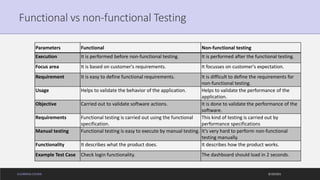
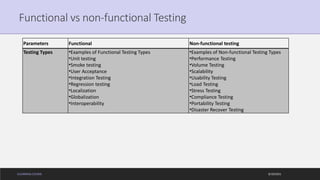
Functional vs non-functional Testing
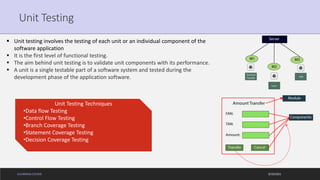
Unit Testing
Integration Testing
System Testing
Acceptance Testing
Alpha Testing
Verification vs Validation
9/19/2021
ELEARNING COURSE
Type of Software Testing
9/19/2021
S/W Type
Manual
White Box
Black Box
Functional
Unit Test
Integrating Test
System Test
User Acceptance
Test
α Testing
β Testing
Non Functional
Compatibility
Testing
Performance
Testing
Usability Testing
Gray Box
Automated
Smoke Testing
Regression Testing
Data Driven Testing
ELEARNING COURSE
Manual Testing
9/19/2021
The process of checking the
functionality of an application as
per the customer needs without
taking any help of automation
tools is known as manual testing.
ELEARNING COURSE
Whit Box Testing
9/19/2021
▪Knowledge of Programming design & internal structure of system is
must be known to the tester
▪Software developers are responsible for doing such type of testing
▪Developer focuses on program control flow, code logic, and structure of
the system.
▪White box sometimes called “Glass box testing”
is software testing technique in which internal structure,
design and coding of software are tested to verify flow of
input-output and to improve design, usability and security.
In white box testing, code is visible to testers so it is also
called Clear box testing, Open box testing, Transparent
box testing, Code-based testing and Glass box testing.
ELEARNING COURSE
Black Box Testing
9/19/2021
is a software testing method in which the
functionalities of software applications are tested
without having knowledge of internal code
structure, implementation details and internal
paths. Black Box Testing mainly focuses on input and
output of software applications and it is entirely
based on software requirements and specifications.
It is also known as Behavioral Testing.
ELEARNING COURSE
Gray Box Testing
9/19/2021
Combine black box and white
box testing
ELEARNING COURSE
Functional vs non-functional Testing
9/19/2021
Parameters Functional Non-functional testing
Execution It is performed before non-functional testing. It is performed after the functional testing.
Focus area It is based on customer's requirements. It focusses on customer's expectation.
Requirement It is easy to define functional requirements. It is difficult to define the requirements for
non-functional testing.
Usage Helps to validate the behavior of the application. Helps to validate the performance of the
application.
Objective Carried out to validate software actions. It is done to validate the performance of the
software.
Requirements Functional testing is carried out using the functional
specification.
This kind of testing is carried out by
performance specifications
Manual testing Functional testing is easy to execute by manual testing. It's very hard to perform non-functional
testing manually.
Functionality It describes what the product does. It describes how the product works.
Example Test Case Check login functionality. The dashboard should load in 2 seconds.
ELEARNING COURSE
Functional vs non-functional Testing
9/19/2021
Parameters Functional Non-functional testing
Testing Types •Examples of Functional Testing Types
•Unit testing
•Smoke testing
•User Acceptance
•Integration Testing
•Regression testing
•Localization
•Globalization
•Interoperability
•Examples of Non-functional Testing Types
•Performance Testing
•Volume Testing
•Scalability
•Usability Testing
•Load Testing
•Stress Testing
•Compliance Testing
•Portability Testing
•Disaster Recover Testing
ELEARNING COURSE
Unit Testing
9/19/2021
▪ Unit testing involves the testing of each unit or an individual component of the
software application
▪ It is the first level of functional testing.
▪ The aim behind unit testing is to validate unit components with its performance.
▪ A unit is a single testable part of a software system and tested during the
development phase of the application software.
Unit Testing Techniques
•Data flow Testing
•Control Flow Testing
•Branch Coverage Testing
•Statement Coverage Testing
•Decision Coverage Testing
ELEARNING COURSE
Integration Testing
9/19/2021
▪ Integration testing is the second level of the software testing process comes
after unit testing.
▪ n this testing, units or individual components of the software are tested in a
group.
▪ The focus of the integration testing level is to expose defects at the time of
interaction between integrated components or units.
▪ Unit testing uses modules for testing purpose, and these modules are
combined and tested in integration testing
ELEARNING COURSE
System Testing
9/19/2021
▪ To check the end-to-end flow of an application or the software as a user is
known as System testing
▪ System Testing used to test a whole system
▪ In this, we navigate (go through) all the necessary modules of an application
and check if the end features or the end business works fine, and test the
product as a whole system.
▪ It is end-to-end testing where the testing environment is similar to the
production environment.
ELEARNING COURSE
Acceptance Testing
9/19/2021
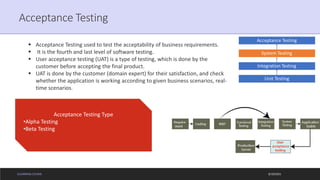
▪ Acceptance Testing used to test the acceptability of business requirements.
▪ It is the fourth and last level of software testing.
▪ User acceptance testing (UAT) is a type of testing, which is done by the
customer before accepting the final product.
▪ UAT is done by the customer (domain expert) for their satisfaction, and check
whether the application is working according to given business scenarios, real-
time scenarios.
Acceptance Testing Type
•Alpha Testing
•Beta Testing
ELEARNING COURSE
Alpha Testing
9/19/2021
▪ Alpha Testing is a type of software testing performed to identify bugs before
releasing the software product to the real users or public.
▪ Alpha testing is conducted in the organization and tested by a representative group
of end-users at the developer's side and sometimes by an independent team of
testers.
▪ Alpha testing is simulated or real operational testing at an in-house site.
▪ It comes after the unit testing, integration testing, etc. Alpha testing used after all the
testing are executed.
ELEARNING COURSE
Beta Testing
9/19/2021
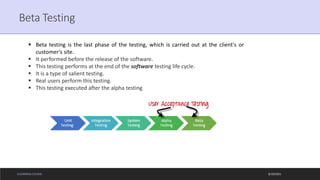
▪ Beta testing is the last phase of the testing, which is carried out at the client's or
customer's site.
▪ It performed before the release of the software.
▪ This testing performs at the end of the software testing life cycle.
▪ It is a type of salient testing.
▪ Real users perform this testing.
▪ This testing executed after the alpha testing
ELEARNING COURSE
Regression Testing
9/19/2021
▪ Repeated testing of an already tested program after modification.
▪ Regression testing is making sure that the product works fine with new
functionality, bug fixes, or any change in the existing feature.
▪ Test cases are re-executed to check the previous functionality of the application is
working fine, and the new changes have not produced any bugs.
▪ Regression testing is to ensure that changes have not affected unchanged part
Following Cases
1. When new functionality added to the application.
2. When there is a Change Requirement.
3. When the defect fixed
4. When there is a performance issue fix
5. When there is an environment change(update DB MySql to Oracle)
ELEARNING COURSE
Re-Testing
9/19/2021
▪ Retesting is done to make sure that the tests cases which failed in last
execution are passed after the defects are fixed
▪ Retesting is carried out based on the defect fixes.
▪ To ensure that the defects which were found and posted in the earlier build
were fixed or hot in the current build
Example
1. Build 1.0 was released. Test team found some defect (defect 1.0.1 and 1.0.2) and
posted.
2. Build 1.1 was released. Now testing the defects 1.0.1 and 1.0.2 in this build is re-
testing
ELEARNING COURSE
Re-Testing vs Regression Testing
9/19/2021
Regression Testing Re-Testing
Regression testing is to ensure that changes have not affected
unchanged part.
Retesting is done to make sure that the tests cases which failed in
last execution are passed after the defects are fixed.
Regression testing is not carried out for specific defect fixes. Retesting is carried out based on the defect fixes.
In Regression testing, the test cases which passed earlier can be
included to check the functionality which was working earlier.
In Retesting, the cases which are failed earlier can be included to
check if the functionality failure in an earlier build.
Regression test cases are derived from the functional specification,
the user manuals, user tutorials, and defect reports in relation to
corrected problems.
Test cases for Retesting cannot be prepared before start testing. In
Retesting, test cases that are failed in the prior execution are only
re-executed.
Automation is the key for regression testing. Manual regression
testing tends to get more expensive with each new release.
Automation always complements the regression test process.
Test cases for re-testing cannot be automated due to uncertainty
Defect verification doesn’t fall under Regression testing. Defect verification is coming under Retesting.
Based on the resource availability the Regression testing can be
carried out in parallel with Retesting.
Priority of Retesting over Regression testing is higher, so it is carried
out before regression testing.
ELEARNING COURSE
A Strategy of Testing conventional Software
9/19/2021
UAT
Acceptance Testing
System
System Testing
Modules
Integration Testing
Unit Module
Unit Testing
Unit Module
Unit Testing
Modules
Integration Testing
Unit Module
Unit Testing
Unit Module
Unit Testing
Unit
Testing
Integration
Testing
System
Testing
Acceptance
Testing
ELEARNING COURSE
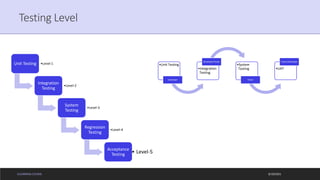
Testing Level
9/19/2021
•Unit Testing
Developer
•Integration
Testing
Developer/Tester
•System
Testing
Tester
•UAT
Tester/Developer
Unit Testing •Level-1
Integration
Testing
•Level-2
System
Testing
•Level-3
Regression
Testing
•Level-4
Acceptance
Testing • Level-5
ELEARNING COURSE
Automation Testing
9/19/2021
Is a process of converting any manual
test case into the scripts with the help
of automation tools or any
programming language is known as
automation testing.
Tools: kobiton, test project, ranorex etc
ELEARNING COURSE
Compatibility Testing
9/19/2021
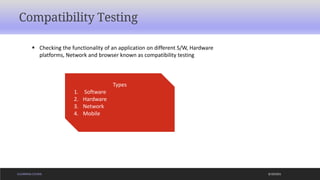
▪ Checking the functionality of an application on different S/W, Hardware
platforms, Network and browser known as compatibility testing
Types
1. Software
2. Hardware
3. Network
4. Mobile
ELEARNING COURSE
Usability Testing
9/19/2021
▪ A wide testing where we need to have an application knowledge
▪ End user interaction of an S/W or Product
▪ Checking the user-friendliness, efficiency, and accuracy of the application is known
as Usability Testing
▪ usability testing is performed from an end-user viewpoint to verify if the system is
efficiently working or not.
▪ Known as user Experience(UX) Testing.
ELEARNING COURSE
Performance Testing
9/19/2021
▪ Testing the stability and response time of an application by applying load
▪ Checking the behaviour of an application by applying some load is known as
performance testing.
Stability
Response
Load
▪ Stability: is nothing but ability to withstand design number of users is called as stability testing
▪ Response: server respond to the client request
▪ Load: no of users using the application at a particular period of time.
ELEARNING COURSE
Load Testing
9/19/2021
▪ The load testing is used to check the performance of an application by applying
some load which is either less than or equal to the desired load is known as load
testing.
1000
900, 1000
Example
ELEARNING COURSE
Stress Testing
9/19/2021
▪ The stress testing is testing, which checks the behaviour of an application by
applying load greater than the desired load.
1000
1100
Example
3 Sec
3 Sec
1200 4 Sec
ELEARNING COURSE
Scalability Testing
9/19/2021
▪ Checking the performance of an application by increasing or decreasing the load in
particular scales (no of a user) is known as scalability testing. Upward scalability
and downward scalability testing are called scalability testing
1000 users
1500 users
Example
3 Sec
3 Sec
2000 users 4 Sec
5000 users 40 Sec
5100 users Crashed
1000 users
900 users
3 Sec
3 Sec
2000 users 4 Sec
5000 users 40 Sec
5100 users ∞
ELEARNING COURSE
Stability Testing
9/19/2021
▪ Checking the performance of an application by applying the load for a particular
duration of time is known as Stability Testing
ELEARNING COURSE
Volume Testing
9/19/2021
▪ Are testing the stability and response time of an application by transferring the
huge volume of data in volume testing
▪ It refers as flood testing
▪ Testing the capacity of Database (DB).
▪ Volume is a capacity while Load is a quantity, i.e., load testing means no. of
users, and volume testing means amount of data.
ELEARNING COURSE
Soak Testing
9/19/2021
▪ testing the stability and response time of an application by applying for a long duration of time.
▪ It refers as endurance testing
▪ Volume and soak testing is a type of testing but not performance testing.
▪ A system may behave as expected when tested for about 2 hours but when the same
system is tested for 5 hours or even more than that, the problems such as memory leaks
cause the system to fail or behave randomly or even the application might crash.
ELEARNING COURSE
Data Driven Testing
9/19/2021
▪ Data Driven Testing is where the test scripts read from data sources such as excel, ODBC sources,
csv files etc rather than using hard-coded values.
▪ It can be any of the below data files.
•Datapools
•Excel files
•ADO objects
•CSV files
•ODBC sources
ELEARNING COURSE
Verification vs Validation
9/19/2021
Serial Verification Validation
1. Static Testing Dynamic Testing
2. Does not include execution of code It include execution of code
3. It come before validation It come after verification
4. Activity:
Review, walkthrough, inspection
Activity:
Testing :UAT, Regression, smoke
5. Check: Are we building the product right? Check: Are we building the right product?
6. Conform or check specification Conform requirements and of a customer expectation
7. Example:
Design code – Developer Team
Test Plan review – QA Team
Code walkthrough - Developer Team
Code inspection- Developer Team
Food Order
▪ Verification of look
Example:
Food Order
▪ Verification by eating
Thank You!
You have any query just notify via mail. I will try response the mail.
9/19/2021
ELEARNING COURSE

Software-Testing.pdf

  • 1.
  • 2.
    ELEARNING COURSE Course Outline Typeof Software Testing Manual Testing Whit Box Testing Black Box Testing Gray Box Testing Functional vs non-functional Testing Unit Testing Integration Testing System Testing Acceptance Testing Alpha Testing Verification vs Validation 9/19/2021
  • 3.
    ELEARNING COURSE Type ofSoftware Testing 9/19/2021 S/W Type Manual White Box Black Box Functional Unit Test Integrating Test System Test User Acceptance Test α Testing β Testing Non Functional Compatibility Testing Performance Testing Usability Testing Gray Box Automated Smoke Testing Regression Testing Data Driven Testing
  • 4.
    ELEARNING COURSE Manual Testing 9/19/2021 Theprocess of checking the functionality of an application as per the customer needs without taking any help of automation tools is known as manual testing.
  • 5.
    ELEARNING COURSE Whit BoxTesting 9/19/2021 ▪Knowledge of Programming design & internal structure of system is must be known to the tester ▪Software developers are responsible for doing such type of testing ▪Developer focuses on program control flow, code logic, and structure of the system. ▪White box sometimes called “Glass box testing” is software testing technique in which internal structure, design and coding of software are tested to verify flow of input-output and to improve design, usability and security. In white box testing, code is visible to testers so it is also called Clear box testing, Open box testing, Transparent box testing, Code-based testing and Glass box testing.
  • 6.
    ELEARNING COURSE Black BoxTesting 9/19/2021 is a software testing method in which the functionalities of software applications are tested without having knowledge of internal code structure, implementation details and internal paths. Black Box Testing mainly focuses on input and output of software applications and it is entirely based on software requirements and specifications. It is also known as Behavioral Testing.
  • 7.
    ELEARNING COURSE Gray BoxTesting 9/19/2021 Combine black box and white box testing
  • 8.
    ELEARNING COURSE Functional vsnon-functional Testing 9/19/2021 Parameters Functional Non-functional testing Execution It is performed before non-functional testing. It is performed after the functional testing. Focus area It is based on customer's requirements. It focusses on customer's expectation. Requirement It is easy to define functional requirements. It is difficult to define the requirements for non-functional testing. Usage Helps to validate the behavior of the application. Helps to validate the performance of the application. Objective Carried out to validate software actions. It is done to validate the performance of the software. Requirements Functional testing is carried out using the functional specification. This kind of testing is carried out by performance specifications Manual testing Functional testing is easy to execute by manual testing. It's very hard to perform non-functional testing manually. Functionality It describes what the product does. It describes how the product works. Example Test Case Check login functionality. The dashboard should load in 2 seconds.
  • 9.
    ELEARNING COURSE Functional vsnon-functional Testing 9/19/2021 Parameters Functional Non-functional testing Testing Types •Examples of Functional Testing Types •Unit testing •Smoke testing •User Acceptance •Integration Testing •Regression testing •Localization •Globalization •Interoperability •Examples of Non-functional Testing Types •Performance Testing •Volume Testing •Scalability •Usability Testing •Load Testing •Stress Testing •Compliance Testing •Portability Testing •Disaster Recover Testing
  • 10.
    ELEARNING COURSE Unit Testing 9/19/2021 ▪Unit testing involves the testing of each unit or an individual component of the software application ▪ It is the first level of functional testing. ▪ The aim behind unit testing is to validate unit components with its performance. ▪ A unit is a single testable part of a software system and tested during the development phase of the application software. Unit Testing Techniques •Data flow Testing •Control Flow Testing •Branch Coverage Testing •Statement Coverage Testing •Decision Coverage Testing
  • 11.
    ELEARNING COURSE Integration Testing 9/19/2021 ▪Integration testing is the second level of the software testing process comes after unit testing. ▪ n this testing, units or individual components of the software are tested in a group. ▪ The focus of the integration testing level is to expose defects at the time of interaction between integrated components or units. ▪ Unit testing uses modules for testing purpose, and these modules are combined and tested in integration testing
  • 12.
    ELEARNING COURSE System Testing 9/19/2021 ▪To check the end-to-end flow of an application or the software as a user is known as System testing ▪ System Testing used to test a whole system ▪ In this, we navigate (go through) all the necessary modules of an application and check if the end features or the end business works fine, and test the product as a whole system. ▪ It is end-to-end testing where the testing environment is similar to the production environment.
  • 13.
    ELEARNING COURSE Acceptance Testing 9/19/2021 ▪Acceptance Testing used to test the acceptability of business requirements. ▪ It is the fourth and last level of software testing. ▪ User acceptance testing (UAT) is a type of testing, which is done by the customer before accepting the final product. ▪ UAT is done by the customer (domain expert) for their satisfaction, and check whether the application is working according to given business scenarios, real- time scenarios. Acceptance Testing Type •Alpha Testing •Beta Testing
  • 14.
    ELEARNING COURSE Alpha Testing 9/19/2021 ▪Alpha Testing is a type of software testing performed to identify bugs before releasing the software product to the real users or public. ▪ Alpha testing is conducted in the organization and tested by a representative group of end-users at the developer's side and sometimes by an independent team of testers. ▪ Alpha testing is simulated or real operational testing at an in-house site. ▪ It comes after the unit testing, integration testing, etc. Alpha testing used after all the testing are executed.
  • 15.
    ELEARNING COURSE Beta Testing 9/19/2021 ▪Beta testing is the last phase of the testing, which is carried out at the client's or customer's site. ▪ It performed before the release of the software. ▪ This testing performs at the end of the software testing life cycle. ▪ It is a type of salient testing. ▪ Real users perform this testing. ▪ This testing executed after the alpha testing
  • 16.
    ELEARNING COURSE Regression Testing 9/19/2021 ▪Repeated testing of an already tested program after modification. ▪ Regression testing is making sure that the product works fine with new functionality, bug fixes, or any change in the existing feature. ▪ Test cases are re-executed to check the previous functionality of the application is working fine, and the new changes have not produced any bugs. ▪ Regression testing is to ensure that changes have not affected unchanged part Following Cases 1. When new functionality added to the application. 2. When there is a Change Requirement. 3. When the defect fixed 4. When there is a performance issue fix 5. When there is an environment change(update DB MySql to Oracle)
  • 17.
    ELEARNING COURSE Re-Testing 9/19/2021 ▪ Retestingis done to make sure that the tests cases which failed in last execution are passed after the defects are fixed ▪ Retesting is carried out based on the defect fixes. ▪ To ensure that the defects which were found and posted in the earlier build were fixed or hot in the current build Example 1. Build 1.0 was released. Test team found some defect (defect 1.0.1 and 1.0.2) and posted. 2. Build 1.1 was released. Now testing the defects 1.0.1 and 1.0.2 in this build is re- testing
  • 18.
    ELEARNING COURSE Re-Testing vsRegression Testing 9/19/2021 Regression Testing Re-Testing Regression testing is to ensure that changes have not affected unchanged part. Retesting is done to make sure that the tests cases which failed in last execution are passed after the defects are fixed. Regression testing is not carried out for specific defect fixes. Retesting is carried out based on the defect fixes. In Regression testing, the test cases which passed earlier can be included to check the functionality which was working earlier. In Retesting, the cases which are failed earlier can be included to check if the functionality failure in an earlier build. Regression test cases are derived from the functional specification, the user manuals, user tutorials, and defect reports in relation to corrected problems. Test cases for Retesting cannot be prepared before start testing. In Retesting, test cases that are failed in the prior execution are only re-executed. Automation is the key for regression testing. Manual regression testing tends to get more expensive with each new release. Automation always complements the regression test process. Test cases for re-testing cannot be automated due to uncertainty Defect verification doesn’t fall under Regression testing. Defect verification is coming under Retesting. Based on the resource availability the Regression testing can be carried out in parallel with Retesting. Priority of Retesting over Regression testing is higher, so it is carried out before regression testing.
  • 19.
    ELEARNING COURSE A Strategyof Testing conventional Software 9/19/2021 UAT Acceptance Testing System System Testing Modules Integration Testing Unit Module Unit Testing Unit Module Unit Testing Modules Integration Testing Unit Module Unit Testing Unit Module Unit Testing Unit Testing Integration Testing System Testing Acceptance Testing
  • 20.
    ELEARNING COURSE Testing Level 9/19/2021 •UnitTesting Developer •Integration Testing Developer/Tester •System Testing Tester •UAT Tester/Developer Unit Testing •Level-1 Integration Testing •Level-2 System Testing •Level-3 Regression Testing •Level-4 Acceptance Testing • Level-5
  • 21.
    ELEARNING COURSE Automation Testing 9/19/2021 Isa process of converting any manual test case into the scripts with the help of automation tools or any programming language is known as automation testing. Tools: kobiton, test project, ranorex etc
  • 22.
    ELEARNING COURSE Compatibility Testing 9/19/2021 ▪Checking the functionality of an application on different S/W, Hardware platforms, Network and browser known as compatibility testing Types 1. Software 2. Hardware 3. Network 4. Mobile
  • 23.
    ELEARNING COURSE Usability Testing 9/19/2021 ▪A wide testing where we need to have an application knowledge ▪ End user interaction of an S/W or Product ▪ Checking the user-friendliness, efficiency, and accuracy of the application is known as Usability Testing ▪ usability testing is performed from an end-user viewpoint to verify if the system is efficiently working or not. ▪ Known as user Experience(UX) Testing.
  • 24.
    ELEARNING COURSE Performance Testing 9/19/2021 ▪Testing the stability and response time of an application by applying load ▪ Checking the behaviour of an application by applying some load is known as performance testing. Stability Response Load ▪ Stability: is nothing but ability to withstand design number of users is called as stability testing ▪ Response: server respond to the client request ▪ Load: no of users using the application at a particular period of time.
  • 25.
    ELEARNING COURSE Load Testing 9/19/2021 ▪The load testing is used to check the performance of an application by applying some load which is either less than or equal to the desired load is known as load testing. 1000 900, 1000 Example
  • 26.
    ELEARNING COURSE Stress Testing 9/19/2021 ▪The stress testing is testing, which checks the behaviour of an application by applying load greater than the desired load. 1000 1100 Example 3 Sec 3 Sec 1200 4 Sec
  • 27.
    ELEARNING COURSE Scalability Testing 9/19/2021 ▪Checking the performance of an application by increasing or decreasing the load in particular scales (no of a user) is known as scalability testing. Upward scalability and downward scalability testing are called scalability testing 1000 users 1500 users Example 3 Sec 3 Sec 2000 users 4 Sec 5000 users 40 Sec 5100 users Crashed 1000 users 900 users 3 Sec 3 Sec 2000 users 4 Sec 5000 users 40 Sec 5100 users ∞
  • 28.
    ELEARNING COURSE Stability Testing 9/19/2021 ▪Checking the performance of an application by applying the load for a particular duration of time is known as Stability Testing
  • 29.
    ELEARNING COURSE Volume Testing 9/19/2021 ▪Are testing the stability and response time of an application by transferring the huge volume of data in volume testing ▪ It refers as flood testing ▪ Testing the capacity of Database (DB). ▪ Volume is a capacity while Load is a quantity, i.e., load testing means no. of users, and volume testing means amount of data.
  • 30.
    ELEARNING COURSE Soak Testing 9/19/2021 ▪testing the stability and response time of an application by applying for a long duration of time. ▪ It refers as endurance testing ▪ Volume and soak testing is a type of testing but not performance testing. ▪ A system may behave as expected when tested for about 2 hours but when the same system is tested for 5 hours or even more than that, the problems such as memory leaks cause the system to fail or behave randomly or even the application might crash.
  • 31.
    ELEARNING COURSE Data DrivenTesting 9/19/2021 ▪ Data Driven Testing is where the test scripts read from data sources such as excel, ODBC sources, csv files etc rather than using hard-coded values. ▪ It can be any of the below data files. •Datapools •Excel files •ADO objects •CSV files •ODBC sources
  • 32.
    ELEARNING COURSE Verification vsValidation 9/19/2021 Serial Verification Validation 1. Static Testing Dynamic Testing 2. Does not include execution of code It include execution of code 3. It come before validation It come after verification 4. Activity: Review, walkthrough, inspection Activity: Testing :UAT, Regression, smoke 5. Check: Are we building the product right? Check: Are we building the right product? 6. Conform or check specification Conform requirements and of a customer expectation 7. Example: Design code – Developer Team Test Plan review – QA Team Code walkthrough - Developer Team Code inspection- Developer Team Food Order ▪ Verification of look Example: Food Order ▪ Verification by eating
  • 33.
    Thank You! You haveany query just notify via mail. I will try response the mail. 9/19/2021 ELEARNING COURSE