Group No. 7
GROUP MEMBERS
• Hamza Wilayat
Reg. no. 1409
BS-CS
• Ali Raza Saleem
Reg. no. 1402
BS-CS
• Hafiz Ali Raza
Reg. no. 1433
BS-CS
Software Testing
WHAT IS TESTING?
Simple Definition:
It is the process used to identify the correctn
ess, completeness and quality of developed co
mputer software.
SOFTWARE TESTING
Standard Definition:
According to ANSI/IEEE 1059 standard, Testing
can be defined as “A process of analyzing a software it
em to detect the differences between existing and r
equired conditions (that is defects/errors/bugs) and to
evaluate the features of the software item”.
TESTING V/S DEBUGGING
 Testing
It involves the identification of bug/error/defect in the
software without correcting it. Normally professionals are in
volved in the identification of bugs. Testing is perform
ed in the testing phase.
 Debugging
It involves identifying, isolating and fixing the proble
ms/bugs. Developers who code the software conduct debu
gging upon encountering an error in the code.
VERIFICATION AND
VALIDATION (V&V)
• Verification
` The software should confirm to its specification. (A
re we building the product right?)
• Validation
The software should do what the user really requires
.(Are we building the right product?)
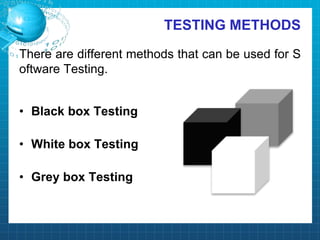
TESTING METHODS
There are different methods that can be used for S
oftware Testing.
• Black box Testing
• White box Testing
• Grey box Testing
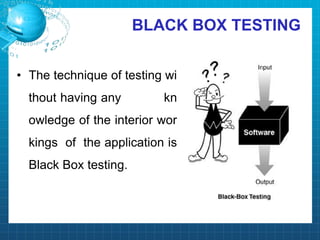
BLACK BOX TESTING
• The technique of testing wi
thout having any kn
owledge of the interior wor
kings of the application is
Black Box testing.
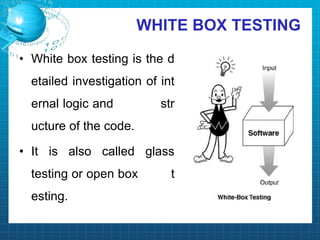
WHITE BOX TESTING
• White box testing is the d
etailed investigation of int
ernal logic and str
ucture of the code.
• It is also called glass
testing or open box t
esting.
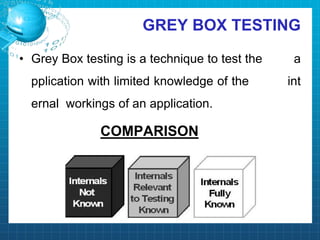
GREY BOX TESTING
• Grey Box testing is a technique to test the a
pplication with limited knowledge of the int
ernal workings of an application.
COMPARISON
Ali Raza Saleem
Reg. No# 14-arid-1402
BS(CS)
TESTING LEVELS
There are different testing levels during the process of
Software Testing.
• Functional Testing
• Non-Functional Testing
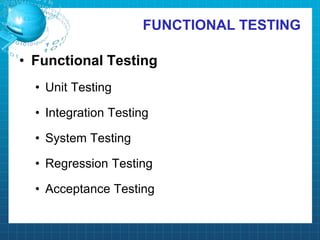
FUNCTIONAL TESTING
• Functional Testing
• Unit Testing
• Integration Testing
• System Testing
• Regression Testing
• Acceptance Testing
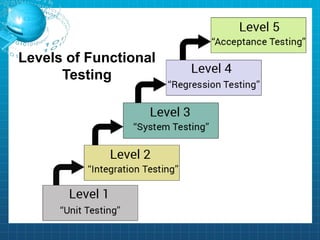
Levels of Functional
Testing
FUNCTIONAL TESTING cont..
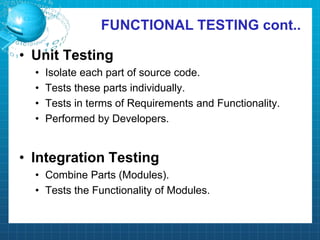
• Unit Testing
• Isolate each part of source code.
• Tests these parts individually.
• Tests in terms of Requirements and Functionality.
• Performed by Developers.
• Integration Testing
• Combine Parts (Modules).
• Tests the Functionality of Modules.
FUNCTIONAL TESTING cont..
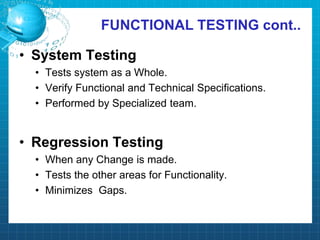
• System Testing
• Tests system as a Whole.
• Verify Functional and Technical Specifications.
• Performed by Specialized team.
• Regression Testing
• When any Change is made.
• Tests the other areas for Functionality.
• Minimizes Gaps.
FUNCTIONAL TESTING cont..
• Acceptance Testing
• Most Important Testing.
• Fulfill intended Specifications.
• Satisfies Customer Requirements.
• Point out any Bug/Major Errors.
• Performed by Quality Assurance Team.
Two Stages of Acceptance Testing
• Alpha Testing
• Beta Testing
FUNCTIONAL TESTING cont..
• Alpha Testing
• Unit, Integration, System all testing combined is kn
own as Alpha Testing.
• Performed by Developer/QA Team.
• Test for Spelling Mistakes, Broken Links, Loading a
nd Latency Problems.
FUNCTIONAL TESTING cont..
• Beta Testing
• Pre-release Testing.
• Beta test versions distributed to general public.
• Getting feedback, Fixing issues, increasing Quality.
• Having higher Quality, increases Customer Satisfactio
n
NON-FUNCTIONAL TESTING
• Non-Functional Testing
• Performance Testing
• Portability Testing
• Security Testing
NON-FUNCTIONAL TESTING cont..
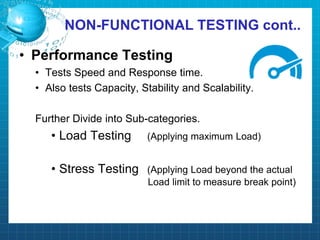
• Performance Testing
• Tests Speed and Response time.
• Also tests Capacity, Stability and Scalability.
Further Divide into Sub-categories.
• Load Testing (Applying maximum Load)
• Stress Testing (Applying Load beyond the actual
Load limit to measure break point)
NON-FUNCTIONAL TESTING cont..
• Portability Testing
• Tests Re-usability of software.
• Tests on Transferring the installed software.
• Security Testing
• Identify any Gaps from security point of view.
• Secures from unknown Vulnerability.
• Ensures Authentication and Availability.
• Remove Injections Flaws [if any].
Hafiz Ali Raza
Reg. No# 14-arid-1433
BS(IT)
SOFTWARE TESTING TOOLS
 What are Testing Tools?
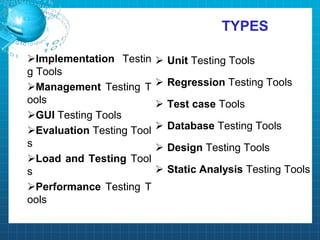
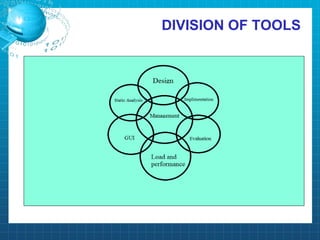
TYPES
Implementation Testin
g Tools
Management Testing T
ools
GUI Testing Tools
Evaluation Testing Tool
s
Load and Testing Tool
s
Performance Testing T
ools
 Unit Testing Tools
 Regression Testing Tools
 Test case Tools
 Database Testing Tools
 Design Testing Tools
 Static Analysis Testing Tools
DIVISION OF TOOLS
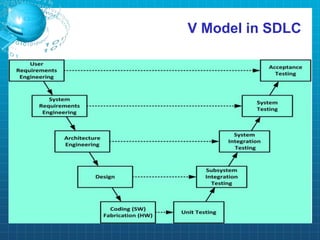
V Model in SDLC
TEST MANAGEMENT TOOLS
What are Test Management Tools?
Approach
Relation with SDLC
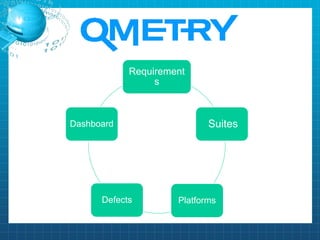
QMetry
Requirement
s
Suites
PlatformsDefects
Dashboard
Software Testing , levels, Techniques, Tools

Software Testing , levels, Techniques, Tools

  • 2.
  • 3.
    GROUP MEMBERS • HamzaWilayat Reg. no. 1409 BS-CS • Ali Raza Saleem Reg. no. 1402 BS-CS • Hafiz Ali Raza Reg. no. 1433 BS-CS
  • 4.
  • 5.
    WHAT IS TESTING? SimpleDefinition: It is the process used to identify the correctn ess, completeness and quality of developed co mputer software.
  • 6.
    SOFTWARE TESTING Standard Definition: Accordingto ANSI/IEEE 1059 standard, Testing can be defined as “A process of analyzing a software it em to detect the differences between existing and r equired conditions (that is defects/errors/bugs) and to evaluate the features of the software item”.
  • 7.
    TESTING V/S DEBUGGING Testing It involves the identification of bug/error/defect in the software without correcting it. Normally professionals are in volved in the identification of bugs. Testing is perform ed in the testing phase.  Debugging It involves identifying, isolating and fixing the proble ms/bugs. Developers who code the software conduct debu gging upon encountering an error in the code.
  • 8.
    VERIFICATION AND VALIDATION (V&V) •Verification ` The software should confirm to its specification. (A re we building the product right?) • Validation The software should do what the user really requires .(Are we building the right product?)
  • 9.
    TESTING METHODS There aredifferent methods that can be used for S oftware Testing. • Black box Testing • White box Testing • Grey box Testing
  • 10.
    BLACK BOX TESTING •The technique of testing wi thout having any kn owledge of the interior wor kings of the application is Black Box testing.
  • 11.
    WHITE BOX TESTING •White box testing is the d etailed investigation of int ernal logic and str ucture of the code. • It is also called glass testing or open box t esting.
  • 12.
    GREY BOX TESTING •Grey Box testing is a technique to test the a pplication with limited knowledge of the int ernal workings of an application. COMPARISON
  • 13.
    Ali Raza Saleem Reg.No# 14-arid-1402 BS(CS)
  • 14.
    TESTING LEVELS There aredifferent testing levels during the process of Software Testing. • Functional Testing • Non-Functional Testing
  • 15.
    FUNCTIONAL TESTING • FunctionalTesting • Unit Testing • Integration Testing • System Testing • Regression Testing • Acceptance Testing
  • 16.
  • 17.
    FUNCTIONAL TESTING cont.. •Unit Testing • Isolate each part of source code. • Tests these parts individually. • Tests in terms of Requirements and Functionality. • Performed by Developers. • Integration Testing • Combine Parts (Modules). • Tests the Functionality of Modules.
  • 18.
    FUNCTIONAL TESTING cont.. •System Testing • Tests system as a Whole. • Verify Functional and Technical Specifications. • Performed by Specialized team. • Regression Testing • When any Change is made. • Tests the other areas for Functionality. • Minimizes Gaps.
  • 19.
    FUNCTIONAL TESTING cont.. •Acceptance Testing • Most Important Testing. • Fulfill intended Specifications. • Satisfies Customer Requirements. • Point out any Bug/Major Errors. • Performed by Quality Assurance Team. Two Stages of Acceptance Testing • Alpha Testing • Beta Testing
  • 20.
    FUNCTIONAL TESTING cont.. •Alpha Testing • Unit, Integration, System all testing combined is kn own as Alpha Testing. • Performed by Developer/QA Team. • Test for Spelling Mistakes, Broken Links, Loading a nd Latency Problems.
  • 21.
    FUNCTIONAL TESTING cont.. •Beta Testing • Pre-release Testing. • Beta test versions distributed to general public. • Getting feedback, Fixing issues, increasing Quality. • Having higher Quality, increases Customer Satisfactio n
  • 22.
    NON-FUNCTIONAL TESTING • Non-FunctionalTesting • Performance Testing • Portability Testing • Security Testing
  • 23.
    NON-FUNCTIONAL TESTING cont.. •Performance Testing • Tests Speed and Response time. • Also tests Capacity, Stability and Scalability. Further Divide into Sub-categories. • Load Testing (Applying maximum Load) • Stress Testing (Applying Load beyond the actual Load limit to measure break point)
  • 24.
    NON-FUNCTIONAL TESTING cont.. •Portability Testing • Tests Re-usability of software. • Tests on Transferring the installed software. • Security Testing • Identify any Gaps from security point of view. • Secures from unknown Vulnerability. • Ensures Authentication and Availability. • Remove Injections Flaws [if any].
  • 25.
    Hafiz Ali Raza Reg.No# 14-arid-1433 BS(IT)
  • 26.
    SOFTWARE TESTING TOOLS What are Testing Tools?
  • 27.
    TYPES Implementation Testin g Tools ManagementTesting T ools GUI Testing Tools Evaluation Testing Tool s Load and Testing Tool s Performance Testing T ools  Unit Testing Tools  Regression Testing Tools  Test case Tools  Database Testing Tools  Design Testing Tools  Static Analysis Testing Tools
  • 28.
  • 29.
  • 30.
    TEST MANAGEMENT TOOLS Whatare Test Management Tools? Approach Relation with SDLC QMetry
  • 31.