1
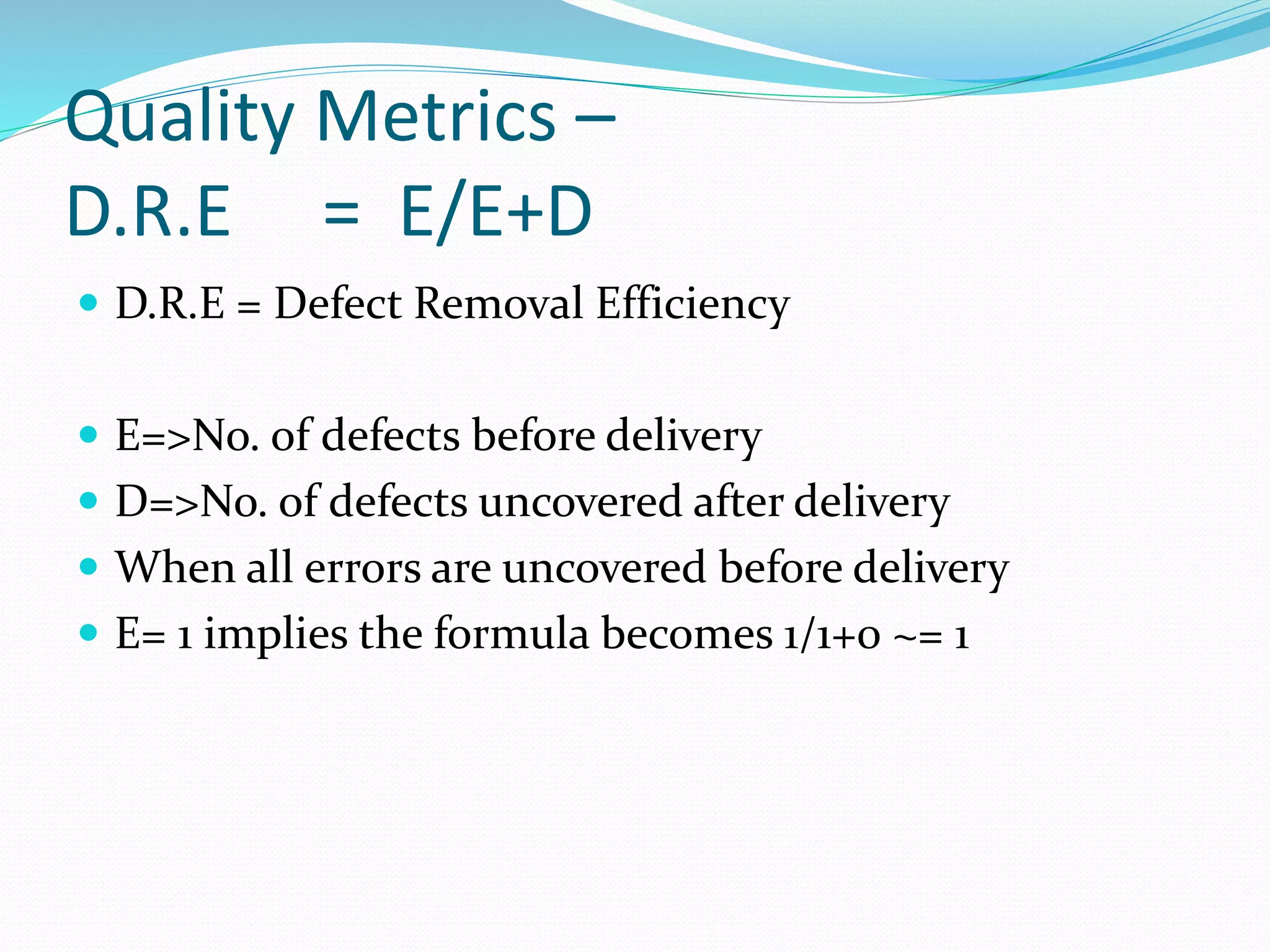
Quality Metrics –
D.R.E = E/E+D
 D.R.E = Defect Removal Efficiency
 E=>No. of defects before delivery
 D=>No. of defects uncovered after delivery
 When all errors are uncovered before delivery
 E= 1 implies the formula becomes 1/1+0 ~= 1
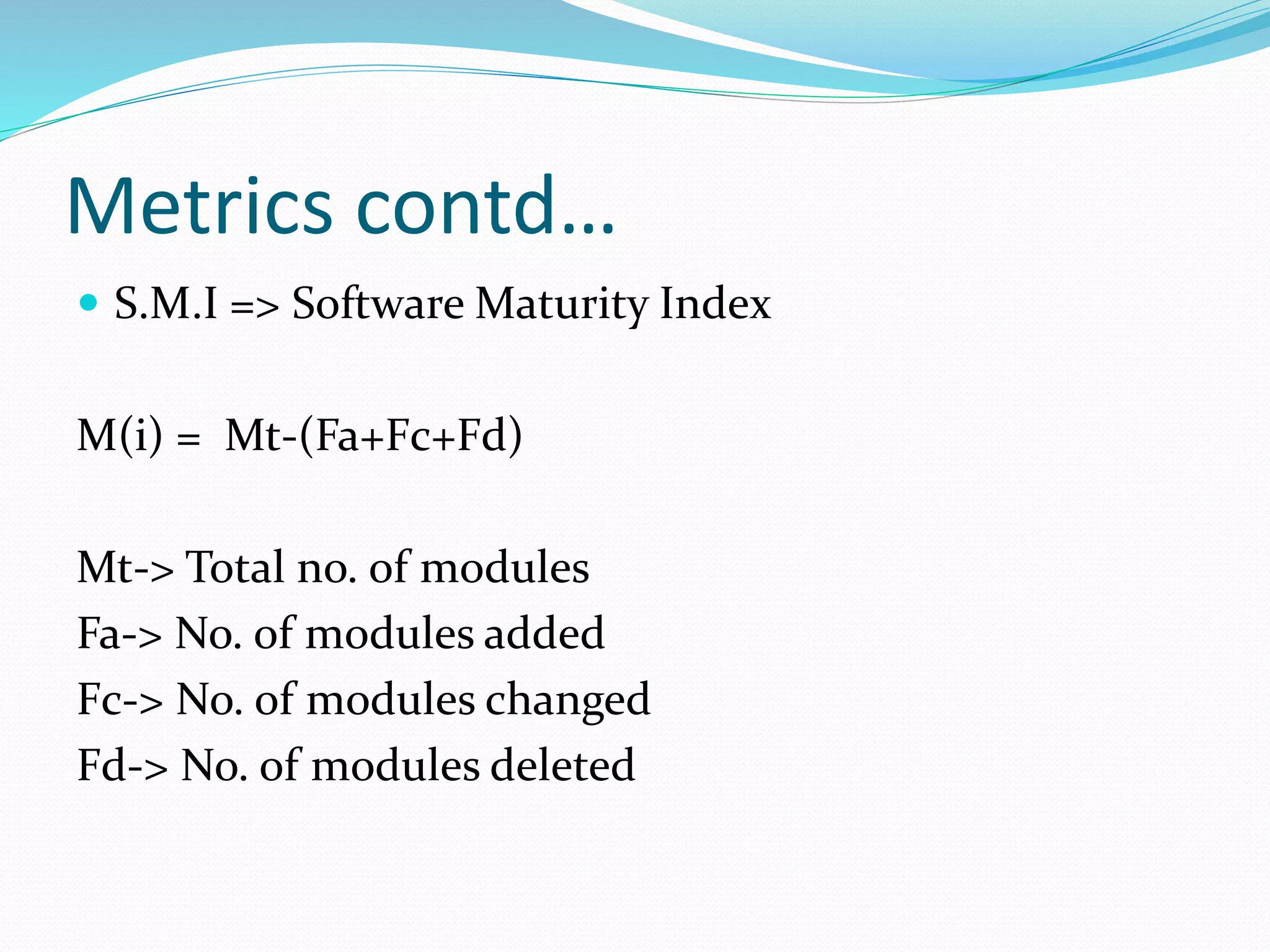
Metrics contd…
 S.M.I => Software Maturity Index
M(i) = Mt-(Fa+Fc+Fd)
Mt-> Total no. of modules
Fa-> No. of modules added
Fc-> No. of modules changed
Fd-> No. of modules deleted
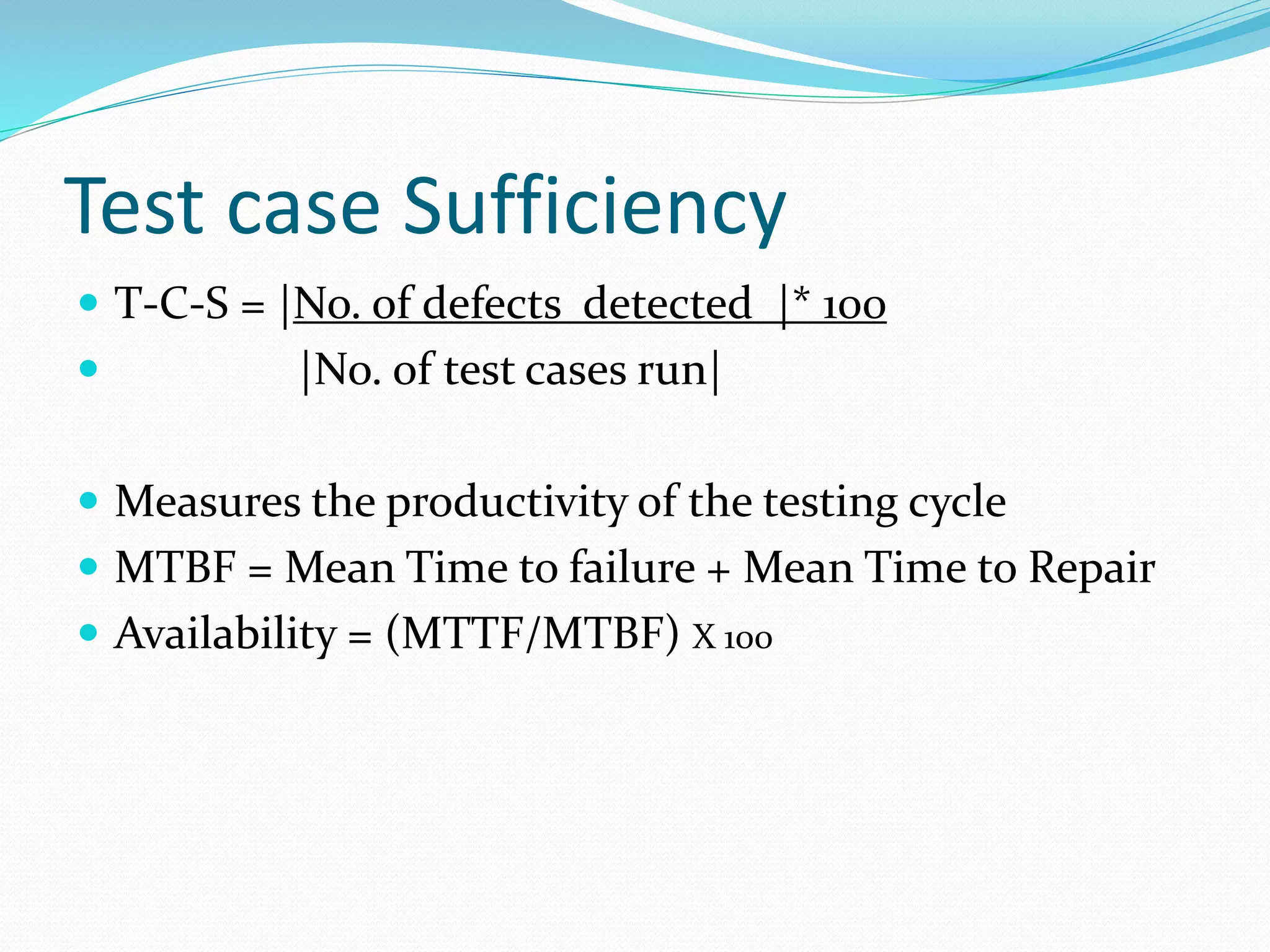
Test case Sufficiency
 T-C-S = |No. of defects detected |* 100
 |No. of test cases run|
 Measures the productivity of the testing cycle
 MTBF = Mean Time to failure + Mean Time to Repair
 Availability = (MTTF/MTBF) X 100
INTRODUCTION
“Quality” - Definition
 Quality devotes the characteristics of a product as
service that ability to satisfy implied needs and free of
deficiencies.
 Quality refer to any measurable characteristics such as
correctness, maintainability, portability, testability,
usability, reliability, efficiency, integrity, reusability and
interoperability.
Software Reliability: -
 The probability of failure-free operation of a computer
program for a specified time under a specified
environment.
Two Terms:
1. FAULT: A defect in the Software , that fail to perform its
required function under particular condition is called fault.
Ex: bug in the code which may cause a failure.
1. Failure: It is inability of a system or component
to perform required function from its
specification.
Ex: external behavior is incorrect
Why We Require Software Quality And Reliability
To face the corporate challenges and to function day to day activities
with out failure, we require software quality reliability.
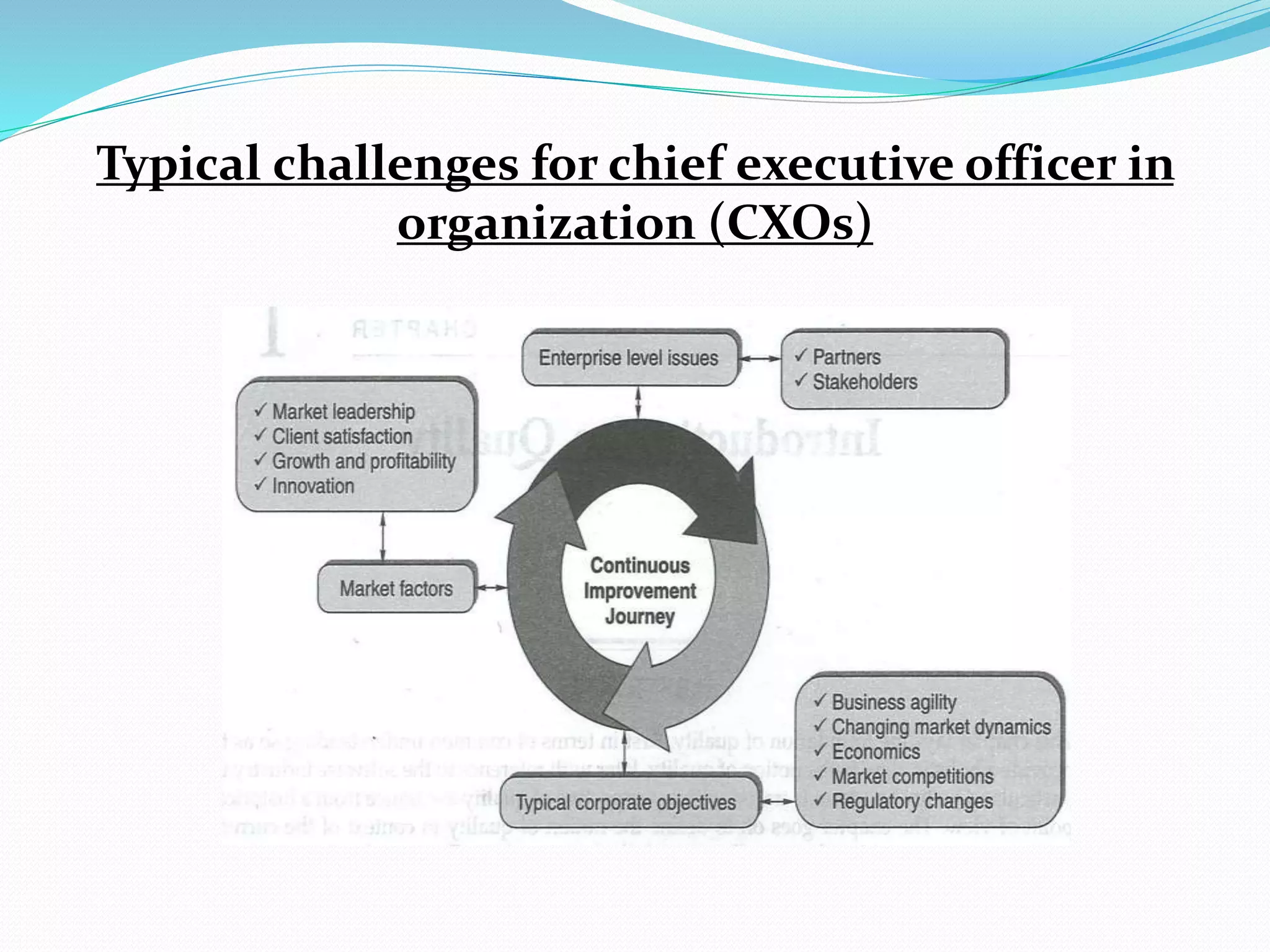
The following figure explains the challenges that various
organization face in their day to day functioning.
Typical challenges for chief executive officer in
organization (CXOs)
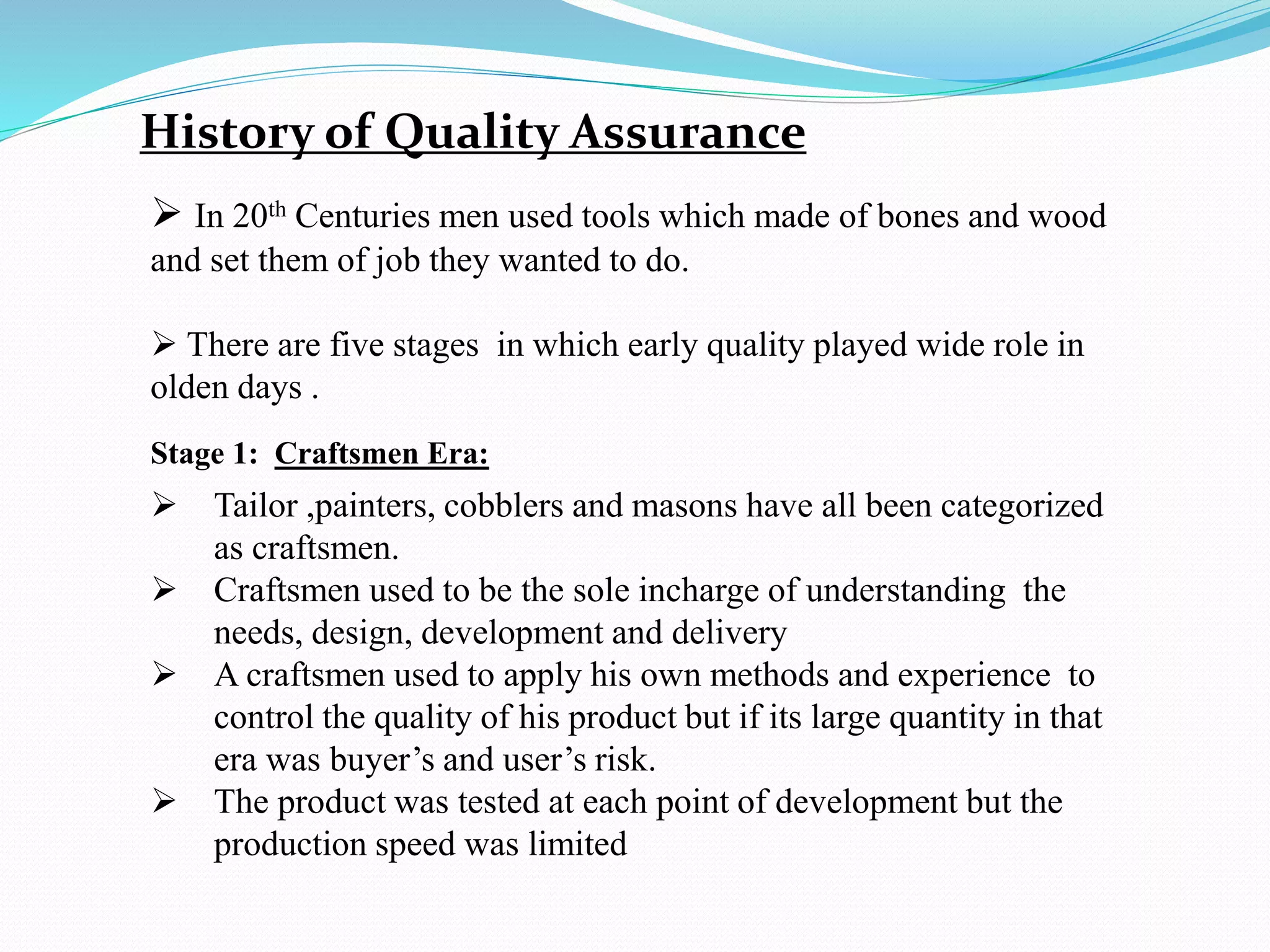
History of Quality Assurance
 In 20th Centuries men used tools which made of bones and wood
and set them of job they wanted to do.
 There are five stages in which early quality played wide role in
olden days .
Stage 1: Craftsmen Era:
 Tailor ,painters, cobblers and masons have all been categorized
as craftsmen.
 Craftsmen used to be the sole incharge of understanding the
needs, design, development and delivery
 A craftsmen used to apply his own methods and experience to
control the quality of his product but if its large quantity in that
era was buyer’s and user’s risk.
 The product was tested at each point of development but the
production speed was limited
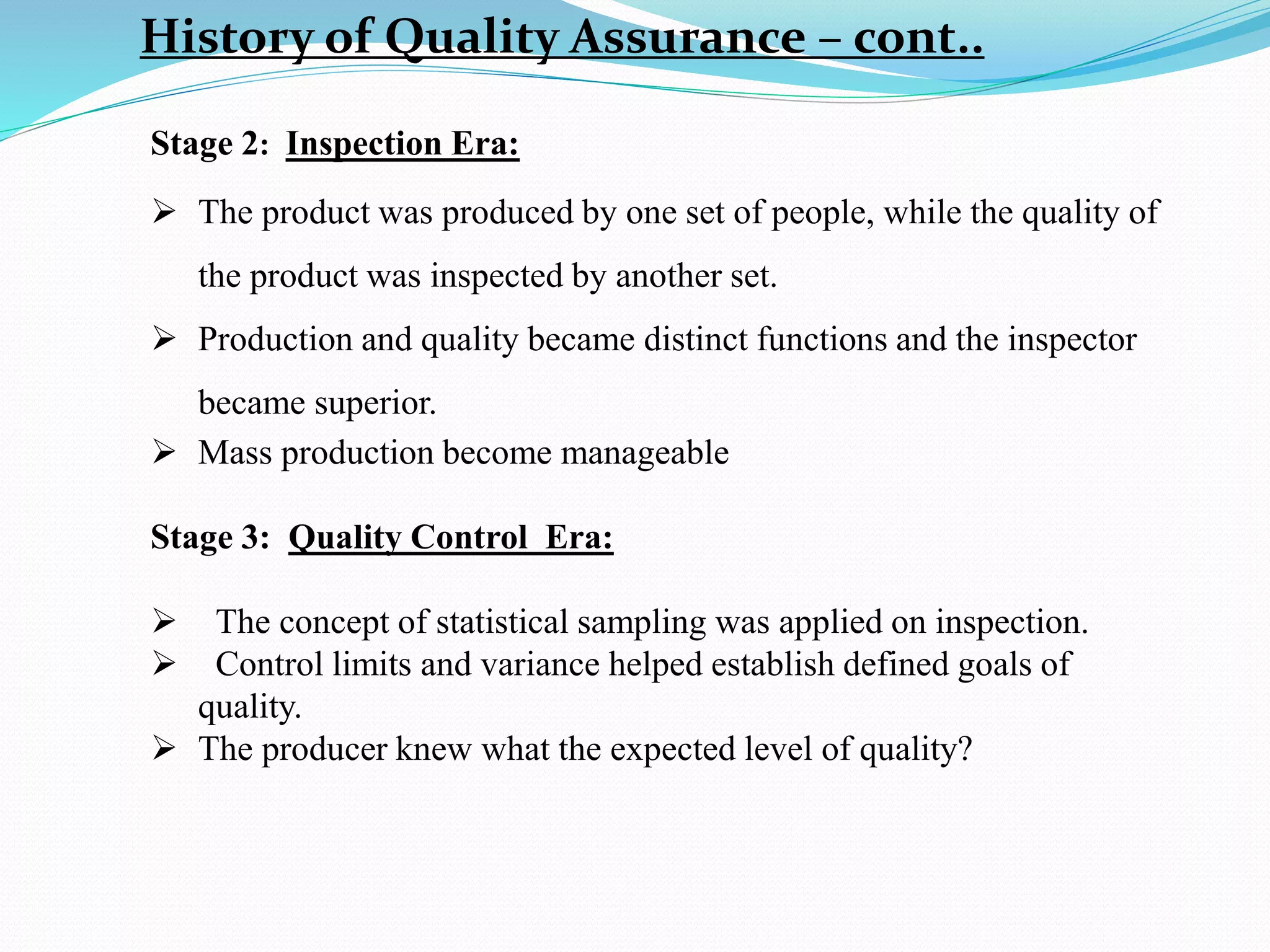
History of Quality Assurance – cont..
Stage 2: Inspection Era:
 The product was produced by one set of people, while the quality of
the product was inspected by another set.
 Production and quality became distinct functions and the inspector
became superior.
 Mass production become manageable
Stage 3: Quality Control Era:
 The concept of statistical sampling was applied on inspection.
 Control limits and variance helped establish defined goals of
quality.
 The producer knew what the expected level of quality?
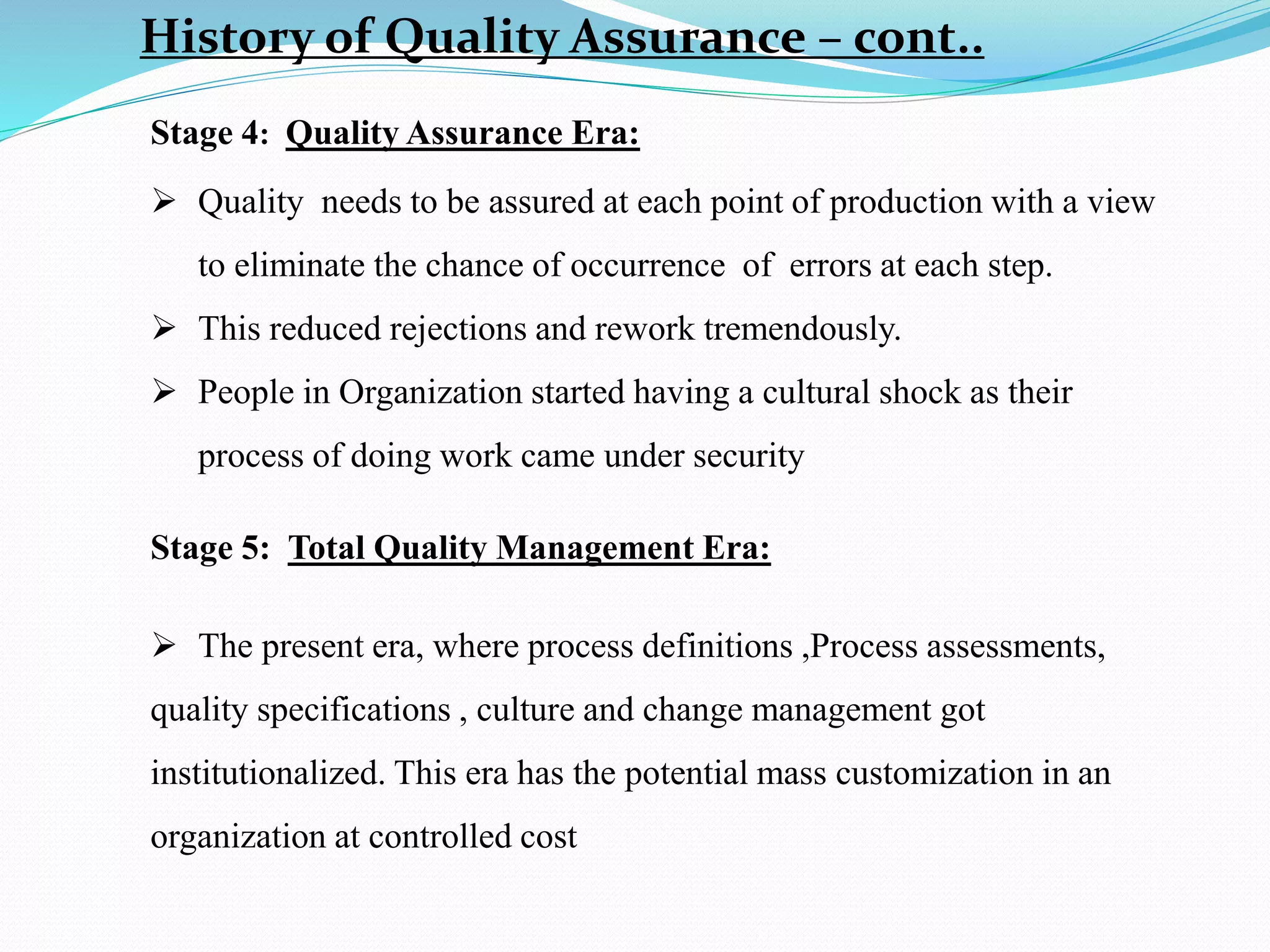
History of Quality Assurance – cont..
Stage 4: Quality Assurance Era:
 Quality needs to be assured at each point of production with a view
to eliminate the chance of occurrence of errors at each step.
 This reduced rejections and rework tremendously.
 People in Organization started having a cultural shock as their
process of doing work came under security
Stage 5: Total Quality Management Era:
 The present era, where process definitions ,Process assessments,
quality specifications , culture and change management got
institutionalized. This era has the potential mass customization in an
organization at controlled cost
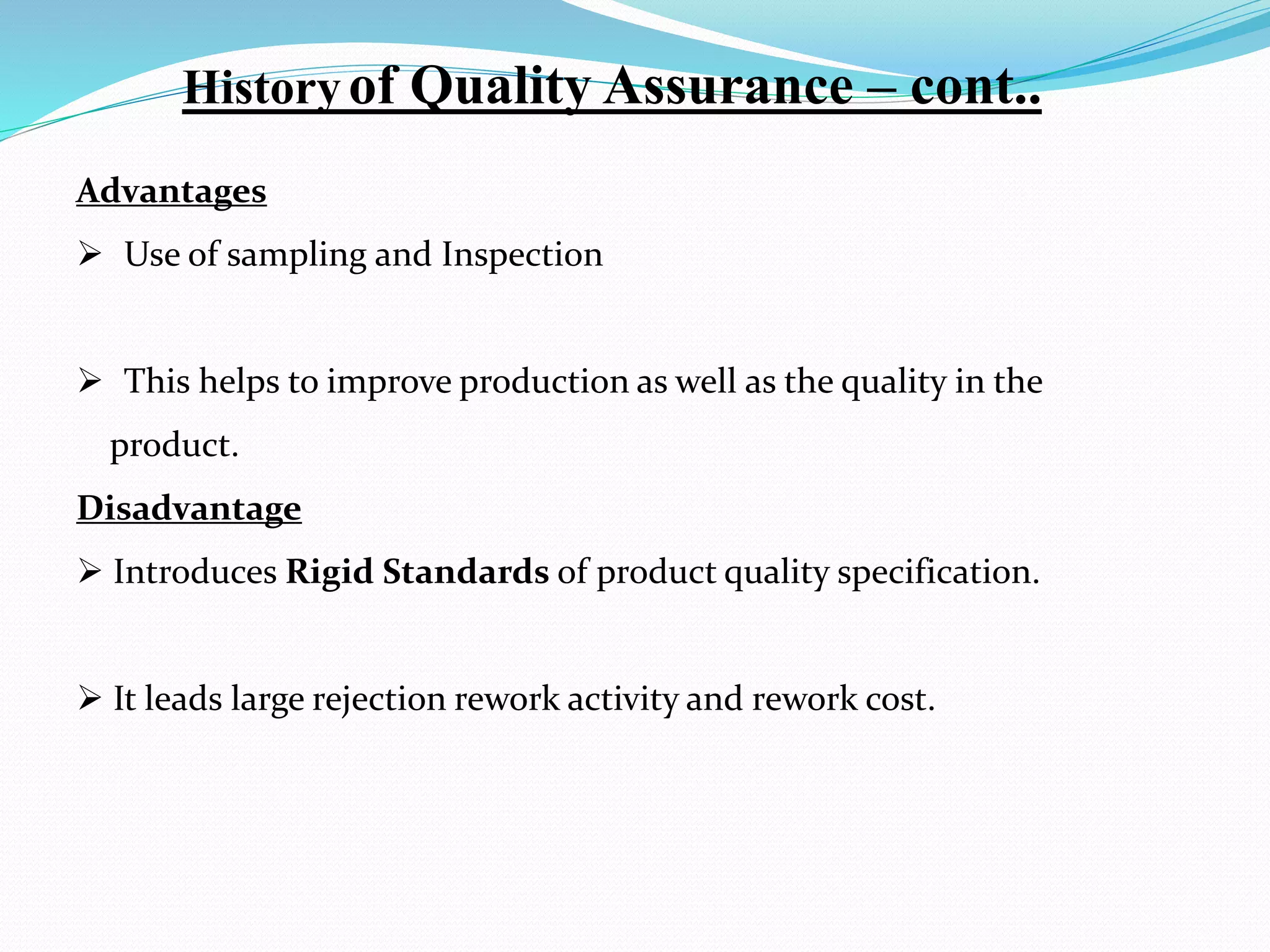
Advantages
 Use of sampling and Inspection
 This helps to improve production as well as the quality in the
product.
Disadvantage
 Introduces Rigid Standards of product quality specification.
 It leads large rejection rework activity and rework cost.
Historyof Quality Assurance – cont..
Quality In The Current Business Scenario
 Quality in the current Business experts changes in some
factors such as
Reducing Cost
Increase Efficiencies
Innovation for Competitive advantage
Manage Industry in consolidation
Deal with investor confidence
 There are two factors
1. Internal
2. external
 Quality in the current Business come from internal & external directions.
Internal Business:
 The stakeholders demand more on customers suppliers, partners & The
Competitors.
 The Corporation expects more on growth, leadership, client satisfaction
ability to face competitor with innovation.
Quality In The Current Business Scenario – cont..
External Business:
 It concentrate more on
 Mergers (union)
 Acquisitions (gaining)
 Regulations & Deregulation
 Technology
 So both external & Internal objectives help the organization to fare the
market forces.
Quality In The Current Business Scenario – cont..
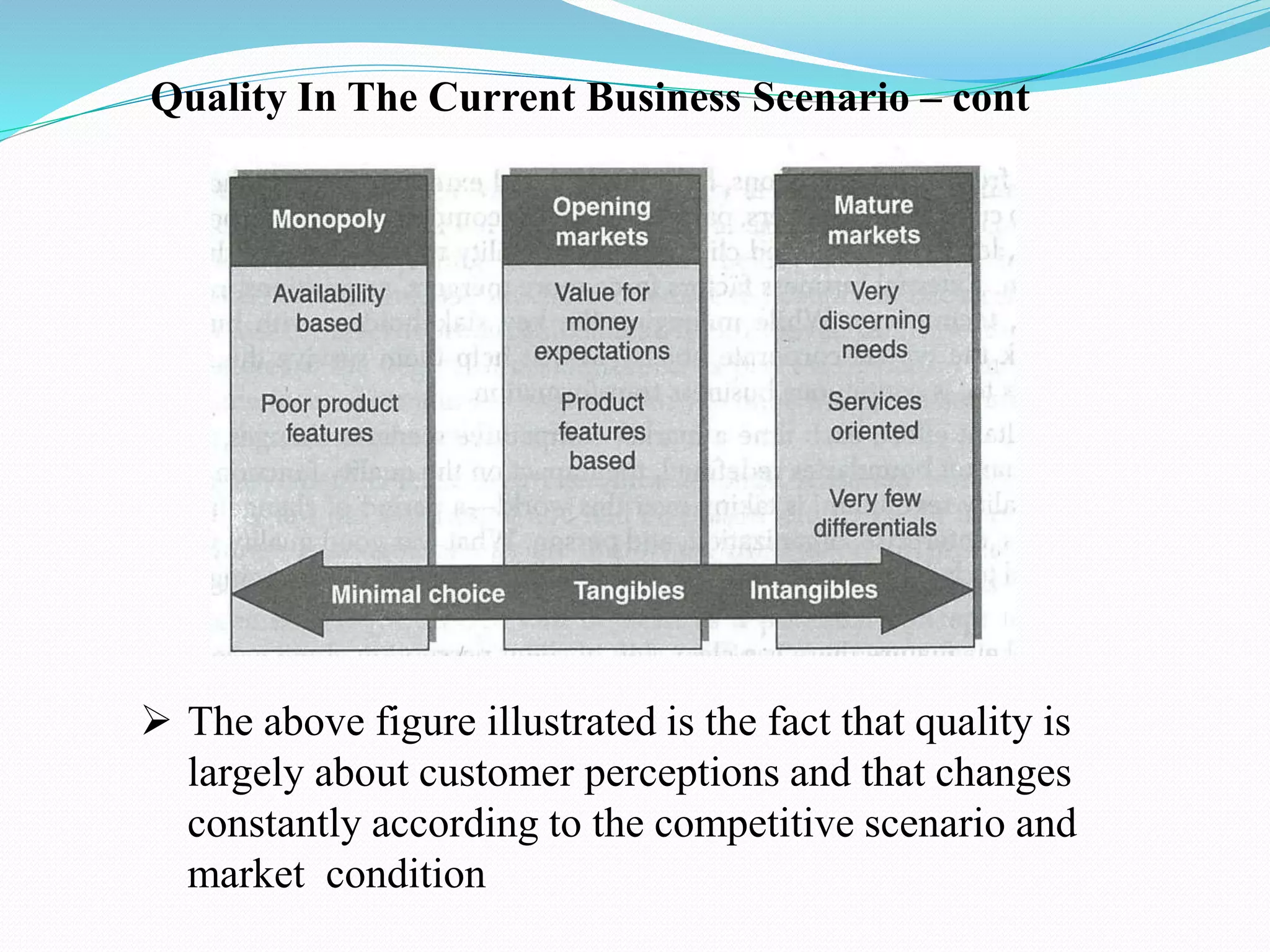
 As a resultant effect, each time a market competitive scenario changes,
new segments are born & market boundaries redefines and quality
function is high.
 Therefore quality changes with customer perception & market maturity.
 Figure illustrate the changes between customer perception & market
maturity.
Quality In The Current Business Scenario – cont
 The above figure illustrated is the fact that quality is
largely about customer perceptions and that changes
constantly according to the competitive scenario and
market condition
1. Juran Trilogy
2. Deming PDCA Cycle
3. Quality Control & Assurance
4. Cost of Quality
5. ISO 9000 & Quality
MODELS & FRAME WORKS OF QUALITY
I ) Juran Trilogy:
 Juran explained his model of quality on the basis of three
Processes so its named as “ Juran Trilogy “. They process
are
1. Quality Planning
2. Quality Control
3. Quality improvement
MODELS & FRAME WORKS OF QUALITY cont..
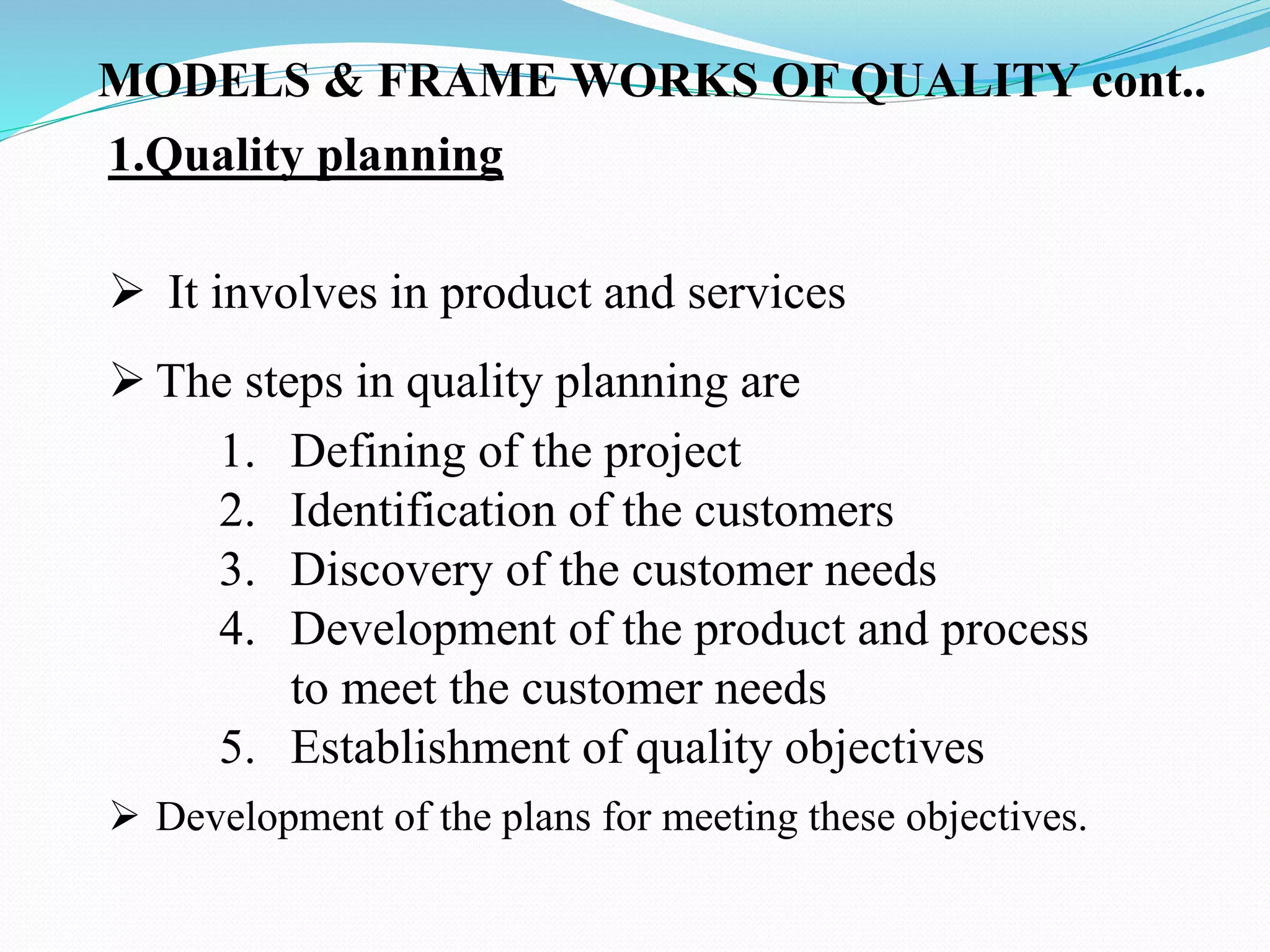
 Development of the plans for meeting these objectives.
MODELS & FRAME WORKS OF QUALITY cont..
1.Quality planning
 It involves in product and services
 The steps in quality planning are
1. Defining of the project
2. Identification of the customers
3. Discovery of the customer needs
4. Development of the product and process
to meet the customer needs
5. Establishment of quality objectives
2.Quality control
 It involves in the developing & maintaining of operational methods to
achieve target.
 The steps followed in quality control.
1. Clear definitions of quality.
2. Knowledge of expected forgets.
3. Evaluation of the actual operating performance.
4. Comparison of the actual performance to goals.
5. Action on the difference.
MODELS & FRAME WORKS OF QUALITY cont..
3.Quality improvement
 It involves to improve the level of performance of the process to
achieve a new innovation or fresh idea to improve the current
performance level.
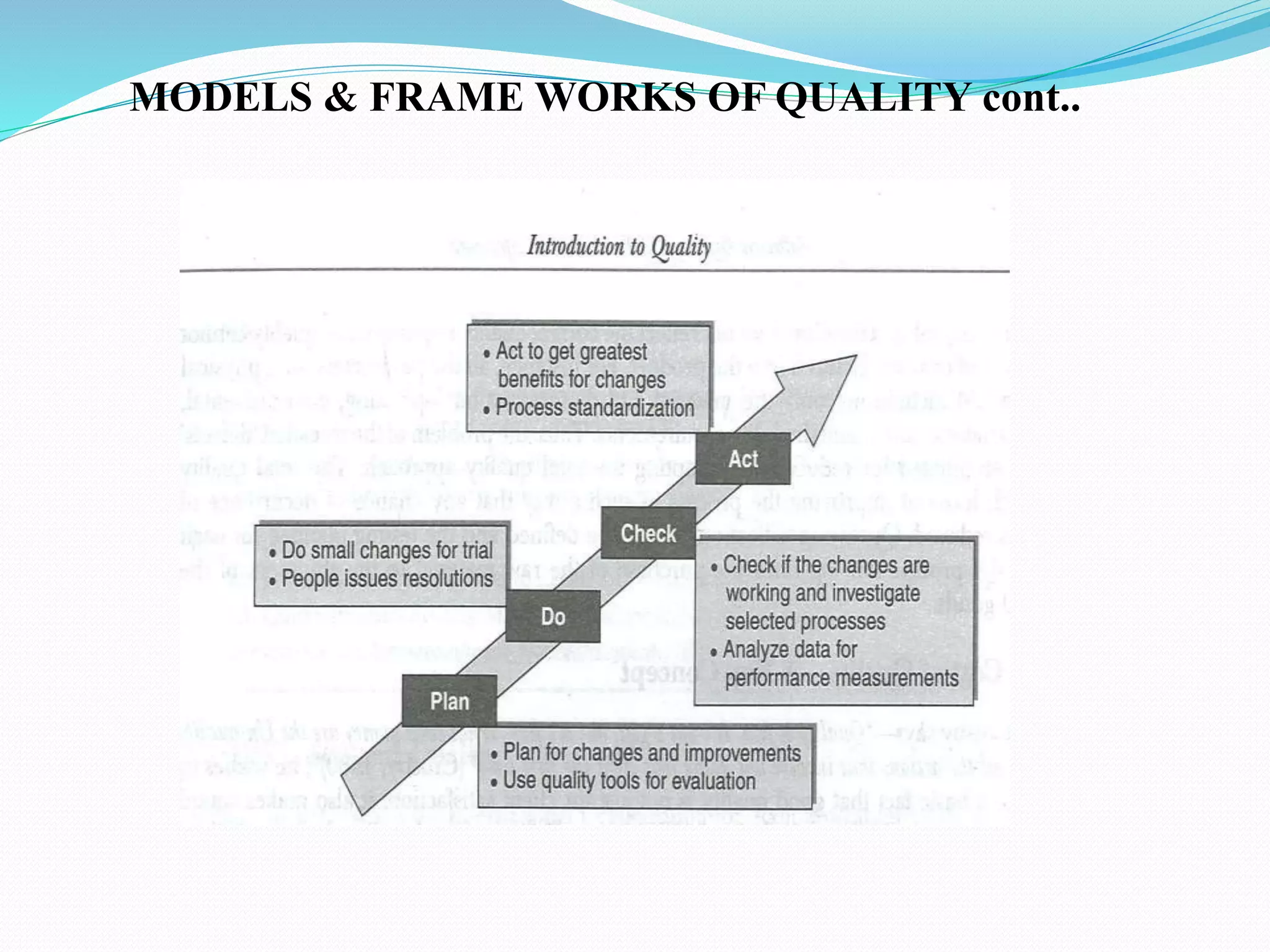
II ) Deming PDCA Cycle:
 He created a four step process that is basic to all the modern improvement.
 The four steps are Plan-Do-Check-Act.
MODELS & FRAME WORKS OF QUALITY cont..
 Characteristics
 Performance
 Reliability
 Maintainability
 Safety
 All of the functions need to be followed to avoid defects, & errors.
 Basic changes introduced in TQC area are:
 Understanding & defining customers requirements.
 Defining the specification.
 Defining the documents.
Conducting the inspection
 Setting up the internal department for rework.
 Satisfactorily dealing with any complaints from customers.
 Use the feedback from the user / customer.
III) Quality control & Assurance:
 It focus on the entire business function as TQC (Total quality Control).
 It includes some of the functions like
MODELS & FRAME WORKS OF QUALITY cont..
IV) Cost of Quality
 The cost of quality defined as
Cost of quality = Cost of Prevention +Cost of Appraisal + Cost of Failure
Two types of cost
1. Good cost – Prevention & Appraisal
2. Bad Cost – Cost of Failure
MODELS & FRAME WORKS OF QUALITY cont..
Prevention cost:
Cost of training
 Quality planning
 Testing Tools
 Evaluations etc.
Delivery
Inspection
Reviews
Testing etc.,
Bad Cost Or Failure Cost:
MODELS & FRAME WORKS OF QUALITY cont..
Cost of Appraisal:
 Product recall
 Rework
 Complaint
 1947 – ISO Found
 International Organization for Standardization
5). ISO 9000 & Quality
ISO Quality
 Certification provided to the companies by certified auditors
 Who were accredited by accreditation bodies & recognized by ISO.
It includes
MODELS & FRAME WORKS OF QUALITY cont..
 Customer satisfaction to the business.
 Management takes responsible with customer.
 Defining the quality policy
 Current business objectives for the organization
 Resource Management to be performed by following aspects
Infrastructure
HR
Training
Monitoring
Development
Competencies
Performed
MODELS & FRAME WORKS OF QUALITY cont..
 Performance are
Software Industry – An Engine To The Future
 Software industry Called as engine to the future
 Industry cannot be Mould or Manufacture
Industry is Software Product & Software Services
It all happening by the Individuals, Individual excellence & process
maturity which vary from one another.
The software industry changes in technologies of telecom, fabric
industry, hardware and software industry in which the world lives
today
1.Software Engineering:
 Software Engineering that creates and maintains software applications
by applying technology & practices from computer science, project Mgt,
Engineering, application domains etc.,
 Software Engineering deals with issues of cost & reliability.
2. History of Software Engineering
Software Quality – An Overview
 “Quality of software development was today called as software
engineering”
 Write about how software engineering came and how (ref : net)
Software Quality – Utilitarian view
Utilitarian View means functionality view.
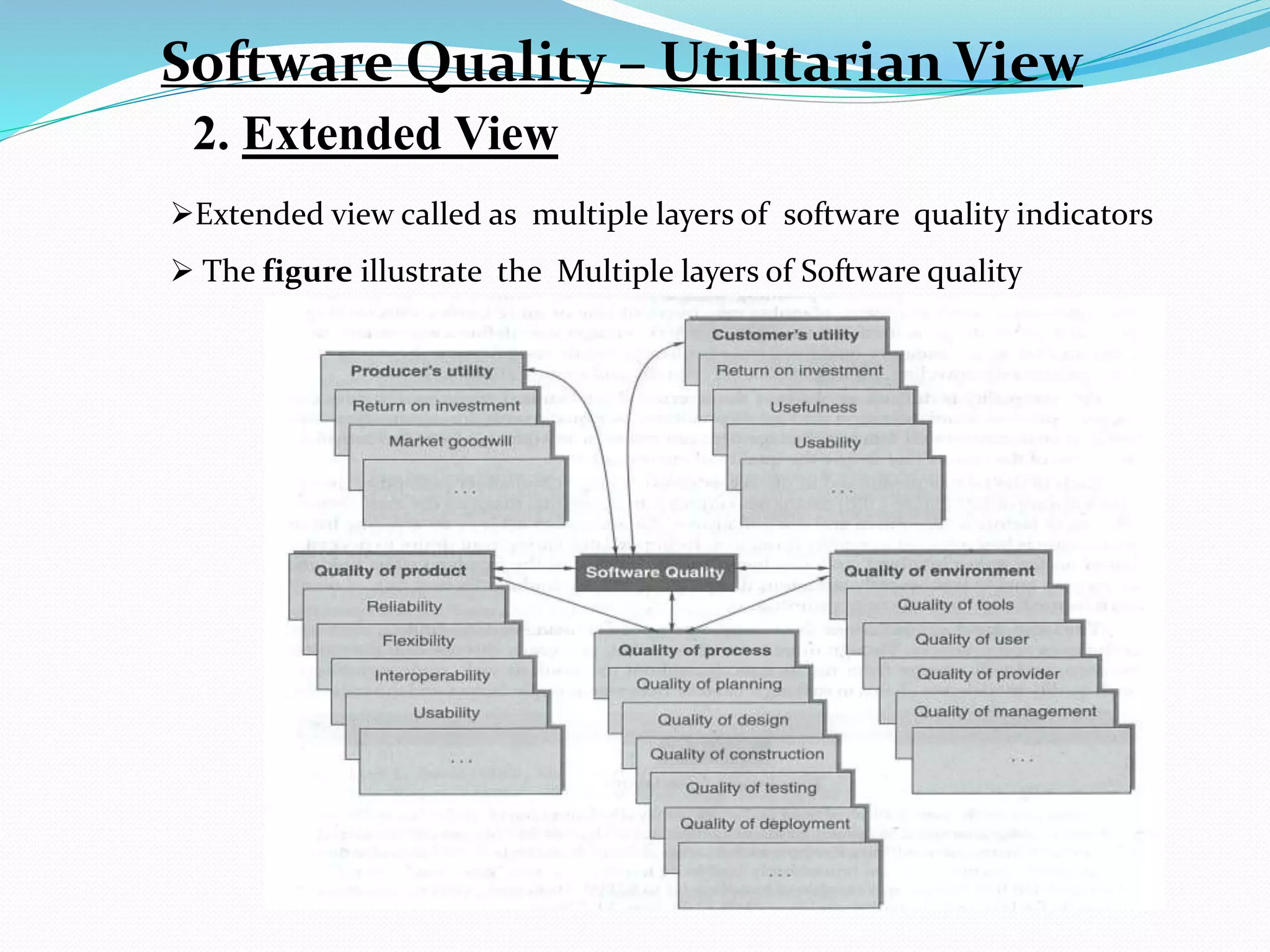
Multiple Layers of Software Quality indicators ie: overview of multi
factors and multi criteria are shown in the figure
Overview Extended View
Extended view called as multiple layers of software quality indicators
 The figure illustrate the Multiple layers of Software quality
2. Extended View
Software Quality – Utilitarian View
Software Process – Models & Frameworks
Definition:
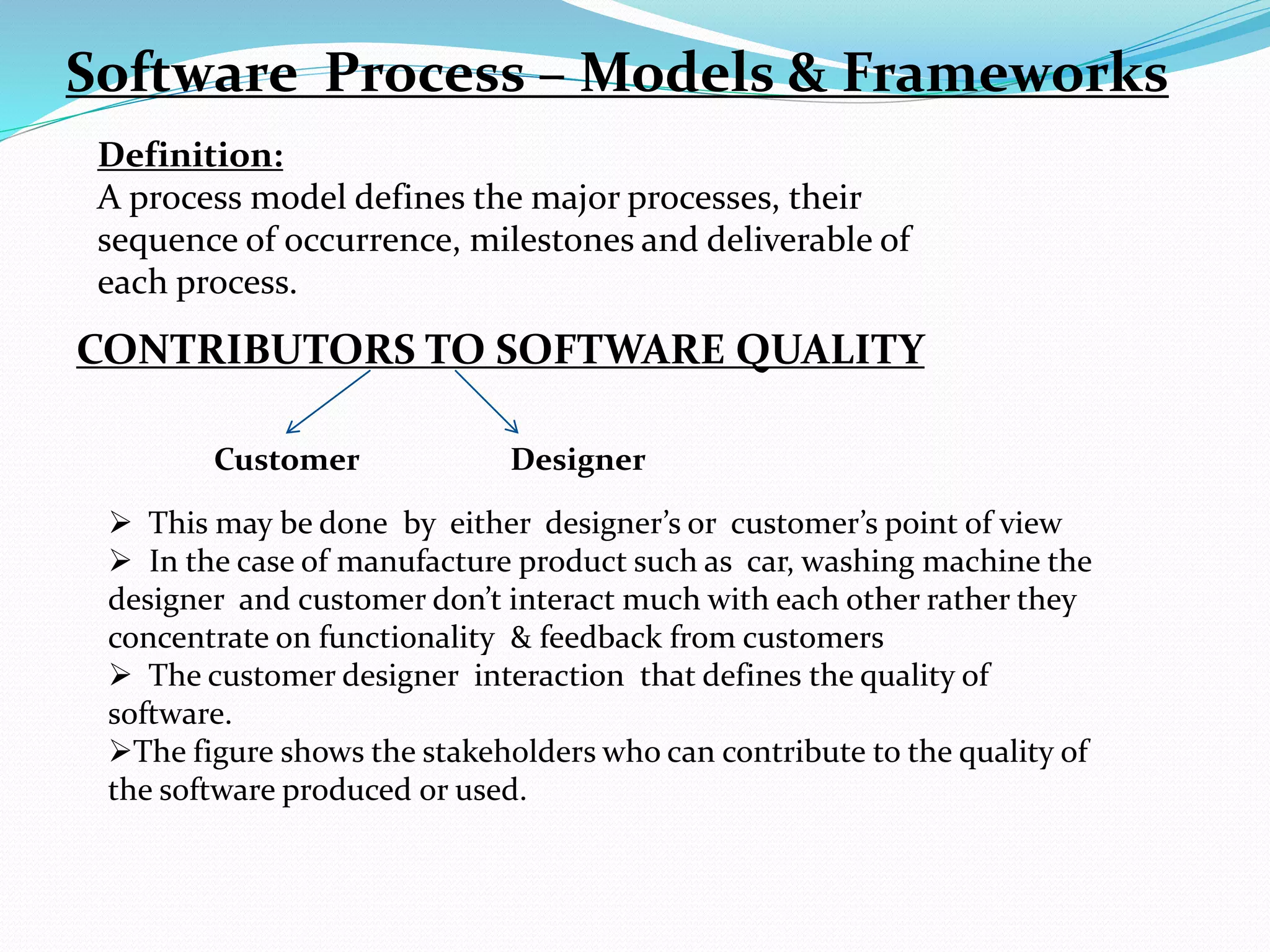
A process model defines the major processes, their
sequence of occurrence, milestones and deliverable of
each process.
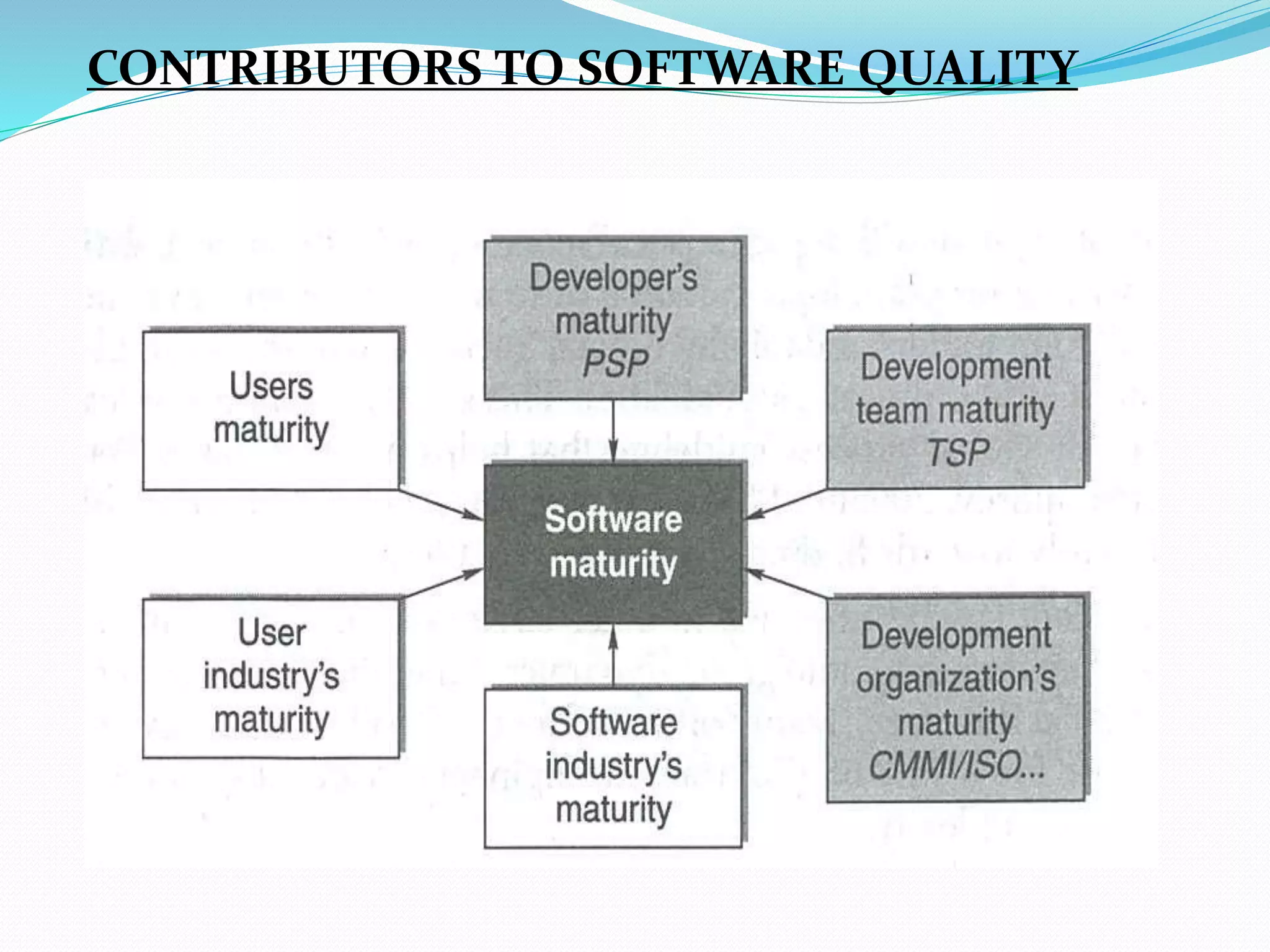
CONTRIBUTORS TO SOFTWARE QUALITY
Customer Designer
 This may be done by either designer’s or customer’s point of view
 In the case of manufacture product such as car, washing machine the
designer and customer don’t interact much with each other rather they
concentrate on functionality & feedback from customers
 The customer designer interaction that defines the quality of
software.
The figure shows the stakeholders who can contribute to the quality of
the software produced or used.
CONTRIBUTORS TO SOFTWARE QUALITY
These are two types of product
1. Physical product
2. Non Physical
CONTRIBUTORS TO SOFTWARE QUALITY
1.Physical product
 Human error is controlled & Standard performances obtained by
engineering tools that work the same way each time without any
change.
 Ex: Painting car mechanism.
2. Non Physical Goods:
CONTRIBUTORS TO SOFTWARE QUALITY
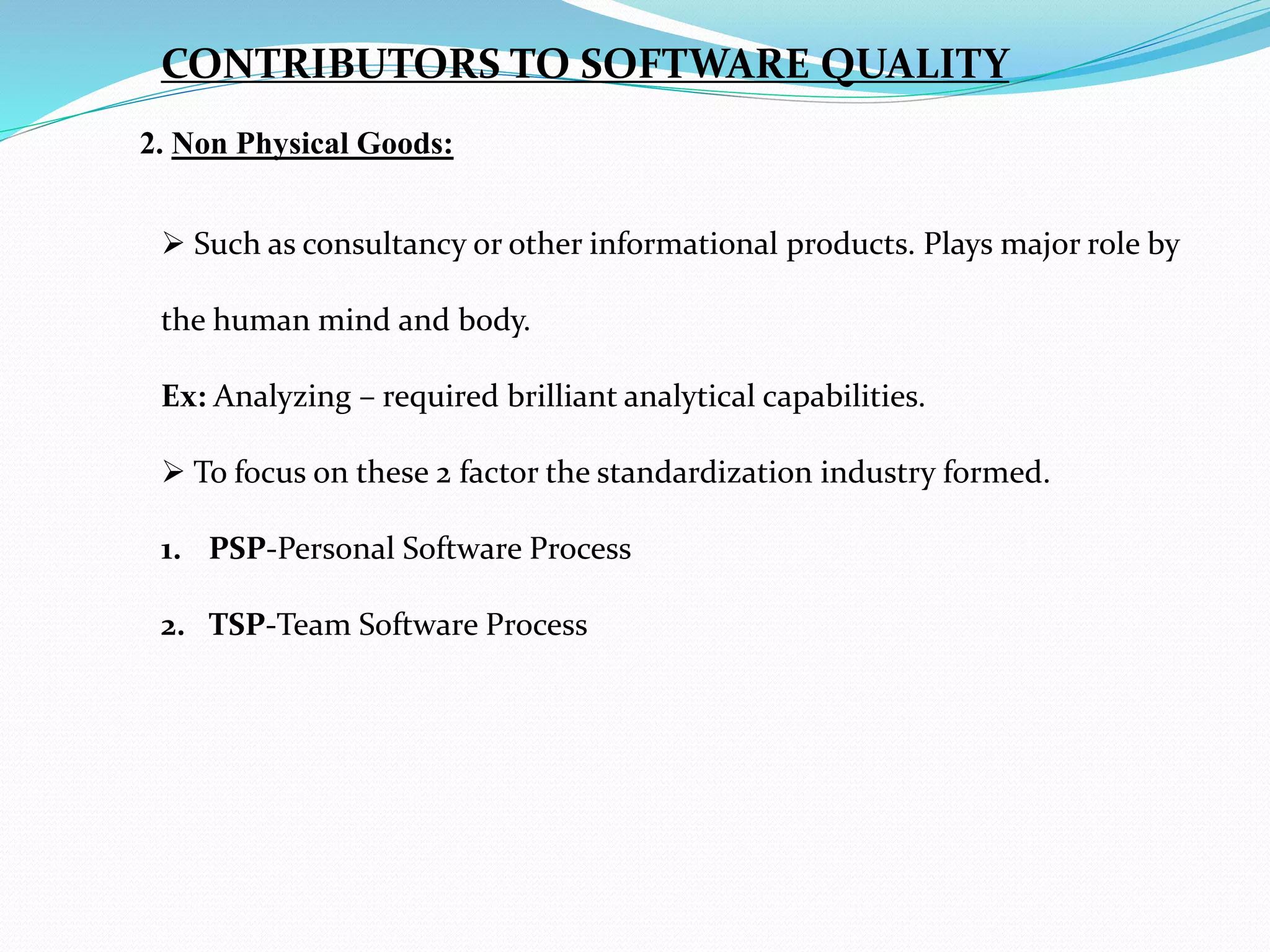
 Such as consultancy or other informational products. Plays major role by
the human mind and body.
Ex: Analyzing – required brilliant analytical capabilities.
 To focus on these 2 factor the standardization industry formed.
1. PSP-Personal Software Process
2. TSP-Team Software Process
MODELS AFFECTING SOFTWARE QUALITY
There are parameters that overall affect the maturity of software
To increase the developer mature there are four categories.
1. Software Development process model (E.g: SDLC, Spiral…)
2. Quality Standards ( Eg: ISO, CRS 9000)
3. Quality Guidelines ( Eg: Six Sigma, PSP, TSP )
4. Software Process Improvement models (Eg: SW-CMM, CMMI)
SOFTWARE DEVELOPMENT PROCESS MODELS
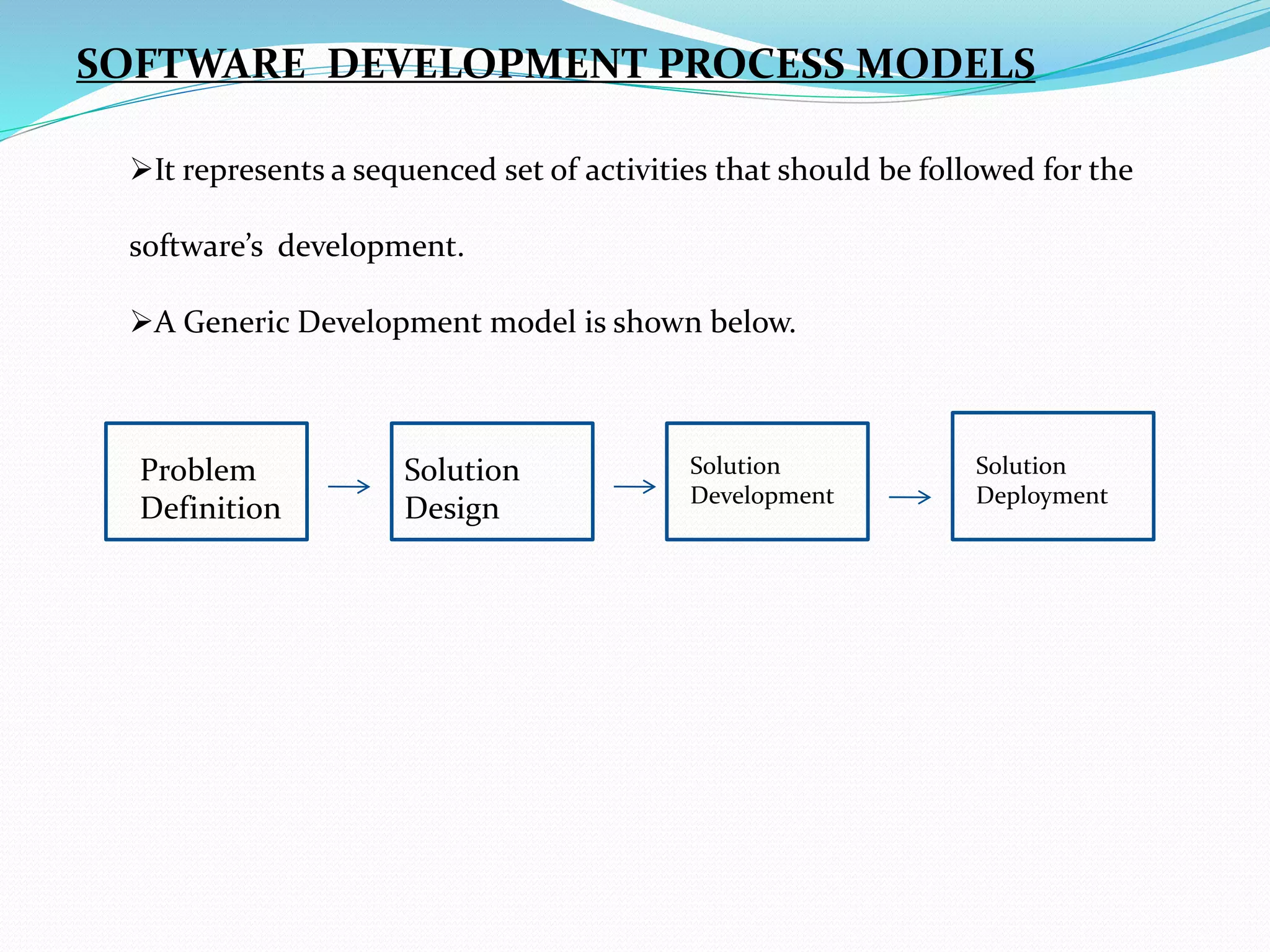
It represents a sequenced set of activities that should be followed for the
software’s development.
A Generic Development model is shown below.
Problem
Definition
Solution
Design
Solution
Development
Solution
Deployment
 They are seven software development process models
1. Software Development life cycle model
2. Prototype model
3. Spiral Model
4. V-Model
5. Unified process model
6. Agile process model
7. Choice of Models
SOFTWARE DEVELOPMENT PROCESS MODELS Cont…
1. Software Development Life Cycle Model
Till 1980 water fall model is used.
After that an improved from of the water fall model is the classical s/w
development Life Cycle (SDLC) Model.
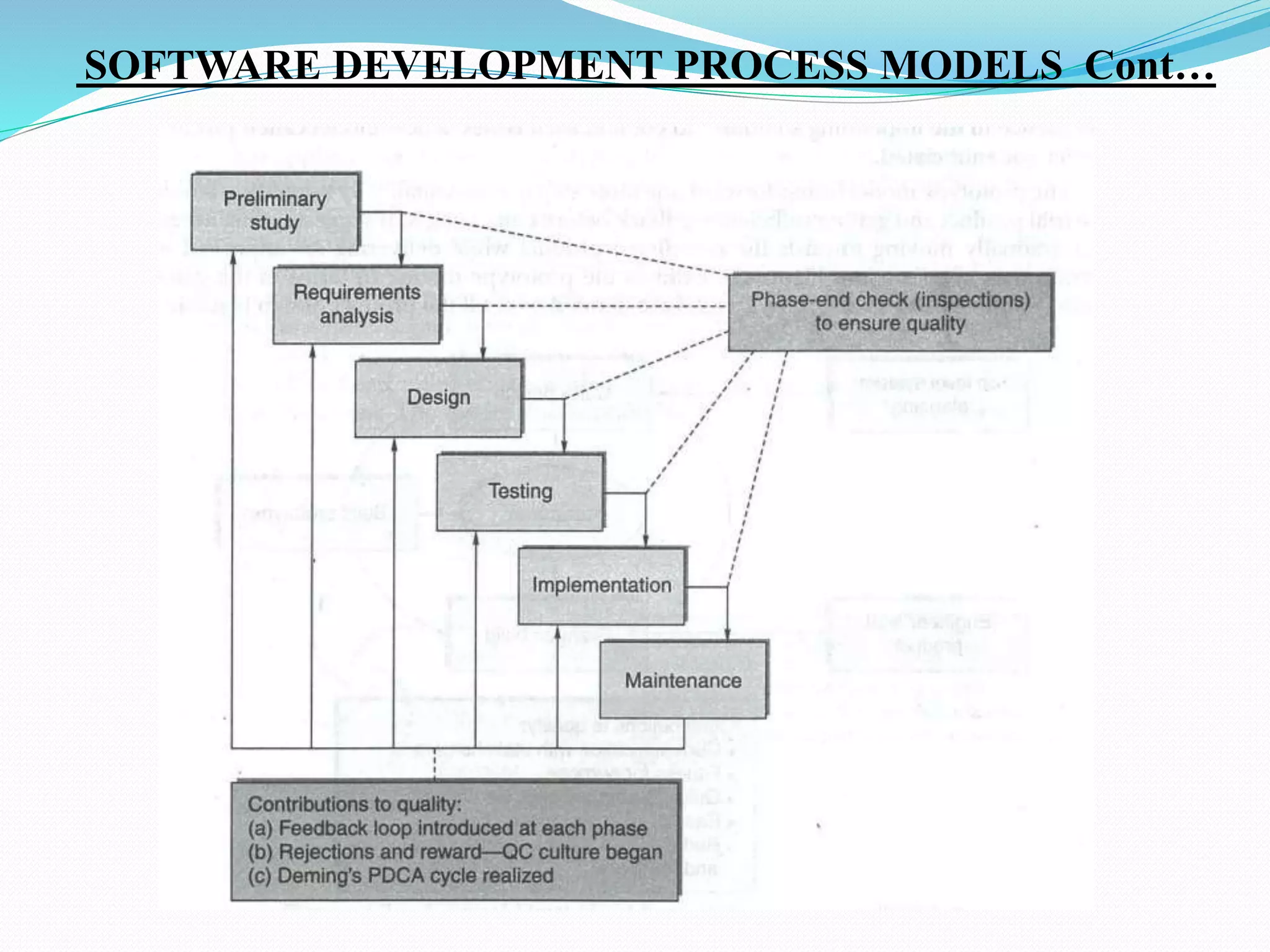
SDLC includes feedback loop from each stage to its previous stage.
 A typical Waterfall Model With Quality Control with feedback loop
shown in the figure
SOFTWARE DEVELOPMENT PROCESS MODELS Cont…
 SDLC includes feedback phase helps to find the feedback to the previous taste.
 Feedback helps to find the error & can be rectified by rework of an activity in
earlier stage.
 SDLC also added the concept of ETVX as a control measure for software
quality (ETVX- Entry-taste-Verification-Exit)
 Before its exit every task must be verified to ensure that the expected goals have
been achieved.
 This model is an implementation of Deming's PDCA cycle.
SOFTWARE DEVELOPMENT PROCESS MODELS Cont…
Purpose Or Us Age
 SDLC model mainly presented for quality control in Software development
projects.
 As a result rejections can be identified at each stage and rework can be done
 It improve the delivery quality to the customer
Disadvantage
 overall turnover time does not reduce
 It requires lot of time
 Cost goes into the rework
SOFTWARE DEVELOPMENT PROCESS MODELS Cont…
Prototype Model
 Prototype model called as Iterative and increment model
 Building of trial product and getting sufficient feedback before
enhancing it.
 Design undergoes iteration process & Incremental process
 Finally it deliver an improved trial version over the iteration.
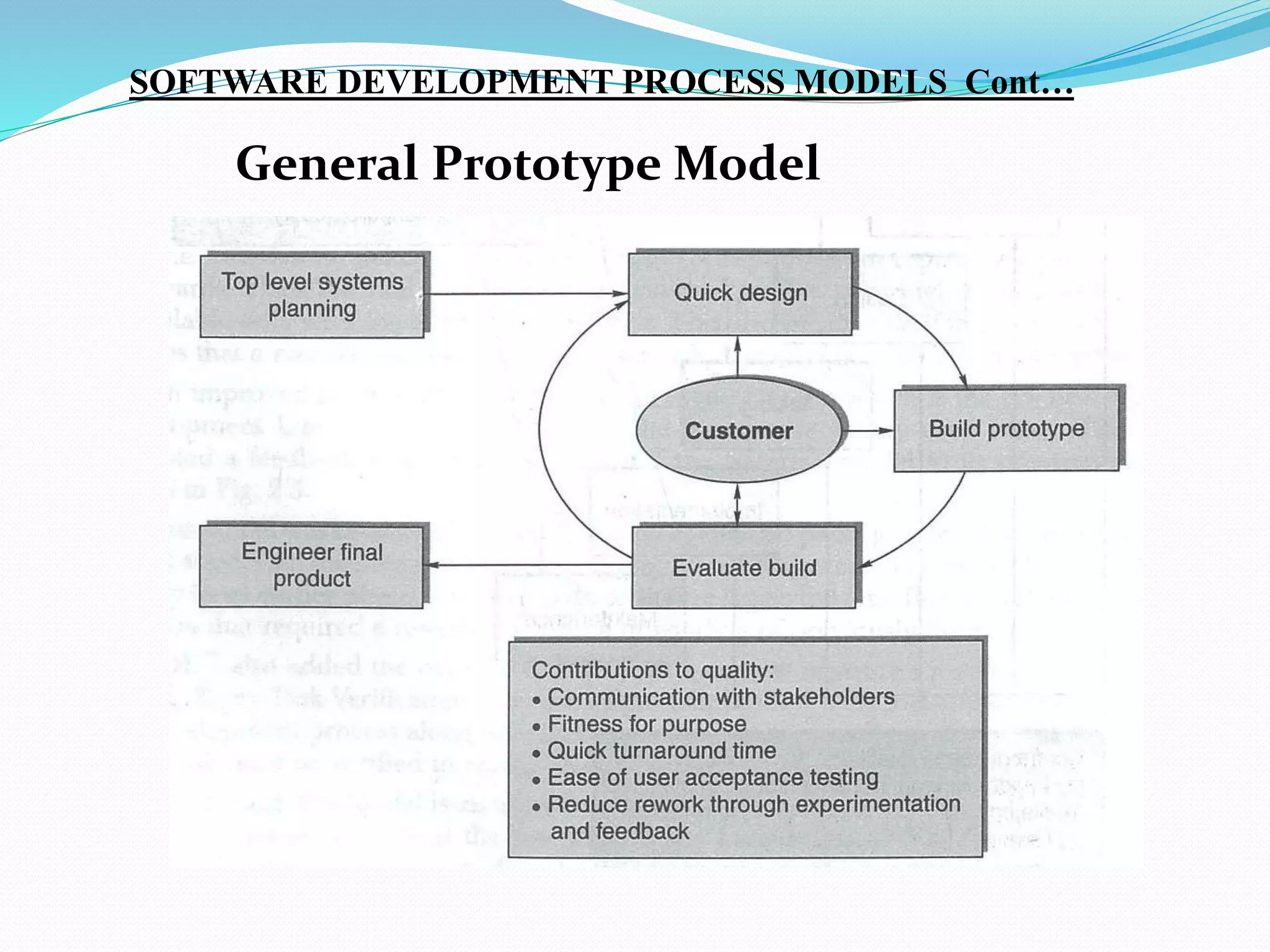
 A general prototype model shown below
SOFTWARE DEVELOPMENT PROCESS MODELS Cont…
General Prototype Model
SOFTWARE DEVELOPMENT PROCESS MODELS Cont…
In this Model, the customer is the center of all progress.
The scope of trial product should be limited so that it can build it lesser time.
The customer would be able to give feedback after seeing a working system than
listening to a heavy technical presentation.
Communication within stakeholders
Fitness for purpose
Quick turnaround time
ease of user acceptance testing
Reduce rework through experimentation & feedback
Advantages in terms of quality
SOFTWARE DEVELOPMENT PROCESS MODELS Cont…
 Time taken for trial process is uncontrolled
 Scrap increase by iterative process
 Trial version rejected by customer
Disadvantage
3.Spiral model
Spiral model called as prevention model
This model is provided for rework & reduce scrap applications.
Here they analyzed cost of quality towards rework is lesser than Prevention cost
Spiral model developed by Boehm in 1988
Boehm introduced evolutionary approach for development
This model implements prevention method by taking well defined & limited
scaope of work after risk identifications (Analysis)
SOFTWARE DEVELOPMENT PROCESS MODELS Cont…
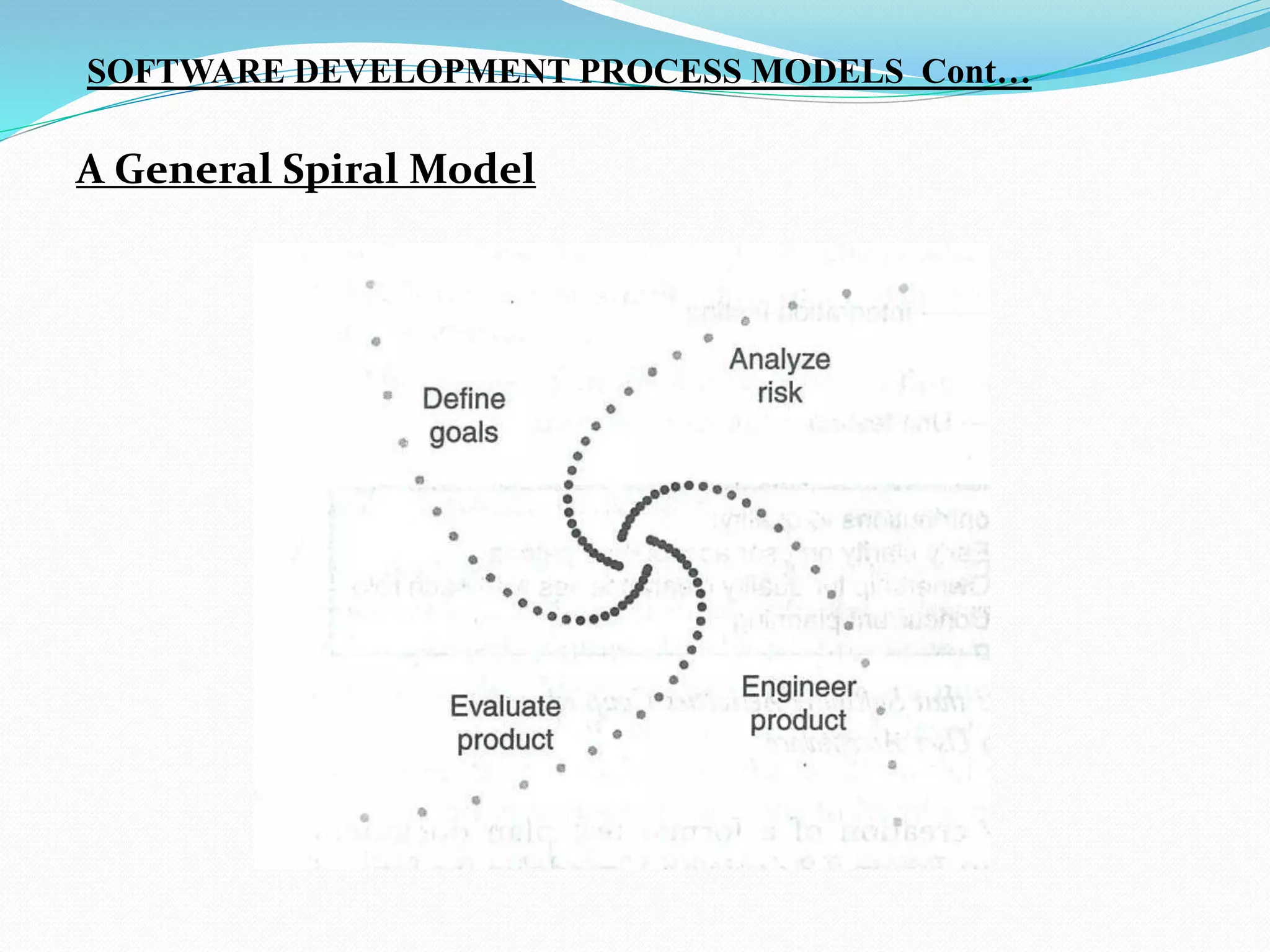
A General Spiral Model
SOFTWARE DEVELOPMENT PROCESS MODELS Cont…
A General Spiral Model
This model supports fast delivery with lesser rework
It can be stopped with outcomes of risk analysis or customer feed back
Advantage in Terms of quality:
 It is Goal definition
 Take each improvement as a project
 Quality assurance through risk analysis
 Reduce scrap by evolutionary development
SOFTWARE DEVELOPMENT PROCESS MODELS Cont…
Disadvantage:
 It leads to uncertainly white prevention method
SOFTWARE DEVELOPMENT PROCESS MODELS Cont…
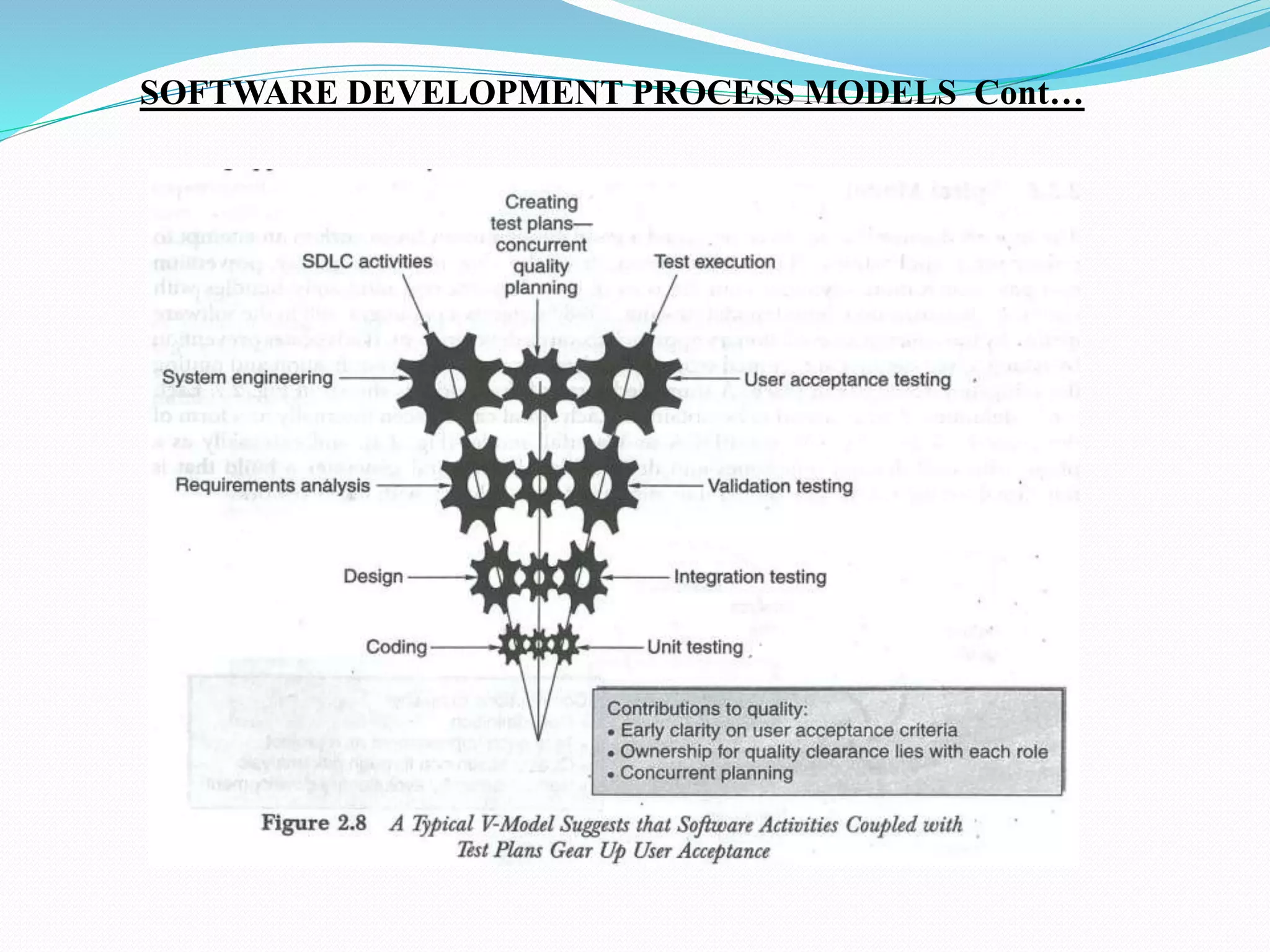
4.V-Model
This model supports in quality in testing
It suggest concurrent simultaneous development and test planning
Testing quality in nature way
Testing planned with functional specification
Testing can plan early in the project cycle
 A typical V-Model suggest that software activities coupled with test plans
which is for user acceptance
A general V- Model shown in the figure
SOFTWARE DEVELOPMENT PROCESS MODELS Cont…
 This model gives important to test plan by creation of formal test plan
document simultaneously while working on a software activity
 V- Model that joins the driver
5.Unified process model:
This model developed by (Kruchten 1999)
(UPM) – promotes iterative evolutionary style of software development
It concentrate on workflows, milestones & deliverables
Unique feature of this model is case centric approach
 Case Centric approach defines
SOFTWARE DEVELOPMENT PROCESS MODELS Cont…
1. Business Scenario
2. Customer needs
3. Environment focus point
 It became the industry standard
6.Agile Process Model:
The demand for agility has increased in business & personal lives
Customization & instant delivery requirements developed more
Agility implies dynamic & contextual orientation to change and growth
It brings more of philosophy their series of task or milestone ie to achieve target
Model in this Process are
1. extreme programming
2. Promote feasible team structures and culture
3. Rapid delivery of operational software
SOFTWARE DEVELOPMENT PROCESS MODELS Cont…
7.Choice Of Model:
 The software requirement go more complex compared to the
competence level of customer and development team the choice of model
would shift from waterfall to agile.
The Waterfall model may take more time to deliver its first working
product and give fewer directions to handle quality as against the agile
model .
The table gives a comparative view of the development models their
contribution to quality.
SOFTWARE DEVELOPMENT PROCESS MODELS Cont…
QUALITY STANDARDS & GUIDELINES
Quality system standard defines basic task an organization must
do in order to join the quality ladder.
The commonly used standards is given below with a contribution
to the field of software quality.
Quality standards are
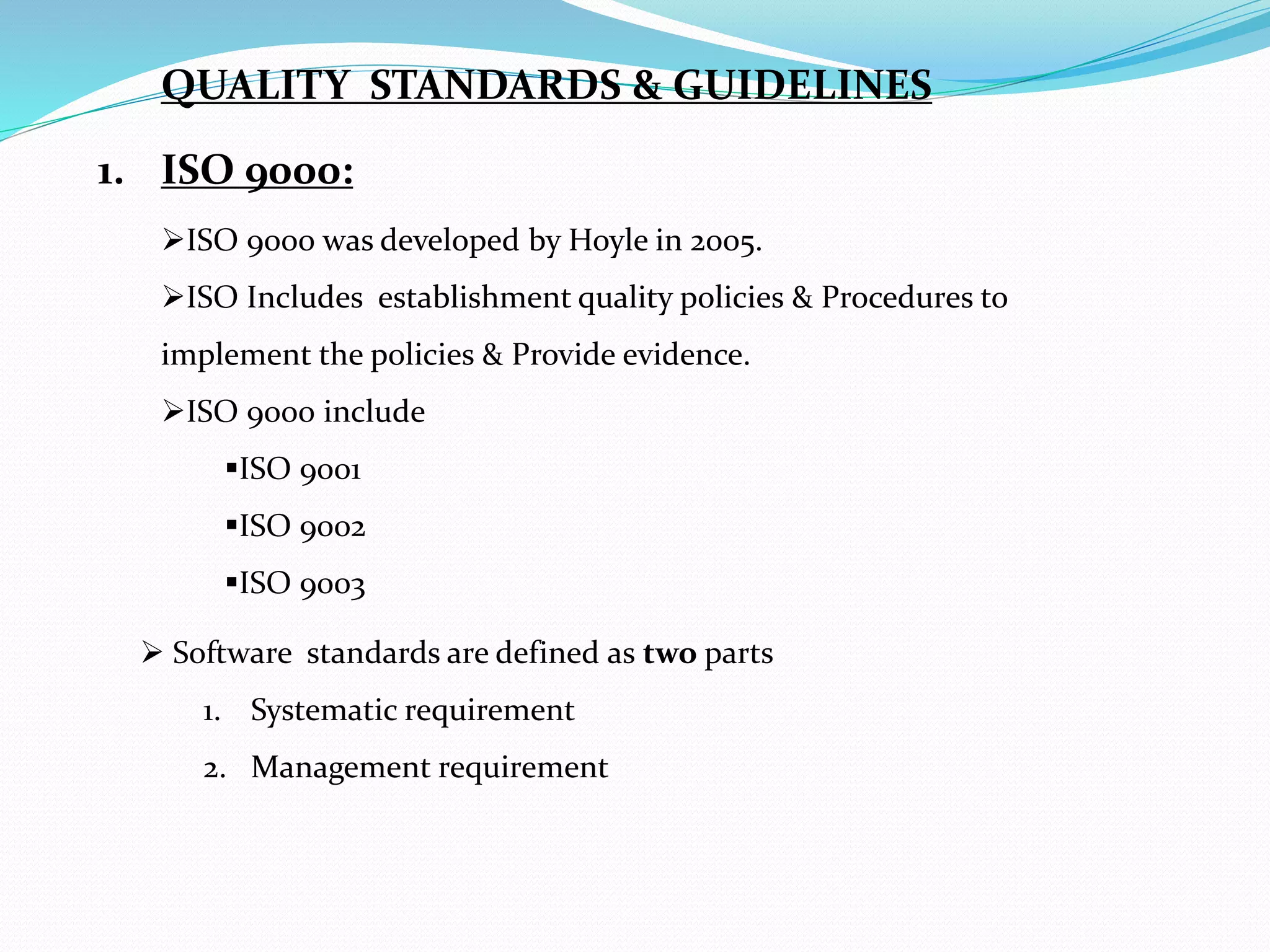
 ISO 9000
 Malcom Baldrige National quality Award [MBNQA]
 Six Sigma
 Personal Software Process
 Team Software Process
1. ISO 9000:
ISO 9000 was developed by Hoyle in 2005.
ISO Includes establishment quality policies & Procedures to
implement the policies & Provide evidence.
ISO 9000 include
ISO 9001
ISO 9002
ISO 9003
 Software standards are defined as two parts
1. Systematic requirement
2. Management requirement
QUALITY STANDARDS & GUIDELINES
1. Systematic requirements:
Systematic requirements and guidelines to
 Establish Quality management system for software products such
as Identify, define implement & improve
 Document software oriented quality system.
2. Management requirements:
 Management requirements and guidelines to
Support quality
Forus on customer needs
Establish a quality focus
Perform quality planning
Control quality planning
Review quality initiatives
QUALITY STANDARDS & GUIDELINES
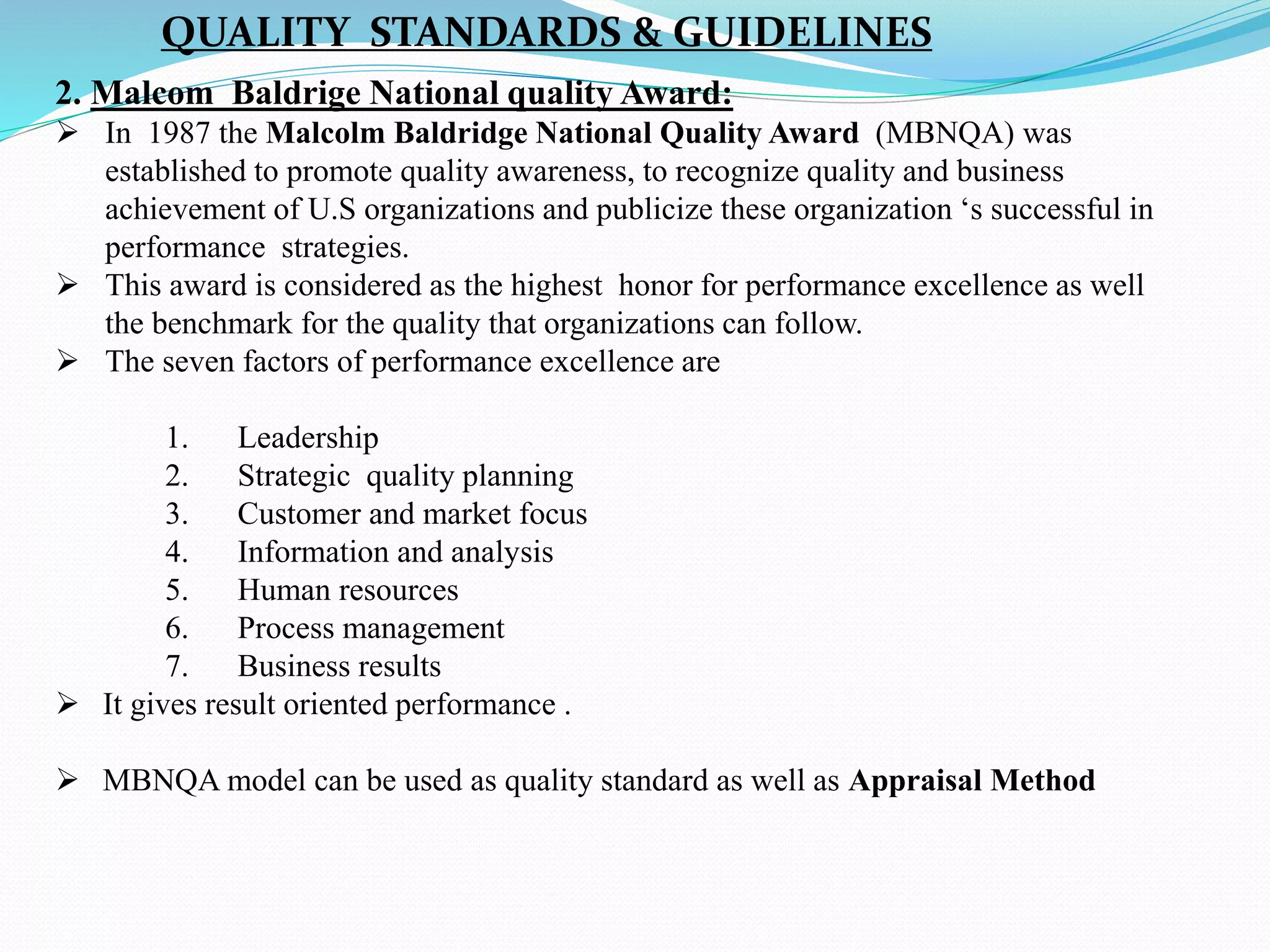
2. Malcom Baldrige National quality Award:
 In 1987 the Malcolm Baldridge National Quality Award (MBNQA) was
established to promote quality awareness, to recognize quality and business
achievement of U.S organizations and publicize these organization ‘s successful in
performance strategies.
 This award is considered as the highest honor for performance excellence as well
the benchmark for the quality that organizations can follow.
 The seven factors of performance excellence are
1. Leadership
2. Strategic quality planning
3. Customer and market focus
4. Information and analysis
5. Human resources
6. Process management
7. Business results
 It gives result oriented performance .
 MBNQA model can be used as quality standard as well as Appraisal Method
QUALITY STANDARDS & GUIDELINES
3. Six Sigma:
It originated in 1986 at Motorola.
Six Sigma derives its name form statistics. Where sigma defines the degree of
variance.
Higher the sigma value lower the rejection rate & lower the cost of quality
Six Sigma basic steps to process improvement are [DMAIC]
 Define
 Measure
 Analyse
 Improve
 Control
 DMAIC provide result in performance
 Six Sigma is more of philosophy than a model and applicable in industries
 Six Sigma applied to the process control and customer focus are
1. The customer focus to define “critical to quality factors”(CTQ)
2. Use absolute scales to measure defects .
QUALITY STANDARDS & GUIDELINES
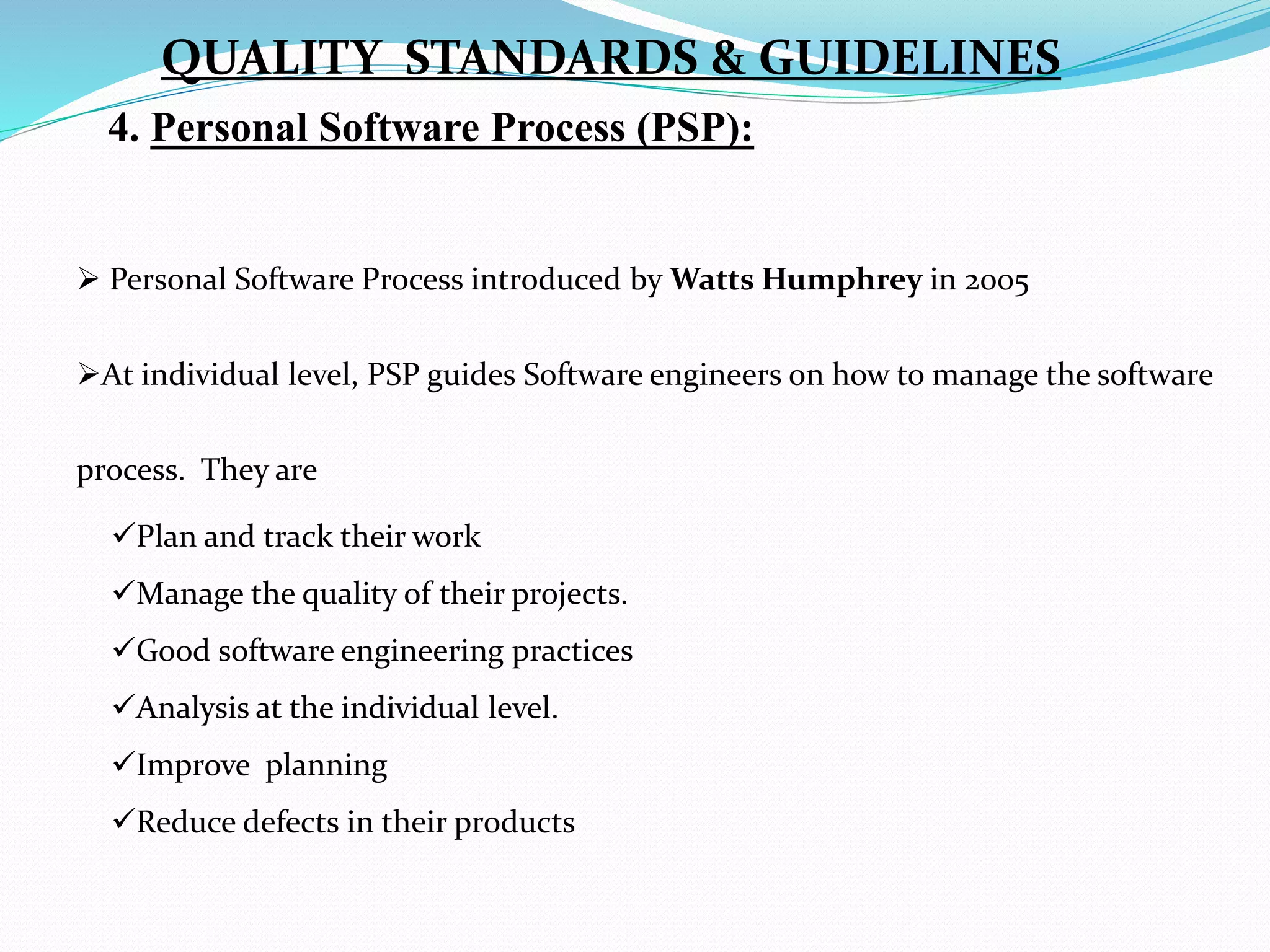
4. Personal Software Process (PSP):
 Personal Software Process introduced by Watts Humphrey in 2005
At individual level, PSP guides Software engineers on how to manage the software
process. They are
Plan and track their work
Manage the quality of their projects.
Good software engineering practices
Analysis at the individual level.
Improve planning
Reduce defects in their products
QUALITY STANDARDS & GUIDELINES
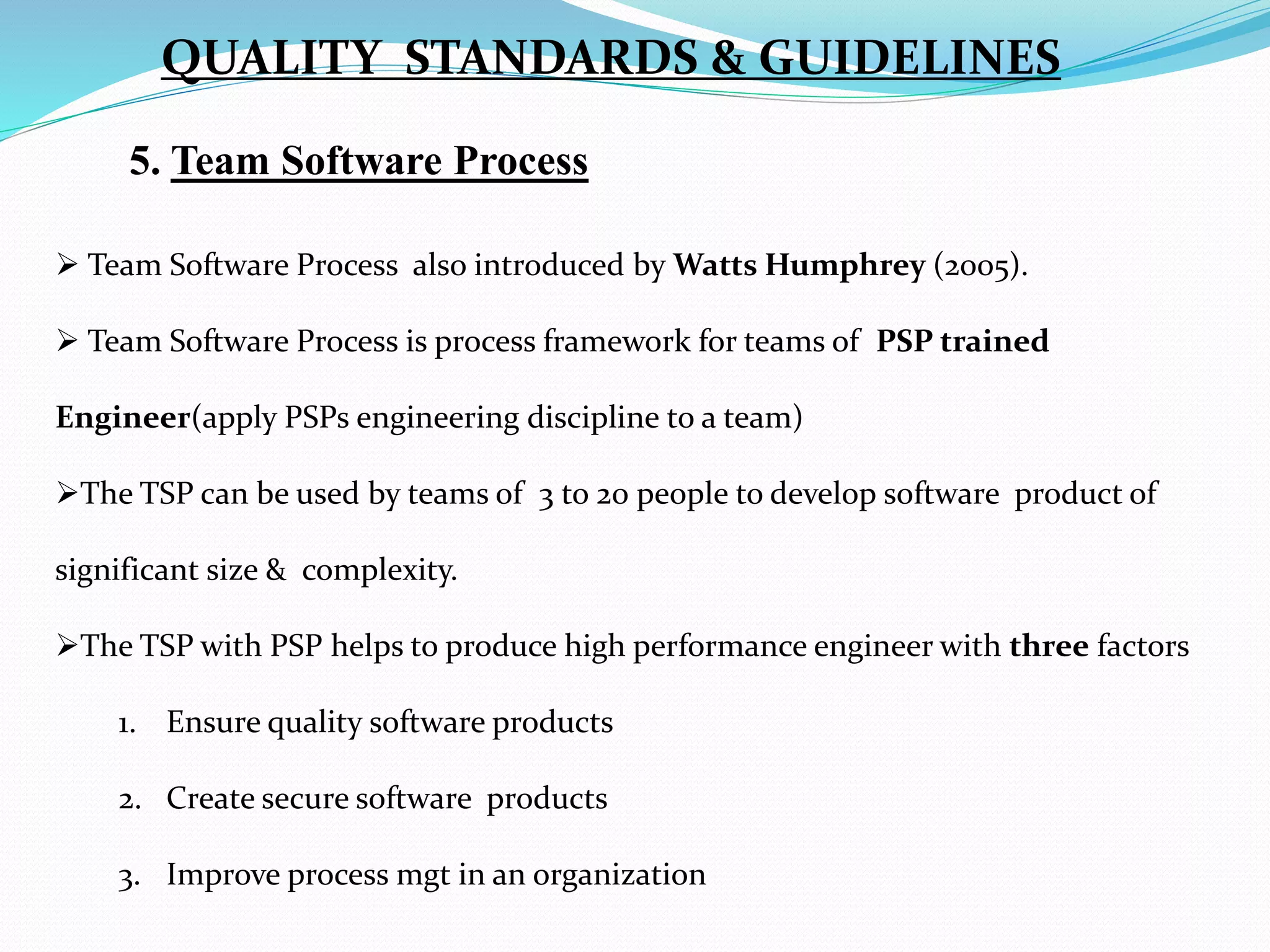
5. Team Software Process
 Team Software Process also introduced by Watts Humphrey (2005).
 Team Software Process is process framework for teams of PSP trained
Engineer(apply PSPs engineering discipline to a team)
The TSP can be used by teams of 3 to 20 people to develop software product of
significant size & complexity.
The TSP with PSP helps to produce high performance engineer with three factors
1. Ensure quality software products
2. Create secure software products
3. Improve process mgt in an organization
QUALITY STANDARDS & GUIDELINES
Difference between PSP and TSP
TSP:
 Engineering groups use TSP to apply integrated team concept to
development of software system.
PSP:
 It is a prerequisite for an organization planning to introduce TSP.
QUALITY STANDARDS & GUIDELINES
 The Development process models focus on the product under construction.The
process improvement models focus on the process useful to all future products.
Software process capability are of Two Models. They are
1. Software – Capability Maturity Model
2. Capability Maturity Model Integration
 1.Software capability maturity Models (SW-CMM)
 It has been the first model which started an average software professional to
field of software quality.
 The model suggested five levels of process maturity .They are
1. Initial
2. Repeatable
3. Define
4. Managed
5. Optimizing
 An organization can access the current level and plan for the next level by
understanding Key Process Areas(KPAs) and Key Results.
 This model is adapted for many fields other than software deveopment such
as People – CMM (P-CMM),Software Acquisition CMM (SA-CMM) etc..
 This model is developed at software engineering Institute and has announced
in December 2005.
SOFTWARE PROCESS CAPABILITY IMPROVEMENT MODELS
2.Capability Maturity Models (CMMI)
 Capability maturity model integration or CMMI emerged as integration of
four bodies of knowledge .They are
1. System engineering model
2. Software – CMM
3. Integrated Software –System Engineering
4. Supplier Sourcing .
 This model brings with it the system view encompassing stakeholders and
organizational focus in a refined manner.
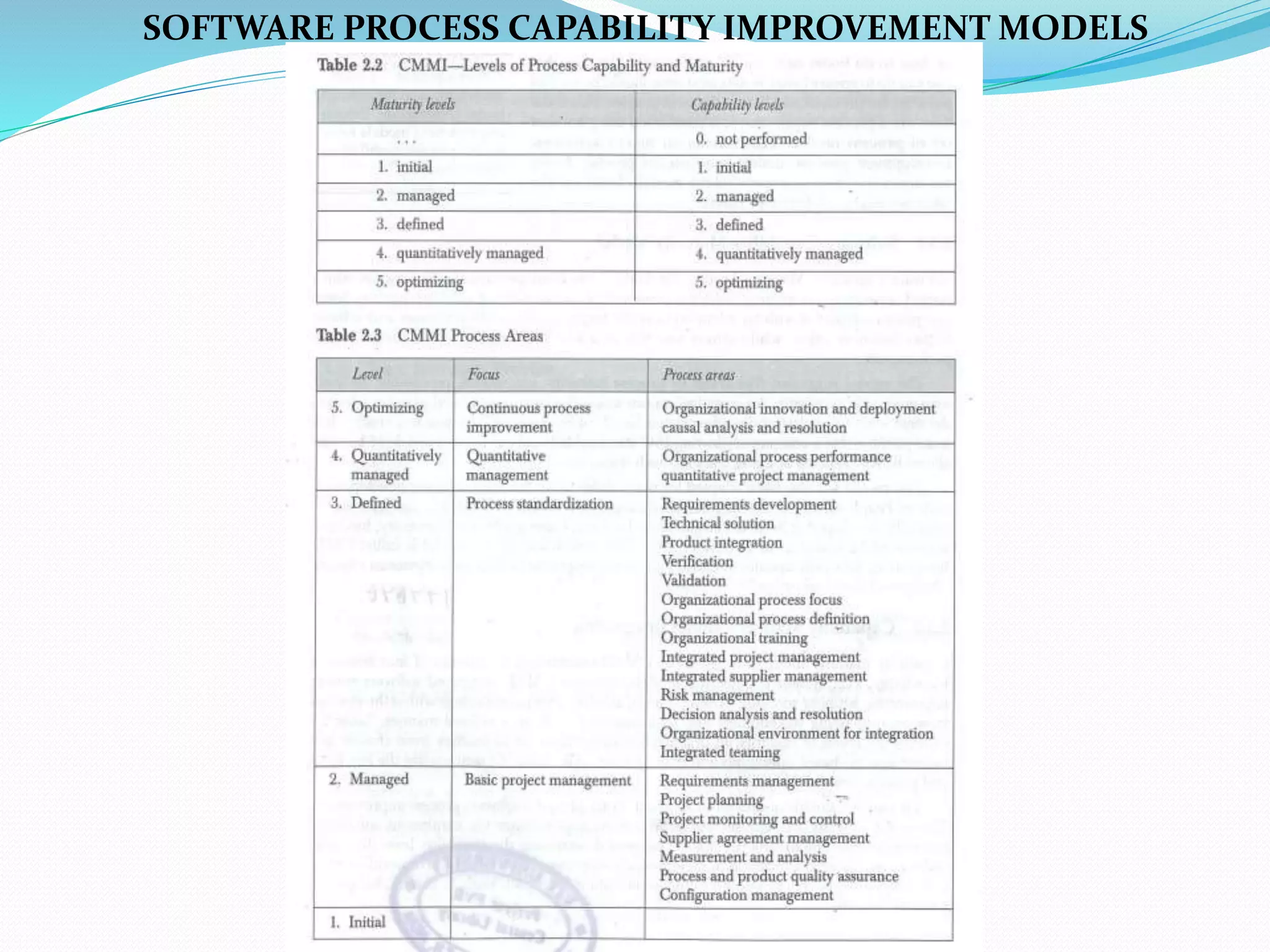
 The table shows the level of maturity an organization can achieve in mature
process based operation and management style and process area of CMMI.
 This model provide a structured approach to adopting the software process
improvement.
 The model suggest two representations for process improvement such as
Continuous and staged.
 Continuous suggests determining the capability level (0 to 5) In order to
enable an organization to incrementally improve the processes to an
individual process area to the continuous growth towards maturity
 Staged : This staged is to allow organization to improve Pre-defined set of
related process addressing set of process for next maturity level
 This path would lead to staged growth towards maturity
SOFTWARE PROCESS CAPABILITY IMPROVEMENT MODELS
SOFTWARE PROCESS DETAILED VIEW
Process is a medium that diffuses Quality into Work, Product & Services.
Let us see what is important either Product or the Process
Need of Software Process
The Architects and developer who initiated the project have changed after
their project but not the project .Ex: WWW team members are changed but not
the WWW .
Each part and piece of software is seen as unique creation.
Making of a software product makes for team ‘s achievement
A product can be seen as a set of features planned to achieve a mission for a set
of targeted customers.
If one person had developed process end to end the task would take multiple
years or may never get over.
Team structure becomes a necessary for large integrated product development.
Brooks (1975,1975) brings out the woes of craft of programmers they are
SOFTWARE PROCESS DETAILED VIEW
One must perform perfectly.
Others control the circumstance of work
Designing designs and make them to work
By the time of product is ready ,its concepts becomes obsolete.
A process is a pathway to the product.
It defines the tasks that should be carried out in a well-defined order and
also suggest the way to execute these tasks.
The quality of process is more important to the product quality.
Choice of processes depends on the type of project .
 whatever may be the process one needs to define,deploy it properly to
achieve quality in results
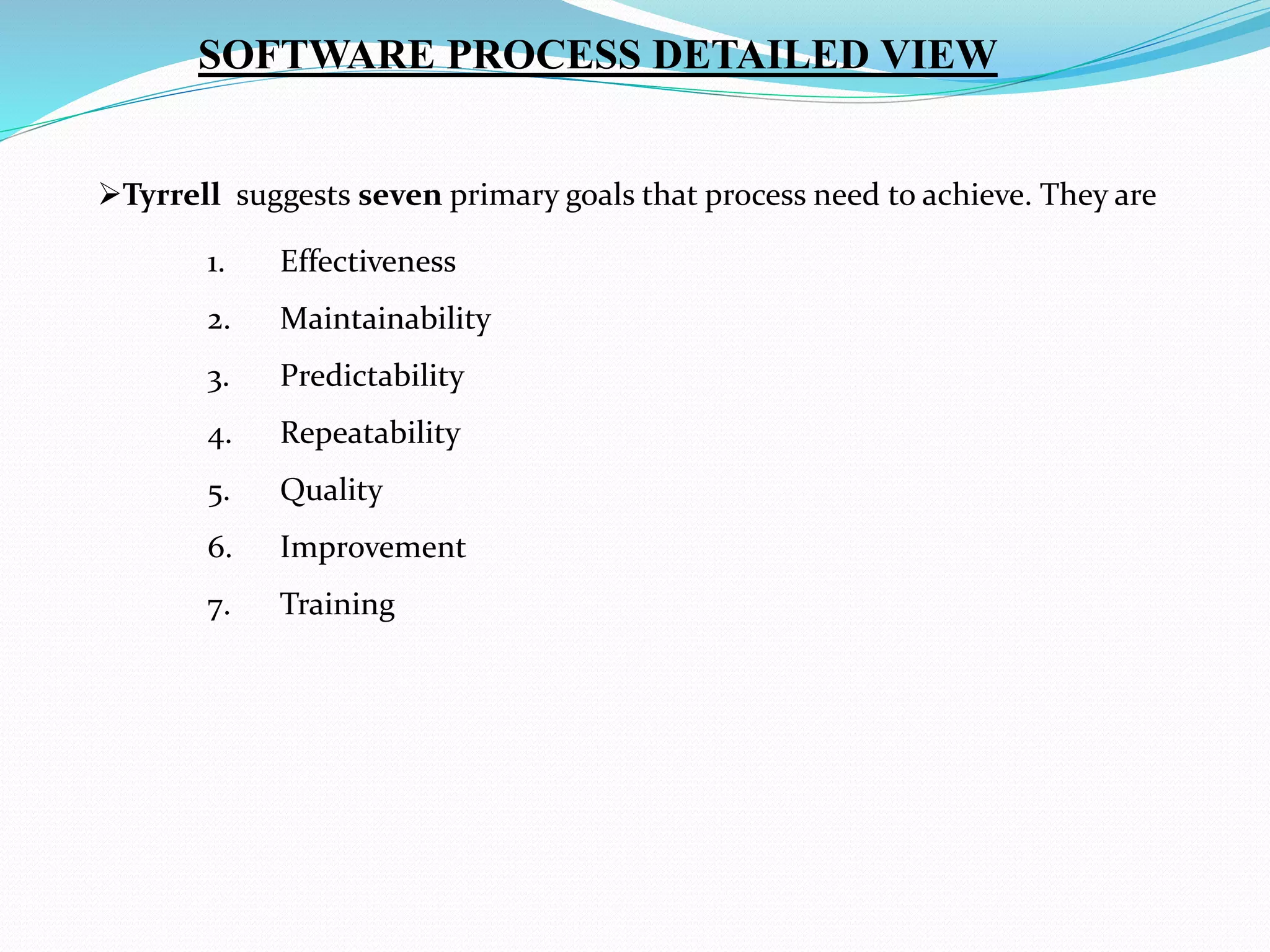
Tyrrell suggests seven primary goals that process need to achieve. They are
1. Effectiveness
2. Maintainability
3. Predictability
4. Repeatability
5. Quality
6. Improvement
7. Training
SOFTWARE PROCESS DETAILED VIEW
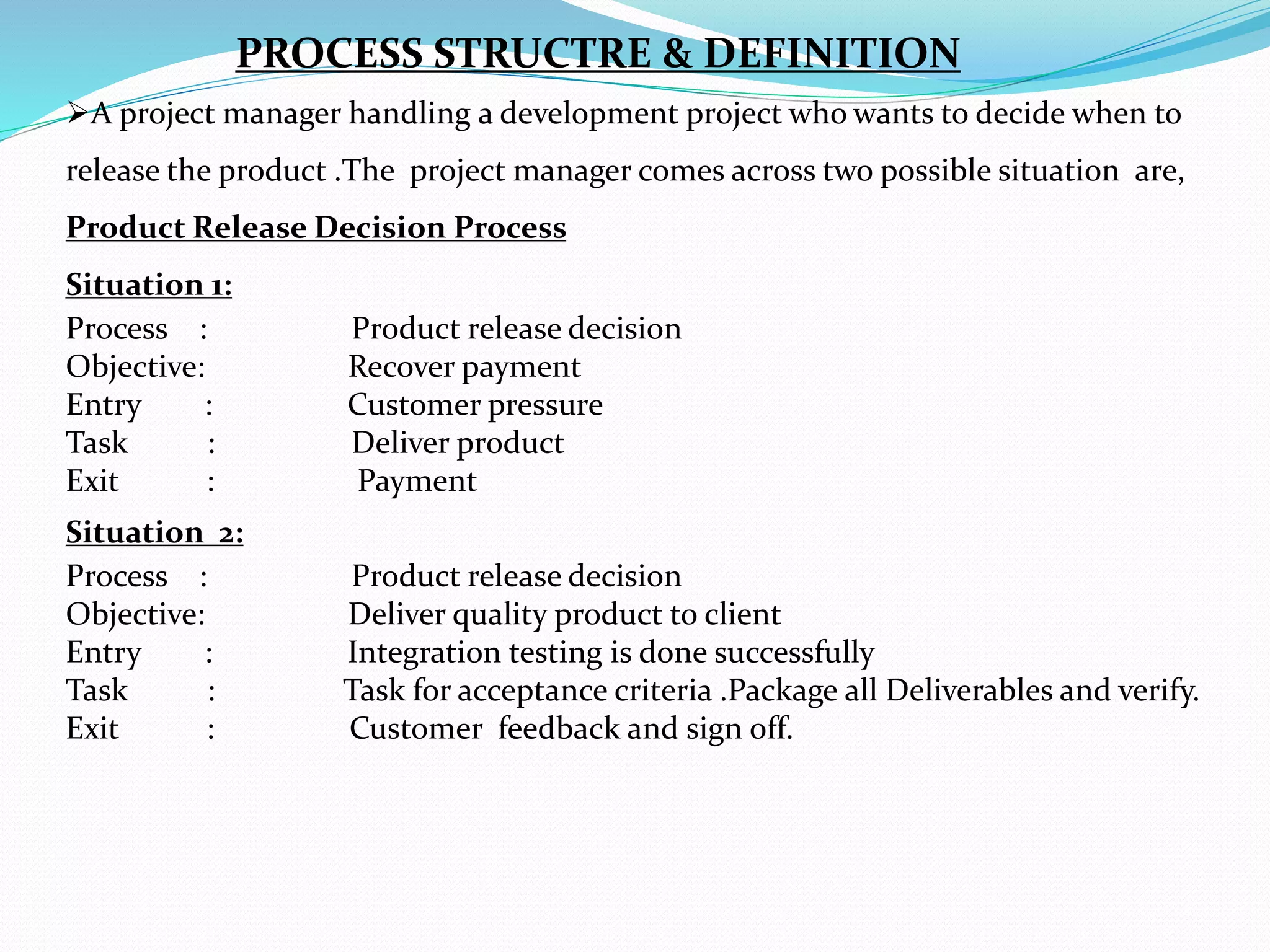
A project manager handling a development project who wants to decide when to
release the product .The project manager comes across two possible situation are,
Product Release Decision Process
Situation 1:
Process : Product release decision
Objective: Recover payment
Entry : Customer pressure
Task : Deliver product
Exit : Payment
Situation 2:
Process : Product release decision
Objective: Deliver quality product to client
Entry : Integration testing is done successfully
Task : Task for acceptance criteria .Package all Deliverables and verify.
Exit : Customer feedback and sign off.
PROCESS STRUCTRE & DEFINITION
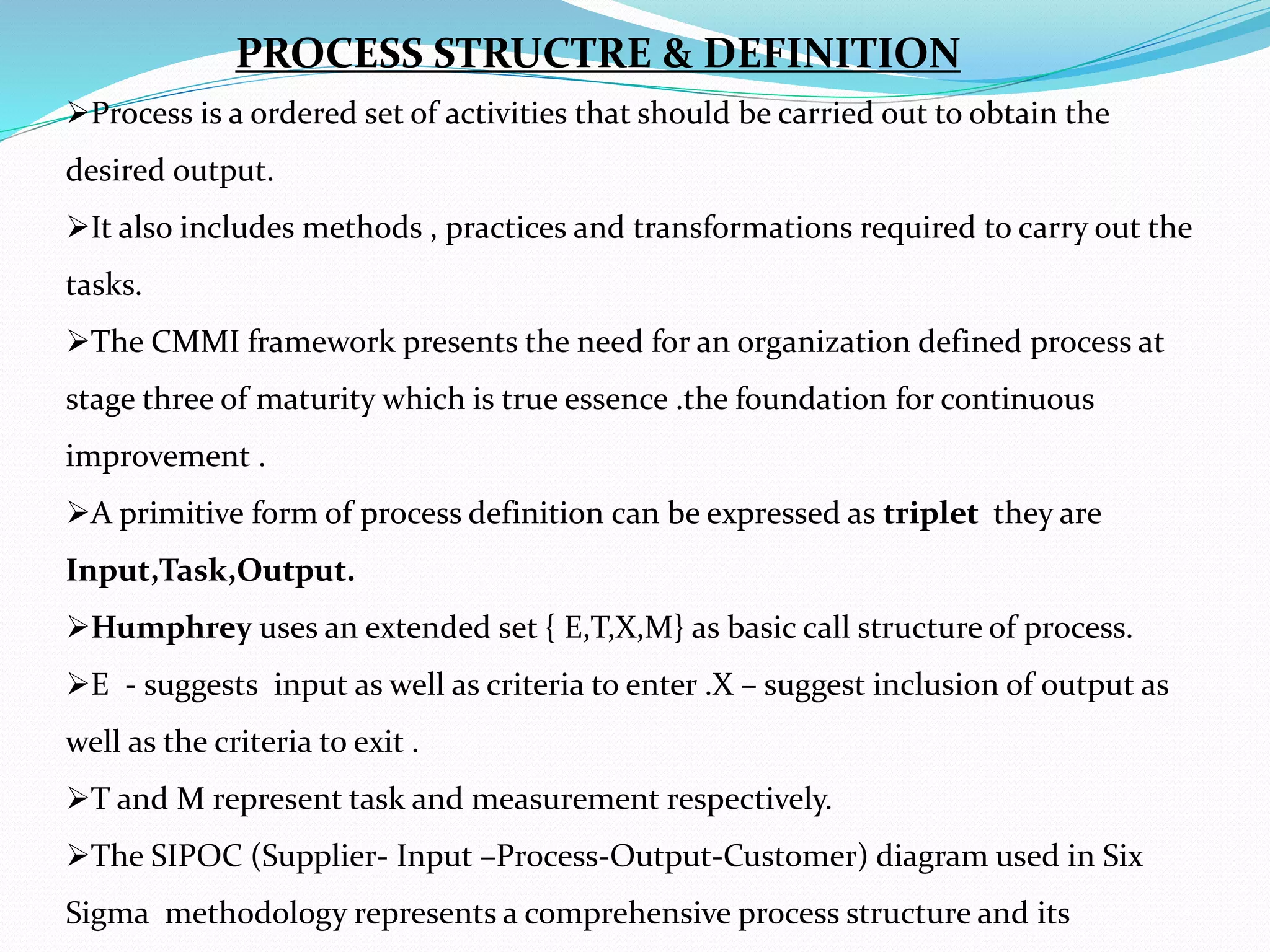
Process is a ordered set of activities that should be carried out to obtain the
desired output.
It also includes methods , practices and transformations required to carry out the
tasks.
The CMMI framework presents the need for an organization defined process at
stage three of maturity which is true essence .the foundation for continuous
improvement .
A primitive form of process definition can be expressed as triplet they are
Input,Task,Output.
Humphrey uses an extended set { E,T,X,M} as basic call structure of process.
E - suggests input as well as criteria to enter .X – suggest inclusion of output as
well as the criteria to exit .
T and M represent task and measurement respectively.
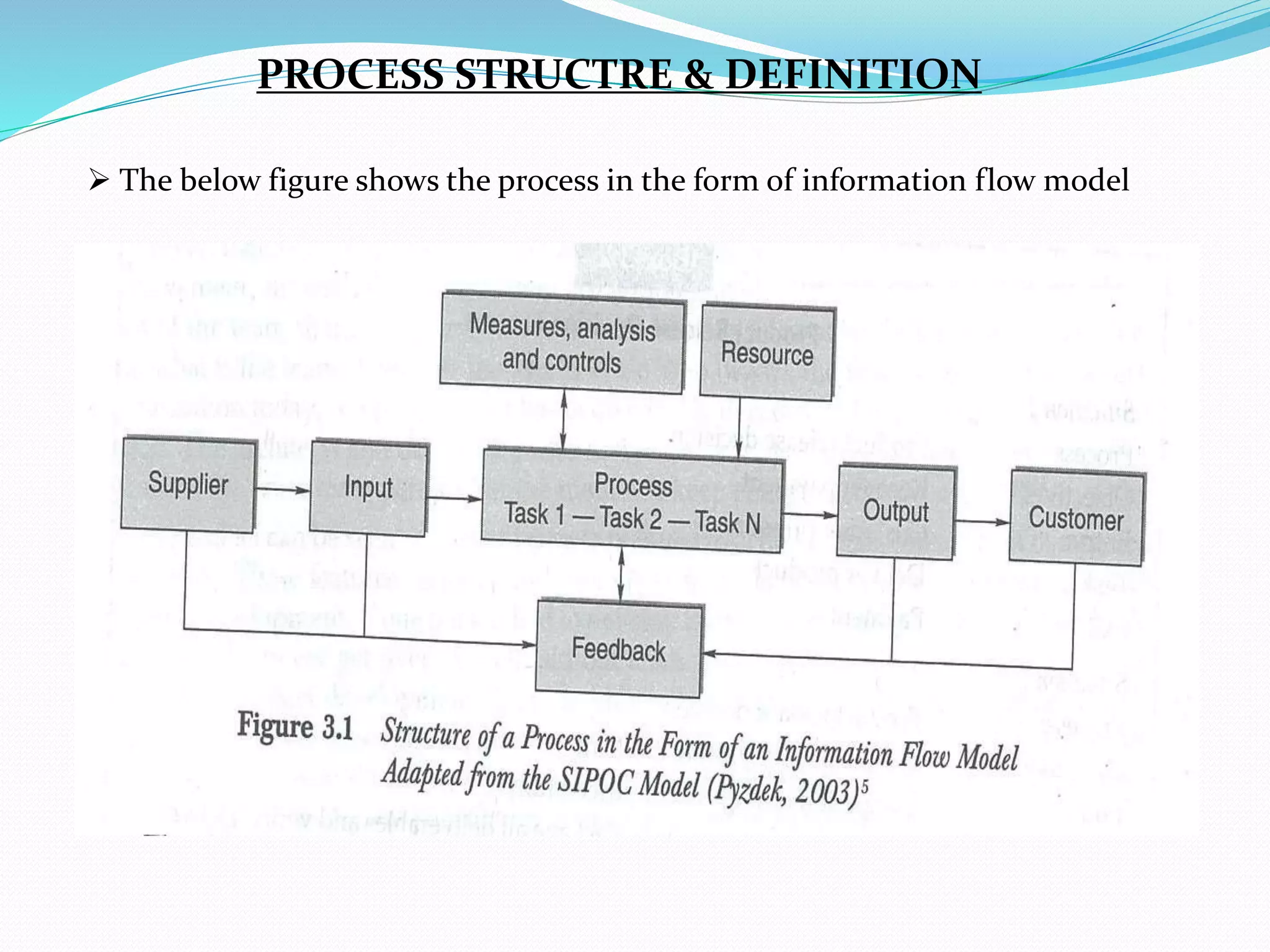
The SIPOC (Supplier- Input –Process-Output-Customer) diagram used in Six
Sigma methodology represents a comprehensive process structure and its
PROCESS STRUCTRE & DEFINITION
 The below figure shows the process in the form of information flow model
Process classification
 Analysis, design,code,test and maintain are processes .
 These processes look same for all the organization at meta
level.
 If an organization implements these processes, many more
processes seems important.
 Organization expands these meta level process to more
details at macro and micro level processes within their own
setup.
 Macro level should explain the daily task to be carried out
to execute these meta process.
 Example if analysis is the meta process, then gathering req,
process flow models, writing specifications are seen as
macro level processes and defining a way to carry out these
task are micro level processes.
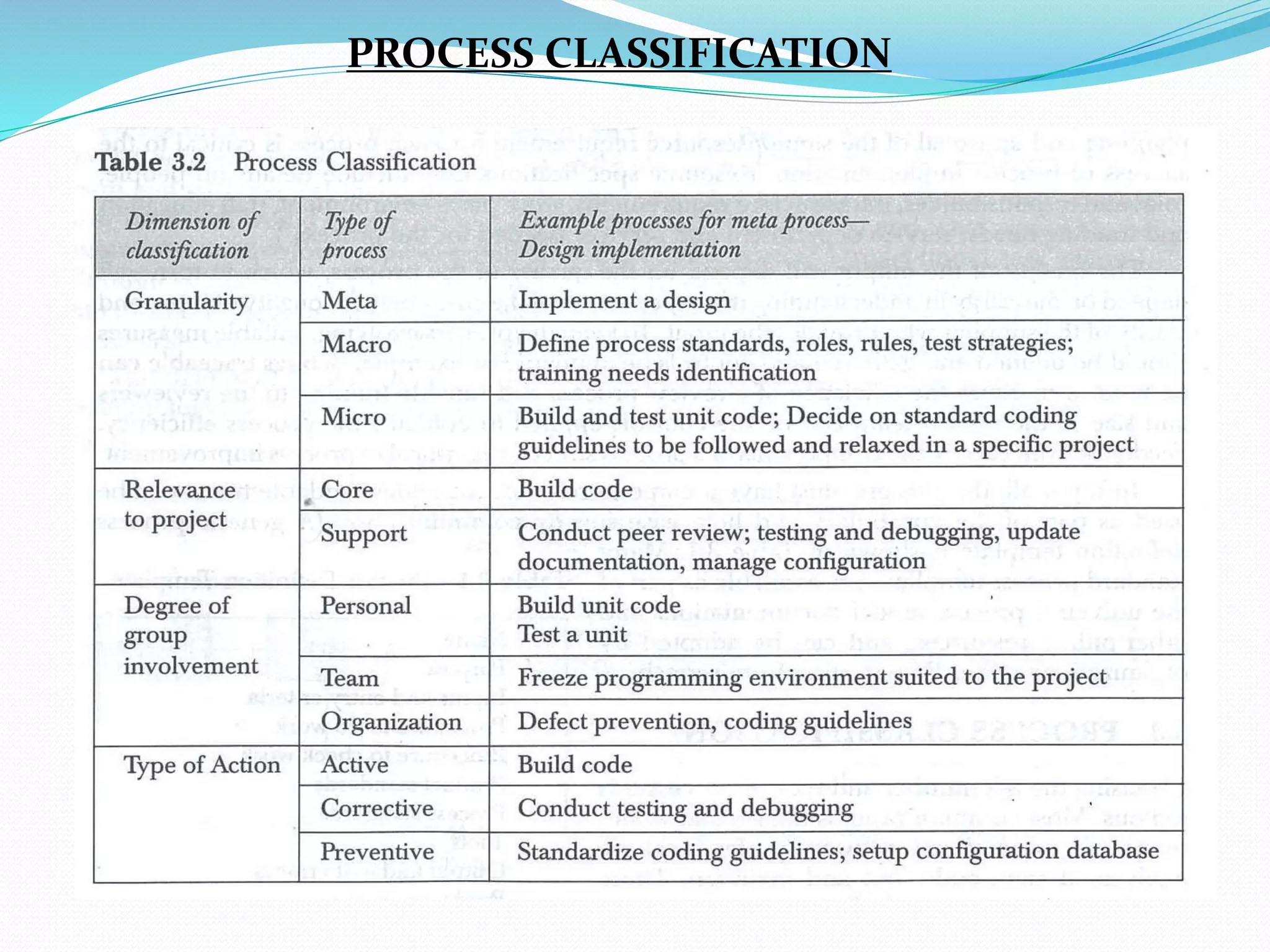
PROCESS CLASSIFICATION
 Meta level –enables policy making
 Micro level- enables task execution.
 Core processes, active – project completion, direct
productivity.
 Support processes – quality
management,reviews,test,debug,update
 Organisation level- act as guidelines, offer
standization, integration across multiple projects.
 Personal – directing individuals mind-set and
practices towards larger interest of organization
 Corrective – survival
 Preventive – standardize coding.
 Personal process – Individuals can track their
performance (i.e) have to do a list and tick it whenever
a task is completed.
 Records personal productivity through set of charts(
code produced,errors occurred)
 For team (tsp) can be followed.
 For organization CMMI,ISO,MBNQA can be followed
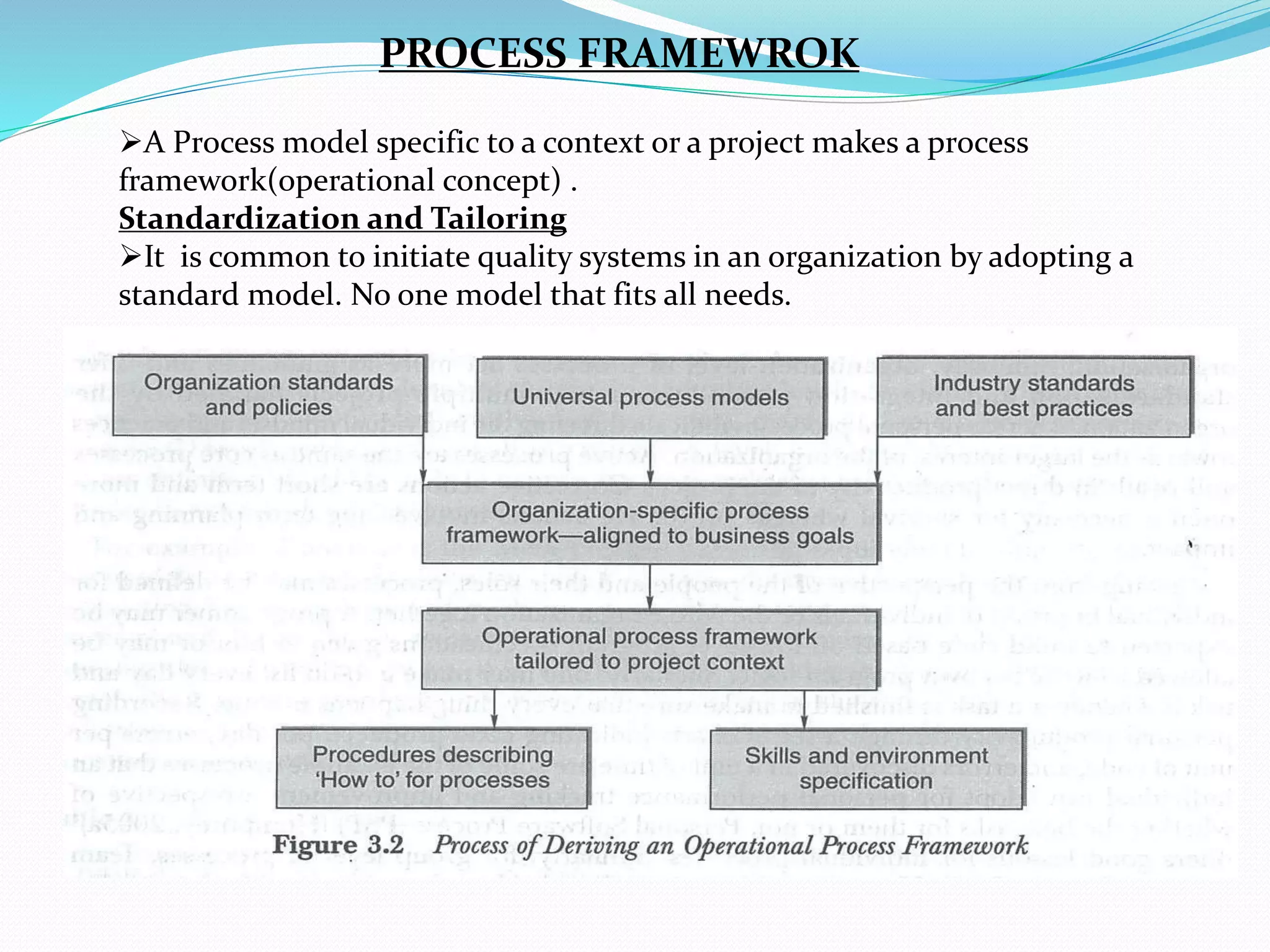
A Process model specific to a context or a project makes a process
framework(operational concept) .
Standardization and Tailoring
It is common to initiate quality systems in an organization by adopting a
standard model. No one model that fits all needs.
PROCESS FRAMEWROK
 Patterns
 If you wish to make sure that “no smoking zone” is truly so
deploy smoke detectors and alarms.
PROCESS FRAMEWROK
 An organization that believes in an informal culture will have difficulty following
the formal technical review process.
To establish a formal review process at such place ,training and cultural shift
becomes a necessity defining the rules to conduct formal reviews.
Few criteria that can help validate a process are
 Completeness- The process should clearly define all the duties that
executor is expected to know Eg: Roles tasks sequence tools etc..
 Practicality – We define a process to add predictability to our expected
results .
 Suitability – The process should to philosophy and culture of the
organization
 Usability – The process should be well documented and easy to
understand .
PROCESS VALIDATION AND IMPROVEMENT
 Reusability – The process should be generic enough so hat it is usable
in varied situations and projects are against in nature and description.
 Tools availability – Appropriate tools should be identified and installed
to enable the execution of the process
 Viability – Every process should be able to contribute positively towards
quality and business benefits.
 Agility – The process should be open to changes and adaptable in
description.
 Interoperability – No process works in isolation. So it must to test the
process under consideration by large process frame work.
PROCESS VALIDATION AND IMPROVEMENT

Software Quality Assurance

  • 1.
  • 2.
    Quality Metrics – D.R.E= E/E+D  D.R.E = Defect Removal Efficiency  E=>No. of defects before delivery  D=>No. of defects uncovered after delivery  When all errors are uncovered before delivery  E= 1 implies the formula becomes 1/1+0 ~= 1
  • 3.
    Metrics contd…  S.M.I=> Software Maturity Index M(i) = Mt-(Fa+Fc+Fd) Mt-> Total no. of modules Fa-> No. of modules added Fc-> No. of modules changed Fd-> No. of modules deleted
  • 4.
    Test case Sufficiency T-C-S = |No. of defects detected |* 100  |No. of test cases run|  Measures the productivity of the testing cycle  MTBF = Mean Time to failure + Mean Time to Repair  Availability = (MTTF/MTBF) X 100
  • 5.
    INTRODUCTION “Quality” - Definition Quality devotes the characteristics of a product as service that ability to satisfy implied needs and free of deficiencies.  Quality refer to any measurable characteristics such as correctness, maintainability, portability, testability, usability, reliability, efficiency, integrity, reusability and interoperability.
  • 6.
    Software Reliability: - The probability of failure-free operation of a computer program for a specified time under a specified environment. Two Terms: 1. FAULT: A defect in the Software , that fail to perform its required function under particular condition is called fault. Ex: bug in the code which may cause a failure.
  • 7.
    1. Failure: Itis inability of a system or component to perform required function from its specification. Ex: external behavior is incorrect Why We Require Software Quality And Reliability To face the corporate challenges and to function day to day activities with out failure, we require software quality reliability. The following figure explains the challenges that various organization face in their day to day functioning.
  • 8.
    Typical challenges forchief executive officer in organization (CXOs)
  • 9.
    History of QualityAssurance  In 20th Centuries men used tools which made of bones and wood and set them of job they wanted to do.  There are five stages in which early quality played wide role in olden days . Stage 1: Craftsmen Era:  Tailor ,painters, cobblers and masons have all been categorized as craftsmen.  Craftsmen used to be the sole incharge of understanding the needs, design, development and delivery  A craftsmen used to apply his own methods and experience to control the quality of his product but if its large quantity in that era was buyer’s and user’s risk.  The product was tested at each point of development but the production speed was limited
  • 10.
    History of QualityAssurance – cont.. Stage 2: Inspection Era:  The product was produced by one set of people, while the quality of the product was inspected by another set.  Production and quality became distinct functions and the inspector became superior.  Mass production become manageable Stage 3: Quality Control Era:  The concept of statistical sampling was applied on inspection.  Control limits and variance helped establish defined goals of quality.  The producer knew what the expected level of quality?
  • 11.
    History of QualityAssurance – cont.. Stage 4: Quality Assurance Era:  Quality needs to be assured at each point of production with a view to eliminate the chance of occurrence of errors at each step.  This reduced rejections and rework tremendously.  People in Organization started having a cultural shock as their process of doing work came under security Stage 5: Total Quality Management Era:  The present era, where process definitions ,Process assessments, quality specifications , culture and change management got institutionalized. This era has the potential mass customization in an organization at controlled cost
  • 12.
    Advantages  Use ofsampling and Inspection  This helps to improve production as well as the quality in the product. Disadvantage  Introduces Rigid Standards of product quality specification.  It leads large rejection rework activity and rework cost. Historyof Quality Assurance – cont..
  • 13.
    Quality In TheCurrent Business Scenario  Quality in the current Business experts changes in some factors such as Reducing Cost Increase Efficiencies Innovation for Competitive advantage Manage Industry in consolidation Deal with investor confidence  There are two factors 1. Internal 2. external
  • 14.
     Quality inthe current Business come from internal & external directions. Internal Business:  The stakeholders demand more on customers suppliers, partners & The Competitors.  The Corporation expects more on growth, leadership, client satisfaction ability to face competitor with innovation. Quality In The Current Business Scenario – cont..
  • 15.
    External Business:  Itconcentrate more on  Mergers (union)  Acquisitions (gaining)  Regulations & Deregulation  Technology  So both external & Internal objectives help the organization to fare the market forces. Quality In The Current Business Scenario – cont..
  • 16.
     As aresultant effect, each time a market competitive scenario changes, new segments are born & market boundaries redefines and quality function is high.  Therefore quality changes with customer perception & market maturity.  Figure illustrate the changes between customer perception & market maturity. Quality In The Current Business Scenario – cont
  • 17.
    Quality In TheCurrent Business Scenario – cont  The above figure illustrated is the fact that quality is largely about customer perceptions and that changes constantly according to the competitive scenario and market condition
  • 18.
    1. Juran Trilogy 2.Deming PDCA Cycle 3. Quality Control & Assurance 4. Cost of Quality 5. ISO 9000 & Quality MODELS & FRAME WORKS OF QUALITY
  • 19.
    I ) JuranTrilogy:  Juran explained his model of quality on the basis of three Processes so its named as “ Juran Trilogy “. They process are 1. Quality Planning 2. Quality Control 3. Quality improvement MODELS & FRAME WORKS OF QUALITY cont..
  • 20.
     Development ofthe plans for meeting these objectives. MODELS & FRAME WORKS OF QUALITY cont.. 1.Quality planning  It involves in product and services  The steps in quality planning are 1. Defining of the project 2. Identification of the customers 3. Discovery of the customer needs 4. Development of the product and process to meet the customer needs 5. Establishment of quality objectives
  • 21.
    2.Quality control  Itinvolves in the developing & maintaining of operational methods to achieve target.  The steps followed in quality control. 1. Clear definitions of quality. 2. Knowledge of expected forgets. 3. Evaluation of the actual operating performance. 4. Comparison of the actual performance to goals. 5. Action on the difference. MODELS & FRAME WORKS OF QUALITY cont..
  • 22.
    3.Quality improvement  Itinvolves to improve the level of performance of the process to achieve a new innovation or fresh idea to improve the current performance level. II ) Deming PDCA Cycle:  He created a four step process that is basic to all the modern improvement.  The four steps are Plan-Do-Check-Act. MODELS & FRAME WORKS OF QUALITY cont..
  • 23.
    MODELS & FRAMEWORKS OF QUALITY cont..
  • 24.
     Characteristics  Performance Reliability  Maintainability  Safety  All of the functions need to be followed to avoid defects, & errors.  Basic changes introduced in TQC area are:  Understanding & defining customers requirements.  Defining the specification.  Defining the documents. Conducting the inspection  Setting up the internal department for rework.  Satisfactorily dealing with any complaints from customers.  Use the feedback from the user / customer. III) Quality control & Assurance:  It focus on the entire business function as TQC (Total quality Control).  It includes some of the functions like MODELS & FRAME WORKS OF QUALITY cont..
  • 25.
    IV) Cost ofQuality  The cost of quality defined as Cost of quality = Cost of Prevention +Cost of Appraisal + Cost of Failure Two types of cost 1. Good cost – Prevention & Appraisal 2. Bad Cost – Cost of Failure MODELS & FRAME WORKS OF QUALITY cont.. Prevention cost: Cost of training  Quality planning  Testing Tools  Evaluations etc.
  • 26.
    Delivery Inspection Reviews Testing etc., Bad CostOr Failure Cost: MODELS & FRAME WORKS OF QUALITY cont.. Cost of Appraisal:  Product recall  Rework  Complaint
  • 27.
     1947 –ISO Found  International Organization for Standardization 5). ISO 9000 & Quality ISO Quality  Certification provided to the companies by certified auditors  Who were accredited by accreditation bodies & recognized by ISO. It includes MODELS & FRAME WORKS OF QUALITY cont..  Customer satisfaction to the business.  Management takes responsible with customer.  Defining the quality policy  Current business objectives for the organization  Resource Management to be performed by following aspects
  • 28.
  • 29.
    Software Industry –An Engine To The Future  Software industry Called as engine to the future  Industry cannot be Mould or Manufacture Industry is Software Product & Software Services It all happening by the Individuals, Individual excellence & process maturity which vary from one another. The software industry changes in technologies of telecom, fabric industry, hardware and software industry in which the world lives today
  • 30.
    1.Software Engineering:  SoftwareEngineering that creates and maintains software applications by applying technology & practices from computer science, project Mgt, Engineering, application domains etc.,  Software Engineering deals with issues of cost & reliability. 2. History of Software Engineering Software Quality – An Overview  “Quality of software development was today called as software engineering”  Write about how software engineering came and how (ref : net)
  • 31.
    Software Quality –Utilitarian view Utilitarian View means functionality view. Multiple Layers of Software Quality indicators ie: overview of multi factors and multi criteria are shown in the figure Overview Extended View
  • 32.
    Extended view calledas multiple layers of software quality indicators  The figure illustrate the Multiple layers of Software quality 2. Extended View Software Quality – Utilitarian View
  • 33.
    Software Process –Models & Frameworks Definition: A process model defines the major processes, their sequence of occurrence, milestones and deliverable of each process. CONTRIBUTORS TO SOFTWARE QUALITY Customer Designer  This may be done by either designer’s or customer’s point of view  In the case of manufacture product such as car, washing machine the designer and customer don’t interact much with each other rather they concentrate on functionality & feedback from customers  The customer designer interaction that defines the quality of software. The figure shows the stakeholders who can contribute to the quality of the software produced or used.
  • 34.
  • 35.
    These are twotypes of product 1. Physical product 2. Non Physical CONTRIBUTORS TO SOFTWARE QUALITY 1.Physical product  Human error is controlled & Standard performances obtained by engineering tools that work the same way each time without any change.  Ex: Painting car mechanism.
  • 36.
    2. Non PhysicalGoods: CONTRIBUTORS TO SOFTWARE QUALITY  Such as consultancy or other informational products. Plays major role by the human mind and body. Ex: Analyzing – required brilliant analytical capabilities.  To focus on these 2 factor the standardization industry formed. 1. PSP-Personal Software Process 2. TSP-Team Software Process
  • 37.
    MODELS AFFECTING SOFTWAREQUALITY There are parameters that overall affect the maturity of software To increase the developer mature there are four categories. 1. Software Development process model (E.g: SDLC, Spiral…) 2. Quality Standards ( Eg: ISO, CRS 9000) 3. Quality Guidelines ( Eg: Six Sigma, PSP, TSP ) 4. Software Process Improvement models (Eg: SW-CMM, CMMI)
  • 38.
    SOFTWARE DEVELOPMENT PROCESSMODELS It represents a sequenced set of activities that should be followed for the software’s development. A Generic Development model is shown below. Problem Definition Solution Design Solution Development Solution Deployment
  • 39.
     They areseven software development process models 1. Software Development life cycle model 2. Prototype model 3. Spiral Model 4. V-Model 5. Unified process model 6. Agile process model 7. Choice of Models SOFTWARE DEVELOPMENT PROCESS MODELS Cont…
  • 40.
    1. Software DevelopmentLife Cycle Model Till 1980 water fall model is used. After that an improved from of the water fall model is the classical s/w development Life Cycle (SDLC) Model. SDLC includes feedback loop from each stage to its previous stage.  A typical Waterfall Model With Quality Control with feedback loop shown in the figure SOFTWARE DEVELOPMENT PROCESS MODELS Cont…
  • 41.
  • 42.
     SDLC includesfeedback phase helps to find the feedback to the previous taste.  Feedback helps to find the error & can be rectified by rework of an activity in earlier stage.  SDLC also added the concept of ETVX as a control measure for software quality (ETVX- Entry-taste-Verification-Exit)  Before its exit every task must be verified to ensure that the expected goals have been achieved.  This model is an implementation of Deming's PDCA cycle. SOFTWARE DEVELOPMENT PROCESS MODELS Cont…
  • 43.
    Purpose Or UsAge  SDLC model mainly presented for quality control in Software development projects.  As a result rejections can be identified at each stage and rework can be done  It improve the delivery quality to the customer Disadvantage  overall turnover time does not reduce  It requires lot of time  Cost goes into the rework SOFTWARE DEVELOPMENT PROCESS MODELS Cont…
  • 44.
    Prototype Model  Prototypemodel called as Iterative and increment model  Building of trial product and getting sufficient feedback before enhancing it.  Design undergoes iteration process & Incremental process  Finally it deliver an improved trial version over the iteration.  A general prototype model shown below SOFTWARE DEVELOPMENT PROCESS MODELS Cont…
  • 45.
    General Prototype Model SOFTWAREDEVELOPMENT PROCESS MODELS Cont…
  • 46.
    In this Model,the customer is the center of all progress. The scope of trial product should be limited so that it can build it lesser time. The customer would be able to give feedback after seeing a working system than listening to a heavy technical presentation. Communication within stakeholders Fitness for purpose Quick turnaround time ease of user acceptance testing Reduce rework through experimentation & feedback Advantages in terms of quality SOFTWARE DEVELOPMENT PROCESS MODELS Cont…
  • 47.
     Time takenfor trial process is uncontrolled  Scrap increase by iterative process  Trial version rejected by customer Disadvantage 3.Spiral model Spiral model called as prevention model This model is provided for rework & reduce scrap applications. Here they analyzed cost of quality towards rework is lesser than Prevention cost Spiral model developed by Boehm in 1988 Boehm introduced evolutionary approach for development This model implements prevention method by taking well defined & limited scaope of work after risk identifications (Analysis) SOFTWARE DEVELOPMENT PROCESS MODELS Cont…
  • 48.
    A General SpiralModel SOFTWARE DEVELOPMENT PROCESS MODELS Cont…
  • 49.
    A General SpiralModel This model supports fast delivery with lesser rework It can be stopped with outcomes of risk analysis or customer feed back Advantage in Terms of quality:  It is Goal definition  Take each improvement as a project  Quality assurance through risk analysis  Reduce scrap by evolutionary development SOFTWARE DEVELOPMENT PROCESS MODELS Cont… Disadvantage:  It leads to uncertainly white prevention method
  • 50.
    SOFTWARE DEVELOPMENT PROCESSMODELS Cont… 4.V-Model This model supports in quality in testing It suggest concurrent simultaneous development and test planning Testing quality in nature way Testing planned with functional specification Testing can plan early in the project cycle  A typical V-Model suggest that software activities coupled with test plans which is for user acceptance A general V- Model shown in the figure
  • 51.
  • 52.
     This modelgives important to test plan by creation of formal test plan document simultaneously while working on a software activity  V- Model that joins the driver 5.Unified process model: This model developed by (Kruchten 1999) (UPM) – promotes iterative evolutionary style of software development It concentrate on workflows, milestones & deliverables Unique feature of this model is case centric approach  Case Centric approach defines SOFTWARE DEVELOPMENT PROCESS MODELS Cont… 1. Business Scenario 2. Customer needs 3. Environment focus point  It became the industry standard
  • 53.
    6.Agile Process Model: Thedemand for agility has increased in business & personal lives Customization & instant delivery requirements developed more Agility implies dynamic & contextual orientation to change and growth It brings more of philosophy their series of task or milestone ie to achieve target Model in this Process are 1. extreme programming 2. Promote feasible team structures and culture 3. Rapid delivery of operational software SOFTWARE DEVELOPMENT PROCESS MODELS Cont…
  • 54.
    7.Choice Of Model: The software requirement go more complex compared to the competence level of customer and development team the choice of model would shift from waterfall to agile. The Waterfall model may take more time to deliver its first working product and give fewer directions to handle quality as against the agile model . The table gives a comparative view of the development models their contribution to quality. SOFTWARE DEVELOPMENT PROCESS MODELS Cont…
  • 55.
  • 56.
    QUALITY STANDARDS &GUIDELINES Quality system standard defines basic task an organization must do in order to join the quality ladder. The commonly used standards is given below with a contribution to the field of software quality. Quality standards are  ISO 9000  Malcom Baldrige National quality Award [MBNQA]  Six Sigma  Personal Software Process  Team Software Process
  • 57.
    1. ISO 9000: ISO9000 was developed by Hoyle in 2005. ISO Includes establishment quality policies & Procedures to implement the policies & Provide evidence. ISO 9000 include ISO 9001 ISO 9002 ISO 9003  Software standards are defined as two parts 1. Systematic requirement 2. Management requirement QUALITY STANDARDS & GUIDELINES
  • 58.
    1. Systematic requirements: Systematicrequirements and guidelines to  Establish Quality management system for software products such as Identify, define implement & improve  Document software oriented quality system. 2. Management requirements:  Management requirements and guidelines to Support quality Forus on customer needs Establish a quality focus Perform quality planning Control quality planning Review quality initiatives QUALITY STANDARDS & GUIDELINES
  • 59.
    2. Malcom BaldrigeNational quality Award:  In 1987 the Malcolm Baldridge National Quality Award (MBNQA) was established to promote quality awareness, to recognize quality and business achievement of U.S organizations and publicize these organization ‘s successful in performance strategies.  This award is considered as the highest honor for performance excellence as well the benchmark for the quality that organizations can follow.  The seven factors of performance excellence are 1. Leadership 2. Strategic quality planning 3. Customer and market focus 4. Information and analysis 5. Human resources 6. Process management 7. Business results  It gives result oriented performance .  MBNQA model can be used as quality standard as well as Appraisal Method QUALITY STANDARDS & GUIDELINES
  • 60.
    3. Six Sigma: Itoriginated in 1986 at Motorola. Six Sigma derives its name form statistics. Where sigma defines the degree of variance. Higher the sigma value lower the rejection rate & lower the cost of quality Six Sigma basic steps to process improvement are [DMAIC]  Define  Measure  Analyse  Improve  Control  DMAIC provide result in performance  Six Sigma is more of philosophy than a model and applicable in industries  Six Sigma applied to the process control and customer focus are 1. The customer focus to define “critical to quality factors”(CTQ) 2. Use absolute scales to measure defects . QUALITY STANDARDS & GUIDELINES
  • 61.
    4. Personal SoftwareProcess (PSP):  Personal Software Process introduced by Watts Humphrey in 2005 At individual level, PSP guides Software engineers on how to manage the software process. They are Plan and track their work Manage the quality of their projects. Good software engineering practices Analysis at the individual level. Improve planning Reduce defects in their products QUALITY STANDARDS & GUIDELINES
  • 62.
    5. Team SoftwareProcess  Team Software Process also introduced by Watts Humphrey (2005).  Team Software Process is process framework for teams of PSP trained Engineer(apply PSPs engineering discipline to a team) The TSP can be used by teams of 3 to 20 people to develop software product of significant size & complexity. The TSP with PSP helps to produce high performance engineer with three factors 1. Ensure quality software products 2. Create secure software products 3. Improve process mgt in an organization QUALITY STANDARDS & GUIDELINES
  • 63.
    Difference between PSPand TSP TSP:  Engineering groups use TSP to apply integrated team concept to development of software system. PSP:  It is a prerequisite for an organization planning to introduce TSP. QUALITY STANDARDS & GUIDELINES
  • 64.
     The Developmentprocess models focus on the product under construction.The process improvement models focus on the process useful to all future products. Software process capability are of Two Models. They are 1. Software – Capability Maturity Model 2. Capability Maturity Model Integration  1.Software capability maturity Models (SW-CMM)  It has been the first model which started an average software professional to field of software quality.  The model suggested five levels of process maturity .They are 1. Initial 2. Repeatable 3. Define 4. Managed 5. Optimizing  An organization can access the current level and plan for the next level by understanding Key Process Areas(KPAs) and Key Results.  This model is adapted for many fields other than software deveopment such as People – CMM (P-CMM),Software Acquisition CMM (SA-CMM) etc..  This model is developed at software engineering Institute and has announced in December 2005. SOFTWARE PROCESS CAPABILITY IMPROVEMENT MODELS
  • 65.
    2.Capability Maturity Models(CMMI)  Capability maturity model integration or CMMI emerged as integration of four bodies of knowledge .They are 1. System engineering model 2. Software – CMM 3. Integrated Software –System Engineering 4. Supplier Sourcing .  This model brings with it the system view encompassing stakeholders and organizational focus in a refined manner.  The table shows the level of maturity an organization can achieve in mature process based operation and management style and process area of CMMI.  This model provide a structured approach to adopting the software process improvement.  The model suggest two representations for process improvement such as Continuous and staged.  Continuous suggests determining the capability level (0 to 5) In order to enable an organization to incrementally improve the processes to an individual process area to the continuous growth towards maturity  Staged : This staged is to allow organization to improve Pre-defined set of related process addressing set of process for next maturity level  This path would lead to staged growth towards maturity SOFTWARE PROCESS CAPABILITY IMPROVEMENT MODELS
  • 66.
    SOFTWARE PROCESS CAPABILITYIMPROVEMENT MODELS
  • 67.
    SOFTWARE PROCESS DETAILEDVIEW Process is a medium that diffuses Quality into Work, Product & Services. Let us see what is important either Product or the Process Need of Software Process The Architects and developer who initiated the project have changed after their project but not the project .Ex: WWW team members are changed but not the WWW . Each part and piece of software is seen as unique creation. Making of a software product makes for team ‘s achievement A product can be seen as a set of features planned to achieve a mission for a set of targeted customers. If one person had developed process end to end the task would take multiple years or may never get over. Team structure becomes a necessary for large integrated product development.
  • 68.
    Brooks (1975,1975) bringsout the woes of craft of programmers they are SOFTWARE PROCESS DETAILED VIEW One must perform perfectly. Others control the circumstance of work Designing designs and make them to work By the time of product is ready ,its concepts becomes obsolete. A process is a pathway to the product. It defines the tasks that should be carried out in a well-defined order and also suggest the way to execute these tasks. The quality of process is more important to the product quality. Choice of processes depends on the type of project .  whatever may be the process one needs to define,deploy it properly to achieve quality in results
  • 69.
    Tyrrell suggests sevenprimary goals that process need to achieve. They are 1. Effectiveness 2. Maintainability 3. Predictability 4. Repeatability 5. Quality 6. Improvement 7. Training SOFTWARE PROCESS DETAILED VIEW
  • 70.
    A project managerhandling a development project who wants to decide when to release the product .The project manager comes across two possible situation are, Product Release Decision Process Situation 1: Process : Product release decision Objective: Recover payment Entry : Customer pressure Task : Deliver product Exit : Payment Situation 2: Process : Product release decision Objective: Deliver quality product to client Entry : Integration testing is done successfully Task : Task for acceptance criteria .Package all Deliverables and verify. Exit : Customer feedback and sign off. PROCESS STRUCTRE & DEFINITION
  • 71.
    Process is aordered set of activities that should be carried out to obtain the desired output. It also includes methods , practices and transformations required to carry out the tasks. The CMMI framework presents the need for an organization defined process at stage three of maturity which is true essence .the foundation for continuous improvement . A primitive form of process definition can be expressed as triplet they are Input,Task,Output. Humphrey uses an extended set { E,T,X,M} as basic call structure of process. E - suggests input as well as criteria to enter .X – suggest inclusion of output as well as the criteria to exit . T and M represent task and measurement respectively. The SIPOC (Supplier- Input –Process-Output-Customer) diagram used in Six Sigma methodology represents a comprehensive process structure and its PROCESS STRUCTRE & DEFINITION
  • 72.
    PROCESS STRUCTRE &DEFINITION  The below figure shows the process in the form of information flow model
  • 73.
    Process classification  Analysis,design,code,test and maintain are processes .  These processes look same for all the organization at meta level.  If an organization implements these processes, many more processes seems important.  Organization expands these meta level process to more details at macro and micro level processes within their own setup.  Macro level should explain the daily task to be carried out to execute these meta process.  Example if analysis is the meta process, then gathering req, process flow models, writing specifications are seen as macro level processes and defining a way to carry out these task are micro level processes.
  • 74.
  • 75.
     Meta level–enables policy making  Micro level- enables task execution.  Core processes, active – project completion, direct productivity.  Support processes – quality management,reviews,test,debug,update  Organisation level- act as guidelines, offer standization, integration across multiple projects.  Personal – directing individuals mind-set and practices towards larger interest of organization  Corrective – survival  Preventive – standardize coding.
  • 76.
     Personal process– Individuals can track their performance (i.e) have to do a list and tick it whenever a task is completed.  Records personal productivity through set of charts( code produced,errors occurred)  For team (tsp) can be followed.  For organization CMMI,ISO,MBNQA can be followed
  • 77.
    A Process modelspecific to a context or a project makes a process framework(operational concept) . Standardization and Tailoring It is common to initiate quality systems in an organization by adopting a standard model. No one model that fits all needs. PROCESS FRAMEWROK
  • 78.
  • 79.
     If youwish to make sure that “no smoking zone” is truly so deploy smoke detectors and alarms. PROCESS FRAMEWROK
  • 80.
     An organizationthat believes in an informal culture will have difficulty following the formal technical review process. To establish a formal review process at such place ,training and cultural shift becomes a necessity defining the rules to conduct formal reviews. Few criteria that can help validate a process are  Completeness- The process should clearly define all the duties that executor is expected to know Eg: Roles tasks sequence tools etc..  Practicality – We define a process to add predictability to our expected results .  Suitability – The process should to philosophy and culture of the organization  Usability – The process should be well documented and easy to understand . PROCESS VALIDATION AND IMPROVEMENT
  • 81.
     Reusability –The process should be generic enough so hat it is usable in varied situations and projects are against in nature and description.  Tools availability – Appropriate tools should be identified and installed to enable the execution of the process  Viability – Every process should be able to contribute positively towards quality and business benefits.  Agility – The process should be open to changes and adaptable in description.  Interoperability – No process works in isolation. So it must to test the process under consideration by large process frame work. PROCESS VALIDATION AND IMPROVEMENT