Software, licences and other usage
issues
Anthony (Ant) Beck
Twitter: AntArch
Potential of satellite images and hyper/multi-spectral
recording in archaeology
Poznan – 31st June 2012

School of Computing
Faculty of Engineering
Software - Proprietary

Examples
•Erdas Imagine
•ENVI
•ArcGIS
Software - Proprietary

Pros
•Well supported in universities
•Expected by employers
•Tight integration with sensors (ENVI in particular)
•Generic
•Robust?
Software - Proprietary

Cons
•Requires dedicated machines (normally a lab)
•Expensive
•Black-box
Software - FOSS

Examples
•GRASS – The daddy of them all
•Opticks
•Q-GIS
•U-DIG
•Whitebox
•SAGA
•ILWIS
•MapWindow
•Etc.
Software - FOSS

Pros
•Well supported by the community
•Allows development on any machine
• You can develop a portfolio of work that stays with you
• Generally cross platform
•Transparent processing
• White box (VERY important)
•Open processes are more in-line with CLOUD processing
• Workflow orchestration
•Robust
•Extendable by individuals
Software - Proprietary

Cons
•Some interface issues
•There is a perception that FOSS is not as good as proprietary
•Bleeding edge 3d does not always compete with the
commercial
Software – Open Source Geospatial foundation

OSGeo: http://www.osgeo.org/
• To provide resources for foundation projects -
• To promote freely available geodata
• To promote the use of open source software in the geospatial industry
  (not just foundation software) - eg. PR, training, outreach.
• To encourage the implementation of open standards and standards-
  based interoperability in foundation projects.
• To provide support for the use of OSGeo software in education via
  curriculum development, outreach, and support.
• To support use and contribution to foundation projects from the
  worldwide community through internationalization of software and
  community outreach.
• To operate an annual OSGeo Conference,
Software – Open Source Geospatial foundation

OSGeo: http://www.osgeo.org/
• Live DVD: http://live.osgeo.org/
  • A pre-configured XUBUNTU O/S with a range of applications installed
    and pre-configured (this is excellent  )
• OSGeo4W: https://trac.osgeo.org/osgeo4w/
  • A pre-compiled binary install of different OSGeo approved packages
    for windows.


• Both the above deal with some of the more complex bindings between
  applications.
The Future – collaborative computing
Licences - Why are they an issue?

Data is rarely in the „public domain‟
• It is normally available under a licence.
Licences dictate:
• Who owns the data
• How you can use data
• How you reference the data
• How you can share/redistribute the data (and any derivatives)


LICENCES ARE REALLY IMPORTANT
Licences – examples: Commercial high resolution
satellite

Under a strict license that dictates:
• Who can use the data (normally a single organisation)
• Sometimes for how long
• What happens with the derivatives
The license protects their data which protects their income
stream
A user does not „own‟ this data
• They use it under licence
Licences – examples: GovernmentResearch satellite
data

The licences vary:
• Military
• Research grade
• Archive
Much of this data is released to the academic community
• Community science (?) initiatives
  • The collecting body does not have the resources to analyse the data
  • The collecting body captures data on behalf of a broad community
• The data is no longer sensitive or relevant
Examples: Landsat, ASTER, Corona
Licences – examples Landsat 8

Australia will publish images captured by soon-to-launch
satellite Landsat 8 online, in close to real time, for free under
the Creative Commons Attribution 3.0 Australia licence.


“We want to make as much data freely available as possible,”
says Jeff Kingwell, the Section Leader of GA‟s National Earth
Observation Group. “We will move towards a system where
we are taking Landsat data in, in near real time.” Data will be
corrected to make it usable, then published, all in as close to
real time as is practical.


How COOL is that 
Licences – examples: Data you OWN

It‟s yours! What do you want to do with it?
Licences – Take Home Points

Prior to using data find out the licensing constraints
• Licence holders ARE litigious – they have every right to sue you if you
  infringe their licence
If you buy data – ensure you licence this for as broad a re-use
base as possible (NEVER licence to an individual)
If you own data – always provide it to others with a CLEAR re-
use licence
• If you want credit include an attribution clause
DO NOT derive maps etc. from Google Earth data – it is illegal
Licences – DART (www.dartproject.info)

DART does the following:
• For data under licences:
  • Ensures broad access
  • Opens data where possible (NERC ARSF)
  • Encourages re-use
• For data it owns: gives it away
  • Data: Open Data Commons By Attribution licences
    (http://opendefinition.org/licenses/odc-by/)
  • Everything else: Creative Commons By Attribution licences (CC-By:
    http://opendefinition.org/licenses/cc-by/)
• Why
  • Open Science
Open Data: Server (in the near future)

The full project archive will be available from the server
  Raw Data
  Processed Data
  Web Services
Will also include
  TDR data
  Weather data
  Subsurface temperature data
  Soil analyses
  spectro-radiometry transects
  Crop analyses
  Excavation data
  In-situ photos ETC.
Why are we doing this – spreading the love
Why are we doing this – it‟s the right thing to do

DART is a publically funded project
Publically funded data should provide benefit to the public
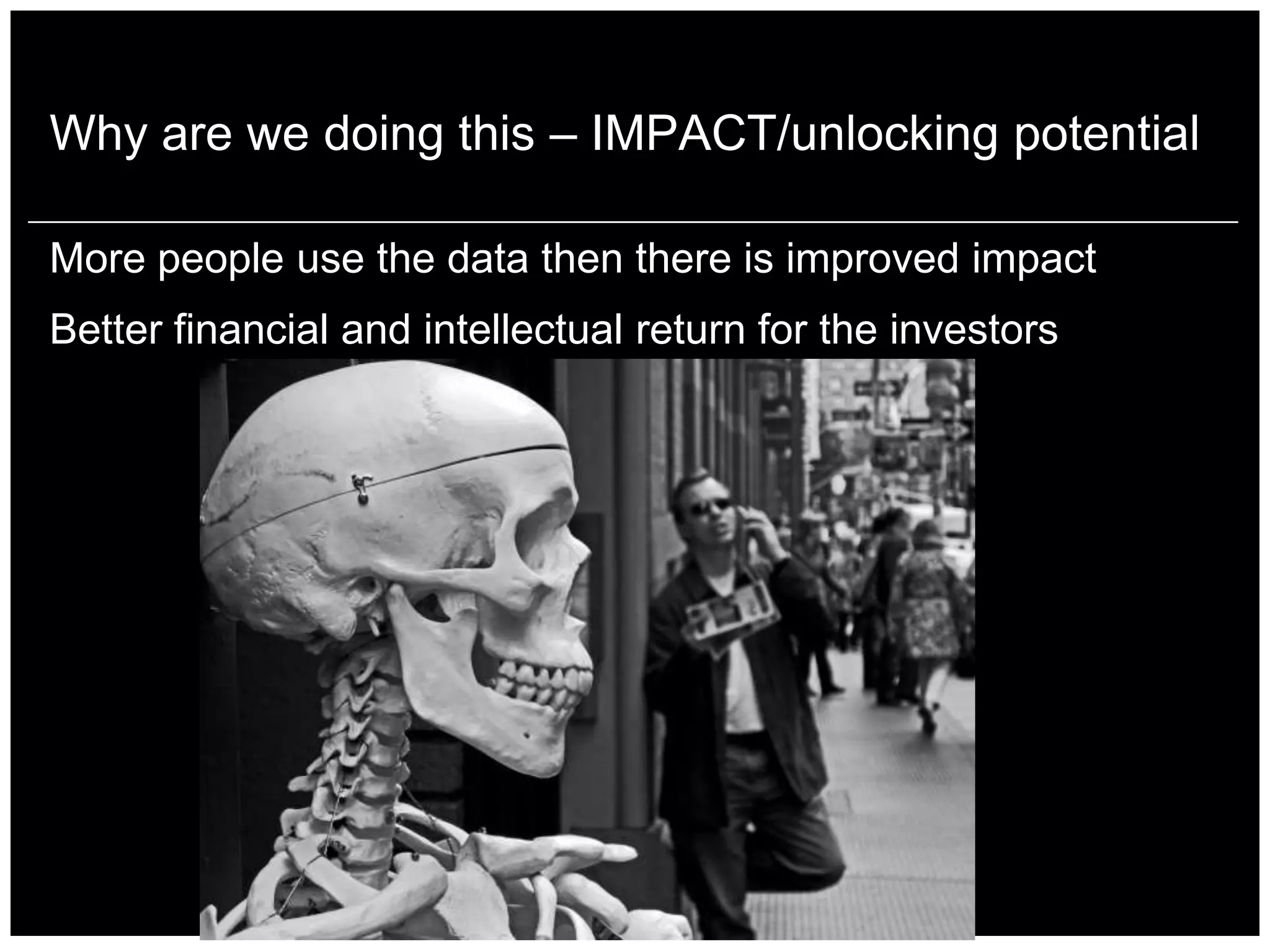
Why are we doing this – IMPACT/unlocking potential

More people use the data then there is improved impact
Better financial and intellectual return for the investors
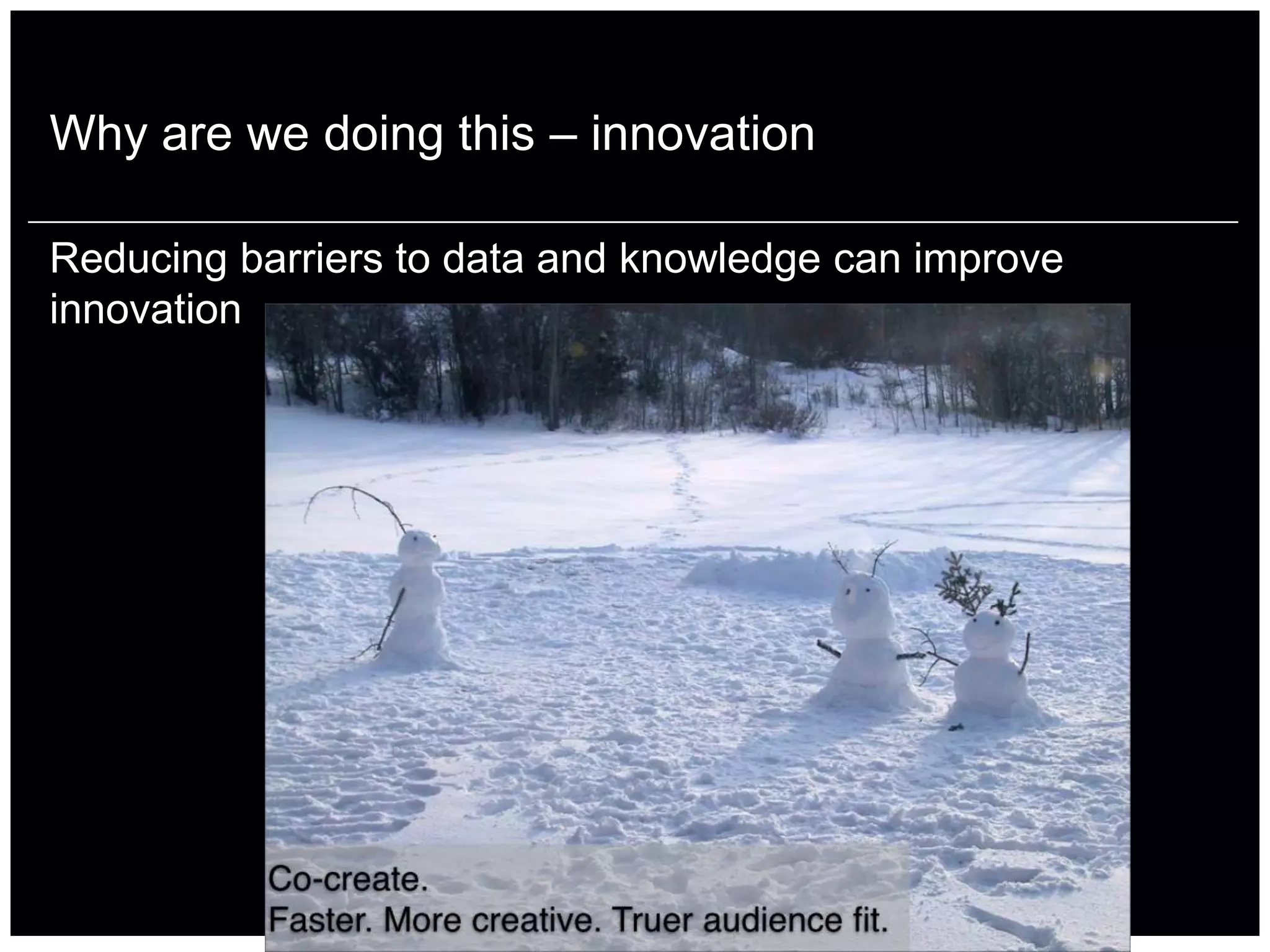
Why are we doing this – innovation

Reducing barriers to data and knowledge can improve
innovation
Why are we doing this – education

To provide baseline exemplar data for teaching and learning
Why are we doing this – building our network

Find new ways to exploit our data
Develop contacts
Write more grant applications
School of Computing
Faculty of Engineering

Software, Licences etc

  • 1.
    Software, licences andother usage issues Anthony (Ant) Beck Twitter: AntArch Potential of satellite images and hyper/multi-spectral recording in archaeology Poznan – 31st June 2012 School of Computing Faculty of Engineering
  • 2.
  • 3.
    Software - Proprietary Pros •Wellsupported in universities •Expected by employers •Tight integration with sensors (ENVI in particular) •Generic •Robust?
  • 4.
    Software - Proprietary Cons •Requiresdedicated machines (normally a lab) •Expensive •Black-box
  • 5.
    Software - FOSS Examples •GRASS– The daddy of them all •Opticks •Q-GIS •U-DIG •Whitebox •SAGA •ILWIS •MapWindow •Etc.
  • 6.
    Software - FOSS Pros •Wellsupported by the community •Allows development on any machine • You can develop a portfolio of work that stays with you • Generally cross platform •Transparent processing • White box (VERY important) •Open processes are more in-line with CLOUD processing • Workflow orchestration •Robust •Extendable by individuals
  • 7.
    Software - Proprietary Cons •Someinterface issues •There is a perception that FOSS is not as good as proprietary •Bleeding edge 3d does not always compete with the commercial
  • 8.
    Software – OpenSource Geospatial foundation OSGeo: http://www.osgeo.org/ • To provide resources for foundation projects - • To promote freely available geodata • To promote the use of open source software in the geospatial industry (not just foundation software) - eg. PR, training, outreach. • To encourage the implementation of open standards and standards- based interoperability in foundation projects. • To provide support for the use of OSGeo software in education via curriculum development, outreach, and support. • To support use and contribution to foundation projects from the worldwide community through internationalization of software and community outreach. • To operate an annual OSGeo Conference,
  • 10.
    Software – OpenSource Geospatial foundation OSGeo: http://www.osgeo.org/ • Live DVD: http://live.osgeo.org/ • A pre-configured XUBUNTU O/S with a range of applications installed and pre-configured (this is excellent  ) • OSGeo4W: https://trac.osgeo.org/osgeo4w/ • A pre-compiled binary install of different OSGeo approved packages for windows. • Both the above deal with some of the more complex bindings between applications.
  • 11.
    The Future –collaborative computing
  • 12.
    Licences - Whyare they an issue? Data is rarely in the „public domain‟ • It is normally available under a licence. Licences dictate: • Who owns the data • How you can use data • How you reference the data • How you can share/redistribute the data (and any derivatives) LICENCES ARE REALLY IMPORTANT
  • 13.
    Licences – examples:Commercial high resolution satellite Under a strict license that dictates: • Who can use the data (normally a single organisation) • Sometimes for how long • What happens with the derivatives The license protects their data which protects their income stream A user does not „own‟ this data • They use it under licence
  • 14.
    Licences – examples:GovernmentResearch satellite data The licences vary: • Military • Research grade • Archive Much of this data is released to the academic community • Community science (?) initiatives • The collecting body does not have the resources to analyse the data • The collecting body captures data on behalf of a broad community • The data is no longer sensitive or relevant Examples: Landsat, ASTER, Corona
  • 15.
    Licences – examplesLandsat 8 Australia will publish images captured by soon-to-launch satellite Landsat 8 online, in close to real time, for free under the Creative Commons Attribution 3.0 Australia licence. “We want to make as much data freely available as possible,” says Jeff Kingwell, the Section Leader of GA‟s National Earth Observation Group. “We will move towards a system where we are taking Landsat data in, in near real time.” Data will be corrected to make it usable, then published, all in as close to real time as is practical. How COOL is that 
  • 16.
    Licences – examples:Data you OWN It‟s yours! What do you want to do with it?
  • 17.
    Licences – TakeHome Points Prior to using data find out the licensing constraints • Licence holders ARE litigious – they have every right to sue you if you infringe their licence If you buy data – ensure you licence this for as broad a re-use base as possible (NEVER licence to an individual) If you own data – always provide it to others with a CLEAR re- use licence • If you want credit include an attribution clause DO NOT derive maps etc. from Google Earth data – it is illegal
  • 18.
    Licences – DART(www.dartproject.info) DART does the following: • For data under licences: • Ensures broad access • Opens data where possible (NERC ARSF) • Encourages re-use • For data it owns: gives it away • Data: Open Data Commons By Attribution licences (http://opendefinition.org/licenses/odc-by/) • Everything else: Creative Commons By Attribution licences (CC-By: http://opendefinition.org/licenses/cc-by/) • Why • Open Science
  • 19.
    Open Data: Server(in the near future) The full project archive will be available from the server Raw Data Processed Data Web Services Will also include TDR data Weather data Subsurface temperature data Soil analyses spectro-radiometry transects Crop analyses Excavation data In-situ photos ETC.
  • 20.
    Why are wedoing this – spreading the love
  • 21.
    Why are wedoing this – it‟s the right thing to do DART is a publically funded project Publically funded data should provide benefit to the public
  • 22.
    Why are wedoing this – IMPACT/unlocking potential More people use the data then there is improved impact Better financial and intellectual return for the investors
  • 23.
    Why are wedoing this – innovation Reducing barriers to data and knowledge can improve innovation
  • 24.
    Why are wedoing this – education To provide baseline exemplar data for teaching and learning
  • 25.
    Why are wedoing this – building our network Find new ways to exploit our data Develop contacts Write more grant applications
  • 26.

Editor's Notes

  • #21 © NevitDilmen [CC-BY-SA-3.0 (www.creativecommons.org/licenses/by-sa/3.0) or GFDL (w