London          March 2010           fiorluis[at]tin.it,


  S   viluppo       O         rizzonte            F      ormativo
h t t p : / / f o r m a z i o n e s o f t . w i k i s p a c e s . c o m 
                                                                                T         erritoriale


     Istituto Pedagogico Bolzano Italy: the project
       How the Italian school system in South Tyrol applies the guidelines of the
                     New District Curricula within the National Ones

               PART 1: institutional and procedural framework -8 slides


                 Attribuzione - Non commerciale - Condividi allo stesso modo 2.5 Italia
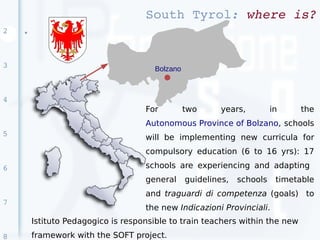
South Tyrol: where is?
2   ●


3                                     Bolzano


4
                                    For         two      years,         in    the
                                    Autonomous Province of Bolzano, schools
5                                   will be implementing new curricula for
                                    compulsory education (6 to 16 yrs): 17

6                                   schools are experiencing and adapting
                                    general     guidelines,   schools    timetable
                                    and traguardi di competenza (goals) to
7
                                    the new Indicazioni Provinciali.
        Istituto Pedagogico is responsible to train teachers within the new
8       framework with the SOFT project.
Why: aims
2


3   1.To help schools, with individual actions, applying the guidelines for
    ●


    testing new curricula.
    2.To promote South Tyrolean school professional practices aimed at
4
    achieving high quality standards while respecting diversity of each
    individual.
5   3.To draw out all the experiences that have been adopted and share
    them through the network.
    4.To move the process of renewal in schools where it hasn't started
6
    yet.
    5.To train teachers to new teaching methodologies.
7


8
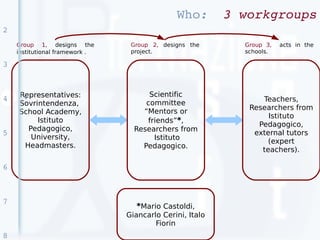
Who:  3 workgroups
2
    Group 1, designs the         Group 2, designs the     Group 3,   acts in the
    institutional framework .    project.                 schools.

3


    Representatives:                  Scientific
4    ●
                                                              Teachers,
    Sovrintendenza,                  committee
                                                           Researchers from
    School Academy,                 “Mentors or
                                                                Istituto
         Istituto                    friends”*,
                                                             Pedagogico,
       Pedagogico,                Researchers from
5                                                           external tutors
        University,                    Istituto
                                                                (expert
     Headmasters.                   Pedagogico.
                                                              teachers).

6


7
                                  *Mario Castoldi,
                                Giancarlo Cerini, Italo
                                        Fiorin
8
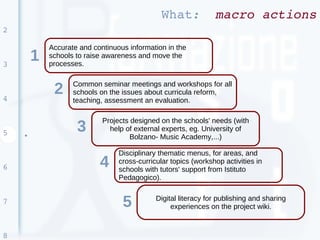
What:  macro actions
2

            Accurate and continuous information in the

3
        1   schools to raise awareness and move the
            processes.


4
             2     Common seminar meetings and workshops for all
                   schools on the issues about curricula reform,
                   teaching, assessment an evaluation.

                            Projects designed on the schools' needs (with
5   ●
                    3         help of external experts, eg. University of
                                     Bolzano- Music Academy,...)

                                 Disciplinary thematic menus, for areas, and
6                          4     cross-curricular topics (workshop activities in
                                 schools with tutors' support from Istituto
                                 Pedagogico).


7                                 5          Digital literacy for publishing and sharing
                                                  experiences on the project wiki.


8
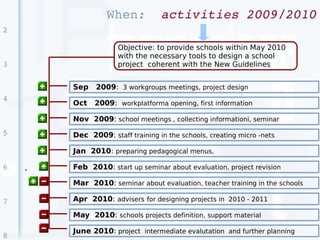
When:  activities 2009/2010
2

                     Objective: to provide schools within May 2010
                     with the necessary tools to design a school
3                    project coherent with the New Guidelines


        Sep   2009: 3 workgroups meetings, project design
4
        Oct   2009: workplatforma opening, first information

        Nov 2009: school meetings , collecting informationi, seminar
5       Dec 2009: staff training in the schools, creating micro -nets

        Jan 2010: preparing pedagogical menus,

6   ●   Feb 2010: start up seminar about evaluation, project revision

        Mar 2010: seminar about evaluation, teacher training in the schools

7       Apr 2010: advisers for designing projects in 2010 - 2011

        May 2010: schools projects definition, support material

        June 2010: project intermediate evalutation and further planning
8
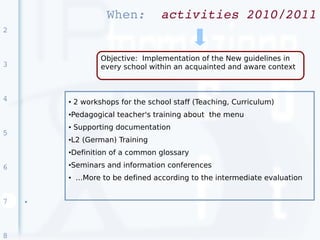
When:  activities 2010/2011
2


                   Objective: Implementation of the New guidelines in
3                  every school within an acquainted and aware context


4       ●   2 workshops for the school staff (Teaching, Curriculum)
        Pedagogical teacher's training about the menu
        ●


        ●   Supporting documentation
5
        L2 (German) Training
        ●


        Definition of a common glossary
        ●


6       Seminars and information conferences
        ●


        ●   ...More to be defined according to the intermediate evaluation


7   ●


8
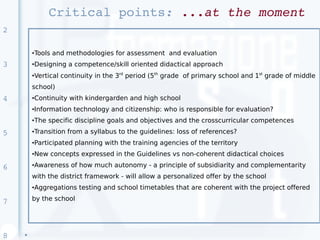
Critical points: ...at the moment
2

        Tools and methodologies for assessment and evaluation
        ●


3       Designing a competence/skill oriented didactical approach
        ●


        Vertical continuity in the 3rd period (5th grade of primary school and 1st grade of middle
        ●


        school)
4       Continuity with kindergarden and high school
        ●


        Information technology and citizenship: who is responsible for evaluation?
        ●


        The specific discipline goals and objectives and the crosscurricular competences
        ●


5       Transition from a syllabus to the guidelines: loss of references?
        ●


        Participated planning with the training agencies of the territory
        ●


        New concepts expressed in the Guidelines vs non-coherent didactical choices
        ●


6       Awareness of how much autonomy - a principle of subsidiarity and complementarity
        ●


        with the district framework - will allow a personalized offer by the school
        Aggregations testing and school timetables that are coherent with the project offered
        ●


7       by the school


8   ●
S   viluppo    O     rizzonte         F    ormativo           T     erritoriale
h t t p : / / f o r m a z i o n e s o f t . w i k i s p a c e s . c o m 


               SO(F)TENIBILITY
          Openness as a framework for teacher training
                   PART 2: we are the engine and the machine, 14 slides
2    ●
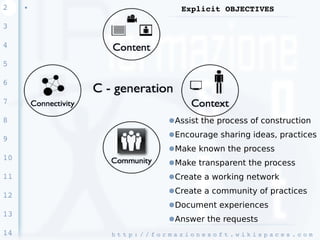
                                 Explicit OBJECTIVES 

3

4

5

6

7

8                           ●Assist the process of construction
                            ●Encourage sharing ideas, practices
9
                            ●Make known the process
10
                            ●Make transparent the process
11                          ●Create a working network
                            ●Create a community of practices
12
                            ●Document experiences
13
                            ●Answer the requests
14       h t t p : / / f o r m a z i o n e s o f t . w i k i s p a c e s . c o m 
2    ●
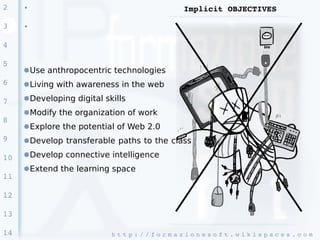
                                                    Implicit OBJECTIVES

3    ●


4

5
     ●Use anthropocentric technologies
6    ●Living with awareness in the web

7    ●Developing digital skills
     ●Modify the organization of work
8
     ●Explore the potential of Web 2.0
9    ●Develop transferable paths to the class

10   ●Develop connective intelligence
     ●Extend the learning space
11

12

13

14                         h t t p : / / f o r m a z i o n e s o f t . w i k i s p a c e s . c o m 
2    ●
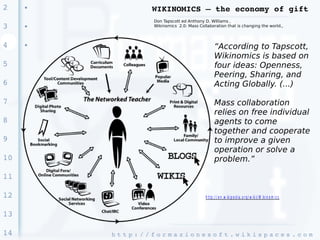
                       WIKINOMICS – the economy of gift
                       Don Tapscott ed Anthony D. Williams ,
3    ●                 Wikinomics 2.0: Mass Collaboration that is changing the world.,


4    ●
                                                       “According to Tapscott,
                                                       Wikinomics is based on
5                                                      four ideas: Openness,
                                                       Peering, Sharing, and
6                                                      Acting Globally. (...)

7                                                      Mass collaboration
                                                       relies on free individual
8                                                      agents to come
                                                       together and cooperate
9                                                      to improve a given
                                                       operation or solve a
10                                                     problem.”

11

12                                              h t t p : / / e n .w ik ip e d ia .o r g / w ik i/ W ik in o m ic s


13

14       h t t p : / / f o r m a z i o n e s o f t . w i k i s p a c e s . c o m 
2    ●
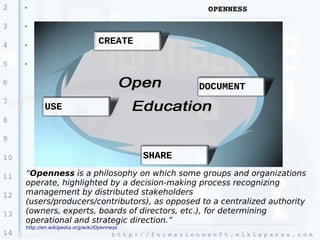
                                                                        OPENNESS 

3    ●


4    ●
                                  CREATE

5    ●


6
                                                                     DOCUMENT
7
            USE
8

9

10                                               SHARE

11   “Openness is a philosophy on which some groups and organizations
     operate, highlighted by a decision-making process recognizing
12   management by distributed stakeholders
     (users/producers/contributors), as opposed to a centralized authority
13   (owners, experts, boards of directors, etc.), for determining
     operational and strategic direction.”
     http://en.wikipedia.org/wiki/Openness
14                                     h t t p : / / f o r m a z i o n e s o f t . w i k i s p a c e s . c o m 
2    ●
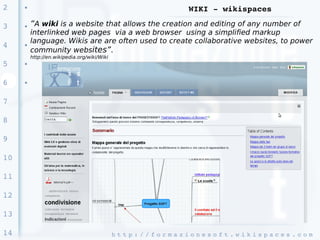
                                                                        WIKI ­ wikispaces

3    ●   “A wiki is a website that allows the creation and editing of any number of
         interlinked web pages via a web browser using a simplified markup
         language. Wikis are are often used to create collaborative websites, to power
4    ●
         community websites”.
         http://en.wikipedia.org/wiki/Wiki
5    ●


6    ●


7

8

9

10

11

12

13

14                                           h t t p : / / f o r m a z i o n e s o f t . w i k i s p a c e s . c o m 
2    ●                                                 WIKISPACES ­ why

3    ●

         ●Requires low digital skills but high content management skills and
4    ●
         high skills in recognizing interdependence relationships between
5    ●   things and people.
         ●Shows      the      importance          of      content          and        not       of
6    ●

         performance/representation
7    ●
         ●No architectural barriers due to the difficulties by using it.
8        ●It is independent from the operative system.
         ●Accustoms people to work in positive interdepence from one
9
         another.
10       ●Stimulates collaboration and shared responsibility.
11       ●It is clear trasparente.
         ●And free for educational use.
12

13

14                          h t t p : / / f o r m a z i o n e s o f t . w i k i s p a c e s . c o m 
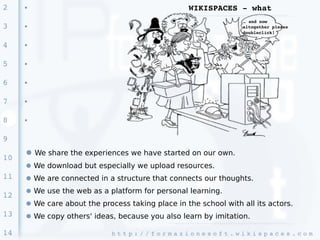
2    ●                                                  WIKISPACES ­ what
                                                                          … and now
3    ●                                                                    altogether please
                                                                          doubleclick!


4    ●


5    ●


6    ●


7    ●


8    ●


9
     ● We share the experiences we have started on our own.
10
     ● We download but especially we upload resources.
11   ● We are connected in a structure that connects our thoughts.
     ● We use the web as a platform for personal learning.
12
     ● We care about the process taking place in the school with all its actors.
13   ● We copy others' ideas, because you also learn by imitation.

14                           h t t p : / / f o r m a z i o n e s o f t . w i k i s p a c e s . c o m 
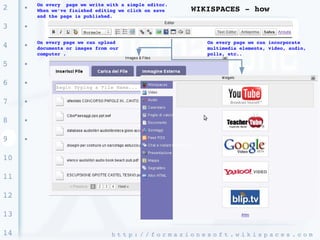
On every  page we write with a simple editor. 
2    ●
         When we’ve finished editing we click on save        WIKISPACES ­ how
         and the page is published. 

3    ●


         On every page we can upload                               On every page we can incorporate 
4    ●
         documents or images from our                              multimedia elements, video, audio, 
         computer .                                                polls, etc.. 

5    ●


6    ●


7    ●


8    ●


9    ●


10

11

12

13

14                                h t t p : / / f o r m a z i o n e s o f t . w i k i s p a c e s . c o m 
2    ●
                                                    WIKISPACES ­ when

3    ●

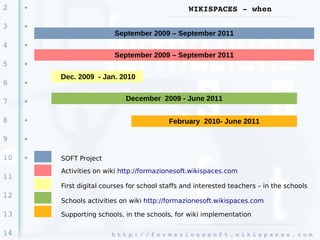
                          September 2009 – September 2011
4    ●


                          September 2009 – September 2011
5    ●


         Dec. 2009 - Jan. 2010
6    ●


7    ●                        December 2009 - June 2011

8    ●
                                             February 2010- June 2011

9    ●


10   ●   SOFT Project
         Activities on wiki http://formazionesoft.wikispaces.com
11
         First digital courses for school staffs and interested teachers – in the schools
12
         Schools activities on wiki http://formazionesoft.wikispaces.com

13       Supporting schools, in the schools, for wiki implementation

14                       h t t p : / / f o r m a z i o n e s o f t . w i k i s p a c e s . c o m 
2    ●
                                     WIKISPACES ­ who

3    ●


                          We are the engine: the engine is
4    ●
                          everybody and we are part of the
5    ●                    educational community in the Italian
                          schools - district of Bolzano, Italy.
6    ●

                          Istituto Pedagogico offers activities and
7    ●
                          training courses, accepts and develops
8    ●                    the different active requests, encourages
                          autonomy and creativity.
9    ●

                          In a wiki there are no hierarchical
10   ●
                          positions, and only some are related to
                          the correct working of the wiki.
11   ●

                          Everyone can develop the collective
12                        project.
13

14       h t t p : / / f o r m a z i o n e s o f t . w i k i s p a c e s . c o m 
2    ●                            HELP AND ASSISTANCE – ready to work...

3    ●


4    ●


5    ●   For information, help, requests, proposals:

6    ●

         Laura Portesi, director of IPI Bolzano, Italy     laura.portesi@scuola.alto-adige.it

7    ●
         Alessandro Garavelli, project manager       alessandro.garavelli@scuola.alto-adige.it


8    ●   Luisanna Fiorini, communication editor       luisanna.fiorini@scuola.alto-adige.it


         Emanuela Atz, translation and project implementation                       emanuela.atz@scuola.alto-adige.it
9    ●


10   ●


11   ●


12   ●


13

14                              h t t p : / / f o r m a z i o n e s o f t . w i k i s p a c e s . c o m 
2    ●
              ACTIVE CITIZENSHIP – freedom is participation

3    ●


4    ●


5    ●
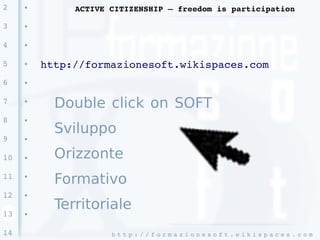
         http://formazionesoft.wikispaces.com 
6    ●


7    ●
           Double click on SOFT
8    ●


           Sviluppo
9    ●


10   ●     Orizzonte
11   ●
           Formativo
12   ●


           Territoriale
13   ●


14                   h t t p : / / f o r m a z i o n e s o f t . w i k i s p a c e s . c o m 
2    ●
                                                                                    CREDITS

3    ●

          Picture   pg   2 http://www.titticimmino.com/wp-content/uploads/image/generazione%20c_001.jpg
          Picture   pg   3 http://www.martybucella.com/edtoons.html
4    ●
          Picture   pg   4 http://api.ning.com/files/connectivism.jpg
          Picture   pg   5 revisited http://blogs.ubc.ca/dean/files/2009/02/open_education1.jpg
          Picture   pg   7 revisited http://www.iskra.coop/immagini/Collaborare03.jpg
5    ●    Picture   pg   8 revisited http://www.martybucella.com/comptoons.html
          Picture   pg   11 http://www.orianit.edu-negev.gov.il/

6    ●


7    ●
                                                                           HANDMADE GUARANTEED 
                                                                 OpenOffice.org on Linux Debian
8    ●


         for Istituto Pedagogico di Bolzano, translation  Emanuela Atz
9    ●

          SOFT PROJECT                                                                              YEAR2010
10   ●


11   ●


                           Attribuzione - Non commerciale - Condividi allo stesso modo 2.5 Italia
12   ●


13   ●


14   ●
                                          h t t p : / / f o r m a z i o n e s o f t . w i k i s p a c e s . c o m 

Soft Project

  • 1.
    London March 2010 fiorluis[at]tin.it, S viluppo O rizzonte F ormativo h t t p : / / f o r m a z i o n e s o f t . w i k i s p a c e s . c o m  T erritoriale Istituto Pedagogico Bolzano Italy: the project How the Italian school system in South Tyrol applies the guidelines of the New District Curricula within the National Ones PART 1: institutional and procedural framework -8 slides Attribuzione - Non commerciale - Condividi allo stesso modo 2.5 Italia
  • 2.
    South Tyrol: where is? 2 ● 3 Bolzano 4 For two years, in the Autonomous Province of Bolzano, schools 5 will be implementing new curricula for compulsory education (6 to 16 yrs): 17 6 schools are experiencing and adapting general guidelines, schools timetable and traguardi di competenza (goals) to 7 the new Indicazioni Provinciali. Istituto Pedagogico is responsible to train teachers within the new 8 framework with the SOFT project.
  • 3.
    Why: aims 2 3 1.To help schools, with individual actions, applying the guidelines for ● testing new curricula. 2.To promote South Tyrolean school professional practices aimed at 4 achieving high quality standards while respecting diversity of each individual. 5 3.To draw out all the experiences that have been adopted and share them through the network. 4.To move the process of renewal in schools where it hasn't started 6 yet. 5.To train teachers to new teaching methodologies. 7 8
  • 4.
    Who:  3 workgroups 2 Group 1, designs the Group 2, designs the Group 3, acts in the institutional framework . project. schools. 3 Representatives: Scientific 4 ● Teachers, Sovrintendenza, committee Researchers from School Academy, “Mentors or Istituto Istituto friends”*, Pedagogico, Pedagogico, Researchers from 5 external tutors University, Istituto (expert Headmasters. Pedagogico. teachers). 6 7 *Mario Castoldi, Giancarlo Cerini, Italo Fiorin 8
  • 5.
    What:  macro actions 2 Accurate and continuous information in the 3 1 schools to raise awareness and move the processes. 4 2 Common seminar meetings and workshops for all schools on the issues about curricula reform, teaching, assessment an evaluation. Projects designed on the schools' needs (with 5 ● 3 help of external experts, eg. University of Bolzano- Music Academy,...) Disciplinary thematic menus, for areas, and 6 4 cross-curricular topics (workshop activities in schools with tutors' support from Istituto Pedagogico). 7 5 Digital literacy for publishing and sharing experiences on the project wiki. 8
  • 6.
    When:  activities 2009/2010 2 Objective: to provide schools within May 2010 with the necessary tools to design a school 3 project coherent with the New Guidelines Sep 2009: 3 workgroups meetings, project design 4 Oct 2009: workplatforma opening, first information Nov 2009: school meetings , collecting informationi, seminar 5 Dec 2009: staff training in the schools, creating micro -nets Jan 2010: preparing pedagogical menus, 6 ● Feb 2010: start up seminar about evaluation, project revision Mar 2010: seminar about evaluation, teacher training in the schools 7 Apr 2010: advisers for designing projects in 2010 - 2011 May 2010: schools projects definition, support material June 2010: project intermediate evalutation and further planning 8
  • 7.
    When:  activities 2010/2011 2 Objective: Implementation of the New guidelines in 3 every school within an acquainted and aware context 4 ● 2 workshops for the school staff (Teaching, Curriculum) Pedagogical teacher's training about the menu ● ● Supporting documentation 5 L2 (German) Training ● Definition of a common glossary ● 6 Seminars and information conferences ● ● ...More to be defined according to the intermediate evaluation 7 ● 8
  • 8.
    Critical points: ...at the moment 2 Tools and methodologies for assessment and evaluation ● 3 Designing a competence/skill oriented didactical approach ● Vertical continuity in the 3rd period (5th grade of primary school and 1st grade of middle ● school) 4 Continuity with kindergarden and high school ● Information technology and citizenship: who is responsible for evaluation? ● The specific discipline goals and objectives and the crosscurricular competences ● 5 Transition from a syllabus to the guidelines: loss of references? ● Participated planning with the training agencies of the territory ● New concepts expressed in the Guidelines vs non-coherent didactical choices ● 6 Awareness of how much autonomy - a principle of subsidiarity and complementarity ● with the district framework - will allow a personalized offer by the school Aggregations testing and school timetables that are coherent with the project offered ● 7 by the school 8 ●
  • 9.
    S viluppo O rizzonte F ormativo T erritoriale h t t p : / / f o r m a z i o n e s o f t . w i k i s p a c e s . c o m  SO(F)TENIBILITY Openness as a framework for teacher training PART 2: we are the engine and the machine, 14 slides
  • 10.
    2 ● Explicit OBJECTIVES  3 4 5 6 7 8 ●Assist the process of construction ●Encourage sharing ideas, practices 9 ●Make known the process 10 ●Make transparent the process 11 ●Create a working network ●Create a community of practices 12 ●Document experiences 13 ●Answer the requests 14 h t t p : / / f o r m a z i o n e s o f t . w i k i s p a c e s . c o m 
  • 11.
    2 ● Implicit OBJECTIVES 3 ● 4 5 ●Use anthropocentric technologies 6 ●Living with awareness in the web 7 ●Developing digital skills ●Modify the organization of work 8 ●Explore the potential of Web 2.0 9 ●Develop transferable paths to the class 10 ●Develop connective intelligence ●Extend the learning space 11 12 13 14 h t t p : / / f o r m a z i o n e s o f t . w i k i s p a c e s . c o m 
  • 12.
    2 ● WIKINOMICS – the economy of gift Don Tapscott ed Anthony D. Williams , 3 ● Wikinomics 2.0: Mass Collaboration that is changing the world., 4 ● “According to Tapscott, Wikinomics is based on 5 four ideas: Openness, Peering, Sharing, and 6 Acting Globally. (...) 7 Mass collaboration relies on free individual 8 agents to come together and cooperate 9 to improve a given operation or solve a 10 problem.” 11 12 h t t p : / / e n .w ik ip e d ia .o r g / w ik i/ W ik in o m ic s 13 14 h t t p : / / f o r m a z i o n e s o f t . w i k i s p a c e s . c o m 
  • 13.
    2 ● OPENNESS  3 ● 4 ● CREATE 5 ● 6 DOCUMENT 7 USE 8 9 10 SHARE 11 “Openness is a philosophy on which some groups and organizations operate, highlighted by a decision-making process recognizing 12 management by distributed stakeholders (users/producers/contributors), as opposed to a centralized authority 13 (owners, experts, boards of directors, etc.), for determining operational and strategic direction.” http://en.wikipedia.org/wiki/Openness 14 h t t p : / / f o r m a z i o n e s o f t . w i k i s p a c e s . c o m 
  • 14.
    2 ● WIKI ­ wikispaces 3 ● “A wiki is a website that allows the creation and editing of any number of interlinked web pages via a web browser using a simplified markup language. Wikis are are often used to create collaborative websites, to power 4 ● community websites”. http://en.wikipedia.org/wiki/Wiki 5 ● 6 ● 7 8 9 10 11 12 13 14 h t t p : / / f o r m a z i o n e s o f t . w i k i s p a c e s . c o m 
  • 15.
    2 ● WIKISPACES ­ why 3 ● ●Requires low digital skills but high content management skills and 4 ● high skills in recognizing interdependence relationships between 5 ● things and people. ●Shows the importance of content and not of 6 ● performance/representation 7 ● ●No architectural barriers due to the difficulties by using it. 8 ●It is independent from the operative system. ●Accustoms people to work in positive interdepence from one 9 another. 10 ●Stimulates collaboration and shared responsibility. 11 ●It is clear trasparente. ●And free for educational use. 12 13 14 h t t p : / / f o r m a z i o n e s o f t . w i k i s p a c e s . c o m 
  • 16.
    2 ● WIKISPACES ­ what … and now 3 ● altogether please doubleclick! 4 ● 5 ● 6 ● 7 ● 8 ● 9 ● We share the experiences we have started on our own. 10 ● We download but especially we upload resources. 11 ● We are connected in a structure that connects our thoughts. ● We use the web as a platform for personal learning. 12 ● We care about the process taking place in the school with all its actors. 13 ● We copy others' ideas, because you also learn by imitation. 14 h t t p : / / f o r m a z i o n e s o f t . w i k i s p a c e s . c o m 
  • 17.
    On every  page we write with a simple editor.  2 ● When we’ve finished editing we click on save  WIKISPACES ­ how and the page is published.  3 ● On every page we can upload  On every page we can incorporate  4 ● documents or images from our  multimedia elements, video, audio,  computer . polls, etc..  5 ● 6 ● 7 ● 8 ● 9 ● 10 11 12 13 14 h t t p : / / f o r m a z i o n e s o f t . w i k i s p a c e s . c o m 
  • 18.
    2 ● WIKISPACES ­ when 3 ● September 2009 – September 2011 4 ● September 2009 – September 2011 5 ● Dec. 2009 - Jan. 2010 6 ● 7 ● December 2009 - June 2011 8 ● February 2010- June 2011 9 ● 10 ● SOFT Project Activities on wiki http://formazionesoft.wikispaces.com 11 First digital courses for school staffs and interested teachers – in the schools 12 Schools activities on wiki http://formazionesoft.wikispaces.com 13 Supporting schools, in the schools, for wiki implementation 14 h t t p : / / f o r m a z i o n e s o f t . w i k i s p a c e s . c o m 
  • 19.
    2 ● WIKISPACES ­ who 3 ● We are the engine: the engine is 4 ● everybody and we are part of the 5 ● educational community in the Italian schools - district of Bolzano, Italy. 6 ● Istituto Pedagogico offers activities and 7 ● training courses, accepts and develops 8 ● the different active requests, encourages autonomy and creativity. 9 ● In a wiki there are no hierarchical 10 ● positions, and only some are related to the correct working of the wiki. 11 ● Everyone can develop the collective 12 project. 13 14 h t t p : / / f o r m a z i o n e s o f t . w i k i s p a c e s . c o m 
  • 20.
    2 ● HELP AND ASSISTANCE – ready to work... 3 ● 4 ● 5 ● For information, help, requests, proposals: 6 ● Laura Portesi, director of IPI Bolzano, Italy laura.portesi@scuola.alto-adige.it 7 ● Alessandro Garavelli, project manager alessandro.garavelli@scuola.alto-adige.it 8 ● Luisanna Fiorini, communication editor luisanna.fiorini@scuola.alto-adige.it Emanuela Atz, translation and project implementation emanuela.atz@scuola.alto-adige.it 9 ● 10 ● 11 ● 12 ● 13 14 h t t p : / / f o r m a z i o n e s o f t . w i k i s p a c e s . c o m 
  • 21.
    2 ● ACTIVE CITIZENSHIP – freedom is participation 3 ● 4 ● 5 ● http://formazionesoft.wikispaces.com  6 ● 7 ● Double click on SOFT 8 ● Sviluppo 9 ● 10 ● Orizzonte 11 ● Formativo 12 ● Territoriale 13 ● 14 h t t p : / / f o r m a z i o n e s o f t . w i k i s p a c e s . c o m 
  • 22.
    2 ● CREDITS 3 ● Picture pg 2 http://www.titticimmino.com/wp-content/uploads/image/generazione%20c_001.jpg Picture pg 3 http://www.martybucella.com/edtoons.html 4 ● Picture pg 4 http://api.ning.com/files/connectivism.jpg Picture pg 5 revisited http://blogs.ubc.ca/dean/files/2009/02/open_education1.jpg Picture pg 7 revisited http://www.iskra.coop/immagini/Collaborare03.jpg 5 ● Picture pg 8 revisited http://www.martybucella.com/comptoons.html Picture pg 11 http://www.orianit.edu-negev.gov.il/ 6 ● 7 ● HANDMADE GUARANTEED  OpenOffice.org on Linux Debian 8 ● for Istituto Pedagogico di Bolzano, translation  Emanuela Atz 9 ● SOFT PROJECT YEAR2010 10 ● 11 ● Attribuzione - Non commerciale - Condividi allo stesso modo 2.5 Italia 12 ● 13 ● 14 ● h t t p : / / f o r m a z i o n e s o f t . w i k i s p a c e s . c o m