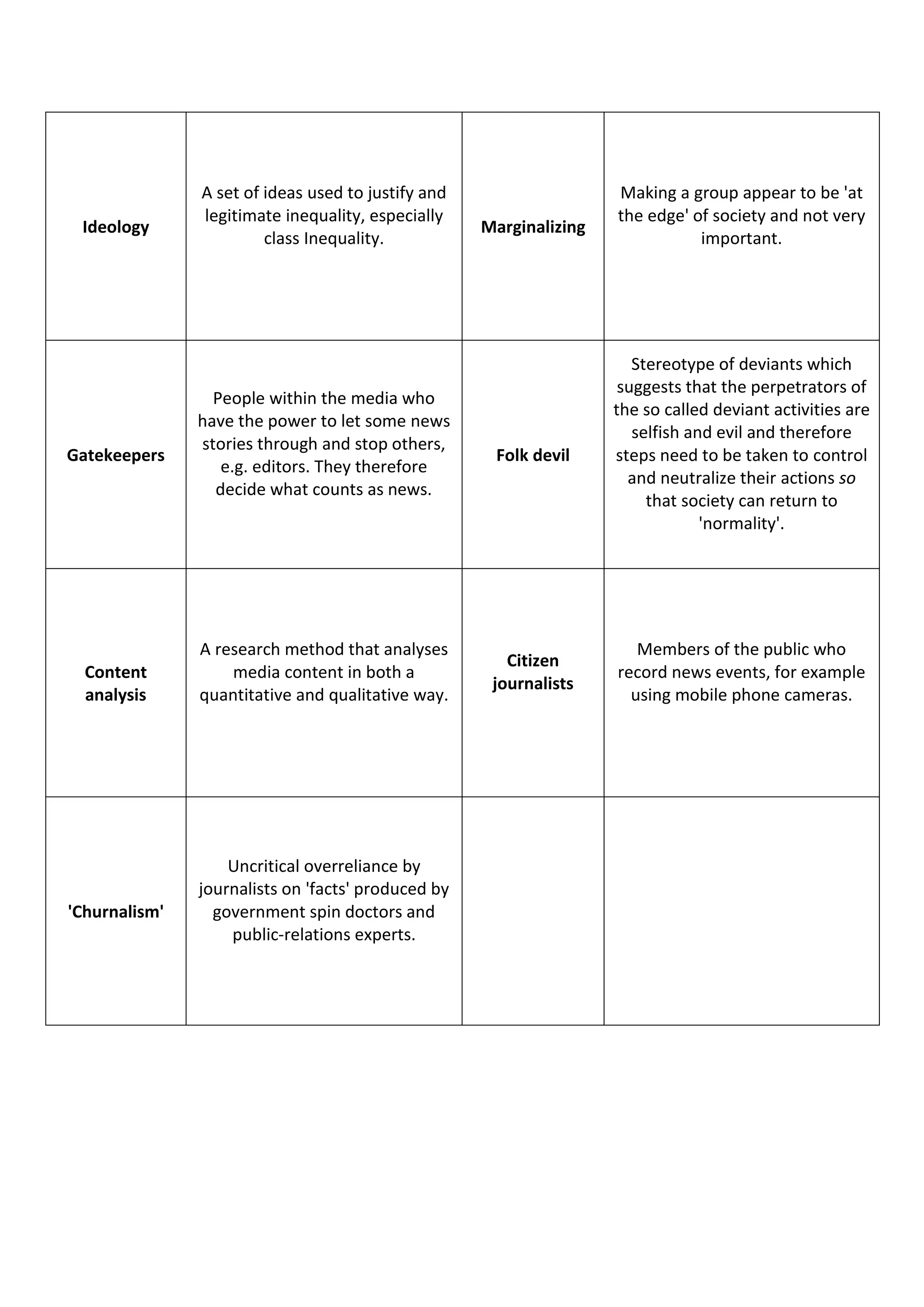
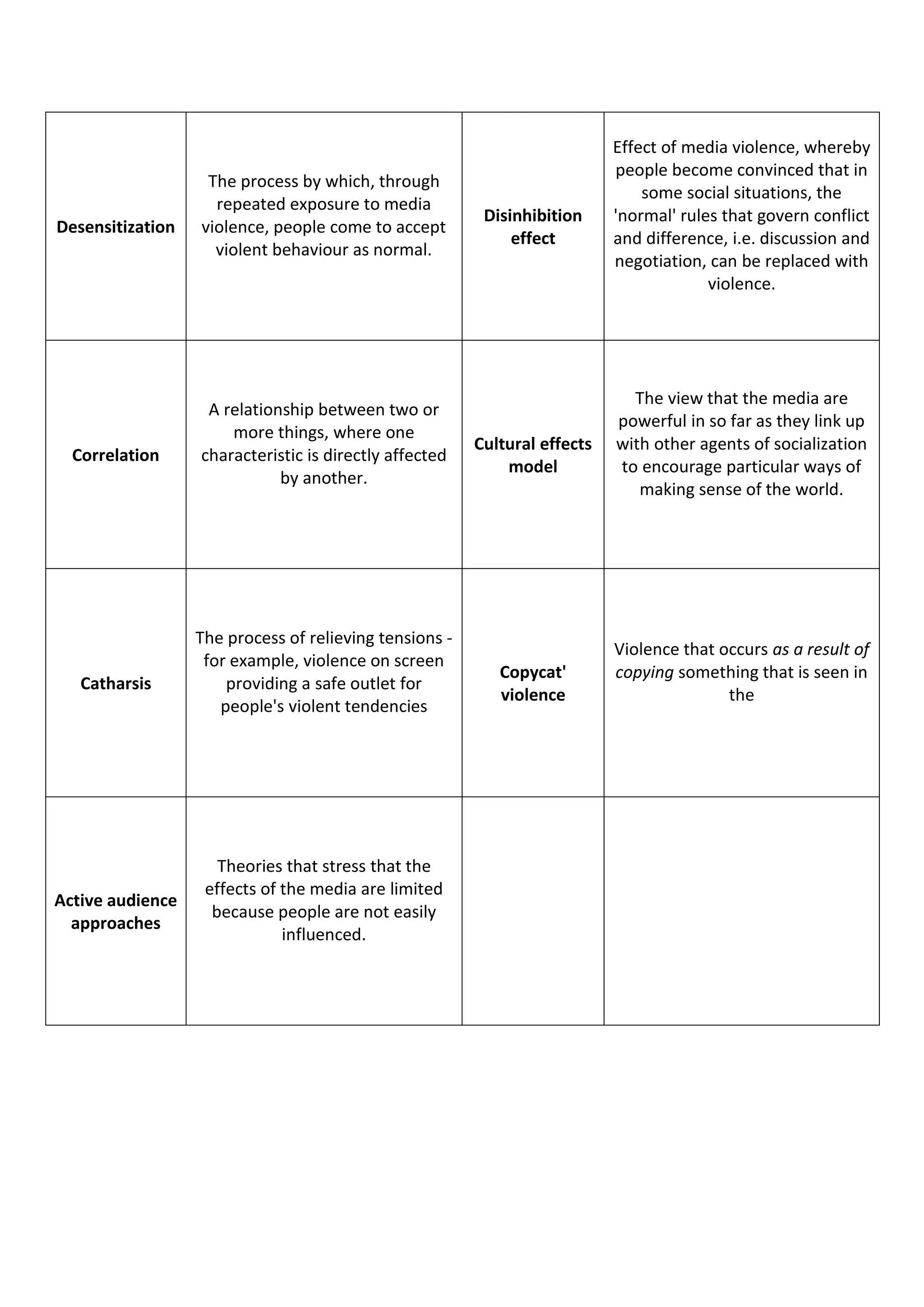
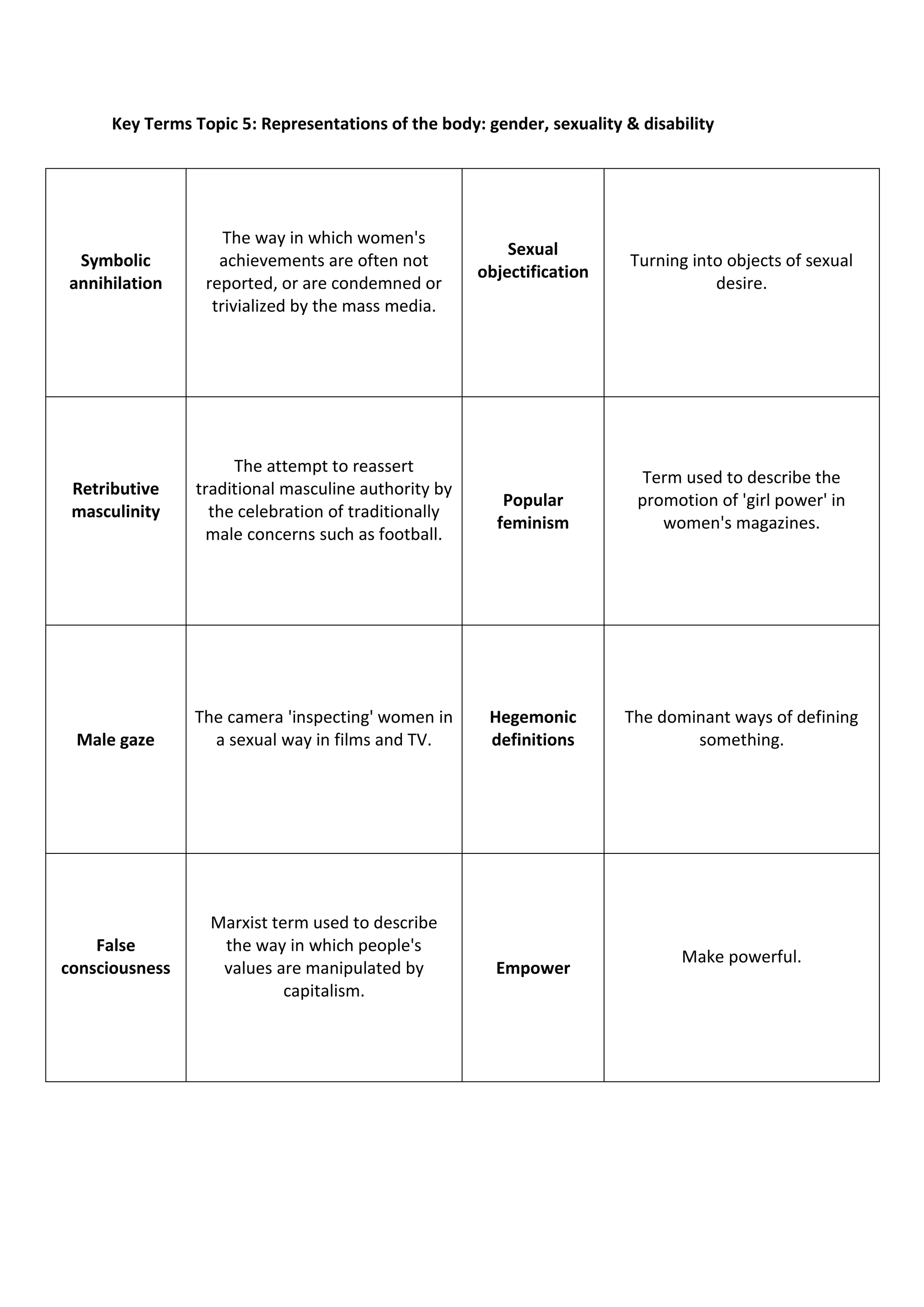
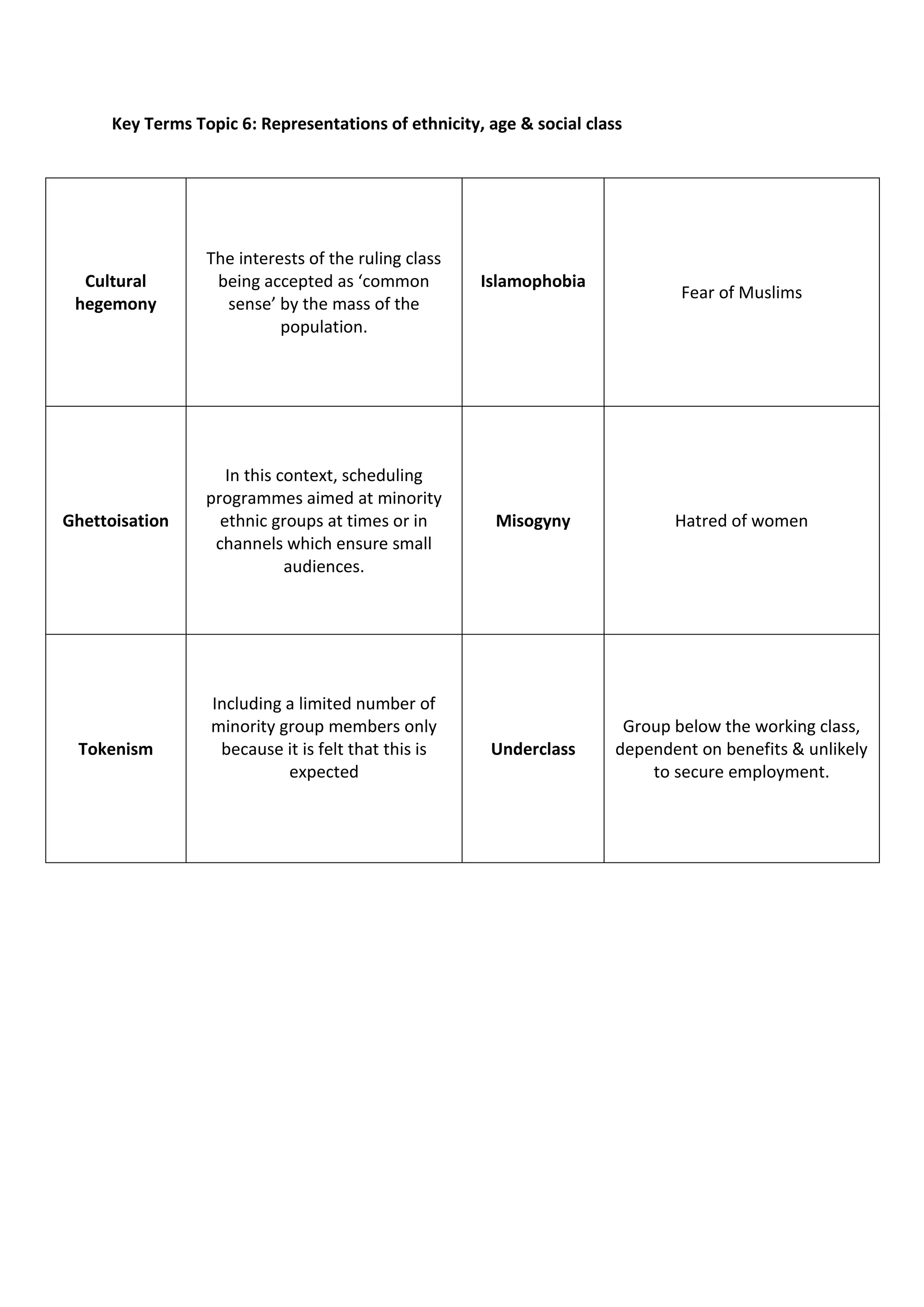
Key Terms Topic 1: Trends in the ownership & control of the mass media.SynergyA mutually advantageous combination of distinct elements, as where two or more related businesses work together, e.g. to promote and sell a film, computer game and toys more effectively than they could individually.Public servicebroadcastingMedia outlets controlled by the state.Media concentrationThe result of smaller media companies merging, or beingbought up by larger companies, to form a small number of very large companies.Mass mediaAgencies of communication that transmit information, education, news and entertainment to massaudiences.Horizontal integrationAlso known as cross-media ownership. Refers to the fact that the bigger media companies often own a diverse range of media.Investigative journalismJournalism that aims to expose the misdeeds of the powerful.HegemonyDomination by consent (used to describe the way in which the ruling class project their view of the world so that it becomes the consensus view).False class-consciousnessComing to believe (wrongly) that capitalism is a fair system which benefits us all equally. Associated with Marxism.Global conglomerationThe trend for mediacorporations to have a presence in many countries and operate in a global market.DiversificationThe practice of spreading risk by moving into new, unrelated areas of business.CybermediaThe internet and worldwide web.Cross-media ownershipOccurs where different types of media - e.g. radio and TV stations - are owned by thesame company.TechnologicalconvergenceThe tendency for once diverse media forms tocombine as a result of digital technology.PluralismA theory that society is made up of many different groups, all having more or less equal power.Vertical integrationOwning all the stages in the production, distribution and consumption of a productMedia conglomerateA company that owns various types of media.Agenda settingControlling which issues come to public attention.<br />Key Terms Topic 2: New Media, globalisation & popular culture<br />Collective intelligenceThe way in which users of new media combine skills, resources and knowledge.CompressionThe way in which digital technologies can send many signals through the same cable.Convergence.The combination of different ways of presenting a variety of types of information (e.g. text, photographs, video, film, voices and music) into a single delivery systemCultural pessimistsCommentators who are pessimistic about the spread and influence of new media technologies.InteractivityDigital technologies that are responsive in 'real time' to user input.NeophiliacsCommentators who are optimistic about the spread and influence of new media technologies.New mediaGenerally refers to the evolution of existing media delivery systems and the development of new digital communication technologies.Participatory culture.Media producers and consumers no longer occupy separate roles; they interact with each other according to a new set of rules<br />Key Terms Topic 3: Selection & Presentation of news & moral panics<br />SemioticsThe sociological study of signs and symbols contained in languages and images such as advertisements : See also content analysisPrimary definersPowerful groups that have easier and more effective access to themedia, e.g. the government the rich and powerful.News valuesAssumptions about what makes an event newsworthy (i.e. interesting to a particular audience) that guide journalists and editor when selecting news items.Power eliteThe wealthy minority who control economic and political power.NarrativizationTransforming real events intoeasily digestible stories withcausal agents, (heroes andvillains) and a sense of closure.Neo-pluralismView that journalists are professional, objective pursuers of truth who face obstacles in living up to these principles in themodern world.Moral entrepreneursPoliticians, religious leaders,etc., who react to sensationalmedia reports and makestatements condemning thegroup or activity and insist thatthe police, courts and government take action against them.Moral panicsMedia reactions to particular social groups or particular activities which are defined asthreatening societal values andconsequently create anxietyamongst the general population.IdeologyA set of ideas used to justify and legitimate inequality, especially class Inequality.MarginalizingMaking a group appear to be 'at the edge' of society and not veryimportant.GatekeepersPeople within the media who have the power to let some news stories through and stop others, e.g. editors. They therefore decide what counts as news.Folk devilStereotype of deviants which suggests that the perpetrators of the so called deviant activities areselfish and evil and therefore steps need to be taken to control and neutralize their actions so that society can return to 'normality'.Content analysisA research method that analyses media content in both a quantitative and qualitative way.Citizen journalistsMembers of the public who record news events, for example using mobile phone cameras.'Churnalism'Uncritical overreliance by journalists on 'facts' produced by government spin doctors and public-relations experts.<br />Key Terms Topic 4: The Mass Media & Audiences<br />Preferred (dominant)readingThe intended messagescontained within the text.Reception analysis modelThe view that individuals makemeanings from media messages.Selective exposureThe idea that people only watch, listen or read what they want to.Selective filter modelThe view that audience members only allow certain media messages through.Selective perception theIdea that people only take noticeof certain media messages.Selective retentionThe idea that people only remember certain media messages.Uses and gratificationsModel the view that people usethe media for their own purposes.SensitizationThe process of becoming more aware of the consequences of violence.Negotiated readingAn interpretation of a media text that modifies the intended (preferred) reading so that it fits with the audience member's own views.PolysemicAttracts more than one type of reading or interpretation.Media textAny media output - written, aural or visual, e.g. magazine article, photo, CD, film, TV or radio programme.Oppositional readingAn interpretation of a media text that rejects its intended (preferred) reading.Hypodermic syringe modelThe view that the media are verypowerful and the audience veryweak. The media can 'inject' theirmessages into the audience, whoaccept them uncritically.Media literateAn intelligent, critical and informed attitude to the media.Effects approachAn approach based on the hypodermic syringe model which believes that the media have direct effects on their audience.HomogeneousThe same throughout, undifferentiated.DesensitizationThe process by which, through repeated exposure to media violence, people come to accept violent behaviour as normal.Disinhibition effectEffect of media violence, whereby people become convinced that in some social situations, the 'normal' rules that govern conflict and difference, i.e. discussion and negotiation, can be replaced with violence.CorrelationA relationship between two or more things, where one characteristic is directly affected by another.Cultural effects modelThe view that the media are powerful in so far as they link up with other agents of socialization to encourage particular ways of making sense of the world.CatharsisThe process of relieving tensions - for example, violence on screen providing a safe outlet for people's violent tendenciesCopycat' violenceViolence that occurs as a result of copying something that is seen in theActive audience approachesTheories that stress that the effects of the media are limited because people are not easily influenced.<br />Key Terms Topic 5: Representations of the body: gender, sexuality & disability<br />Symbolic annihilationThe way in which women's achievements are often not reported, or are condemned or trivialized by the mass media.Sexual objectificationTurning into objects of sexual desire.Retributive masculinityThe attempt to reassert traditional masculine authority by the celebration of traditionally male concerns such as football.Popular feminismTerm used to describe the promotion of 'girl power' in women's magazines.Male gazeThe camera 'inspecting' women in a sexual way in films and TV.Hegemonic definitionsThe dominant ways of defining something.False consciousnessMarxist term used to describethe way in which people'svalues are manipulated by capitalism.EmpowerMake powerful.Cult of femininityThe promotion of a traditionalideal where excellence is achieved through caring for others, the family, marriage and appearance.Beauty idealThe idea that women should strive for beauty.<br />Key Terms Topic 6: Representations of ethnicity, age & social class<br />Cultural hegemonyThe interests of the ruling class being accepted as ‘common sense’ by the mass of the population.IslamophobiaFear of MuslimsGhettoisationIn this context, scheduling programmes aimed at minority ethnic groups at times or in channels which ensure small audiences.MisogynyHatred of womenTokenismIncluding a limited number of minority group members only because it is felt that this is expectedUnderclassGroup below the working class, dependent on benefits & unlikely to secure employment.<br />
SociologyExchange.co.uk Shared Resource

SociologyExchange.co.uk Shared Resource

  • 1.
    Key Terms Topic1: Trends in the ownership & control of the mass media.SynergyA mutually advantageous combination of distinct elements, as where two or more related businesses work together, e.g. to promote and sell a film, computer game and toys more effectively than they could individually.Public servicebroadcastingMedia outlets controlled by the state.Media concentrationThe result of smaller media companies merging, or beingbought up by larger companies, to form a small number of very large companies.Mass mediaAgencies of communication that transmit information, education, news and entertainment to massaudiences.Horizontal integrationAlso known as cross-media ownership. Refers to the fact that the bigger media companies often own a diverse range of media.Investigative journalismJournalism that aims to expose the misdeeds of the powerful.HegemonyDomination by consent (used to describe the way in which the ruling class project their view of the world so that it becomes the consensus view).False class-consciousnessComing to believe (wrongly) that capitalism is a fair system which benefits us all equally. Associated with Marxism.Global conglomerationThe trend for mediacorporations to have a presence in many countries and operate in a global market.DiversificationThe practice of spreading risk by moving into new, unrelated areas of business.CybermediaThe internet and worldwide web.Cross-media ownershipOccurs where different types of media - e.g. radio and TV stations - are owned by thesame company.TechnologicalconvergenceThe tendency for once diverse media forms tocombine as a result of digital technology.PluralismA theory that society is made up of many different groups, all having more or less equal power.Vertical integrationOwning all the stages in the production, distribution and consumption of a productMedia conglomerateA company that owns various types of media.Agenda settingControlling which issues come to public attention.<br />Key Terms Topic 2: New Media, globalisation & popular culture<br />Collective intelligenceThe way in which users of new media combine skills, resources and knowledge.CompressionThe way in which digital technologies can send many signals through the same cable.Convergence.The combination of different ways of presenting a variety of types of information (e.g. text, photographs, video, film, voices and music) into a single delivery systemCultural pessimistsCommentators who are pessimistic about the spread and influence of new media technologies.InteractivityDigital technologies that are responsive in 'real time' to user input.NeophiliacsCommentators who are optimistic about the spread and influence of new media technologies.New mediaGenerally refers to the evolution of existing media delivery systems and the development of new digital communication technologies.Participatory culture.Media producers and consumers no longer occupy separate roles; they interact with each other according to a new set of rules<br />Key Terms Topic 3: Selection & Presentation of news & moral panics<br />SemioticsThe sociological study of signs and symbols contained in languages and images such as advertisements : See also content analysisPrimary definersPowerful groups that have easier and more effective access to themedia, e.g. the government the rich and powerful.News valuesAssumptions about what makes an event newsworthy (i.e. interesting to a particular audience) that guide journalists and editor when selecting news items.Power eliteThe wealthy minority who control economic and political power.NarrativizationTransforming real events intoeasily digestible stories withcausal agents, (heroes andvillains) and a sense of closure.Neo-pluralismView that journalists are professional, objective pursuers of truth who face obstacles in living up to these principles in themodern world.Moral entrepreneursPoliticians, religious leaders,etc., who react to sensationalmedia reports and makestatements condemning thegroup or activity and insist thatthe police, courts and government take action against them.Moral panicsMedia reactions to particular social groups or particular activities which are defined asthreatening societal values andconsequently create anxietyamongst the general population.IdeologyA set of ideas used to justify and legitimate inequality, especially class Inequality.MarginalizingMaking a group appear to be 'at the edge' of society and not veryimportant.GatekeepersPeople within the media who have the power to let some news stories through and stop others, e.g. editors. They therefore decide what counts as news.Folk devilStereotype of deviants which suggests that the perpetrators of the so called deviant activities areselfish and evil and therefore steps need to be taken to control and neutralize their actions so that society can return to 'normality'.Content analysisA research method that analyses media content in both a quantitative and qualitative way.Citizen journalistsMembers of the public who record news events, for example using mobile phone cameras.'Churnalism'Uncritical overreliance by journalists on 'facts' produced by government spin doctors and public-relations experts.<br />Key Terms Topic 4: The Mass Media & Audiences<br />Preferred (dominant)readingThe intended messagescontained within the text.Reception analysis modelThe view that individuals makemeanings from media messages.Selective exposureThe idea that people only watch, listen or read what they want to.Selective filter modelThe view that audience members only allow certain media messages through.Selective perception theIdea that people only take noticeof certain media messages.Selective retentionThe idea that people only remember certain media messages.Uses and gratificationsModel the view that people usethe media for their own purposes.SensitizationThe process of becoming more aware of the consequences of violence.Negotiated readingAn interpretation of a media text that modifies the intended (preferred) reading so that it fits with the audience member's own views.PolysemicAttracts more than one type of reading or interpretation.Media textAny media output - written, aural or visual, e.g. magazine article, photo, CD, film, TV or radio programme.Oppositional readingAn interpretation of a media text that rejects its intended (preferred) reading.Hypodermic syringe modelThe view that the media are verypowerful and the audience veryweak. The media can 'inject' theirmessages into the audience, whoaccept them uncritically.Media literateAn intelligent, critical and informed attitude to the media.Effects approachAn approach based on the hypodermic syringe model which believes that the media have direct effects on their audience.HomogeneousThe same throughout, undifferentiated.DesensitizationThe process by which, through repeated exposure to media violence, people come to accept violent behaviour as normal.Disinhibition effectEffect of media violence, whereby people become convinced that in some social situations, the 'normal' rules that govern conflict and difference, i.e. discussion and negotiation, can be replaced with violence.CorrelationA relationship between two or more things, where one characteristic is directly affected by another.Cultural effects modelThe view that the media are powerful in so far as they link up with other agents of socialization to encourage particular ways of making sense of the world.CatharsisThe process of relieving tensions - for example, violence on screen providing a safe outlet for people's violent tendenciesCopycat' violenceViolence that occurs as a result of copying something that is seen in theActive audience approachesTheories that stress that the effects of the media are limited because people are not easily influenced.<br />Key Terms Topic 5: Representations of the body: gender, sexuality & disability<br />Symbolic annihilationThe way in which women's achievements are often not reported, or are condemned or trivialized by the mass media.Sexual objectificationTurning into objects of sexual desire.Retributive masculinityThe attempt to reassert traditional masculine authority by the celebration of traditionally male concerns such as football.Popular feminismTerm used to describe the promotion of 'girl power' in women's magazines.Male gazeThe camera 'inspecting' women in a sexual way in films and TV.Hegemonic definitionsThe dominant ways of defining something.False consciousnessMarxist term used to describethe way in which people'svalues are manipulated by capitalism.EmpowerMake powerful.Cult of femininityThe promotion of a traditionalideal where excellence is achieved through caring for others, the family, marriage and appearance.Beauty idealThe idea that women should strive for beauty.<br />Key Terms Topic 6: Representations of ethnicity, age & social class<br />Cultural hegemonyThe interests of the ruling class being accepted as ‘common sense’ by the mass of the population.IslamophobiaFear of MuslimsGhettoisationIn this context, scheduling programmes aimed at minority ethnic groups at times or in channels which ensure small audiences.MisogynyHatred of womenTokenismIncluding a limited number of minority group members only because it is felt that this is expectedUnderclassGroup below the working class, dependent on benefits & unlikely to secure employment.<br />