The Future of Artificial Intelligence
Exploring the potential and challenges of AI in the 21st century
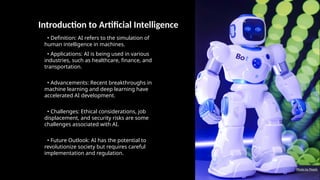
Introduction to Artificial Intelligence
• Definition: AI refers to the simulation of
human intelligence in machines.
• Applications: AI is being used in various
industries, such as healthcare, finance, and
transportation.
• Advancements: Recent breakthroughs in
machine learning and deep learning have
accelerated AI development.
• Challenges: Ethical considerations, job
displacement, and security risks are some
challenges associated with AI.
• Future Outlook: AI has the potential to
revolutionize society but requires careful
implementation and regulation.
Photo by Pexels
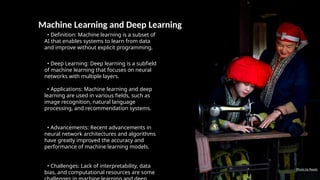
Machine Learning and Deep Learning
• Definition: Machine learning is a subset of
AI that enables systems to learn from data
and improve without explicit programming.
• Deep Learning: Deep learning is a subfield
of machine learning that focuses on neural
networks with multiple layers.
• Applications: Machine learning and deep
learning are used in various fields, such as
image recognition, natural language
processing, and recommendation systems.
• Advancements: Recent advancements in
neural network architectures and algorithms
have greatly improved the accuracy and
performance of machine learning models.
• Challenges: Lack of interpretability, data
bias, and computational resources are some
Photo by Pexels
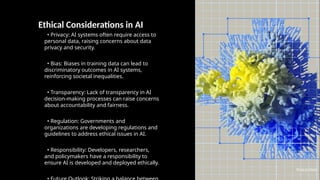
Ethical Considerations in AI
• Privacy: AI systems often require access to
personal data, raising concerns about data
privacy and security.
• Bias: Biases in training data can lead to
discriminatory outcomes in AI systems,
reinforcing societal inequalities.
• Transparency: Lack of transparency in AI
decision-making processes can raise concerns
about accountability and fairness.
• Regulation: Governments and
organizations are developing regulations and
guidelines to address ethical issues in AI.
• Responsibility: Developers, researchers,
and policymakers have a responsibility to
ensure AI is developed and deployed ethically.
Photo by Pexels
AI, Jobs, and Society
• Job Displacement: AI technologies have the
potential to automate repetitive tasks, leading
to job losses in certain sectors.
• Job Creation: AI can also create new job
opportunities, particularly in areas such as
data analysis, AI development, and human-AI
collaboration.
• Reskilling: Preparing the workforce for the
AI-driven future will require investments in
reskilling and upskilling programs.
• Society Impact: AI will have profound
effects on society, including changes in
employment, economy, and social
interactions.
• Collaboration: A human-centered
approach, where AI augments human
Photo by Pexels
Security and Governance in AI
• Security Risks: AI systems can be
vulnerable to attacks, including adversarial
attacks and data poisoning.
• Data Privacy: Protecting user data and
ensuring privacy are critical in the
development and deployment of AI systems.
• Accountability: Establishing guidelines and
frameworks to hold AI systems and their
creators accountable is essential.
• International Cooperation: Global
collaboration is needed to address security
and governance challenges in AI.
• Regulation: Governments and
organizations are developing policies and
regulations to mitigate risks and protect
societal interests.
Photo by Pexels