ORIGINS 
Social Realism in terms of filmmaking traces back to ‘The Golden Age of 
Italian Cinema’ known as ‘Italian Neorealism’ where they made films of the 
hardship of the working-class. 
 These f i lms were set in I taly af ter Wor ld-War 2 and 
f o c u s e d o n t h e d i f f i c u l t c o n d i t i o n s o f t h e p o o r ’ s l i f e 
st ruggl ing wi th pover ty and injust ice. 
 Non-professional actors were of ten used but 
somet imes there would be use of wel l known actors 
for lead roles, this would be to at t ract audience to 
the f i lm. Fi lms were, more of ten than not , f i lmed on 
locat ion of rural and run down areas. 
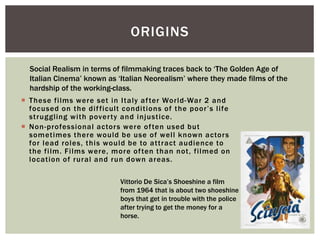
Vittorio De Sica’s Shoeshine a film 
from 1964 that is about two shoeshine 
boys that get in trouble with the police 
after trying to get the money for a 
horse.
BRITISH CINEMA 
 A lot of fi lms in Britain stemmed from the World War where it 
represented the hardship people were going through af ter 
coming back from the war and being unemployed. Historian 
Roger Manvel l said once cinemas were opened again the 
public were desperate to find rel ief from hard work and 
emotional troubles. 
 Social real ism fi lms grew in style and were influenced by 
British Documentary tradition of the 1930s and became 
critically and commercially successful. 
 Generally the middle-class would be the typical viewers of 
social real ist fi lms where as the working-class would prefer 
Hol lywood fi lms this could be explained by the need to escape 
your own l i fe when watching a fi lm.
CATHY COME HOME 
 Whi lst social real ism in fi lm was blowing up, there was also 
success in the documentary style series aired on TV. 
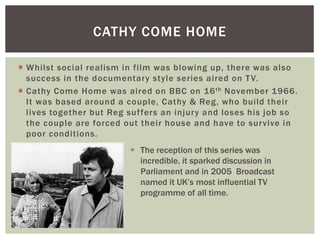
 Cathy Come Home was aired on BBC on 16th November 1966. 
I t was based around a couple, Cathy & Reg, who bui ld their 
l ives together but Reg suf fers an injury and loses his job so 
the couple are forced out their house and have to survive in 
poor conditions. 
 The reception of this series was 
incredible, it sparked discussion in 
Parliament and in 2005 Broadcast 
named it UK’s most influential TV 
programme of all time.
CHARACTERS 
 We usually have a working-class hero 
for a protagonist who the audience can 
admire for the change he is trying to 
spark in his own l ife. 
 We usually have a dysfunctional fami ly 
in the home setting which might explain 
t h e p rot a g o nis t’ s s i t u a tio n a nd g i ve 
more back story. 
 We of ten meet characters that are 
hosti le to a lot of situations due to their 
situation. This can result in them acting 
in violent ways.
LOCATION & CINEMATOGRAPHY 
 Large amount of close ups used to show emot ion and resul ts in 
audience sympathising wi th characters. 
 There tends to be qui te a lot establ ishing shots, to show the 
l iving condi t ions of the characters. Of ten run down, estate 
areas. 
 Tracking shots are also a big par t of social real ism f i lms, i t 
makes i t clear who the audience should be paying at tent ion to. 
 Natural , dul l , unforced l ight ing is of ten used as i t gives the f i lm 
a mo r e r e a l i s t i c f e e l i n g a s i t ’ s wo u l d t h e a u d i e n c e wo u l d r e a l l y 
see i f they were present in the scene. 
 Location is almost always in an urban area that is often run down 
with bad conditions. This shows the audience the protagonist’s 
struggle with daily life. These are often real places rather than 
artificial sets made in studios, this gives the film more of a real life 
feeling. Eg. Estates, parks.
CONNOTATIONS 
 Little amount on non-diegetic sound. 
 No special ef fects. 
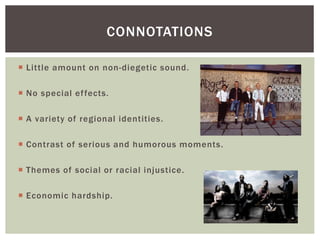
 A variety of regional identities. 
 Contrast of serious and humorous moments. 
 Themes of social or racial injustice. 
 Economic hardship.
WHY SO POPULAR? 
 Billy Elliot – Domestic Total Gross: $21,995,263 
 This is England had a spin of f series made some 
years af ter the film came out, both done very well. 
 Adulthood received ‘Honorar y Production Award’ in 
2009 by Screen Nation 
People like social realism films because audiences 
can connect with characters situations. The genre also 
tackles a lot of unspoken issues which people find 
interesting as it is rare. This is also creates shock in 
the audiences.

Social Realism

  • 2.
    ORIGINS Social Realismin terms of filmmaking traces back to ‘The Golden Age of Italian Cinema’ known as ‘Italian Neorealism’ where they made films of the hardship of the working-class.  These f i lms were set in I taly af ter Wor ld-War 2 and f o c u s e d o n t h e d i f f i c u l t c o n d i t i o n s o f t h e p o o r ’ s l i f e st ruggl ing wi th pover ty and injust ice.  Non-professional actors were of ten used but somet imes there would be use of wel l known actors for lead roles, this would be to at t ract audience to the f i lm. Fi lms were, more of ten than not , f i lmed on locat ion of rural and run down areas. Vittorio De Sica’s Shoeshine a film from 1964 that is about two shoeshine boys that get in trouble with the police after trying to get the money for a horse.
  • 3.
    BRITISH CINEMA A lot of fi lms in Britain stemmed from the World War where it represented the hardship people were going through af ter coming back from the war and being unemployed. Historian Roger Manvel l said once cinemas were opened again the public were desperate to find rel ief from hard work and emotional troubles.  Social real ism fi lms grew in style and were influenced by British Documentary tradition of the 1930s and became critically and commercially successful.  Generally the middle-class would be the typical viewers of social real ist fi lms where as the working-class would prefer Hol lywood fi lms this could be explained by the need to escape your own l i fe when watching a fi lm.
  • 4.
    CATHY COME HOME  Whi lst social real ism in fi lm was blowing up, there was also success in the documentary style series aired on TV.  Cathy Come Home was aired on BBC on 16th November 1966. I t was based around a couple, Cathy & Reg, who bui ld their l ives together but Reg suf fers an injury and loses his job so the couple are forced out their house and have to survive in poor conditions.  The reception of this series was incredible, it sparked discussion in Parliament and in 2005 Broadcast named it UK’s most influential TV programme of all time.
  • 5.
    CHARACTERS  Weusually have a working-class hero for a protagonist who the audience can admire for the change he is trying to spark in his own l ife.  We usually have a dysfunctional fami ly in the home setting which might explain t h e p rot a g o nis t’ s s i t u a tio n a nd g i ve more back story.  We of ten meet characters that are hosti le to a lot of situations due to their situation. This can result in them acting in violent ways.
  • 6.
    LOCATION & CINEMATOGRAPHY  Large amount of close ups used to show emot ion and resul ts in audience sympathising wi th characters.  There tends to be qui te a lot establ ishing shots, to show the l iving condi t ions of the characters. Of ten run down, estate areas.  Tracking shots are also a big par t of social real ism f i lms, i t makes i t clear who the audience should be paying at tent ion to.  Natural , dul l , unforced l ight ing is of ten used as i t gives the f i lm a mo r e r e a l i s t i c f e e l i n g a s i t ’ s wo u l d t h e a u d i e n c e wo u l d r e a l l y see i f they were present in the scene.  Location is almost always in an urban area that is often run down with bad conditions. This shows the audience the protagonist’s struggle with daily life. These are often real places rather than artificial sets made in studios, this gives the film more of a real life feeling. Eg. Estates, parks.
  • 7.
    CONNOTATIONS  Littleamount on non-diegetic sound.  No special ef fects.  A variety of regional identities.  Contrast of serious and humorous moments.  Themes of social or racial injustice.  Economic hardship.
  • 8.
    WHY SO POPULAR?  Billy Elliot – Domestic Total Gross: $21,995,263  This is England had a spin of f series made some years af ter the film came out, both done very well.  Adulthood received ‘Honorar y Production Award’ in 2009 by Screen Nation People like social realism films because audiences can connect with characters situations. The genre also tackles a lot of unspoken issues which people find interesting as it is rare. This is also creates shock in the audiences.