Social Media Communications Strategy   Robin Gurney altex marketing www.altex.ee
The Hype: Twitter Enters Trough of Di si llusionment
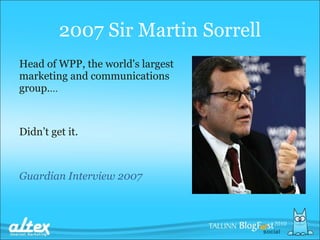
2007 Sir Martin Sorrell Head of WPP, the world's largest marketing and communications group. ... Didn’t get it. Guardian Interview  2007
May 2010: Martin Sorrell Is Learning Too.. “ Invading these [social] media with commercial messages  might  not be the right thing.”  Tubli Martin !  
Macro Economic Factors Recession means many companies are seeking: Emerging markets - older (rich) people, geo-reach (export).  Customer insights . Cost savings . Are we  emerging from  the  Age of Acquisition ? Are we  entering  the  Age of Retention ? Can social media help us?
Strategy  I sn't  A bout ROI It's  A bout WINNING “ All men can see these tactics whereby I conquer, but what none can see is the strategy out of which victory is evolved.”   Sun Tzu in The Art of War Strategy is not a plan . Strategy is not a timeline . Strategy is not a goal . Strategy is not  the  tactics you will use to achieve your   goal .  
Steps to Defining the Strategy in Your Social Media Strategy   Push for clarity around the overall business strategy Push for clarity around the strategies you feel social media should be in direct alignment with; i.e. marketing, communications, customer service, human resources, etc. Ask yourself, how will you extend this strategic alignment to the social web? *hint, focus on guiding principles or rules of engagement. Ask what experience/reaction do you want people to “take out” when they interact with your brand/company online. Is your strategy proactive or reactive? Will you actively seek people or wait for them to find you/mention you?
Setting Objectives It's a long term game.    Social media in the marketing mix is a long-term commitment to change, the best way to start is to pick SMART goals.   S = Specific M = Measurable A = Attainable R = Realistic T = Timely  
But Before You Start...Q & A Can and do you track in “actual or near real time” what people are saying about your business, brands, people and industry online? Do you have a dashboard or are feeding all the data into one place? Are you really listening to what they are saying and therefore listing and prioritising the issues they care about? Have you researched the way your target audience’s live, how they have fun, what motivates them personally and professionally?
If someone says something bad about you do you step in fast and fix the problem and take steps internally to make sure this/these same problem(s) don’t happen again? Do you proactively join in discussions about your business, brands and industry? Do follow and participate in ALL the various social media channels your target audiences use? You should not hide behind fake or anonymous identities when you do get involved: transparency is a good thing. We have written down our policy for social media marketing online and have shared/will share it both with employees and the public.
Do you just incentivise people to be your friends with special offers etc. e.g. on facebook? Not good. You should want real friends and fans, who can offer the potential for multiple, real, human connections. Do you REALLY want to offer your target audiences genuine added value? Have you committed enough time and money to create quality content for your audiences? Are you aware why people like to share what you say and do online? Is it really, really easy for people to share what you say and do online?
Do you measure, evaluate and tweak your social media marketing programme? How do you measure and evaluate? What goals have you set? We have an experienced social media marketing strategist (in-house or agency side) leading our efforts. Our PR agency and/or in-house PR are understanding and 100 per cent supportive. They see the value of social media marketing online and want to add value. We have people inside our business who live and breathe social media. We listen to and involve them. We recognise our people’s talents. Our strategy is not a gimmick, fashion, stunt or simply dictated activity from the boardroom because “we must do something, like our competitors”.
SM Might Not Be For You..Yet Don’t  “join the conversation” to  hit  your quarterly numbers.  Don’t create a Facebook Fan Page if your product  sucks. Don’t use Twitter if  a “student” will post for you. D on’t engage if you  won’t listen and  change. Connecting with customers, partners and employees can drive innovation, decrease cycle time, improve customer service and so on.  It has a transformative power but, like fire, not everyone is ready to wield it without getting burned. Source  -  Mashable
Saving  M oney with  S ocial  Training, Ideas, Education Building a knowledge base, like a wiki or other collaborative resource center, to avoid having to reinvent and redeploy training materials, and to spread the effort and costs of development across all of the contributors. Creating a video library of employee-generated tutorials, tips, and ideas based on common training needs for new employees. Building an internal social network or communication platform so that employees can share their best practices and learning on and ongoing basis. Looking into attending seminars and events virtually, or curating materials, links and information from backchannel discussions, like on Twitter. Hosting organized peer-sharing sessions on Skype to do remote meetings or training sessions Deploying an internal UserVoice or other idea capture/voting mechanism to curate ideas for improving business processes, like a virtual suggestion box. Source
Saving Money with Social:  Real Cases HP   saved $10 million in call cent re  costs by infusing social listening into customer service.  Procter & Gamble  says  nearly half of its innovation is coming from outside the company through forms of social engagement, like its InnoCentive initiative.  IBM is infusing ongoing real-time social intelligence across the organization for myriad use cases.  Social Media is  about business redesign.  Source
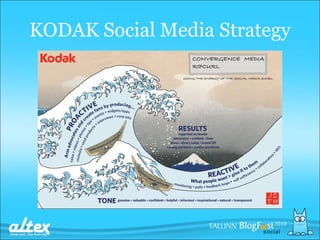
KODAK Social Media Strategy
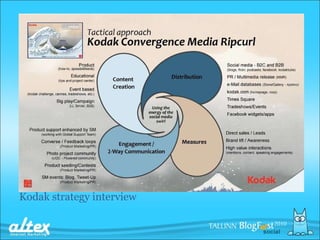
Kodak strategy interview
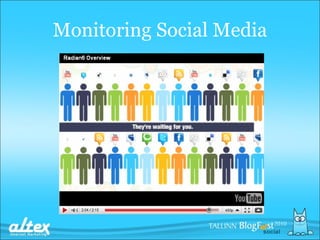
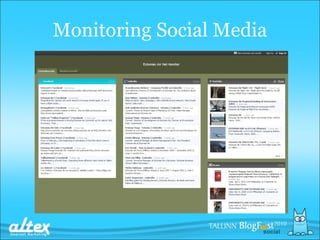
Monitor and Measure  (not same thing) Monitoring is not measuring. People often get confused.  Measuring is how we calculate the results of our monitoring over time against our objectives to test whether we are achieving them.  Measuring is important because tells us if we are having success.
Monitoring Social Media
What to  M easure Traffic: remember quality beats quantity . Interactions/Engagement: forum participation, downloads, reviews, ratings, newsletter sign ups etc. Sales: Dell made $1m sales from Twitter in 18 months.  Leads: brochures requests, contact/enquiry form fills, Skype chat button activations etc. Search marketing: The SEO factor is really important. Good social media footprint means lots of inbound links. Google loves links.
Brand metrics: Positive brand associations from social media marketing can help drive response to paid search marketing, email marketing, online display ads etc. PR: If you can measure PR then you can measure social media. Find out and measuring the sentiment of what people say about you, your brands and your people. Customer engagement: By listening and acting you can improve your business, your products, and your levels of service. You can measure the ROI of these actions. Retention: Retention rates and repeat orders should increase with positive interactions in social media. But only if you add value – just pushing will see a measurable decrease. Cost savings: Recruitment, purchasing, internal communication and other costs can be reduced significantly using social media.
Sources &  Resources US  defence   Social  Media iMedia Connection Case Study   Slideshare  -  Winning the internet way Slideshare  -  The Third Industrial Revolution And Pr Mashable  -  The 10 Stages of Social Media Business Integration FutureLab  -  Social Media Case Study: LEGO CLICK Altitude  -  Practical Social Media Measurement: Awareness, Attention, Reach Mashable  -   HOW TO: Measure Social Media ROI SocialSteve  -  Measuring the Value of Social Media Slideshare  -  Olivier Blanchard Basics Of Social Media  Roi
Shannon Paul  -  Social Media and the C Level: It’s Not Them, It’s You Lithium lithosphere  -  Social Graphs: The Art and the Insights iMedia Connection  -  6 experimental social media campaigns Marketing Prof s   Social Media Slideshare  -  Case Study: The  Barack Obama  Strategy Altex’s social media policy Presentations from Tallinn Blogfest  2010  are shared on  Slideshare Thankyou   Need help navigating the social web? Get in touch.. I should be easy to find on social media.. More Sources &  Resources

Social media communications strategy by Robin Gurney

  • 1.
    Social Media CommunicationsStrategy   Robin Gurney altex marketing www.altex.ee
  • 2.
    The Hype: TwitterEnters Trough of Di si llusionment
  • 3.
    2007 Sir MartinSorrell Head of WPP, the world's largest marketing and communications group. ... Didn’t get it. Guardian Interview 2007
  • 4.
    May 2010: MartinSorrell Is Learning Too.. “ Invading these [social] media with commercial messages might not be the right thing.” Tubli Martin !  
  • 5.
    Macro Economic FactorsRecession means many companies are seeking: Emerging markets - older (rich) people, geo-reach (export). Customer insights . Cost savings . Are we emerging from the Age of Acquisition ? Are we entering the Age of Retention ? Can social media help us?
  • 6.
    Strategy Isn't A bout ROI It's A bout WINNING “ All men can see these tactics whereby I conquer, but what none can see is the strategy out of which victory is evolved.”  Sun Tzu in The Art of War Strategy is not a plan . Strategy is not a timeline . Strategy is not a goal . Strategy is not the tactics you will use to achieve your goal .  
  • 7.
    Steps to Definingthe Strategy in Your Social Media Strategy Push for clarity around the overall business strategy Push for clarity around the strategies you feel social media should be in direct alignment with; i.e. marketing, communications, customer service, human resources, etc. Ask yourself, how will you extend this strategic alignment to the social web? *hint, focus on guiding principles or rules of engagement. Ask what experience/reaction do you want people to “take out” when they interact with your brand/company online. Is your strategy proactive or reactive? Will you actively seek people or wait for them to find you/mention you?
  • 8.
    Setting Objectives It'sa long term game.    Social media in the marketing mix is a long-term commitment to change, the best way to start is to pick SMART goals.   S = Specific M = Measurable A = Attainable R = Realistic T = Timely  
  • 9.
    But Before YouStart...Q & A Can and do you track in “actual or near real time” what people are saying about your business, brands, people and industry online? Do you have a dashboard or are feeding all the data into one place? Are you really listening to what they are saying and therefore listing and prioritising the issues they care about? Have you researched the way your target audience’s live, how they have fun, what motivates them personally and professionally?
  • 10.
    If someone sayssomething bad about you do you step in fast and fix the problem and take steps internally to make sure this/these same problem(s) don’t happen again? Do you proactively join in discussions about your business, brands and industry? Do follow and participate in ALL the various social media channels your target audiences use? You should not hide behind fake or anonymous identities when you do get involved: transparency is a good thing. We have written down our policy for social media marketing online and have shared/will share it both with employees and the public.
  • 11.
    Do you justincentivise people to be your friends with special offers etc. e.g. on facebook? Not good. You should want real friends and fans, who can offer the potential for multiple, real, human connections. Do you REALLY want to offer your target audiences genuine added value? Have you committed enough time and money to create quality content for your audiences? Are you aware why people like to share what you say and do online? Is it really, really easy for people to share what you say and do online?
  • 12.
    Do you measure,evaluate and tweak your social media marketing programme? How do you measure and evaluate? What goals have you set? We have an experienced social media marketing strategist (in-house or agency side) leading our efforts. Our PR agency and/or in-house PR are understanding and 100 per cent supportive. They see the value of social media marketing online and want to add value. We have people inside our business who live and breathe social media. We listen to and involve them. We recognise our people’s talents. Our strategy is not a gimmick, fashion, stunt or simply dictated activity from the boardroom because “we must do something, like our competitors”.
  • 13.
    SM Might NotBe For You..Yet Don’t “join the conversation” to hit your quarterly numbers. Don’t create a Facebook Fan Page if your product sucks. Don’t use Twitter if a “student” will post for you. D on’t engage if you won’t listen and change. Connecting with customers, partners and employees can drive innovation, decrease cycle time, improve customer service and so on. It has a transformative power but, like fire, not everyone is ready to wield it without getting burned. Source - Mashable
  • 14.
    Saving Money with S ocial Training, Ideas, Education Building a knowledge base, like a wiki or other collaborative resource center, to avoid having to reinvent and redeploy training materials, and to spread the effort and costs of development across all of the contributors. Creating a video library of employee-generated tutorials, tips, and ideas based on common training needs for new employees. Building an internal social network or communication platform so that employees can share their best practices and learning on and ongoing basis. Looking into attending seminars and events virtually, or curating materials, links and information from backchannel discussions, like on Twitter. Hosting organized peer-sharing sessions on Skype to do remote meetings or training sessions Deploying an internal UserVoice or other idea capture/voting mechanism to curate ideas for improving business processes, like a virtual suggestion box. Source
  • 15.
    Saving Money withSocial: Real Cases HP saved $10 million in call cent re costs by infusing social listening into customer service. Procter & Gamble says nearly half of its innovation is coming from outside the company through forms of social engagement, like its InnoCentive initiative. IBM is infusing ongoing real-time social intelligence across the organization for myriad use cases. Social Media is about business redesign. Source
  • 16.
  • 17.
  • 18.
    Monitor and Measure (not same thing) Monitoring is not measuring. People often get confused. Measuring is how we calculate the results of our monitoring over time against our objectives to test whether we are achieving them. Measuring is important because tells us if we are having success.
  • 19.
  • 20.
  • 21.
    What to M easure Traffic: remember quality beats quantity . Interactions/Engagement: forum participation, downloads, reviews, ratings, newsletter sign ups etc. Sales: Dell made $1m sales from Twitter in 18 months. Leads: brochures requests, contact/enquiry form fills, Skype chat button activations etc. Search marketing: The SEO factor is really important. Good social media footprint means lots of inbound links. Google loves links.
  • 22.
    Brand metrics: Positivebrand associations from social media marketing can help drive response to paid search marketing, email marketing, online display ads etc. PR: If you can measure PR then you can measure social media. Find out and measuring the sentiment of what people say about you, your brands and your people. Customer engagement: By listening and acting you can improve your business, your products, and your levels of service. You can measure the ROI of these actions. Retention: Retention rates and repeat orders should increase with positive interactions in social media. But only if you add value – just pushing will see a measurable decrease. Cost savings: Recruitment, purchasing, internal communication and other costs can be reduced significantly using social media.
  • 23.
    Sources & Resources US defence Social Media iMedia Connection Case Study Slideshare - Winning the internet way Slideshare - The Third Industrial Revolution And Pr Mashable - The 10 Stages of Social Media Business Integration FutureLab - Social Media Case Study: LEGO CLICK Altitude - Practical Social Media Measurement: Awareness, Attention, Reach Mashable - HOW TO: Measure Social Media ROI SocialSteve - Measuring the Value of Social Media Slideshare - Olivier Blanchard Basics Of Social Media Roi
  • 24.
    Shannon Paul - Social Media and the C Level: It’s Not Them, It’s You Lithium lithosphere - Social Graphs: The Art and the Insights iMedia Connection - 6 experimental social media campaigns Marketing Prof s Social Media Slideshare - Case Study: The Barack Obama Strategy Altex’s social media policy Presentations from Tallinn Blogfest 2010 are shared on Slideshare Thankyou  Need help navigating the social web? Get in touch.. I should be easy to find on social media.. More Sources & Resources

Editor's Notes

  • #2 T he social media conversation is dominated by technologies and platforms. "Facebook" and "Twitter." This is not a strategic conversation. It is an immature discussion.  
  • #3 Analyst firm Gartner in mid 2009 released its latest Hype Cycle white paper looking at major trends . Twitter wa s said to have "tipped over the peak" and is just about to enter the infamous "Trough of Disillusionment." Social software suites and other microblogging services are likewise starting their downward trend. For me personally they are very productive Microblogging is only ranked "moderate," so Gartner doesn't think that Twitter is a very meaningful technology. Is Gartner underestimating the impact of microblogging ? Gartner does not analyze the over-arching trend of Real-time web that microblogging exemplifies. Personally I think the search and flitering products around twitter means twitter will not be a fad and will claim a long term place...if they can make some money....
  • #4 Martin said using a PR agency to supply information from “apparently independent” news sources reflected an interest from web users for “ideas and knowledge” was a way for brands to get around people’s aversion to web adverts. Basically he focussed on talking about using social media to push messages out . He mentioned nothing about listening, nothing about conversation. Nothing about how PR agencies can become the eyes and ears of a brand and the startegy of relationship management and how social media changes the dynamics of conversations that shape relationships to brands. Basically he had not grokked SM in 2007.
  • #5 Cynical comment: Is this because agency margin on Facebook ads is low? and display ads/r ic h media banners on portals provide better re venue/profit for an ad/media agency? BTW Sir Martin: There is no "might". But we are all guilty. .. But at least he has identified social media as more of an opportunity for public relations than traditional advertising. He is on the right track...but perhaps not for the noblest of reasons.
  • #7 “ Strategy isn’t “Let’s create a Facebook page” unless your  goal is “How can we copycat every other company out there?”" I am often asked who is doing social media well but I rarely answer. How can I? I do not know what their strategy is…. all I see are their tactics. How am I to know without more information? Don’t copy what you dont understand.
  • #21 Contact robin@altex.ee to find out more about how altex’s real time social media monitoring dashboard can help keep you in touch with what people are saying about you, your company, your brands and your people.