SOCIAL MEDIA FOR EMPLOYERS:
        SURVIVING THE STORM


                   David M. Kight, Esq.
       Spencer Fane Britt & Browne, LLP

        Kansas City, Missouri Overland Park, Kansas Jefferson City, Missouri
                  St. Louis, Missouri            Omaha, Nebraska
2012 Labor and Employment Seminar
May 10, 2012
Overland Park Convention Center
6000 College Boulevard
Overland Park, KS 66211
May 22, 2012
Hilton St. Louis Frontenac
1335 South Lindbergh Boulevard
St. Louis, MO 63131
June 14, 2012
Freeman Business Center
3220 McClelland Boulevard
Joplin, Missouri 64804

6.25 hours of HRCI credit is provided.
WHAT IS SOCIAL MEDIA
ANYWAY?
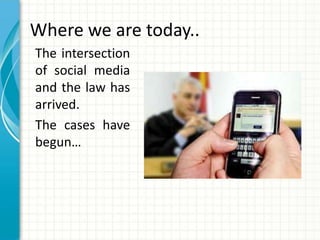
Where we are today..
The intersection
of social media
and the law has
arrived.
The cases have
begun…
Watch What You Post
Purvis v. Commissioner of Social
Security, 2011 WL 741234 (D. N.J. Feb.
23, 2011). Plaintiff claimed asthma as
basis for social security income. Claim
was denied. On Purvis's appeal, the
court noted that "[a]lthough the Court
remands the ALJ's decision for a more
detailed finding, it notes that in the
course of its own research, it discovered
one profile on what is believed to be
Plaintiff's Facebook page where she
appears to be smoking ... If accurately
depicted, Plaintiff's credibility is
justifiably suspect." Id. at *7.
Social Media Another Way
Former employee has contacted
20 of the contract workers you
use on behalf of her new
employer and is soliciting their
business. The former employee
has “connected” with 20 of your
clients via Linkedin and is
encouraging them to call her.

• Does this conduct violate the
  non-compete agreement?
Yes Virginia, You can sue…
• TekSystems, Inc. v. Hammernik, et al., 2010
  WL 1624258 (D. Minn. Mar. 16, 2010)

• The lawsuit alleged that after Hammernik
  left TEKsystems in November 2009, she
  “communicated” with at least 20
  TEKSystems contract employees and
  “connected” with about 16 of them using
  the LinkedIn professional network.
How it ended…
• The case settled after the Company got a
  permanent injunction against the employee.
                      The lesson learned:
                      Conduct over Twitter, Facebook
                      and LinkedIn are increasingly being
                      used by the Courts and are being
                      analyzed as if they were spoken or
                      sent by e-mail, fax or letter. Your
                      employees should be aware that
                      policies relating to conduct apply
                      equally to social media.
So what does this mean?
• Social media is becoming an increasing part
  of our daily work lives. Thus, we will see it
  becoming more intertwined with how
  employees – and former employees –
  operate…
• And demonstrate
  their idiocy.
On The Agenda
• The National Labor Relations Board’s Social
  Media Push
• Questions We Get from Clients

• You Make the Call

• Social Media in Litigation
The New Sheriff in Town…


They are the primary government employment related agency
which is addressing the rights of employees and employers
regarding social media.

They are getting very aggressive (historically) in taking actions
to increase employee rights. (See the new posting rule)

They are encouraging employees (even non-union employees)
to file unfair labor practice charges related to social media
discipline.
The NLRB
• Federal Agency headquartered in
  Washington, D.C.

• Has a five member governing board, but the
  majority is determined by the party in power
  – (thus, politics occasionally enters the picture)

• Has the authority to investigate, ajudicate
  and sue you to enforce their orders.
So, what can they do, really?
 Remedies available to the NLRB if you have
 committed an Unfair Labor Practice:
 1. Requiring you to cleanse their record of
    discipline;
 2. Requiring you to reinstate them;
 3. Requiring you to pay them backpay;
 4. Requiring you to post a notice to employees; and
 5. Court Injunctions.
                                                  13
So what is the biggest issue?
• Policies which the NLRB feel are too broad.
   – Example: “Employees should not make disparaging
     remarks about the company, their supervisor, etc. on
     social media websites, blogs or any other form of
     electronic media.”

• Drafting tip?
   – If you must have a policy addressing comments,
     make sure it is limited to trade secrets, confidential
     information about the company or customers, and
     information which if released would breach
     agreements the company has.
You Make the Call #1
Five employees do not like their co-worker. They
believe the co-worker is a slacker and fakes illnesses to
get out of work. They post derogatory messages on
her Facebook page containing obscenities and openly
expressing their negative feelings toward her. The
victim complains. Following an investigation, the five
employees are discharged for harassment under the
company’s zero tolerance policy. Any problem with
the discharges?
You Make the Call #1
Most likely. Recently, an administrative law judge of the Board
held that the five employees were engaging in concerted
protected activity for which they could not be discharged.
The judge held that the Facebook postings were no different
than “water cooler” talk and could not be interfered with. He
held that even though the conversations were not directed to
the employer, because they involved terms and conditions of
employment they were protected.

The judge ordered the employees reinstated. An appeal to the
Board is pending.
You Make the Call #2
Employer is an ambulance service. Employer had a policy
prohibiting disparaging comments when discussing the
company or an employee’s superiors. An employee is asked by
a supervisor to prepare an incident report about a customer
complaint about the employee. The employee asked for a
union representative to be present during the preparation of
the report. She did not get the union rep. Employee goes
home and makes a negative post about her supervisor on her
personal Facebook page which drew supportive comments
from co-workers and further negative comments about the
supervisor. Employee is fired. Was it permissible?
You Make the Call #2
According to the NLRB, no. The policy prohibiting
negative comments was unlawful as likely to prohibit
an employee from engaging in lawful activity.
The NLRB further found that a discussion about an
employer’s refusal to comply with an employee’s
Weingarten right and discussing a supervisor on
Facebook was protected activity.
The termination was unlawful.
You Make the Call #3
Employee is a reporter. His employer encourages him to open
a Twitter account and use twitter to get stories out. Employee
gets a twitter account. Employee’s twitter biography mentions
that the employee is a reporter and names his employer.
Employee sends out a tweet critical of the newspaper’s copy
editors. Employer questions the employee and orders him not
to air internal grievances or comment about the paper publicly.
Employee then posts derogatory comments about homicides in
the city and tweets negatively about a tv station. Employer
terminates employee because of his repeated tweets damaging
the newspaper’s good will. Was the termination lawful?
You Make the Call #3
According to the NLRB, yes. The reporters tweets
were not related to his wages, hours or working
conditions. In addition, he was not tweeting in order
to involve others in issues related to employer. Rather,
he ignored his employer’s warnings about
inappropriate tweets.
The termination was lawful.
You Make the Call #4
Employer is a restaurant with an unwritten policy that
waitresses don’t share tips with the bartenders even though
the bartenders help serve food. A bartender discussed the
issue with a co-worker who agreed that it “sucked.” Several
months later in Facebook posts, the bartender complained to a
relative that he was doing waitresses work without the tips.
He called the restaurant’s customers “rednecks” and said he
hoped that they choked on glass as they drove home drunk.
He didn’t discuss the posting with co-workers and none of
them responded. The owner sent a facebook message to the
employee telling him his services were no longer needed. Was
the termination lawful?
You Make the Call #4
According to the NLRB, yes. Although the postings
concerned terms and conditions of work, the
employee did not discuss the posting with co-workers
and none of them responded to the posting. There
were no employee meetings or any attempt to initiate
group action concerning the policy.
The termination was lawful.
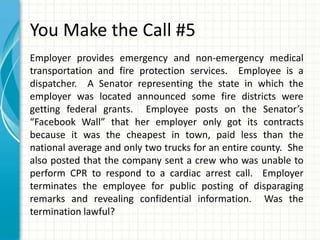
You Make the Call #5
Employer provides emergency and non-emergency medical
transportation and fire protection services. Employee is a
dispatcher. A Senator representing the state in which the
employer was located announced some fire districts were
getting federal grants. Employee posts on the Senator’s
“Facebook Wall” that her employer only got its contracts
because it was the cheapest in town, paid less than the
national average and only two trucks for an entire county. She
also posted that the company sent a crew who was unable to
perform CPR to respond to a cardiac arrest call. Employer
terminates the employee for public posting of disparaging
remarks and revealing confidential information. Was the
termination lawful?
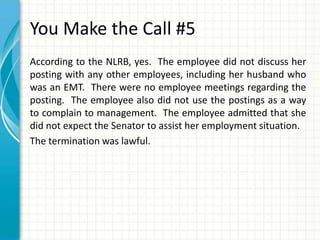
You Make the Call #5
According to the NLRB, yes. The employee did not discuss her
posting with any other employees, including her husband who
was an EMT. There were no employee meetings regarding the
posting. The employee also did not use the postings as a way
to complain to management. The employee admitted that she
did not expect the Senator to assist her employment situation.
The termination was lawful.
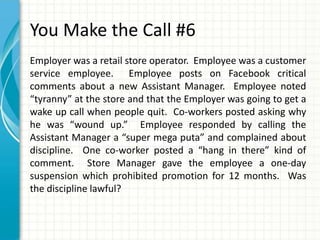
You Make the Call #6
Employer was a retail store operator. Employee was a customer
service employee. Employee posts on Facebook critical
comments about a new Assistant Manager. Employee noted
“tyranny” at the store and that the Employer was going to get a
wake up call when people quit. Co-workers posted asking why
he was “wound up.” Employee responded by calling the
Assistant Manager a “super mega puta” and complained about
discipline. One co-worker posted a “hang in there” kind of
comment. Store Manager gave the employee a one-day
suspension which prohibited promotion for 12 months. Was
the discipline lawful?
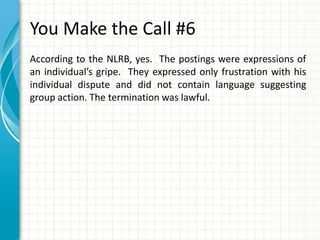
You Make the Call #6
According to the NLRB, yes. The postings were expressions of
an individual’s gripe. They expressed only frustration with his
individual dispute and did not contain language suggesting
group action. The termination was lawful.
Questions We Get From Clients
• I need a social media policy, don’t I?

• What do I need to have in a social media
  policy?
Social Media
 Policies: The
Right Approach

   Step 1:
   Address Use and
   Misuse of Electronic
   Devices
Step 2:
Confidentiality and
Trade Secret
Protection
Step 3: Make clear
that ethics and
harassment policies
apply to social
media
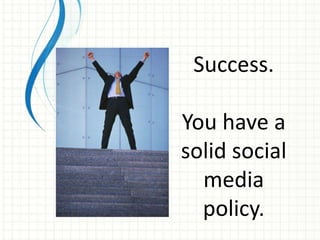
Success.

You have a
solid social
  media
  policy.
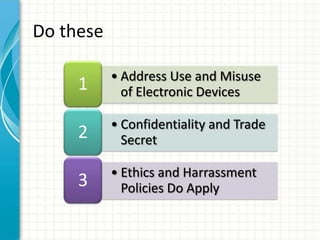
Do these

           • Address Use and Misuse
     1       of Electronic Devices

           • Confidentiality and Trade
     2       Secret

           • Ethics and Harrassment
     3       Policies Do Apply
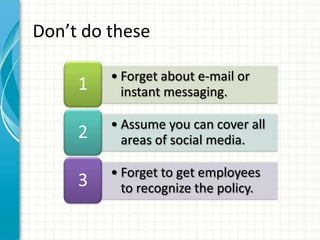
Don’t do these

         • Forget about e-mail or
     1     instant messaging.

         • Assume you can cover all
     2     areas of social media.

         • Forget to get employees
     3     to recognize the policy.
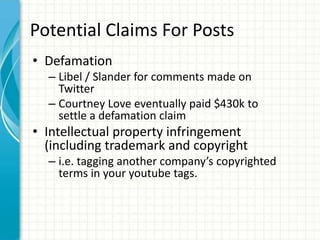
Potential Claims For Posts
• Defamation
  – Libel / Slander for comments made on
    Twitter
  – Courtney Love eventually paid $430k to
    settle a defamation claim
• Intellectual property infringement
  (including trademark and copyright
  – i.e. tagging another company’s copyrighted
    terms in your youtube tags.
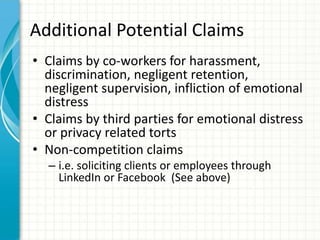
Additional Potential Claims
• Claims by co-workers for harassment,
  discrimination, negligent retention,
  negligent supervision, infliction of emotional
  distress
• Claims by third parties for emotional distress
  or privacy related torts
• Non-competition claims
  – i.e. soliciting clients or employees through
    LinkedIn or Facebook (See above)
Potential Claims by Users
•   Off-Duty conduct laws (IL, CA, NY, CO, ND)
•   Retaliation under Title VII or state law
•   Whistleblowing under Sarbanes Oxley
•   Discrimination under Title VII or state law
•   Invasion of Privacy
•   Violation of the Stored Communications Act
Not there yet
• There is no such thing as a
“Friend” privilege preventing a
Court from ordering someone
to provide a username,
password or details from a
Social Media account where you
have limited your posts to “friends.”
Discovery of Social Media Content
• E.E.O.C. v. Simply Storage
  Management, U.S. Dist. Court for S.D.
  Indiana (May 11, 2010).
  http://bit.ly/c58NxX
• In this case, the employer was sued for
  sexual harassment by two employees.
• In discovery, the employer sought
  production of photographs and videos
  as well as updates and messages on
  their Facebook and MySpace pages.
Discovery of Social Media Content
• The EEOC objected arguing based on privacy
  and an attempt to embarrass the plaintiffs.
• The employer countered that the EEOC had
  placed the emotional health of the woman
  at issue by claiming “medical treatment”
  stemming from alleged harassment and
  claiming depression from post traumatic
  stress disorder.
Discovery of Social Media Content
• The court ruled:
  – “It is reasonable to expect severe emotional or
    mental injury to manifest itself in some SNS
    content, and an examination of that content
    might reveal whether onset occurred, when,
    and the degree of distress. Further, information
    that evidences other stressors that could have
    produced the alleged emotional distress is also
    relevant.”
Discovery of Social Media Content
• Crispin v. Christian Audigier, Inc., U.S. Dist. Court
  for the Central District of California (May 26,
  2010)
• http://scr.bi/a11m59
• Employer sought postings on Facebook,
  MySpace and Media Temple.
• Court quashed a subpoena to the extent it
  sought private e-mail messages through the site
  as protected under the Stored Communications
  Act.
Discovery of Social Media Content
• Barnes v. CUS Nashville, 3:09-cv00764, U.S. Dist.
  Ct. M.D. of Tenn.
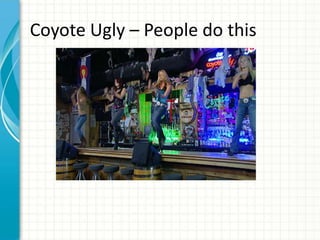
• Plaintiff claims she fell from a bar at a “Coyote
  Ugly” saloon in Nashville. She argued that the
  bar was wet and slick and when she tried to
  climb onto the bar hit her head.
• Defendant subpoenaed Facebook for plaintiff's
  Facebook information, including photos of
  plaintiff and her friends dancing on the bar.
Coyote Ugly – People do this
Discovery of Social Media Content
• The court ruled:
  – “In order to try to expedite further discovery
    regarding the photographs, their captions and
    comments, the Magistrate Judge is willing to
    create a Facebook account. If Julie Knudsen
    and Michael Vann will accept the Magistrate
    Judge as a “friend” on Facebook for the sole
    purpose of reviewing photographs and related
    comments in camera, he will promptly review
    and disseminate any relevant information to
    the parties. The Magistrate Judge will then
    close this Facebook account.”
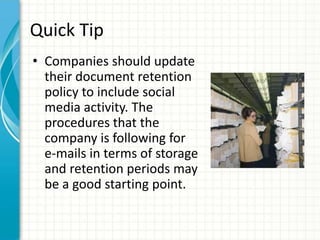
Quick Tip
• Companies should update
  their document retention
  policy to include social
  media activity. The
  procedures that the
  company is following for
  e-mails in terms of storage
  and retention periods may
  be a good starting point.
FINRA is There
• FINRA issued guidance in January 2010 for blogs
  and social networking sites:

• "Every firm that intends to communicate, or permit
  its associated persons to communicate, through
  social media sites must first ensure that it can
  retain records of those communications as
  required by Rules 17a-3 ad 17a-4 under the
  Securities Exchange Act of 1934 and NASD Rule
  3110."
THANK YOU FOR COMING!

• Any Questions?


     David Kight, Esq.
     Spencer Fane Britt & Browne, LLP
     dkight@spencerfane.com

Social Media for Employers: Tips and Guidance

  • 1.
    SOCIAL MEDIA FOREMPLOYERS: SURVIVING THE STORM David M. Kight, Esq. Spencer Fane Britt & Browne, LLP Kansas City, Missouri Overland Park, Kansas Jefferson City, Missouri St. Louis, Missouri Omaha, Nebraska
  • 2.
    2012 Labor andEmployment Seminar May 10, 2012 Overland Park Convention Center 6000 College Boulevard Overland Park, KS 66211 May 22, 2012 Hilton St. Louis Frontenac 1335 South Lindbergh Boulevard St. Louis, MO 63131 June 14, 2012 Freeman Business Center 3220 McClelland Boulevard Joplin, Missouri 64804 6.25 hours of HRCI credit is provided.
  • 3.
    WHAT IS SOCIALMEDIA ANYWAY?
  • 4.
    Where we aretoday.. The intersection of social media and the law has arrived. The cases have begun…
  • 5.
    Watch What YouPost Purvis v. Commissioner of Social Security, 2011 WL 741234 (D. N.J. Feb. 23, 2011). Plaintiff claimed asthma as basis for social security income. Claim was denied. On Purvis's appeal, the court noted that "[a]lthough the Court remands the ALJ's decision for a more detailed finding, it notes that in the course of its own research, it discovered one profile on what is believed to be Plaintiff's Facebook page where she appears to be smoking ... If accurately depicted, Plaintiff's credibility is justifiably suspect." Id. at *7.
  • 6.
    Social Media AnotherWay Former employee has contacted 20 of the contract workers you use on behalf of her new employer and is soliciting their business. The former employee has “connected” with 20 of your clients via Linkedin and is encouraging them to call her. • Does this conduct violate the non-compete agreement?
  • 7.
    Yes Virginia, Youcan sue… • TekSystems, Inc. v. Hammernik, et al., 2010 WL 1624258 (D. Minn. Mar. 16, 2010) • The lawsuit alleged that after Hammernik left TEKsystems in November 2009, she “communicated” with at least 20 TEKSystems contract employees and “connected” with about 16 of them using the LinkedIn professional network.
  • 8.
    How it ended… •The case settled after the Company got a permanent injunction against the employee. The lesson learned: Conduct over Twitter, Facebook and LinkedIn are increasingly being used by the Courts and are being analyzed as if they were spoken or sent by e-mail, fax or letter. Your employees should be aware that policies relating to conduct apply equally to social media.
  • 9.
    So what doesthis mean? • Social media is becoming an increasing part of our daily work lives. Thus, we will see it becoming more intertwined with how employees – and former employees – operate… • And demonstrate their idiocy.
  • 10.
    On The Agenda •The National Labor Relations Board’s Social Media Push • Questions We Get from Clients • You Make the Call • Social Media in Litigation
  • 11.
    The New Sheriffin Town… They are the primary government employment related agency which is addressing the rights of employees and employers regarding social media. They are getting very aggressive (historically) in taking actions to increase employee rights. (See the new posting rule) They are encouraging employees (even non-union employees) to file unfair labor practice charges related to social media discipline.
  • 12.
    The NLRB • FederalAgency headquartered in Washington, D.C. • Has a five member governing board, but the majority is determined by the party in power – (thus, politics occasionally enters the picture) • Has the authority to investigate, ajudicate and sue you to enforce their orders.
  • 13.
    So, what canthey do, really? Remedies available to the NLRB if you have committed an Unfair Labor Practice: 1. Requiring you to cleanse their record of discipline; 2. Requiring you to reinstate them; 3. Requiring you to pay them backpay; 4. Requiring you to post a notice to employees; and 5. Court Injunctions. 13
  • 14.
    So what isthe biggest issue? • Policies which the NLRB feel are too broad. – Example: “Employees should not make disparaging remarks about the company, their supervisor, etc. on social media websites, blogs or any other form of electronic media.” • Drafting tip? – If you must have a policy addressing comments, make sure it is limited to trade secrets, confidential information about the company or customers, and information which if released would breach agreements the company has.
  • 15.
    You Make theCall #1 Five employees do not like their co-worker. They believe the co-worker is a slacker and fakes illnesses to get out of work. They post derogatory messages on her Facebook page containing obscenities and openly expressing their negative feelings toward her. The victim complains. Following an investigation, the five employees are discharged for harassment under the company’s zero tolerance policy. Any problem with the discharges?
  • 16.
    You Make theCall #1 Most likely. Recently, an administrative law judge of the Board held that the five employees were engaging in concerted protected activity for which they could not be discharged. The judge held that the Facebook postings were no different than “water cooler” talk and could not be interfered with. He held that even though the conversations were not directed to the employer, because they involved terms and conditions of employment they were protected. The judge ordered the employees reinstated. An appeal to the Board is pending.
  • 17.
    You Make theCall #2 Employer is an ambulance service. Employer had a policy prohibiting disparaging comments when discussing the company or an employee’s superiors. An employee is asked by a supervisor to prepare an incident report about a customer complaint about the employee. The employee asked for a union representative to be present during the preparation of the report. She did not get the union rep. Employee goes home and makes a negative post about her supervisor on her personal Facebook page which drew supportive comments from co-workers and further negative comments about the supervisor. Employee is fired. Was it permissible?
  • 18.
    You Make theCall #2 According to the NLRB, no. The policy prohibiting negative comments was unlawful as likely to prohibit an employee from engaging in lawful activity. The NLRB further found that a discussion about an employer’s refusal to comply with an employee’s Weingarten right and discussing a supervisor on Facebook was protected activity. The termination was unlawful.
  • 19.
    You Make theCall #3 Employee is a reporter. His employer encourages him to open a Twitter account and use twitter to get stories out. Employee gets a twitter account. Employee’s twitter biography mentions that the employee is a reporter and names his employer. Employee sends out a tweet critical of the newspaper’s copy editors. Employer questions the employee and orders him not to air internal grievances or comment about the paper publicly. Employee then posts derogatory comments about homicides in the city and tweets negatively about a tv station. Employer terminates employee because of his repeated tweets damaging the newspaper’s good will. Was the termination lawful?
  • 20.
    You Make theCall #3 According to the NLRB, yes. The reporters tweets were not related to his wages, hours or working conditions. In addition, he was not tweeting in order to involve others in issues related to employer. Rather, he ignored his employer’s warnings about inappropriate tweets. The termination was lawful.
  • 21.
    You Make theCall #4 Employer is a restaurant with an unwritten policy that waitresses don’t share tips with the bartenders even though the bartenders help serve food. A bartender discussed the issue with a co-worker who agreed that it “sucked.” Several months later in Facebook posts, the bartender complained to a relative that he was doing waitresses work without the tips. He called the restaurant’s customers “rednecks” and said he hoped that they choked on glass as they drove home drunk. He didn’t discuss the posting with co-workers and none of them responded. The owner sent a facebook message to the employee telling him his services were no longer needed. Was the termination lawful?
  • 22.
    You Make theCall #4 According to the NLRB, yes. Although the postings concerned terms and conditions of work, the employee did not discuss the posting with co-workers and none of them responded to the posting. There were no employee meetings or any attempt to initiate group action concerning the policy. The termination was lawful.
  • 23.
    You Make theCall #5 Employer provides emergency and non-emergency medical transportation and fire protection services. Employee is a dispatcher. A Senator representing the state in which the employer was located announced some fire districts were getting federal grants. Employee posts on the Senator’s “Facebook Wall” that her employer only got its contracts because it was the cheapest in town, paid less than the national average and only two trucks for an entire county. She also posted that the company sent a crew who was unable to perform CPR to respond to a cardiac arrest call. Employer terminates the employee for public posting of disparaging remarks and revealing confidential information. Was the termination lawful?
  • 24.
    You Make theCall #5 According to the NLRB, yes. The employee did not discuss her posting with any other employees, including her husband who was an EMT. There were no employee meetings regarding the posting. The employee also did not use the postings as a way to complain to management. The employee admitted that she did not expect the Senator to assist her employment situation. The termination was lawful.
  • 25.
    You Make theCall #6 Employer was a retail store operator. Employee was a customer service employee. Employee posts on Facebook critical comments about a new Assistant Manager. Employee noted “tyranny” at the store and that the Employer was going to get a wake up call when people quit. Co-workers posted asking why he was “wound up.” Employee responded by calling the Assistant Manager a “super mega puta” and complained about discipline. One co-worker posted a “hang in there” kind of comment. Store Manager gave the employee a one-day suspension which prohibited promotion for 12 months. Was the discipline lawful?
  • 26.
    You Make theCall #6 According to the NLRB, yes. The postings were expressions of an individual’s gripe. They expressed only frustration with his individual dispute and did not contain language suggesting group action. The termination was lawful.
  • 27.
    Questions We GetFrom Clients • I need a social media policy, don’t I? • What do I need to have in a social media policy?
  • 28.
    Social Media Policies:The Right Approach Step 1: Address Use and Misuse of Electronic Devices
  • 29.
  • 30.
    Step 3: Makeclear that ethics and harassment policies apply to social media
  • 31.
    Success. You have a solidsocial media policy.
  • 32.
    Do these • Address Use and Misuse 1 of Electronic Devices • Confidentiality and Trade 2 Secret • Ethics and Harrassment 3 Policies Do Apply
  • 33.
    Don’t do these • Forget about e-mail or 1 instant messaging. • Assume you can cover all 2 areas of social media. • Forget to get employees 3 to recognize the policy.
  • 34.
    Potential Claims ForPosts • Defamation – Libel / Slander for comments made on Twitter – Courtney Love eventually paid $430k to settle a defamation claim • Intellectual property infringement (including trademark and copyright – i.e. tagging another company’s copyrighted terms in your youtube tags.
  • 35.
    Additional Potential Claims •Claims by co-workers for harassment, discrimination, negligent retention, negligent supervision, infliction of emotional distress • Claims by third parties for emotional distress or privacy related torts • Non-competition claims – i.e. soliciting clients or employees through LinkedIn or Facebook (See above)
  • 36.
    Potential Claims byUsers • Off-Duty conduct laws (IL, CA, NY, CO, ND) • Retaliation under Title VII or state law • Whistleblowing under Sarbanes Oxley • Discrimination under Title VII or state law • Invasion of Privacy • Violation of the Stored Communications Act
  • 37.
    Not there yet •There is no such thing as a “Friend” privilege preventing a Court from ordering someone to provide a username, password or details from a Social Media account where you have limited your posts to “friends.”
  • 38.
    Discovery of SocialMedia Content • E.E.O.C. v. Simply Storage Management, U.S. Dist. Court for S.D. Indiana (May 11, 2010). http://bit.ly/c58NxX • In this case, the employer was sued for sexual harassment by two employees. • In discovery, the employer sought production of photographs and videos as well as updates and messages on their Facebook and MySpace pages.
  • 39.
    Discovery of SocialMedia Content • The EEOC objected arguing based on privacy and an attempt to embarrass the plaintiffs. • The employer countered that the EEOC had placed the emotional health of the woman at issue by claiming “medical treatment” stemming from alleged harassment and claiming depression from post traumatic stress disorder.
  • 40.
    Discovery of SocialMedia Content • The court ruled: – “It is reasonable to expect severe emotional or mental injury to manifest itself in some SNS content, and an examination of that content might reveal whether onset occurred, when, and the degree of distress. Further, information that evidences other stressors that could have produced the alleged emotional distress is also relevant.”
  • 41.
    Discovery of SocialMedia Content • Crispin v. Christian Audigier, Inc., U.S. Dist. Court for the Central District of California (May 26, 2010) • http://scr.bi/a11m59 • Employer sought postings on Facebook, MySpace and Media Temple. • Court quashed a subpoena to the extent it sought private e-mail messages through the site as protected under the Stored Communications Act.
  • 42.
    Discovery of SocialMedia Content • Barnes v. CUS Nashville, 3:09-cv00764, U.S. Dist. Ct. M.D. of Tenn. • Plaintiff claims she fell from a bar at a “Coyote Ugly” saloon in Nashville. She argued that the bar was wet and slick and when she tried to climb onto the bar hit her head. • Defendant subpoenaed Facebook for plaintiff's Facebook information, including photos of plaintiff and her friends dancing on the bar.
  • 43.
    Coyote Ugly –People do this
  • 44.
    Discovery of SocialMedia Content • The court ruled: – “In order to try to expedite further discovery regarding the photographs, their captions and comments, the Magistrate Judge is willing to create a Facebook account. If Julie Knudsen and Michael Vann will accept the Magistrate Judge as a “friend” on Facebook for the sole purpose of reviewing photographs and related comments in camera, he will promptly review and disseminate any relevant information to the parties. The Magistrate Judge will then close this Facebook account.”
  • 45.
    Quick Tip • Companiesshould update their document retention policy to include social media activity. The procedures that the company is following for e-mails in terms of storage and retention periods may be a good starting point.
  • 46.
    FINRA is There •FINRA issued guidance in January 2010 for blogs and social networking sites: • "Every firm that intends to communicate, or permit its associated persons to communicate, through social media sites must first ensure that it can retain records of those communications as required by Rules 17a-3 ad 17a-4 under the Securities Exchange Act of 1934 and NASD Rule 3110."
  • 47.
    THANK YOU FORCOMING! • Any Questions? David Kight, Esq. Spencer Fane Britt & Browne, LLP dkight@spencerfane.com

Editor's Notes

  • #2 This template can be used as a starter file for presenting training materials in a group setting.SectionsRight-click on a slide to add sections. Sections can help to organize your slides or facilitate collaboration between multiple authors.NotesUse the Notes section for delivery notes or to provide additional details for the audience. View these notes in Presentation View during your presentation. Keep in mind the font size (important for accessibility, visibility, videotaping, and online production)Coordinated colors Pay particular attention to the graphs, charts, and text boxes.Consider that attendees will print in black and white or grayscale. Run a test print to make sure your colors work when printed in pure black and white and grayscale.Graphics, tables, and graphsKeep it simple: If possible, use consistent, non-distracting styles and colors.Label all graphs and tables.
  • #29 This is another option for an Overview slides using transitions.
  • #33 This is another option for an Overview slide.
  • #34 This is another option for an Overview slide.