The New Normal
Emerging Legal Trends
Affecting the Workplace
Mark Bakker
Wyche, P.A.
November 12, 2013
www.wyche.com
The New Normal:
Increased Regulatory Scrutiny

Federal Agencies:
• DOL
• EEOC
• NLRB
The DOL New Normal:
Scrutiny of Independent
Contractor Classification
• Benefits of IC relationship
– Reduced payroll taxes and no benefits
– No Workers’ Compensation liability
– No overtime liability or other related claims
– Potential for reduced working space/other
overhead
– Hedge against future uncertainty
Misclassification of
Independent Contractors
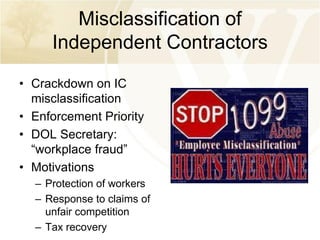
• Crackdown on IC
misclassification
• Enforcement Priority
• DOL Secretary:
“workplace fraud”
• Motivations
– Protection of workers
– Response to claims of
unfair competition
– Tax recovery
IC Classification
Economic Realities Test (FLSA)
(1) Degree of control
(2) Investment in facilities/equipment
(3) Opportunity for profit and loss
(4) Permanency of the relationship
(5) Required skill
IC Misclassification
Red Flags
•
•
•
•
•

Relying solely on consultant label
Integrated workforce (“side-by-side”)
Integrated compensation systems
Long-term or exclusive relationship
Headcount/cost-saving motivation
Consequences of
Misclassification
•
•
•
•
•
•
•
•

DOL and IRS (state and federal)
Tax penalties
Overtime liability
Unemployment Assessment – SCDEW
Penalties/liquidated damages
Attorneys’ fees and costs
Benefits (e.g., retirement benefits)
Potential for class/collective action litigation
Practical Steps
• Written Agreements
–
–
–
–
–

Limit exclusivity
Encourage economic independence
Enhance flexibility
Establish conclusion of the work
Disavow employment relationship and benefits

• Require worker to set up LLC/corporation
• Periodically audit and evaluate
• Consider alternative (temp staffing)
The New Normal:
EEOC & Background Checks
Enforcement Guidance (2012)

Consideration of Arrest and Conviction
Records in Employment Decisions
Under Title VII of the Civil Rights Act
• “New normal” or “clarity” of existing reg’s?
EEOC Enforcement Guidance
• Race and national origin discrimination
• Arrest v. conviction records
• Disparate treatment v. disparate impact
– Reliance on national data
– Targeting general, blanket anti-hire exclusions
“Even when employers apply criminal record exclusions
uniformly, the exclusions may still operate to
disproportionately and unjustifiably exclude persons of a
particular race or national origin.”
Liability for Negligent Hire
Claim for negligent hiring and negligent
entrustment:
a) The company is on notice of an issue that
requires it to reasonably inquire into the
fitness of a particular employee for a
particular position
b) The company fails to inquire
c) That failure to inquire causes legal
damage
Best Practices
• Eliminate “blanket” policies or practices
• Develop narrowly tailored written policy:
– Considers job requirements/contexts
– Specify offenses that demonstrate unfitness
– Limits duration of exclusions
– Conduct individualized assessment

• Limit inquiries to “job related” & “consistent
with business necessity”
• Establish appropriate confidentiality
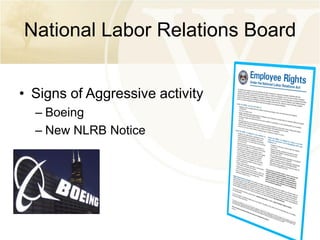
National Labor Relations Board
• Signs of Aggressive activity
– Boeing
– New NLRB Notice
NLRB
• Why?
National Labor Relations Act
• NLRB counsel: not “new normal” but “catch up”
• Covers most private-sector employees
• “Section 7” rights
– guarantees employees the right to “engage in”
“concerted” and “protected” activities with
other employees
– Protected activities include:
• Discussing wages, discipline, unions
• Complaining about policies, supervisors
• Complaining about terms/conditions of employment
Handbook Clauses that May
Implicate Section 7 Rights
•
•
•
•
•
•
•
•
•
•

Bans on Disclosing Wages
Social Media
Bans on Use of Company Name*
“Employment-at-will” disclaimers*
Confidentiality*
– General/investigations
Off-duty conduct
Access Provisions
Solicitation and distribution
Harassment*
Dispute Resolution Procedures
Social Networking Policies
(NLRB)
• Activity may be protected if
– Done on employee’s time and equipment
– Related to terms/conditions of employment or
exercise of NLRA rights
– Involves “concerted” activity

• Swearing/name calling may not justify
termination
• Overbroad policies will be scrutinized
Social Media and NLRB
• Examples of policies that were overbroad: general
prohibitions against
– Self-identifying as employee
– Using company logo
– Posting Facebook comments about work
– Disparaging company products on-line
– Harming the image and integrity of the company
– Inaccurate or misleading or offensive remarks
• Others that NLRB deemed problematic:
– Encouraging employees to solve work problems in the
workplace rather than post online
– Discouraging the “friending” of co-workers
Butler Medical (Sept. 2013)
• E’ee A: terminated & complained on FB
– Allegedly told patient about poor condition of vehicles

• E’ee B responded:
“Sorry to hear that but if you want you may think about
getting a lawyer and taking them to court.”

• E’ee C:
“Hey everybody!!!!! Im [f—— ing] broke down in the
same [s—— ] I was broke in last week because they
don’t wanna buy new [s—— ]!!!! Cha-Chinnngggggg
chinnng—at Sheetz Convenience Store.”
Butler : B&C terminated--posts violated company policy
Drafting Your Social Media
Policy
CLARITY
• You CAN prohibit social media postings that:
– Make comments about coworkers or supervisors or the
employer that are vulgar, obscene, threatening,
intimidating, or harassing
– That constitutes illegal discrimination or harassment
– Carry out illegal conduct

– Are maliciously untrue
• Specific examples are key

• Disclaim that not interfering with NLRA rights
Access Provisions
• Employers may prohibit:
– Non-employees from entering premises
– Off-duty employees from entering internal
premises

• Employers may not prohibit:
– Non-employees from public property
– Off-duty employees from external premises
Non-Discriminatory enforcement!
Solicitation and Distribution
Provisions
• Employers may prohibit
– Non-employees from soliciting and distributing
– Employees from soliciting and distributing
during “work time” and in “work areas”

• Employers may not prohibit:
– All employee solicitation and distribution
– Employees from “talking” about a union or
terms and conditions of employment
Non-discriminatory enforcement!
Arbitration Agreements
• DR Horton Case (2012)
– Agreement requiring employee to arbitrate
claims violates Section 7 rights
• Interferes with access to NLRB
• Must expressly carve out right to bring NLRB
charges

– Class action waivers violate Section 7 rights
The New Normal:
Managing Other Social Media Issues
• Some old boundaries and axioms no longer
relevant (business/personal)
• “Frontier law” but apply familiar frameworks
Social Media – Hiring
• Appeal of SM in Hiring
• Risks
– False identity
– Inaccurate information
– Impermissible subject matter
• E.g., UK professor/religious discrimination

• Limit Risks
– Third party vendors
– Separate cybervetters from decision makers
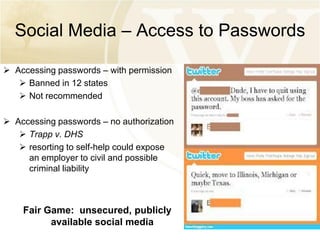
Social Media – Access to Passwords
 Accessing passwords – with permission
 Banned in 12 states
 Not recommended
 Accessing passwords – no authorization
 Trapp v. DHS
 resorting to self-help could expose
an employer to civil and possible
criminal liability

Fair Game: unsecured, publicly
available social media
Bring Your Own Device Policy (BYOD)
• Benefits
– Employees carry single device
– Convenience/practical response to technology
– Reduce costs of devices to employer

• Risks
– Security concerns
– Potentially higher IT costs
– Disaster for discovery in litigation
– Erosion of personal/business spheres
Other BYOD Employment Law
Issues
• Personal Privacy protections
– Computer Fraud and Abuse Act
– Stored Communications Act

• Wage & Hour considerations
• Harassment/hostile work environment
• Security of confidential information
BYOD Policy
• Broad Authorization to:
– Monitor use and content
– Wipe data upon termination/lost device
– Turn over devices for investigations

• Diminished expectation of privacy
• Obligation to notify if lost/stolen
• Require data encryption/password
protection
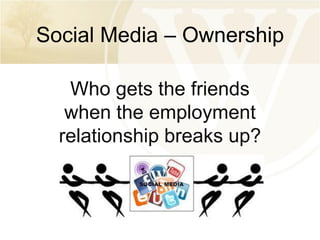
Social Media – Ownership
Who gets the friends
when the employment
relationship breaks up?
Best Company Practices to Protect
Social Media
• Company establishes Account (name and content)

• Structural protection
– Adopt uniform branding, content and style guides
– Assign employees to administer SM accounts

• Anticipate separation of employment
– Reference SM in restrictive covenants
– Have manager also keep account/password
information
– Take quick action upon separation of employment
Best Practices, ctd.
• Written agreement/policy that clarifies rights
and duties
– Blogs, accounts are company property
– Employee must transfer all account
information upon termination
– Administering SM is part of employee’s job

Remember NLRB admonitions: Write
policies in pencil rather than in pen
Impact of Supreme Court Decision
on Same Sex Marriage on
Employment Law
• Defense of Marriage Act enacted 1996
– Definition of “marriage” and “spouse”
– Affected numerous tax/estate/employee
benefit laws

• U.S. v. Windsor decided 2013
– Unconstitutional to limit “marriage” and
“spouse” to opposite-sex couples
Primary Employer-Related Laws
Affected
•
•
•
•
•

Federal Tax
ERISA
COBRA
HIPAA
FMLA

IRS/ERISA determination: “place of celebration”
FMLA determination: “place of residence”
Next Steps
• Best practice: obtain same-sex marriage information
• Review employment policies, handbooks, benefit
plans, SPDs and summaries and insurance policies
• Make legally necessary changes and any changes
desired in accordance with corporate HR strategy

Stay Tuned: More guidance
expected
And while we are on the subject of Sexual
Orientation and Emerging Trends

• Increased jurisdictional protection in
states/cities
• Employment Non-Discrimination Act
(ENDA)
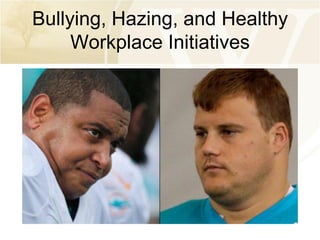
Bullying, Hazing, and Healthy
Workplace Initiatives
Legal aspects of bullying
• No current anti-bullying laws
– “Healthy Workplace Act”

• Laws/causes of action
– Federal and state anti-discrimination laws
– Harassment
– Intentional Infliction of Emotional Distress
– OSHA General Duty Clause
– ADA accommodation

Next Major Arena for Employment Claims?
The New Normal
Emerging Legal Trends
Affecting the Workplace
Mark Bakker
Wyche, P.A.
November 12, 2013
www.wyche.com

The New Normal

  • 1.
    The New Normal EmergingLegal Trends Affecting the Workplace Mark Bakker Wyche, P.A. November 12, 2013 www.wyche.com
  • 2.
    The New Normal: IncreasedRegulatory Scrutiny Federal Agencies: • DOL • EEOC • NLRB
  • 3.
    The DOL NewNormal: Scrutiny of Independent Contractor Classification • Benefits of IC relationship – Reduced payroll taxes and no benefits – No Workers’ Compensation liability – No overtime liability or other related claims – Potential for reduced working space/other overhead – Hedge against future uncertainty
  • 4.
    Misclassification of Independent Contractors •Crackdown on IC misclassification • Enforcement Priority • DOL Secretary: “workplace fraud” • Motivations – Protection of workers – Response to claims of unfair competition – Tax recovery
  • 5.
    IC Classification Economic RealitiesTest (FLSA) (1) Degree of control (2) Investment in facilities/equipment (3) Opportunity for profit and loss (4) Permanency of the relationship (5) Required skill
  • 6.
    IC Misclassification Red Flags • • • • • Relyingsolely on consultant label Integrated workforce (“side-by-side”) Integrated compensation systems Long-term or exclusive relationship Headcount/cost-saving motivation
  • 7.
    Consequences of Misclassification • • • • • • • • DOL andIRS (state and federal) Tax penalties Overtime liability Unemployment Assessment – SCDEW Penalties/liquidated damages Attorneys’ fees and costs Benefits (e.g., retirement benefits) Potential for class/collective action litigation
  • 8.
    Practical Steps • WrittenAgreements – – – – – Limit exclusivity Encourage economic independence Enhance flexibility Establish conclusion of the work Disavow employment relationship and benefits • Require worker to set up LLC/corporation • Periodically audit and evaluate • Consider alternative (temp staffing)
  • 9.
    The New Normal: EEOC& Background Checks Enforcement Guidance (2012) Consideration of Arrest and Conviction Records in Employment Decisions Under Title VII of the Civil Rights Act • “New normal” or “clarity” of existing reg’s?
  • 10.
    EEOC Enforcement Guidance •Race and national origin discrimination • Arrest v. conviction records • Disparate treatment v. disparate impact – Reliance on national data – Targeting general, blanket anti-hire exclusions “Even when employers apply criminal record exclusions uniformly, the exclusions may still operate to disproportionately and unjustifiably exclude persons of a particular race or national origin.”
  • 12.
    Liability for NegligentHire Claim for negligent hiring and negligent entrustment: a) The company is on notice of an issue that requires it to reasonably inquire into the fitness of a particular employee for a particular position b) The company fails to inquire c) That failure to inquire causes legal damage
  • 13.
    Best Practices • Eliminate“blanket” policies or practices • Develop narrowly tailored written policy: – Considers job requirements/contexts – Specify offenses that demonstrate unfitness – Limits duration of exclusions – Conduct individualized assessment • Limit inquiries to “job related” & “consistent with business necessity” • Establish appropriate confidentiality
  • 14.
    National Labor RelationsBoard • Signs of Aggressive activity – Boeing – New NLRB Notice
  • 15.
  • 16.
    National Labor RelationsAct • NLRB counsel: not “new normal” but “catch up” • Covers most private-sector employees • “Section 7” rights – guarantees employees the right to “engage in” “concerted” and “protected” activities with other employees – Protected activities include: • Discussing wages, discipline, unions • Complaining about policies, supervisors • Complaining about terms/conditions of employment
  • 17.
    Handbook Clauses thatMay Implicate Section 7 Rights • • • • • • • • • • Bans on Disclosing Wages Social Media Bans on Use of Company Name* “Employment-at-will” disclaimers* Confidentiality* – General/investigations Off-duty conduct Access Provisions Solicitation and distribution Harassment* Dispute Resolution Procedures
  • 18.
    Social Networking Policies (NLRB) •Activity may be protected if – Done on employee’s time and equipment – Related to terms/conditions of employment or exercise of NLRA rights – Involves “concerted” activity • Swearing/name calling may not justify termination • Overbroad policies will be scrutinized
  • 19.
    Social Media andNLRB • Examples of policies that were overbroad: general prohibitions against – Self-identifying as employee – Using company logo – Posting Facebook comments about work – Disparaging company products on-line – Harming the image and integrity of the company – Inaccurate or misleading or offensive remarks • Others that NLRB deemed problematic: – Encouraging employees to solve work problems in the workplace rather than post online – Discouraging the “friending” of co-workers
  • 20.
    Butler Medical (Sept.2013) • E’ee A: terminated & complained on FB – Allegedly told patient about poor condition of vehicles • E’ee B responded: “Sorry to hear that but if you want you may think about getting a lawyer and taking them to court.” • E’ee C: “Hey everybody!!!!! Im [f—— ing] broke down in the same [s—— ] I was broke in last week because they don’t wanna buy new [s—— ]!!!! Cha-Chinnngggggg chinnng—at Sheetz Convenience Store.” Butler : B&C terminated--posts violated company policy
  • 21.
    Drafting Your SocialMedia Policy CLARITY • You CAN prohibit social media postings that: – Make comments about coworkers or supervisors or the employer that are vulgar, obscene, threatening, intimidating, or harassing – That constitutes illegal discrimination or harassment – Carry out illegal conduct – Are maliciously untrue • Specific examples are key • Disclaim that not interfering with NLRA rights
  • 22.
    Access Provisions • Employersmay prohibit: – Non-employees from entering premises – Off-duty employees from entering internal premises • Employers may not prohibit: – Non-employees from public property – Off-duty employees from external premises Non-Discriminatory enforcement!
  • 23.
    Solicitation and Distribution Provisions •Employers may prohibit – Non-employees from soliciting and distributing – Employees from soliciting and distributing during “work time” and in “work areas” • Employers may not prohibit: – All employee solicitation and distribution – Employees from “talking” about a union or terms and conditions of employment Non-discriminatory enforcement!
  • 24.
    Arbitration Agreements • DRHorton Case (2012) – Agreement requiring employee to arbitrate claims violates Section 7 rights • Interferes with access to NLRB • Must expressly carve out right to bring NLRB charges – Class action waivers violate Section 7 rights
  • 25.
    The New Normal: ManagingOther Social Media Issues • Some old boundaries and axioms no longer relevant (business/personal) • “Frontier law” but apply familiar frameworks
  • 26.
    Social Media –Hiring • Appeal of SM in Hiring • Risks – False identity – Inaccurate information – Impermissible subject matter • E.g., UK professor/religious discrimination • Limit Risks – Third party vendors – Separate cybervetters from decision makers
  • 27.
    Social Media –Access to Passwords  Accessing passwords – with permission  Banned in 12 states  Not recommended  Accessing passwords – no authorization  Trapp v. DHS  resorting to self-help could expose an employer to civil and possible criminal liability Fair Game: unsecured, publicly available social media
  • 28.
    Bring Your OwnDevice Policy (BYOD) • Benefits – Employees carry single device – Convenience/practical response to technology – Reduce costs of devices to employer • Risks – Security concerns – Potentially higher IT costs – Disaster for discovery in litigation – Erosion of personal/business spheres
  • 29.
    Other BYOD EmploymentLaw Issues • Personal Privacy protections – Computer Fraud and Abuse Act – Stored Communications Act • Wage & Hour considerations • Harassment/hostile work environment • Security of confidential information
  • 30.
    BYOD Policy • BroadAuthorization to: – Monitor use and content – Wipe data upon termination/lost device – Turn over devices for investigations • Diminished expectation of privacy • Obligation to notify if lost/stolen • Require data encryption/password protection
  • 31.
    Social Media –Ownership Who gets the friends when the employment relationship breaks up?
  • 32.
    Best Company Practicesto Protect Social Media • Company establishes Account (name and content) • Structural protection – Adopt uniform branding, content and style guides – Assign employees to administer SM accounts • Anticipate separation of employment – Reference SM in restrictive covenants – Have manager also keep account/password information – Take quick action upon separation of employment
  • 33.
    Best Practices, ctd. •Written agreement/policy that clarifies rights and duties – Blogs, accounts are company property – Employee must transfer all account information upon termination – Administering SM is part of employee’s job Remember NLRB admonitions: Write policies in pencil rather than in pen
  • 34.
    Impact of SupremeCourt Decision on Same Sex Marriage on Employment Law • Defense of Marriage Act enacted 1996 – Definition of “marriage” and “spouse” – Affected numerous tax/estate/employee benefit laws • U.S. v. Windsor decided 2013 – Unconstitutional to limit “marriage” and “spouse” to opposite-sex couples
  • 35.
    Primary Employer-Related Laws Affected • • • • • FederalTax ERISA COBRA HIPAA FMLA IRS/ERISA determination: “place of celebration” FMLA determination: “place of residence”
  • 36.
    Next Steps • Bestpractice: obtain same-sex marriage information • Review employment policies, handbooks, benefit plans, SPDs and summaries and insurance policies • Make legally necessary changes and any changes desired in accordance with corporate HR strategy Stay Tuned: More guidance expected
  • 37.
    And while weare on the subject of Sexual Orientation and Emerging Trends • Increased jurisdictional protection in states/cities • Employment Non-Discrimination Act (ENDA)
  • 38.
    Bullying, Hazing, andHealthy Workplace Initiatives
  • 39.
    Legal aspects ofbullying • No current anti-bullying laws – “Healthy Workplace Act” • Laws/causes of action – Federal and state anti-discrimination laws – Harassment – Intentional Infliction of Emotional Distress – OSHA General Duty Clause – ADA accommodation Next Major Arena for Employment Claims?
  • 40.
    The New Normal EmergingLegal Trends Affecting the Workplace Mark Bakker Wyche, P.A. November 12, 2013 www.wyche.com