Managing Legal Risks In Social Media A review of uncharted legal waters— How to navigate uncertainty on the real-time Web.
Introduction: “It Depends” There IS NO “law of social media,” yet! Law evolves slowly and cannot maintain pace with technological change Much is likely adaption of legacy rules Applying traditional common law and statutory principles to new media Unique aspects of social networking, e.g., one-to-many public communications, eventually reflected in specific decisions Progress in fits and starts, formed principally by litigation,  e.g., LaRossa v. Twitter  (2009) State or federal legislation virtually impossible and hardly comprehensive
Overview “ Old wine in new bottles” Social media & intellectual property Social media & employment Social media & privacy Corporate/regulatory compliance Managing enterprise legal risks Potential regulation
“ Are users liable for their tweets and posts?” Privacy and tort Defamation Invasion of privacy/false light A/C, NDA and proprietary/confidential content Legal ethics obligations (represented parties, judge/jurors, etc.) Others: cyber bullying, prostitution, child pornography, etc. 19 Facebook posts that led to arrests http://www.huffingtonpost.com/2010/08/16/arrested-over-facebook-po_n_683160.html But see new Mass. law (5/2010) requiring public school officials to enforce anti-bullying rules also on email/social networks Old Wine In New Bottles
Social Media and IP Major issue is who owns user-generated content (UGC)?  Possession ≠ 90% of law Different conclusions for TM, © and patents No present consensus on what is protected, what is public domain and what is in between,  e.g.,  Facebook 2009 “ToS” crisis Nature of expression AND nature of posting are both key factors Implied license for (some) “public” postings, depending on content, ToS and author/generator claim? Tweets v. photos, for instance
Social Media and IP (con’t) Are Tweets copyrighted? http://blogmaverick.com/2009/03/29/are-tweets-copyrighted/ Original expression v. opinion v. fact Compare,  e.g.,  “Three-peat” TM That Twitter ToS does not claim copyright is not dispositive ToS cannot create legal rights Public domain (implied license) IF unprotected...? UK Press Complaint Commission says publishing socially-posted “epic boobs” photos permissible http://www.pcc.org.uk/cases/adjudicated.html?article=NjM5OA== Tweets, fair use (CNN?) and “retweeting”
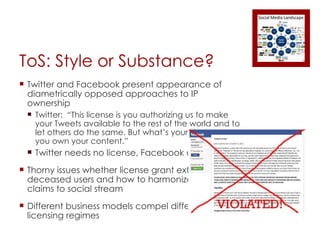
Twitter and Facebook present appearance of diametrically opposed approaches to IP ownership Twitter:  “This license is you authorizing us to make your Tweets available to the rest of the world and to let others do the same. But what’s yours is yours — you own your content.” Twitter needs no license, Facebook does Thorny issues whether license grant extends to deceased users and how to harmonize conflicting claims to social stream Different business models compel different IP licensing regimes ToS: Style or Substance?
TMs, Genericide & Twittersquatting Aspirin on the real-time Web Massive volume of UGC presents increased compliance burdens. Vexing customer relations issues from infringing brand “fans” User name infringement/dilution Anti-Cybersquatting Act and DMCA notice-and-takedown procedures possibly inapplicable to social media. Personal names (unlike brands) have not usually achieved protected “secondary meaning.” Parody and “gripe” usage likely not “in commerce” Deep pocket reality puts social networks in $$ center of disputes, with common law theories (conversion, negligence, defamation) akin to early domain name struggles
Social Media & Employment Employers may use social media UGC for hiring/firing decisions Corporate “social media policy” can prohibit employee participation,  e.g.,  DoD, WSJ, NFL player tweets, marks/logos, use of company IT Unclear whether company “owns” employee UGC Evolving common law right to workplace email privacy ( e.g.,  New Jersey) may extend to UGC Can employer meet out employee discipline for third-party comments (AP)? http://www.wired.comthreatlevel/2009/06/facebookfollow/ Marketing/PR positions present different rights & risks ECPA and/or CFAA may protect non-consensual intrusion into third-party employee accounts
Social Media & Privacy No general privacy law, but sector-specific legislation (HIPAA, GLB, etc.) on info. security/privacy applies to social media Boucher-Stearns draft “discussion” privacy bill (2010) FTC and EU complaints against Facebook raise possibility of adjudicatory “rules” development CAN-SPAM likely inapplicable beyond “commercial email” (but see SMS/texts under TCPA) Does “business relationship” safe harbor allow mobile wireless delivery? Growing LBS technologies present new/different privacy issues  See, e.g.,  http://blog.cdt.org/2009/06/19/the-dawn-of-the-location-enabled-web/ EC opines Data Protection Directive applies to social networks (WP 163 Opinion 5/2009)
Corporate/Regulatory Compliance Traditional compliance issues (contracting, FCRA/FDCPA, trade secrets, etc.) also presented via social media Heavily regulated industries — pharmaceuticals, health care, financial services — face challenge of ensuring reg. compliance in “social stream,” especially re mandatory disclaimers CDT petitions FDA to disallow pharmaceutical use of social media posts w/o sufficient space for risk disclaimers (5/2010) FDA fines Novartis for socmedia marketing (8/2010) SEC Reg. FD always applicable to employee posts, not “individual capacity ”  ) Public companies may rely on blogs for Reg. FD compliance (7/2008) http://www.sec.gov/rules/interp/2008/34-58288.pdf SEC 21st Century Disclosure Initiative http://www.sec.gov/disclosureinitiative HR postings/practices on social media can create EEOC and Title VII issues,  e.g.,  listing text, “friend/follower” selection, etc. User anonymity is different, but major issue for social media sites
Managing Legal Risks Proactive or defensive use of socmedia for business? Clear SMP for enterprise, different from email and IT system privileges Manage employees’ reasonable privacy expectations Practices as relevant as formal policy Protect IP assets against dilution and genericide Product marketing, reputation mgmt. and hiring present major areas of risk Disclosure Nondiscrimination Position-specific guidelines and “hotline”
“ Best Practices”— http://sncr.org/wp-content/uploads/2008/09/sncr-social-media-policy-best-practices.pdf Culture— Foster corporate culture of openness. Listen to & respect opinions of employees, customers and other stakeholders. Trust— Employees should be trusted to communicate and develop relationships with customers. Do not review content prior to posting.  Training— Provide employee training about how to blog; review legal issues with employees. Give employees option of participation for off-hours socmedia activities. Transparency— Disclose connections with customers. Reveal commercial and sponsored relationships. Transparency and authenticity are key. Accuracy— Confirm facts. Check with colleagues before publishing content that will affect them. If employees write about private matters, insist upon permission before postings. Comments— Develop and clearly communicate SMP. Set expectations by clearly communicating what is (and what is not) allowed on enterprise blogs/posts. Permit both negative and positive comments, but restrict inappropriate comments. Managing Legal Risks (con’t)
Potential Regulation Sponsored posts and PPT face FTC, state consumer protection, Lanham Act and tort exposure.  Disclosure is best practice whether or not yet mandatory. States developing laws specific to social media,  e.g.,  North Carolina re sex offender access, New Jersey A-3757 re harassment/abuse, Calif. AB-632 re social photostream copy protection. Potential for federal preemption IF national standard established. Never underestimate ability of legislators to pass silly laws,  e.g.,  prohibiting “silent” cell phone cameras http://www.pcworld.com/article/158444/congress_and_camera_phones_arent_clicking.html
Conclusions Little social media-specific judicial precedents & essentially no legislation.  Don’t expect short-term statutory resolution. Legacy real-world rules apply, sometimes as adapted, to social stream.  Otherwise unlawful practices are still illegal when online. Typical privacy rules (sector-specific) for social media, including EU Directive UGC ownership is significant IP and corporate/HR issue Special compliance concerns for regulated industries and Reg FD financial releases.  Pharma, banking, etc., need special SMPs. Cauldron of litigation likely to yield confusing & conflicting precedents, more certainty for socmedia than corporate GCs

Social Media: Managing Legal Risks

  • 1.
    Managing Legal RisksIn Social Media A review of uncharted legal waters— How to navigate uncertainty on the real-time Web.
  • 2.
    Introduction: “It Depends”There IS NO “law of social media,” yet! Law evolves slowly and cannot maintain pace with technological change Much is likely adaption of legacy rules Applying traditional common law and statutory principles to new media Unique aspects of social networking, e.g., one-to-many public communications, eventually reflected in specific decisions Progress in fits and starts, formed principally by litigation, e.g., LaRossa v. Twitter (2009) State or federal legislation virtually impossible and hardly comprehensive
  • 3.
    Overview “ Oldwine in new bottles” Social media & intellectual property Social media & employment Social media & privacy Corporate/regulatory compliance Managing enterprise legal risks Potential regulation
  • 4.
    “ Are usersliable for their tweets and posts?” Privacy and tort Defamation Invasion of privacy/false light A/C, NDA and proprietary/confidential content Legal ethics obligations (represented parties, judge/jurors, etc.) Others: cyber bullying, prostitution, child pornography, etc. 19 Facebook posts that led to arrests http://www.huffingtonpost.com/2010/08/16/arrested-over-facebook-po_n_683160.html But see new Mass. law (5/2010) requiring public school officials to enforce anti-bullying rules also on email/social networks Old Wine In New Bottles
  • 5.
    Social Media andIP Major issue is who owns user-generated content (UGC)? Possession ≠ 90% of law Different conclusions for TM, © and patents No present consensus on what is protected, what is public domain and what is in between, e.g., Facebook 2009 “ToS” crisis Nature of expression AND nature of posting are both key factors Implied license for (some) “public” postings, depending on content, ToS and author/generator claim? Tweets v. photos, for instance
  • 6.
    Social Media andIP (con’t) Are Tweets copyrighted? http://blogmaverick.com/2009/03/29/are-tweets-copyrighted/ Original expression v. opinion v. fact Compare, e.g., “Three-peat” TM That Twitter ToS does not claim copyright is not dispositive ToS cannot create legal rights Public domain (implied license) IF unprotected...? UK Press Complaint Commission says publishing socially-posted “epic boobs” photos permissible http://www.pcc.org.uk/cases/adjudicated.html?article=NjM5OA== Tweets, fair use (CNN?) and “retweeting”
  • 7.
    Twitter and Facebookpresent appearance of diametrically opposed approaches to IP ownership Twitter: “This license is you authorizing us to make your Tweets available to the rest of the world and to let others do the same. But what’s yours is yours — you own your content.” Twitter needs no license, Facebook does Thorny issues whether license grant extends to deceased users and how to harmonize conflicting claims to social stream Different business models compel different IP licensing regimes ToS: Style or Substance?
  • 8.
    TMs, Genericide &Twittersquatting Aspirin on the real-time Web Massive volume of UGC presents increased compliance burdens. Vexing customer relations issues from infringing brand “fans” User name infringement/dilution Anti-Cybersquatting Act and DMCA notice-and-takedown procedures possibly inapplicable to social media. Personal names (unlike brands) have not usually achieved protected “secondary meaning.” Parody and “gripe” usage likely not “in commerce” Deep pocket reality puts social networks in $$ center of disputes, with common law theories (conversion, negligence, defamation) akin to early domain name struggles
  • 9.
    Social Media &Employment Employers may use social media UGC for hiring/firing decisions Corporate “social media policy” can prohibit employee participation, e.g., DoD, WSJ, NFL player tweets, marks/logos, use of company IT Unclear whether company “owns” employee UGC Evolving common law right to workplace email privacy ( e.g., New Jersey) may extend to UGC Can employer meet out employee discipline for third-party comments (AP)? http://www.wired.comthreatlevel/2009/06/facebookfollow/ Marketing/PR positions present different rights & risks ECPA and/or CFAA may protect non-consensual intrusion into third-party employee accounts
  • 10.
    Social Media &Privacy No general privacy law, but sector-specific legislation (HIPAA, GLB, etc.) on info. security/privacy applies to social media Boucher-Stearns draft “discussion” privacy bill (2010) FTC and EU complaints against Facebook raise possibility of adjudicatory “rules” development CAN-SPAM likely inapplicable beyond “commercial email” (but see SMS/texts under TCPA) Does “business relationship” safe harbor allow mobile wireless delivery? Growing LBS technologies present new/different privacy issues See, e.g., http://blog.cdt.org/2009/06/19/the-dawn-of-the-location-enabled-web/ EC opines Data Protection Directive applies to social networks (WP 163 Opinion 5/2009)
  • 11.
    Corporate/Regulatory Compliance Traditionalcompliance issues (contracting, FCRA/FDCPA, trade secrets, etc.) also presented via social media Heavily regulated industries — pharmaceuticals, health care, financial services — face challenge of ensuring reg. compliance in “social stream,” especially re mandatory disclaimers CDT petitions FDA to disallow pharmaceutical use of social media posts w/o sufficient space for risk disclaimers (5/2010) FDA fines Novartis for socmedia marketing (8/2010) SEC Reg. FD always applicable to employee posts, not “individual capacity ” ) Public companies may rely on blogs for Reg. FD compliance (7/2008) http://www.sec.gov/rules/interp/2008/34-58288.pdf SEC 21st Century Disclosure Initiative http://www.sec.gov/disclosureinitiative HR postings/practices on social media can create EEOC and Title VII issues, e.g., listing text, “friend/follower” selection, etc. User anonymity is different, but major issue for social media sites
  • 12.
    Managing Legal RisksProactive or defensive use of socmedia for business? Clear SMP for enterprise, different from email and IT system privileges Manage employees’ reasonable privacy expectations Practices as relevant as formal policy Protect IP assets against dilution and genericide Product marketing, reputation mgmt. and hiring present major areas of risk Disclosure Nondiscrimination Position-specific guidelines and “hotline”
  • 13.
    “ Best Practices”—http://sncr.org/wp-content/uploads/2008/09/sncr-social-media-policy-best-practices.pdf Culture— Foster corporate culture of openness. Listen to & respect opinions of employees, customers and other stakeholders. Trust— Employees should be trusted to communicate and develop relationships with customers. Do not review content prior to posting. Training— Provide employee training about how to blog; review legal issues with employees. Give employees option of participation for off-hours socmedia activities. Transparency— Disclose connections with customers. Reveal commercial and sponsored relationships. Transparency and authenticity are key. Accuracy— Confirm facts. Check with colleagues before publishing content that will affect them. If employees write about private matters, insist upon permission before postings. Comments— Develop and clearly communicate SMP. Set expectations by clearly communicating what is (and what is not) allowed on enterprise blogs/posts. Permit both negative and positive comments, but restrict inappropriate comments. Managing Legal Risks (con’t)
  • 14.
    Potential Regulation Sponsoredposts and PPT face FTC, state consumer protection, Lanham Act and tort exposure. Disclosure is best practice whether or not yet mandatory. States developing laws specific to social media, e.g., North Carolina re sex offender access, New Jersey A-3757 re harassment/abuse, Calif. AB-632 re social photostream copy protection. Potential for federal preemption IF national standard established. Never underestimate ability of legislators to pass silly laws, e.g., prohibiting “silent” cell phone cameras http://www.pcworld.com/article/158444/congress_and_camera_phones_arent_clicking.html
  • 15.
    Conclusions Little socialmedia-specific judicial precedents & essentially no legislation. Don’t expect short-term statutory resolution. Legacy real-world rules apply, sometimes as adapted, to social stream. Otherwise unlawful practices are still illegal when online. Typical privacy rules (sector-specific) for social media, including EU Directive UGC ownership is significant IP and corporate/HR issue Special compliance concerns for regulated industries and Reg FD financial releases. Pharma, banking, etc., need special SMPs. Cauldron of litigation likely to yield confusing & conflicting precedents, more certainty for socmedia than corporate GCs