Social Media & Its Implications for
Content Strategy
Pam Noreault
pamnoreault@gmail.com
@pnoreault
1.Power of Choice
2.Social Network Connection
3.Aha! Metrics
4.Impact
5.Tada! Strategy
Story
Choice
1. Keep the baggage and
become irrelevant
2. Join the revolution,
change the perception,
and evolve
5Slide 5
Social Media and Content Strategy
What does content strategy require you
to know?
If you don’t know your
audience/market, the industry trends,
and what the industry leaders are doing
and you create a content strategy, the
basis of that strategy is on quicksand.
Not what they want. What they NEED.
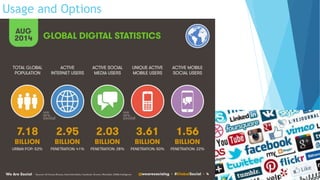
Usage and Options
What can you do?
Customer Experience Impacts Strategy
Understand how your users use
your deliverables prior to creating
your content strategy
Collaborate with anyone who
works with your users or is
representative of your users
Forget Hurdles
Focus on Wins & Get Creative
• Hang with your users
• Get to groups of people who are
representative of your users
• Get the answers you need
• Network
Pilot an Idea – Apply to Strategy
• Content validation (before vs after)
• Card sorts for information architecture on new
deliverables
• Contextual interviews to understand how users work
• User shadowing to observe software usage
• Case analysis to look for patterns and trends
• Opinion polls via LinkedIn groups
• Product focus groups to get feedback
Slide 10
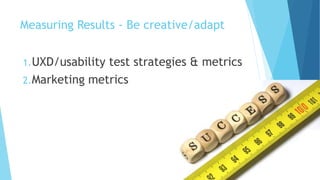
Measuring Results - Be creative/adapt
1.UXD/usability test strategies & metrics
2.Marketing metrics
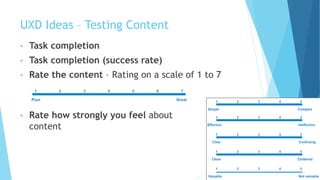
UXD Ideas – Testing Content
• Task completion
• Task completion (success rate)
• Rate the content – Rating on a scale of 1 to 7
• Rate how strongly you feel about
content
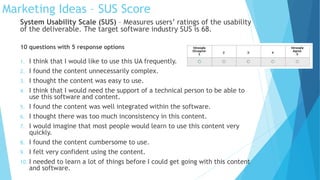
Marketing Ideas – SUS Score
System Usability Scale (SUS) – Measures users’ ratings of the usability
of the deliverable. The target software industry SUS is 68.
10 questions with 5 response options
1. I think that I would like to use this UA frequently.
2. I found the content unnecessarily complex.
3. I thought the content was easy to use.
4. I think that I would need the support of a technical person to be able to
use this software and content.
5. I found the content was well integrated within the software.
6. I thought there was too much inconsistency in this content.
7. I would imagine that most people would learn to use this content very
quickly.
8. I found the content cumbersome to use.
9. I felt very confident using the content.
10. I needed to learn a lot of things before I could get going with this content
and software.
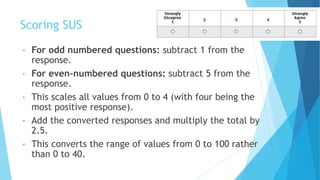
Scoring SUS
• For odd numbered questions: subtract 1 from the
response.
• For even-numbered questions: subtract 5 from the
response.
• This scales all values from 0 to 4 (with four being the
most positive response).
• Add the converted responses and multiply the total by
2.5.
• This converts the range of values from 0 to 100 rather
than 0 to 40.
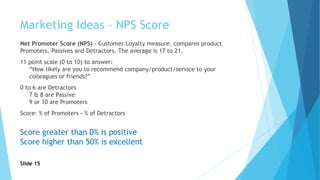
Marketing Ideas – NPS Score
Net Promoter Score (NPS) - Customer Loyalty measure. compares product
Promoters, Passives and Detractors. The average is 17 to 21.
11 point scale (0 to 10) to answer:
“How likely are you to recommend company/product/service to your
colleagues or friends?”
0 to 6 are Detractors
7 & 8 are Passive
9 or 10 are Promoters
Score: % of Promoters - % of Detractors
Score greater than 0% is positive
Score higher than 50% is excellent
Slide 15
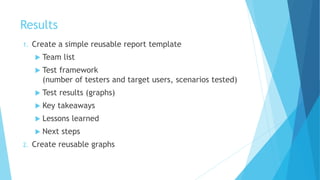
Results
1. Create a simple reusable report template
 Team list
 Test framework
(number of testers and target users, scenarios tested)
 Test results (graphs)
 Key takeaways
 Lessons learned
 Next steps
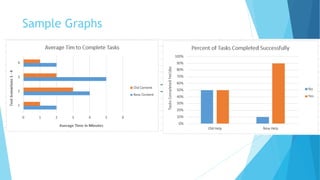
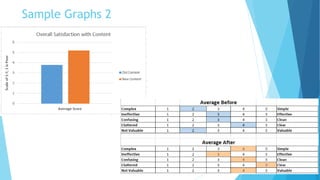
2. Create reusable graphs
Sample Graphs
Sample Graphs 2
Bonus! Writer Impact
• Content strategy is understood
• Social media valued by writers/business
• Benefits experienced first hand
• Results resonate and provide
measurable impact to customers and
folded into the content strategy
• Customer engagement is front center
Business Impact = Win!
Content strategy/methodology evolving
(iterative)
• Customer engagement programs created
• UXD, Customer Service, and Product Management partnerships
• Content strategy evolving (iterative)
• Small teams of writers create standards and templates
 User research
 User assistance validation testing
Slide 20
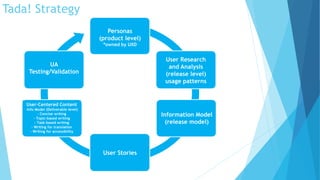
Tada! Strategy
User-Centered Content
-Info Model (Deliverable level)
- Concise writing
- Topic-based writing
- Task-based writing
- Writing for translation
- Writing for accessibility
Personas
(product level)
*owned by UXD
User Research
and Analysis
(release level)
usage patterns
UA
Testing/Validation
User Stories
Information Model
(release model)
Pam Noreault
Sr. Mgr. Information Development
ACI Worldwide
pamnoreault@gmail.com
Twitter @pnoreault

Social Media & Its Implications for Content Strategy

  • 1.
    Social Media &Its Implications for Content Strategy Pam Noreault pamnoreault@gmail.com @pnoreault
  • 2.
    1.Power of Choice 2.SocialNetwork Connection 3.Aha! Metrics 4.Impact 5.Tada! Strategy
  • 3.
  • 4.
    Choice 1. Keep thebaggage and become irrelevant 2. Join the revolution, change the perception, and evolve
  • 5.
  • 6.
    Social Media andContent Strategy What does content strategy require you to know? If you don’t know your audience/market, the industry trends, and what the industry leaders are doing and you create a content strategy, the basis of that strategy is on quicksand. Not what they want. What they NEED.
  • 7.
  • 8.
    What can youdo? Customer Experience Impacts Strategy Understand how your users use your deliverables prior to creating your content strategy Collaborate with anyone who works with your users or is representative of your users
  • 9.
    Forget Hurdles Focus onWins & Get Creative • Hang with your users • Get to groups of people who are representative of your users • Get the answers you need • Network
  • 10.
    Pilot an Idea– Apply to Strategy • Content validation (before vs after) • Card sorts for information architecture on new deliverables • Contextual interviews to understand how users work • User shadowing to observe software usage • Case analysis to look for patterns and trends • Opinion polls via LinkedIn groups • Product focus groups to get feedback Slide 10
  • 11.
    Measuring Results -Be creative/adapt 1.UXD/usability test strategies & metrics 2.Marketing metrics
  • 12.
    UXD Ideas –Testing Content • Task completion • Task completion (success rate) • Rate the content – Rating on a scale of 1 to 7 • Rate how strongly you feel about content
  • 13.
    Marketing Ideas –SUS Score System Usability Scale (SUS) – Measures users’ ratings of the usability of the deliverable. The target software industry SUS is 68. 10 questions with 5 response options 1. I think that I would like to use this UA frequently. 2. I found the content unnecessarily complex. 3. I thought the content was easy to use. 4. I think that I would need the support of a technical person to be able to use this software and content. 5. I found the content was well integrated within the software. 6. I thought there was too much inconsistency in this content. 7. I would imagine that most people would learn to use this content very quickly. 8. I found the content cumbersome to use. 9. I felt very confident using the content. 10. I needed to learn a lot of things before I could get going with this content and software.
  • 14.
    Scoring SUS • Forodd numbered questions: subtract 1 from the response. • For even-numbered questions: subtract 5 from the response. • This scales all values from 0 to 4 (with four being the most positive response). • Add the converted responses and multiply the total by 2.5. • This converts the range of values from 0 to 100 rather than 0 to 40.
  • 15.
    Marketing Ideas –NPS Score Net Promoter Score (NPS) - Customer Loyalty measure. compares product Promoters, Passives and Detractors. The average is 17 to 21. 11 point scale (0 to 10) to answer: “How likely are you to recommend company/product/service to your colleagues or friends?” 0 to 6 are Detractors 7 & 8 are Passive 9 or 10 are Promoters Score: % of Promoters - % of Detractors Score greater than 0% is positive Score higher than 50% is excellent Slide 15
  • 16.
    Results 1. Create asimple reusable report template  Team list  Test framework (number of testers and target users, scenarios tested)  Test results (graphs)  Key takeaways  Lessons learned  Next steps 2. Create reusable graphs
  • 17.
  • 18.
  • 19.
    Bonus! Writer Impact •Content strategy is understood • Social media valued by writers/business • Benefits experienced first hand • Results resonate and provide measurable impact to customers and folded into the content strategy • Customer engagement is front center
  • 20.
    Business Impact =Win! Content strategy/methodology evolving (iterative) • Customer engagement programs created • UXD, Customer Service, and Product Management partnerships • Content strategy evolving (iterative) • Small teams of writers create standards and templates  User research  User assistance validation testing Slide 20
  • 21.
    Tada! Strategy User-Centered Content -InfoModel (Deliverable level) - Concise writing - Topic-based writing - Task-based writing - Writing for translation - Writing for accessibility Personas (product level) *owned by UXD User Research and Analysis (release level) usage patterns UA Testing/Validation User Stories Information Model (release model)
  • 22.
    Pam Noreault Sr. Mgr.Information Development ACI Worldwide pamnoreault@gmail.com Twitter @pnoreault

Editor's Notes

  • #7 If you don’t know your audience/market, the industry trends, and what the industry leaders are doing and you create a content strategy, the basis of that strategy is on quicksand. The foundation is always your customer/your market and what they need. Not what they want. What they NEED.
  • #8 There are so many options out there that it can make you nauseous. However, you’d be crazy not to tap into the options that make sense to you.
  • #9 Ann Gentle’s Book – Conversation and Community: The Social Web for Documentation
  • #11 Analyze your results and apply that information to your content strategy
  • #12 Use these metrics in your content strategy
  • #17 All of your results should feed back into your content strategy.
  • #20 Killed two birds with one stone. Customer engagement front center and content strategy evolving over time.