Social Media 101:
Getting Started
October 9, 2013 #Good360
Nonprofit Webinar Series
October 30:
Prospect Research: Diving Deeper with Social Data
Featuring Small Act’s Casey Golden
Ongoing Webinars:
•Good360 101
•Good360 Framing Hope Webinar
•Good360 Retail Donation Program Webinar
•Good360 Best Practices in Truckload Donations
Register online at: http://www.giftsinkind.org/Charities/FREE_Webinars
#Good360
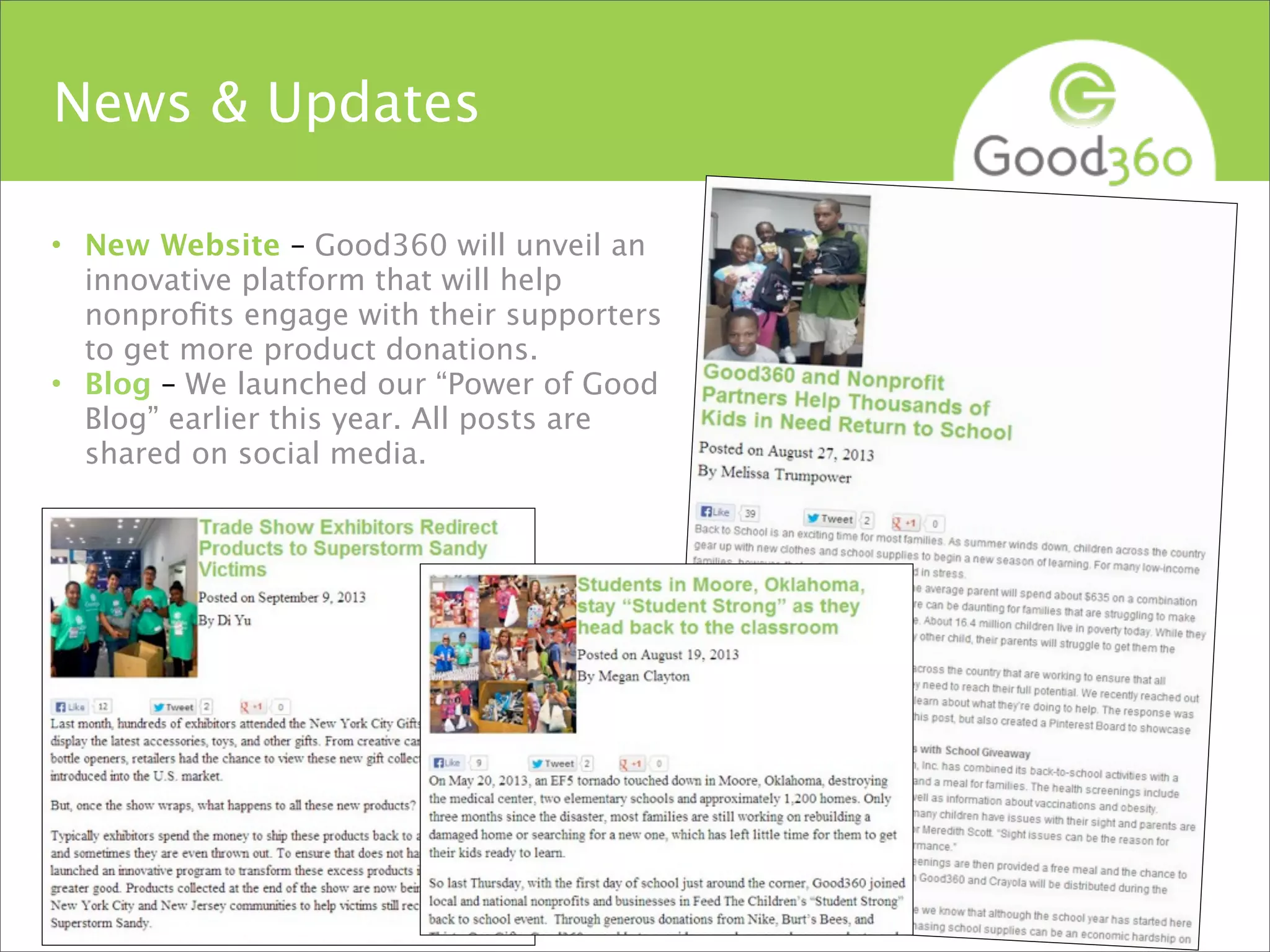
News & Updates
• New Website – Good360 will unveil an
innovative platform that will help
nonprofits engage with their supporters
to get more product donations.
• Blog – We launched our “Power of Good
Blog” earlier this year. All posts are
shared on social media.
#Good360
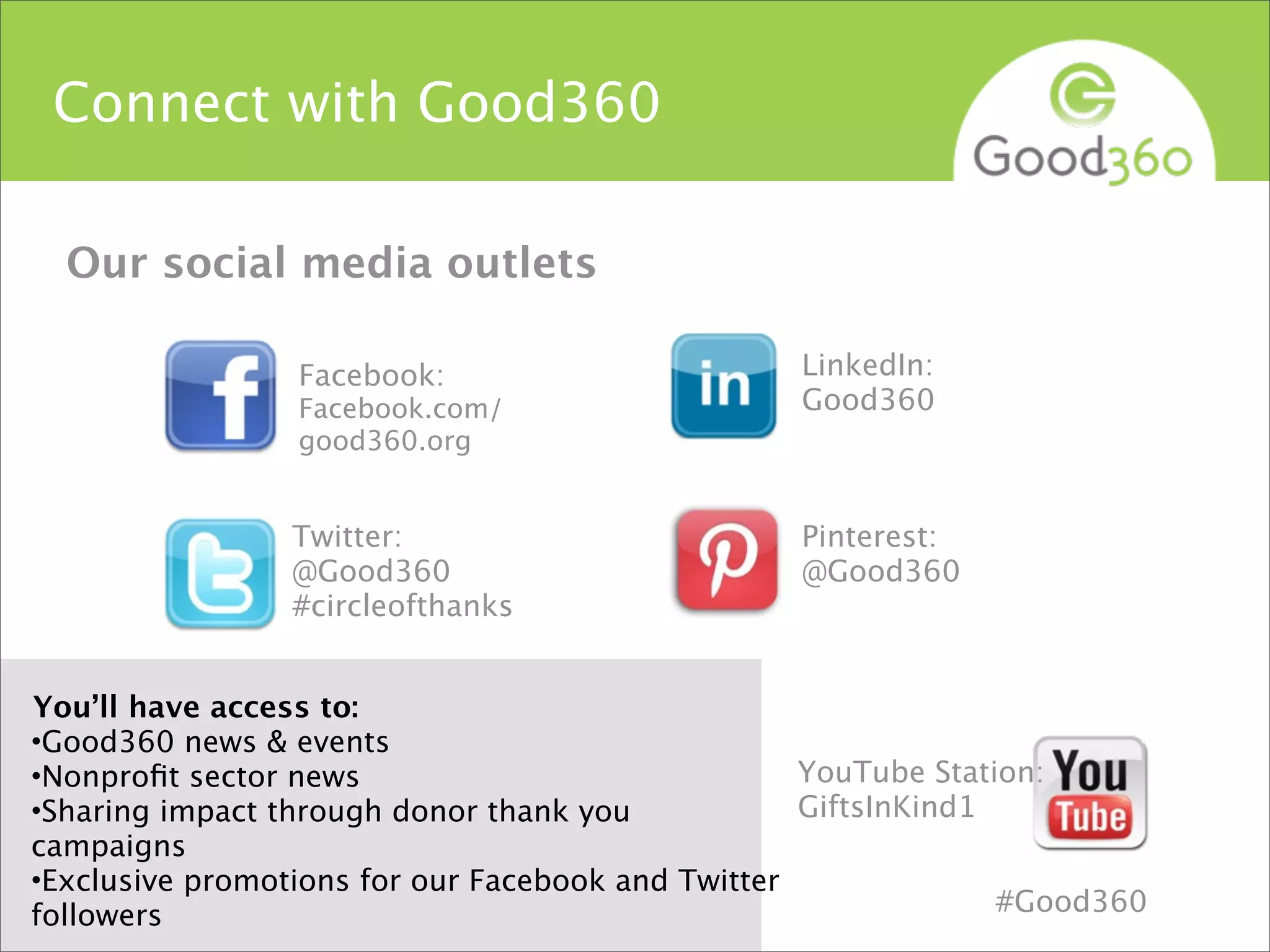
Twitter:
@Good360
#circleofthanks
YouTube Station:
GiftsInKind1
Facebook:
Facebook.com/
good360.org
Connect with Good360
You’ll have access to:
•Good360 news & events
•Nonprofit sector news
•Sharing impact through donor thank you
campaigns
•Exclusive promotions for our Facebook and Twitter
followers
Pinterest:
@Good360
LinkedIn:
Good360
Our social media outlets
#Good360
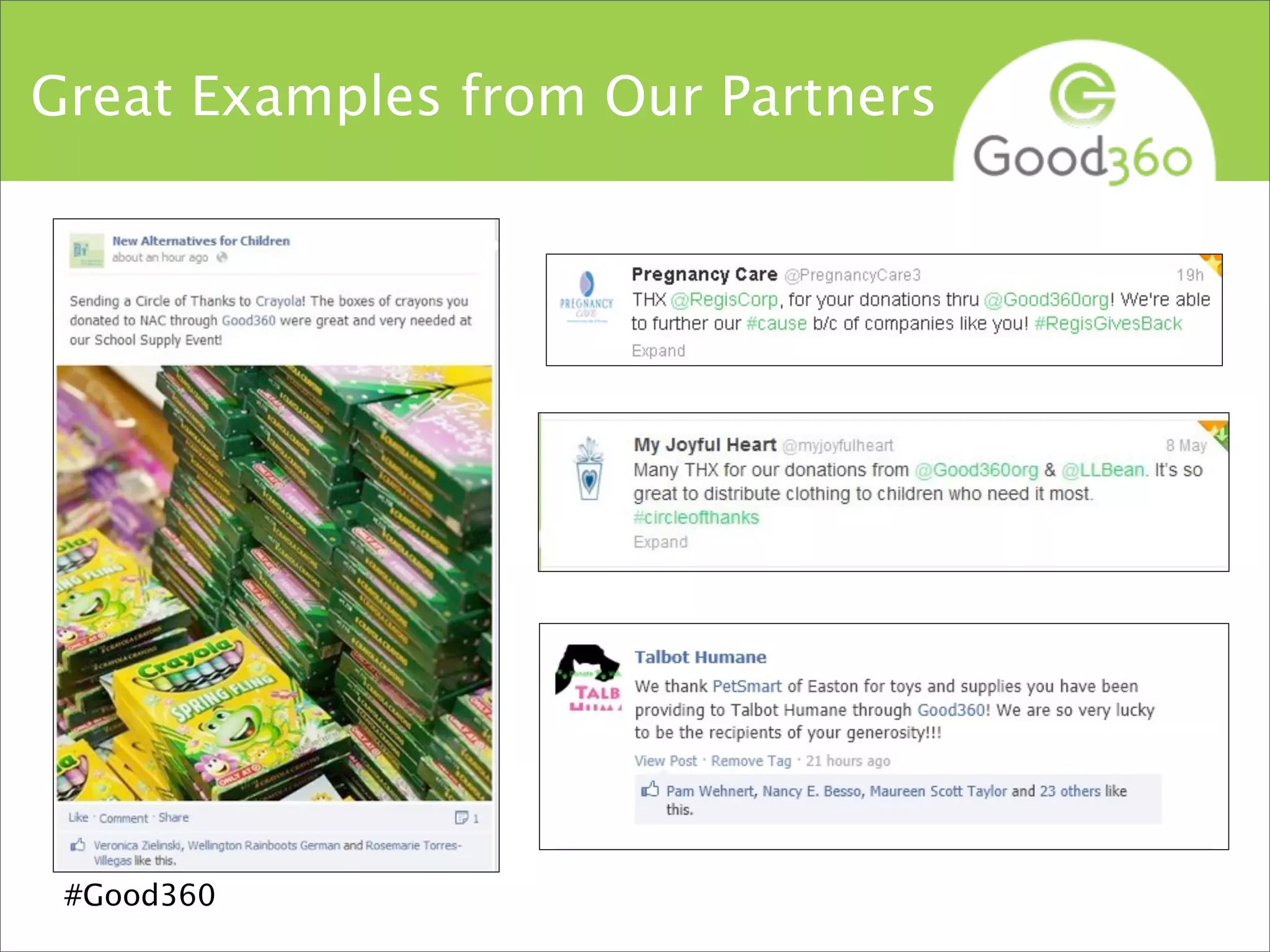
Great Examples from Our Partners
#Good360
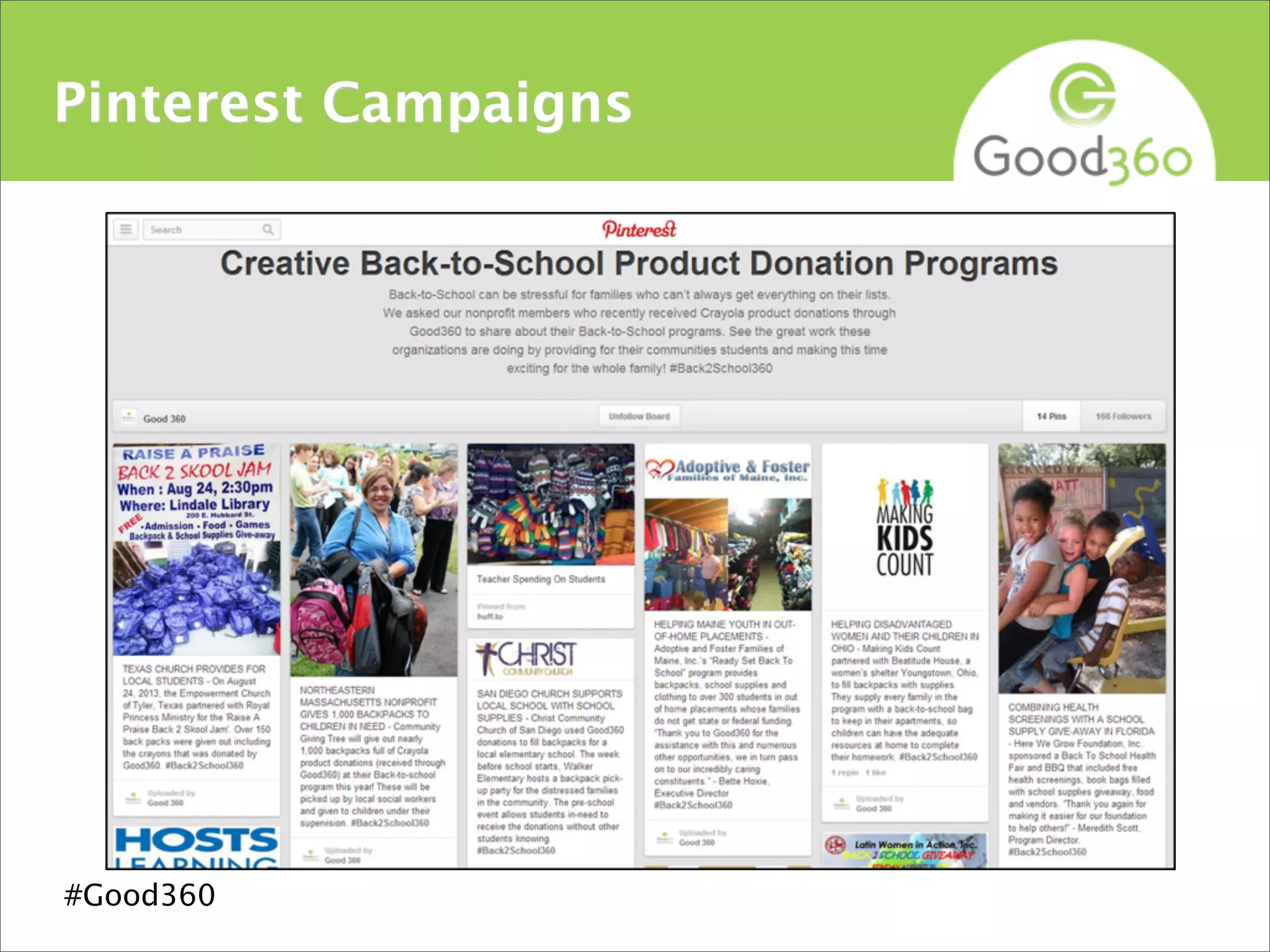
Pinterest Campaigns
#Good360
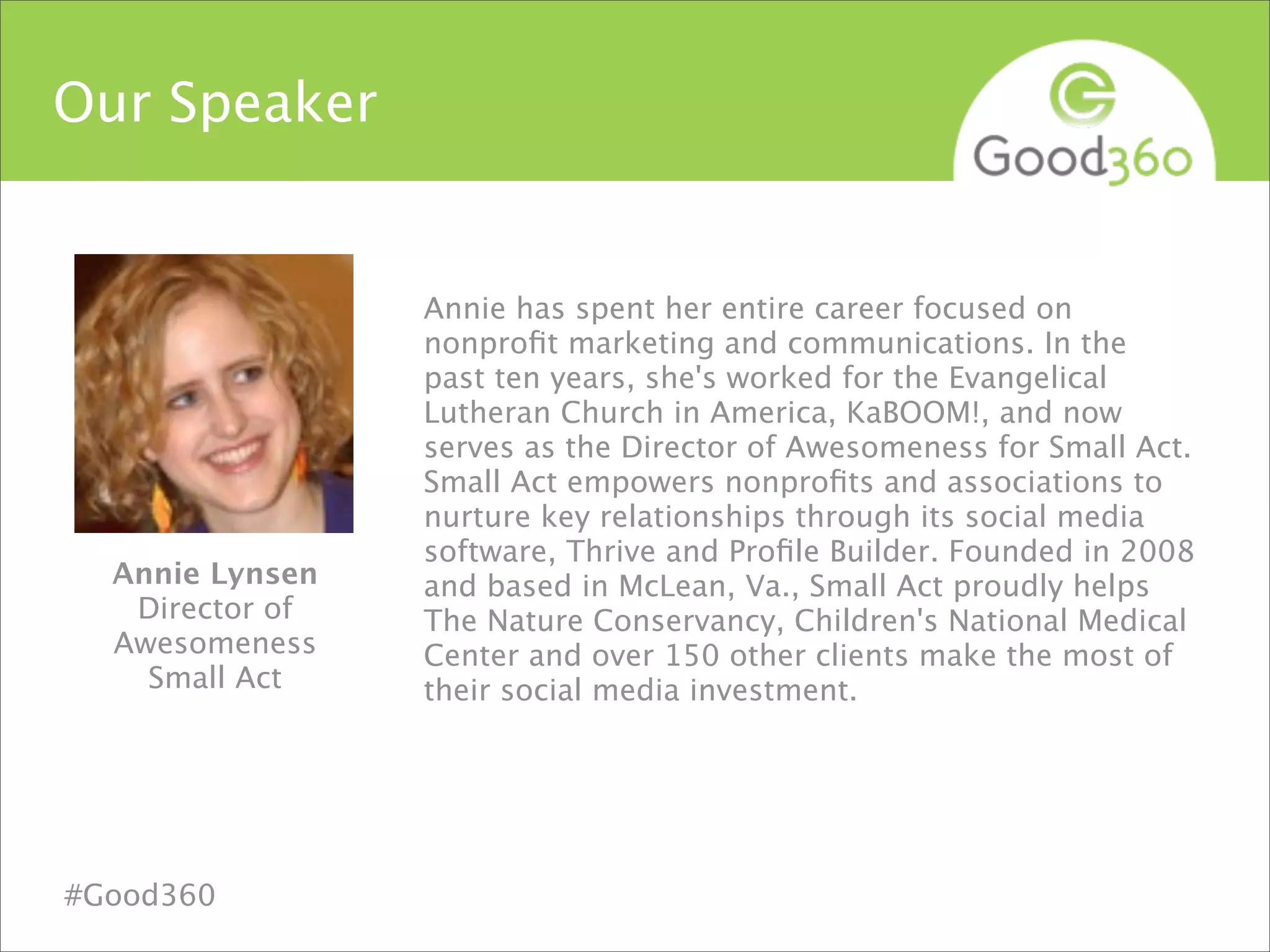
Our Speaker
Annie has spent her entire career focused on
nonprofit marketing and communications. In the
past ten years, she's worked for the Evangelical
Lutheran Church in America, KaBOOM!, and now
serves as the Director of Awesomeness for Small Act.
Small Act empowers nonprofits and associations to
nurture key relationships through its social media
software, Thrive and Profile Builder. Founded in 2008
and based in McLean, Va., Small Act proudly helps
The Nature Conservancy, Children's National Medical
Center and over 150 other clients make the most of
their social media investment.
Annie Lynsen
Director of
Awesomeness
Small Act
#Good360
Social Media 101
by Annie Lynsen
Tweet about this presentation with the hashtag
#good360
What are we
going to cover?
Overview of social media
Platforms: Twitter and Facebook
Strategy
Brand presence vs. campaigns
Etiquette
Measurement
And a whole lotta case studies
Key takeaways
You can’t afford to ignore social media.
Social media rocks, but it’s not a silver
bullet. Like any other marketing effort,
you have to use it well to be effective.
Each network has its own strengths
and strategies, and they may not all be
right for your business.
Listen, be nice, and measure everything.
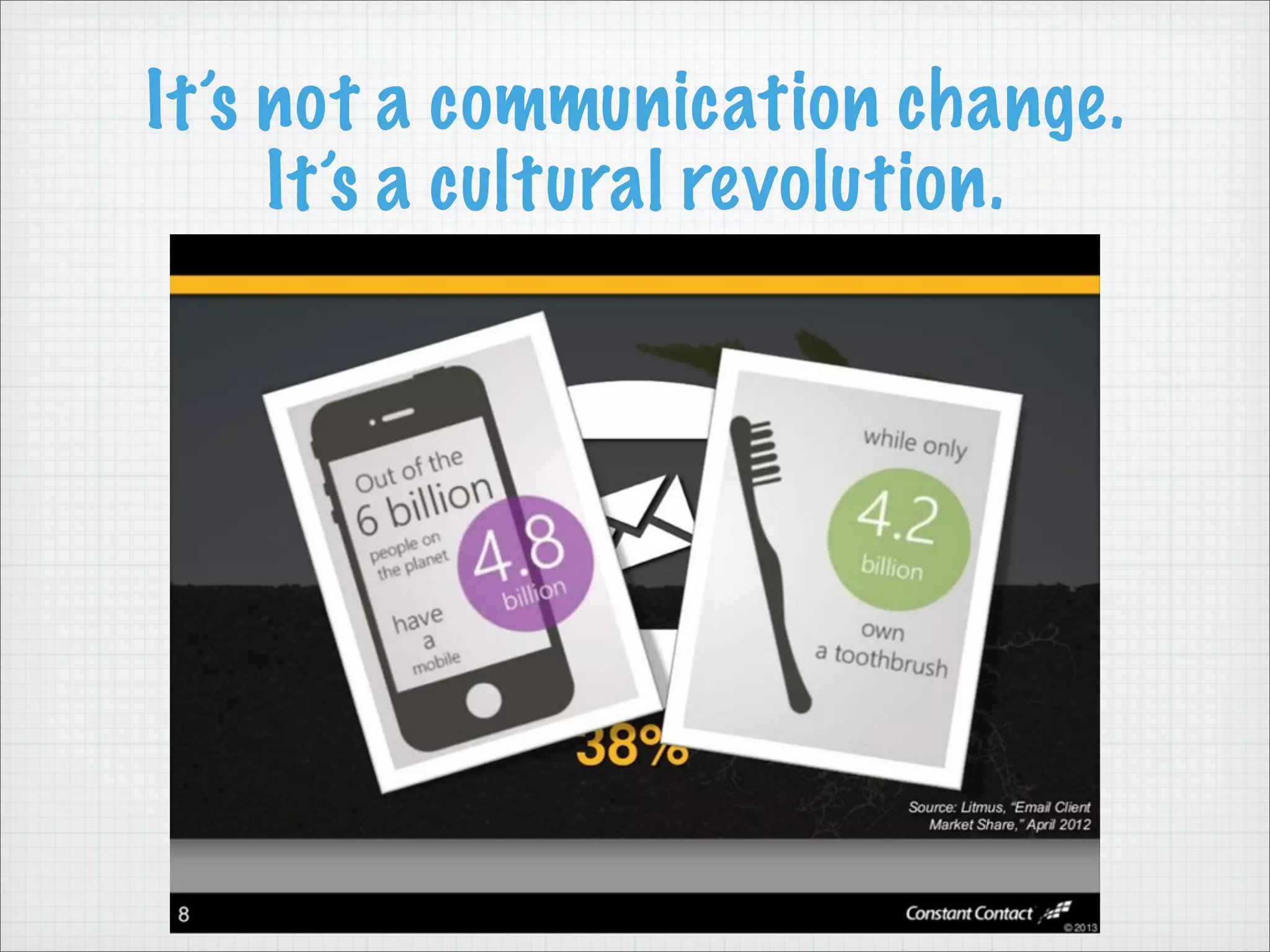
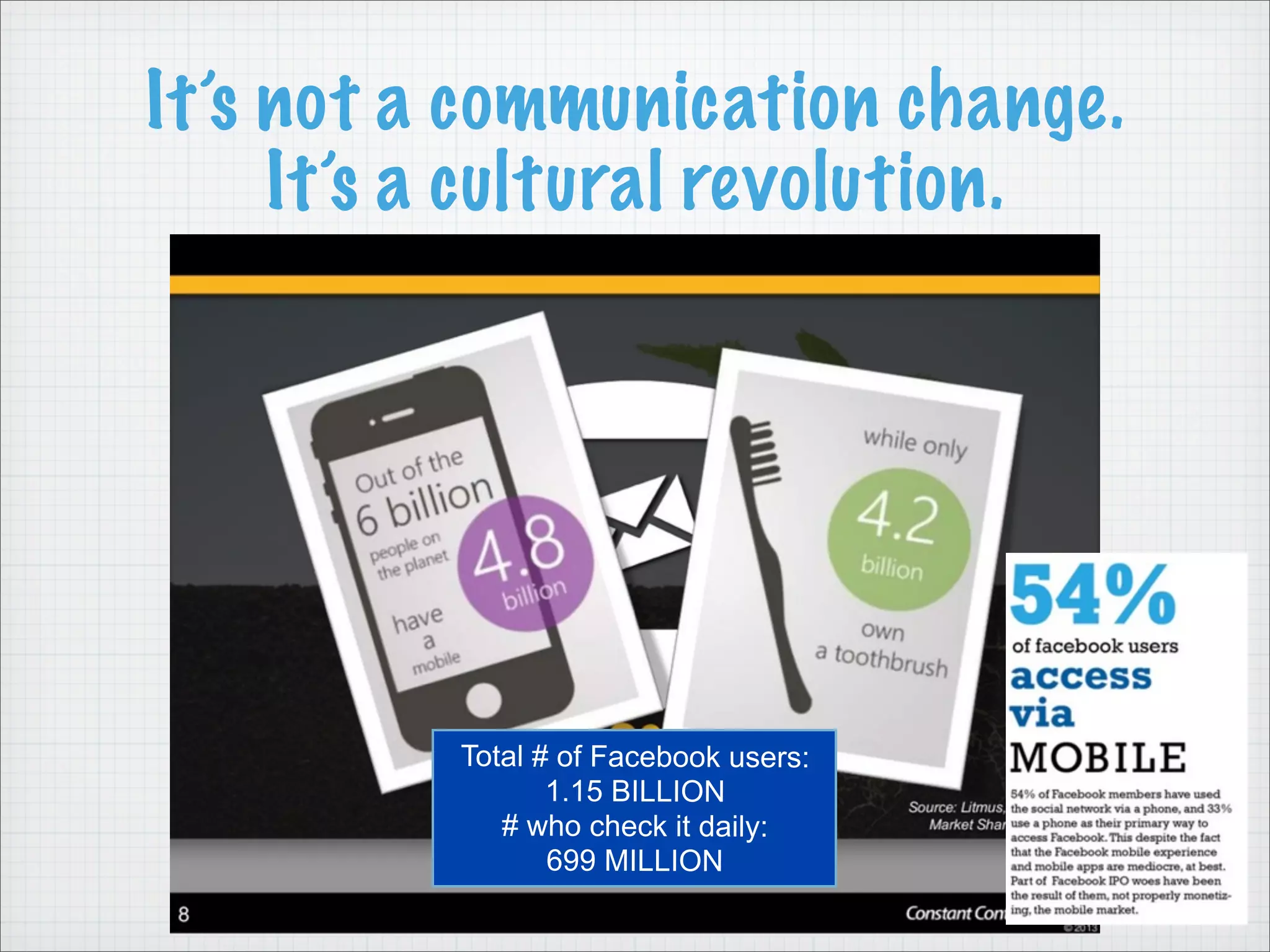
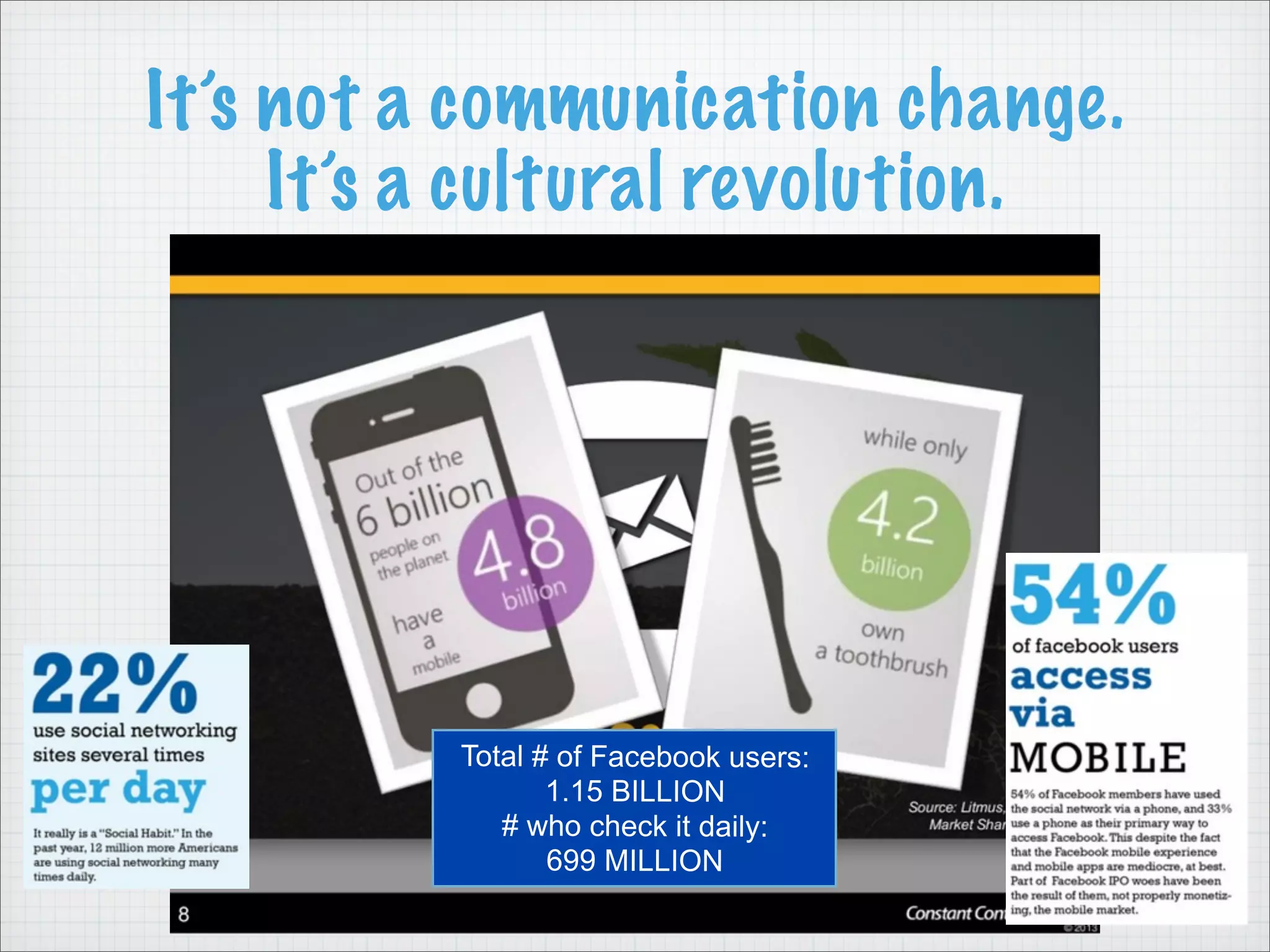
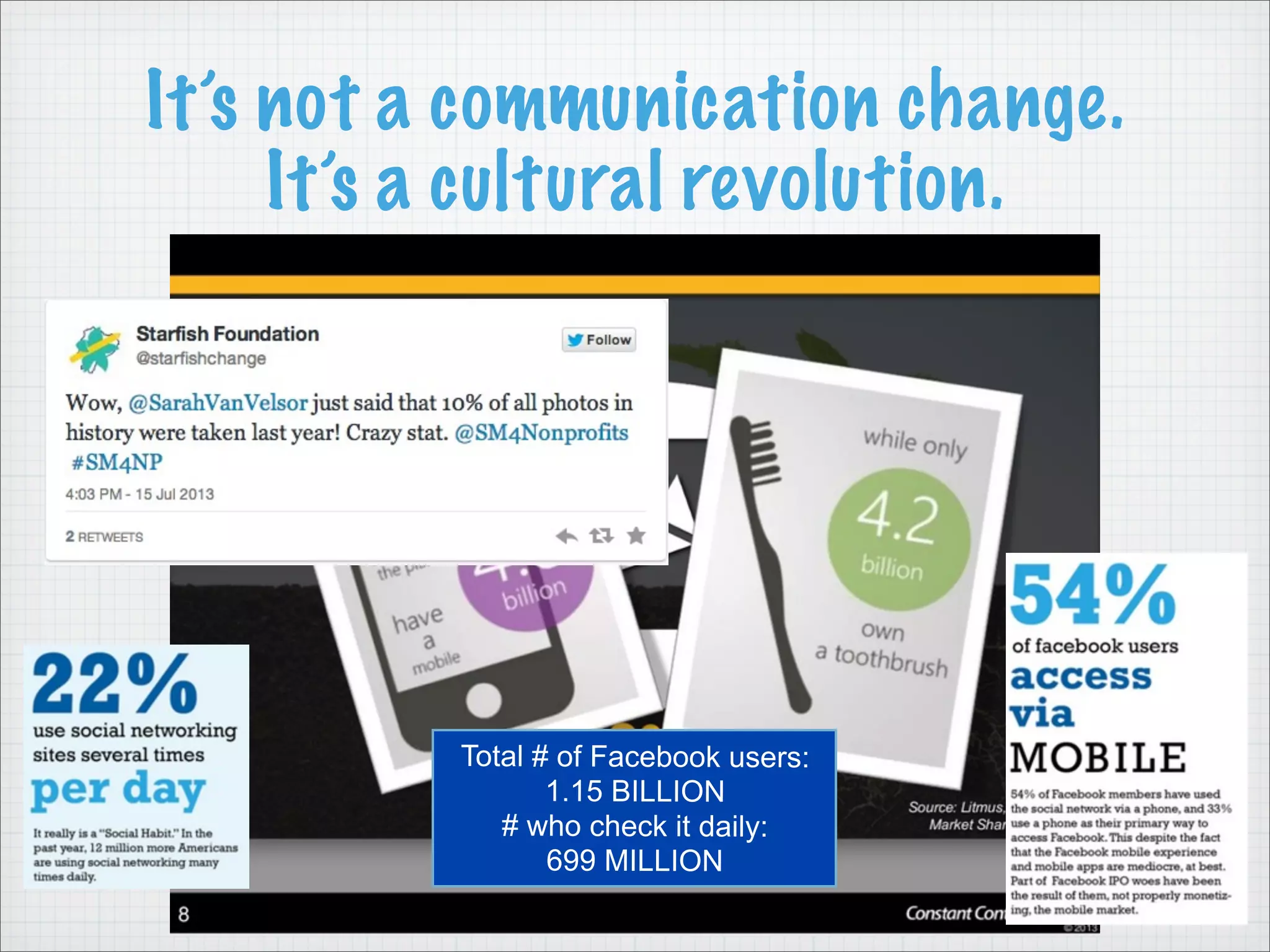
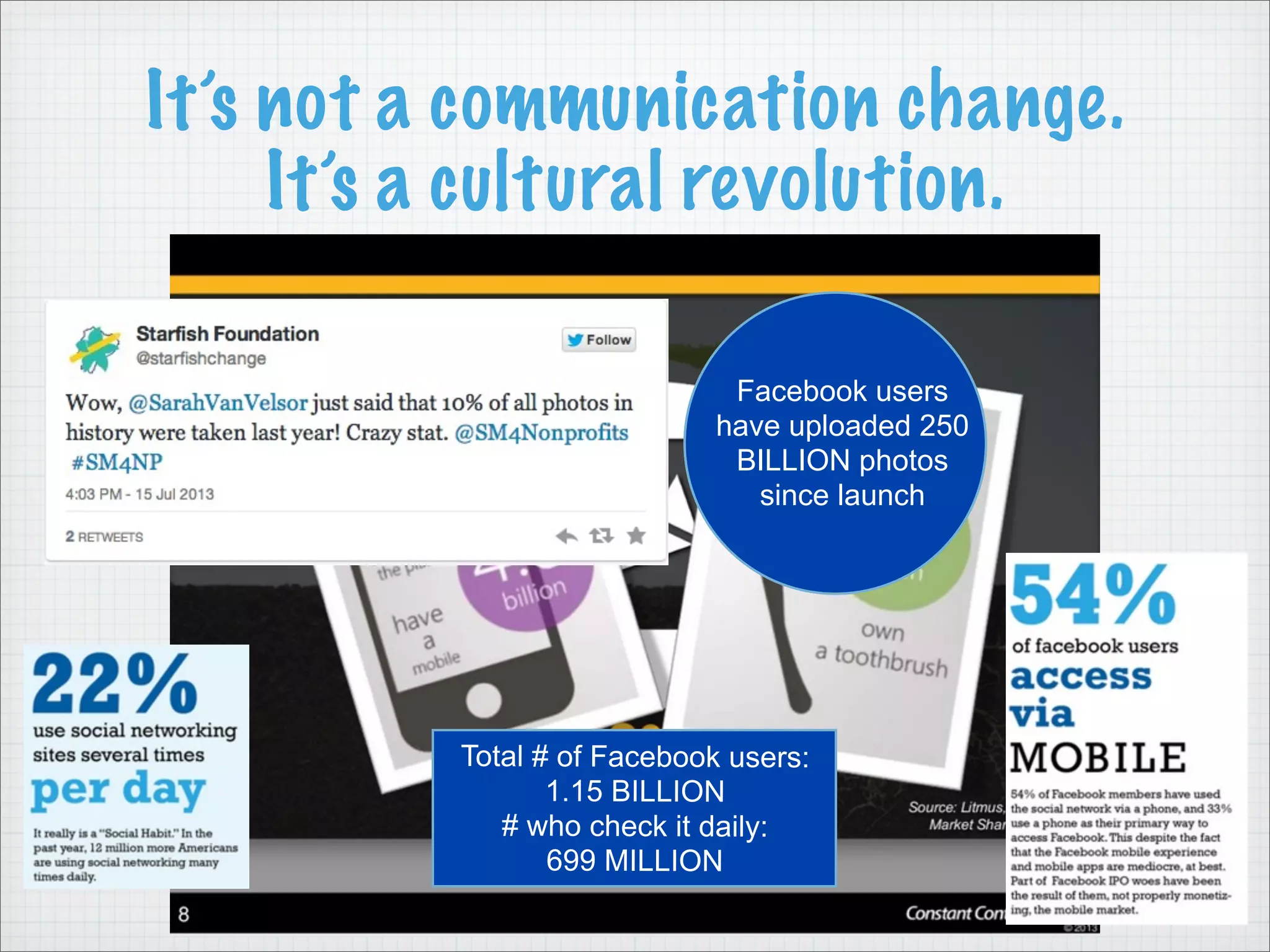
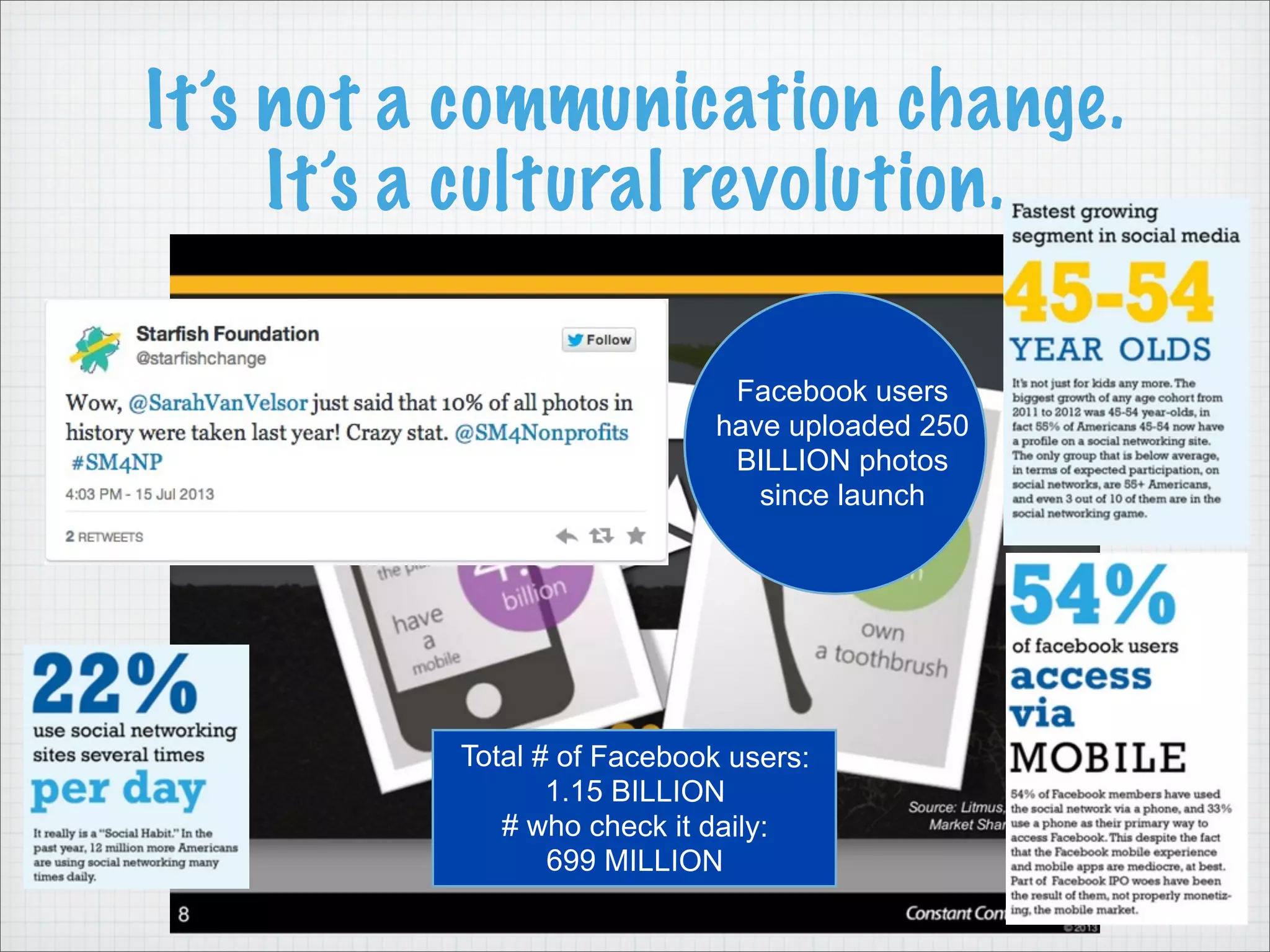
It’s not a communication change.
It’s a cultural revolution.
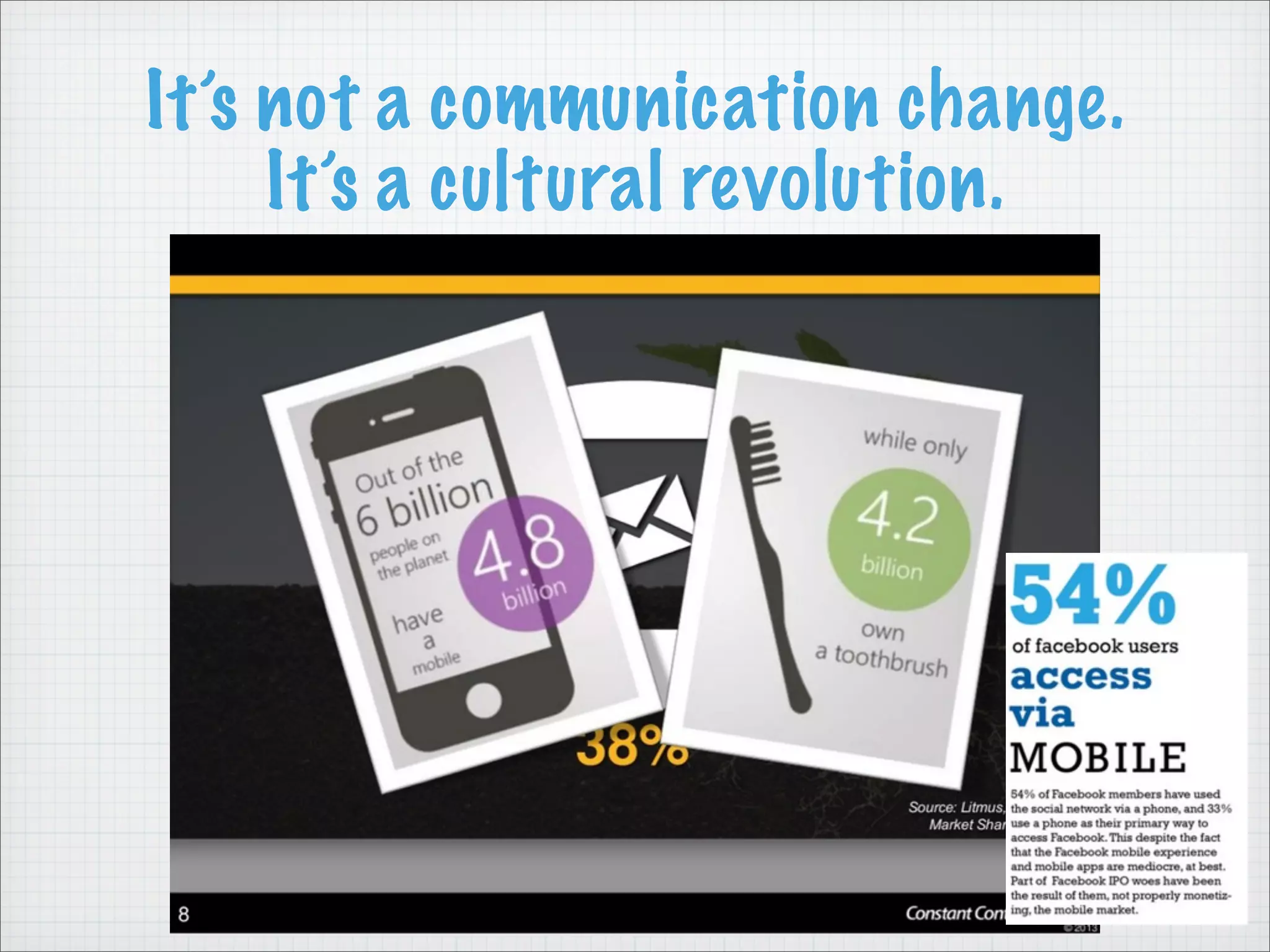
It’s not a communication change.
It’s a cultural revolution.
It’s not a communication change.
It’s a cultural revolution.
Total # of Facebook users:
1.15 BILLION
# who check it daily:
699 MILLION
It’s not a communication change.
It’s a cultural revolution.
Total # of Facebook users:
1.15 BILLION
# who check it daily:
699 MILLION
It’s not a communication change.
It’s a cultural revolution.
Total # of Facebook users:
1.15 BILLION
# who check it daily:
699 MILLION
It’s not a communication change.
It’s a cultural revolution.
Total # of Facebook users:
1.15 BILLION
# who check it daily:
699 MILLION
Facebook users
have uploaded 250
BILLION photos
since launch
It’s not a communication change.
It’s a cultural revolution.
Total # of Facebook users:
1.15 BILLION
# who check it daily:
699 MILLION
Facebook users
have uploaded 250
BILLION photos
since launch
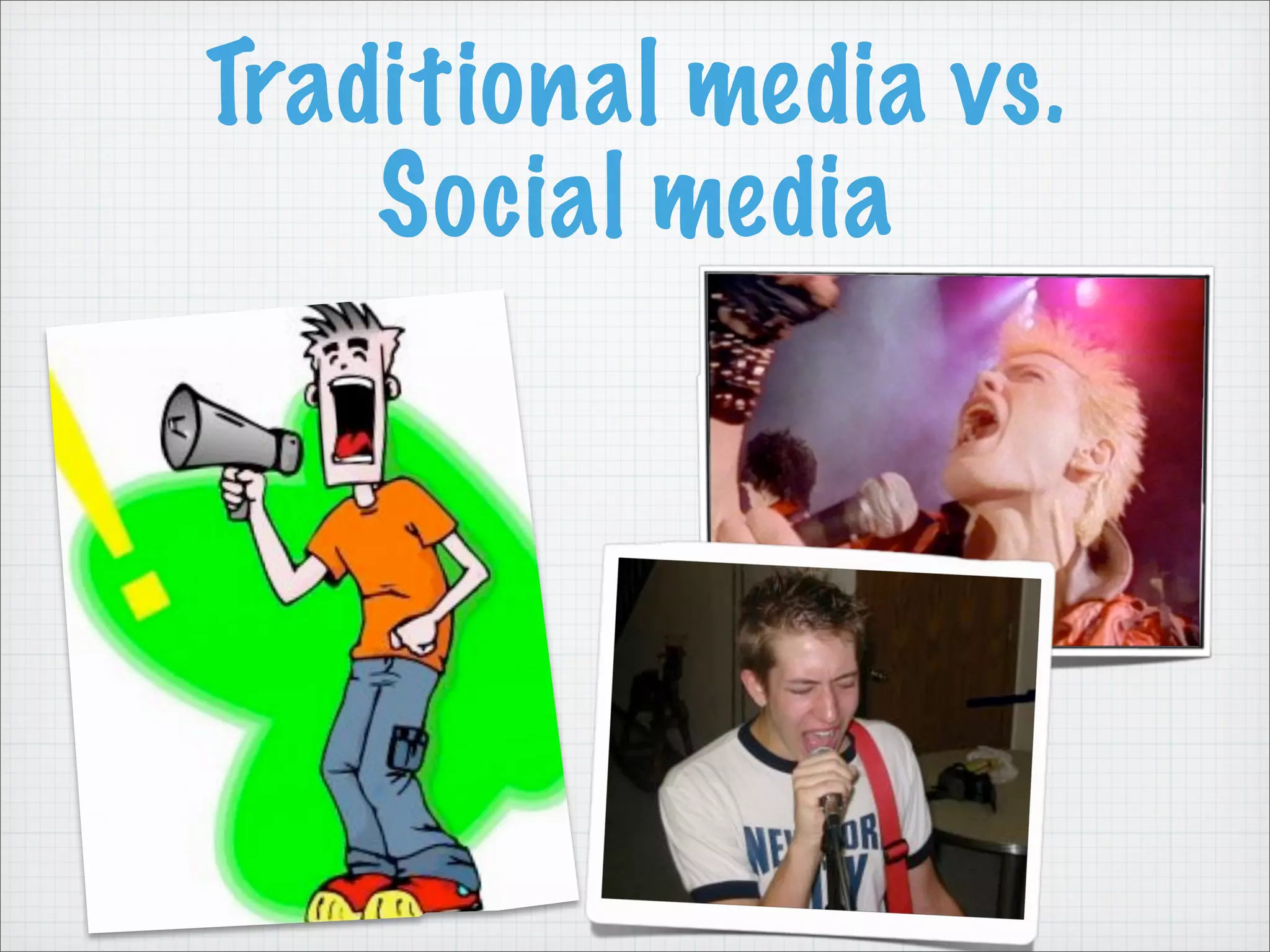
Traditional media vs.
Social media
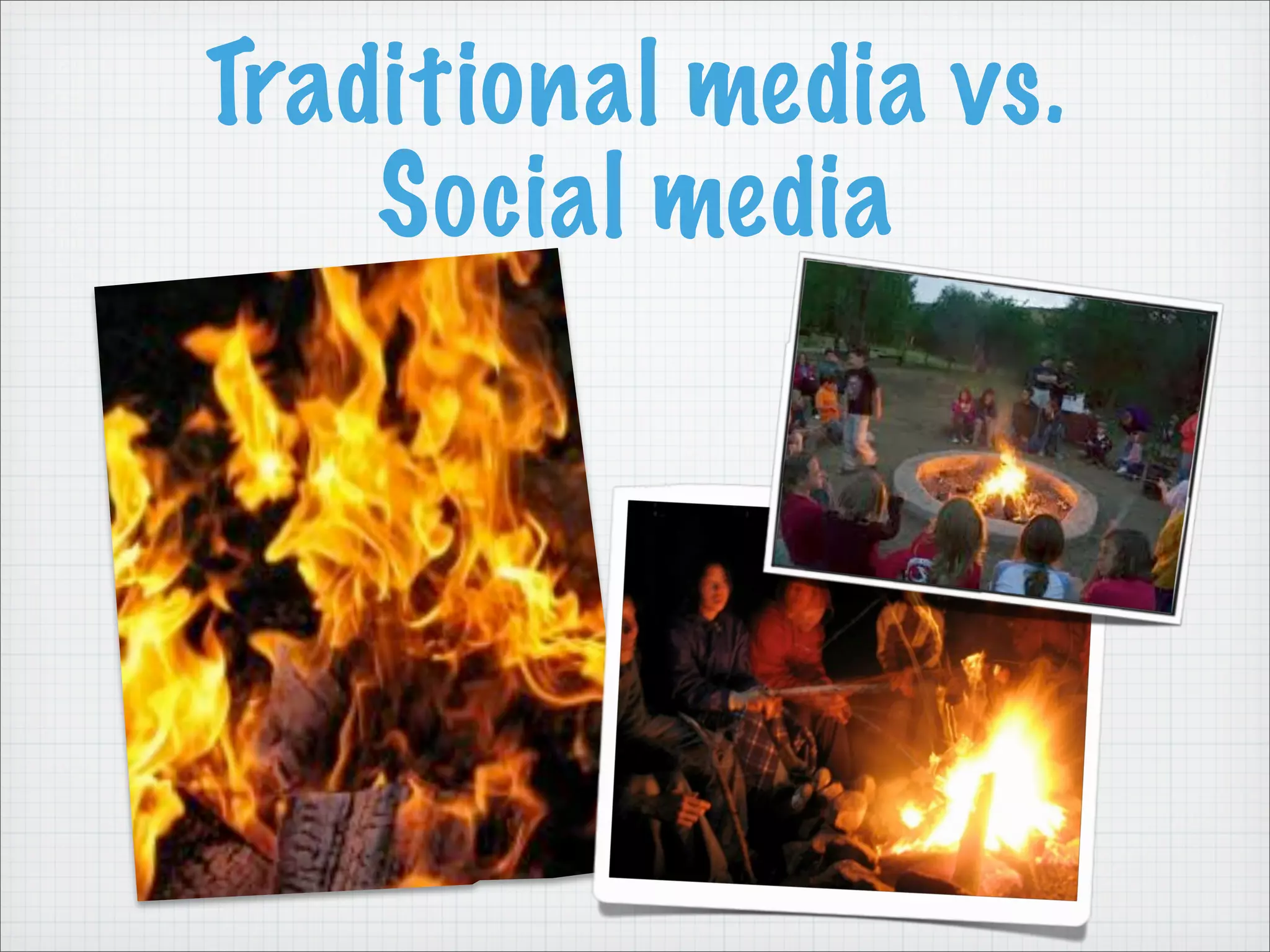
Traditional media vs.
Social media
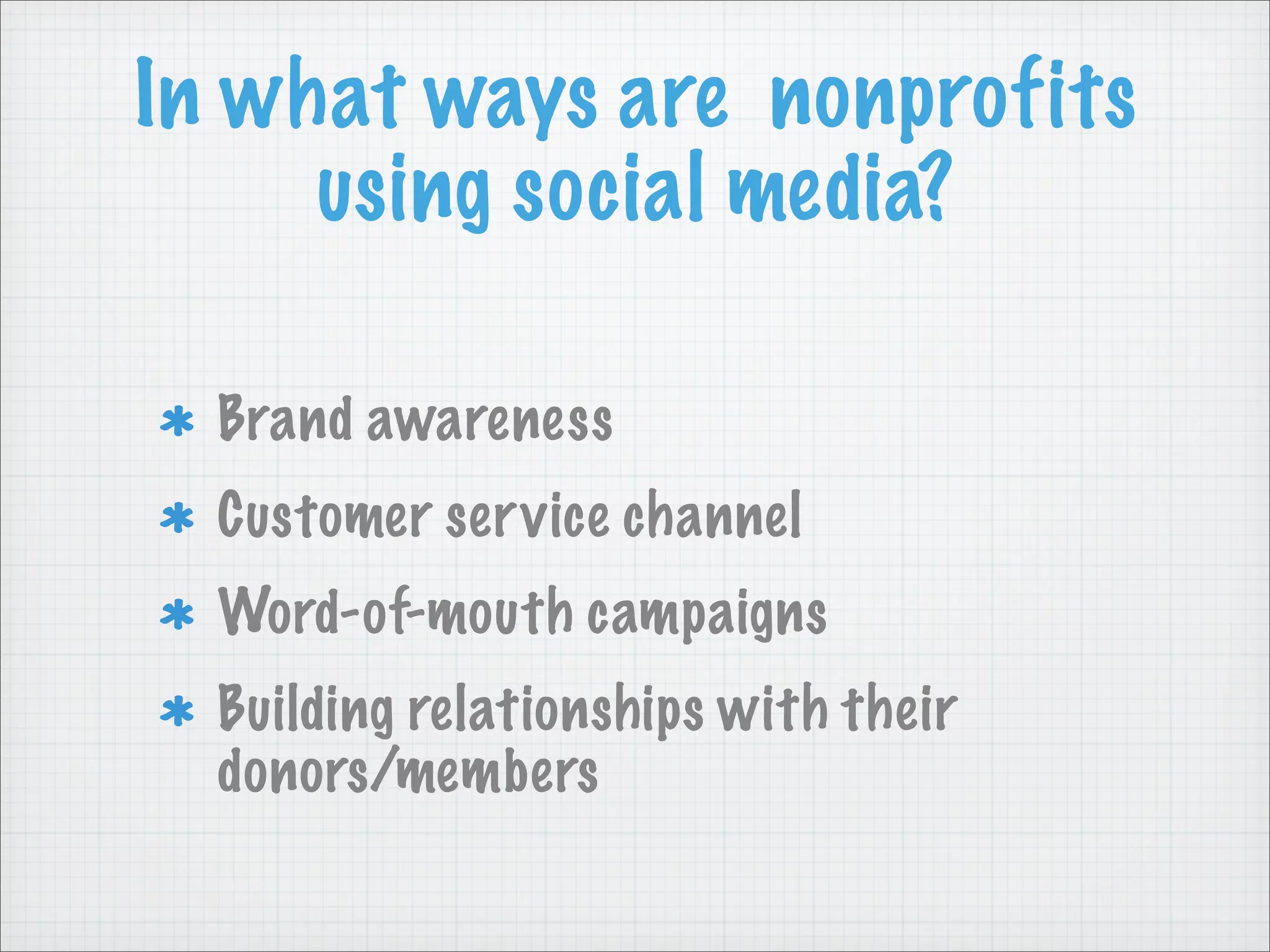
In what ways are nonprofits
using social media?
Brand awareness
Customer service channel
Word-of-mouth campaigns
Building relationships with their
donors/members
How can social media be used
(effectively) in marketing?
Get around advertising fatigue &
ineffectiveness
“Humanize” the brand/give the brand
personality
Offer better, on-the-spot customer
service/responses to questions
Find donors/members where they spend
the most time
Platforms
Where can you do stuff?
Twitter
What is Twitter?
Twitter is a website which lets you send
and read messages called tweets.
Tweets are text-based posts of up to
140 characters.
Users “follow,” or subscribe, to various
people’s tweets so they can read their
updates.
Why bother?
Twitter has plenty of time for your
organization.
Public tweets often end up at the top of
Google searches.
Do you want to create an account when
times are good, or when a crisis hits?
General Twitter strategy:
Relationship cultivation
Relationships ➡ inspiration ➡
expanding your network.
Provide value to the masses, but speak
to individuals as individuals when you
can.
Bottom line: More supporters, more
money.
What is Facebook?
Facebook is the world's most popular
social networking website.
Users share “status updates,” pictures,
videos, links, etc.
The updates of your friends (and brands
you follow) appear in your “News Feed.”
Why bother?
Huge, highly-engaged audience (1.15
billion, 699 million check daily).
User-friendly, inexpensive advertising
you can target very specifically based
on people’s demographics AND interests.
Can drive tons of traffic to your
website.
Fun fact: 46% of millionaires are on
Facebook, vs. 19% on LinkedIn
General Facebook strategy:
Daily, share-able posts
Post a few times a week.
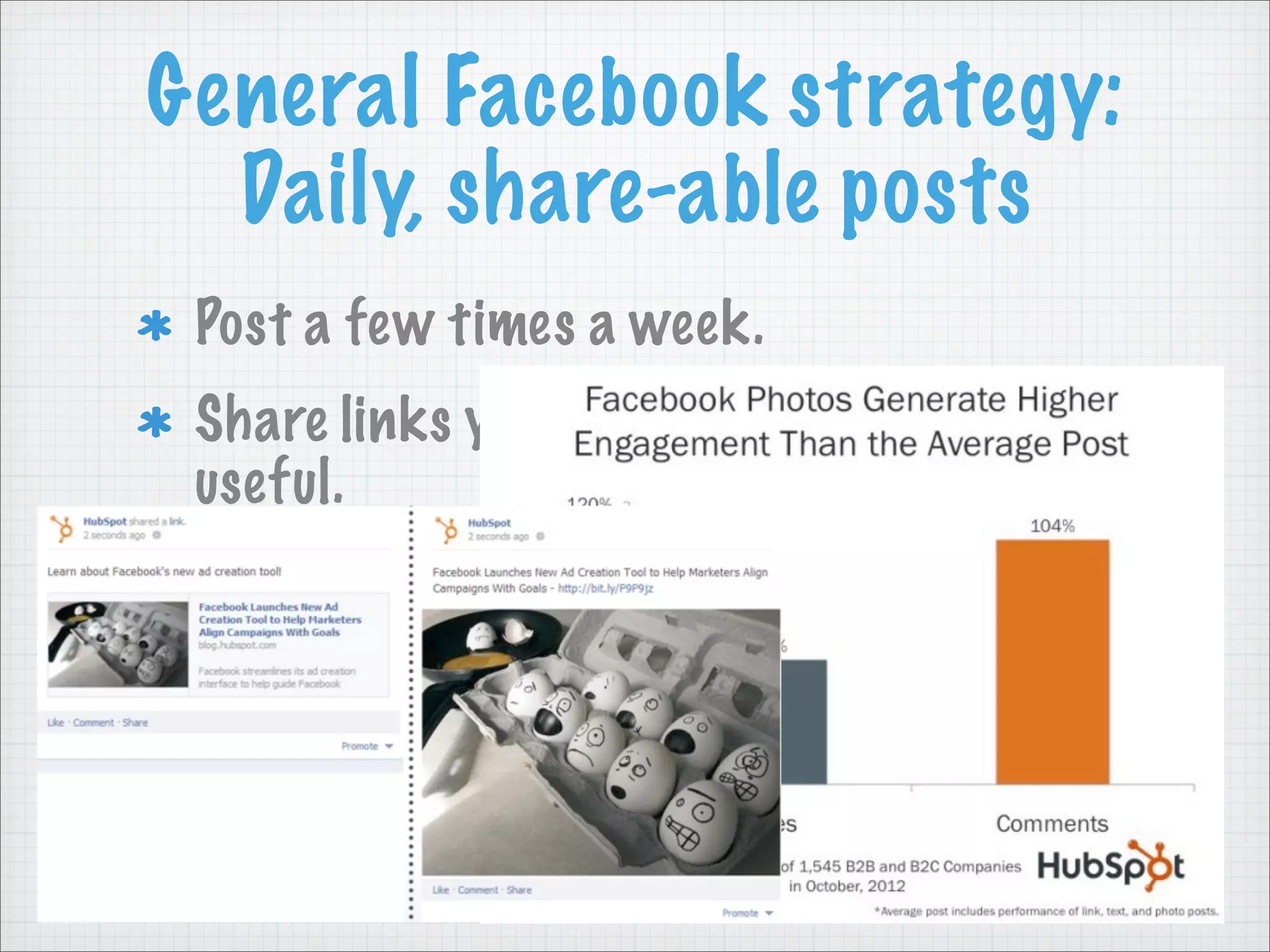
Share links your audience will find
useful.
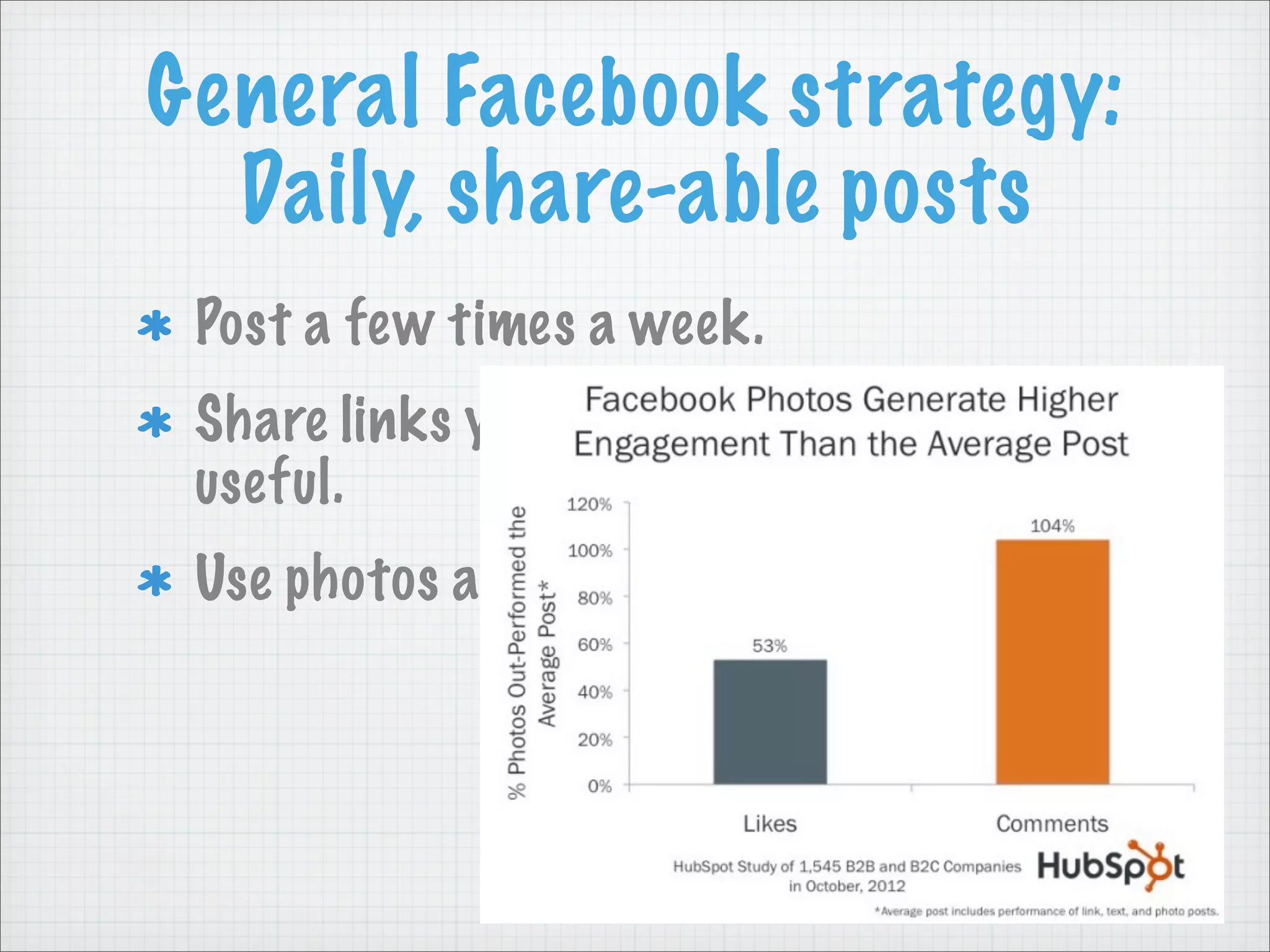
Use photos a LOT.
General Facebook strategy:
Daily, share-able posts
Post a few times a week.
Share links your audience will find
useful.
Use photos a LOT.
General Facebook strategy:
Daily, share-able posts
Post a few times a week.
Share links your audience will find
useful.
Use photos a LOT.
General Facebook strategy:
Daily, share-able posts
Post a few times a week.
Share links your audience will find
useful.
Use photos a LOT.
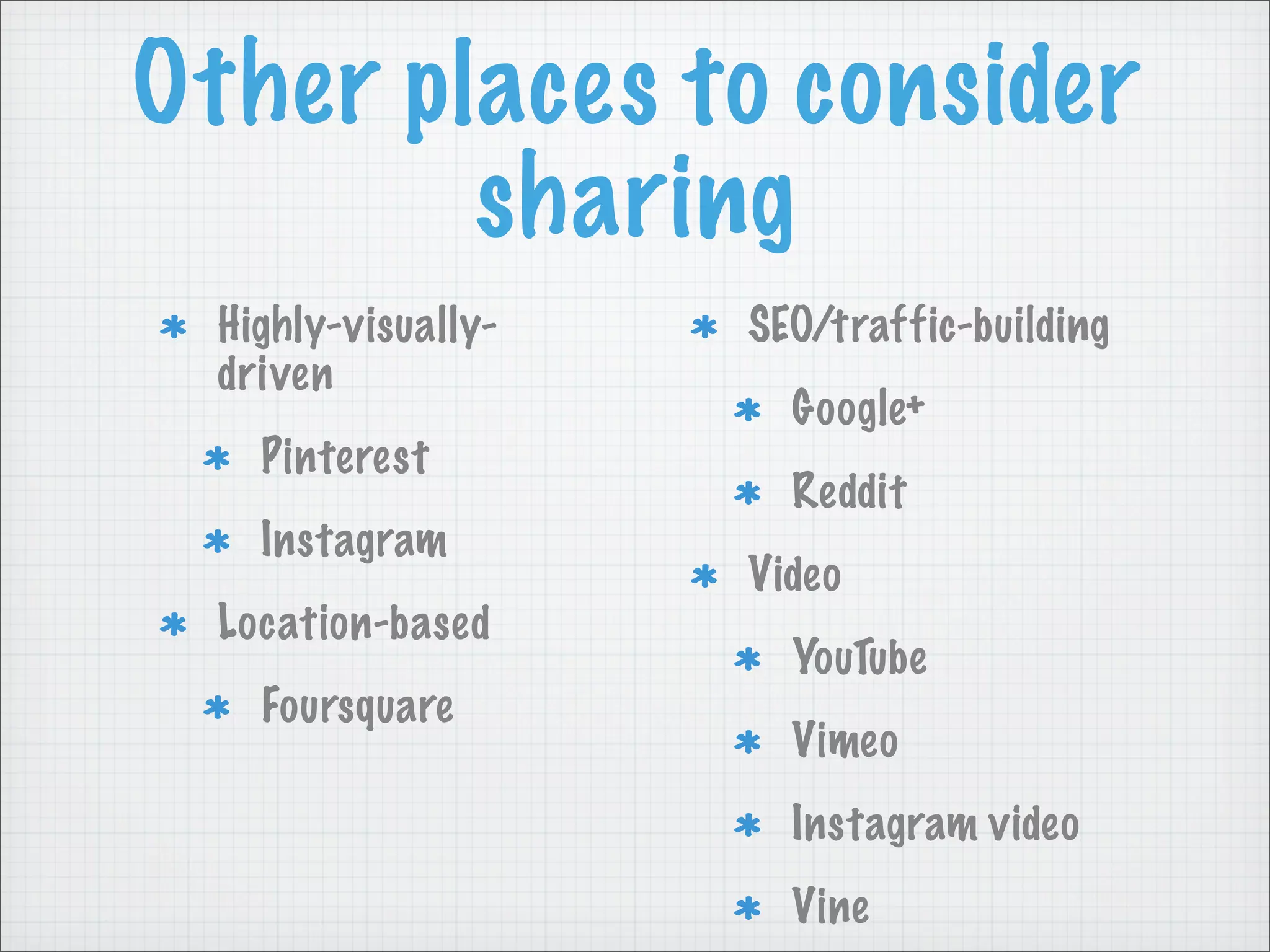
Other places to consider
sharing
Highly-visually-
driven
Pinterest
Instagram
Location-based
Foursquare
SEO/traffic-building
Google+
Reddit
Video
YouTube
Vimeo
Instagram video
Vine
Strategy
Gettin’ it done
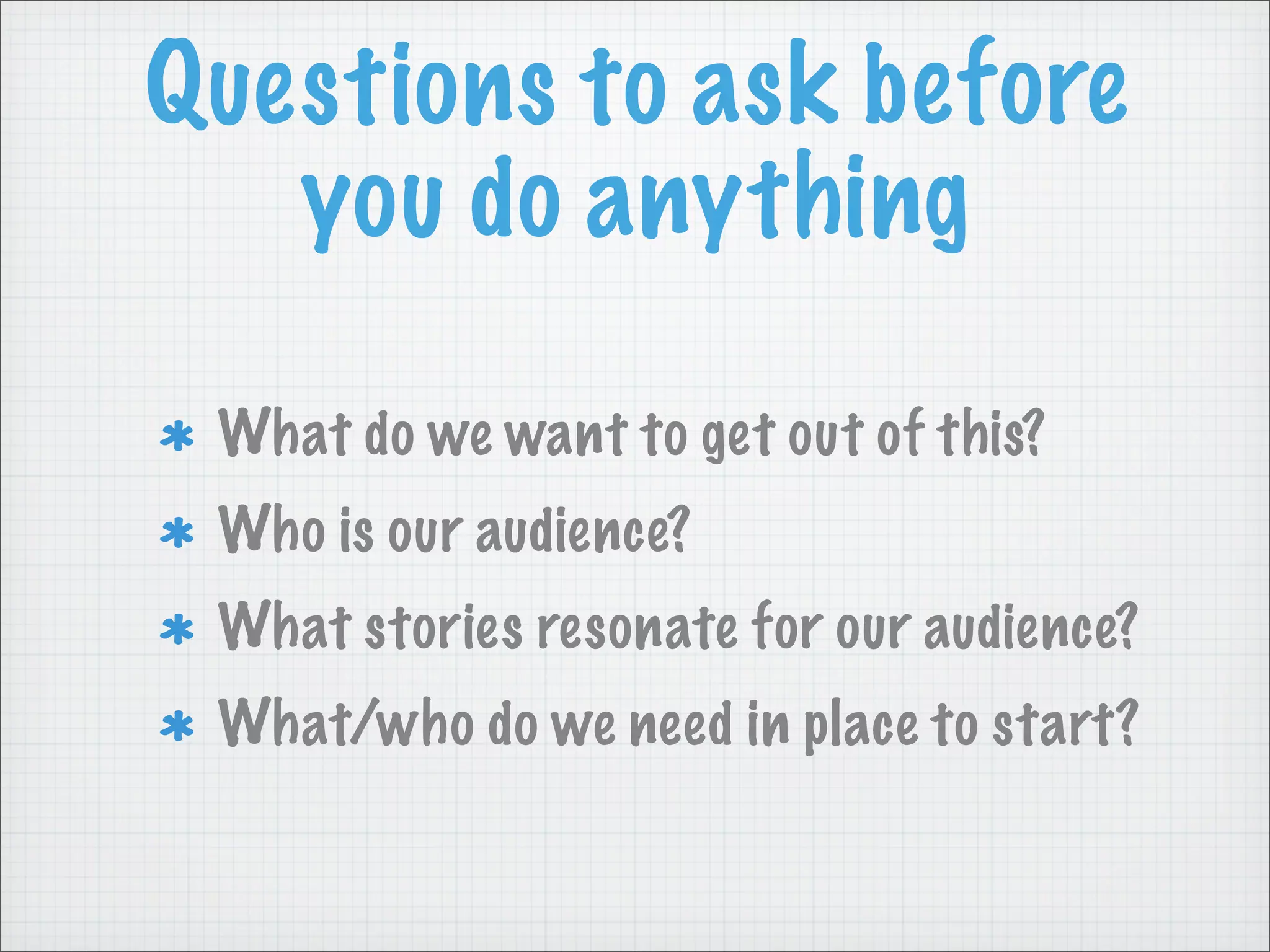
Questions to ask before
you do anything
What do we want to get out of this?
Who is our audience?
What stories resonate for our audience?
What/who do we need in place to start?
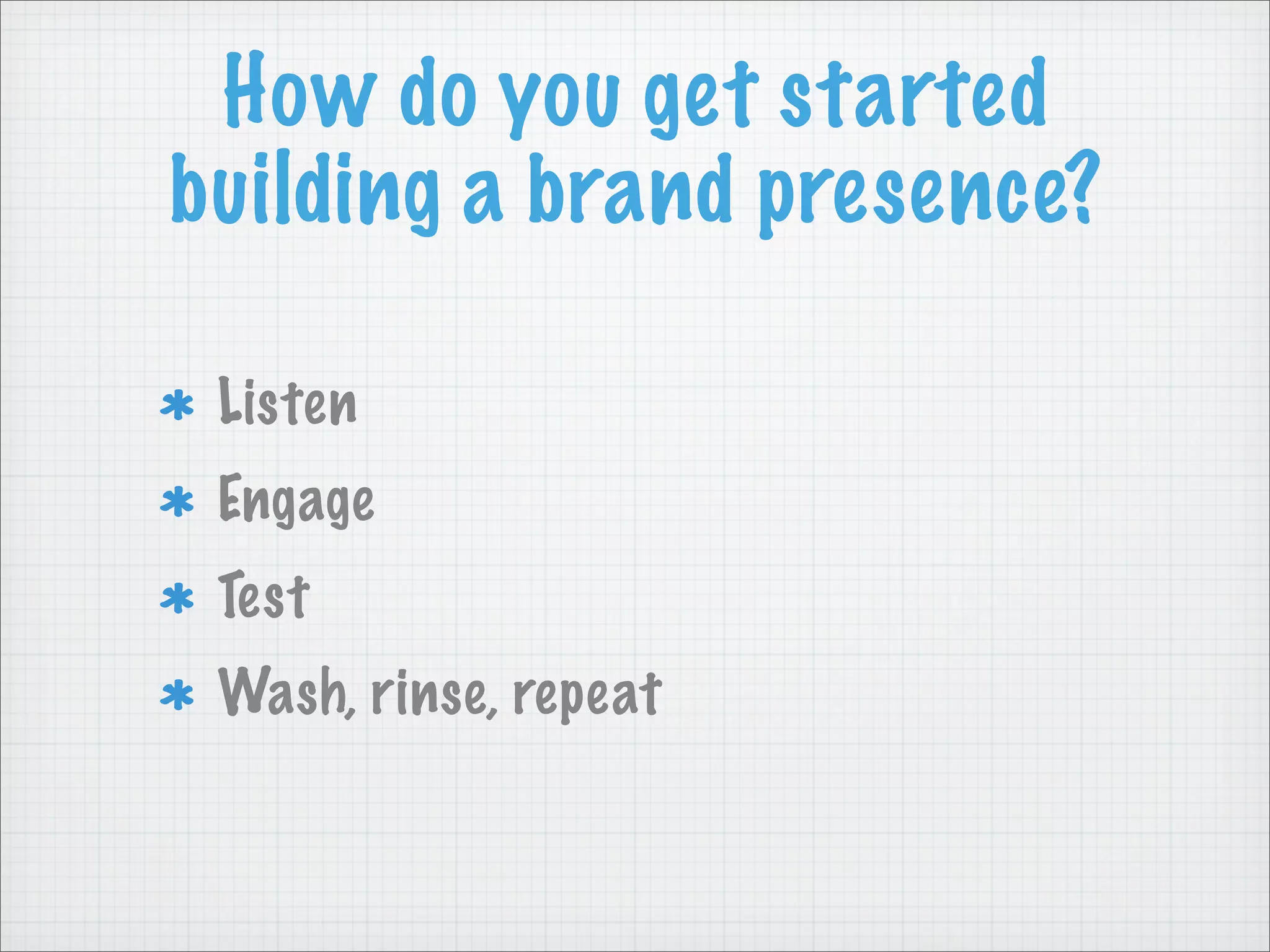
How do you get started
building a brand presence?
Listen
Engage
Test
Wash, rinse, repeat
Brand- building vs.
campaigns
Brand-building
Fewer short-term but more long-term gains
Establishes a “voice”
Builds trust
Campaigns
Mostly short-term gains, possible long-term
gains
Quick acquisition of followers & buzz
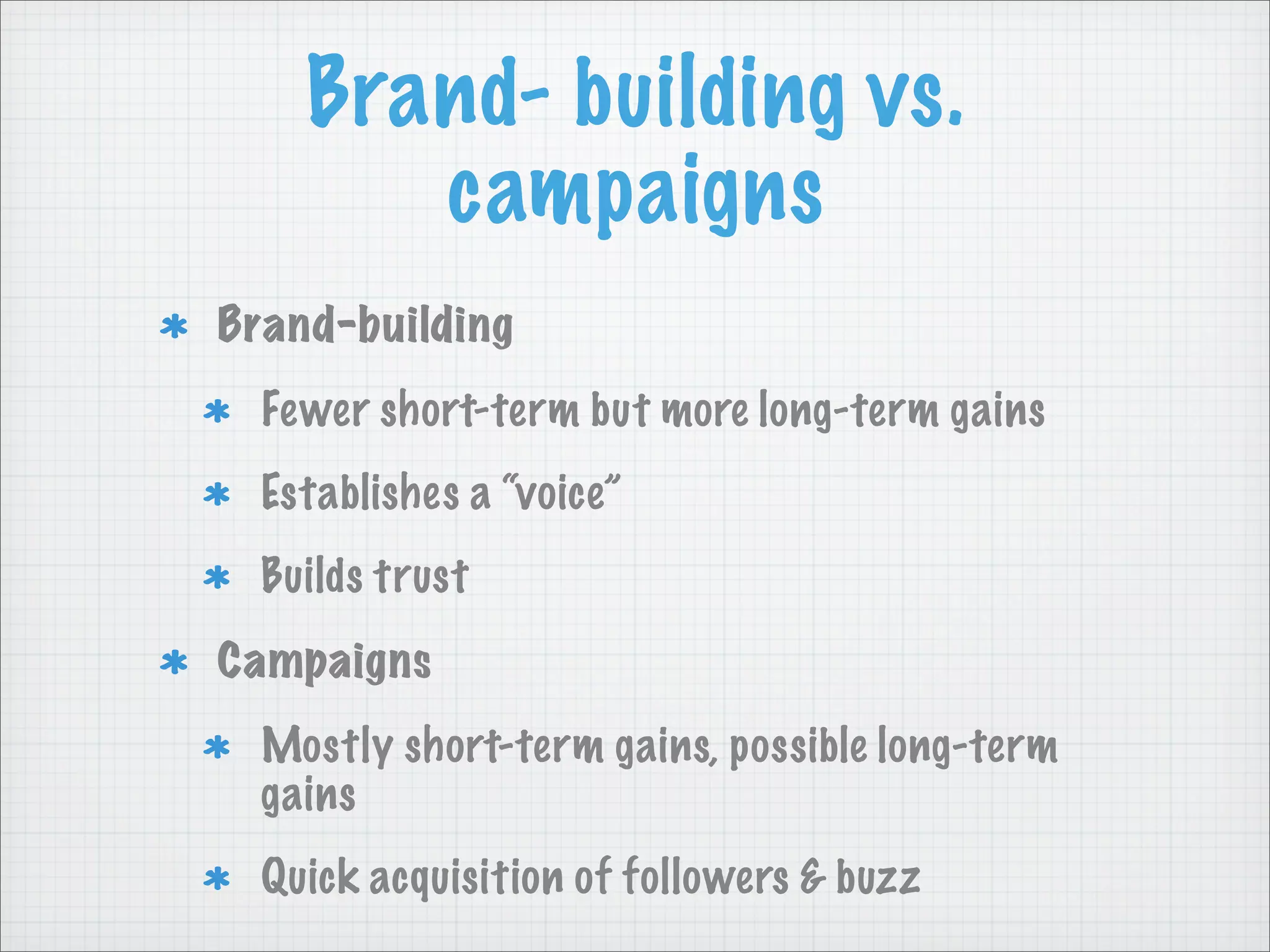
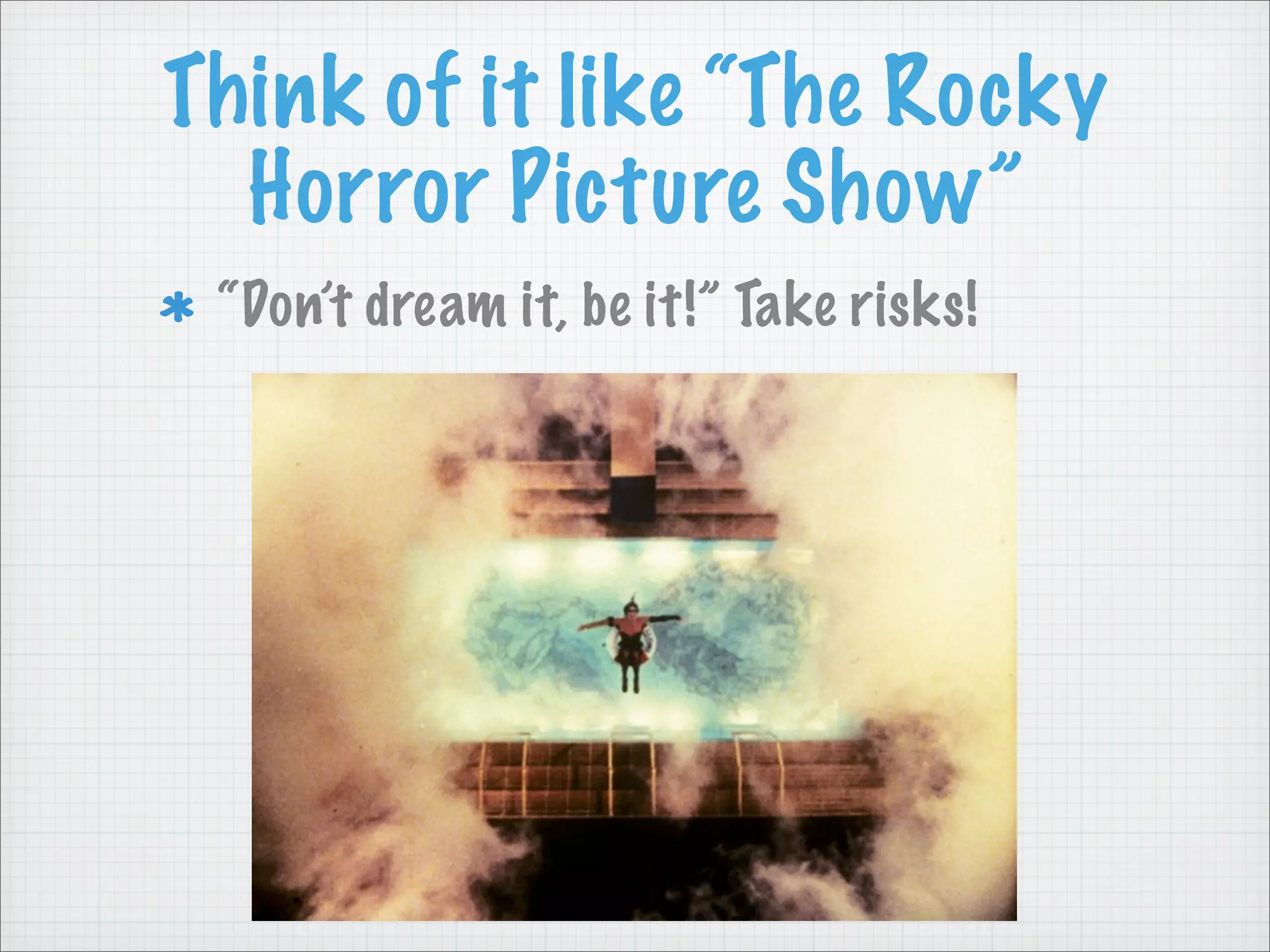
Think of it like “The Rocky
Horror Picture Show”
Audience participation is key.
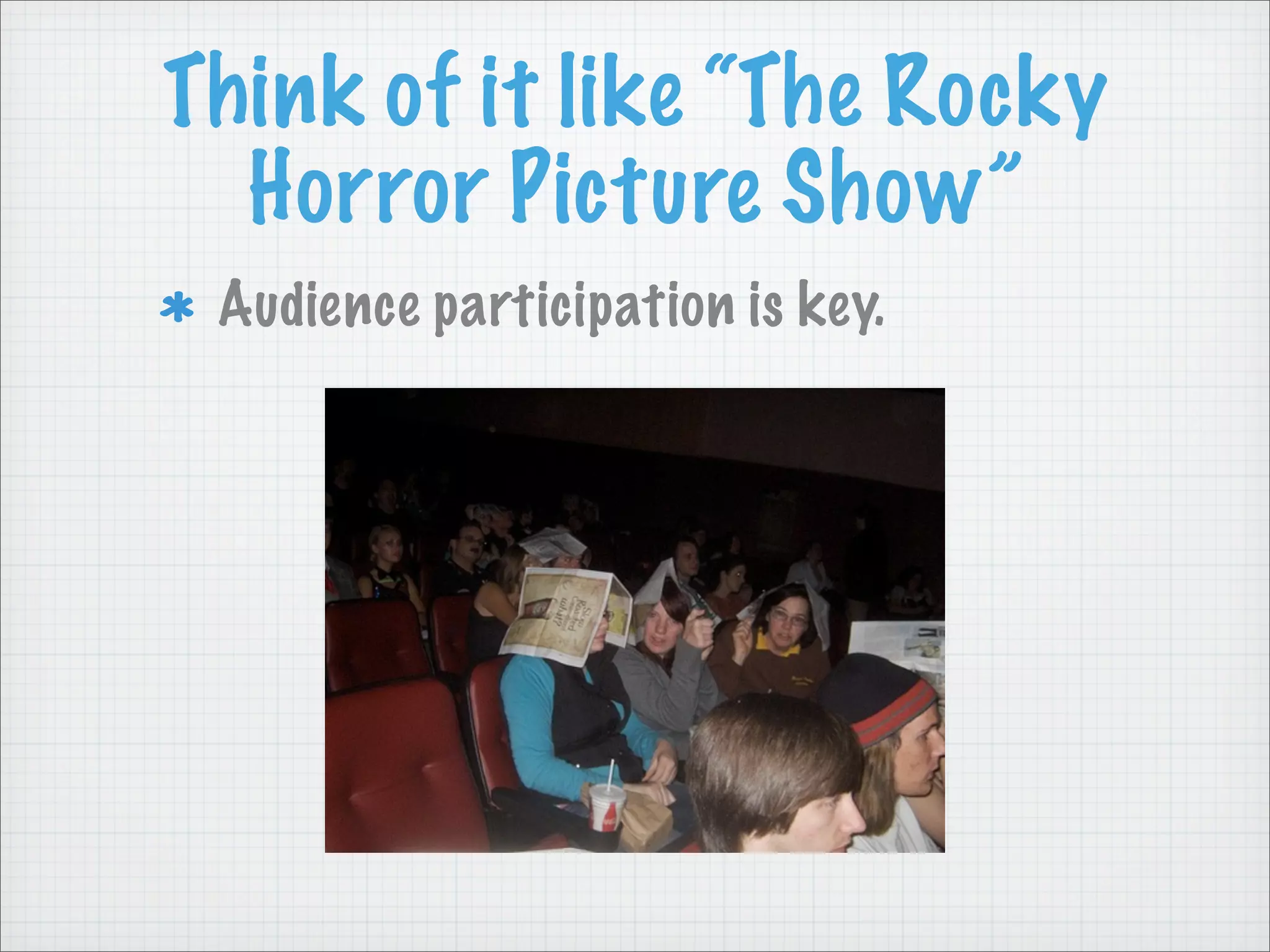
Think of it like “The Rocky
Horror Picture Show”
Antici...pation works.
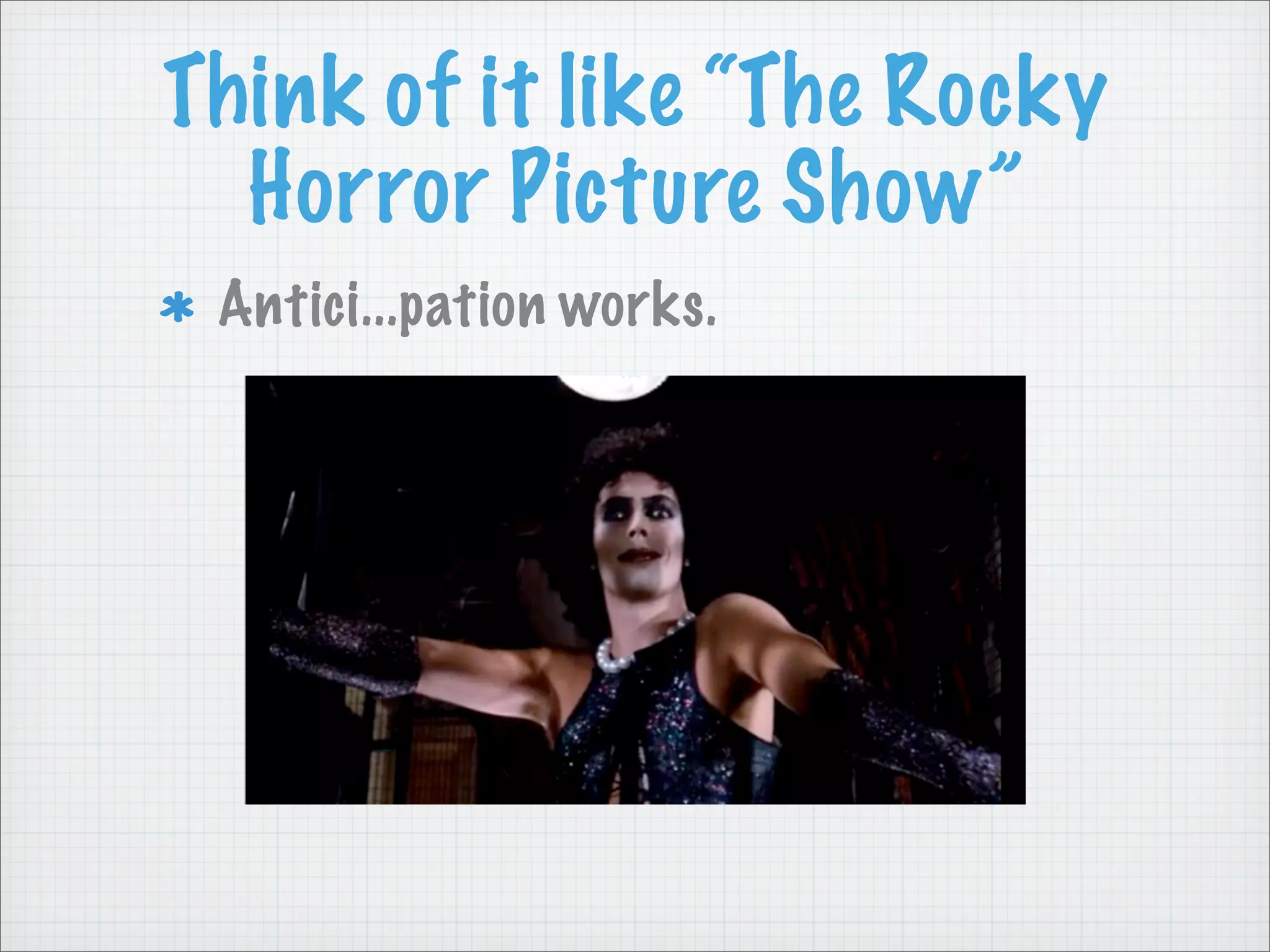
Think of it like “The Rocky
Horror Picture Show”
Show your favorite obsession: Strive to
be a thought leader.
Think of it like “The Rocky
Horror Picture Show”
“Don’t dream it, be it!” Take risks!
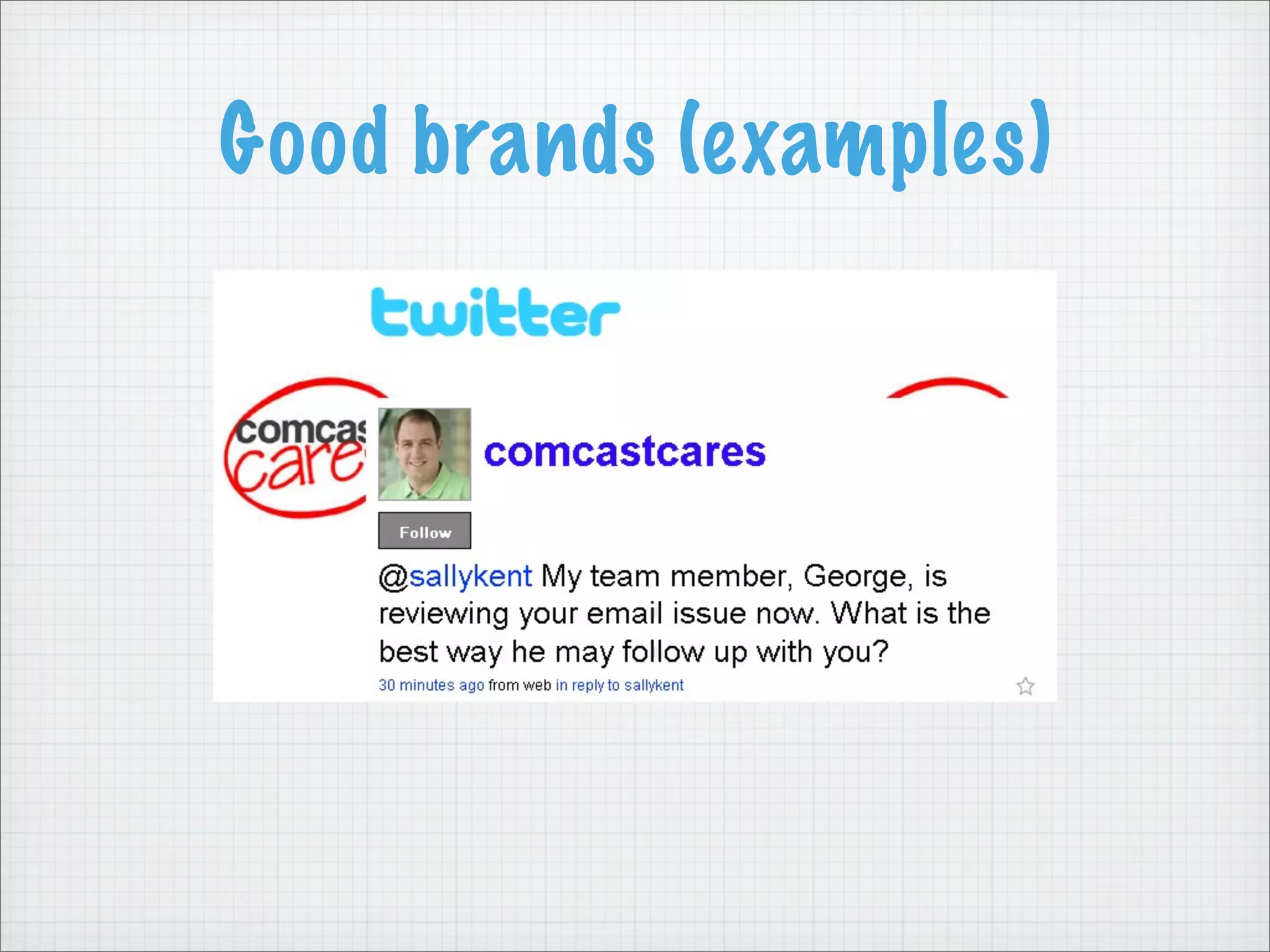
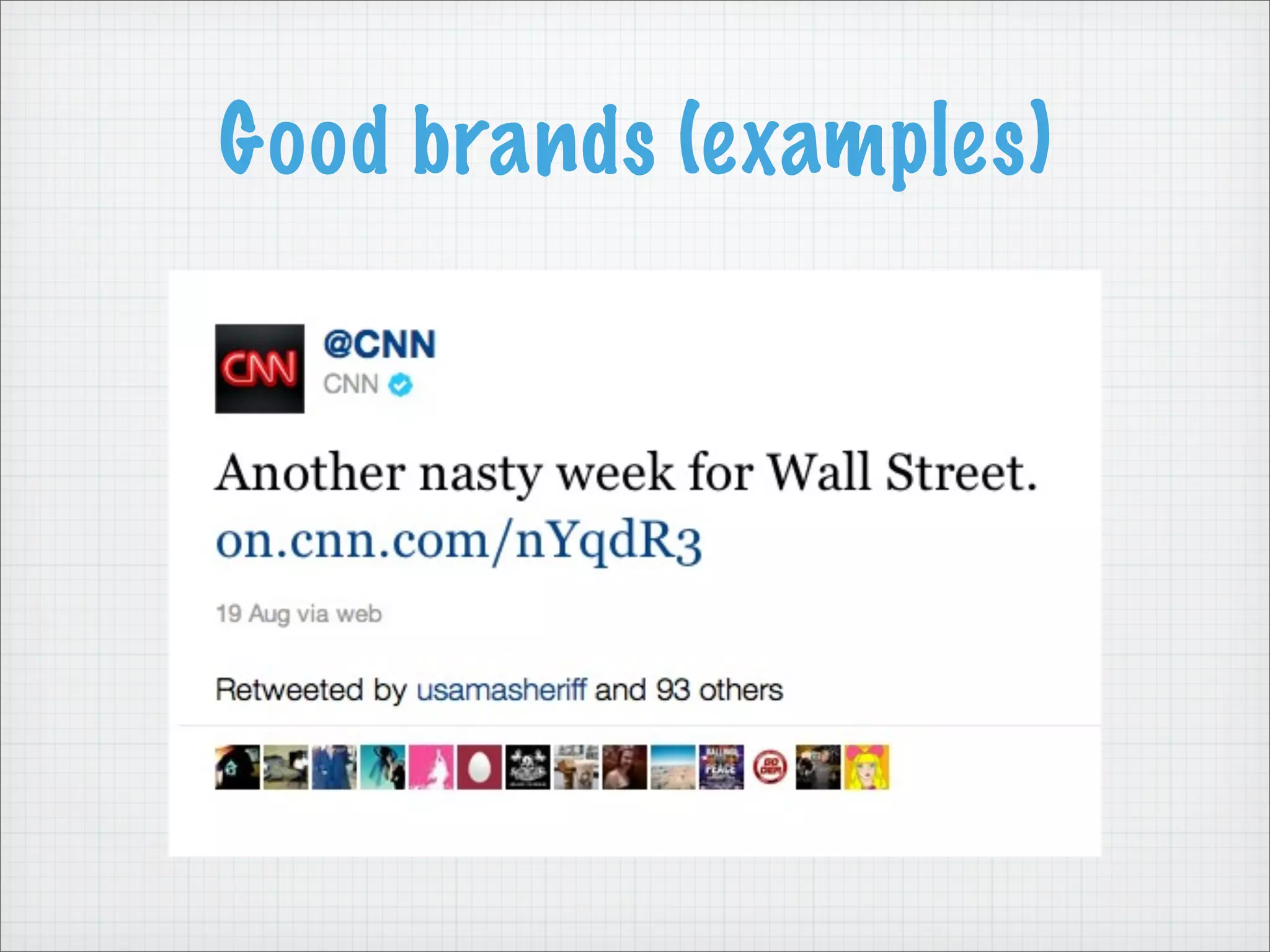
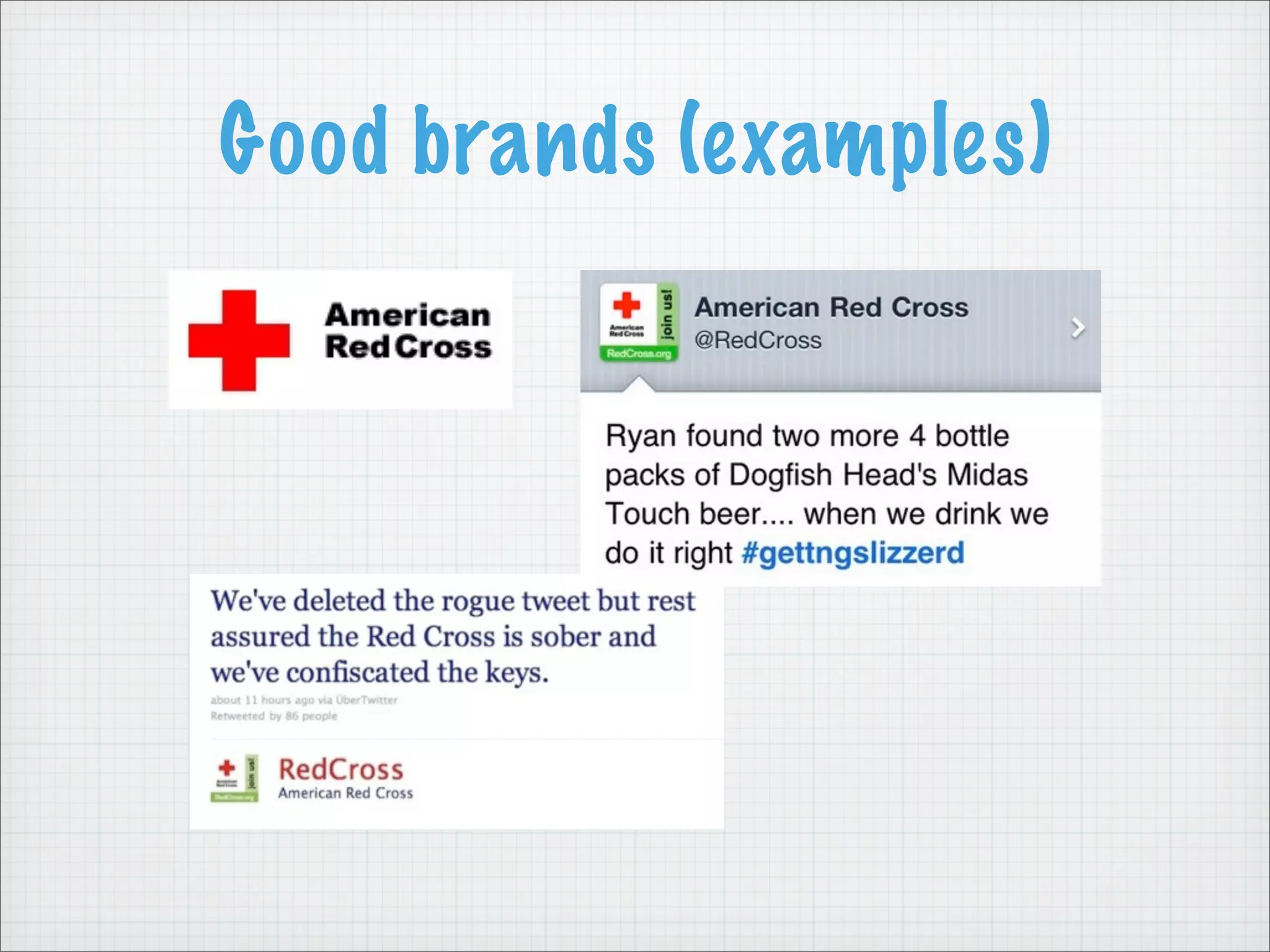
Good brands (examples)
Etiquette
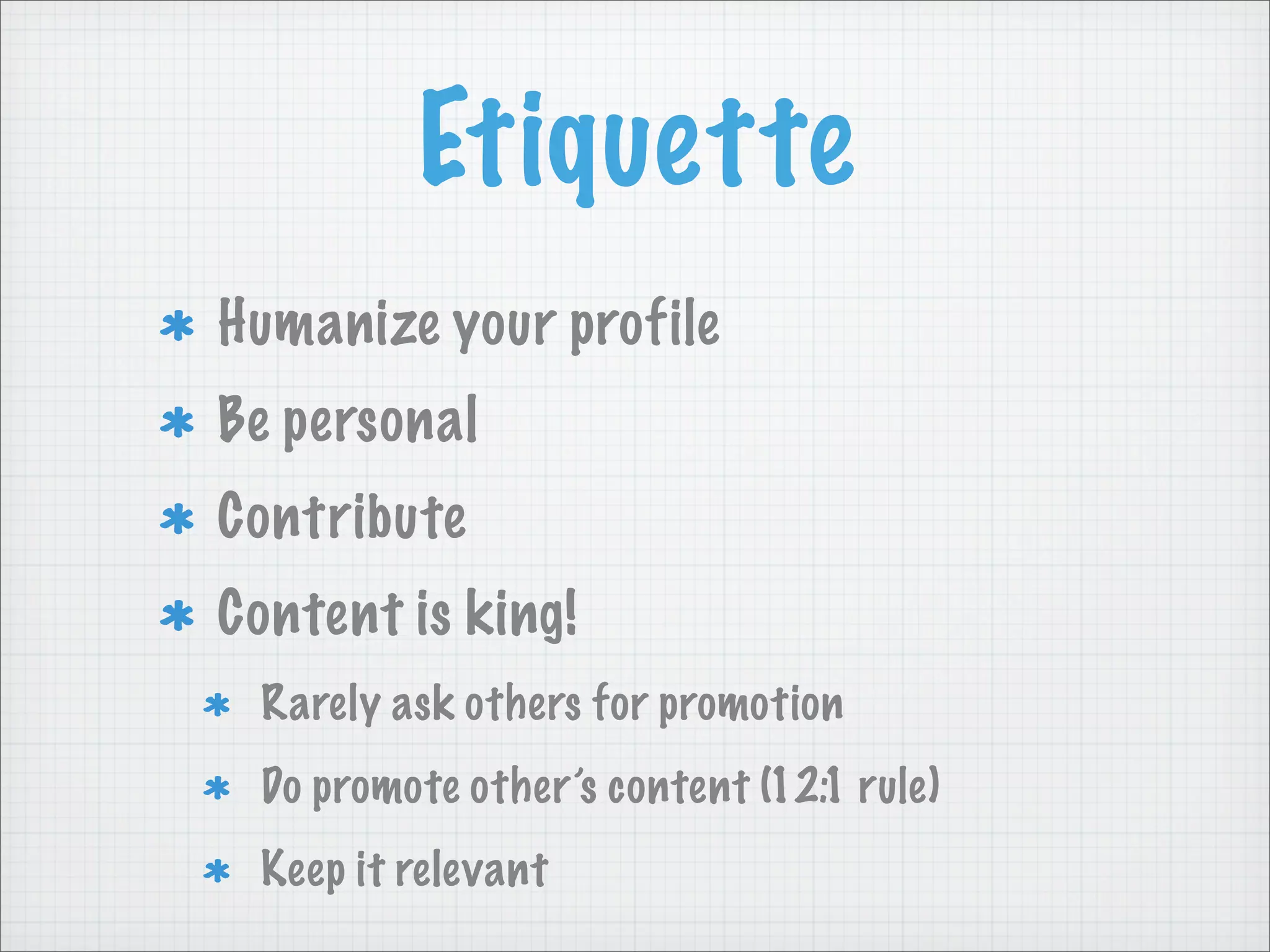
Humanize your profile
Be personal
Contribute
Content is king!
Rarely ask others for promotion
Do promote other’s content (12:1 rule)
Keep it relevant
Measurement
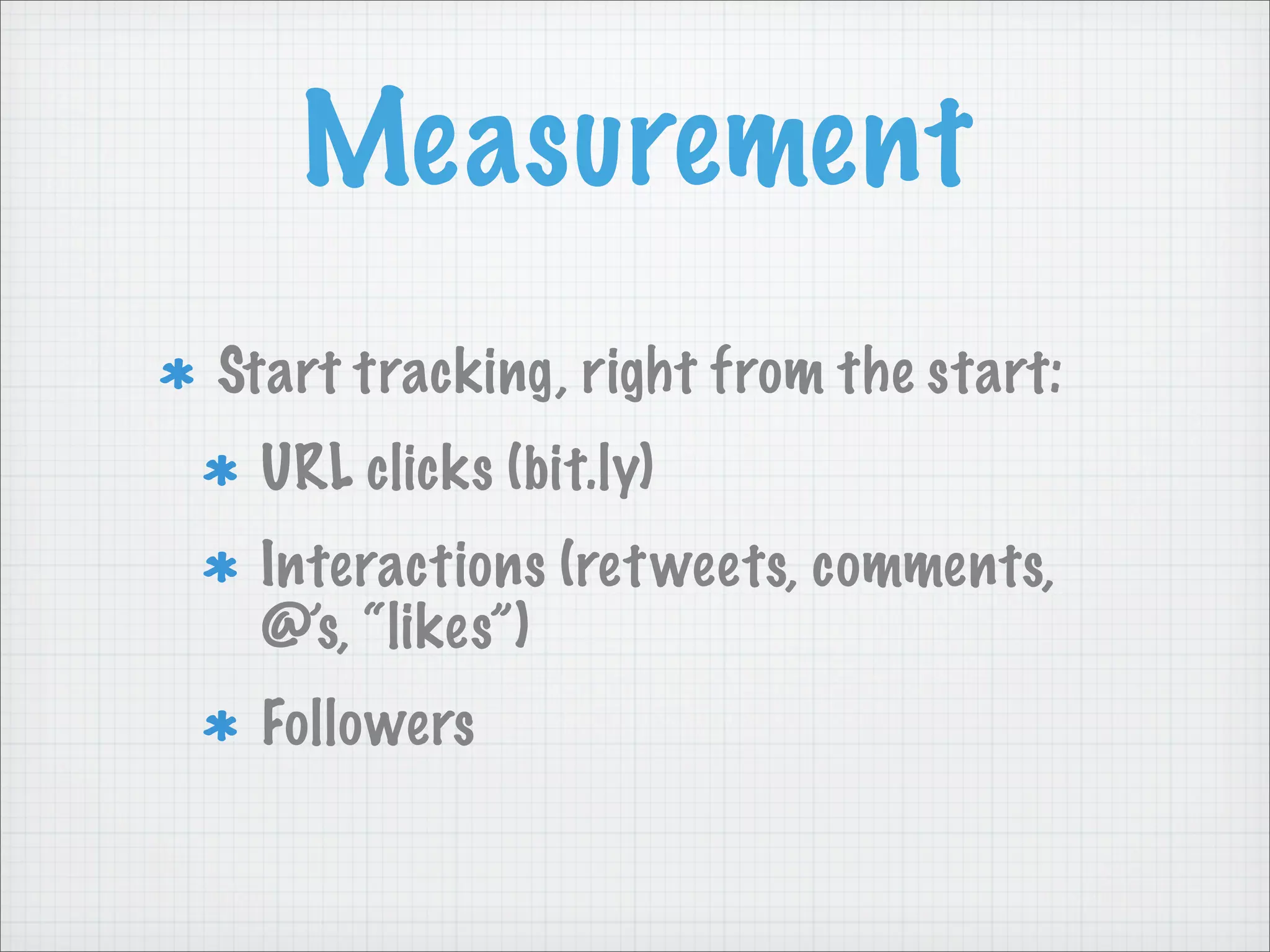
Start tracking, right from the start:
URL clicks (bit.ly)
Interactions (retweets, comments,
@’s, “likes”)
Followers
Measurement
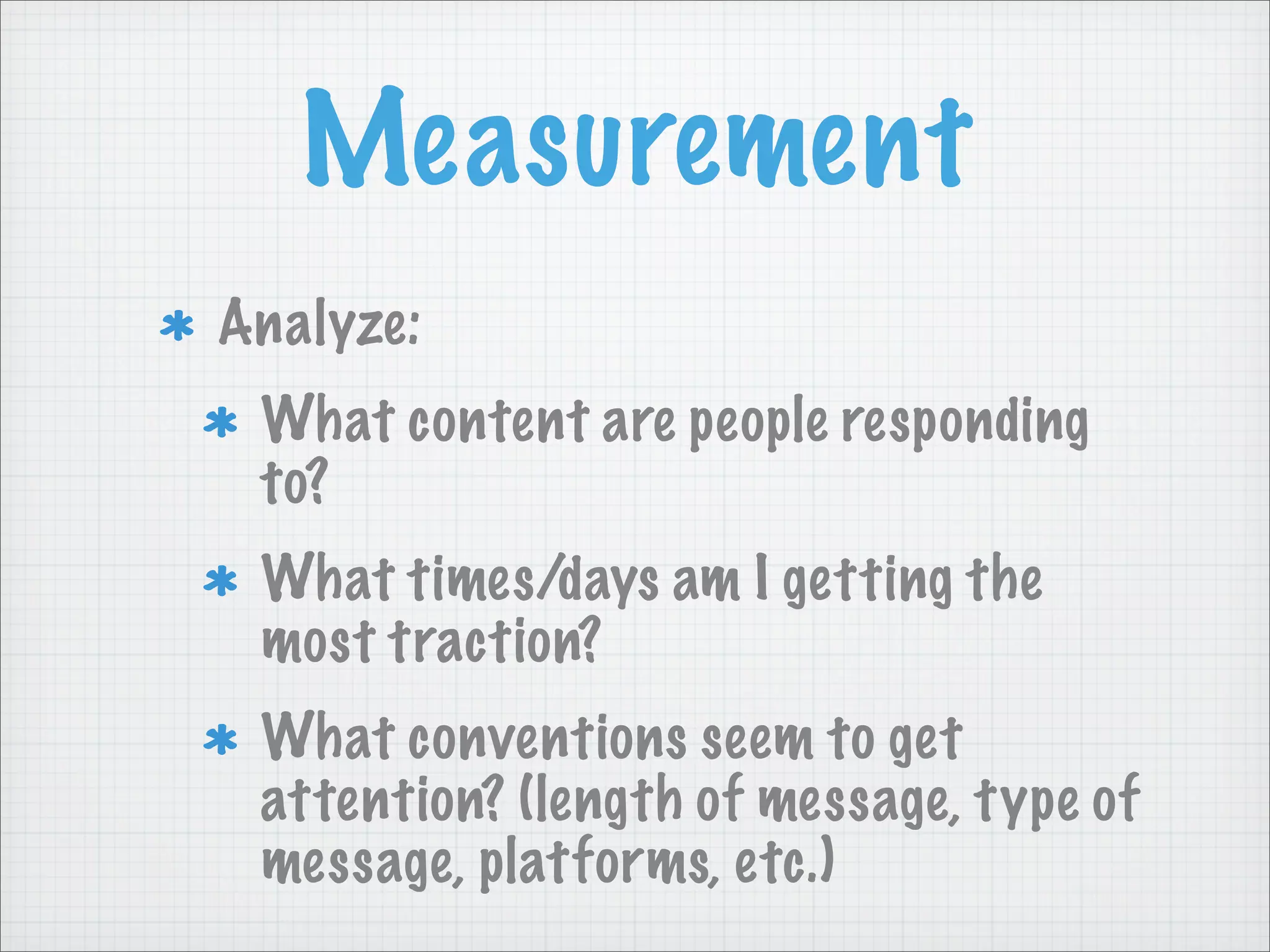
Analyze:
What content are people responding
to?
What times/days am I getting the
most traction?
What conventions seem to get
attention? (length of message, type of
message, platforms, etc.)
Measurement
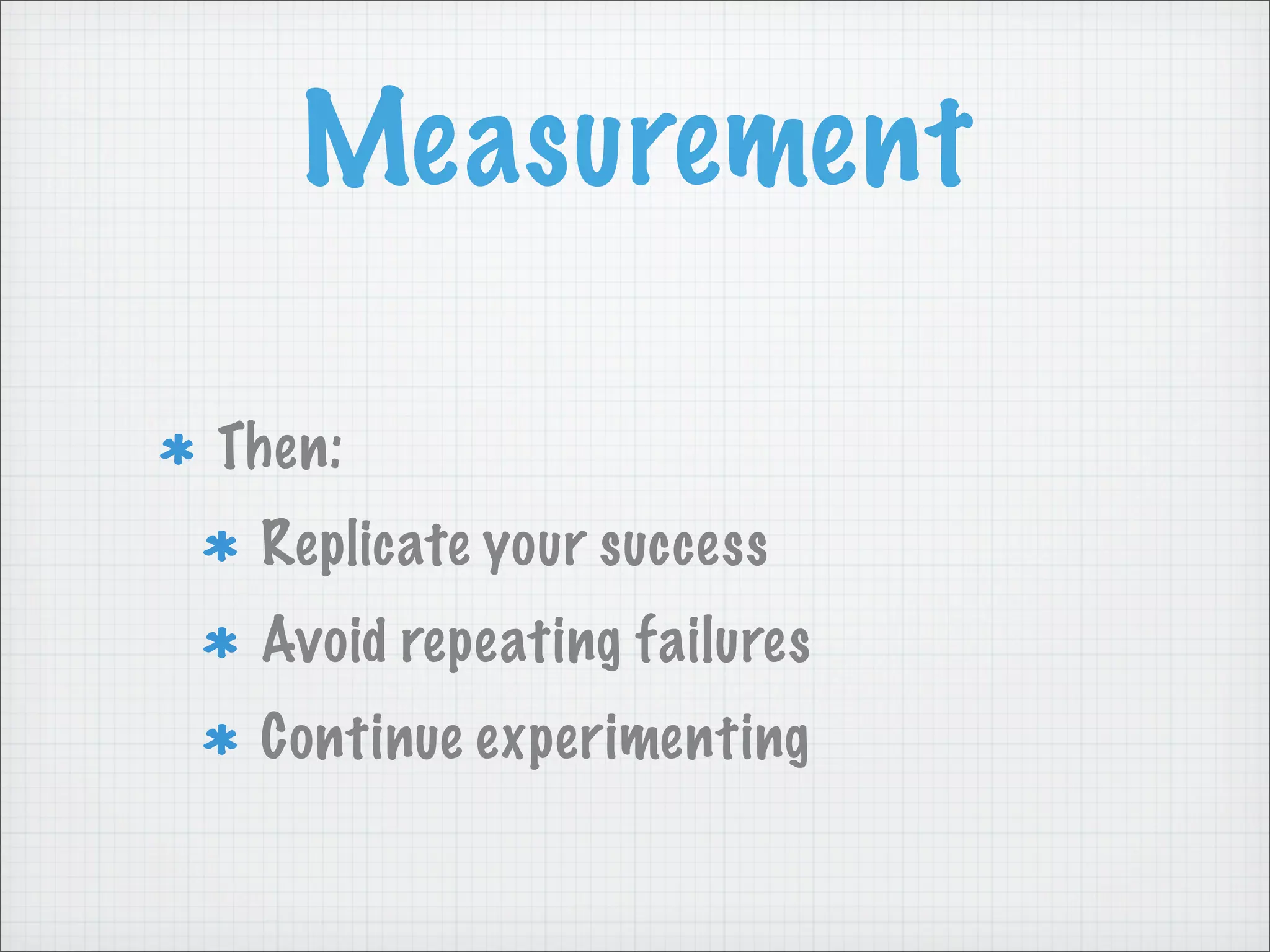
Then:
Replicate your success
Avoid repeating failures
Continue experimenting
Wrap up:
Key takeaways
You can’t afford to ignore social media in
your marketing efforts.
Social media rocks, but it’s not a silver
bullet. Like any other marketing effort,
you have to use it well to be effective.
Each network has its own strengths
and strategies, and they may not all be
right for you.
Listen, be nice, and measure everything.
Happy question time
Thanks!
Find me online:
annie@smallact.com
smallact.com/blog
gplus.to/smallact
@smallact

Social Media 101: Why Is It Worth My Time? How Can I Get Started? (Good360)

  • 1.
    Social Media 101: GettingStarted October 9, 2013 #Good360
  • 2.
    Nonprofit Webinar Series October30: Prospect Research: Diving Deeper with Social Data Featuring Small Act’s Casey Golden Ongoing Webinars: •Good360 101 •Good360 Framing Hope Webinar •Good360 Retail Donation Program Webinar •Good360 Best Practices in Truckload Donations Register online at: http://www.giftsinkind.org/Charities/FREE_Webinars #Good360
  • 3.
    News & Updates •New Website – Good360 will unveil an innovative platform that will help nonprofits engage with their supporters to get more product donations. • Blog – We launched our “Power of Good Blog” earlier this year. All posts are shared on social media. #Good360
  • 4.
    Twitter: @Good360 #circleofthanks YouTube Station: GiftsInKind1 Facebook: Facebook.com/ good360.org Connect withGood360 You’ll have access to: •Good360 news & events •Nonprofit sector news •Sharing impact through donor thank you campaigns •Exclusive promotions for our Facebook and Twitter followers Pinterest: @Good360 LinkedIn: Good360 Our social media outlets #Good360
  • 5.
    Great Examples fromOur Partners #Good360
  • 6.
  • 7.
    Our Speaker Annie hasspent her entire career focused on nonprofit marketing and communications. In the past ten years, she's worked for the Evangelical Lutheran Church in America, KaBOOM!, and now serves as the Director of Awesomeness for Small Act. Small Act empowers nonprofits and associations to nurture key relationships through its social media software, Thrive and Profile Builder. Founded in 2008 and based in McLean, Va., Small Act proudly helps The Nature Conservancy, Children's National Medical Center and over 150 other clients make the most of their social media investment. Annie Lynsen Director of Awesomeness Small Act #Good360
  • 8.
    Social Media 101 byAnnie Lynsen Tweet about this presentation with the hashtag #good360
  • 9.
    What are we goingto cover? Overview of social media Platforms: Twitter and Facebook Strategy Brand presence vs. campaigns Etiquette Measurement And a whole lotta case studies
  • 10.
    Key takeaways You can’tafford to ignore social media. Social media rocks, but it’s not a silver bullet. Like any other marketing effort, you have to use it well to be effective. Each network has its own strengths and strategies, and they may not all be right for your business. Listen, be nice, and measure everything.
  • 11.
    It’s not acommunication change. It’s a cultural revolution.
  • 12.
    It’s not acommunication change. It’s a cultural revolution.
  • 13.
    It’s not acommunication change. It’s a cultural revolution. Total # of Facebook users: 1.15 BILLION # who check it daily: 699 MILLION
  • 14.
    It’s not acommunication change. It’s a cultural revolution. Total # of Facebook users: 1.15 BILLION # who check it daily: 699 MILLION
  • 15.
    It’s not acommunication change. It’s a cultural revolution. Total # of Facebook users: 1.15 BILLION # who check it daily: 699 MILLION
  • 16.
    It’s not acommunication change. It’s a cultural revolution. Total # of Facebook users: 1.15 BILLION # who check it daily: 699 MILLION Facebook users have uploaded 250 BILLION photos since launch
  • 17.
    It’s not acommunication change. It’s a cultural revolution. Total # of Facebook users: 1.15 BILLION # who check it daily: 699 MILLION Facebook users have uploaded 250 BILLION photos since launch
  • 18.
  • 19.
  • 20.
    In what waysare nonprofits using social media? Brand awareness Customer service channel Word-of-mouth campaigns Building relationships with their donors/members
  • 21.
    How can socialmedia be used (effectively) in marketing? Get around advertising fatigue & ineffectiveness “Humanize” the brand/give the brand personality Offer better, on-the-spot customer service/responses to questions Find donors/members where they spend the most time
  • 22.
  • 23.
  • 24.
    What is Twitter? Twitteris a website which lets you send and read messages called tweets. Tweets are text-based posts of up to 140 characters. Users “follow,” or subscribe, to various people’s tweets so they can read their updates.
  • 25.
    Why bother? Twitter hasplenty of time for your organization. Public tweets often end up at the top of Google searches. Do you want to create an account when times are good, or when a crisis hits?
  • 26.
    General Twitter strategy: Relationshipcultivation Relationships ➡ inspiration ➡ expanding your network. Provide value to the masses, but speak to individuals as individuals when you can. Bottom line: More supporters, more money.
  • 28.
    What is Facebook? Facebookis the world's most popular social networking website. Users share “status updates,” pictures, videos, links, etc. The updates of your friends (and brands you follow) appear in your “News Feed.”
  • 29.
    Why bother? Huge, highly-engagedaudience (1.15 billion, 699 million check daily). User-friendly, inexpensive advertising you can target very specifically based on people’s demographics AND interests. Can drive tons of traffic to your website. Fun fact: 46% of millionaires are on Facebook, vs. 19% on LinkedIn
  • 30.
    General Facebook strategy: Daily,share-able posts Post a few times a week. Share links your audience will find useful. Use photos a LOT.
  • 31.
    General Facebook strategy: Daily,share-able posts Post a few times a week. Share links your audience will find useful. Use photos a LOT.
  • 32.
    General Facebook strategy: Daily,share-able posts Post a few times a week. Share links your audience will find useful. Use photos a LOT.
  • 33.
    General Facebook strategy: Daily,share-able posts Post a few times a week. Share links your audience will find useful. Use photos a LOT.
  • 34.
    Other places toconsider sharing Highly-visually- driven Pinterest Instagram Location-based Foursquare SEO/traffic-building Google+ Reddit Video YouTube Vimeo Instagram video Vine
  • 35.
  • 36.
    Questions to askbefore you do anything What do we want to get out of this? Who is our audience? What stories resonate for our audience? What/who do we need in place to start?
  • 37.
    How do youget started building a brand presence? Listen Engage Test Wash, rinse, repeat
  • 38.
    Brand- building vs. campaigns Brand-building Fewershort-term but more long-term gains Establishes a “voice” Builds trust Campaigns Mostly short-term gains, possible long-term gains Quick acquisition of followers & buzz
  • 39.
    Think of itlike “The Rocky Horror Picture Show” Audience participation is key.
  • 40.
    Think of itlike “The Rocky Horror Picture Show” Antici...pation works.
  • 41.
    Think of itlike “The Rocky Horror Picture Show” Show your favorite obsession: Strive to be a thought leader.
  • 42.
    Think of itlike “The Rocky Horror Picture Show” “Don’t dream it, be it!” Take risks!
  • 43.
  • 44.
  • 45.
  • 46.
    Etiquette Humanize your profile Bepersonal Contribute Content is king! Rarely ask others for promotion Do promote other’s content (12:1 rule) Keep it relevant
  • 47.
    Measurement Start tracking, rightfrom the start: URL clicks (bit.ly) Interactions (retweets, comments, @’s, “likes”) Followers
  • 48.
    Measurement Analyze: What content arepeople responding to? What times/days am I getting the most traction? What conventions seem to get attention? (length of message, type of message, platforms, etc.)
  • 49.
    Measurement Then: Replicate your success Avoidrepeating failures Continue experimenting
  • 50.
    Wrap up: Key takeaways Youcan’t afford to ignore social media in your marketing efforts. Social media rocks, but it’s not a silver bullet. Like any other marketing effort, you have to use it well to be effective. Each network has its own strengths and strategies, and they may not all be right for you. Listen, be nice, and measure everything.
  • 51.
  • 52.