Sorsogon State College
SCHOOL OF GRADUATE STUDIES
Summer 2014
Social Issue: Revolution
Discussant: Marian A. Habla
MAEd - English
Revolution
• a fundamental change in the way of thinking
about or visualizing something
(http://www.merriam-webster.com/dictionary/revolution)
• a radical and pervasive change in society and the
social structure, especially one made suddenly and
often accompanied by violence.
(http://dictionary.reference.com/browse/revolution )
Three (3) Phases of Education
Apprenticeship (19th Century)
Universal Schooling (20th Century)
Life Long Learning (21st Century)
- Allan Collins and Richard Halverson
The Apprenticeship Era
Education was largely the
responsibility of parents.
Learned the skills they
needed, whether it was
reading and counting or
plowing and sewing, from
their parents or other kin.
Individual children were
taught all they needed to
know by those close to
them.
Where people took up other occupations,
such as crafts or midwifery, apprenticeship
was the way they learned these occupations.
Often, they were apprenticed to a friend or
relative of the family, if not to their parents.
They learned by observation, imitation, and
guided practice.
The Apprenticeship Era
As Lawrence Cremin states,
” In general the pedagogy of household
education was the pedagogy of
apprenticeship, that is a relentless round of
imitation, explanation, and trial and error.”
Universal Schooling
Horace Mann led a
movement toward
Universal Schooling
that shifted the
responsibility of
educating children
from the family to the
state.
Universal Schooling
This movement resulted mainly from a chain
of events that included:
a. The invention of the printing press,
b. the Reformation,
c. the American Revolution
d. the Industrial Revolution
Universal Schooling
The school structures and institutions that
evolved in the first 100 years of Universal
Schooling solved a set of problems facing a
growing an urbanizing country in very efficient
and effective ways.
Main pieces that constructed the interlocking system of
universal schooling and that also solved many of the
educational problems faced in the process of creating
this system.
Compulsory Attendance:
This was the main thrust of the universal
schooling. Its goal was to ensure that the
populace was educated enough to make wise
political decisions since the control of the
government at that period was turned over to
the public.
Graded Schools:
This was a response to the problems created
by the huge increase in students brought on
by compulsory attendance. Working with
students of the same age reduced the amount
of curricular knowledge for teachers and
made it easier to control classes.
Tests:
Tests were used to sort students into classes
where they have the same ability. They were
used to track the progress of students through
the system so that they would advance to the
next grade based on demonstrating that they
had mastered the material covered in the
current grade.
Textbooks:
Textbooks were introduced to solve the
problem of what students should learn. This
was necessary to provide some uniformity in
what students were learning in the different
schools across the country.
Comprehensive High Schools:
These allowed schools to offer a diversity of
courses to suit different kinds of students.
They were part of the solution to the problem
of how to meet the learning needs of a wide
variety of students.
The system that evolved from all of the
aforementioned features proved to be very
effective in educating a highly diverse
population.
But the society has continued to change, while
these features have been locked in place for
over 100 years. So the pressures are building
for new solutions to the problems of
education.
Life Long Learning Era
With the advance of
technology and
telecommunications the
seeds of a new educational
system started to blossom
giving birth to what is now
called Life-Long Learning.
These seeds can be seen in
a. the explosive growth of home schooling
b. workplace learning
c. distance education
d. adult education
e. learning centers
f. educational television and videos
g. computer-based learning software
h. technical certifications
i. Internet Cafes
Many of these seeds will affect the learning of
children, but many others will affect people of
all ages, as learning becomes a lifelong
enterprise.
The face of education is changing rapidly and
it remains to be seen exactly what form it will
take.
Difference between the three (3) eras of
education
a. Who was responsible for
children’s education?
b. What was the purpose and
the content of their
education?
c. How were they to be
taught and assessed?
d. What did we expect them
to learn?
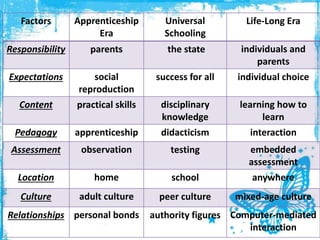
Factors Apprenticeship
Era
Universal
Schooling
Life-Long Era
Responsibility parents the state individuals and
parents
Expectations social
reproduction
success for all individual choice
Content practical skills disciplinary
knowledge
learning how to
learn
Pedagogy apprenticeship didacticism interaction
Assessment observation testing embedded
assessment
Location home school anywhere
Culture adult culture peer culture mixed-age culture
Relationships personal bonds authority figures Computer-mediated
interaction
Thank you
For
Listening!

Social Issues: Revolution

  • 1.
    Sorsogon State College SCHOOLOF GRADUATE STUDIES Summer 2014 Social Issue: Revolution Discussant: Marian A. Habla MAEd - English
  • 2.
    Revolution • a fundamentalchange in the way of thinking about or visualizing something (http://www.merriam-webster.com/dictionary/revolution) • a radical and pervasive change in society and the social structure, especially one made suddenly and often accompanied by violence. (http://dictionary.reference.com/browse/revolution )
  • 3.
    Three (3) Phasesof Education Apprenticeship (19th Century) Universal Schooling (20th Century) Life Long Learning (21st Century) - Allan Collins and Richard Halverson
  • 4.
    The Apprenticeship Era Educationwas largely the responsibility of parents. Learned the skills they needed, whether it was reading and counting or plowing and sewing, from their parents or other kin. Individual children were taught all they needed to know by those close to them.
  • 5.
    Where people tookup other occupations, such as crafts or midwifery, apprenticeship was the way they learned these occupations. Often, they were apprenticed to a friend or relative of the family, if not to their parents. They learned by observation, imitation, and guided practice. The Apprenticeship Era
  • 6.
    As Lawrence Creminstates, ” In general the pedagogy of household education was the pedagogy of apprenticeship, that is a relentless round of imitation, explanation, and trial and error.”
  • 7.
    Universal Schooling Horace Mannled a movement toward Universal Schooling that shifted the responsibility of educating children from the family to the state.
  • 8.
    Universal Schooling This movementresulted mainly from a chain of events that included: a. The invention of the printing press, b. the Reformation, c. the American Revolution d. the Industrial Revolution
  • 9.
    Universal Schooling The schoolstructures and institutions that evolved in the first 100 years of Universal Schooling solved a set of problems facing a growing an urbanizing country in very efficient and effective ways.
  • 10.
    Main pieces thatconstructed the interlocking system of universal schooling and that also solved many of the educational problems faced in the process of creating this system. Compulsory Attendance: This was the main thrust of the universal schooling. Its goal was to ensure that the populace was educated enough to make wise political decisions since the control of the government at that period was turned over to the public.
  • 11.
    Graded Schools: This wasa response to the problems created by the huge increase in students brought on by compulsory attendance. Working with students of the same age reduced the amount of curricular knowledge for teachers and made it easier to control classes.
  • 12.
    Tests: Tests were usedto sort students into classes where they have the same ability. They were used to track the progress of students through the system so that they would advance to the next grade based on demonstrating that they had mastered the material covered in the current grade.
  • 13.
    Textbooks: Textbooks were introducedto solve the problem of what students should learn. This was necessary to provide some uniformity in what students were learning in the different schools across the country.
  • 14.
    Comprehensive High Schools: Theseallowed schools to offer a diversity of courses to suit different kinds of students. They were part of the solution to the problem of how to meet the learning needs of a wide variety of students.
  • 15.
    The system thatevolved from all of the aforementioned features proved to be very effective in educating a highly diverse population. But the society has continued to change, while these features have been locked in place for over 100 years. So the pressures are building for new solutions to the problems of education.
  • 16.
    Life Long LearningEra With the advance of technology and telecommunications the seeds of a new educational system started to blossom giving birth to what is now called Life-Long Learning.
  • 17.
    These seeds canbe seen in a. the explosive growth of home schooling b. workplace learning c. distance education d. adult education e. learning centers f. educational television and videos g. computer-based learning software h. technical certifications i. Internet Cafes
  • 18.
    Many of theseseeds will affect the learning of children, but many others will affect people of all ages, as learning becomes a lifelong enterprise. The face of education is changing rapidly and it remains to be seen exactly what form it will take.
  • 19.
    Difference between thethree (3) eras of education a. Who was responsible for children’s education? b. What was the purpose and the content of their education? c. How were they to be taught and assessed? d. What did we expect them to learn?
  • 20.
    Factors Apprenticeship Era Universal Schooling Life-Long Era Responsibilityparents the state individuals and parents Expectations social reproduction success for all individual choice Content practical skills disciplinary knowledge learning how to learn Pedagogy apprenticeship didacticism interaction Assessment observation testing embedded assessment Location home school anywhere Culture adult culture peer culture mixed-age culture Relationships personal bonds authority figures Computer-mediated interaction
  • 21.