Downloaded 229 times












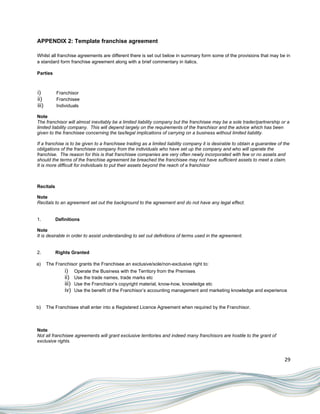
![If exclusivity is granted care should be taken in establishing the territories to be granted. If, for instance, customers for a
franchised business are likely to be obtained by way of telephone directories, the territories to be given should be linked
to the area covered by the directory.
3. Franchise
The Franchisee will pay an initial fee of £[ ] plus VAT on execution of this Agreement
Note
It may be desirable to stagger payment of the initial franchise fee if it is a large amount.
There are two guiding principles concerning the initial fee. The first is that it should not contain a profit element for the
franchisor. The second is that the initial fee should not exceed 10% of the total investment which the franchisee will have
to make. Ultimately, the amount which can be charged by way of an initial fee will depend on the reputation of the
franchisor, the profitability of his franchise, the term granted, whether it contains an exclusive area etc.
4. Term
The term of the agreement is [ ] years from the date of this Agreement.
Note
Most franchises are for an initial term of 5 years with a significant number of franchises being granted for 10 years.
5. Rights of Renewal
a) The Franchise may renew the Agreement for a further term unless he has committed a material breach or has not
substantially performed the terms of the Agreement.
b) Prior to renewal the Franchisee may be required to enter into the then current form of the agreement and may have
to refurbish the Premises.
Note
It is important for a franchisee to ensure that he may renew the franchise at the end of the initial term and that the renewal
can be exercised without further payment. The right to renew should not be lost merely for minor breaches of the
franchise agreement.
6. Franchisors Initial Obligations
The Franchisor will on execution provide the following:-
a) Advice on finding premises
b) Advice on alterations to and fixtures and fittings in the Premises
c) General advice on how to set up the franchise
d) Such equipment, stock, fixtures and fittings as are listed in the Schedule
e) A PR launch
f) A copy on loan of the Operations Manual
g) An initial training programme for the Franchisee
Note
The purpose of the franchisor’s initial obligations is to put the franchisee (who probably has no knowledge of the business
to be franchised) in a position to operate the franchised business. If a franchisee ‘fails’ the initial training the franchisor
usually reserves the right to terminate the agreement and return to the franchisee payments which have been made less
all expenses incurred by the franchisor.
30](https://image.slidesharecdn.com/socialfranchisingmodel2011-110420022138-phpapp01/85/Social-Franchising-Model-2011-31-320.jpg)

![a) The Franchisee shall pay a Management Charge of [ ]% of gross turnover on monthly sales
b) The Management Charge is to be paid within two weeks of the end of every month with interest of 15% per annum
on late payments
Note
Ideally, from the franchisor’s point of view the Management or Service Charge should be paid weekly since this will
improve the franchisor’s cash flow and enable the franchisor to establish at an early stage a franchisee’s ability to pay the
Management Charges. A franchisee will usually wish to establish the level of any mark up on the goods/services
supplied by the franchisor to ensure that a franchisor is not charging a high mark up and Management Charge.
11. Accounting Records
The Franchisee shall:-
a) Maintain records of gross turnover and submit a statement of gross turnover with the Management Charge in the
form specified in the Operations Manual
b) Maintain all records needed to verify the gross turnover for not less than 6 years.
c) Allow representatives of the Franchisor to enter the Premises to investigate the Franchisee‟s records
d) Supply to the Franchisor copies of all VAT returns
Note
The extent of the accounting records to be provided to the Franchisor will depend on whether the franchisor charges a
continuing fee. VAT returns are usually required to be provided because they enable the franchisor to check the financial
information provided by the franchisee.
12. Advertising
a) The Franchisee shall spend a minimum of £[ ] per year on advertising in the Franchisee‟s territory
b) All advertising is to be approved by the Franchisor
c) The Franchisor shall spend not less than £[ ] per year on national advertising
Note
Most franchise agreements require franchisees to contribute to national advertising by way of an advertising levy to be
held by the franchisor in a separate fund so as to ensure that it can only be used for advertising.
13. Insurance
a) The Franchisee shall take out with a reputable insurance company all such insurance cover relating to the Business
as the Franchisor shall reasonably require
b) The Franchisee shall ensure that the Franchisor‟s interest is noted on policies and/or furnish to the Franchisor
copies of policies and evidence of payment premiums
Note
Franchisors are usually concerned to ensure that their franchisees are adequately insured because of the possibility of
claims being made against the franchisor for the acts of the franchisee.
14. Sale of the Business
a) The Franchisor shall have no right to transfer the franchise without the Franchisor‟s consent
b) The Franchisor shall consent to a transfer provided that:-
32](https://image.slidesharecdn.com/socialfranchisingmodel2011-110420022138-phpapp01/85/Social-Franchising-Model-2011-33-320.jpg)
![i) The Purchaser meets the Franchisor‟s minimum standards
ii) Payment of the costs of investigation and training are made
iii) There are no subsisting breaches of this Agreement
c) The Franchisor shall have the option to match any offer for the Business which is made to the Franchisee
Note
Special provisions will have to be inserted if the franchise is a limited liability company to ensure that the franchise cannot
be transferred simply by transferring shares.
15. Non-Competition
Neither the Franchisee nor the Individuals will during the term of the franchise:-
i) Carry on any other business
ii) Entice employees away from the Franchisor or other franchisees
iii) Use or disclose confidential information for any purpose other than a purpose set out in the Agreement
16. Death of an Individual
a) The Franchisor will provide a manager for a period of three months following the death or incapacity of the last of the
Individuals to die, on payment of the Franchisor‟s then current costs and expenses.
b) Within the three months period the Individual‟s personal representatives or beneficiaries must either:-
i) Qualify as a Franchisee by training etc
ii) Notify the Franchisor of their desire to sell the franchise
Failing which the Franchisor may terminate this Agreement
Note
A franchisee’s family or personal representatives may wish the franchised business to continue to operate because this
increases the value of the business should it have to be sold. Further, a franchisor may not wish a franchise outlet to
cease trading because of adverse publicity that would result.
Provisions may need to be inserted to deal with incapacity as well as death.
17. Termination
The Franchisor may terminate this Agreement if the Franchisee:-
a) Fails to commence business within three months of execution of the Agreement
b) Is in breach of [any of] the terms of the Agreement
c) Persistently defaults in payment of any amounts due to the Franchisor
d) Is found to have supplied materially false or misleading information in or supporting the franchise application
e) Goes into liquidation/bankruptcy or is insolvent
18. Consequences of Termination
The Franchisee:
a) Must cease use of the Franchisor‟s trade name and trade marks and must not thereafter hold itself out as being a
franchisee of the Franchisor.
b) Must pay to the Franchisor all sums payable to the Franchisor whether or not then due
c) Shall return to the Franchisor all manuals literature promotional material letterheads invoices or anything else which
bears the trade name or indicates any association with the Franchisor
33](https://image.slidesharecdn.com/socialfranchisingmodel2011-110420022138-phpapp01/85/Social-Franchising-Model-2011-34-320.jpg)


This document provides an introduction to social franchising. It defines social franchising as applying commercial franchising methods and concepts to achieve social goals. The key elements of a social franchise include a codified business model, franchise agreement, common brand, training and support from the central organization, demand for replication, quality assurance, and clear fee structure. Social franchising combines social objectives of sharing learning with financial objectives of generating revenue. It can be an effective strategy for organizations seeking to grow their social impact while maintaining control and ensuring sustainability. Readiness for social franchising depends on factors like a proven impact, transferable model, and financial stability.


