Social Enterprise: A Critical Engine of Simultaneous Economic and Social Development By Lisa Nitze CEO, Social Enterprise Alliance I-7 Conference October 15, 2010
A New Vision The world’s problems are outstripping our current initiatives to address them – not necessarily our current capacity to address them Our old models for how to address social problems need to be updated Resources residing in silos need to be combined through collaborative partnerships for maximum positive social impact
The Role of Government Traditional View Take care of those who can’t take care of themselves Educate the people Protect the environment Build and maintain transportation and communications infrastructures Build and maintain public health infrastructures Create and implement laws and punishments to provide safety, social stability, equity and fairness in society
The Role of Government Revised View Provide those who can’t take care of themselves with the tools to help themselves Partner with others in the market to educate, protect the environment, create and maintain infrastructures, protect public health Provide incentives for people to self-govern for safety, social stability and equity Use leverage to convene partnerships among sources of resources for public good Use leverage to convene stakeholders around issues so they can define a middle ground Incentivize corporations to invest in societies’ well-being Provide seed-funding, be the convener and catalyst
Corporations Traditional View Emphasis on short-term profit for shareholders See societal needs as the job of government See environmental issues as the job of government See non-profits as an adjunct of government and make annual contributions to them as asked See Universities as disconnected from economy See citizen and advocacy groups as on another team See government as ineffective
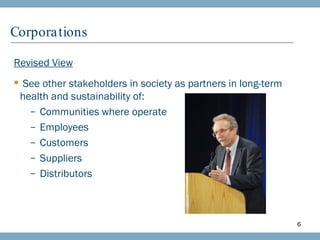
Corporations Revised View See other stakeholders in society as partners in long-term health and sustainability of: Communities where operate Employees Customers Suppliers Distributors
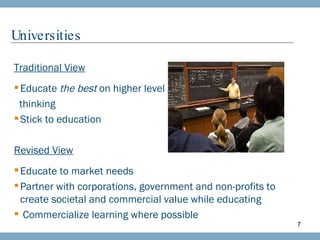
Universities Traditional View Educate  the best  on higher level  thinking Stick to education Revised View Educate to market needs Partner with corporations, government and non-profits to create societal and commercial value while educating Commercialize learning where possible
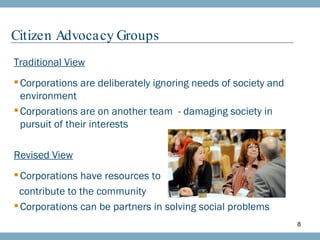
Citizen Advocacy Groups Traditional View Corporations are deliberately ignoring needs of society and environment Corporations are on another team  - damaging society in pursuit of their interests Revised View Corporations have resources to  contribute to the community Corporations can be partners in solving social problems
Nonprofits Old View: The Traditional Nonprofit Model of meeting need through dependency on donations Model of pursuing good without responsibility for figuring out how to pay for it Lack of connection to market drivers allows original model to become out of touch Federal organizations do not meet local needs with local solutions
Social Enterprises Revised View: The Social Enterprise A market-based, business-like approach to solving a social problem  Its mission is to meet a societal need in a way that is self-sustaining Simultaneous pursuit of social and economic development that is not zero-sum Partnering with government, business, universities and all other sources of resources creatively to achieve goals
What is a Social Enterprise? A “Social Enterprise” is a nonprofit or private sector entity that:   Uses  earned   revenue strategies, either exclusively as a business or as a significant part of a nonprofit’s revenue stream, and Directly   addresses social needs either through its goods and/or services or by employing people who are disabled or disadvantaged
Social Enterprises Make up a Rapidly Growing and Vital Sector of the U.S. Economy The economic downturn has caused nonprofits to seek new solutions for sustainability as charitable contributions decline Social need has increased as corporations and government cut jobs and budgets Public awareness of social entrepreneurship has risen and purchasers are increasingly seeking to support positive social change with their dollars Nonprofits adding revenue-generating streams to their business models can increase scale and impact  Government social program budgets are shrinking creating market opportunities for growth of the social enterprise sector Having market-based elements to their business models keeps nonprofits tracking with the evolution of market need
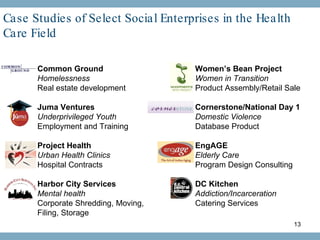
A Few Examples of Social Enterprises   Common Ground Women’s Bean Project   Homelessness Women in Transition   Real estate development Product Assembly/Retail Sale   Juma Ventures Cornerstone/National Day 1   Underprivileged Youth Domestic Violence   Employment and Training Database Product   Project Health EngAGE   Urban Health Clinics Elderly Care   Hospital Contracts Program Design Consulting   Harbor City Services DC Kitchen   Mental health Addiction/Incarceration   Corporate Shredding, Moving,  Catering Services   Filing, Storage Case Studies of Select Social Enterprises in the Health Care Field
Economic and Social Infrastructures Can’t Keep Pace with the Growth of Social Enterprise New legal and tax structures are needed Access to growth capital is constrained by outdated frameworks Clear definitions of the sector are necessary to measure impact Branding and awareness building is required to drive greater growth
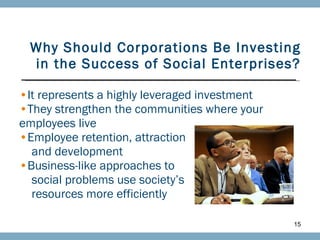
Why Should Corporations Be Investing in the Success of Social Enterprises? It represents a highly leveraged investment They strengthen the communities where your employees live Employee retention, attraction  and development Business-like approaches to  social problems use society’s  resources more efficiently
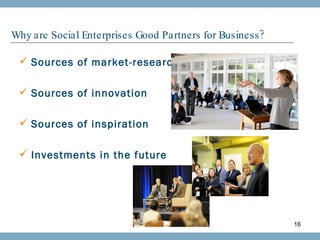
Why are Social Enterprises Good Partners for Business? Sources of market-research Sources of innovation Sources of inspiration Investments in the future
Social and economic development are no longer mutually exclusive “ Nonprofit” and “For Profit” are rapidly becoming outdated distinctions Triple bottom line analysis is being done by all actors in pursuit of sustainable progress Those enterprises that will be the most successful as the shifts continue are those that have attracted and invested in the largest percentage of change leaders – innovators who excel at leadership, teamwork and empathy  The Sands are Shifting and Stakeholder Roles are Changing in the Economy and in Society
Social Enterprise Alliance 5358 42 nd  Place NW Washington, DC 20015 www.se-alliance.org   [email_address]   P: (202) 758-0194 F: (202) 449-9611 Questions?

Lisa Nitze presents SE Alliance

  • 1.
    Social Enterprise: ACritical Engine of Simultaneous Economic and Social Development By Lisa Nitze CEO, Social Enterprise Alliance I-7 Conference October 15, 2010
  • 2.
    A New VisionThe world’s problems are outstripping our current initiatives to address them – not necessarily our current capacity to address them Our old models for how to address social problems need to be updated Resources residing in silos need to be combined through collaborative partnerships for maximum positive social impact
  • 3.
    The Role ofGovernment Traditional View Take care of those who can’t take care of themselves Educate the people Protect the environment Build and maintain transportation and communications infrastructures Build and maintain public health infrastructures Create and implement laws and punishments to provide safety, social stability, equity and fairness in society
  • 4.
    The Role ofGovernment Revised View Provide those who can’t take care of themselves with the tools to help themselves Partner with others in the market to educate, protect the environment, create and maintain infrastructures, protect public health Provide incentives for people to self-govern for safety, social stability and equity Use leverage to convene partnerships among sources of resources for public good Use leverage to convene stakeholders around issues so they can define a middle ground Incentivize corporations to invest in societies’ well-being Provide seed-funding, be the convener and catalyst
  • 5.
    Corporations Traditional ViewEmphasis on short-term profit for shareholders See societal needs as the job of government See environmental issues as the job of government See non-profits as an adjunct of government and make annual contributions to them as asked See Universities as disconnected from economy See citizen and advocacy groups as on another team See government as ineffective
  • 6.
    Corporations Revised ViewSee other stakeholders in society as partners in long-term health and sustainability of: Communities where operate Employees Customers Suppliers Distributors
  • 7.
    Universities Traditional ViewEducate the best on higher level thinking Stick to education Revised View Educate to market needs Partner with corporations, government and non-profits to create societal and commercial value while educating Commercialize learning where possible
  • 8.
    Citizen Advocacy GroupsTraditional View Corporations are deliberately ignoring needs of society and environment Corporations are on another team - damaging society in pursuit of their interests Revised View Corporations have resources to contribute to the community Corporations can be partners in solving social problems
  • 9.
    Nonprofits Old View:The Traditional Nonprofit Model of meeting need through dependency on donations Model of pursuing good without responsibility for figuring out how to pay for it Lack of connection to market drivers allows original model to become out of touch Federal organizations do not meet local needs with local solutions
  • 10.
    Social Enterprises RevisedView: The Social Enterprise A market-based, business-like approach to solving a social problem Its mission is to meet a societal need in a way that is self-sustaining Simultaneous pursuit of social and economic development that is not zero-sum Partnering with government, business, universities and all other sources of resources creatively to achieve goals
  • 11.
    What is aSocial Enterprise? A “Social Enterprise” is a nonprofit or private sector entity that: Uses earned revenue strategies, either exclusively as a business or as a significant part of a nonprofit’s revenue stream, and Directly addresses social needs either through its goods and/or services or by employing people who are disabled or disadvantaged
  • 12.
    Social Enterprises Makeup a Rapidly Growing and Vital Sector of the U.S. Economy The economic downturn has caused nonprofits to seek new solutions for sustainability as charitable contributions decline Social need has increased as corporations and government cut jobs and budgets Public awareness of social entrepreneurship has risen and purchasers are increasingly seeking to support positive social change with their dollars Nonprofits adding revenue-generating streams to their business models can increase scale and impact Government social program budgets are shrinking creating market opportunities for growth of the social enterprise sector Having market-based elements to their business models keeps nonprofits tracking with the evolution of market need
  • 13.
    A Few Examplesof Social Enterprises Common Ground Women’s Bean Project Homelessness Women in Transition Real estate development Product Assembly/Retail Sale Juma Ventures Cornerstone/National Day 1 Underprivileged Youth Domestic Violence Employment and Training Database Product Project Health EngAGE Urban Health Clinics Elderly Care Hospital Contracts Program Design Consulting Harbor City Services DC Kitchen Mental health Addiction/Incarceration Corporate Shredding, Moving, Catering Services Filing, Storage Case Studies of Select Social Enterprises in the Health Care Field
  • 14.
    Economic and SocialInfrastructures Can’t Keep Pace with the Growth of Social Enterprise New legal and tax structures are needed Access to growth capital is constrained by outdated frameworks Clear definitions of the sector are necessary to measure impact Branding and awareness building is required to drive greater growth
  • 15.
    Why Should CorporationsBe Investing in the Success of Social Enterprises? It represents a highly leveraged investment They strengthen the communities where your employees live Employee retention, attraction and development Business-like approaches to social problems use society’s resources more efficiently
  • 16.
    Why are SocialEnterprises Good Partners for Business? Sources of market-research Sources of innovation Sources of inspiration Investments in the future
  • 17.
    Social and economicdevelopment are no longer mutually exclusive “ Nonprofit” and “For Profit” are rapidly becoming outdated distinctions Triple bottom line analysis is being done by all actors in pursuit of sustainable progress Those enterprises that will be the most successful as the shifts continue are those that have attracted and invested in the largest percentage of change leaders – innovators who excel at leadership, teamwork and empathy The Sands are Shifting and Stakeholder Roles are Changing in the Economy and in Society
  • 18.
    Social Enterprise Alliance5358 42 nd Place NW Washington, DC 20015 www.se-alliance.org [email_address] P: (202) 758-0194 F: (202) 449-9611 Questions?

Editor's Notes

  • #2 Change photo to one from conference showing social entrepreneurs learning Change Title to: How Social Enterprise Can Help Your Organization Sustainably Pursue Positive Social Change
  • #10 Change title to Nonprofits
  • #14 Space and bold names of organizations Bullet them Italics under name of orgs with problem being solved be social enterprise and revenue str
  • #15 delete
  • #16 Delete all pages following this
  • #17 delete