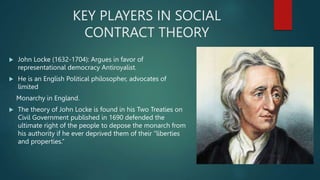
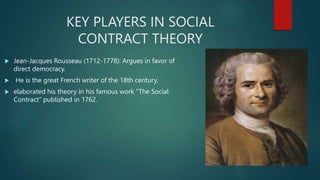
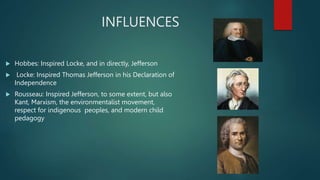
Social Contract Theory proposes that individuals in a state of nature came together to form societies and governments through an implicit agreement, or social contract. The key thinkers on social contract theory - Thomas Hobbes, John Locke, and Jean-Jacques Rousseau - each proposed different views of human nature, the state of nature, and the role of the sovereign. While Hobbes argued for absolute monarchy, Locke advocated for limited monarchy and representational democracy, and Rousseau favored direct democracy with the people as sovereign.