Social Class
Definition: social class is the measurement of how well of someone is in terms of
their job, education, family background and where they live.
Lower Class
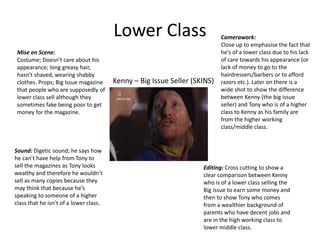
Kenny – Big Issue Seller (SKINS)
Mise en Scene:
Costume; Doesn’t care about his
appearance; long greasy hair,
hasn’t shaved, wearing shabby
clothes. Props; Big Issue magazine
that people who are supposedly of
lower class sell although they
sometimes fake being poor to get
money for the magazine.
Camerawork:
Close up to emphasise the fact that
he’s of a lower class due to his lack
of care towards his appearance (or
lack of money to go to the
hairdressers/barbers or to afford
razors etc.). Later on there is a
wide shot to show the difference
between Kenny (the big issue
seller) and Tony who is of a higher
class to Kenny as his family are
from the higher working
class/middle class.
Sound: Digetic sound; he says how
he can’t have help from Tony to
sell the magazines as Tony looks
wealthy and therefore he wouldn’t
sell as many copies because they
may think that because he’s
speaking to someone of a higher
class that he isn’t of a lower class.
Editing: Cross cutting to show a
clear comparison between Kenny
who is of a lower class selling the
Big Issue to earn some money and
then to show Tony who comes
from a wealthier background of
parents who have decent jobs and
are in the high working class to
lower middle class.
Working Class
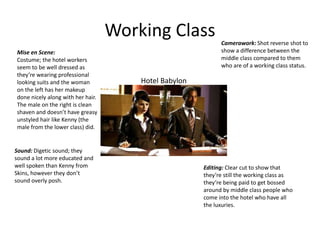
Hotel Babylon
Mise en Scene:
Costume; the hotel workers
seem to be well dressed as
they’re wearing professional
looking suits and the woman
on the left has her makeup
done nicely along with her hair.
The male on the right is clean
shaven and doesn’t have greasy
unstyled hair like Kenny (the
male from the lower class) did.
Camerawork: Shot reverse shot to
show a difference between the
middle class compared to them
who are of a working class status.
Sound: Digetic sound; they
sound a lot more educated and
well spoken than Kenny from
Skins, however they don’t
sound overly posh.
Editing: Clear cut to show that
they’re still the working class as
they’re being paid to get bossed
around by middle class people who
come into the hotel who have all
the luxuries.
Lower Middle Class
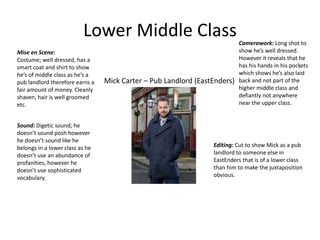
Mick Carter – Pub Landlord (EastEnders)
Mise en Scene:
Costume; well dressed, has a
smart coat and shirt to show
he’s of middle class as he’s a
pub landlord therefore earns a
fair amount of money. Cleanly
shaven, hair is well groomed
etc.
Camerawork: Long shot to
show he’s well dressed.
However it reveals that he
has his hands in his pockets
which shows he’s also laid
back and not part of the
higher middle class and
defiantly not anywhere
near the upper class.
Sound: Digetic sound; he
doesn’t sound posh however
he doesn’t sound like he
belongs in a lower class as he
doesn’t use an abundance of
profanities, however he
doesn’t use sophisticated
vocabulary.
Editing: Cut to show Mick as a pub
landlord to someone else in
EastEnders that is of a lower class
than him to make the juxtaposition
obvious.
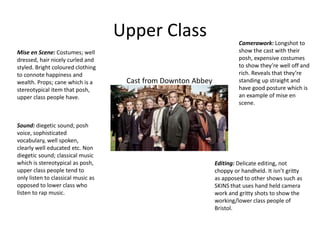
Upper Class
Cast from Downton Abbey
Mise en Scene: Costumes; well
dressed, hair nicely curled and
styled. Bright coloured clothing
to connote happiness and
wealth. Props; cane which is a
stereotypical item that posh,
upper class people have.
Camerawork: Longshot to
show the cast with their
posh, expensive costumes
to show they’re well off and
rich. Reveals that they’re
standing up straight and
have good posture which is
an example of mise en
scene.
Sound: diegetic sound; posh
voice, sophisticated
vocabulary, well spoken,
clearly well educated etc. Non
diegetic sound; classical music
which is stereotypical as posh,
upper class people tend to
only listen to classical music as
opposed to lower class who
listen to rap music.
Editing: Delicate editing, not
choppy or handheld. It isn’t gritty
as apposed to other shows such as
SKINS that uses hand held camera
work and gritty shots to show the
working/lower class people of
Bristol.
Theories
• Dominant ideology is a theory that can be applied to
social class as the ‘upper class’ are believed to be
dominant whereas the lower and working class are
seen as the subordinate.
• Levi Strauss’ theory of Binary Opposites could be
applied to social class as there are two clear opposites;
the upper class and the lower class. These can be
clearly identified through looking at mise en scene. For
example the upper class would have brightly coloured
clothing, a clean shaven face and done up hair,
whereas the lower class would look greasy, not be well
groomed and wear dull coloured, baggy clothing.

Social Class - Media G322

  • 1.
    Social Class Definition: socialclass is the measurement of how well of someone is in terms of their job, education, family background and where they live.
  • 2.
    Lower Class Kenny –Big Issue Seller (SKINS) Mise en Scene: Costume; Doesn’t care about his appearance; long greasy hair, hasn’t shaved, wearing shabby clothes. Props; Big Issue magazine that people who are supposedly of lower class sell although they sometimes fake being poor to get money for the magazine. Camerawork: Close up to emphasise the fact that he’s of a lower class due to his lack of care towards his appearance (or lack of money to go to the hairdressers/barbers or to afford razors etc.). Later on there is a wide shot to show the difference between Kenny (the big issue seller) and Tony who is of a higher class to Kenny as his family are from the higher working class/middle class. Sound: Digetic sound; he says how he can’t have help from Tony to sell the magazines as Tony looks wealthy and therefore he wouldn’t sell as many copies because they may think that because he’s speaking to someone of a higher class that he isn’t of a lower class. Editing: Cross cutting to show a clear comparison between Kenny who is of a lower class selling the Big Issue to earn some money and then to show Tony who comes from a wealthier background of parents who have decent jobs and are in the high working class to lower middle class.
  • 3.
    Working Class Hotel Babylon Miseen Scene: Costume; the hotel workers seem to be well dressed as they’re wearing professional looking suits and the woman on the left has her makeup done nicely along with her hair. The male on the right is clean shaven and doesn’t have greasy unstyled hair like Kenny (the male from the lower class) did. Camerawork: Shot reverse shot to show a difference between the middle class compared to them who are of a working class status. Sound: Digetic sound; they sound a lot more educated and well spoken than Kenny from Skins, however they don’t sound overly posh. Editing: Clear cut to show that they’re still the working class as they’re being paid to get bossed around by middle class people who come into the hotel who have all the luxuries.
  • 4.
    Lower Middle Class MickCarter – Pub Landlord (EastEnders) Mise en Scene: Costume; well dressed, has a smart coat and shirt to show he’s of middle class as he’s a pub landlord therefore earns a fair amount of money. Cleanly shaven, hair is well groomed etc. Camerawork: Long shot to show he’s well dressed. However it reveals that he has his hands in his pockets which shows he’s also laid back and not part of the higher middle class and defiantly not anywhere near the upper class. Sound: Digetic sound; he doesn’t sound posh however he doesn’t sound like he belongs in a lower class as he doesn’t use an abundance of profanities, however he doesn’t use sophisticated vocabulary. Editing: Cut to show Mick as a pub landlord to someone else in EastEnders that is of a lower class than him to make the juxtaposition obvious.
  • 5.
    Upper Class Cast fromDownton Abbey Mise en Scene: Costumes; well dressed, hair nicely curled and styled. Bright coloured clothing to connote happiness and wealth. Props; cane which is a stereotypical item that posh, upper class people have. Camerawork: Longshot to show the cast with their posh, expensive costumes to show they’re well off and rich. Reveals that they’re standing up straight and have good posture which is an example of mise en scene. Sound: diegetic sound; posh voice, sophisticated vocabulary, well spoken, clearly well educated etc. Non diegetic sound; classical music which is stereotypical as posh, upper class people tend to only listen to classical music as opposed to lower class who listen to rap music. Editing: Delicate editing, not choppy or handheld. It isn’t gritty as apposed to other shows such as SKINS that uses hand held camera work and gritty shots to show the working/lower class people of Bristol.
  • 6.
    Theories • Dominant ideologyis a theory that can be applied to social class as the ‘upper class’ are believed to be dominant whereas the lower and working class are seen as the subordinate. • Levi Strauss’ theory of Binary Opposites could be applied to social class as there are two clear opposites; the upper class and the lower class. These can be clearly identified through looking at mise en scene. For example the upper class would have brightly coloured clothing, a clean shaven face and done up hair, whereas the lower class would look greasy, not be well groomed and wear dull coloured, baggy clothing.