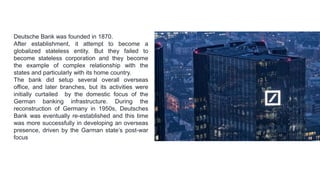
Deutsche Bank was founded in 1870.
After establishment, it attempt to become a
globalized stateless entity. But they failed to
become stateless corporation and they become
the example of complex relationship with the
states and particularly with its home country.
The bank did setup several overall overseas
office, and later branches, but its activities were
initially curtailed by the domestic focus of the
German banking infrastructure. During the
reconstruction of Germany in 1950s, Deutsches
Bank was eventually re-established and this time
was more successfully in developing an overseas
presence, driven by the Garman state’s post-war
focus
Q-1. How closely would you say Deutsche’s degree of internationalization is linked with state policy and how much
with wider global financial trends?
At the time of unification of the German state, the Deutsche Bank is founded. Since then the bank was wanted to
recognize themselves as an international bank. In my sense, I think the Deutsche’s degree of internationalization is
very much closely linked with state policy. The Deutsche bank is unique by comparing other globalizing companies
because it holds a strong position in international business but still able to remain its image as German. Most of its
overseas investment and asset managements are focused on the German market. To hold the position in global
market they merged some local financial and trading firms. The bank formed alliances with large regional banks,
giving itself an entry into Germany's main industrial regions. Joint ventures were symptomatic of the concentration
then under way in the German banking industry. Besides the whole regulations and laws of Deutsche bank is
undertaken by the German states themselves. In the end, the Deutsche bank is continued because of the
deregulation in the German domestic market by relaxing the rules of acquisition and mergers.
Besides, its internationalization is very much linked with the wider global financial trends. Previous to the founding of Deutsche
Bank, German importers and exporters were dependent upon English and French banking institutions in the world markets—a
serious handicap in that German bills were almost unknown in international commerce, generally disliked and subject to a higher
rate of discount than English or French bills. Understanding this limitation, the Deutsche bank is formed to reduce the cost of
foreign exchange and also introduced themselves in the global financial market. Private banks control roughly 30% of the market,
while publicly owned savings banks partially linked to state and local governments account for 50% of banking transactions, and
cooperative banks make up the balance. All three types of banks offer a full range of services to their customers. A private-owned
bank, Deutsche bank, provides special credit services, including the financing of homeowner mortgages, guarantees to small and
medium-sized businesses, financing for projects in disadvantaged regions in Germany and export financing for projects in
developing countries.
Q-2.
In your opinion, can a business ever be truly independent of the state?
In my opinion a business cannot truly independent of the state. Not truly independent is not a curse for any
business. Business is essential – in its place. So is government, in its place. The place of business is in the competitive
marketplace, to supply us with goods and services. The place of government, aside from protecting us from threats,
is to help keep that marketplace competitive and responsible. Today, the world is shifting towards a free market
economy. In this marketplace, whole economy is decided and control by the supply and demand of particular
product and service. Again free market promotes the capitalism. In many states, capitalism establishes power in the
hands of a minority capitalist class that exists through the exploitation of the majority working class, prioritizes profit
over social good, natural resources and the environment; and is an engine of inequality and economic instabilities.
To enjoy the free market economy, there should be some standard rules and regulations to stable the market from
such manipulation. The role of government in this type of economy is to
guarantee the fluidity and complete functioning of
the world of business. That is so easy to say. But
how can government make that possible? That’s
where the bulk of the challenge lies. Government
makes possible the fluidity and functioning of the
business world by enacting and implementing laws
or policies that could guarantee the rights of the
individuals to own properties and have these rights
secured and respected. Also, government must
strengthen the institutions that could guarantee the
security of the physical aspect of all private
investments in a stable political climate. There is no
such state where all the business activities are free
from state policy and state’s interruption. Most of
the country’s political system is democratic.
Democracy promotes that the government is by the
people, for the people, of the people. For this
reason democratic political system inspires political
freedom from business. But at the same time they
provide some general rule to protect each and
every investment. Again the communist countries
are fully control the marketplace. Almost every
businesses are state-owned.
For example: The Deutsche bank was
dreaming to develop a ‘stateless’ entity.
But they could not spate themselves from
their origin. Because of prioritizing too
much on stateless image, they failed at
earlier stage. And the reason is that time
the German banking infrastructure is
focused on domestic market economy.
Deutsche Bank’s situation as regard its
globalization can be described as mixed.
While it certainly has a strong international
presence as a financial institution, its
image remains strongly German. Though
they emphasizing their global activities
over its German roots, Deutsche’s activities
focused on the German market. Most of
the investment decision is also took by the
influence of the German states in
international operations. The Bank follows
both the international rules and their
domestic rules.
Q-3. What sort of
state activities can
encourage global
networking among
nationally originating
businesses ?
Lower Interest Rates
The Federal Reserve can alter the
Federal Funds Target Rate—the figure
that directly influences the prime
interest rate—to stimulate lending to
businesses and consumers. When the
prime rate dips, borrowing becomes
more profitable. This encourages
businesses to expand, and allows
consumers to experience temporary
increases in discretionary income.
Give Tax Incentives
Aside from the age-old argument that
lower corporate income taxes encourage
business activity, the government has
other techniques in its tax toolkit that can
stimulate specific industries. Tax
incentives to certain types of businesses,
or incentives for consumers who patronize
certain industries, can give fledgling
markets a powerful boost. A prime
example of this is the business and
residential solar power industry. Tax
incentives encourage entrepreneurs to
start new solar power businesses, and
incentives to purchasers encourage small
businesses and families to purchase solar
equipment.
Friendly Trade Policies
Foreign trade policies, such as
tariffs and import quotas, can
be lowered or eliminated to
encourage foreign trade.
Relaxed trade restrictions and
free-trade zones can allow local
businesses to realize significant
cost savings, allowing them to
increase their bottom lines. The
ability to outsource labor and
manufacturing to lower-cost
markets in addition to sourcing
cheaper materials helps to
increase profit margins,
encouraging business
expansion.
Contract Work
Government entities directly encourage
business activity when they contract
with private companies to perform
government responsibilities. Counties,
for example, can contract with third-
party road pavers, snow plowers and
towing services rather than creating
internal departments for these activities.
At the federal level, contractors are used
for war-zone logistics and intelligence
processing, among other things.
Grants, Loans and Disbursements
The government has access to an entire population's worth of
individual and business tax money, and has the ability to
distribute that money to affect change throughout the
economy.
Loans and grant programs offered directly to entrepreneurs are
one way to use tax revenue to stimulate business activity.
Another way, according to America.gov, is to fund agencies and
programs such as the Small Business Administration, which
provide assistance to startup entrepreneurs. Unemployment
and other federal assistance benefits ensure that a large
number of people have enough money to pay their bills,
leaving them with extra discretionary income that generally
falls into the hands of businesses.
Q-4.
Why might states encourage companies such as Deutsche to develop a global presence, knowing that this might lead to
reduced immediate financial benefits for them?
1. Increase sales: If the business is succeeding then expanding
globally will likely improve overall revenue. Approximately 90%
of the world’s population does not speak English – this suggests
customers are global and that if your company looks beyond
the shores of the domestic market. If the company has a
unique product or technological advantage not available to
international competitors then this advantage should result in
major business success abroad. For example, if we run a
software company and add a French and German language
version, we will extend the total market by nearly 200 million.
2. Improve profits: Many export markets are not as
competitive as Germany and therefore price pressures are far
less . It is common practice for German products to be sold at a
higher price in many export markets – software translated into
English is much appreciated by users in the U.S and they will
become loyal customers and pay a premium.
3. Short-term security: the business will be less vulnerable to
periodic fluctuations and downturns in the German economy
and marketplace.
4. Long-term security: German market is a large, mature
market with intense competition from domestic and foreign
competitors. Additionally, they currently has excess capacity so
international business trade may become a necessity if you
want to keep up in an increasingly global marketplace and
enjoy the potential for cost savings.
5. Increase innovation: Extending our customer base
internationally can help us finance new product development.
6. Exclusivity: The company’s management may have exclusive
market information about foreign customers/prospects,
marketplaces or market situations that are not known to
others.
7. Economies of scale: Exporting is an excellent way to expand
the business with products that are more widely accepted
around the world. In many manufacturing industries, for
example, internationalization can help companies achieve
greater scales of economy, especially for companies from
smaller domestic markets. In other cases, a company may seek
to exploit a unique and differentiating advantage (intellectual
property), such as a brand, service model, or patented product.
The emphasis should be on “more of the same,” with relatively
little adjustment to local markets, which would undermine
scale economies.
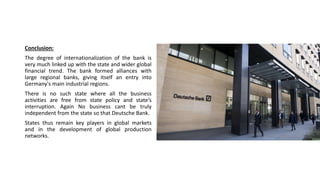
Conclusion:
The degree of internationalization of the bank is
very much linked up with the state and wider global
financial trend. The bank formed alliances with
large regional banks, giving itself an entry into
Germany's main industrial regions.
There is no such state where all the business
activities are free from state policy and state’s
interruption. Again No business cant be truly
independent from the state so that Deutsche Bank.
States thus remain key players in global markets
and in the development of global production
networks.

A Case Study on Deutsche Bank

  • 1.
    Deutsche Bank wasfounded in 1870. After establishment, it attempt to become a globalized stateless entity. But they failed to become stateless corporation and they become the example of complex relationship with the states and particularly with its home country. The bank did setup several overall overseas office, and later branches, but its activities were initially curtailed by the domestic focus of the German banking infrastructure. During the reconstruction of Germany in 1950s, Deutsches Bank was eventually re-established and this time was more successfully in developing an overseas presence, driven by the Garman state’s post-war focus
  • 2.
    Q-1. How closelywould you say Deutsche’s degree of internationalization is linked with state policy and how much with wider global financial trends?
  • 3.
    At the timeof unification of the German state, the Deutsche Bank is founded. Since then the bank was wanted to recognize themselves as an international bank. In my sense, I think the Deutsche’s degree of internationalization is very much closely linked with state policy. The Deutsche bank is unique by comparing other globalizing companies because it holds a strong position in international business but still able to remain its image as German. Most of its overseas investment and asset managements are focused on the German market. To hold the position in global market they merged some local financial and trading firms. The bank formed alliances with large regional banks, giving itself an entry into Germany's main industrial regions. Joint ventures were symptomatic of the concentration then under way in the German banking industry. Besides the whole regulations and laws of Deutsche bank is undertaken by the German states themselves. In the end, the Deutsche bank is continued because of the deregulation in the German domestic market by relaxing the rules of acquisition and mergers.
  • 4.
    Besides, its internationalizationis very much linked with the wider global financial trends. Previous to the founding of Deutsche Bank, German importers and exporters were dependent upon English and French banking institutions in the world markets—a serious handicap in that German bills were almost unknown in international commerce, generally disliked and subject to a higher rate of discount than English or French bills. Understanding this limitation, the Deutsche bank is formed to reduce the cost of foreign exchange and also introduced themselves in the global financial market. Private banks control roughly 30% of the market, while publicly owned savings banks partially linked to state and local governments account for 50% of banking transactions, and cooperative banks make up the balance. All three types of banks offer a full range of services to their customers. A private-owned bank, Deutsche bank, provides special credit services, including the financing of homeowner mortgages, guarantees to small and medium-sized businesses, financing for projects in disadvantaged regions in Germany and export financing for projects in developing countries.
  • 5.
    Q-2. In your opinion,can a business ever be truly independent of the state?
  • 6.
    In my opiniona business cannot truly independent of the state. Not truly independent is not a curse for any business. Business is essential – in its place. So is government, in its place. The place of business is in the competitive marketplace, to supply us with goods and services. The place of government, aside from protecting us from threats, is to help keep that marketplace competitive and responsible. Today, the world is shifting towards a free market economy. In this marketplace, whole economy is decided and control by the supply and demand of particular product and service. Again free market promotes the capitalism. In many states, capitalism establishes power in the hands of a minority capitalist class that exists through the exploitation of the majority working class, prioritizes profit over social good, natural resources and the environment; and is an engine of inequality and economic instabilities. To enjoy the free market economy, there should be some standard rules and regulations to stable the market from such manipulation. The role of government in this type of economy is to
  • 7.
    guarantee the fluidityand complete functioning of the world of business. That is so easy to say. But how can government make that possible? That’s where the bulk of the challenge lies. Government makes possible the fluidity and functioning of the business world by enacting and implementing laws or policies that could guarantee the rights of the individuals to own properties and have these rights secured and respected. Also, government must strengthen the institutions that could guarantee the security of the physical aspect of all private investments in a stable political climate. There is no such state where all the business activities are free from state policy and state’s interruption. Most of the country’s political system is democratic. Democracy promotes that the government is by the people, for the people, of the people. For this reason democratic political system inspires political freedom from business. But at the same time they provide some general rule to protect each and every investment. Again the communist countries are fully control the marketplace. Almost every businesses are state-owned. For example: The Deutsche bank was dreaming to develop a ‘stateless’ entity. But they could not spate themselves from their origin. Because of prioritizing too much on stateless image, they failed at earlier stage. And the reason is that time the German banking infrastructure is focused on domestic market economy. Deutsche Bank’s situation as regard its globalization can be described as mixed. While it certainly has a strong international presence as a financial institution, its image remains strongly German. Though they emphasizing their global activities over its German roots, Deutsche’s activities focused on the German market. Most of the investment decision is also took by the influence of the German states in international operations. The Bank follows both the international rules and their domestic rules.
  • 8.
    Q-3. What sortof state activities can encourage global networking among nationally originating businesses ?
  • 9.
    Lower Interest Rates TheFederal Reserve can alter the Federal Funds Target Rate—the figure that directly influences the prime interest rate—to stimulate lending to businesses and consumers. When the prime rate dips, borrowing becomes more profitable. This encourages businesses to expand, and allows consumers to experience temporary increases in discretionary income. Give Tax Incentives Aside from the age-old argument that lower corporate income taxes encourage business activity, the government has other techniques in its tax toolkit that can stimulate specific industries. Tax incentives to certain types of businesses, or incentives for consumers who patronize certain industries, can give fledgling markets a powerful boost. A prime example of this is the business and residential solar power industry. Tax incentives encourage entrepreneurs to start new solar power businesses, and incentives to purchasers encourage small businesses and families to purchase solar equipment.
  • 10.
    Friendly Trade Policies Foreigntrade policies, such as tariffs and import quotas, can be lowered or eliminated to encourage foreign trade. Relaxed trade restrictions and free-trade zones can allow local businesses to realize significant cost savings, allowing them to increase their bottom lines. The ability to outsource labor and manufacturing to lower-cost markets in addition to sourcing cheaper materials helps to increase profit margins, encouraging business expansion. Contract Work Government entities directly encourage business activity when they contract with private companies to perform government responsibilities. Counties, for example, can contract with third- party road pavers, snow plowers and towing services rather than creating internal departments for these activities. At the federal level, contractors are used for war-zone logistics and intelligence processing, among other things.
  • 11.
    Grants, Loans andDisbursements The government has access to an entire population's worth of individual and business tax money, and has the ability to distribute that money to affect change throughout the economy. Loans and grant programs offered directly to entrepreneurs are one way to use tax revenue to stimulate business activity. Another way, according to America.gov, is to fund agencies and programs such as the Small Business Administration, which provide assistance to startup entrepreneurs. Unemployment and other federal assistance benefits ensure that a large number of people have enough money to pay their bills, leaving them with extra discretionary income that generally falls into the hands of businesses.
  • 12.
    Q-4. Why might statesencourage companies such as Deutsche to develop a global presence, knowing that this might lead to reduced immediate financial benefits for them?
  • 13.
    1. Increase sales:If the business is succeeding then expanding globally will likely improve overall revenue. Approximately 90% of the world’s population does not speak English – this suggests customers are global and that if your company looks beyond the shores of the domestic market. If the company has a unique product or technological advantage not available to international competitors then this advantage should result in major business success abroad. For example, if we run a software company and add a French and German language version, we will extend the total market by nearly 200 million. 2. Improve profits: Many export markets are not as competitive as Germany and therefore price pressures are far less . It is common practice for German products to be sold at a higher price in many export markets – software translated into English is much appreciated by users in the U.S and they will become loyal customers and pay a premium.
  • 14.
    3. Short-term security:the business will be less vulnerable to periodic fluctuations and downturns in the German economy and marketplace. 4. Long-term security: German market is a large, mature market with intense competition from domestic and foreign competitors. Additionally, they currently has excess capacity so international business trade may become a necessity if you want to keep up in an increasingly global marketplace and enjoy the potential for cost savings. 5. Increase innovation: Extending our customer base internationally can help us finance new product development.
  • 15.
    6. Exclusivity: Thecompany’s management may have exclusive market information about foreign customers/prospects, marketplaces or market situations that are not known to others. 7. Economies of scale: Exporting is an excellent way to expand the business with products that are more widely accepted around the world. In many manufacturing industries, for example, internationalization can help companies achieve greater scales of economy, especially for companies from smaller domestic markets. In other cases, a company may seek to exploit a unique and differentiating advantage (intellectual property), such as a brand, service model, or patented product. The emphasis should be on “more of the same,” with relatively little adjustment to local markets, which would undermine scale economies.
  • 16.
    Conclusion: The degree ofinternationalization of the bank is very much linked up with the state and wider global financial trend. The bank formed alliances with large regional banks, giving itself an entry into Germany's main industrial regions. There is no such state where all the business activities are free from state policy and state’s interruption. Again No business cant be truly independent from the state so that Deutsche Bank. States thus remain key players in global markets and in the development of global production networks.