Wavelength Connect 2014 
Social Enterprise Members 
October 9th Session 
Key Challenges and 
top tips from the group
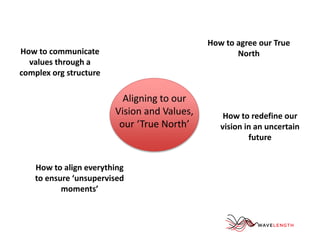
Aligning to our 
Vision and Values, 
our ‘True North’ 
How to agree our True 
North 
How to redefine our 
vision in an uncertain 
future 
How to communicate 
values through a 
complex org structure 
How to align everything 
to ensure ‘unsupervised 
moments’
Top tips and reflections – Aligning vision and values 
• Create ‘evidence-based’ arguments for change and clarity of purpose. Move it 
from a ‘fancy leadership exercise’ to a logical, rational business imperative 
• Articulate values through people stories. Clear and simple messages which talk 
about specific behaviours 
• Relentless commitment to the purpose, vision and values – look for every 
opportunity to align (people, messages, environment, processes, communication, 
meetings, contracts, etc etc). Use creativity and keep going. The job is never 
• The ‘Golden Thread’. Tie everyone’s objectives and performance management into 
the values and the strategy 
• Develop and use a behaviour framework – but beware, behaviours should be 
positioned as a guide not a prescription. No one likes to be told how to behave! 
• It must start from the top. If the board are not role-modeling this then don’t 
bother trying to get anyone else to do it! In fact, make it work with the board first 
before you launch it to anyone else 
• Tone of voice – make sure it is consistent internally and externally. Treat your 
people how you wish to treat your customers
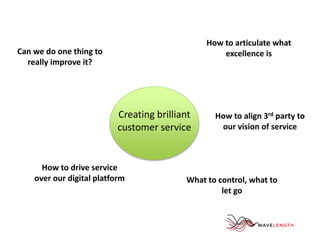
Creating brilliant 
customer service 
How to articulate what 
excellence is 
How to align 3rd party to 
our vision of service 
Can we do one thing to 
really improve it? 
How to drive service 
over our digital platform 
What to control, what to 
let go
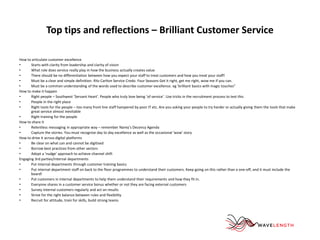
Top tips and reflections – Brilliant Customer Service 
How to articulate customer excellence 
• Starts with clarity from leadership and clarity of vision 
• What role does service really play in how the business actually creates value 
• There should be no differentiation between how you expect your staff to treat customers and how you treat your staff! 
• Must be a clear and simple definition. Ritz Carlton Service Credo. Four Seasons Get it right, get me right, wow me if you can. 
• Must be a common understanding of the words used to describe customer excellence. eg 'brilliant basics with magic touches" 
How to make it happen 
• Right people – Southwest ‘Servant Heart’. People who truly love being ‘of service’. Use tricks in the recruitment process to test this 
• People in the right place 
• Right tools for the people – too many front line staff hampered by poor IT etc. Are you asking your people to try harder or actually giving them the tools that make 
great service almost inevitable 
• Right training for the people 
How to share it 
• Relentless messaging in appropriate way – remember Narey’s Decency Agenda 
• Capture the stories. You must recognise day to day excellence as well as the occasional ‘wow’ story 
How to drive it across digital platforms 
• Be clear on what can and cannot be digitised 
• Borrow best practices from other sectors 
• Adopt a 'nudge' approach to achieve channel shift 
Engaging 3rd parties/internal departments 
• Put internal departments through customer training basics 
• Put internal department staff on back to the floor programmes to understand their customers. Keep going on this rather than a one-off, and it must include the 
board! 
• Put customers in internal departments to help them understand their requirements and how they fit in. 
• Everyone shares in a customer service bonus whether or not they are facing external customers 
• Survey internal customers regularly and act on results 
• Strive for the right balance between rules and flexibility 
• Recruit for attitude, train for skills, build strong teams
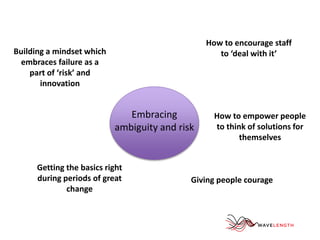
Embracing 
ambiguity and risk 
How to encourage staff 
to ‘deal with it’ 
How to empower people 
to think of solutions for 
themselves 
Building a mindset which 
embraces failure as a 
part of ‘risk’ and 
innovation 
Getting the basics right 
during periods of great 
change 
Giving people courage
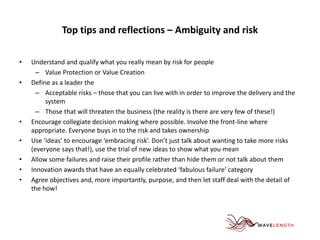
Top tips and reflections – Ambiguity and risk 
• Understand and qualify what you really mean by risk for people 
– Value Protection or Value Creation 
• Define as a leader the 
– Acceptable risks – those that you can live with in order to improve the delivery and the 
system 
– Those that will threaten the business (the reality is there are very few of these!) 
• Encourage collegiate decision making where possible. Involve the front-line where 
appropriate. Everyone buys in to the risk and takes ownership 
• Use ‘ideas’ to encourage ‘embracing risk’. Don’t just talk about wanting to take more risks 
(everyone says that!), use the trial of new ideas to show what you mean 
• Allow some failures and raise their profile rather than hide them or not talk about them 
• Innovation awards that have an equally celebrated ‘fabulous failure’ category 
• Agree objectives and, more importantly, purpose, and then let staff deal with the detail of 
the how!
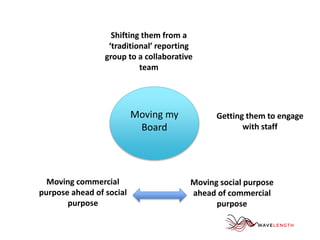
Shifting them from a 
‘traditional’ reporting 
group to a collaborative 
team 
Moving my 
Board 
Getting them to engage 
with staff 
Moving social purpose 
ahead of commercial 
purpose 
Moving commercial 
purpose ahead of social 
purpose
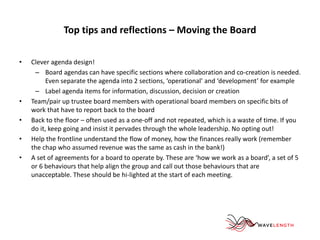
Top tips and reflections – Moving the Board 
• Clever agenda design! 
– Board agendas can have specific sections where collaboration and co-creation is needed. 
Even separate the agenda into 2 sections, ‘operational’ and ‘development’ for example 
– Label agenda items for information, discussion, decision or creation 
• Team/pair up trustee board members with operational board members on specific bits of 
work that have to report back to the board 
• Back to the floor – often used as a one-off and not repeated, which is a waste of time. If you 
do it, keep going and insist it pervades through the whole leadership. No opting out! 
• Help the frontline understand the flow of money, how the finances really work (remember 
the chap who assumed revenue was the same as cash in the bank!) 
• A set of agreements for a board to operate by. These are ‘how we work as a board’, a set of 5 
or 6 behaviours that help align the group and call out those behaviours that are 
unacceptable. These should be hi-lighted at the start of each meeting.
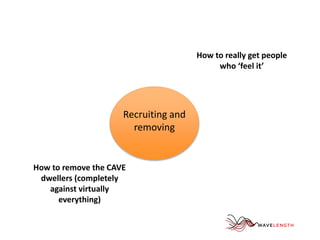
Recruiting and 
removing 
How to really get people 
who ‘feel it’ 
How to remove the CAVE 
dwellers (completely 
against virtually 
everything)
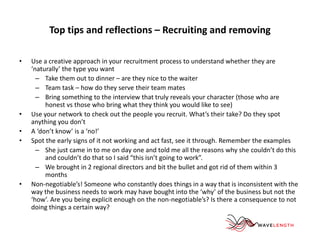
Top tips and reflections – Recruiting and removing 
• Use a creative approach in your recruitment process to understand whether they are 
‘naturally’ the type you want 
– Take them out to dinner – are they nice to the waiter 
– Team task – how do they serve their team mates 
– Bring something to the interview that truly reveals your character (those who are 
honest vs those who bring what they think you would like to see) 
• Use your network to check out the people you recruit. What’s their take? Do they spot 
anything you don’t 
• A ‘don’t know’ is a ‘no!’ 
• Spot the early signs of it not working and act fast, see it through. Remember the examples 
– She just came in to me on day one and told me all the reasons why she couldn’t do this 
and couldn’t do that so I said “this isn’t going to work”. 
– We brought in 2 regional directors and bit the bullet and got rid of them within 3 
months 
• Non-negotiable’s! Someone who constantly does things in a way that is inconsistent with the 
way the business needs to work may have bought into the ‘why’ of the business but not the 
‘how’. Are you being explicit enough on the non-negotiable’s? Is there a consequence to not 
doing things a certain way?
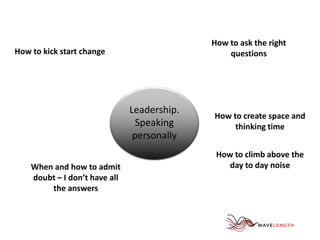
Leadership. 
Speaking 
personally 
How to ask the right 
questions 
How to create space and 
thinking time 
How to climb above the 
day to day noise 
How to kick start change 
When and how to admit 
doubt – I don’t have all 
the answers
Top tips and reflections – Leadership, speaking personally 
Run 
Walk 
Go for walks with your team 
Agenda-less meetings 
Breathe! 
Breathe some more! 
A good PA will create space for you 
Delete your whole inbox ‘by mistake’ 
Keep breathing! 
Keep connecting back to purpose – it helps 
you ask smart questions 
Personal Boardroom – are you balanced and 
are you tapping it 
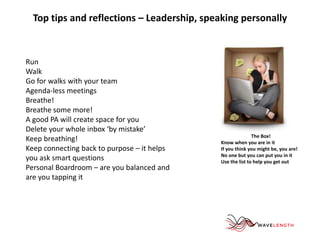
The Box! 
Know when you are in it 
If you think you might be, you are! 
No one but you can put you in it 
Use the list to help you get out
Wavelength Connect 2014 
Social Enterprise Members 
April 2nd Session 
Key Themes
‘Your True North’ 
Creating that sense of purpose that moves people beyond 
‘task’ 
From burning platform to burning ambition (Lars Kolind) 
Giving something meaning – ‘Its time to stop marketing to 
people and start mattering to people’ (Geoff from Unilever) 
It comes back to your moral purpose (Sue Campbell) 
Having strong business purpose means you can remove 
irrelevance – not being afraid to stop doing things 
Aligning your purpose with your values – do your values 
really drive your purpose, or are they just ‘nice’ ways of 
working
Culture as a true competitive 
advantage 
Being very specific about the culture you wish to create, and 
what you don’t want 
Giving it boundaries – who we are, who we are not! 
Intolerant of those who don’t fit – not turds allowed in the 
pool! 
F.I F.O – Fit in or feel free to leave! 
Steve Cadogan at LinkedIn. The only way to compete with 
Google is culturally. 
Continually reiterating what the culture is – Ritz Carlton line 
ups and storytelling
Focus - on what matters 
‘Unused Value = Waste’ – Lisa Gansky 
‘What more could you do’ – Sue Campbell, who found 
unused value in her people (The lady who became the drug 
information guru) 
Don’t simply make the irrelevant more efficient 
Relentless implementation – we know what we need to do. 
Incremental improvement can transform
Empowerment and 
Permission 
Pushing decision making to the front line where possible 
Unsupervised moments of service – how you create the 
conditions where people feel trusted, creative and caring at 
those moments. 
Allowing people a ‘Hinterland’ – Martin Narey 
What do you do, what more could you do? What’s stopping 
you? – Sue Campbell 
Permission to work differently, unencumbered by ‘the way 
we do things round here’. Eg, Lisa Gansky’s digital sabbath
Storytelling 
Keep saying it until it becomes true – Lisa Gansky 
Using stories to illustrate what’s important to us, customers, 
behaviours 
People don’t like lists of behaviours, so if you want to tell 
them what good looks like, tell them a few stories 
History, heritage, vision, customers, values, strategy – they 
all make good stories
Resourcefulness and 
Resilience 
‘Leave time for Love. Nurture those parts of your life that 
are nurturing to you’ – Helena Kennedy 
Look after yourself! There’s only so much you can do! 
Create a hinterland – thinking and assimilation time 
Martin Narey enforced KPI’s on a team member ensuring he 
spent time with his kids and got home on time. 
Connecting to purpose – spending 2-5 minutes through your 
day consciously connecting back to your purpose for… this 
meeting, this project, this phone call, this relationship etc 
Make a small difference every day
Agitated, itchy, even angry 
‘People follow leaders who are up to something’ 
It doesn’t have to be massively transformational – 
‘Relentless implementation (Martin Narey) 
Martin Narey’s decency agenda 
Do you need a plan to start? No, that comes later or is even 
retrospectively fitted! 
Every day everyone should come in and do one thing to 
make it a little bit better! 
Look for small margins that can make a big improvement – 
Sue Campbell
Leadership is a mindset 
‘The true quest for leadership is an inner one’ – Sam Conniff 
Its about how you think, then what you do 
‘Doubt is healthy’ – Martin Narey 
Its ok not to know all the answers. 
‘Its misguided to think you have to have all the answers just 
because someone who doesn’t have any of the answers has 
made you a leader!’ 
Not knowing is as much a part of authenticity as knowing 
Always accept invitations to do things that are challenging or 
frightening (Helena Kennedy)

Social Enterprise Challenges and Top Tips

  • 1.
    Wavelength Connect 2014 Social Enterprise Members October 9th Session Key Challenges and top tips from the group
  • 2.
    Aligning to our Vision and Values, our ‘True North’ How to agree our True North How to redefine our vision in an uncertain future How to communicate values through a complex org structure How to align everything to ensure ‘unsupervised moments’
  • 3.
    Top tips andreflections – Aligning vision and values • Create ‘evidence-based’ arguments for change and clarity of purpose. Move it from a ‘fancy leadership exercise’ to a logical, rational business imperative • Articulate values through people stories. Clear and simple messages which talk about specific behaviours • Relentless commitment to the purpose, vision and values – look for every opportunity to align (people, messages, environment, processes, communication, meetings, contracts, etc etc). Use creativity and keep going. The job is never • The ‘Golden Thread’. Tie everyone’s objectives and performance management into the values and the strategy • Develop and use a behaviour framework – but beware, behaviours should be positioned as a guide not a prescription. No one likes to be told how to behave! • It must start from the top. If the board are not role-modeling this then don’t bother trying to get anyone else to do it! In fact, make it work with the board first before you launch it to anyone else • Tone of voice – make sure it is consistent internally and externally. Treat your people how you wish to treat your customers
  • 4.
    Creating brilliant customerservice How to articulate what excellence is How to align 3rd party to our vision of service Can we do one thing to really improve it? How to drive service over our digital platform What to control, what to let go
  • 5.
    Top tips andreflections – Brilliant Customer Service How to articulate customer excellence • Starts with clarity from leadership and clarity of vision • What role does service really play in how the business actually creates value • There should be no differentiation between how you expect your staff to treat customers and how you treat your staff! • Must be a clear and simple definition. Ritz Carlton Service Credo. Four Seasons Get it right, get me right, wow me if you can. • Must be a common understanding of the words used to describe customer excellence. eg 'brilliant basics with magic touches" How to make it happen • Right people – Southwest ‘Servant Heart’. People who truly love being ‘of service’. Use tricks in the recruitment process to test this • People in the right place • Right tools for the people – too many front line staff hampered by poor IT etc. Are you asking your people to try harder or actually giving them the tools that make great service almost inevitable • Right training for the people How to share it • Relentless messaging in appropriate way – remember Narey’s Decency Agenda • Capture the stories. You must recognise day to day excellence as well as the occasional ‘wow’ story How to drive it across digital platforms • Be clear on what can and cannot be digitised • Borrow best practices from other sectors • Adopt a 'nudge' approach to achieve channel shift Engaging 3rd parties/internal departments • Put internal departments through customer training basics • Put internal department staff on back to the floor programmes to understand their customers. Keep going on this rather than a one-off, and it must include the board! • Put customers in internal departments to help them understand their requirements and how they fit in. • Everyone shares in a customer service bonus whether or not they are facing external customers • Survey internal customers regularly and act on results • Strive for the right balance between rules and flexibility • Recruit for attitude, train for skills, build strong teams
  • 6.
    Embracing ambiguity andrisk How to encourage staff to ‘deal with it’ How to empower people to think of solutions for themselves Building a mindset which embraces failure as a part of ‘risk’ and innovation Getting the basics right during periods of great change Giving people courage
  • 7.
    Top tips andreflections – Ambiguity and risk • Understand and qualify what you really mean by risk for people – Value Protection or Value Creation • Define as a leader the – Acceptable risks – those that you can live with in order to improve the delivery and the system – Those that will threaten the business (the reality is there are very few of these!) • Encourage collegiate decision making where possible. Involve the front-line where appropriate. Everyone buys in to the risk and takes ownership • Use ‘ideas’ to encourage ‘embracing risk’. Don’t just talk about wanting to take more risks (everyone says that!), use the trial of new ideas to show what you mean • Allow some failures and raise their profile rather than hide them or not talk about them • Innovation awards that have an equally celebrated ‘fabulous failure’ category • Agree objectives and, more importantly, purpose, and then let staff deal with the detail of the how!
  • 8.
    Shifting them froma ‘traditional’ reporting group to a collaborative team Moving my Board Getting them to engage with staff Moving social purpose ahead of commercial purpose Moving commercial purpose ahead of social purpose
  • 9.
    Top tips andreflections – Moving the Board • Clever agenda design! – Board agendas can have specific sections where collaboration and co-creation is needed. Even separate the agenda into 2 sections, ‘operational’ and ‘development’ for example – Label agenda items for information, discussion, decision or creation • Team/pair up trustee board members with operational board members on specific bits of work that have to report back to the board • Back to the floor – often used as a one-off and not repeated, which is a waste of time. If you do it, keep going and insist it pervades through the whole leadership. No opting out! • Help the frontline understand the flow of money, how the finances really work (remember the chap who assumed revenue was the same as cash in the bank!) • A set of agreements for a board to operate by. These are ‘how we work as a board’, a set of 5 or 6 behaviours that help align the group and call out those behaviours that are unacceptable. These should be hi-lighted at the start of each meeting.
  • 10.
    Recruiting and removing How to really get people who ‘feel it’ How to remove the CAVE dwellers (completely against virtually everything)
  • 11.
    Top tips andreflections – Recruiting and removing • Use a creative approach in your recruitment process to understand whether they are ‘naturally’ the type you want – Take them out to dinner – are they nice to the waiter – Team task – how do they serve their team mates – Bring something to the interview that truly reveals your character (those who are honest vs those who bring what they think you would like to see) • Use your network to check out the people you recruit. What’s their take? Do they spot anything you don’t • A ‘don’t know’ is a ‘no!’ • Spot the early signs of it not working and act fast, see it through. Remember the examples – She just came in to me on day one and told me all the reasons why she couldn’t do this and couldn’t do that so I said “this isn’t going to work”. – We brought in 2 regional directors and bit the bullet and got rid of them within 3 months • Non-negotiable’s! Someone who constantly does things in a way that is inconsistent with the way the business needs to work may have bought into the ‘why’ of the business but not the ‘how’. Are you being explicit enough on the non-negotiable’s? Is there a consequence to not doing things a certain way?
  • 12.
    Leadership. Speaking personally How to ask the right questions How to create space and thinking time How to climb above the day to day noise How to kick start change When and how to admit doubt – I don’t have all the answers
  • 13.
    Top tips andreflections – Leadership, speaking personally Run Walk Go for walks with your team Agenda-less meetings Breathe! Breathe some more! A good PA will create space for you Delete your whole inbox ‘by mistake’ Keep breathing! Keep connecting back to purpose – it helps you ask smart questions Personal Boardroom – are you balanced and are you tapping it The Box! Know when you are in it If you think you might be, you are! No one but you can put you in it Use the list to help you get out
  • 14.
    Wavelength Connect 2014 Social Enterprise Members April 2nd Session Key Themes
  • 15.
    ‘Your True North’ Creating that sense of purpose that moves people beyond ‘task’ From burning platform to burning ambition (Lars Kolind) Giving something meaning – ‘Its time to stop marketing to people and start mattering to people’ (Geoff from Unilever) It comes back to your moral purpose (Sue Campbell) Having strong business purpose means you can remove irrelevance – not being afraid to stop doing things Aligning your purpose with your values – do your values really drive your purpose, or are they just ‘nice’ ways of working
  • 16.
    Culture as atrue competitive advantage Being very specific about the culture you wish to create, and what you don’t want Giving it boundaries – who we are, who we are not! Intolerant of those who don’t fit – not turds allowed in the pool! F.I F.O – Fit in or feel free to leave! Steve Cadogan at LinkedIn. The only way to compete with Google is culturally. Continually reiterating what the culture is – Ritz Carlton line ups and storytelling
  • 17.
    Focus - onwhat matters ‘Unused Value = Waste’ – Lisa Gansky ‘What more could you do’ – Sue Campbell, who found unused value in her people (The lady who became the drug information guru) Don’t simply make the irrelevant more efficient Relentless implementation – we know what we need to do. Incremental improvement can transform
  • 18.
    Empowerment and Permission Pushing decision making to the front line where possible Unsupervised moments of service – how you create the conditions where people feel trusted, creative and caring at those moments. Allowing people a ‘Hinterland’ – Martin Narey What do you do, what more could you do? What’s stopping you? – Sue Campbell Permission to work differently, unencumbered by ‘the way we do things round here’. Eg, Lisa Gansky’s digital sabbath
  • 19.
    Storytelling Keep sayingit until it becomes true – Lisa Gansky Using stories to illustrate what’s important to us, customers, behaviours People don’t like lists of behaviours, so if you want to tell them what good looks like, tell them a few stories History, heritage, vision, customers, values, strategy – they all make good stories
  • 20.
    Resourcefulness and Resilience ‘Leave time for Love. Nurture those parts of your life that are nurturing to you’ – Helena Kennedy Look after yourself! There’s only so much you can do! Create a hinterland – thinking and assimilation time Martin Narey enforced KPI’s on a team member ensuring he spent time with his kids and got home on time. Connecting to purpose – spending 2-5 minutes through your day consciously connecting back to your purpose for… this meeting, this project, this phone call, this relationship etc Make a small difference every day
  • 21.
    Agitated, itchy, evenangry ‘People follow leaders who are up to something’ It doesn’t have to be massively transformational – ‘Relentless implementation (Martin Narey) Martin Narey’s decency agenda Do you need a plan to start? No, that comes later or is even retrospectively fitted! Every day everyone should come in and do one thing to make it a little bit better! Look for small margins that can make a big improvement – Sue Campbell
  • 22.
    Leadership is amindset ‘The true quest for leadership is an inner one’ – Sam Conniff Its about how you think, then what you do ‘Doubt is healthy’ – Martin Narey Its ok not to know all the answers. ‘Its misguided to think you have to have all the answers just because someone who doesn’t have any of the answers has made you a leader!’ Not knowing is as much a part of authenticity as knowing Always accept invitations to do things that are challenging or frightening (Helena Kennedy)