











Sneaking Scala
through the Back
Door
Dianne Marsh
OSCON 2013
Try the Front
Door
Know the “Why”
DO
Present from audience’s
point of view
DO
Use buzzwords
DON’T
Emphasize high value
points
DO
Represent success
stories
DO
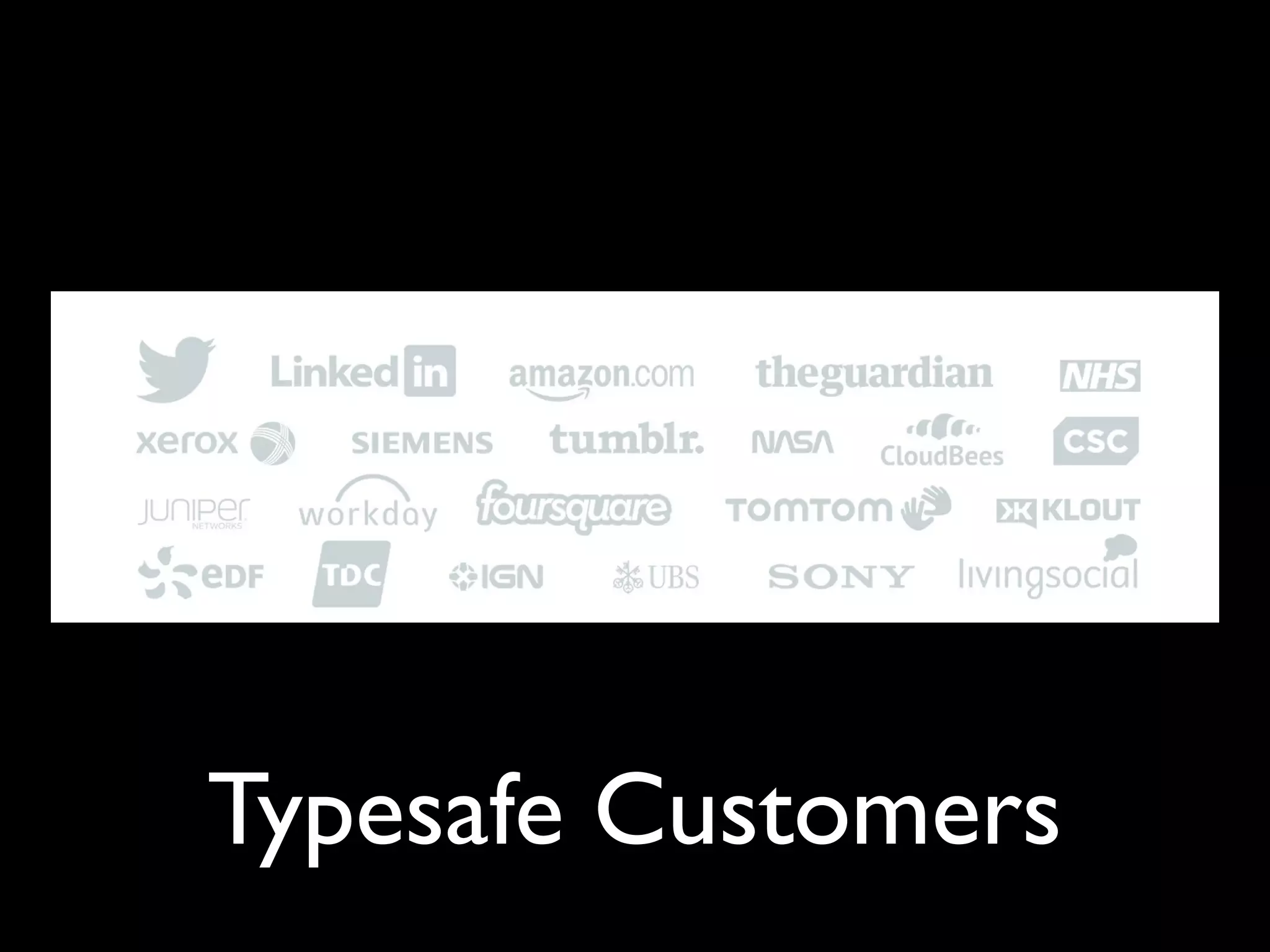
Typesafe Customers
Edda
Records AWS History
Open Source
Scala
Freedom & Responsibility
Killer Apps
• Play for web (Scala and Java)
• Akka for concurrency
• Object-oriented + mathematical modeling
= good fit for Scala
Domains
• Business Intelligence
• Social apps
• Border security
• eCommerce
• Anti-spam
• Advertising
Companies say ...
• Rapid development and productivity
• Asynchronous stateless scalabilty
• Massive configurability for peak load
• Reduces time to market
• DSL reduces load on devs
Anticipate objections
DO
Companies say ...• “Easy to find very good Java engineers and
excite them with new technologies”
• “Look for smart, energetic engineers eager
to learn”
• “No prior knowledge of Java, productive 2-
3 weeks into project”
• “Quickly productive with Scala”
• Reduces time to market
• DSL improves reduces load on devs
Use Scala for new
development
DO
Leverage existing Java
code
DO
Convert all legacy code
immediately*
*(maybe never)
*(maybe never)
DON’T
Use Scala as a Better
Java
DO
Use Scala for non-
production code
DO
Refer to code written
before 2.9
DON’T
Make Scala perl-like
DON’T
Discuss developer
productivity
DO
Draw from team’s
experience
DO
Use Scala to attract
candidates
DO
Try ScalaTest
DO
Stress about functional
perfection
DON’T
Try Play web
framework
DO
Try Scalaz
DON’T
Learn about parallel
collections
DO
Leverage TypeSafe’s
support
DO
Be a language zealot
DON’T
Get feedback from
others
DO
Contact Info
• twitter: @dmarsh
• Google+: dmarsh@netflix.com
• email: dmarsh@netflix.com
Additional References
• Making a persuasive argument: http://sixminutes.dlugan.com/logos-examples-speaking/
• Atomic Scala at http://atomicscala.com
• Learn Scala with the Koans at http://scalakoans.org
• Integrate testing with Scalatest: http://www.scalatest.org/
• Case studies: http://typesafe.com/company/casestudies
• Futures and promises in 2.10: https://speakerdeck.com/heathermiller/futures-and-promises-
in-scala-2-dot-10

Sneaking Scala through the Back Door

Editor's Notes

  • #2 I hope to give you some ideas about how you can bring Scala into your organization, addressing concerns that others might have. Also want to hear from you about what worked and what didn’t.
  • #3 Some companies will come to agreement on changing languages. Some of these tips will still be useful.
  • #4 But we live in interesting times. Whole generation of developers who are still programming in the language they used in college or their first job. Intimidating.
  • #5 Take time to understand WHY your company will benefit and build the persuasive argument. What’s wrong with current approach? What problem are you trying to solve? Concurrency? Performance? Scalability? Extensibility? Persuasive arguments are most effective if you put them in the context of the problem.
  • #6 Talk about business value.
  • #7 Don’t go deep into technical issues (unless you are talking to a highly technical decision maker). And, if you do, give the talking points to that person as well, for reaching others.
  • #8 All points are not of equal weight. A smaller number of strong arguments is better than getting lost in completeness.
  • #9 This speaks to decision makers in ways that they understand. Shows how other companies have experienced success and lets them relate your problems to theirs. Typesafe’s website has great case studies. Read them and find 1 or 2 that seem similar to your situation.
  • #10 It’s not just twitter using Scala.
  • #11 At Netflix, our developers choose their own languages with an understanding of how it will fit into the culture.
  • #15 Talk about hiring. Typesafe’s case studies talk about many companies that used enthusiastic PHP and Java developers in their Scala migration.
  • #17 Once you know the language, use it for new things, preserving your investment in Java code.
  • #18 Call Scala from Java. Call Java from Scala.
  • #19 Preserve your investment in Java code. Don’t refactor “just because”. Only convert libraries that make sense.
  • #20 It’s OK. Get comfortable with the language. Write Java-like Scala code. You will learn the idioms in time. You will become more functional.
  • #21 Low risk way to get to learn language. Testing. Internal apps. Gains confidence of team and management.
  • #22 Early adopters experimented with the language. The language has changed. Read recent blogs and books.
  • #23 Sometimes people use the language to impress. It can be very terse. Write-only. Don’t do that.
  • #24 Scala has less boilerplate. Streamlines focus on business problem. Expressive language illustrates meaning. Fast code/test cycle (Play/SBT).
  • #25 Does your team have C++/STL experience? Google Guava? C# with LINQ? These are all great ways to ease into functional programming.
  • #26 Energetic, eager developers often like to learn new languages. Use this to your advantage in hiring.
  • #27 This is a great testing framework that you can use on Java code or Scala code. It’s not production code, so you can learn the language at your leisure.
  • #28 Let functional programming emerge. You will be enchanted by Scala and simple functional concepts will come first; others will follow. Don’t force it.
  • #29 Stateless. Extensible. Works well with Javascript libraries.
  • #30 If you need scalaz, you will know it. Don’t go there now. Or anytime soon. You will scare people away.
  • #33 Scala isn’t the only language. Keep an open mind. Know when to fold.