Phases of the Moon + Eclipses
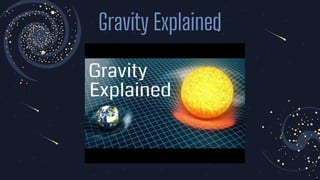
Gravity Explained
● Gravitational force = the force of attraction between
two massive objects → gravity
● There is a force of attraction between all objects in
the Universe.
● The planets are kept in orbit around the Sun due to
gravity.
● In the same way, the gravitational forces of both the
Earth and the Moon keep the Moon in orbit around
the Earth.
The Role of Gravity
The Lunar Cycle
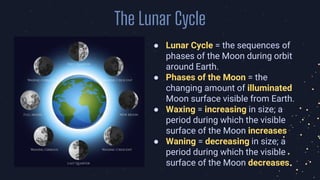
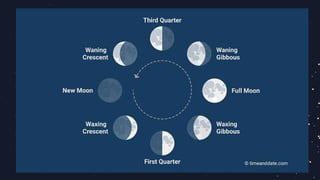
● Lunar Cycle = the sequences of
phases of the Moon during orbit
around Earth.
● Phases of the Moon = the
changing amount of illuminated
Moon surface visible from Earth.
● Waxing = increasing in size; a
period during which the visible
surface of the Moon increases
● Waning = decreasing in size; a
period during which the visible
surface of the Moon decreases.
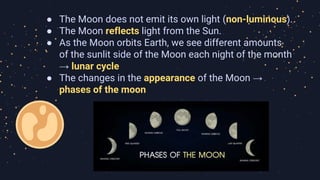
● The Moon does not emit its own light (non-luminous).
● The Moon reflects light from the Sun.
● As the Moon orbits Earth, we see different amounts
of the sunlit side of the Moon each night of the month
→ lunar cycle
● The changes in the appearance of the Moon →
phases of the moon
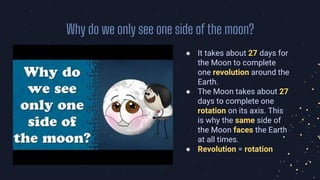
Why do we only see one side of the moon?
● It takes about 27 days for
the Moon to complete
one revolution around the
Earth.
● The Moon takes about 27
days to complete one
rotation on its axis. This
is why the same side of
the Moon faces the Earth
at all times.
● Revolution = rotation
Lunar Cycle
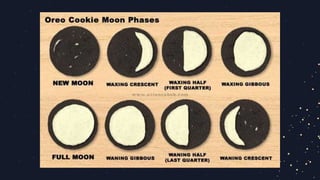
● The lunar cycle begins with the New Moon, when the sunlit
side of the Moon is facing away from the Earth.
○ New Moon = NO Moon (we see no moon)
● As the Moon continues to revolve and rotate, we continue
to see more of its sunlit side - the visible surface is
increasing = WAXING
● Full Moon = All Moon (we see all of its sunlit side)
● After the Full Moon, the part of the moon we see begins
decreasing = WANING
● We see less and less of the sunlit side until we are back to
the New Moon.
CREDITS: This presentation template was created by
Slidesgo, including icons by Flaticon, infographics &
images by Freepik
Solar Eclipse
Solar Eclipse
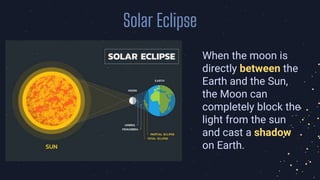
When the moon is
directly between the
Earth and the Sun,
the Moon can
completely block the
light from the sun
and cast a shadow
on Earth.
Solar Eclipse
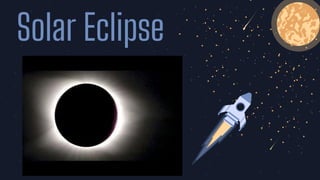
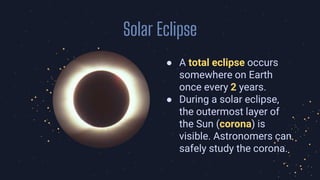
● A total eclipse occurs
somewhere on Earth
once every 2 years.
● During a solar eclipse,
the outermost layer of
the Sun (corona) is
visible. Astronomers can
safely study the corona.
Solar Eclipse Eye Protection
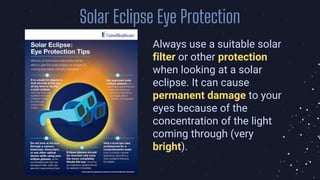
Always use a suitable solar
filter or other protection
when looking at a solar
eclipse. It can cause
permanent damage to your
eyes because of the
concentration of the light
coming through (very
bright).
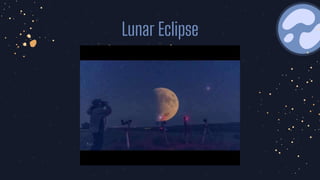
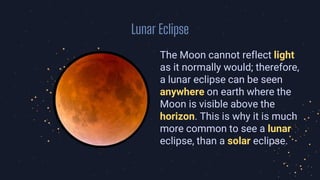
Lunar Eclipse
Lunar Eclipse
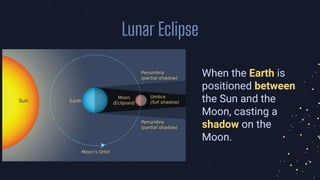
When the Earth is
positioned between
the Sun and the
Moon, casting a
shadow on the
Moon.
Lunar Eclipse
The Moon cannot reflect light
as it normally would; therefore,
a lunar eclipse can be seen
anywhere on earth where the
Moon is visible above the
horizon. This is why it is much
more common to see a lunar
eclipse, than a solar eclipse.
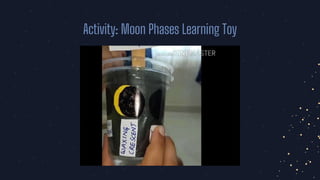
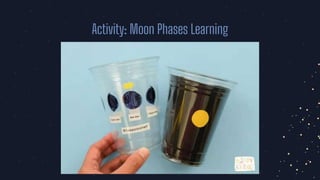
Activity: Moon Phases Learning Toy
Materials
● 2 large clear plastic cups
● Black permanent marker
● 1-inch diameter yellow circle
● A piece of black construction paper
● Basic stationery like glue, tape, and ruler
Procedure
1. Measure the height of the plastic cup. Cut a
rectangular piece of black construction paper with the
height of the plastic cup as the length of the paper.
2. Paste a yellow circle on the outside of the first cup.
3. Roll the black paper up with the yellow circle facing out,
making sure that the yellow circle is not covered by the
black paper. Insert the roll of black paper into one of
the plastic cups. Then secure the black paper onto the
cup.
4. Put this plastic cup with the black paper and yellow
circle INTO the second plastic cup. NOTE: We will be
drawing on the second plastic cup that’s outside in the
following steps.
CREDITS: This presentation template was created by
Slidesgo, including icons by Flaticon, infographics &
images by Freepik
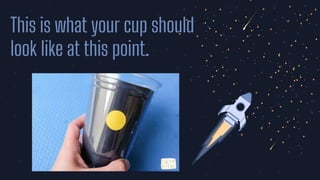
This is what your cup should
look like at this point.
Procedure
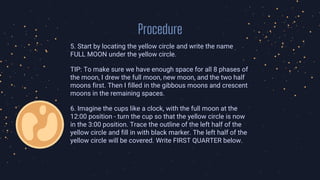
5. Start by locating the yellow circle and write the name
FULL MOON under the yellow circle.
TIP: To make sure we have enough space for all 8 phases of
the moon, I drew the full moon, new moon, and the two half
moons first. Then I filled in the gibbous moons and crescent
moons in the remaining spaces.
6. Imagine the cups like a clock, with the full moon at the
12:00 position - turn the cup so that the yellow circle is now
in the 3:00 position. Trace the outline of the left half of the
yellow circle and fill in with black marker. The left half of the
yellow circle will be covered. Write FIRST QUARTER below.
Procedure
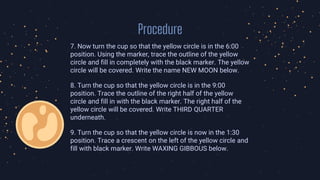
7. Now turn the cup so that the yellow circle is in the 6:00
position. Using the marker, trace the outline of the yellow
circle and fill in completely with the black marker. The yellow
circle will be covered. Write the name NEW MOON below.
8. Turn the cup so that the yellow circle is in the 9:00
position. Trace the outline of the right half of the yellow
circle and fill in with the black marker. The right half of the
yellow circle will be covered. Write THIRD QUARTER
underneath.
9. Turn the cup so that the yellow circle is now in the 1:30
position. Trace a crescent on the left of the yellow circle and
fill with black marker. Write WAXING GIBBOUS below.
Procedure
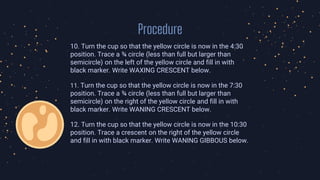
10. Turn the cup so that the yellow circle is now in the 4:30
position. Trace a ¾ circle (less than full but larger than
semicircle) on the left of the yellow circle and fill in with
black marker. Write WAXING CRESCENT below.
11. Turn the cup so that the yellow circle is now in the 7:30
position. Trace a ¾ circle (less than full but larger than
semicircle) on the right of the yellow circle and fill in with
black marker. Write WANING CRESCENT below.
12. Turn the cup so that the yellow circle is now in the 10:30
position. Trace a crescent on the right of the yellow circle
and fill in with black marker. Write WANING GIBBOUS below.
Activity: Moon Phases Learning
What did they look like on your birthday?
Hubble Space
Telescope
(NASA)
https://themoonjo
y.com/birthday-
moon-phase/
https://www.nasa.gov/
content/goddard/what-
did-hubble-see-on-your-
birthday
Moon Phase

SNC1P Space

  • 1.
    Phases of theMoon + Eclipses
  • 2.
  • 3.
    ● Gravitational force= the force of attraction between two massive objects → gravity ● There is a force of attraction between all objects in the Universe. ● The planets are kept in orbit around the Sun due to gravity. ● In the same way, the gravitational forces of both the Earth and the Moon keep the Moon in orbit around the Earth. The Role of Gravity
  • 4.
    The Lunar Cycle ●Lunar Cycle = the sequences of phases of the Moon during orbit around Earth. ● Phases of the Moon = the changing amount of illuminated Moon surface visible from Earth. ● Waxing = increasing in size; a period during which the visible surface of the Moon increases ● Waning = decreasing in size; a period during which the visible surface of the Moon decreases.
  • 5.
    ● The Moondoes not emit its own light (non-luminous). ● The Moon reflects light from the Sun. ● As the Moon orbits Earth, we see different amounts of the sunlit side of the Moon each night of the month → lunar cycle ● The changes in the appearance of the Moon → phases of the moon
  • 6.
    Why do weonly see one side of the moon? ● It takes about 27 days for the Moon to complete one revolution around the Earth. ● The Moon takes about 27 days to complete one rotation on its axis. This is why the same side of the Moon faces the Earth at all times. ● Revolution = rotation
  • 7.
    Lunar Cycle ● Thelunar cycle begins with the New Moon, when the sunlit side of the Moon is facing away from the Earth. ○ New Moon = NO Moon (we see no moon) ● As the Moon continues to revolve and rotate, we continue to see more of its sunlit side - the visible surface is increasing = WAXING ● Full Moon = All Moon (we see all of its sunlit side) ● After the Full Moon, the part of the moon we see begins decreasing = WANING ● We see less and less of the sunlit side until we are back to the New Moon.
  • 11.
    CREDITS: This presentationtemplate was created by Slidesgo, including icons by Flaticon, infographics & images by Freepik Solar Eclipse
  • 12.
    Solar Eclipse When themoon is directly between the Earth and the Sun, the Moon can completely block the light from the sun and cast a shadow on Earth.
  • 13.
    Solar Eclipse ● Atotal eclipse occurs somewhere on Earth once every 2 years. ● During a solar eclipse, the outermost layer of the Sun (corona) is visible. Astronomers can safely study the corona.
  • 14.
    Solar Eclipse EyeProtection Always use a suitable solar filter or other protection when looking at a solar eclipse. It can cause permanent damage to your eyes because of the concentration of the light coming through (very bright).
  • 15.
  • 16.
    Lunar Eclipse When theEarth is positioned between the Sun and the Moon, casting a shadow on the Moon.
  • 17.
    Lunar Eclipse The Mooncannot reflect light as it normally would; therefore, a lunar eclipse can be seen anywhere on earth where the Moon is visible above the horizon. This is why it is much more common to see a lunar eclipse, than a solar eclipse.
  • 18.
  • 19.
    Materials ● 2 largeclear plastic cups ● Black permanent marker ● 1-inch diameter yellow circle ● A piece of black construction paper ● Basic stationery like glue, tape, and ruler
  • 20.
    Procedure 1. Measure theheight of the plastic cup. Cut a rectangular piece of black construction paper with the height of the plastic cup as the length of the paper. 2. Paste a yellow circle on the outside of the first cup. 3. Roll the black paper up with the yellow circle facing out, making sure that the yellow circle is not covered by the black paper. Insert the roll of black paper into one of the plastic cups. Then secure the black paper onto the cup. 4. Put this plastic cup with the black paper and yellow circle INTO the second plastic cup. NOTE: We will be drawing on the second plastic cup that’s outside in the following steps.
  • 21.
    CREDITS: This presentationtemplate was created by Slidesgo, including icons by Flaticon, infographics & images by Freepik This is what your cup should look like at this point.
  • 22.
    Procedure 5. Start bylocating the yellow circle and write the name FULL MOON under the yellow circle. TIP: To make sure we have enough space for all 8 phases of the moon, I drew the full moon, new moon, and the two half moons first. Then I filled in the gibbous moons and crescent moons in the remaining spaces. 6. Imagine the cups like a clock, with the full moon at the 12:00 position - turn the cup so that the yellow circle is now in the 3:00 position. Trace the outline of the left half of the yellow circle and fill in with black marker. The left half of the yellow circle will be covered. Write FIRST QUARTER below.
  • 23.
    Procedure 7. Now turnthe cup so that the yellow circle is in the 6:00 position. Using the marker, trace the outline of the yellow circle and fill in completely with the black marker. The yellow circle will be covered. Write the name NEW MOON below. 8. Turn the cup so that the yellow circle is in the 9:00 position. Trace the outline of the right half of the yellow circle and fill in with the black marker. The right half of the yellow circle will be covered. Write THIRD QUARTER underneath. 9. Turn the cup so that the yellow circle is now in the 1:30 position. Trace a crescent on the left of the yellow circle and fill with black marker. Write WAXING GIBBOUS below.
  • 24.
    Procedure 10. Turn thecup so that the yellow circle is now in the 4:30 position. Trace a ¾ circle (less than full but larger than semicircle) on the left of the yellow circle and fill in with black marker. Write WAXING CRESCENT below. 11. Turn the cup so that the yellow circle is now in the 7:30 position. Trace a ¾ circle (less than full but larger than semicircle) on the right of the yellow circle and fill in with black marker. Write WANING CRESCENT below. 12. Turn the cup so that the yellow circle is now in the 10:30 position. Trace a crescent on the right of the yellow circle and fill in with black marker. Write WANING GIBBOUS below.
  • 25.
  • 26.
    What did theylook like on your birthday? Hubble Space Telescope (NASA) https://themoonjo y.com/birthday- moon-phase/ https://www.nasa.gov/ content/goddard/what- did-hubble-see-on-your- birthday Moon Phase

Editor's Notes

  • #2 Learning Goals Success Criteria Curriculum Connections
  • #3 https://www.youtube.com/watch?v=ljRlB6TuMOU