


Brand Study
Unlocking the success story - one case study at a time!
Overview
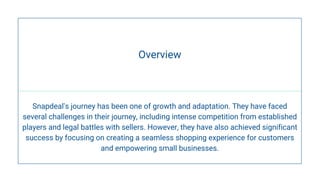
Snapdeal's journey has been one of growth and adaptation. They have faced
several challenges in their journey, including intense competition from established
players and legal battles with sellers. However, they have also achieved significant
success by focusing on creating a seamless shopping experience for customers
and empowering small businesses.
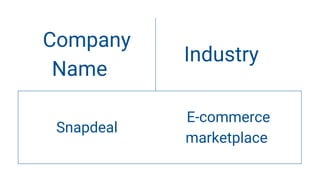
Company
Name 🏨
Industry 🏗
Snapdeal
E-commerce
marketplace
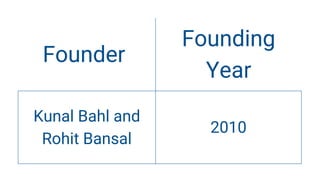
Founder
Founding
Year
Kunal Bahl and
Rohit Bansal
2010
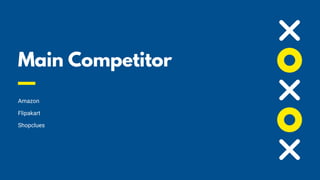
Main Competitor
Amazon
Flipakart
Shopclues
SWOT Analysis
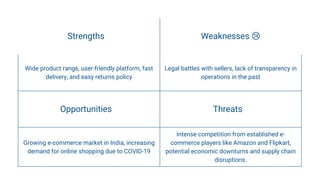
Strengths 💪 Weaknesses 😢
Wide product range, user-friendly platform, fast
delivery, and easy returns policy
Legal battles with sellers, lack of transparency in
operations in the past
Opportunities 🚀 Threats 🛑
Growing e-commerce market in India, increasing
demand for online shopping due to COVID-19
Intense competition from established e-
commerce players like Amazon and Flipkart,
potential economic downturns and supply chain
disruptions.
All About Brand
Short Founding
Story 🔍
Kunal Bahl and Rohit Bansal, both
graduates of Wharton School of the
University of Pennsylvania, were inspired
by the e-commerce boom in India during
their visit to India in 2007. They observed
that there was a gap in the market
between the demand and supply of
products, which led to the rise of
middlemen. This insight led them to start
Snapdeal in 2010, an online marketplace
that directly connects buyers and sellers,
eliminating the need for middlemen.
Problem Solved By
Snapdeal💡
Snapdeal aimed to solve the problem of intermediaries in the Indian e-commerce space. By
providing a platform that directly connects buyers and sellers, they wanted to make
shopping more convenient, accessible, and affordable for Indian customers.
Brand Positioning 📍
Snapdeal positions itself as a customer-centric brand that offers a wide range of products
at competitive prices. They focus on providing a seamless shopping experience and
empowering small businesses.
Business Model🧑‍💼
Snapdeal operates on the business-to-business-to-consumer (B2B2C) model, where they
allow sellers to list their products on the platform, and customers can buy them directly
from the sellers. They earn a commission on every transaction made on their platform.
Revenue Model 🤑💰
Snapdeal's revenue model is based on commissions earned from transactions made on
their platform. They also offer advertising services to sellers to increase their visibility on
the platform.
Target Customer 🎯
Snapdeal targets customers of all ages and life phases, but its primary target
audience is young adults aged between 18-35 years.
Product Line 🛒
Snapdeal offers a wide range of products across various categories like electronics,
fashion, home decor, personal care, and more. They also offer services like flight
bookings, hotel reservations, and bus tickets.
Best Selling Products on
Snapdeal 👍
Snapdeal's best-selling products are electronics, mobile phones, and fashion items.
Snapdeal USP 🤩 Snapdeal's unique value proposition lies in
its focus on providing a seamless online
shopping experience for customers. Their
platform is user-friendly and offers a wide
range of products at competitive prices.
They also offer fast delivery and easy
returns, making it convenient for
customers to shop from their platform.
How Snapdeal Become
Successful? 📈
Snapdeal's focus on providing a seamless shopping experience and their commitment to
empowering small businesses helped them gain a loyal customer base. Their targeted
marketing campaigns and innovative product offerings also played a significant role in
their success.
What You Can
Learn From Them?
📖
You can learn from Snapdeal's customer-
centric approach and their focus on
building a reliable and frictionless
commerce ecosystem. They also provide
an excellent example of how innovation
and technology can disrupt traditional
industries and create new opportunities.
Additionally, their emphasis on
empowering small businesses and
creating jobs for millions of people is an
excellent example of how brands can have
a positive impact on society.
Lessons Brand
Learned
Snapdeal's journey has taught them the importance of transparency, quality control, and
customer-centricity. They have learned to adapt and innovate to stay competitive in the
ever-evolving e-commerce industry.
Conclusion In conclusion, Snapdeal is a prime example of a
brand that has democratized e-commerce and
empowered small businesses and individual sellers
in India. By prioritizing its target audience's needs
and leveraging social media effectively, Shopclues
has built a loyal following and achieved rapid growth.
As an e-commerce business owner, you can learn
from Shopclues' innovative approach to reaching and
empowering underserved markets, building a strong
community of sellers, and continually adapting to
meet changing market conditions.

Snapdeal Case Study

  • 1.
    Brand Study Unlocking thesuccess story - one case study at a time!
  • 2.
    Overview Snapdeal's journey hasbeen one of growth and adaptation. They have faced several challenges in their journey, including intense competition from established players and legal battles with sellers. However, they have also achieved significant success by focusing on creating a seamless shopping experience for customers and empowering small businesses.
  • 3.
  • 4.
  • 5.
  • 6.
  • 7.
    Strengths 💪 Weaknesses😢 Wide product range, user-friendly platform, fast delivery, and easy returns policy Legal battles with sellers, lack of transparency in operations in the past Opportunities 🚀 Threats 🛑 Growing e-commerce market in India, increasing demand for online shopping due to COVID-19 Intense competition from established e- commerce players like Amazon and Flipkart, potential economic downturns and supply chain disruptions.
  • 8.
  • 9.
    Short Founding Story 🔍 KunalBahl and Rohit Bansal, both graduates of Wharton School of the University of Pennsylvania, were inspired by the e-commerce boom in India during their visit to India in 2007. They observed that there was a gap in the market between the demand and supply of products, which led to the rise of middlemen. This insight led them to start Snapdeal in 2010, an online marketplace that directly connects buyers and sellers, eliminating the need for middlemen.
  • 10.
    Problem Solved By Snapdeal💡 Snapdealaimed to solve the problem of intermediaries in the Indian e-commerce space. By providing a platform that directly connects buyers and sellers, they wanted to make shopping more convenient, accessible, and affordable for Indian customers.
  • 11.
    Brand Positioning 📍 Snapdealpositions itself as a customer-centric brand that offers a wide range of products at competitive prices. They focus on providing a seamless shopping experience and empowering small businesses.
  • 12.
    Business Model🧑‍💼 Snapdeal operateson the business-to-business-to-consumer (B2B2C) model, where they allow sellers to list their products on the platform, and customers can buy them directly from the sellers. They earn a commission on every transaction made on their platform.
  • 13.
    Revenue Model 🤑💰 Snapdeal'srevenue model is based on commissions earned from transactions made on their platform. They also offer advertising services to sellers to increase their visibility on the platform.
  • 14.
    Target Customer 🎯 Snapdealtargets customers of all ages and life phases, but its primary target audience is young adults aged between 18-35 years.
  • 15.
    Product Line 🛒 Snapdealoffers a wide range of products across various categories like electronics, fashion, home decor, personal care, and more. They also offer services like flight bookings, hotel reservations, and bus tickets.
  • 16.
    Best Selling Productson Snapdeal 👍 Snapdeal's best-selling products are electronics, mobile phones, and fashion items.
  • 17.
    Snapdeal USP 🤩Snapdeal's unique value proposition lies in its focus on providing a seamless online shopping experience for customers. Their platform is user-friendly and offers a wide range of products at competitive prices. They also offer fast delivery and easy returns, making it convenient for customers to shop from their platform.
  • 18.
    How Snapdeal Become Successful?📈 Snapdeal's focus on providing a seamless shopping experience and their commitment to empowering small businesses helped them gain a loyal customer base. Their targeted marketing campaigns and innovative product offerings also played a significant role in their success.
  • 19.
    What You Can LearnFrom Them? 📖 You can learn from Snapdeal's customer- centric approach and their focus on building a reliable and frictionless commerce ecosystem. They also provide an excellent example of how innovation and technology can disrupt traditional industries and create new opportunities. Additionally, their emphasis on empowering small businesses and creating jobs for millions of people is an excellent example of how brands can have a positive impact on society.
  • 20.
    Lessons Brand Learned Snapdeal's journeyhas taught them the importance of transparency, quality control, and customer-centricity. They have learned to adapt and innovate to stay competitive in the ever-evolving e-commerce industry.
  • 21.
    Conclusion In conclusion,Snapdeal is a prime example of a brand that has democratized e-commerce and empowered small businesses and individual sellers in India. By prioritizing its target audience's needs and leveraging social media effectively, Shopclues has built a loyal following and achieved rapid growth. As an e-commerce business owner, you can learn from Shopclues' innovative approach to reaching and empowering underserved markets, building a strong community of sellers, and continually adapting to meet changing market conditions.