I would like to thank my englishteacher Kalpana Sahu Mamand my
groupmembers for helping me in making this presentation. My group
members helped me in editingof this presentation. My parents helped
me in formatting the matterof the presentation. I collected the
informationfromthe internet and fromsome books.My other gratitude
I would like to convey to my school who suggest me to make this and to
have marks for addingit intoexamination.
• David Herbert Richards
Lawrence (11 September 1885 – 2
March 1930) was an English
novelist, poet, playwright,
essayist, literary critic and
painter who published as D. H.
Lawrence. His collected works,
among other things, represent an
extended reflection upon the
dehumanizing effects of
modernity
and industrialization. In them,
some of the issues Lawrence
explores are emotional health,
vitality, spontaneity and
instinct. D.H. LAWRENCE
• Lawrence's opinions earned him many enemies and he
endured official persecution, censorship, and
misrepresentation of his creative work throughout the
second half of his life, much of which he spent in a
voluntary exile which he called his "savage pilgrimage“.
At the time of his death, his public reputation was that of
a pornographer who had wasted his considerable
talents. E. M. Forster, in an obituary notice, challenged
this widely held view, describing him as, "The greatest
imaginative novelist of our generation.”Later, the
influential Cambridge critic F. R. Leavis championed
both his artistic integrity and his moral seriousness,
placing much of Lawrence's fiction within
the canonical "great tradition" of the English novel.
Novels
•The White Peacock (1911)
•The Trespasser (1912)
•Sons and Lovers (1913)
•The Rainbow (1915)
•Women in Love (1920)
•The Lost Girl (1920)
•Aaron's Rod (1922)
•Kangaroo (1923)
•The Boy in the Bush (1924)
•The Plumed Serpent (1926)
•Lady Chatterley's Lover(1928)
•The Escaped Cock (1929)
Poetrycollections
•Love Poems and others (1913)
•Amores (1916)
•Look! We have come through! (1917)
•New Poems (1918)
•Bay: a book of poems (1919)
•Tortoises (1921)
•Birds, Beasts and Flowers (1923)
•The Collected Poems of D H Lawrence (1928)
•Pansies (1929)
•Nettles (1930)
•Last Poems (1932)
•Fire and other poems (1940)
•the Complete Poems of D H Lawrence (1964)
•The White Horse (1964)
•D. H. Lawrence: Selected Poems (1972)
Plays
•The Daughter-in-Law (1912)
•The Widowing of Mrs Holroyd (1914)
•Touch and Go (1920)
•David (1926)
•The Fight for Barbara (1933)
•A Collier's Friday Night (1934)
•The Married Man (1940)
•The Merry-Go-Round (1941)
•The Complete Plays of D H Lawrence (1965)
Short storiescollections
•The Prussian Officerand Other Stories (1914)
•England, My England and Other Stories (1922)
•The Horse Dealer's Daughter (1922)
•The Fox (1923)
•The Captain's Doll (1923)
•The Ladybird (1923)
•St Mawr and other stories (1925)
•The Woman who Rode Away and other stories (1928)
•The Rocking-HorseWinner (1926)
•The Virgin and the Gipsy and Other Stories (1930)
•Love Among the Haystacks and other stories (1930)
•Collected Stories (1994) – Everyman's Library
Collectedletters
•The Letters of D. H. Lawrence, Volume I, September 1901 – May 1913
•The Letters of D. H. Lawrence, Volume II, June 1913 – October 1916
•The Letters of D. H. Lawrence, Volume III, October 1916 – June 1921
•The Letters of D. H. Lawrence, Volume IV, June 1921 – March 1924
•The Letters of D. H. Lawrence, Volume V, March 1924 – March 1927
•The Letters of D. H. Lawrence, Volume VI, March 1927 – November 1928
•The Letters of D. H. Lawrence, Volume VII, November 1928 – February 1930
•The Letters of D. H. Lawrence, with index, Volume VIII
•The Selected Letters of D H Lawrence
Non-fictionbooksandpamphlets
•Study of Thomas Hardy and other essays (1914)
•Movements in European History (1921)
• Psychoanalysis and the Unconscious and fantasia of the Unconscious (1921/1922)
•Studies in Classic American Literature (1923)
•Reflections on the Death of a Porcupine and other essays (1925)
• A Propos of Lady Chatterley's Lover (1929)
•Apocalypse and the writings on Revelation (1931)
•Phoenix: The Posthumous Papers of D. H. Lawrence (1936)
•Phoenix II: Uncollected, Unpublished and Other Prose Works by D. H. Lawrence (1968)
•Late Essays and Articles
•Selected Letters
Travelbooks
•Twilight in Italy and Other Essays (1916)
•Sea and Sardinia (1921)
•Mornings in Mexico and Other Essays (1927)
•Sketches of Etruscan Places and other Italian essays (1932)
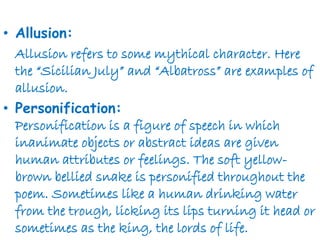
A snake came to my water-trough
On a hot, hot day, and I in pyjamas
for the heat,
To drink there.
In the deep, strange-scented shade of the
great dark carob-tree
I came down the steps with my pitcher
And must wait, must stand and
wait, for there he was at the trough
before
me.
He reached down from a fissure in the
earth-wall in the gloom
And trailed his yellow-brown
slackness soft-bellied down, over the
edge of
the stone trough
And rested his throat
upon the stone
bottom,
And where the water
had dripped from the
tap, in a small
clearness,
He sipped with his
straight mouth,
Softly drank
through his straight
gums, into his
slack long
body, Silently.
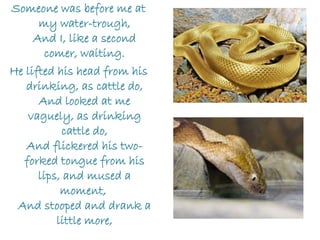
Someone was before me at
my water-trough,
And I, like a second
comer, waiting.
He lifted his head from his
drinking, as cattle do,
And looked at me
vaguely, as drinking
cattle do,
And flickered his two-
forked tongue from his
lips, and mused a
moment,
And stooped and drank a
little more,
Being earth-brown, earth-
golden from the burning
bowels of the earth
On the day of Sicilian
July, with Etna smoking.
The voice of my education
said to me
He must be killed,
For in Sicily the black,
black snakes are
innocent, the gold are
venomous.
And voices in me said, If
you were a man
You would take a stick
and break him now, and
finish him off.
But must I confess how I
liked him,
How glad I was he had
come like a guest in
quiet, to drink at my
water-trough
And depart peaceful,
pacified, and thankless,
Into the burning bowels
of this earth?
Was it cowardice, that I dared not
kill him? Was it perversity, that
I longed to talk to him? Was it
humility, to feel so honoured?
I felt so honored.
And yet those voices:
If you were not afraid, you
would kill him!
And truly I was afraid, I was most
afraid, But even so, honoured
still more
That he should seek my
hospitality
From out the dark door of the
secret earth.
He drank enough
And lifted his head, dreamily,
as one who has drunken,
And flickered his tongue like a
forked night on the air, so
black,
Seeming to lick his lips,
And looked around like a god,
unseeing, into the air,
And slowly turned his head,
And slowly, very slowly, as if
thrice a dream,
Proceeded to draw his slow
length curving round
And climb again the broken
bank of my wall-face.
And as he put his head into
that dreadful hole,
And as he slowly drew up,
snake-easing his shoulders,
and entered farther,
A sort of horror, a sort of
protest against his
withdrawing into that
horrid black hole,
Deliberately going into the
blackness, and slowly
drawing himself after,
Overcame me now his back
was turned
I looked round, I put down my
pitcher,
I picked up a clumsy log
And threw it at the water-
trough with a clatter.
I think it did not hit him,
But suddenly that part of him
that was left behind convulsed
in undignified haste.
Writhed like lightning, and
was gone
Into the black hole, the earth-
lipped fissure in the wall-front,
At which, in the intense still
noon, I stared with fascination.
And immediately I
regretted it.
I thought how paltry,
how vulgar, what a
mean act!
I despised myself and
the voices of my
accursed human
education.
And I thought of the
albatross
And I wished he would
come back, my snake.
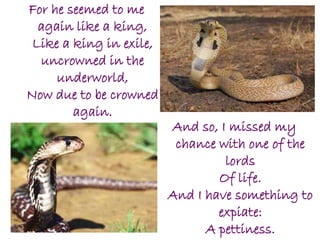
For he seemed to me
again like a king,
Like a king in exile,
uncrowned in the
underworld,
Now due to be crowned
again.
And so, I missed my
chance with one of the
lords
Of life.
And I have something to
expiate:
A pettiness.
• The poem begins about an encounter with a snake on a hot
day when the poet was in his pajamas and was going to fill
his pitcher. The snake was ahead of the poet and it was there to
drink water from the trough. When the poet came towards the
Carob tree, spreading its strange scent, he saw the snake and
had to stand and wait.
• The poet stood there watching the snake which slithered down
from the crack in the earthen wall and slipped over the edge of
the trough of water. The poet describes the snake as having a
soft yellow-brown belly. Lawrence stands there watching the
snake as the snake sips the water that is dripping from the
trough.
• The snake stood there sipping water from the trough which was
entering his mouth straight and into its gums. The poet waited
and watched over the snake. The snake then lifted his head,
looked at the poet ‘vaguely’, flickered his two-forked tongue,
stopped for a moment and then drank a little more. The poet then
goes on to describe that very hot day of July in the city of Sicily
and Etna with the smoky volcano that aggravates the heat. The
poet then hears a voice of his education that tells him to kill the
snake as black snakes in Sicily are not poisonous as yellow
snakes are. That was a yellow bellied snake. The voice in his
head provokes him by saying that if he was a man, he would
have taken a stick and killed the snake. ‘Finish him off’ is what
the voice urged him to do. But the poet confesses that he liked the
snake. The poet was glad that the snake paid a visit to his water-
trough. The snake went back into the ‘burning bowels of the
earth’ without thanking him.
• The poet questions himself that was it cowardice that
kept him from killing the snake? Or was it his
obstinacy that urged him to talk to it? The poet
contemplates if it was his humility that made him
feel so honored. A voice then challenges him that if he
was not afraid, he would have killed the snake.
• The poet confesses that he was truly afraid. He was
afraid that he let the dangerous snake to go and
feelings of honoUr that the snake sought the poet’s
hospitality.
• The poet describes the pacified snake in these lines who
lifted his head, drank water as if he was drunken
state, flickered his tongue, licked his lips and looked
around like god and slowly turned his head. After
quenching his thirst, the snake climbed back the wall
and disappeared into the earth.
• As the snake was slithering back into the hole, the poet
suddenly felt a sense of protest and horror and hastily he
puts down his pitcher, picks up a log and hurls at the
water trough where the snake was stranded.
• The snake was unhurt. The poet saw its slow retreating
body of the snake, disappearing into the hole from where
it once appeared. The poet regrets for his foolish act of
trying to kill the snake. For a moment, his emotions were
different and he hated himself and the voices that urged
him to do so. He despised the ‘accursed human education.’
• The poet thinks of the ‘albatross’ and wishes that the
snake would visit him again.
• The snake seemed like a king to the poet, a king
in exile and the one who lost his crown waiting to
be crowned again. The poet regrets that he missed
to spend time with one of the lords of life. He is left
with something to ‘expatiate’ and that is his
‘pettiness.’
• D.H Lawrence has used a simple, lucid, colorful,
descriptive and imaginative diction in the poem.
All these elements make the poem picturesque.
• The verses of “Snake” are unrhymed and written
in free verse. The first segment of the poem talks
about the arrival and description of the snake, the
second talks about the drinking from the water
trough. The third segment is about the poet’s
feeling and his sudden desire to kill the snake. In
the final segment, we find the poet’s remorse.
• Alliteration:
Alliteration is the close repetition of the consonant
sounds at the beginning of words to facilitate
narration.
• Simile:
A simile is a figure of speech in which two
dissimilar objects are compared and the comparison
is made clear by the use of terms like ‘like’, ‘such
as’ and so on.
• Allusion:
Allusion refers to some mythical character. Here
the “Sicilian July” and “Albatross” are examples of
allusion.
• Personification:
Personification is a figure of speech in which
inanimate objects or abstract ideas are given
human attributes or feelings. The soft yellow-
brown bellied snake is personified throughout the
poem. Sometimes like a human drinking water
from the trough, licking its lips turning it head or
sometimes as the king, the lords of life.
THANK YOU

Snake

  • 3.
    I would liketo thank my englishteacher Kalpana Sahu Mamand my groupmembers for helping me in making this presentation. My group members helped me in editingof this presentation. My parents helped me in formatting the matterof the presentation. I collected the informationfromthe internet and fromsome books.My other gratitude I would like to convey to my school who suggest me to make this and to have marks for addingit intoexamination.
  • 5.
    • David HerbertRichards Lawrence (11 September 1885 – 2 March 1930) was an English novelist, poet, playwright, essayist, literary critic and painter who published as D. H. Lawrence. His collected works, among other things, represent an extended reflection upon the dehumanizing effects of modernity and industrialization. In them, some of the issues Lawrence explores are emotional health, vitality, spontaneity and instinct. D.H. LAWRENCE
  • 6.
    • Lawrence's opinionsearned him many enemies and he endured official persecution, censorship, and misrepresentation of his creative work throughout the second half of his life, much of which he spent in a voluntary exile which he called his "savage pilgrimage“. At the time of his death, his public reputation was that of a pornographer who had wasted his considerable talents. E. M. Forster, in an obituary notice, challenged this widely held view, describing him as, "The greatest imaginative novelist of our generation.”Later, the influential Cambridge critic F. R. Leavis championed both his artistic integrity and his moral seriousness, placing much of Lawrence's fiction within the canonical "great tradition" of the English novel.
  • 8.
    Novels •The White Peacock(1911) •The Trespasser (1912) •Sons and Lovers (1913) •The Rainbow (1915) •Women in Love (1920) •The Lost Girl (1920) •Aaron's Rod (1922) •Kangaroo (1923) •The Boy in the Bush (1924) •The Plumed Serpent (1926) •Lady Chatterley's Lover(1928) •The Escaped Cock (1929) Poetrycollections •Love Poems and others (1913) •Amores (1916) •Look! We have come through! (1917) •New Poems (1918) •Bay: a book of poems (1919) •Tortoises (1921) •Birds, Beasts and Flowers (1923) •The Collected Poems of D H Lawrence (1928) •Pansies (1929) •Nettles (1930) •Last Poems (1932) •Fire and other poems (1940) •the Complete Poems of D H Lawrence (1964) •The White Horse (1964) •D. H. Lawrence: Selected Poems (1972) Plays •The Daughter-in-Law (1912) •The Widowing of Mrs Holroyd (1914) •Touch and Go (1920) •David (1926) •The Fight for Barbara (1933) •A Collier's Friday Night (1934) •The Married Man (1940) •The Merry-Go-Round (1941) •The Complete Plays of D H Lawrence (1965)
  • 9.
    Short storiescollections •The PrussianOfficerand Other Stories (1914) •England, My England and Other Stories (1922) •The Horse Dealer's Daughter (1922) •The Fox (1923) •The Captain's Doll (1923) •The Ladybird (1923) •St Mawr and other stories (1925) •The Woman who Rode Away and other stories (1928) •The Rocking-HorseWinner (1926) •The Virgin and the Gipsy and Other Stories (1930) •Love Among the Haystacks and other stories (1930) •Collected Stories (1994) – Everyman's Library Collectedletters •The Letters of D. H. Lawrence, Volume I, September 1901 – May 1913 •The Letters of D. H. Lawrence, Volume II, June 1913 – October 1916 •The Letters of D. H. Lawrence, Volume III, October 1916 – June 1921 •The Letters of D. H. Lawrence, Volume IV, June 1921 – March 1924 •The Letters of D. H. Lawrence, Volume V, March 1924 – March 1927 •The Letters of D. H. Lawrence, Volume VI, March 1927 – November 1928 •The Letters of D. H. Lawrence, Volume VII, November 1928 – February 1930 •The Letters of D. H. Lawrence, with index, Volume VIII •The Selected Letters of D H Lawrence
  • 10.
    Non-fictionbooksandpamphlets •Study of ThomasHardy and other essays (1914) •Movements in European History (1921) • Psychoanalysis and the Unconscious and fantasia of the Unconscious (1921/1922) •Studies in Classic American Literature (1923) •Reflections on the Death of a Porcupine and other essays (1925) • A Propos of Lady Chatterley's Lover (1929) •Apocalypse and the writings on Revelation (1931) •Phoenix: The Posthumous Papers of D. H. Lawrence (1936) •Phoenix II: Uncollected, Unpublished and Other Prose Works by D. H. Lawrence (1968) •Late Essays and Articles •Selected Letters Travelbooks •Twilight in Italy and Other Essays (1916) •Sea and Sardinia (1921) •Mornings in Mexico and Other Essays (1927) •Sketches of Etruscan Places and other Italian essays (1932)
  • 12.
    A snake cameto my water-trough On a hot, hot day, and I in pyjamas for the heat, To drink there. In the deep, strange-scented shade of the great dark carob-tree I came down the steps with my pitcher And must wait, must stand and wait, for there he was at the trough before me. He reached down from a fissure in the earth-wall in the gloom And trailed his yellow-brown slackness soft-bellied down, over the edge of the stone trough
  • 13.
    And rested histhroat upon the stone bottom, And where the water had dripped from the tap, in a small clearness, He sipped with his straight mouth, Softly drank through his straight gums, into his slack long body, Silently.
  • 14.
    Someone was beforeme at my water-trough, And I, like a second comer, waiting. He lifted his head from his drinking, as cattle do, And looked at me vaguely, as drinking cattle do, And flickered his two- forked tongue from his lips, and mused a moment, And stooped and drank a little more,
  • 15.
    Being earth-brown, earth- goldenfrom the burning bowels of the earth On the day of Sicilian July, with Etna smoking. The voice of my education said to me He must be killed, For in Sicily the black, black snakes are innocent, the gold are venomous. And voices in me said, If you were a man
  • 16.
    You would takea stick and break him now, and finish him off. But must I confess how I liked him, How glad I was he had come like a guest in quiet, to drink at my water-trough And depart peaceful, pacified, and thankless, Into the burning bowels of this earth?
  • 17.
    Was it cowardice,that I dared not kill him? Was it perversity, that I longed to talk to him? Was it humility, to feel so honoured? I felt so honored. And yet those voices: If you were not afraid, you would kill him! And truly I was afraid, I was most afraid, But even so, honoured still more That he should seek my hospitality From out the dark door of the secret earth.
  • 18.
    He drank enough Andlifted his head, dreamily, as one who has drunken, And flickered his tongue like a forked night on the air, so black, Seeming to lick his lips, And looked around like a god, unseeing, into the air, And slowly turned his head, And slowly, very slowly, as if thrice a dream, Proceeded to draw his slow length curving round And climb again the broken bank of my wall-face.
  • 19.
    And as heput his head into that dreadful hole, And as he slowly drew up, snake-easing his shoulders, and entered farther, A sort of horror, a sort of protest against his withdrawing into that horrid black hole, Deliberately going into the blackness, and slowly drawing himself after, Overcame me now his back was turned
  • 20.
    I looked round,I put down my pitcher, I picked up a clumsy log And threw it at the water- trough with a clatter. I think it did not hit him, But suddenly that part of him that was left behind convulsed in undignified haste. Writhed like lightning, and was gone Into the black hole, the earth- lipped fissure in the wall-front, At which, in the intense still noon, I stared with fascination.
  • 21.
    And immediately I regrettedit. I thought how paltry, how vulgar, what a mean act! I despised myself and the voices of my accursed human education. And I thought of the albatross And I wished he would come back, my snake.
  • 22.
    For he seemedto me again like a king, Like a king in exile, uncrowned in the underworld, Now due to be crowned again. And so, I missed my chance with one of the lords Of life. And I have something to expiate: A pettiness.
  • 23.
    • The poembegins about an encounter with a snake on a hot day when the poet was in his pajamas and was going to fill his pitcher. The snake was ahead of the poet and it was there to drink water from the trough. When the poet came towards the Carob tree, spreading its strange scent, he saw the snake and had to stand and wait. • The poet stood there watching the snake which slithered down from the crack in the earthen wall and slipped over the edge of the trough of water. The poet describes the snake as having a soft yellow-brown belly. Lawrence stands there watching the snake as the snake sips the water that is dripping from the trough.
  • 24.
    • The snakestood there sipping water from the trough which was entering his mouth straight and into its gums. The poet waited and watched over the snake. The snake then lifted his head, looked at the poet ‘vaguely’, flickered his two-forked tongue, stopped for a moment and then drank a little more. The poet then goes on to describe that very hot day of July in the city of Sicily and Etna with the smoky volcano that aggravates the heat. The poet then hears a voice of his education that tells him to kill the snake as black snakes in Sicily are not poisonous as yellow snakes are. That was a yellow bellied snake. The voice in his head provokes him by saying that if he was a man, he would have taken a stick and killed the snake. ‘Finish him off’ is what the voice urged him to do. But the poet confesses that he liked the snake. The poet was glad that the snake paid a visit to his water- trough. The snake went back into the ‘burning bowels of the earth’ without thanking him.
  • 25.
    • The poetquestions himself that was it cowardice that kept him from killing the snake? Or was it his obstinacy that urged him to talk to it? The poet contemplates if it was his humility that made him feel so honored. A voice then challenges him that if he was not afraid, he would have killed the snake. • The poet confesses that he was truly afraid. He was afraid that he let the dangerous snake to go and feelings of honoUr that the snake sought the poet’s hospitality. • The poet describes the pacified snake in these lines who lifted his head, drank water as if he was drunken state, flickered his tongue, licked his lips and looked around like god and slowly turned his head. After quenching his thirst, the snake climbed back the wall and disappeared into the earth.
  • 26.
    • As thesnake was slithering back into the hole, the poet suddenly felt a sense of protest and horror and hastily he puts down his pitcher, picks up a log and hurls at the water trough where the snake was stranded. • The snake was unhurt. The poet saw its slow retreating body of the snake, disappearing into the hole from where it once appeared. The poet regrets for his foolish act of trying to kill the snake. For a moment, his emotions were different and he hated himself and the voices that urged him to do so. He despised the ‘accursed human education.’ • The poet thinks of the ‘albatross’ and wishes that the snake would visit him again.
  • 27.
    • The snakeseemed like a king to the poet, a king in exile and the one who lost his crown waiting to be crowned again. The poet regrets that he missed to spend time with one of the lords of life. He is left with something to ‘expatiate’ and that is his ‘pettiness.’
  • 28.
    • D.H Lawrencehas used a simple, lucid, colorful, descriptive and imaginative diction in the poem. All these elements make the poem picturesque. • The verses of “Snake” are unrhymed and written in free verse. The first segment of the poem talks about the arrival and description of the snake, the second talks about the drinking from the water trough. The third segment is about the poet’s feeling and his sudden desire to kill the snake. In the final segment, we find the poet’s remorse.
  • 29.
    • Alliteration: Alliteration isthe close repetition of the consonant sounds at the beginning of words to facilitate narration. • Simile: A simile is a figure of speech in which two dissimilar objects are compared and the comparison is made clear by the use of terms like ‘like’, ‘such as’ and so on.
  • 30.
    • Allusion: Allusion refersto some mythical character. Here the “Sicilian July” and “Albatross” are examples of allusion. • Personification: Personification is a figure of speech in which inanimate objects or abstract ideas are given human attributes or feelings. The soft yellow- brown bellied snake is personified throughout the poem. Sometimes like a human drinking water from the trough, licking its lips turning it head or sometimes as the king, the lords of life.
  • 31.