Coaching and Feedback
Coaching and Feedback “ If you  really  want to demonstrate strong leadership,  COACH  your people.”   Anonymous
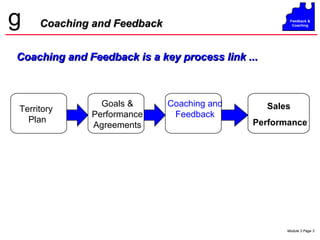
Territory  Plan Coaching and Feedback Coaching and Feedback Sales  Performance Coaching and Feedback is a key process link ... Goals & Performance Agreements
Learning Objectives Match a coaching style to individual salespeople.  Give effective feedback to reinforce desirable performance or redirect undesirable behaviors. Apply the characteristics of effective feedback. Recognize and manage resistance to feedback. Coach for sales effectiveness. By the end of this module, you will be able to…
“ My Best Coach” What did this coach  do ?  (Behaviors) What  assumptions  did you have about the coach based on this behavior? What was the  impact  on you? Table Team Exercise Think about the best sales coach you ever had ...
Model  successful  behaviors Clarify  (and communicate)  assumptions Provide individual, focused, timely  feedback Coaching and Feedback Best Coaches ...
Helps your salespeople understand their performance objectives by answering these questions: -   “What is expected of me?” -   “Why?” -  “ How will I be measured/evaluated on these expectations?” Coaching and Feedback Coaching…
Observing  specific  behaviors or actions, and … -   reinforcing  them, or  -   redirecting  them Helping your salespeople answer these questions: -  “How will I know whether I am performing  well  or performing  poorly ?” -  “How will you help me  improve  my performance?” Coaching and Feedback Effective Sales Managers utilize  both  types of feedback! Feedback Is ...
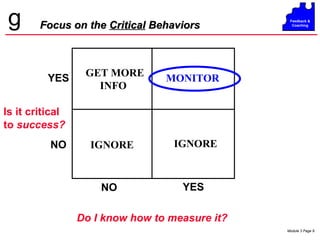
Focus on the  Critical  Behaviors Do I know how to measure it? Is it critical  to  success? NO YES NO YES GET MORE INFO MONITOR IGNORE IGNORE
Feedback to  Reinforce Where you want to  inspire  or  instruct  salespeople Provides individual recognition for accomplishments and contributions Can enhance the salesperson’s self-esteem and motivation Can be difficult to give and receive:  “uncomfortable” “ I don’t want to ‘jinx’ the situation”
Feedback to  Redirect Begins with informing your salesperson: The “facts” as you understand them. Your perceptions of the situation. If delivered under the right circumstances: Becomes an effective coaching intervention. Welcomed by the salesperson. Effective in initiating change. If delivered under the wrong circumstances: Viewed only as “criticism.” Leads to defensiveness, excuses, rejection.
Review of Definitions Coaching helps people to understand expectations Often pre-sales call Feedback reinforces or redirects specific behaviors and actions Post-sales call Feedback can be as powerful a tool in  reinforcing  desirable behavior or performance as it is in  redirecting  unsatisfactory behavior or performance! Feedback to  redirect  requires careful planning--thinking through the situation and   the desired outcome, or behavior change, which we want to affect.
Only become involved in face-to-face selling when your presence makes a unique difference. Do not make sales calls on a customer unless your salesperson is with you. Before any joint call, agree on specific and clear selling roles with your salesperson.  Avoid taking over call. Be an active internal seller for your salespeople. Always have a withdrawal strategy that prevents any customer from becoming dependent on you personally. Delivery of Coaching and Feedback “ Five Fundamental Principles to Guide a Sales Manager’s Face-to-Face Involvement with Customers.”
Delivery of Coaching and Feedback Class Discussion Ideally  when  and  where  should you coach or give feedback to your sales employees? What if they are remotely located?
“ As Sales Managers, what are some of the  challenges  we face in coaching and providing feedback to our salespeople?” Delivery of Coaching and Feedback 1. __________________________________________________ 2. __________________________________________________ 3. __________________________________________________ 4. __________________________________________________ 5. __________________________________________________ 6. __________________________________________________ Table Team Exercise
Coaching and Feedback  Challenges Tips for Coaching a  Diverse or Global  Sales Team There is no such thing as “stereo-typical behavior! Let your team know sexual harassment is taken very seriously, and incidents should be reported. Get H.R. counsel   immediately   if there is a sexual harassment issue Professional image can be hurt by inappropriate attire Need to provide feedback  carefully Be aware that body language differs by country … eye contact, hand gestures, etc. If you want some perspective on cultural norms or behavior patterns for your new salesperson, Zhang Chou, talk to your (Sales Manager) counterpart in Beijing. Read  Kiss, Bow, or Shake Hands,  by Morrison, Conaway, and Borden to learn about business norms in 60 countries.
Coaching and Feedback  Challenges Summary of Challenges Salespeople not co-located with you. Age and experience of the sales team.  Different levels of experience. Sales Manager  ‘forced’  into role of  ‘super-salesperson.’ The diversity of many sales teams. Must be prepared to  deal with each of these challenges
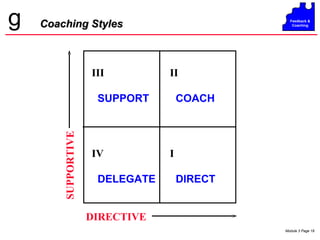
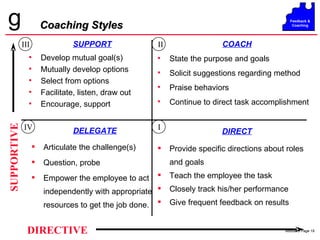
Coaching Styles III SUPPORT IV DELEGATE I DIRECT II COACH SUPPORTIVE DIRECTIVE
SUPPORT Develop mutual goal(s) Mutually develop options Select from options Facilitate, listen, draw out Encourage, support COACH State the purpose and goals Solicit suggestions regarding method Praise behaviors Continue to direct task accomplishment Coaching Styles DELEGATE Articulate the challenge(s) Question, probe Empower the employee to act independently with appropriate resources to get the job done. DIRECT Provide specific directions about roles and goals Teach the employee the task Closely track his/her performance Give frequent feedback on results SUPPORTIVE DIRECTIVE IV II III I
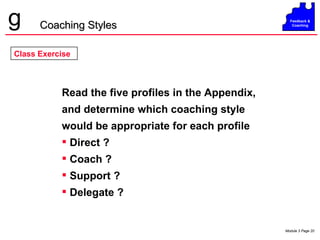
Class Exercise Read the five profiles in the Appendix, and determine which coaching style would be appropriate for each profile Direct ? Coach ? Support ? Delegate ? Coaching Styles
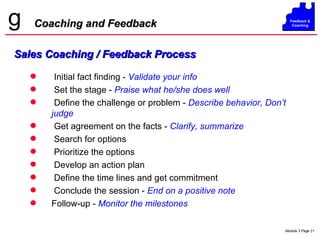
Coaching and Feedback Initial fact finding -  Validate your info   Set the stage -  Praise what he/she does well Define the challenge or problem -  Describe behavior, Don’t judge Get agreement on the facts -  Clarify, summarize Search for options Prioritize the options Develop an action plan Define the time lines and get commitment Conclude the session -   End on a positive note Follow-up -  Monitor the milestones Sales Coaching / Feedback Process
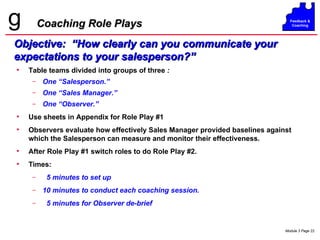
Coaching Role Plays Table teams divided into groups of three  : One “Salesperson.” One “Sales Manager.” One “Observer.” Use sheets in Appendix for Role Play #1 Observers evaluate how effectively Sales Manager provided baselines against which the Salesperson can measure and monitor their effectiveness. After Role Play #1 switch roles to do Role Play #2. Times: 5 minutes to set up 10 minutes to conduct each coaching session. 5 minutes for Observer de-brief Objective:  “How clearly can you communicate your expectations to your salesperson?”
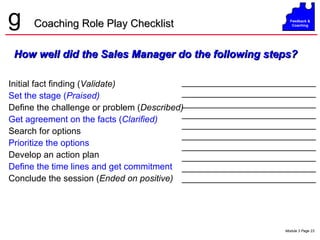
Coaching Role Play Checklist Initial fact finding ( Validate) Set the stage ( Praised) Define the challenge or problem ( Described) Get agreement on the facts ( Clarified) Search for options Prioritize the options Develop an action plan Define the time lines and get commitment Conclude the session ( Ended on positive) How well did the Sales Manager do the following steps? ______________________________________________________________________________________________________________________________________________________________________________________________________________________________________________________________________________
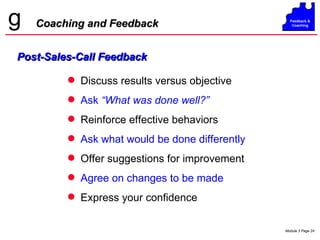
Coaching and Feedback Discuss results versus objective Ask  “What was done well?” Reinforce effective behaviors Ask what would be done differently Offer suggestions for improvement Agree on changes to be made Express your confidence Post-Sales-Call Feedback
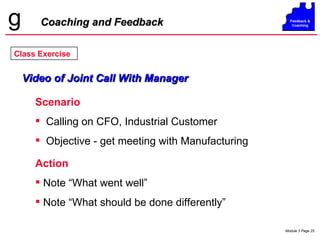
Coaching and Feedback  Video of Joint Call With Manager Scenario Calling on CFO, Industrial Customer Objective - get meeting with Manufacturing Action Note “What went well” Note “What should be done differently” Class Exercise
Resistance to Feedback Think about a situation where you have to give feedback to re-direct performance …. What was the reaction? Class Discussion
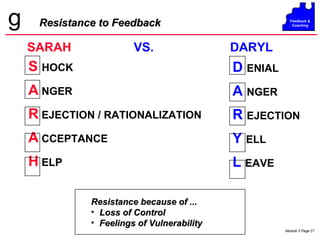
Resistance to Feedback S   HOCK A  NGER R  EJECTION / RATIONALIZATION A  CCEPTANCE H  ELP Resistance because of ... Loss of Control Feelings of Vulnerability SARAH   VS.  DARYL D   ENIAL A   NGER R   EJECTION Y   ELL L   EAVE
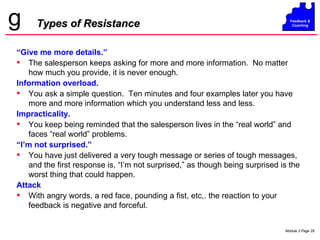
Types of Resistance “ Give me more details.” The salesperson keeps asking for more and more information.  No matter how much you provide, it is never enough. Information overload. You ask a simple question.  Ten minutes and four examples later you have more and more information which you understand less and less. Impracticality. You keep being reminded that the salesperson lives in the “real world” and faces “real world” problems. “ I’m not surprised.” You have just delivered a very tough message or series of tough messages, and the first response is, “I’m not surprised,” as though being surprised is the worst thing that could happen. Attack With angry words, a red face, pounding a fist, etc,. the reaction to your feedback is negative and forceful.
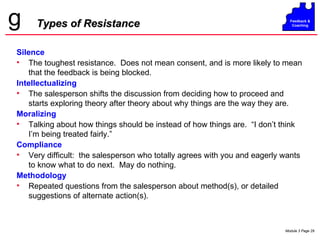
Types of Resistance Silence The toughest resistance.  Does not mean consent, and is more likely to mean that the feedback is being blocked. Intellectualizing The salesperson shifts the discussion from deciding how to proceed and starts exploring theory after theory about why things are the way they are. Moralizing Talking about how things should be instead of how things are.  “I don’t think I’m being treated fairly.” Compliance Very difficult:  the salesperson who totally agrees with you and eagerly wants to know what to do next.  May do nothing. Methodology Repeated questions from the salesperson about method(s), or detailed suggestions of alternate action(s).
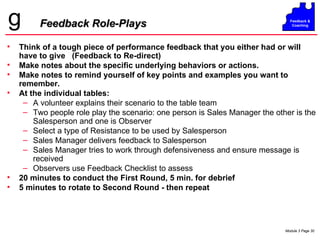
Feedback Role-Plays Think of a tough piece of performance feedback that you either had or will have to give  (Feedback to Re-direct) Make notes about the specific underlying behaviors or actions.  Make notes to remind yourself of key points and examples you want to remember. At the individual tables: A volunteer explains their scenario to the table team Two people role play the scenario: one person is Sales Manager the other is the Salesperson and one is Observer Select a type of Resistance to be used by Salesperson Sales Manager delivers feedback to Salesperson Sales Manager tries to work through defensiveness and ensure message is received Observers use Feedback Checklist to assess 20 minutes to conduct the First Round, 5 min. for debrief 5 minutes to rotate to Second Round - then repeat
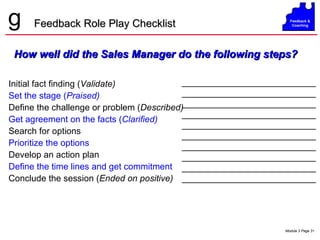
Feedback Role Play Checklist How well did the Sales Manager do the following steps?  Initial fact finding ( Validate) Set the stage ( Praised) Define the challenge or problem ( Described) Get agreement on the facts ( Clarified) Search for options Prioritize the options Develop an action plan Define the time lines and get commitment Conclude the session ( Ended on positive) ______________________________________________________________________________________________________________________________________________________________________________________________________________________________________________________________________________
Module 3 Appendix
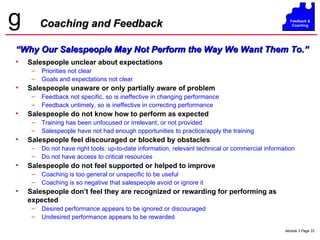
Coaching and Feedback “ Why Our Salespeople May Not Perform the Way We Want Them To.”  Salespeople unclear about expectations Priorities not clear Goals and expectations not clear Salespeople unaware or only partially aware of problem Feedback not specific, so is ineffective in changing performance Feedback untimely, so is ineffective in correcting performance Salespeople do not know how to perform as expected Training has been unfocused or irrelevant, or not provided Salespeople have not had enough opportunities to practice/apply the training Salespeople feel discouraged or blocked by obstacles Do not have right tools: up-to-date information, relevant technical or commercial information Do not have access to critical resources Salespeople do not feel supported or helped to improve Coaching is too general or unspecific to be useful Coaching is so negative that salespeople avoid or ignore it Salespeople don’t feel they are recognized or rewarding for performing as expected Desired performance appears to be ignored or discouraged Undesired performance appears to be rewarded
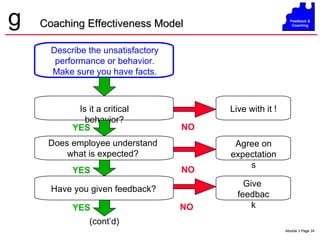
Coaching Effectiveness Model Describe the unsatisfactory performance or behavior. Make sure you have facts. Is it a critical behavior? Does employee understand what is expected? Have you given feedback? YES Live with it ! Agree on expectations Give  feedback YES YES NO NO NO (cont’d)
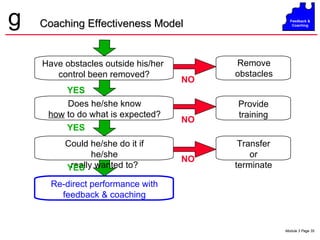
Coaching Effectiveness Model Does he/she know how  to do what is expected? Have obstacles outside his/her  control been removed? Could he/she do it if he/she really wanted to? YES YES YES NO NO NO Remove obstacles Provide training Transfer or terminate Re-direct performance with feedback & coaching
PROFILE 1 George Landgrabe Seasoned sales veteran.  Your most experienced employee. Consistent sales performance, but little evidence of real [sales-volume] growth. Jokes with the newer members of the sales team at the sales meetings:  “ If you want to know how it’s done around here, just ask Ole’ George.” When you invite him to participate in the B.S.T. / All Sales Days, he “had a cannot- miss meeting with his best customer.” When you asked him last month if he was interested in attending training on ‘ Understanding Customer Financial Analyses’, he declined, remarking mildly, “ My customers buy from us because they know me and trust me.” Coaching Styles
PROFILE 2 Walter Christoforo On the sales team for three years, the last two as Account Manager. Very consistent performance growth. As a result of this, Walter has taken on increased responsibilities in addition to his regular account management responsibilities: chaired the local B.S.T., put together a “Stand Up and Win” reception for key customers .  Two recent rumblings about “missed deadlines” lead you to believe that “things are starting to slip.” Following your last joint sales call with Walter, you reviewed these missed deadlines. His reply,  “ Not a problem….you’re right….I screwed up…. won’t happen again.” Coaching Styles
PROFILE 3 Helen Foster On the sales team for less than one year.  Transferred from GE ________, where she had been a Sales Engineer for four years. Had a great track record at her former GE Business.  Her former boss told you,  “ Helen worked very effectively with her customers….highly reliable….a real  customer ‘advocate’.”  Her past sales experience was with a  different  customer base (than her current assignment), selling different products and services to different markets. Your Sales Support person tipped you off that  “ Helen is really struggling with our Order Entry System.  I give her “A” for effort, but I know it’s frustrating her.” Coaching Styles
PROFILE 4 Deebolena Bose Joined the sales team late last year from GE International.  Has been doing an outstanding job in reviving the “deadest” territory.  Very positive feedback from customers. Your assessment to date: perhaps the highest-potential member of the sales team. To give her some top-level exposure, you have asked her to “host” next month’s visit by the Vice President-Sales.  This will include two visits to her Key Customers, and a review of the Customer CTQs and Dashboard Metrics. She has not complained (or asked for detailed guidance) concerning this visit, but you sense that she is somewhat overwhelmed by the task.  You are determined  not to let her fail. Coaching Styles
PROFILE 5 R. L. “Bob” Sharp Has been on the sales team for four years.  Has let it be known (privately) that  “ I should have been promoted to Sales Manager [your job].” Good, solid--not spectacular--sales performance.  No customer complaints. No evidence of a desire to transfer to another GE Business, or to accept another assignment within your Business.  Says (publicly),  “ I’ve put down some roots in the community…. I like it here.” You would be VERY hard put to classify Bob as a low performing (L10) player! In easier times, you might opt for a less pro-active stance with Bob, BUT, you are getting top-level pressure to increase Orders and Sales to Bob’s accounts. Coaching Styles
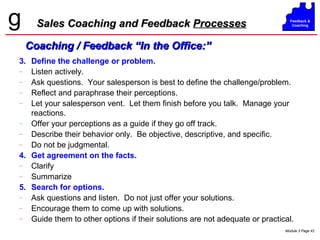
Sales Coaching and Feedback  Processes 1. Initial fact finding ... “Have I got it right?” What was covered in previous sessions? What goals were set?  Were they met? Have I personally quantified the results? Am I basing this on second-hand or third-hand information? Am I being objective? Do I have a current evaluation of this salesperson?  Strengths, Weaknesses, Opportunities. Have I talked with others as a reality check? What are the goals for this session? What action(s) would I like to have occur as a result of this session? 2. Set the Stage Praise what the salesperson does well. Briefly describe the opportunity for change/growth as you see it. Communicate your expectations for the session. Coaching / Feedback “In the Office:”
Sales Coaching and Feedback  Processes 3. Define the challenge or problem. Listen actively. Ask questions.  Your salesperson is best to define the challenge/problem. Reflect and paraphrase their perceptions. Let your salesperson vent.  Let them finish before you talk.  Manage your reactions. Offer your perceptions as a guide if they go off track. Describe their behavior only.  Be objective, descriptive, and specific. Do not be judgmental. 4. Get agreement on the facts. Clarify Summarize 5. Search for options. Ask questions and listen.  Do not just offer your solutions. Encourage them to come up with solutions. Guide them to other options if their solutions are not adequate or practical. Coaching / Feedback “In the Office:”
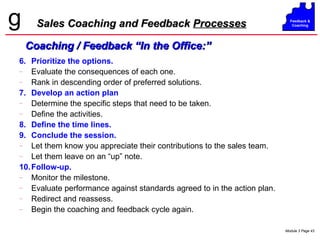
Sales Coaching and Feedback  Processes 6. Prioritize the options. Evaluate the consequences of each one. Rank in descending order of preferred solutions. 7. Develop an action plan Determine the specific steps that need to be taken. Define the activities. 8. Define the time lines. 9. Conclude the session. Let them know you appreciate their contributions to the sales team. Let them leave on an “up” note. 10. Follow-up. Monitor the milestone. Evaluate performance against standards agreed to in the action plan. Redirect and reassess. Begin the coaching and feedback cycle again. Coaching / Feedback “In the Office:”
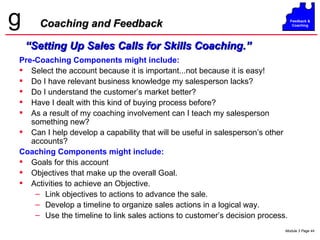
Coaching and Feedback Pre-Coaching Components might include: Select the account because it is important...not because it is easy! Do I have relevant business knowledge my salesperson lacks? Do I understand the customer’s market better? Have I dealt with this kind of buying process before? As a result of my coaching involvement can I teach my salesperson something new? Can I help develop a capability that will be useful in salesperson’s other accounts? Coaching Components might include: Goals for this account Objectives that make up the overall Goal. Activities to achieve an Objective. Link objectives to actions to advance the sale. Develop a timeline to organize sales actions in a logical way. Use the timeline to link sales actions to customer’s decision process. “ Setting Up Sales Calls for Skills Coaching.”
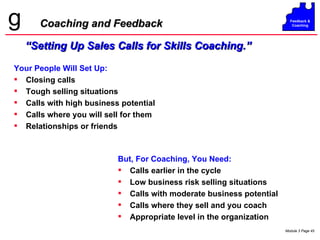
Coaching and Feedback “ Setting Up Sales Calls for Skills Coaching.” Your People Will Set Up: Closing calls Tough selling situations Calls with high business potential Calls where you will sell for them Relationships or friends But, For Coaching, You Need: Calls earlier in the cycle Low business risk selling situations Calls with moderate business potential Calls where they sell and you coach Appropriate level in the organization
ROLE PLAY #1A   SALESPERSON ROLE Your name is Aimee Fitzpatrick - Outside Sales Person First year on the sales team.  Bright, high-energy, high-potential.  You took over C.J. Strife’s accounts when C.J. retired after 35 years of great GE service. You have just returned from your first call on Midwest Industries, your second highest-potential / highest-volume account.  You are  depressed !  When your Manager asked how the call went, you replied that Karl Schimerhorn, Executive Vice President, had agreed to meet you  “because we have a great relationship with GE ______.”   Virtually the entire scheduled time was taken with Schimerhorn lamenting the retirement of C.J. Strife.  “We had a great relationship with C.J…..It is because of C.J. that we’re probably one of your largest customers…..C.J. really knew our people and our needs ….and on and on.” Although Schimerhorn did NOT make any inappropriate remarks or statements,  your impression is that  nobody  -- in Schimerhorn’s mind -- can “fill C.J.’s shoes. Coaching Situations
ROLE PLAY #1A   MANAGER ROLE You are Aimee Fitzpatrick’s Manager. This is Aimee’s first year on the sales team.  Bright, high-energy, high-potential.  She took over C.J. Strife’s accounts when C.J. retired after 35 years of great GE service. Aimee has just returned from her first call on Midwest Industries, her second highest potential / highest-volume account.  She is  depressed !  When you ask how the call went, she replies that Karl Schimerhorn, Executive Vice President, had agreed to meet her  “because we have a great relationship with GE ______.”   Virtually the entire scheduled time was taken with Schimerhorn lamenting the retirement of C.J. Strife.  “We had a great relationship with C.J…..It is because of C.J. that we’re probably one of your largest customers…..C.J. really knew our people and our needs ….and on and on.” Although Schimerhorn did NOT make any inappropriate remarks or statements, Aimee’s impression is that  nobody  -- in Schimerhorn’s mind -- can “fill C.J.’s shoes.” As her Sales Manager, you need to coach her to restore her self-confidence and help her address this obstacle. Coaching Situations
ROLE PLAY #1A   OBSERVER ROLE Observe how the Sales Manager coaches Aimee Fitzpatrick, and use the Coaching Checklist to take notes about this discussion. This is Aimee’s first year on the sales team.  Bright, high-energy, high-potential.  She took over C.J. Strife’s accounts when C.J. retired after 35 years of great GE service. Aimee has just returned from her first call on Midwest Industries, her second highest potential / highest-volume account.  She is  depressed !  When her Manager asks how the call went, she replies that Karl Schimerhorn, Executive Vice President, had agreed to meet her  “because we have a great relationship with GE ______.”   Virtually the entire scheduled time was taken with Schimerhorn lamenting the retirement of C.J. Strife.  “We had a great relationship with C.J…..It is because of C.J. that we’re probably one of your largest customers…..C.J. really knew our people and our needs ….and on and on.” Although Schimerhorn did NOT make any inappropriate remarks or statements, Aimee’s impression is that  nobody  -- in Schimerhorn’s mind -- can “fill C.J.’s shoes.” Her Sales Manager needs to coach her to restore her self-confidence and help her address this obstacle. Coaching Situations
ROLE PLAY #1B   SALESPERSON ROLE Your name is Harry Barlow, very experienced outside salesperson. Some call you a “Lone Ranger”. The reality is that you work very hard, meet (and exceed) your numbers, and have enviable respect and rapport with his customers.  Frankly, why not … you’ve had this same territory for twelve years. Your “hit-list” or “to-be-avoided-at-all-costs” list includes: (1) any type of sales skills training; (2) quarterly team meetings; (3) Customer CTQs and Dashboard Metrics; (4) Boundaryless Selling Team meetings, etc. You detest administrative tasks and feel that Account Plans, Call Reports, etc is an absolute waste of valuable selling time. Coaching Situations
ROLE PLAY #1B   MANAGER ROLE You are Harry Barlow’s Manager. Harry is the classic Lone Ranger. Your predecessor Sales Manager’s parting words as he handed you the keys were,  “Lots of luck with Harry.  He’s out of control!” The reality is that Harry works very hard, meets (and exceeds) his numbers, and has enviable respect and rapport with his customers.  Frankly, why not … Harry’s had this same territory for twelve years. Harry’s “hit-list” or “to-be-avoided-at-all-costs” list includes: (1) any type of sales skills training; (2) quarterly team meetings; (3) Customer CTQs and Dashboard Metrics; (4) Boundaryless Selling; etc. Harry’s reports are consistently submitted one minute  before  the deadline.  You suspect that this might be some games-playing designed to drive the hapless Sales Manager (you) crazy. Your significant issue with Harry is his “shielding” of his customers from contact by you.  Whenever time is available to make a joint sales call with Harry, the “Key Customer Decision Maker” is mysteriously (and consistently) unavailable.  As his Sales Manager, you need to coach him on these performance issues. Coaching Situations
ROLE PLAY #1B   OBSERVER ROLE Observe how the Sales Manager coaches Harry Barlow, and use the Coaching Checklist to take notes about this discussion. Harry is the classic Lone Ranger. The previous Sales Manager’s parting words to the new Manager were,  “Lots of luck with Harry.  He’s out of control!” The reality is that Harry works very hard, meets (and exceeds) his numbers, and has enviable respect and rapport with his customers.  Frankly, why not … Harry’s had this same territory for twelve years. Harry’s “hit-list” or “to-be-avoided-at-all-costs” list includes: (1) any type of sales skills training; (2) quarterly team meetings; (3) Customer CTQs and Dashboard Metrics; (4) Boundaryless Selling; etc. Harry’s reports are consistently submitted one minute  before  the deadline. This might be some games-playing designed to drive the new Sales Manager crazy. A significant issue with Harry is his “shielding” of his customers from contact by his new Manager.  Whenever time is available to make a joint sales call, the “Key Customer Decision Maker” is mysteriously (and consistently) unavailable.  His Sales Manager needs to coach him on these performance issues. Coaching Situations

Smc fdbk cchg tab 3 0403

  • 1.
  • 2.
    Coaching and Feedback“ If you really want to demonstrate strong leadership, COACH your people.” Anonymous
  • 3.
    Territory PlanCoaching and Feedback Coaching and Feedback Sales Performance Coaching and Feedback is a key process link ... Goals & Performance Agreements
  • 4.
    Learning Objectives Matcha coaching style to individual salespeople. Give effective feedback to reinforce desirable performance or redirect undesirable behaviors. Apply the characteristics of effective feedback. Recognize and manage resistance to feedback. Coach for sales effectiveness. By the end of this module, you will be able to…
  • 5.
    “ My BestCoach” What did this coach do ? (Behaviors) What assumptions did you have about the coach based on this behavior? What was the impact on you? Table Team Exercise Think about the best sales coach you ever had ...
  • 6.
    Model successful behaviors Clarify (and communicate) assumptions Provide individual, focused, timely feedback Coaching and Feedback Best Coaches ...
  • 7.
    Helps your salespeopleunderstand their performance objectives by answering these questions: - “What is expected of me?” - “Why?” - “ How will I be measured/evaluated on these expectations?” Coaching and Feedback Coaching…
  • 8.
    Observing specific behaviors or actions, and … - reinforcing them, or - redirecting them Helping your salespeople answer these questions: - “How will I know whether I am performing well or performing poorly ?” - “How will you help me improve my performance?” Coaching and Feedback Effective Sales Managers utilize both types of feedback! Feedback Is ...
  • 9.
    Focus on the Critical Behaviors Do I know how to measure it? Is it critical to success? NO YES NO YES GET MORE INFO MONITOR IGNORE IGNORE
  • 10.
    Feedback to Reinforce Where you want to inspire or instruct salespeople Provides individual recognition for accomplishments and contributions Can enhance the salesperson’s self-esteem and motivation Can be difficult to give and receive: “uncomfortable” “ I don’t want to ‘jinx’ the situation”
  • 11.
    Feedback to Redirect Begins with informing your salesperson: The “facts” as you understand them. Your perceptions of the situation. If delivered under the right circumstances: Becomes an effective coaching intervention. Welcomed by the salesperson. Effective in initiating change. If delivered under the wrong circumstances: Viewed only as “criticism.” Leads to defensiveness, excuses, rejection.
  • 12.
    Review of DefinitionsCoaching helps people to understand expectations Often pre-sales call Feedback reinforces or redirects specific behaviors and actions Post-sales call Feedback can be as powerful a tool in reinforcing desirable behavior or performance as it is in redirecting unsatisfactory behavior or performance! Feedback to redirect requires careful planning--thinking through the situation and the desired outcome, or behavior change, which we want to affect.
  • 13.
    Only become involvedin face-to-face selling when your presence makes a unique difference. Do not make sales calls on a customer unless your salesperson is with you. Before any joint call, agree on specific and clear selling roles with your salesperson. Avoid taking over call. Be an active internal seller for your salespeople. Always have a withdrawal strategy that prevents any customer from becoming dependent on you personally. Delivery of Coaching and Feedback “ Five Fundamental Principles to Guide a Sales Manager’s Face-to-Face Involvement with Customers.”
  • 14.
    Delivery of Coachingand Feedback Class Discussion Ideally when and where should you coach or give feedback to your sales employees? What if they are remotely located?
  • 15.
    “ As SalesManagers, what are some of the challenges we face in coaching and providing feedback to our salespeople?” Delivery of Coaching and Feedback 1. __________________________________________________ 2. __________________________________________________ 3. __________________________________________________ 4. __________________________________________________ 5. __________________________________________________ 6. __________________________________________________ Table Team Exercise
  • 16.
    Coaching and Feedback Challenges Tips for Coaching a Diverse or Global Sales Team There is no such thing as “stereo-typical behavior! Let your team know sexual harassment is taken very seriously, and incidents should be reported. Get H.R. counsel immediately if there is a sexual harassment issue Professional image can be hurt by inappropriate attire Need to provide feedback carefully Be aware that body language differs by country … eye contact, hand gestures, etc. If you want some perspective on cultural norms or behavior patterns for your new salesperson, Zhang Chou, talk to your (Sales Manager) counterpart in Beijing. Read Kiss, Bow, or Shake Hands, by Morrison, Conaway, and Borden to learn about business norms in 60 countries.
  • 17.
    Coaching and Feedback Challenges Summary of Challenges Salespeople not co-located with you. Age and experience of the sales team. Different levels of experience. Sales Manager ‘forced’ into role of ‘super-salesperson.’ The diversity of many sales teams. Must be prepared to deal with each of these challenges
  • 18.
    Coaching Styles IIISUPPORT IV DELEGATE I DIRECT II COACH SUPPORTIVE DIRECTIVE
  • 19.
    SUPPORT Develop mutualgoal(s) Mutually develop options Select from options Facilitate, listen, draw out Encourage, support COACH State the purpose and goals Solicit suggestions regarding method Praise behaviors Continue to direct task accomplishment Coaching Styles DELEGATE Articulate the challenge(s) Question, probe Empower the employee to act independently with appropriate resources to get the job done. DIRECT Provide specific directions about roles and goals Teach the employee the task Closely track his/her performance Give frequent feedback on results SUPPORTIVE DIRECTIVE IV II III I
  • 20.
    Class Exercise Readthe five profiles in the Appendix, and determine which coaching style would be appropriate for each profile Direct ? Coach ? Support ? Delegate ? Coaching Styles
  • 21.
    Coaching and FeedbackInitial fact finding - Validate your info Set the stage - Praise what he/she does well Define the challenge or problem - Describe behavior, Don’t judge Get agreement on the facts - Clarify, summarize Search for options Prioritize the options Develop an action plan Define the time lines and get commitment Conclude the session - End on a positive note Follow-up - Monitor the milestones Sales Coaching / Feedback Process
  • 22.
    Coaching Role PlaysTable teams divided into groups of three : One “Salesperson.” One “Sales Manager.” One “Observer.” Use sheets in Appendix for Role Play #1 Observers evaluate how effectively Sales Manager provided baselines against which the Salesperson can measure and monitor their effectiveness. After Role Play #1 switch roles to do Role Play #2. Times: 5 minutes to set up 10 minutes to conduct each coaching session. 5 minutes for Observer de-brief Objective: “How clearly can you communicate your expectations to your salesperson?”
  • 23.
    Coaching Role PlayChecklist Initial fact finding ( Validate) Set the stage ( Praised) Define the challenge or problem ( Described) Get agreement on the facts ( Clarified) Search for options Prioritize the options Develop an action plan Define the time lines and get commitment Conclude the session ( Ended on positive) How well did the Sales Manager do the following steps? ______________________________________________________________________________________________________________________________________________________________________________________________________________________________________________________________________________
  • 24.
    Coaching and FeedbackDiscuss results versus objective Ask “What was done well?” Reinforce effective behaviors Ask what would be done differently Offer suggestions for improvement Agree on changes to be made Express your confidence Post-Sales-Call Feedback
  • 25.
    Coaching and Feedback Video of Joint Call With Manager Scenario Calling on CFO, Industrial Customer Objective - get meeting with Manufacturing Action Note “What went well” Note “What should be done differently” Class Exercise
  • 26.
    Resistance to FeedbackThink about a situation where you have to give feedback to re-direct performance …. What was the reaction? Class Discussion
  • 27.
    Resistance to FeedbackS HOCK A NGER R EJECTION / RATIONALIZATION A CCEPTANCE H ELP Resistance because of ... Loss of Control Feelings of Vulnerability SARAH VS. DARYL D ENIAL A NGER R EJECTION Y ELL L EAVE
  • 28.
    Types of Resistance“ Give me more details.” The salesperson keeps asking for more and more information. No matter how much you provide, it is never enough. Information overload. You ask a simple question. Ten minutes and four examples later you have more and more information which you understand less and less. Impracticality. You keep being reminded that the salesperson lives in the “real world” and faces “real world” problems. “ I’m not surprised.” You have just delivered a very tough message or series of tough messages, and the first response is, “I’m not surprised,” as though being surprised is the worst thing that could happen. Attack With angry words, a red face, pounding a fist, etc,. the reaction to your feedback is negative and forceful.
  • 29.
    Types of ResistanceSilence The toughest resistance. Does not mean consent, and is more likely to mean that the feedback is being blocked. Intellectualizing The salesperson shifts the discussion from deciding how to proceed and starts exploring theory after theory about why things are the way they are. Moralizing Talking about how things should be instead of how things are. “I don’t think I’m being treated fairly.” Compliance Very difficult: the salesperson who totally agrees with you and eagerly wants to know what to do next. May do nothing. Methodology Repeated questions from the salesperson about method(s), or detailed suggestions of alternate action(s).
  • 30.
    Feedback Role-Plays Thinkof a tough piece of performance feedback that you either had or will have to give (Feedback to Re-direct) Make notes about the specific underlying behaviors or actions. Make notes to remind yourself of key points and examples you want to remember. At the individual tables: A volunteer explains their scenario to the table team Two people role play the scenario: one person is Sales Manager the other is the Salesperson and one is Observer Select a type of Resistance to be used by Salesperson Sales Manager delivers feedback to Salesperson Sales Manager tries to work through defensiveness and ensure message is received Observers use Feedback Checklist to assess 20 minutes to conduct the First Round, 5 min. for debrief 5 minutes to rotate to Second Round - then repeat
  • 31.
    Feedback Role PlayChecklist How well did the Sales Manager do the following steps? Initial fact finding ( Validate) Set the stage ( Praised) Define the challenge or problem ( Described) Get agreement on the facts ( Clarified) Search for options Prioritize the options Develop an action plan Define the time lines and get commitment Conclude the session ( Ended on positive) ______________________________________________________________________________________________________________________________________________________________________________________________________________________________________________________________________________
  • 32.
  • 33.
    Coaching and Feedback“ Why Our Salespeople May Not Perform the Way We Want Them To.” Salespeople unclear about expectations Priorities not clear Goals and expectations not clear Salespeople unaware or only partially aware of problem Feedback not specific, so is ineffective in changing performance Feedback untimely, so is ineffective in correcting performance Salespeople do not know how to perform as expected Training has been unfocused or irrelevant, or not provided Salespeople have not had enough opportunities to practice/apply the training Salespeople feel discouraged or blocked by obstacles Do not have right tools: up-to-date information, relevant technical or commercial information Do not have access to critical resources Salespeople do not feel supported or helped to improve Coaching is too general or unspecific to be useful Coaching is so negative that salespeople avoid or ignore it Salespeople don’t feel they are recognized or rewarding for performing as expected Desired performance appears to be ignored or discouraged Undesired performance appears to be rewarded
  • 34.
    Coaching Effectiveness ModelDescribe the unsatisfactory performance or behavior. Make sure you have facts. Is it a critical behavior? Does employee understand what is expected? Have you given feedback? YES Live with it ! Agree on expectations Give feedback YES YES NO NO NO (cont’d)
  • 35.
    Coaching Effectiveness ModelDoes he/she know how to do what is expected? Have obstacles outside his/her control been removed? Could he/she do it if he/she really wanted to? YES YES YES NO NO NO Remove obstacles Provide training Transfer or terminate Re-direct performance with feedback & coaching
  • 36.
    PROFILE 1 GeorgeLandgrabe Seasoned sales veteran. Your most experienced employee. Consistent sales performance, but little evidence of real [sales-volume] growth. Jokes with the newer members of the sales team at the sales meetings: “ If you want to know how it’s done around here, just ask Ole’ George.” When you invite him to participate in the B.S.T. / All Sales Days, he “had a cannot- miss meeting with his best customer.” When you asked him last month if he was interested in attending training on ‘ Understanding Customer Financial Analyses’, he declined, remarking mildly, “ My customers buy from us because they know me and trust me.” Coaching Styles
  • 37.
    PROFILE 2 WalterChristoforo On the sales team for three years, the last two as Account Manager. Very consistent performance growth. As a result of this, Walter has taken on increased responsibilities in addition to his regular account management responsibilities: chaired the local B.S.T., put together a “Stand Up and Win” reception for key customers . Two recent rumblings about “missed deadlines” lead you to believe that “things are starting to slip.” Following your last joint sales call with Walter, you reviewed these missed deadlines. His reply, “ Not a problem….you’re right….I screwed up…. won’t happen again.” Coaching Styles
  • 38.
    PROFILE 3 HelenFoster On the sales team for less than one year. Transferred from GE ________, where she had been a Sales Engineer for four years. Had a great track record at her former GE Business. Her former boss told you, “ Helen worked very effectively with her customers….highly reliable….a real customer ‘advocate’.” Her past sales experience was with a different customer base (than her current assignment), selling different products and services to different markets. Your Sales Support person tipped you off that “ Helen is really struggling with our Order Entry System. I give her “A” for effort, but I know it’s frustrating her.” Coaching Styles
  • 39.
    PROFILE 4 DeebolenaBose Joined the sales team late last year from GE International. Has been doing an outstanding job in reviving the “deadest” territory. Very positive feedback from customers. Your assessment to date: perhaps the highest-potential member of the sales team. To give her some top-level exposure, you have asked her to “host” next month’s visit by the Vice President-Sales. This will include two visits to her Key Customers, and a review of the Customer CTQs and Dashboard Metrics. She has not complained (or asked for detailed guidance) concerning this visit, but you sense that she is somewhat overwhelmed by the task. You are determined not to let her fail. Coaching Styles
  • 40.
    PROFILE 5 R.L. “Bob” Sharp Has been on the sales team for four years. Has let it be known (privately) that “ I should have been promoted to Sales Manager [your job].” Good, solid--not spectacular--sales performance. No customer complaints. No evidence of a desire to transfer to another GE Business, or to accept another assignment within your Business. Says (publicly), “ I’ve put down some roots in the community…. I like it here.” You would be VERY hard put to classify Bob as a low performing (L10) player! In easier times, you might opt for a less pro-active stance with Bob, BUT, you are getting top-level pressure to increase Orders and Sales to Bob’s accounts. Coaching Styles
  • 41.
    Sales Coaching andFeedback Processes 1. Initial fact finding ... “Have I got it right?” What was covered in previous sessions? What goals were set? Were they met? Have I personally quantified the results? Am I basing this on second-hand or third-hand information? Am I being objective? Do I have a current evaluation of this salesperson? Strengths, Weaknesses, Opportunities. Have I talked with others as a reality check? What are the goals for this session? What action(s) would I like to have occur as a result of this session? 2. Set the Stage Praise what the salesperson does well. Briefly describe the opportunity for change/growth as you see it. Communicate your expectations for the session. Coaching / Feedback “In the Office:”
  • 42.
    Sales Coaching andFeedback Processes 3. Define the challenge or problem. Listen actively. Ask questions. Your salesperson is best to define the challenge/problem. Reflect and paraphrase their perceptions. Let your salesperson vent. Let them finish before you talk. Manage your reactions. Offer your perceptions as a guide if they go off track. Describe their behavior only. Be objective, descriptive, and specific. Do not be judgmental. 4. Get agreement on the facts. Clarify Summarize 5. Search for options. Ask questions and listen. Do not just offer your solutions. Encourage them to come up with solutions. Guide them to other options if their solutions are not adequate or practical. Coaching / Feedback “In the Office:”
  • 43.
    Sales Coaching andFeedback Processes 6. Prioritize the options. Evaluate the consequences of each one. Rank in descending order of preferred solutions. 7. Develop an action plan Determine the specific steps that need to be taken. Define the activities. 8. Define the time lines. 9. Conclude the session. Let them know you appreciate their contributions to the sales team. Let them leave on an “up” note. 10. Follow-up. Monitor the milestone. Evaluate performance against standards agreed to in the action plan. Redirect and reassess. Begin the coaching and feedback cycle again. Coaching / Feedback “In the Office:”
  • 44.
    Coaching and FeedbackPre-Coaching Components might include: Select the account because it is important...not because it is easy! Do I have relevant business knowledge my salesperson lacks? Do I understand the customer’s market better? Have I dealt with this kind of buying process before? As a result of my coaching involvement can I teach my salesperson something new? Can I help develop a capability that will be useful in salesperson’s other accounts? Coaching Components might include: Goals for this account Objectives that make up the overall Goal. Activities to achieve an Objective. Link objectives to actions to advance the sale. Develop a timeline to organize sales actions in a logical way. Use the timeline to link sales actions to customer’s decision process. “ Setting Up Sales Calls for Skills Coaching.”
  • 45.
    Coaching and Feedback“ Setting Up Sales Calls for Skills Coaching.” Your People Will Set Up: Closing calls Tough selling situations Calls with high business potential Calls where you will sell for them Relationships or friends But, For Coaching, You Need: Calls earlier in the cycle Low business risk selling situations Calls with moderate business potential Calls where they sell and you coach Appropriate level in the organization
  • 46.
    ROLE PLAY #1A SALESPERSON ROLE Your name is Aimee Fitzpatrick - Outside Sales Person First year on the sales team. Bright, high-energy, high-potential. You took over C.J. Strife’s accounts when C.J. retired after 35 years of great GE service. You have just returned from your first call on Midwest Industries, your second highest-potential / highest-volume account. You are depressed ! When your Manager asked how the call went, you replied that Karl Schimerhorn, Executive Vice President, had agreed to meet you “because we have a great relationship with GE ______.” Virtually the entire scheduled time was taken with Schimerhorn lamenting the retirement of C.J. Strife. “We had a great relationship with C.J…..It is because of C.J. that we’re probably one of your largest customers…..C.J. really knew our people and our needs ….and on and on.” Although Schimerhorn did NOT make any inappropriate remarks or statements, your impression is that nobody -- in Schimerhorn’s mind -- can “fill C.J.’s shoes. Coaching Situations
  • 47.
    ROLE PLAY #1A MANAGER ROLE You are Aimee Fitzpatrick’s Manager. This is Aimee’s first year on the sales team. Bright, high-energy, high-potential. She took over C.J. Strife’s accounts when C.J. retired after 35 years of great GE service. Aimee has just returned from her first call on Midwest Industries, her second highest potential / highest-volume account. She is depressed ! When you ask how the call went, she replies that Karl Schimerhorn, Executive Vice President, had agreed to meet her “because we have a great relationship with GE ______.” Virtually the entire scheduled time was taken with Schimerhorn lamenting the retirement of C.J. Strife. “We had a great relationship with C.J…..It is because of C.J. that we’re probably one of your largest customers…..C.J. really knew our people and our needs ….and on and on.” Although Schimerhorn did NOT make any inappropriate remarks or statements, Aimee’s impression is that nobody -- in Schimerhorn’s mind -- can “fill C.J.’s shoes.” As her Sales Manager, you need to coach her to restore her self-confidence and help her address this obstacle. Coaching Situations
  • 48.
    ROLE PLAY #1A OBSERVER ROLE Observe how the Sales Manager coaches Aimee Fitzpatrick, and use the Coaching Checklist to take notes about this discussion. This is Aimee’s first year on the sales team. Bright, high-energy, high-potential. She took over C.J. Strife’s accounts when C.J. retired after 35 years of great GE service. Aimee has just returned from her first call on Midwest Industries, her second highest potential / highest-volume account. She is depressed ! When her Manager asks how the call went, she replies that Karl Schimerhorn, Executive Vice President, had agreed to meet her “because we have a great relationship with GE ______.” Virtually the entire scheduled time was taken with Schimerhorn lamenting the retirement of C.J. Strife. “We had a great relationship with C.J…..It is because of C.J. that we’re probably one of your largest customers…..C.J. really knew our people and our needs ….and on and on.” Although Schimerhorn did NOT make any inappropriate remarks or statements, Aimee’s impression is that nobody -- in Schimerhorn’s mind -- can “fill C.J.’s shoes.” Her Sales Manager needs to coach her to restore her self-confidence and help her address this obstacle. Coaching Situations
  • 49.
    ROLE PLAY #1B SALESPERSON ROLE Your name is Harry Barlow, very experienced outside salesperson. Some call you a “Lone Ranger”. The reality is that you work very hard, meet (and exceed) your numbers, and have enviable respect and rapport with his customers. Frankly, why not … you’ve had this same territory for twelve years. Your “hit-list” or “to-be-avoided-at-all-costs” list includes: (1) any type of sales skills training; (2) quarterly team meetings; (3) Customer CTQs and Dashboard Metrics; (4) Boundaryless Selling Team meetings, etc. You detest administrative tasks and feel that Account Plans, Call Reports, etc is an absolute waste of valuable selling time. Coaching Situations
  • 50.
    ROLE PLAY #1B MANAGER ROLE You are Harry Barlow’s Manager. Harry is the classic Lone Ranger. Your predecessor Sales Manager’s parting words as he handed you the keys were, “Lots of luck with Harry. He’s out of control!” The reality is that Harry works very hard, meets (and exceeds) his numbers, and has enviable respect and rapport with his customers. Frankly, why not … Harry’s had this same territory for twelve years. Harry’s “hit-list” or “to-be-avoided-at-all-costs” list includes: (1) any type of sales skills training; (2) quarterly team meetings; (3) Customer CTQs and Dashboard Metrics; (4) Boundaryless Selling; etc. Harry’s reports are consistently submitted one minute before the deadline. You suspect that this might be some games-playing designed to drive the hapless Sales Manager (you) crazy. Your significant issue with Harry is his “shielding” of his customers from contact by you. Whenever time is available to make a joint sales call with Harry, the “Key Customer Decision Maker” is mysteriously (and consistently) unavailable. As his Sales Manager, you need to coach him on these performance issues. Coaching Situations
  • 51.
    ROLE PLAY #1B OBSERVER ROLE Observe how the Sales Manager coaches Harry Barlow, and use the Coaching Checklist to take notes about this discussion. Harry is the classic Lone Ranger. The previous Sales Manager’s parting words to the new Manager were, “Lots of luck with Harry. He’s out of control!” The reality is that Harry works very hard, meets (and exceeds) his numbers, and has enviable respect and rapport with his customers. Frankly, why not … Harry’s had this same territory for twelve years. Harry’s “hit-list” or “to-be-avoided-at-all-costs” list includes: (1) any type of sales skills training; (2) quarterly team meetings; (3) Customer CTQs and Dashboard Metrics; (4) Boundaryless Selling; etc. Harry’s reports are consistently submitted one minute before the deadline. This might be some games-playing designed to drive the new Sales Manager crazy. A significant issue with Harry is his “shielding” of his customers from contact by his new Manager. Whenever time is available to make a joint sales call, the “Key Customer Decision Maker” is mysteriously (and consistently) unavailable. His Sales Manager needs to coach him on these performance issues. Coaching Situations

Editor's Notes

  • #2 Welcome participants to the coaching module.
  • #3 Ask, what is the link between coaching and strong leadership? Coaching is really about sharing the experience everyone has. Coaching is not a natural behavior; it drives you outside your own boundaries.
  • #4 Discuss the link between Territory Planning, Goal Setting (Performance Objectives) and feedback/coaching, and how it leads to increased sales performance. Stress that coaching is the day to day link between performance planning and performance evaluations.
  • #5 Review module objectives. Stress that you will be spending a great deal of time in this module on resistance to feedback and on helping to develop successful sales behaviors.
  • #6 Tell participants to work on their own or with partners at their table to think about their own best sales coach, and then answer these three questions. Use 3 flip charts to list responses (one flip chart for each item). Take one example from each group . • Behaviors Assumption Impact Good listener Cares, understands, Openness, candor values opinion Available Cares, you’re important Better communication I’m willing to take risk, reduce tension Honest Trust, won’t get mislead Consistency, no surprises, integrity, respect Leads by example Believability, credibility Buy in, you learn from or modeling example
  • #7 State that the way to look at coaching is to think about what behaviors do I need to exhibit, what assumptions will my salespeople make, and what will be the impact. Show and discuss the three traits of best coaches. Model Clarify Provide feedback
  • #8 Ask, why do we want to describe our expectations about sales performance to salespeople? Creates a more orderly process Increases credibility Sets priorities Lets them know when they’ve done well
  • #9 Ask, what is the most common feedback we get? Negative, direct Ask, why do we do so little positive feedback? Assume others will know they’re doing right because they are not getting negative inputs Too busy putting out fires Ask, what is the ultimate effect? May not continue to do those right things
  • #10 Explain that coaching needs to focus on critical behaviors that are measurable (MONITOR) Explain how this model helps decide what to coach. Deal with only critical issues, per Module 2 Gather more information before making assumptions Lower left quadrant: Ignore those things that irritate us but aren’t critical to success. For example, an experienced salesperson occasionally drops you small zingers from time to time. It’s not critical and not something that we can easily measure. Therefore, it isn’t a coaching priority. Upper left quadrant: If someone tells you that a salesperson is “dropping the ball” on commitments, you need to get more information if it’s not measurable today.
  • #11 Ask,what are some of the other reasons we don’t give positive feedback? Some think that praise becomes an excuse to slack off.
  • #12 Stress the following points about feedback. Good “feedback to redirect” is immediate. State the facts as you see them. If it’s your perception, say it’s your perception. Wrong circumstances to provide feedback include: When angry; in public; when employee needs to cool off; right after you’ve lost a large account. Address consequences is situation does not improve. Point out the impact to other parts of the organization, people, etc
  • #13 Stress coaching is pre-sales call and feedback is post-sales call.
  • #14 Make it a high, early priority to accompany new salespeople on one or two “safe” or “easy” calls. Consciously adopt the role of observer ... not judge or critic. Ask, why adopt the role of observer? Establishes rapport Makes the process easier at the start Stress that the Sales Manager’s role on a sales call is to be an Observer and Coach, not to overshadow the salesperson or to be a Super-Salesperson. With new salespeople, start with easy calls to build confidence.
  • #15 Capture class comments on a flip chart: Face to face, if possible In private Before and after joint sales calls Stress that joint sales calls are the most powerful opportunities for coaching and feedback … that’s when you can directly observe his/her sales techniques and communication skills
  • #16 Divide into table teams. Tell teams to brainstorm a list of challenges to feedback. Tell teams to report their answers and list on a flip chart page. Overcome denial Taking it personally Providing feedback from a new sales manager to a seasoned professional Consistency and frequency Last month I did well and this month I hear nothing. Create environment for two-way feedback Most businesses have training in how to give and receive feedback as part of team training. Ask, what do you need me to do to help?
  • #17 Stress that behavior varies greatly by individuals, so don’t stereotype. Encourage people to report incidents involving sexual harassment by employees or customers. Ask, how would you coach an individual on how they dressed? Is it critical to success and measurable? Tell them in private: “I would normally not say anything about what someone wears, but since I’m committed to your success, I want to say that your choice of attire is hurting your executive presence .” Make it a discussion around dress for the entire team, and link to business relating and guidelines Ask, how would you handle an emotion reaction/outbreak? Call a time out Acknowledge emotion and ask whether or not you should reconvene, or what should be done about it Explain that Kiss, Bow or Shake Hands is a reference book on how to do business in 60 different countries, including business practices and negotiating.
  • #18 Reinforce that coaching might need to happen by telephone, voice mail, email or other ways when being in the same location is not possible. Response back from salesperson is even more needed Also, pace must be more deliberate and checking more frequent Ask for experience from those who do phone coaching. Some do 72 hr feedback after travel using fax with follow-up phone Set up a specific time to talk Voice mail is fine for positive feedback, but not negative feedback Don’t do voice mail that is too cryptic or suspenseful; i.e., Call me about XYZ; I have some concerns we need to talk over Set up ground rules up front about how you will use voice mail Ask, how will you deal with differences in age and experience of salespeople? Lose respect if you don’t give feedback Substitute a credible systematic process of feedback and coaching for experience Explain that your role is to provide the tools and resources to help be successful Ask, should you use the same coaching style with all of your people? (segue to next topic)
  • #19 Introduce model. State that the amount of direction or support a salesperson needs is based on their experience and skill level as it relates to the task at hand.
  • #20 Coaching style is geared to situation, and whether employee is competent at that task and is committed to that task. A salesperson can be very experienced at calling on small accounts but may be a novice at calling on large accounts. Direct - for people new to their role or task (low competence, high commitment) Coach - for people with performance issues (some competence, but low commitment) Support - when grooming a “rising star” to take on tougher assignments or accounts’ (moderate/high competence, variable commitment) Delegate - for good performers who do not require much direction (high competence, high commitment)
  • #21 Refer to the 5 Coaching Style Profiles in the Appendix: Tell teams to read each profile and then reach a consensus on what style to adopt 1) George - Coach … to fix performance issues 2) Walter - Support … to develop mutual goals & mutually develop options 3) Helen - Direct … to teach her order entry process 4) Deebolena - Support, but teach her how to handle the Sales VP visit 5) Bob - Coach … Need to set the stage and goals and then give him feedback Stress that, when taking over as manager, helps to customize coaching to the new team.
  • #22 Walk through these coaching steps. Refer to Appendix for details.
  • #23 Debriefing comments on the two profiles: Aimee Fitzpatrick - Direct - show her how to deal with Schmilman in a low key way. Harry Barlow - Coach - to fix the performance issues
  • #25 This is a more specific process when feedback is provided after a sales call. Walk through these feedback steps and point out any differences compared to pre-call coaching.
  • #26 Tee up Video by explaining scenario Instruct class to write notes on: What went well What should be done differently Run Video of Sales Call, Stop Video (will be pointed out in the video) and solicit notes from Class, list on flip chart. Run Second half of video-feedback session Ask class for comments on effectiveness.
  • #27 Ask the class for inputs
  • #28 Review this model about how people react negatively to feedback . Discuss each with class and ask them how they would handle
  • #29 Discuss their experiences with these types of resistance
  • #30 Discuss their experiences with these types of resistance
  • #31 Review the directions for this activity. Ask for team reports. Try to focus on critical and measurable issues. Debrief by asking about coaching style.
  • #34 Tell participants to read this information on their own .
  • #35 Here’s another step by step process for coaching and feedback It’s continued on the next slide
  • #36 Continued from previous slide
  • #42 Tell participants to read this information on their own.
  • #43 Tell participants to read this information on their own.
  • #44 Tell participants to read this information on their own .
  • #45 Tell participants to read this information on their own .
  • #46 Tell participants to read this information on their own .