International Research Journal of Engineering and Technology (IRJET) e-ISSN: 2395-0056
Volume: 09 Issue: 06 | Jun 2022 www.irjet.net p-ISSN: 2395-0072
© 2022, IRJET | Impact Factor value: 7.529 | ISO 9001:2008 Certified Journal | Page 2780
Smart Walking Cane for Visually Impaired Pedestrian
Aaliya Basheer1, Fathima Jafar2, Shiyana Nazeer3, Shafna Muhammed4
1,2,3 Electronics and Communication, Ilahia College of Engineering and Technology, Mulavoor ,Kerala, India
4Professor, Electronics and Communication, Ilahia College of Engineering and Technology, Mulavoor ,Kerala, India
---------------------------------------------------------------------***---------------------------------------------------------------------
Abstract - One of the biggest problems faced by the
visually impairedisnavigatingfromplacetoplace.Theadverse
conditions of the roads make it even more difficult for them to
walk outdoors. They have to be alert at all times to avoid
consequences like colliding with stable or moving obstacles,
ascending or descending staircases, slipping down wetterrain.
Also, at times they may be in distress and might want to send
an alert message to their relatives or friends about their
whereabouts. These problemsof blind people canbeaddressed
with the intervention of technology. The proposed solution
employs the Internet of Things (IoT) paradigm to provide a
medium between the blind and the environment. Several
sensors can be used to detect anomalies like obstacles,
staircases and wet terrains respectively. The prototype
discussed here is a simple, sophisticated and affordable smart
blind stick equipped with various IoT sensors and modules.
Also, this solution provides a way to send a message about the
whereabouts of the user to the concerned people. A software
application is designed tohelptheacquaintancesoftheblindto
manage the stick’s configuration ex: add or delete phone
numbers to which alert messages have to be sent. Misplacing
the stick indoors can also be a substantial issue.
Key Words: IoT, Anamolies, Sensor, Stick,Consequences
1. INTRODUCTION
According to the World Health Organization, there are
nearly 285 million people with some form of visual
impairment out of which 86% people have low vision and
14% people are blind. Vision is one of the most important
sense to humans to survive. Vision helps to connect with the
surroundings. People deprived of vision rely on other
dependencies like a simple walking cane or other people. In
familiar places like the interiors of a house, they memorize
the site directions, obstacles on their way and navigate
according to them. However,it is notalwayssafefortheblind
to rely on their memory to move from one place to another.
Especially when they are out-doors. Not all the times blind
people are offered help from others and hencethereisaneed
for a device, such as a stick, which can assist the visually
impaired people in all forms of life. Transceivers and all the
associated components are connected to Ardino Micro
controller. Disabled person will be assisted with a vibration
in the blind stick when they come in contact with a traffic
signal. The button associatedwiththecanewhenpressedwill
displays an additional red light along with the red stop
symbol. The blind stick is also provided with battery and is
supported with a rechargeable port. Hence they are
rechargeable.
1.1 Location Identification
The blind person will be notified when they are close to
public places. Transceivers are used to communicate
between the blind stick and traffic signal. The signal will
initiate a vibration notifying the placeoflocation. eachtraffic
signals are supported with different frequencies so that we
can differentiate the signals from different transceivers. The
same setup can be installed in mall, hospital, school etc
1.2 Indication to the Public
An additional red light is displayed when the blind person
press a button in order to cross the road. The red light is
associated with the regular red stop symbol. This additional
light is provided to give a public attention. People in the
traffic will be notified with the extra light symbol.
2. SYSTEM DESIGN
Systemconsistsoftransceiver,led,pushbutton,ultrasonic
sensor, regulator IC, BMS module, vibrating module and a
rechargeable port.Wireless Communication is the algorithm
that we use in this design. To meet this wireless technique
transceivers are used to establish the connection. Arduino is
the microcontrollerusedhere.ArduuinoMiniisimplemented
in the stick in order to occupy within the small radius.
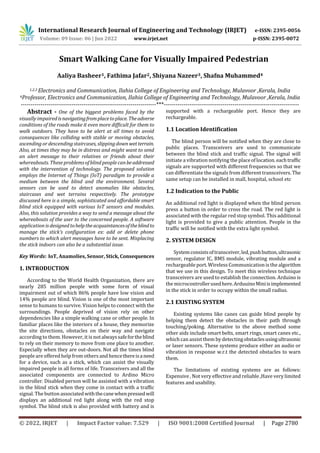
2.1 EXISTING SYSTEM
Existing systems like canes can guide blind people by
helping them detect the obstacles in their path through
touching/poking. Alternative to the above method some
other aids include smart belts, smart rings, smart canes etc.,
which can assist them by detectingobstaclesusingultrasonic
or laser sensors. These systems produce either an audio or
vibration in response w.r.t the detected obstacles to warn
them.
The limitations of existing systems are as follows:
Expensive , Not very effective and reliable ,Have very limited
features and usability.
International Research Journal of Engineering and Technology (IRJET) e-ISSN: 2395-0056
Volume: 09 Issue: 06 | Jun 2022 www.irjet.net p-ISSN: 2395-0072
© 2022, IRJET | Impact Factor value: 7.529 | ISO 9001:2008 Certified Journal | Page 2781
Fig -1: Block Diagram of Existing System
2.2 PROPOSED SYSTEM
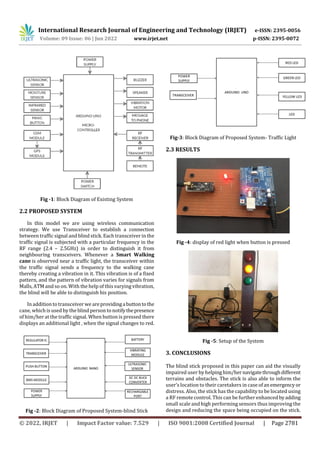
In this model we are using wireless communication
strategy. We use Transceiver to establish a connection
between traffic signal and blind stick. Each transceiver in the
traffic signal is subjected with a particular frequency in the
RF range (2.4 – 2.5GHz) in order to distinguish it from
neighbouring transceivers. Whenever a Smart Walking
cane is observed near a traffic light, the transceiver within
the traffic signal sends a frequency to the walking cane
thereby creating a vibration in it. This vibration is of a fixed
pattern, and the pattern of vibration varies for signals from
Malls, ATM and so on. With the help of this varying vibration,
the blind will be able to distinguish his position.
In addition to transceiver we areprovidingabuttontothe
cane, which is used by the blind person to notifythepresence
of him/her at the traffic signal. When button is pressed there
displays an additional light , when the signal changes to red.
Fig -2: Block Diagram of Proposed System-blind Stick
Fig-3: Block Diagram of Proposed System- Traffic Light
2.3 RESULTS
Fig -4: display of red light when button is pressed
Fig -5: Setup of the System
3. CONCLUSIONS
The blind stick proposed in this paper can aid the visually
impaired user by helpinghim/her navigatethroughdifferent
terrains and obstacles. The stick is also able to inform the
user’s location to their caretakers in case ofanemergency or
distress. Also, the stick has the capability to be located using
a RF remote control. This can be further enhancedbyadding
small scale and high performing sensors thus improving the
design and reducing the space being occupied on the stick.
International Research Journal of Engineering and Technology (IRJET) e-ISSN: 2395-0056
Volume: 09 Issue: 06 | Jun 2022 www.irjet.net p-ISSN: 2395-0072
© 2022, IRJET | Impact Factor value: 7.529 | ISO 9001:2008 Certified Journal | Page 2782
Few improvements can be made to the sensor angle
placement to make them adjust according to the angle of the
stick w.r.t to the ground so that they always point straight
instead of mounting them at a static angle.
ACKNOWLEDGEMENT
The main motivation and driving force behind the work
is Ms. Shafna Muhammed (Asst. Professor, Electronics and
Communication Engineering, Ilahia College of Engineering
and Technology, Muvattupuzha, Kerala). I am unboundedly
grateful for his valuable corrections and guidance that
helped improving this work.
REFERENCES
[1] M. P. Agrawal and A. R. Gupta, "Smart Stick for the Blind
and Visually Impaired People", Second International
Conference on Inventive Communication and
Computational Technologies (ICICCT), pp. 542- 545,
2018.
[2] Radhika R, Payal G Pai, Rakshitha S, Rampur Srinath,
"Implementation of Smart Stick for Obstacle Detection
and Navigation", International Journal of Latest
Research in Engineering and Technology (IJLRET), vol.
02, pp. 45-50, 2016.
[3] Manikanta K, T. Siva Sankara Phani and A. Pravin,
"Implementation and Design of Smart Blind Stick for
Obstacle Detection and Navigation System", 2018.

Smart Walking Cane for Visually Impaired Pedestrian

  • 1.
    International Research Journalof Engineering and Technology (IRJET) e-ISSN: 2395-0056 Volume: 09 Issue: 06 | Jun 2022 www.irjet.net p-ISSN: 2395-0072 © 2022, IRJET | Impact Factor value: 7.529 | ISO 9001:2008 Certified Journal | Page 2780 Smart Walking Cane for Visually Impaired Pedestrian Aaliya Basheer1, Fathima Jafar2, Shiyana Nazeer3, Shafna Muhammed4 1,2,3 Electronics and Communication, Ilahia College of Engineering and Technology, Mulavoor ,Kerala, India 4Professor, Electronics and Communication, Ilahia College of Engineering and Technology, Mulavoor ,Kerala, India ---------------------------------------------------------------------***--------------------------------------------------------------------- Abstract - One of the biggest problems faced by the visually impairedisnavigatingfromplacetoplace.Theadverse conditions of the roads make it even more difficult for them to walk outdoors. They have to be alert at all times to avoid consequences like colliding with stable or moving obstacles, ascending or descending staircases, slipping down wetterrain. Also, at times they may be in distress and might want to send an alert message to their relatives or friends about their whereabouts. These problemsof blind people canbeaddressed with the intervention of technology. The proposed solution employs the Internet of Things (IoT) paradigm to provide a medium between the blind and the environment. Several sensors can be used to detect anomalies like obstacles, staircases and wet terrains respectively. The prototype discussed here is a simple, sophisticated and affordable smart blind stick equipped with various IoT sensors and modules. Also, this solution provides a way to send a message about the whereabouts of the user to the concerned people. A software application is designed tohelptheacquaintancesoftheblindto manage the stick’s configuration ex: add or delete phone numbers to which alert messages have to be sent. Misplacing the stick indoors can also be a substantial issue. Key Words: IoT, Anamolies, Sensor, Stick,Consequences 1. INTRODUCTION According to the World Health Organization, there are nearly 285 million people with some form of visual impairment out of which 86% people have low vision and 14% people are blind. Vision is one of the most important sense to humans to survive. Vision helps to connect with the surroundings. People deprived of vision rely on other dependencies like a simple walking cane or other people. In familiar places like the interiors of a house, they memorize the site directions, obstacles on their way and navigate according to them. However,it is notalwayssafefortheblind to rely on their memory to move from one place to another. Especially when they are out-doors. Not all the times blind people are offered help from others and hencethereisaneed for a device, such as a stick, which can assist the visually impaired people in all forms of life. Transceivers and all the associated components are connected to Ardino Micro controller. Disabled person will be assisted with a vibration in the blind stick when they come in contact with a traffic signal. The button associatedwiththecanewhenpressedwill displays an additional red light along with the red stop symbol. The blind stick is also provided with battery and is supported with a rechargeable port. Hence they are rechargeable. 1.1 Location Identification The blind person will be notified when they are close to public places. Transceivers are used to communicate between the blind stick and traffic signal. The signal will initiate a vibration notifying the placeoflocation. eachtraffic signals are supported with different frequencies so that we can differentiate the signals from different transceivers. The same setup can be installed in mall, hospital, school etc 1.2 Indication to the Public An additional red light is displayed when the blind person press a button in order to cross the road. The red light is associated with the regular red stop symbol. This additional light is provided to give a public attention. People in the traffic will be notified with the extra light symbol. 2. SYSTEM DESIGN Systemconsistsoftransceiver,led,pushbutton,ultrasonic sensor, regulator IC, BMS module, vibrating module and a rechargeable port.Wireless Communication is the algorithm that we use in this design. To meet this wireless technique transceivers are used to establish the connection. Arduino is the microcontrollerusedhere.ArduuinoMiniisimplemented in the stick in order to occupy within the small radius. 2.1 EXISTING SYSTEM Existing systems like canes can guide blind people by helping them detect the obstacles in their path through touching/poking. Alternative to the above method some other aids include smart belts, smart rings, smart canes etc., which can assist them by detectingobstaclesusingultrasonic or laser sensors. These systems produce either an audio or vibration in response w.r.t the detected obstacles to warn them. The limitations of existing systems are as follows: Expensive , Not very effective and reliable ,Have very limited features and usability.
  • 2.
    International Research Journalof Engineering and Technology (IRJET) e-ISSN: 2395-0056 Volume: 09 Issue: 06 | Jun 2022 www.irjet.net p-ISSN: 2395-0072 © 2022, IRJET | Impact Factor value: 7.529 | ISO 9001:2008 Certified Journal | Page 2781 Fig -1: Block Diagram of Existing System 2.2 PROPOSED SYSTEM In this model we are using wireless communication strategy. We use Transceiver to establish a connection between traffic signal and blind stick. Each transceiver in the traffic signal is subjected with a particular frequency in the RF range (2.4 – 2.5GHz) in order to distinguish it from neighbouring transceivers. Whenever a Smart Walking cane is observed near a traffic light, the transceiver within the traffic signal sends a frequency to the walking cane thereby creating a vibration in it. This vibration is of a fixed pattern, and the pattern of vibration varies for signals from Malls, ATM and so on. With the help of this varying vibration, the blind will be able to distinguish his position. In addition to transceiver we areprovidingabuttontothe cane, which is used by the blind person to notifythepresence of him/her at the traffic signal. When button is pressed there displays an additional light , when the signal changes to red. Fig -2: Block Diagram of Proposed System-blind Stick Fig-3: Block Diagram of Proposed System- Traffic Light 2.3 RESULTS Fig -4: display of red light when button is pressed Fig -5: Setup of the System 3. CONCLUSIONS The blind stick proposed in this paper can aid the visually impaired user by helpinghim/her navigatethroughdifferent terrains and obstacles. The stick is also able to inform the user’s location to their caretakers in case ofanemergency or distress. Also, the stick has the capability to be located using a RF remote control. This can be further enhancedbyadding small scale and high performing sensors thus improving the design and reducing the space being occupied on the stick.
  • 3.
    International Research Journalof Engineering and Technology (IRJET) e-ISSN: 2395-0056 Volume: 09 Issue: 06 | Jun 2022 www.irjet.net p-ISSN: 2395-0072 © 2022, IRJET | Impact Factor value: 7.529 | ISO 9001:2008 Certified Journal | Page 2782 Few improvements can be made to the sensor angle placement to make them adjust according to the angle of the stick w.r.t to the ground so that they always point straight instead of mounting them at a static angle. ACKNOWLEDGEMENT The main motivation and driving force behind the work is Ms. Shafna Muhammed (Asst. Professor, Electronics and Communication Engineering, Ilahia College of Engineering and Technology, Muvattupuzha, Kerala). I am unboundedly grateful for his valuable corrections and guidance that helped improving this work. REFERENCES [1] M. P. Agrawal and A. R. Gupta, "Smart Stick for the Blind and Visually Impaired People", Second International Conference on Inventive Communication and Computational Technologies (ICICCT), pp. 542- 545, 2018. [2] Radhika R, Payal G Pai, Rakshitha S, Rampur Srinath, "Implementation of Smart Stick for Obstacle Detection and Navigation", International Journal of Latest Research in Engineering and Technology (IJLRET), vol. 02, pp. 45-50, 2016. [3] Manikanta K, T. Siva Sankara Phani and A. Pravin, "Implementation and Design of Smart Blind Stick for Obstacle Detection and Navigation System", 2018.