Smart meter
AMI-Advanced metering Infrastructure
On Understanding basis
Advanced Metering Infrastructure (AMI)
• Advanced Metering Infrastructure (AMI) is the
• basic building block of Smart Grid. It is defined as a
• system that measure, collect, transfer and analyze
• energy usage and communicate with metering
• devices. It enables end users to participate in
• reducing peak demands and in contributing to
• energy management process. Further, meters can
• also capture, receive and execute remote commands
• like load disconnect/connect.
Advanced Metering Infrastructure (AMI)
------ to be continued
The main enabling features of an AMI
infrastructure include smart meter, communication
medium, MDAS/MDM, load monitoring, Demand
response, Load control, Tamper detection, Alarm
handling, Real time energy audit, Time of Day
(ToD) tariff etc.
AMI ARCHITECTURE
AMI
• In an established AMI
system, it is essential to
• have a common platform
for monitoring as well as
• utilization of essential
features of AMI Systems.
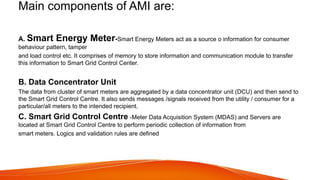
Main components of AMI are:
• A. Smart Energy Meter
• B. Data Concentrator Unit
• C. Smart Grid Control
Centre
Main components of AMI are:
A. Smart Energy Meter-Smart Energy Meters act as a source o information for consumer
behaviour pattern, tamper
and load control etc. It comprises of memory to store information and communication module to transfer
this information to Smart Grid Control Center.
B. Data Concentrator Unit
The data from cluster of smart meters are aggregated by a data concentrator unit (DCU) and then send to
the Smart Grid Control Centre. It also sends messages /signals received from the utility / consumer for a
particular/all meters to the intended recipient.
C. Smart Grid Control Centre -Meter Data Acquisition System (MDAS) and Servers are
located at Smart Grid Control Centre to perform periodic collection of information from
smart meters. Logics and validation rules are defined
AMI ANALYTICS: A CASE STUDY
Different manufactures have provided meters which works on different communication technology. Data
from all meters are integrated, synthesized and stored for data analysis and real time monitoring Smart
Meters have been installed at consumer premises including various distribution transformers
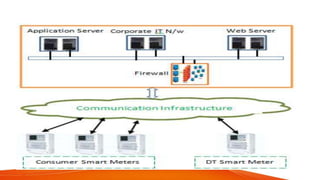
and feeders. These meters work on various technologies namely PLC, GPRS, RF 2.4 GHz and
RF 865 MHz. Smart meters working on RF/PLC communicate to Data Concentrator Unit which
transmits the data to meter data acquisition system.However, Smart Meters working on GPRS
communicate to MDAS directly. MDAS exchange meter data to meter data management system [4]. All
of these components of AMI are integrated at one common platform at Smart Grid Control Center at
Puducherry. Virtualized environment at blade server along with storage is setup at control center for
monitoring real time energy consumption pattern, other parameters and various alarms associated with
it. The utility can use alarm information for reliability evaluation and failure analysis. Further,
information also enables utility to monitor the health/availability of devices in AMI infrastructure.
Data Analaysis and
daily data collection
The analytics help utility to extract and use the
information embedded in meter data which provides
many information such as
1.Meter Data Validation
2.Tamper and missing information due to
communication failure, meter fault etc.
3.Energy Audit & Accounting of Distribution
transformer.
4.Peak Demand Identification.
5.Consumer profile analysis.
6.Forecast and build predictive models for demand
management or demand responseprogram planning.
7.Consumer abnormal pattern analysis.
Data collected at MDAS is used to developed
meter data analytics to identify the exception
and
generate lead for carrying out corrective action.
Data
analytics helps utilities to perform on-line
energy
audit to operate in efficient manner as well as
for
better asset management and system planning
The analytics help utility to extract and use the
information embedded in meter data which
provides
many information such as:
•
Meter Data
Validation
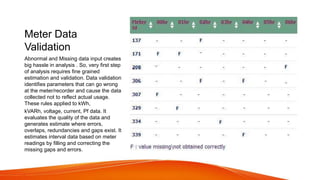
Abnormal and Missing data input creates
big hassle in analysis . So, very first step
of analysis requires fine grained
estimation and validation. Data validation
identifies parameters that can go wrong
at the meter/recorder and cause the data
collected not to reflect actual usage.
These rules applied to kWh,
kVARh, voltage, current, Pf data. It
evaluates the quality of the data and
generates estimate where errors,
overlaps, redundancies and gaps exist. It
estimates interval data based on meter
readings by filling and correcting the
missing gaps and errors.
Tamper and Missing
Information
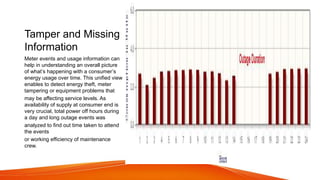
Meter events and usage information can
help in understanding an overall picture
of what’s happening with a consumer’s
energy usage over time. This unified view
enables to detect energy theft, meter
tampering or equipment problems that
may be affecting service levels. As
availability of supply at consumer end is
very crucial, total power off hours during
a day and long outage events was
analyzed to find out time taken to attend
the events
or working efficiency of maintenance
crew.
Energy Audit &
Accounting
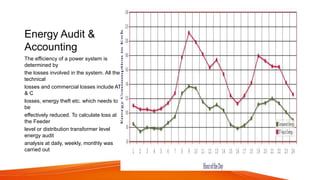
The efficiency of a power system is
determined by
the losses involved in the system. All the
technical
losses and commercial losses include AT
& C
losses, energy theft etc. which needs to
be
effectively reduced. To calculate loss at
the Feeder
level or distribution transformer level
energy audit
analysis at daily, weekly, monthly was
carried out
Peak Demand
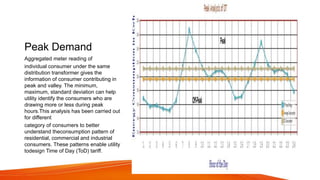
Aggregated meter reading of
individual consumer under the same
distribution transformer gives the
information of consumer contributing in
peak and valley. The minimum,
maximum, standard deviation can help
utility identify the consumers who are
drawing more or less during peak
hours.This analysis has been carried out
for different
category of consumers to better
understand theconsumption pattern of
residential, commercial and industrial
consumers. These patterns enable utility
todesign Time of Day (ToD) tariff.
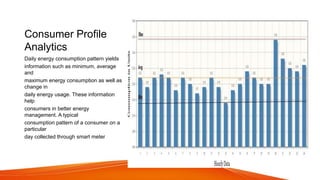
Consumer Profile
Analytics
Daily energy consumption pattern yields
information such as minimum, average
and
maximum energy consumption as well as
change in
daily energy usage. These information
help
consumers in better energy
management. A typical
consumption pattern of a consumer on a
particular
day collected through smart meter
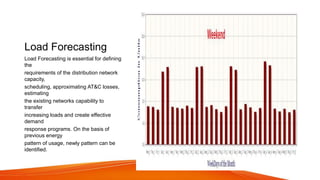
Load Forecasting
Load Forecasting is essential for defining
the
requirements of the distribution network
capacity,
scheduling, approximating AT&C losses,
estimating
the existing networks capability to
transfer
increasing loads and create effective
demand
response programs. On the basis of
previous energy
pattern of usage, newly pattern can be
identified.
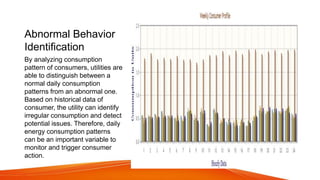
Abnormal Behavior
Identification
By analyzing consumption
pattern of consumers, utilities are
able to distinguish between a
normal daily consumption
patterns from an abnormal one.
Based on historical data of
consumer, the utility can identify
irregular consumption and detect
potential issues. Therefore, daily
energy consumption patterns
can be an important variable to
monitor and trigger consumer
action.
Conclusion
• Analytics of meter data
extracted in different time horizon with different time resolution is helpful in planning and meeting
energy requirements. Meter Data Analytics will help utilities to identify challenges in the existing
distribution system and operate in an efficient manner by enabling energy audit. These analytics
integrated with Management Information System (MIS) gives insight on evaluating network
performance, growing demand, quality of power supply etc. to support decision making process. It
enables consumers to view their own consumption behaviour, which facilities them to control their
energy usage and optimize energy bills. It also provides an opportunity for consumers to participate
in demand response program and manage theavailable resources efficiently.
Smart meter_Advanced metering Infrastructures

Smart meter_Advanced metering Infrastructures

  • 1.
    Smart meter AMI-Advanced meteringInfrastructure On Understanding basis
  • 2.
    Advanced Metering Infrastructure(AMI) • Advanced Metering Infrastructure (AMI) is the • basic building block of Smart Grid. It is defined as a • system that measure, collect, transfer and analyze • energy usage and communicate with metering • devices. It enables end users to participate in • reducing peak demands and in contributing to • energy management process. Further, meters can • also capture, receive and execute remote commands • like load disconnect/connect.
  • 3.
    Advanced Metering Infrastructure(AMI) ------ to be continued The main enabling features of an AMI infrastructure include smart meter, communication medium, MDAS/MDM, load monitoring, Demand response, Load control, Tamper detection, Alarm handling, Real time energy audit, Time of Day (ToD) tariff etc.
  • 4.
    AMI ARCHITECTURE AMI • Inan established AMI system, it is essential to • have a common platform for monitoring as well as • utilization of essential features of AMI Systems. Main components of AMI are: • A. Smart Energy Meter • B. Data Concentrator Unit • C. Smart Grid Control Centre
  • 5.
    Main components ofAMI are: A. Smart Energy Meter-Smart Energy Meters act as a source o information for consumer behaviour pattern, tamper and load control etc. It comprises of memory to store information and communication module to transfer this information to Smart Grid Control Center. B. Data Concentrator Unit The data from cluster of smart meters are aggregated by a data concentrator unit (DCU) and then send to the Smart Grid Control Centre. It also sends messages /signals received from the utility / consumer for a particular/all meters to the intended recipient. C. Smart Grid Control Centre -Meter Data Acquisition System (MDAS) and Servers are located at Smart Grid Control Centre to perform periodic collection of information from smart meters. Logics and validation rules are defined
  • 7.
    AMI ANALYTICS: ACASE STUDY Different manufactures have provided meters which works on different communication technology. Data from all meters are integrated, synthesized and stored for data analysis and real time monitoring Smart Meters have been installed at consumer premises including various distribution transformers and feeders. These meters work on various technologies namely PLC, GPRS, RF 2.4 GHz and RF 865 MHz. Smart meters working on RF/PLC communicate to Data Concentrator Unit which transmits the data to meter data acquisition system.However, Smart Meters working on GPRS communicate to MDAS directly. MDAS exchange meter data to meter data management system [4]. All of these components of AMI are integrated at one common platform at Smart Grid Control Center at Puducherry. Virtualized environment at blade server along with storage is setup at control center for monitoring real time energy consumption pattern, other parameters and various alarms associated with it. The utility can use alarm information for reliability evaluation and failure analysis. Further, information also enables utility to monitor the health/availability of devices in AMI infrastructure.
  • 8.
    Data Analaysis and dailydata collection The analytics help utility to extract and use the information embedded in meter data which provides many information such as 1.Meter Data Validation 2.Tamper and missing information due to communication failure, meter fault etc. 3.Energy Audit & Accounting of Distribution transformer. 4.Peak Demand Identification. 5.Consumer profile analysis. 6.Forecast and build predictive models for demand management or demand responseprogram planning. 7.Consumer abnormal pattern analysis. Data collected at MDAS is used to developed meter data analytics to identify the exception and generate lead for carrying out corrective action. Data analytics helps utilities to perform on-line energy audit to operate in efficient manner as well as for better asset management and system planning The analytics help utility to extract and use the information embedded in meter data which provides many information such as: •
  • 9.
    Meter Data Validation Abnormal andMissing data input creates big hassle in analysis . So, very first step of analysis requires fine grained estimation and validation. Data validation identifies parameters that can go wrong at the meter/recorder and cause the data collected not to reflect actual usage. These rules applied to kWh, kVARh, voltage, current, Pf data. It evaluates the quality of the data and generates estimate where errors, overlaps, redundancies and gaps exist. It estimates interval data based on meter readings by filling and correcting the missing gaps and errors.
  • 10.
    Tamper and Missing Information Meterevents and usage information can help in understanding an overall picture of what’s happening with a consumer’s energy usage over time. This unified view enables to detect energy theft, meter tampering or equipment problems that may be affecting service levels. As availability of supply at consumer end is very crucial, total power off hours during a day and long outage events was analyzed to find out time taken to attend the events or working efficiency of maintenance crew.
  • 11.
    Energy Audit & Accounting Theefficiency of a power system is determined by the losses involved in the system. All the technical losses and commercial losses include AT & C losses, energy theft etc. which needs to be effectively reduced. To calculate loss at the Feeder level or distribution transformer level energy audit analysis at daily, weekly, monthly was carried out
  • 12.
    Peak Demand Aggregated meterreading of individual consumer under the same distribution transformer gives the information of consumer contributing in peak and valley. The minimum, maximum, standard deviation can help utility identify the consumers who are drawing more or less during peak hours.This analysis has been carried out for different category of consumers to better understand theconsumption pattern of residential, commercial and industrial consumers. These patterns enable utility todesign Time of Day (ToD) tariff.
  • 13.
    Consumer Profile Analytics Daily energyconsumption pattern yields information such as minimum, average and maximum energy consumption as well as change in daily energy usage. These information help consumers in better energy management. A typical consumption pattern of a consumer on a particular day collected through smart meter
  • 14.
    Load Forecasting Load Forecastingis essential for defining the requirements of the distribution network capacity, scheduling, approximating AT&C losses, estimating the existing networks capability to transfer increasing loads and create effective demand response programs. On the basis of previous energy pattern of usage, newly pattern can be identified.
  • 15.
    Abnormal Behavior Identification By analyzingconsumption pattern of consumers, utilities are able to distinguish between a normal daily consumption patterns from an abnormal one. Based on historical data of consumer, the utility can identify irregular consumption and detect potential issues. Therefore, daily energy consumption patterns can be an important variable to monitor and trigger consumer action.
  • 16.
    Conclusion • Analytics ofmeter data extracted in different time horizon with different time resolution is helpful in planning and meeting energy requirements. Meter Data Analytics will help utilities to identify challenges in the existing distribution system and operate in an efficient manner by enabling energy audit. These analytics integrated with Management Information System (MIS) gives insight on evaluating network performance, growing demand, quality of power supply etc. to support decision making process. It enables consumers to view their own consumption behaviour, which facilities them to control their energy usage and optimize energy bills. It also provides an opportunity for consumers to participate in demand response program and manage theavailable resources efficiently.