Smart Landscapes concept
                       Connecting the socio-cultural,
                       economic and transcendent
                       dimensions of Human Enhancement
                       and Smart Environment


   Vadim V. Chekletsov, Institute of Philosophy of the Russian
Academy of Sciences, Department for Interdisciplinary Problems of
the Scientific and Technological Development
From a Smart Environment to
                    Smart Landscapes:
            Toward a topological version of the
                posthuman personology.

                             Chekletsov Vadim V.1

    New trends of NBIC-convergence, Human Enhancement
Technologies on the one hand and Smart Environment
(Ambient intelligence, Ubiquitous computing, Internet of
Things) on the other prepare us to a future paradigm shift
blurring Anthropology and Social Philosophy borderlines.
We see not only co-evolution of anthropotechnological
and socio-cultural development but a real convergence of
Human Artifacts and Human Body spheres to the specific
posthuman condition, when a social space became really
alive. The Person self-re-presentation now we can imagine
as new Ecological system for Other. This Posthuman Being
virtual world self-actualization into material world of a
certain Earth (or potentially- extraterrestrial) landscape is
like ontological Game of the Universe. Such a personalized
Chronotope is autopoetic Environment 2.0. This extended
Body is interactive intersubjective         space open for
communication with Other in Present; and at the same time
Smart Landscape         is  postanthropological genius loci-
externalized Memory, active playing field actualizing
Hyperspace of Humanity Culture symbols, memes - Smart
Landscape now is their form of existence in Eternity. Smart
Landscape and Other Interaction is a laboratory producing
Future patterns and New Societies forms toward             a
polyontological Multiverse . Smart Landscape concept is

1chekletsov@mail.ru, Institute of Philosophy of the Russian Academy of Sciences,
Moscow (IPH RAS, http://iph.ras.ru/), Department for Interdisciplinary Problems of the
Scientific and Technological Development.
valuable as an integral synergy approach to the socio-
cultural, transcendent and economic dimensions of
emerging technologies and it can provide sustainable
development in the modern situation of high existential risks.


        The boundaries of a cognitive system.
    According              with Juval Portugali «The Seven Basic
Propositions of            SIRN» (Synergetic Inter-Representation
Networks)2:

       The issue of the boundaries of the cognitive system touches
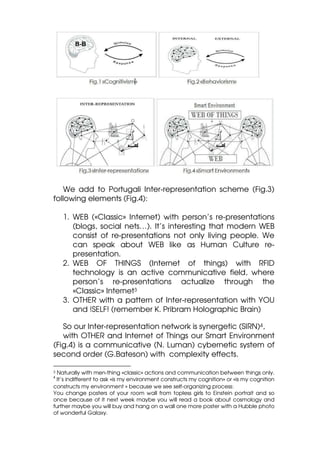
upon the behaviorism-cognitivism historical controversy. Behaviorism
(Fig.2) suggested understanding cognitive phenomena in terms of the
relations between stimuli and responses in the external environment .
That is, in terms of external representations only, with the mind/brain
considered as a blackbox (B-B). Cognitivism (Fig.1) suggests the exact
opposite: cognitive phenomena must be understood in terms of
internal processes and representations, treating stimulus-response
relations as means to reveal processes inside the mind/brain . In both
the mind/brain with its internal representations, and the environment
with its external representations, are perceived as two essentially
independent and causally related, entities. SIRN suggests perceiving
the boundaries of the cognitive system, that is, to treat the behaviorist
and cognitivist perceptions as two aspects of a single, integrated,
inter-representational network (Fig.3). Note that unlike behaviorism
that considered bodily external representations only, the SIRN system
proposed here includes also artifactual representations. The
suggestion to include artifacts within the boundaries of the cognitive
goes back to Vygotsky. According to him, signs, tools, activities, or
artifacts, as Cole prefers to call them, are all integral elements of the
cognitive system by virtue of their role as mediators in higher
psychological processes.


2
  Humans have an innate capability for representation that comes in two forms:
internal and external (1). This shows up in many cognitive tasks that evolve as a
sequential interaction between internal and external representations (2).
Representations enfold, and convey quantitative (Shannonian) and qualitative
(semantic) information (3), and they coexist in implicate and explicate relations (4),
in a way reminiscent of the relations between genotype and phenotype (5). From
propositions 1-5 follows that the boundaries of the cognitive system should be
perceived as distinct from the boundaries of the brain/skull and the body/skin (6).
The above network of internal and external representations emerges as a self-
organizing system. Its dynamics is best captured by Haken’s synergetic approach to
self-organization(7).
We add to Portugali Inter-representation scheme (Fig.3)
following elements (Fig.4):

    1. WEB («Classic» Internet) with person’s re-presentations
       (blogs, social nets…). It’s interesting that modern WEB
       consist of re-presentations not only living people. We
       can speak about WEB like as Human Culture re-
       presentation.
    2. WEB OF THINGS (Internet of things) with RFID
       technology is an active communicative field, where
       person’s re-presentations actualize through the
       «Classic» Internet3
    3. OTHER with a pattern of Inter-representation with YOU
       and !SELF! (remember K. Pribram Holographic Brain)

   So our Inter-representation network is synergetic (SIRN)4,
   with OTHER and Internet of Things our Smart Environment
(Fig.4) is a communicative (N. Luman) cybernetic system of
second order (G.Bateson) with complexity effects.

3 Naturally with men-thing «classic» actions and communication between things only.
4
 It’s indifferent to ask «is my environment constructs my cognition» or «is my cognition
constructs my environment » because we see self-organizing process:
You change posters of your room wall from topless girls to Einstein portrait and so
once because of it next week maybe you will read a book about cosmology and
further maybe you will buy and hang on a wall one more poster with a Hubble photo
of wonderful Galaxy.
From Smart Environment situation (Fig.4) we expect
only one step to the posthuman condition signed Smart
Landscape:

                The boundaries of a Person.
    1.  The boundary of «I» is dynamic.
        It follows, firstly, from the physiology of perception5, and
    secondly - from the many cultural concepts of identity in
    psychology (K. Levin, K.-G. Jung, L. Vygotsky, Mikhail M.
    Bakhtin, and etc.)

    2. Expanding the topology of the Identity out of the
    physical boundaries of the body:
    - Ambiguity of subject-object boundaries, self body
    scheme in relation to psychological phenomena,
    - Technology as extracorporal body parts (Ernst Kapp),
    - Identification with image things (fashion),
    - Transformative anthropological practices (body-without-
    organs),
    - Processes of social identification, etc.

    3. We want to expand and to deepen the concept of
    trading zones6.
        Trading zones should be not only a space of specialists
    communication to put into practice the Nano - Bio - Info -
    and Cogno - projects, but a broader Institute- Subjects of
    New Societies self-realization and self- representation
    Space using the full potential of converging technologies
    and Humanity Culture.7


5 Sonde phenomenon and changing body scheme: Lucilla Cardinali (2009), Henry
Head, Gordon Holmes (1911), Becesy ( 1967)…
6 The term of Peter Galison for US NNI
7 Like a certain modern form of Hermann Hesse The Glass Bead Game in Castalia
4.    Smart Landscape like New Ecological Space.
          New city concept:
    - Instead of districts - personalized interactive landscapes.
    - Your social space now - really alive.
    - Smart Landscape like as ontological Game is a Person for
    You.
    - Such a Smart Landscape is a genius loci: the spirit of
    personality-refraction place with Culture phenomena
    actualization. This reflexive, active playing field recovers
    Hyperspace of Humanity Memory signs, symbols, patterns,
    memes- Smart Landscape now is their form of existence in
    Eternity.8

    5. Smart Landscape is inclusion of integral approach of
    Vseedinstvo   («Integral Knowledge», «All-unity», «True,
    Good, Beauty» or «Sciences, Religions, Arts» Unity) to the
    «NBICS …» -convergence projects.          Vseedinstvo is
    convergence too; it is a convergence of Humanity cultural,
    pragmatic and transcendence spheres. And by
    Vseedinstvo Smart Landscape is co-Creation to Imago Dei9


    Ergo…


8 Akin to the WiCC concept «Nano-Bio-Info-Cogno-Socio-Anthro-Philo-Geo-Eco-
Urbo-Orbo-Macro-Micro-Nano». Converging Technologies –Shaping the Future of
European Societies by Alfred Nordmann, Report 2004
9 Transhumanism and the imago Dei.Narratives of apprehension and hope. Stephen

Robert Garner. The University of Auckland, 2006; The triangle of new and emerging
technologies, disabled people and the World Council of Churches; Able-ism: A
prerequisite for transhumanism By Dr. Gregor Wolbring
http://www.bioethicsanddisability.org/; Russian cosmism, Neoteilhardism also tend
to this point of view.
Integral synergy approach to the socio-cultural,
transcendent and economic dimensions of
Emerging Technologies (NBIC-convergence and
Smart Environment) can be provided by new
Smart Landscape concept. Smart Landscape is a
Posthuman Body meta-form: extrapolation of
Person Topology to a real interactive autopoetic
Environment Space for Other. So Smart Landscape
is Posthuman Being topological self-representation
and self-actualization, where he constructs his
Body     as    a   social   space     to  another
postanthropological Person.

Smart landscapes concept

  • 1.
    Smart Landscapes concept Connecting the socio-cultural, economic and transcendent dimensions of Human Enhancement and Smart Environment Vadim V. Chekletsov, Institute of Philosophy of the Russian Academy of Sciences, Department for Interdisciplinary Problems of the Scientific and Technological Development
  • 2.
    From a SmartEnvironment to Smart Landscapes: Toward a topological version of the posthuman personology. Chekletsov Vadim V.1 New trends of NBIC-convergence, Human Enhancement Technologies on the one hand and Smart Environment (Ambient intelligence, Ubiquitous computing, Internet of Things) on the other prepare us to a future paradigm shift blurring Anthropology and Social Philosophy borderlines. We see not only co-evolution of anthropotechnological and socio-cultural development but a real convergence of Human Artifacts and Human Body spheres to the specific posthuman condition, when a social space became really alive. The Person self-re-presentation now we can imagine as new Ecological system for Other. This Posthuman Being virtual world self-actualization into material world of a certain Earth (or potentially- extraterrestrial) landscape is like ontological Game of the Universe. Such a personalized Chronotope is autopoetic Environment 2.0. This extended Body is interactive intersubjective space open for communication with Other in Present; and at the same time Smart Landscape is postanthropological genius loci- externalized Memory, active playing field actualizing Hyperspace of Humanity Culture symbols, memes - Smart Landscape now is their form of existence in Eternity. Smart Landscape and Other Interaction is a laboratory producing Future patterns and New Societies forms toward a polyontological Multiverse . Smart Landscape concept is 1chekletsov@mail.ru, Institute of Philosophy of the Russian Academy of Sciences, Moscow (IPH RAS, http://iph.ras.ru/), Department for Interdisciplinary Problems of the Scientific and Technological Development.
  • 3.
    valuable as anintegral synergy approach to the socio- cultural, transcendent and economic dimensions of emerging technologies and it can provide sustainable development in the modern situation of high existential risks. The boundaries of a cognitive system. According with Juval Portugali «The Seven Basic Propositions of SIRN» (Synergetic Inter-Representation Networks)2: The issue of the boundaries of the cognitive system touches upon the behaviorism-cognitivism historical controversy. Behaviorism (Fig.2) suggested understanding cognitive phenomena in terms of the relations between stimuli and responses in the external environment . That is, in terms of external representations only, with the mind/brain considered as a blackbox (B-B). Cognitivism (Fig.1) suggests the exact opposite: cognitive phenomena must be understood in terms of internal processes and representations, treating stimulus-response relations as means to reveal processes inside the mind/brain . In both the mind/brain with its internal representations, and the environment with its external representations, are perceived as two essentially independent and causally related, entities. SIRN suggests perceiving the boundaries of the cognitive system, that is, to treat the behaviorist and cognitivist perceptions as two aspects of a single, integrated, inter-representational network (Fig.3). Note that unlike behaviorism that considered bodily external representations only, the SIRN system proposed here includes also artifactual representations. The suggestion to include artifacts within the boundaries of the cognitive goes back to Vygotsky. According to him, signs, tools, activities, or artifacts, as Cole prefers to call them, are all integral elements of the cognitive system by virtue of their role as mediators in higher psychological processes. 2 Humans have an innate capability for representation that comes in two forms: internal and external (1). This shows up in many cognitive tasks that evolve as a sequential interaction between internal and external representations (2). Representations enfold, and convey quantitative (Shannonian) and qualitative (semantic) information (3), and they coexist in implicate and explicate relations (4), in a way reminiscent of the relations between genotype and phenotype (5). From propositions 1-5 follows that the boundaries of the cognitive system should be perceived as distinct from the boundaries of the brain/skull and the body/skin (6). The above network of internal and external representations emerges as a self- organizing system. Its dynamics is best captured by Haken’s synergetic approach to self-organization(7).
  • 4.
    We add toPortugali Inter-representation scheme (Fig.3) following elements (Fig.4): 1. WEB («Classic» Internet) with person’s re-presentations (blogs, social nets…). It’s interesting that modern WEB consist of re-presentations not only living people. We can speak about WEB like as Human Culture re- presentation. 2. WEB OF THINGS (Internet of things) with RFID technology is an active communicative field, where person’s re-presentations actualize through the «Classic» Internet3 3. OTHER with a pattern of Inter-representation with YOU and !SELF! (remember K. Pribram Holographic Brain) So our Inter-representation network is synergetic (SIRN)4, with OTHER and Internet of Things our Smart Environment (Fig.4) is a communicative (N. Luman) cybernetic system of second order (G.Bateson) with complexity effects. 3 Naturally with men-thing «classic» actions and communication between things only. 4 It’s indifferent to ask «is my environment constructs my cognition» or «is my cognition constructs my environment » because we see self-organizing process: You change posters of your room wall from topless girls to Einstein portrait and so once because of it next week maybe you will read a book about cosmology and further maybe you will buy and hang on a wall one more poster with a Hubble photo of wonderful Galaxy.
  • 5.
    From Smart Environmentsituation (Fig.4) we expect only one step to the posthuman condition signed Smart Landscape: The boundaries of a Person. 1. The boundary of «I» is dynamic. It follows, firstly, from the physiology of perception5, and secondly - from the many cultural concepts of identity in psychology (K. Levin, K.-G. Jung, L. Vygotsky, Mikhail M. Bakhtin, and etc.) 2. Expanding the topology of the Identity out of the physical boundaries of the body: - Ambiguity of subject-object boundaries, self body scheme in relation to psychological phenomena, - Technology as extracorporal body parts (Ernst Kapp), - Identification with image things (fashion), - Transformative anthropological practices (body-without- organs), - Processes of social identification, etc. 3. We want to expand and to deepen the concept of trading zones6. Trading zones should be not only a space of specialists communication to put into practice the Nano - Bio - Info - and Cogno - projects, but a broader Institute- Subjects of New Societies self-realization and self- representation Space using the full potential of converging technologies and Humanity Culture.7 5 Sonde phenomenon and changing body scheme: Lucilla Cardinali (2009), Henry Head, Gordon Holmes (1911), Becesy ( 1967)… 6 The term of Peter Galison for US NNI 7 Like a certain modern form of Hermann Hesse The Glass Bead Game in Castalia
  • 6.
    4. Smart Landscape like New Ecological Space. New city concept: - Instead of districts - personalized interactive landscapes. - Your social space now - really alive. - Smart Landscape like as ontological Game is a Person for You. - Such a Smart Landscape is a genius loci: the spirit of personality-refraction place with Culture phenomena actualization. This reflexive, active playing field recovers Hyperspace of Humanity Memory signs, symbols, patterns, memes- Smart Landscape now is their form of existence in Eternity.8 5. Smart Landscape is inclusion of integral approach of Vseedinstvo («Integral Knowledge», «All-unity», «True, Good, Beauty» or «Sciences, Religions, Arts» Unity) to the «NBICS …» -convergence projects. Vseedinstvo is convergence too; it is a convergence of Humanity cultural, pragmatic and transcendence spheres. And by Vseedinstvo Smart Landscape is co-Creation to Imago Dei9 Ergo… 8 Akin to the WiCC concept «Nano-Bio-Info-Cogno-Socio-Anthro-Philo-Geo-Eco- Urbo-Orbo-Macro-Micro-Nano». Converging Technologies –Shaping the Future of European Societies by Alfred Nordmann, Report 2004 9 Transhumanism and the imago Dei.Narratives of apprehension and hope. Stephen Robert Garner. The University of Auckland, 2006; The triangle of new and emerging technologies, disabled people and the World Council of Churches; Able-ism: A prerequisite for transhumanism By Dr. Gregor Wolbring http://www.bioethicsanddisability.org/; Russian cosmism, Neoteilhardism also tend to this point of view.
  • 7.
    Integral synergy approachto the socio-cultural, transcendent and economic dimensions of Emerging Technologies (NBIC-convergence and Smart Environment) can be provided by new Smart Landscape concept. Smart Landscape is a Posthuman Body meta-form: extrapolation of Person Topology to a real interactive autopoetic Environment Space for Other. So Smart Landscape is Posthuman Being topological self-representation and self-actualization, where he constructs his Body as a social space to another postanthropological Person.