

Ministry of Justice, Azerbaijan
The World Bank
Smart Judiciary
Transformation
JSSIP Project
Smart Judiciary Transformation
Review
2006 e-Justice services development began under the World Bank and Azerbaijan Republic
Judicial Modernization Project (JMP) project that started back in 2006.
2009 e-Services and overall ICT Road Map developed by National & International experts team.
2014 The President of Azerbaijan actively engaged in the continuing process for providing the
people of Azerbaijan with an easily accessible, transparent and speedy service in their
interaction with the Ministry of Justice. His excellency spearheaded this process by
signing into law a decree in February 23, 2014 which was designed to kick-start electronic
services within the Ministry of Justice.
2015 Judicial Services Smart Infrastructure Project (JSSIP) approved by the World Bank.
Detailed Action Plan approved by the Ministry of Justice on the delivery of e-Justice
services to improve access, increase efficiency and ensure transparancy.
Smart Judiciary Transformation
Elements
 Modern and efficient Court buildings & facilities for effective administration.
 Robust and fail-safe information and communication technology (ICT)
infrastructure.
 Digitized, transformed and harmonized judicial processes.
 Smart Courts with digital audio & video recording to capture and long-term
archive complete and accurate record of court proceedings.
 Improving court efficiency by combining business-intelligence technology
and performance management tools (dashboards, workbench etc.)
 Using Smart technology to enhance access to justice through innovative and
EASY online and mobile e-Service portals.
Unified Judicial Web Portal
Enhanced Public Access
 Public e-Search through cases, hearings, detailed information on judiciary and
activities of courts.
 Information on cases, decisions and court hearings appointed by a judge
(under the JSSIP project Courts currently connected the the e-Courts systems)
 Online e-Filing/e-Cabinet services introduced for selected lawyers and citizens
(citizens and lawyers can submit claims for civil cases on-line)
 Court fees can be paid on-line, civil claims can be paid in e-Filing system through
Government Payment Portal
 Mobile responsiveness i.e. support for mobile devices (e.g. smartphones, tablets).
 Comfortable environment for visually impaired people.
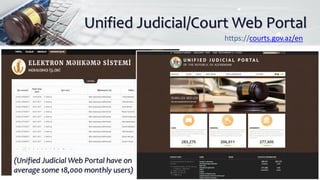
Unified Judicial/Court Web Portal
https://courts.gov.az/en
(Unified Judicial Web Portal have on
average some 18,000 monthly users)
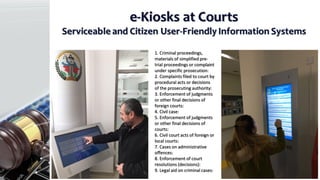
e-Kiosks at Courts
Serviceable and Citizen User-Friendly Information Systems
1. Criminal proceedings,
materials of simplified pre-
trial proceedings or complaint
under specific prosecution:
2. Complaints filed to court by
procedural acts or decisions
of the prosecuting authority:
3. Enforcement of judgments
or other final decisions of
foreign courts:
4. Civil case:
5. Enforcement of judgments
or other final decisions of
courts:
6. Civil court acts of foreign or
local courts:
7. Cases on administrative
offences:
8. Enforcement of court
resolutions (decisions):
9. Legal aid on criminal cases:
e-Justice Services
Fast Tracked Civil Cases Process
Simplified ‘Fast Track’ e-Order processing of Non-Litigious Civil Cases (Enforcement Cases)
 Bulk submission of electronically signed claims (petitions) by big parties like Mobile
Operators, Banks, Sellers of products under credit, etc. and assigned to court judges
automatically.
 Big parties get orders automatically the same day they filed their petition
 Citizens can see all processes and issued orders in the public e-Filing service in the
Unified Judicial Portal
 This fast track process eliminates human interaction and provides transparent
processing of all claims
 Simplified non-litigious civil cases dramatically reduce Judges workload
(more than 60% of nation wide civil cases)
e-Court
Increase efficiency with Court Management System &
Document Management System
 Case Management System (CMS) digitizing case files rolled out to 33 courts,
covering all court instances, court types and case types
(>113,000 cases registered during half-year 2018 >500,000 in total since 2013)
 All cases are disseminated automatically among the judges.
 E-signature solutions from 2 services providers – ASAN Service and Ministry
of Communication and High Technologies are applied in CMS.
 Document Management System (DMS) to store and manage documents
electronically rolled out to most of the MoJ Departments with close CMS
integration especially for the higher instance courts
(> 96,000 documents registered during half-year 2018 > 760,000 in total since 2013)
Smart e-Courts
Accurate Records
AzFemida Court Recording & Transcription System (CRT):
 Smart Courts with digital audio & video to capture and preserve a
complete and accurate record of court proceedings
 Tightly integrated with the Case Management System (CMS) and court
recordings can be viewed directly in CMS
 Economic Courts uses audio/video recording compulsorily due to the
Presidential Decree where this requirement is stated (from. Jan. 2017).
 Court proceedings recorded in audio and video to be long-term stored in
the central and secured Data Center storage
Enforcement Management
Functionality (EMF) for MoJ Bailiffs Offices
 Main features of the EMF service has been built on top of the Case
Management System.
 Enforcement cases (court orders) are registered in the EMF and
disseminated to Bailiff Officers automatically.
 Enforcement documents are generated automatically based on
predefined templates.
 EMF successfully rolled-out to about 80 Bailiff Offices across the
country of Azerbaijan.
Thank you

Smart judiciary transformation

  • 1.
    Ministry of Justice,Azerbaijan The World Bank Smart Judiciary Transformation JSSIP Project
  • 2.
    Smart Judiciary Transformation Review 2006e-Justice services development began under the World Bank and Azerbaijan Republic Judicial Modernization Project (JMP) project that started back in 2006. 2009 e-Services and overall ICT Road Map developed by National & International experts team. 2014 The President of Azerbaijan actively engaged in the continuing process for providing the people of Azerbaijan with an easily accessible, transparent and speedy service in their interaction with the Ministry of Justice. His excellency spearheaded this process by signing into law a decree in February 23, 2014 which was designed to kick-start electronic services within the Ministry of Justice. 2015 Judicial Services Smart Infrastructure Project (JSSIP) approved by the World Bank. Detailed Action Plan approved by the Ministry of Justice on the delivery of e-Justice services to improve access, increase efficiency and ensure transparancy.
  • 3.
    Smart Judiciary Transformation Elements Modern and efficient Court buildings & facilities for effective administration.  Robust and fail-safe information and communication technology (ICT) infrastructure.  Digitized, transformed and harmonized judicial processes.  Smart Courts with digital audio & video recording to capture and long-term archive complete and accurate record of court proceedings.  Improving court efficiency by combining business-intelligence technology and performance management tools (dashboards, workbench etc.)  Using Smart technology to enhance access to justice through innovative and EASY online and mobile e-Service portals.
  • 4.
    Unified Judicial WebPortal Enhanced Public Access  Public e-Search through cases, hearings, detailed information on judiciary and activities of courts.  Information on cases, decisions and court hearings appointed by a judge (under the JSSIP project Courts currently connected the the e-Courts systems)  Online e-Filing/e-Cabinet services introduced for selected lawyers and citizens (citizens and lawyers can submit claims for civil cases on-line)  Court fees can be paid on-line, civil claims can be paid in e-Filing system through Government Payment Portal  Mobile responsiveness i.e. support for mobile devices (e.g. smartphones, tablets).  Comfortable environment for visually impaired people.
  • 5.
    Unified Judicial/Court WebPortal https://courts.gov.az/en (Unified Judicial Web Portal have on average some 18,000 monthly users)
  • 6.
    e-Kiosks at Courts Serviceableand Citizen User-Friendly Information Systems 1. Criminal proceedings, materials of simplified pre- trial proceedings or complaint under specific prosecution: 2. Complaints filed to court by procedural acts or decisions of the prosecuting authority: 3. Enforcement of judgments or other final decisions of foreign courts: 4. Civil case: 5. Enforcement of judgments or other final decisions of courts: 6. Civil court acts of foreign or local courts: 7. Cases on administrative offences: 8. Enforcement of court resolutions (decisions): 9. Legal aid on criminal cases:
  • 7.
    e-Justice Services Fast TrackedCivil Cases Process Simplified ‘Fast Track’ e-Order processing of Non-Litigious Civil Cases (Enforcement Cases)  Bulk submission of electronically signed claims (petitions) by big parties like Mobile Operators, Banks, Sellers of products under credit, etc. and assigned to court judges automatically.  Big parties get orders automatically the same day they filed their petition  Citizens can see all processes and issued orders in the public e-Filing service in the Unified Judicial Portal  This fast track process eliminates human interaction and provides transparent processing of all claims  Simplified non-litigious civil cases dramatically reduce Judges workload (more than 60% of nation wide civil cases)
  • 8.
    e-Court Increase efficiency withCourt Management System & Document Management System  Case Management System (CMS) digitizing case files rolled out to 33 courts, covering all court instances, court types and case types (>113,000 cases registered during half-year 2018 >500,000 in total since 2013)  All cases are disseminated automatically among the judges.  E-signature solutions from 2 services providers – ASAN Service and Ministry of Communication and High Technologies are applied in CMS.  Document Management System (DMS) to store and manage documents electronically rolled out to most of the MoJ Departments with close CMS integration especially for the higher instance courts (> 96,000 documents registered during half-year 2018 > 760,000 in total since 2013)
  • 9.
    Smart e-Courts Accurate Records AzFemidaCourt Recording & Transcription System (CRT):  Smart Courts with digital audio & video to capture and preserve a complete and accurate record of court proceedings  Tightly integrated with the Case Management System (CMS) and court recordings can be viewed directly in CMS  Economic Courts uses audio/video recording compulsorily due to the Presidential Decree where this requirement is stated (from. Jan. 2017).  Court proceedings recorded in audio and video to be long-term stored in the central and secured Data Center storage
  • 10.
    Enforcement Management Functionality (EMF)for MoJ Bailiffs Offices  Main features of the EMF service has been built on top of the Case Management System.  Enforcement cases (court orders) are registered in the EMF and disseminated to Bailiff Officers automatically.  Enforcement documents are generated automatically based on predefined templates.  EMF successfully rolled-out to about 80 Bailiff Offices across the country of Azerbaijan.
  • 11.