E-COURT SYSTEM IN
INDIA
Study And Comparison Of Court’s Website


Report Submitted by:
Indra Bhushan
2010EE50548
Group-TG3(F)
E-Governance(HUL291)                                    Indra Bhushan(2010EE50548)


E-COURT SYSTEM
IN INDIA
Study And Comparison of Court’s Website
Abstract:
The introduction of computers and worldwide internet revolution has brought
about changes in work and efficiency of various activities. Also, the increasing
technology access by citizen and organizations bring expectations and demands
on judicial system. The government of India is active in this domain by spending
amount on ICT for the computerisation and network connection of courts all over
India for the purpose of improvements in operational efficiency, co-ordination,
accessibility and speed in the judicial administration. The court’s websites are
modernized and updated to provide various e-services to common citizens and
people related to the legal field. E-filing, E-orders, E-copies and E-causelists are
some of the services provided by the websites.

This study is based on finding the efficiency and people’s experiences about the
courts website. The high court websites of Delhi, Mumbai, and Patna were
chosen for the study. There were two methods used in our study. First, opinion
survey was done on law student, faculties, lawyers, judges and other customers.
It evaluated users’ opinions as to whether e-court system would be more
effective than a traditional court system, their existing attitudes and knowledge
levels regarding different e-services present on websites, and failures of
websites. Additionally, we also compared e-court services provided in India with
Singapore. The comparisons are based on type, number and technology used in
the services. Secondly, we present analysis of high court’s website in technical
and user-friendly aspects.

The result of survey is shown graphically and valid conclusions are presented in
our study. The study also covers some solutions and future scope of improving
the e-courts in India.


                                                                                1
E-Governance(HUL291)                                           Indra Bhushan(2010EE50548)


Introduction
The use of Information Technology has resulted in increased efficiency, effectiveness and
optimal use of resources in different system all around the globe. Today, one can easily
exchange information to different locations with the help of electronic communication
devices such as facsimile machines, electronic mail, video conferencing, internet, with
great accuracy and speed. These capabilities have been applied to government system and
services to make it more effective, alert, accountable and user-friendly.

NeGP
The Internet revolution arrived in India in some year ago has not been able to transform
all facets of life in equal measure. The government of India has formulated the NeGP,
National e-Governance Plan on May 2006 with basic aim of providing all government
services accessible to every common man in his locality through common service outlets
at affordable rates and ensuring efficiency, transparency and reliability in such services.
NeGP comprise 27 Mission Mode Projects (MMPS). It has divided this into central
MMPs – 10, State MMPs – 10 and 7 integrated MMPs. The 7 integrated MMPs include
e-BIZ, National Service Delivery Gateway, Common Service Centres, e-Procurement, e-
Office, e-Courts, India Portal, Electronic Data Interchange (EDI) for Trade.[10]

 The Government is implementing a project for computerization of District &
Subordinate Courts in the country and for up gradation of ICT infrastructure of the
Supreme Court and the High Courts under the e-Courts Mission Mode Project (MMP).
The e-Court Mission Mode Project (MMP) was conceptualized with a vision to transform
the Indian judiciary by making use of technology. The NIC, National Information Centre
is the main implementing agency of this project.[11]

E-Courts and E-Judiciary
Judiciary is one of the important pillar on which a State stands. It is the interpreter of law.
Following the pattern of naming organizations and functions using IT as .e-something,
we can also think of e-judiciary, which ultimately will function through e-courts to
deliver justice. The ‘e’ in e-Courts and e-Judiciary is abbreviated as ‘electronic’. It is
introduction of electronic means like computers, internet in traditional paper work system
of courts and transforming their services for better efficiency, speed and accuracy.

E-Courts, Paperless Courts or Digital Court are different names given to same thing. The
e-Court Mission Mode Project aims at building the e-court system in India. E-Court, an
integrated MMP, has a clear objective - to re-engineer processes and enhance judicial
productivity both qualitatively and quantitatively to make the justice delivery system
affordable, accessible, cost effective, transparent and accountable.[10]


                                                                                          2
E-Governance(HUL291)                                            Indra Bhushan(2010EE50548)


Department of Justice monitors the project through regular meetings with NIC on project
status review and progress discussions. The whole project is divided into six phases with
different deliveries.
The E-court project aims at developing different services of court and also creation of
new services which will have many benefits. Different initiatives of the projects
are:[1][2][5]
      Establishment of Information Infrastructure for the courts: All the courts of the
       country are being connected on highly secure, reliable and high speed network. A
       national data centre is made available exclusively for the courts.
      Interconnection of Courts, Prisons and Police Station: All Courts, Prisons and Police
       Stations will be connected on a unified, highly secure, reliable and high speed network.
       Also suitable facilities for video conferencing and for audio-video deposition of evidence
       will be made available. This will allow witnesses (especially high‐risk witnesses, child
       witnesses, old and infirm witnesses) to be present via video conference in the court.
      ICT enabled Courts: The courtrooms are now getting equipped with computers and
       other courtroom technology. LCD touch screens display for judges, lawyers, facility for
       video‐conferencing along with audio/video‐recording of oral evidence and large LCD
       panel for display of evidence are being provided.
      Integrated Case and Document Management System: The document management
       system has to be integrated with the case management system. This integrated solution
       may be hosted at the National Data Centre for each court. The system will also provide
       an inbuilt Case Tracking and Monitoring system.
      E-orders, E-copies and E-causelists : These are made available on court’s websites and
       kiosks available in courts
      E-library
      E-Filing, E-services and Digitization:
             Digitization: The courts records are now started being stored electronically.
             E-Filing: This is an important move towards paperless system. The services are
                being made to file petitions, documents and form online or via e-kiosks in court
                premises. On‐line payment of court fees, process fees etc. are being developed.
             E-services: IVRS system and SMS channel are to be established for providing
                notifications to common user.

Many of these services are to be provided by the website of courts. This increases the
importance of websites for the common user like lawyers, judges, law students, and
common man. Websites act as important channel. The NIC has been given the job of
development, maintenance and updating of Indian Court’s websites. The later part of
study is dedicated to the study of websites. The survey which is part of study is based on
the usability of the websites. The focus is not only on the achievement of the websites but
also on negatives, failures of these sites. The comparison of e-court websites in India with
those in Singapore is provided to show the deficiency in present services and other goals
we should aim to achieve. The comparison of different high court websites gives an idea
about the extent of national e-court project in our country. Our study methodology is
described below.


                                                                                            3
E-Governance(HUL291)                                             Indra Bhushan(2010EE50548)


Methodology
The Delhi, Mumbai and Patna High court websites are selected for the current study. The
selection is driven by the fact that most of e-Court activity first started in Delhi, National
Capital and Mumbai, Financial Capital. The city of Patna is chosen to give a common
picture of our country where e-Court activities are yet to start. For international
comparison, Singapore Supreme Court Website is chosen. The selection of Singapore
Court is driven by the fact that Singapore has the best e-Governance in Asia according to
the United Nation e-Governance Report. A web based opinion survey is done to rate
these websites. It evaluated users’ opinions as to whether e-court system would be more
effective than a traditional court system, their existing attitudes and knowledge levels
regarding different e-services present on websites, and failures of websites. Two separate
surveys with different set of questions according to knowledge and interaction levels was
done. First, survey had law student as the participants. While, second survey recorded the
views of lawyers, judges. We send the link of our survey to the participants and recorded
their opinion. Proper definitions and purpose was provided at the beginning of the survey
to bring clarity. We encouraged the participants to also comment on the present system,
identify problems, and describe how they are dealing with them. Additional data for
comparison was obtained by the study of websites.


Court Websites in India
DELHI HIGH COURT
The Delhi High Court websites can be accesses by the link http://delhihighcourt.nic.in/ .
Being the National Capital, the website of Delhi is well structured and good looking
compared to other websites we have studied. The first complete paperless e-Court in the
Delhi High Court (Court No. 24) started functioning as early as 15th December 2009. As
of now 9 courts in the Delhi High Court, including the Chief Justice’s Court, are running
as completely paperless e-Courts. The Delhi High Court has connected to the forensic
sciences lab via video conference for several cases. The Delhi High Court is now using
its website to provide following services [6]:
      Case history in case wise, advocate wise, FIR no. wise, party name wise format.
      The assets of high court judges are provided on the link
        http://delhihighcourt.nic.in/assets.asp in pdf format.
       Customized Cause lists searchable with advocate name, substring, court no.,
        judge wise. There is also a downloadable pdf format.
       Case and Filing status
       Orders and judgments and Certified Copies can be downloaded according to case
        number.


                                                                                         4
E-Governance(HUL291)                                         Indra Bhushan(2010EE50548)


       A very detailed set of FAQs (59 Questions) is available on the Delhi High Court
        Website at http://delhihighcourt.nic.in/faq.asp
       E-library resources at http://www.delhihighcourt.nic.in/library_home.asp
       Public Notices, Job Opening, Tenders are updated on website.
       The Delhi High Court has been successfully conducting e-meetings. They also
        have an intranet portal where the agenda, relevant documents and minutes of the
        meeting are uploaded and archived.

Problems with the website:

       Problem in suggestion or feedback page. People can give their feedback about the
        website. But, feedback form does not cover options for other problems like
        searching, services e.t.c.
       Images are not resized, optimize, this decreases the site speed.
       Search Tab doesn't works inside pdf, it only provide links of webpages. If search
        is done on pdf it will become more reasonable.
       Mobile site not available.
       No IVRS or SMS channel is provided by Delhi high Court.
       The Judgment link http://lobis.nic.in/dhc/ is not working.
       Daily updating of site is required to strengthen the system. This causes user to
        lose interest because of delayed information on site. A special team should be
        deputed having expertise in e system.


MUMBAI HIGH COURT
Mumbai is the financial capital of the country. The Bombay high court has benches at
Nagpur, Panaji, Aurangabad .The Mumbai high court website was ranked 2nd by the NIC
in terms maintenance and services. The Mumbai High Court website is the most
advanced high court website and can be compared to website in foreign countries. The
Bombay High Court is successfully communicating with its respective police stations
through email since last one year. Bombay High Court is already using video
conferencing facility to bring in Judges from different locations in relation to cases. The
Bombay High Court website can be accessed by the link http://bombayhighcourt.nic.in/.
The following services are provides on the website.[7]
     Case Status can be found case number wise, advocate wise, party wise and CIN
       number wise.
     Court orders can be found case number and Coram wise.
     Causelist can be seen at http://bombayhighcourt.nic.in/ and can be searched judge
       wise, lawyers wise, party wise .
     E-filing of cases can be done and link is provided on the website
       http://bombayhighcourt.nic.in/ecasefiling/elogin.php . The advocate are provided
       user name and login password through which they can file cases online.


                                                                                       5
E-Governance(HUL291)                                       Indra Bhushan(2010EE50548)


       E-library         can        be        accessed        by        the      link
       http://bombayhighcourt.nic.in/libweb/judlibwebindex.html .
      Online payment of court fees has been successfully going on in the Bombay High
       Court. The State Government of Maharashtra has created an e-payment platform
       for payments to be made to Government of Maharashtra, through
       https://gras.mahakosh.gov.in/echallan/ - The Bombay High Court is encouraging
       the use of this platform for making e-payments to the High Court.
      The Bombay High Court has recently followed a complete online recruitment
       process through its websites.
      Separate         website        is      there       for      mobile       users
       http://bombayhighcourt.nic.in/mobileindex.html .
      The websites provide IVRS and SMS channel numbers.
      Online display of court case number of three benches Mumbai, Nagpur and
       Aurangabad is present on the website.
      Frequently asked questions regarding Case Management Information System.


Problems with the website:

      Too many keys(Ctrl and Alt) are disabled that annoy the common user more than
       providing any security.
      Poor use of CSS and so many gif files increases page load time.
      Extensive use of pop-up windows making the site more vulnerable to attacks.
      Webpage doesn't looks dynamic enough resulting in slow updates.
      Insufficient documentation about e-services.
      No inbuilt search, Google search often gives outdated results and in incorrect
       order of significance.
      Information about judges and their assets need to be updated and provided.
      E-filing site need to secured.
      No contact / suggestion / feedback page.


PATNA HIGH COURT
The Patna High Court website has the following link http://patnahighcourt.bih.nic.in/ .
The comparison of Patna High Court website with Delhi and Mumbai cannot be done at
the same level. This is because it the case of India that any development project, first
serve the Metros and then it reaches for the rest of country. The website of Patna is
maintained by the NIC. The problems with the website are only done from user point of
view not in terms of services and technology. The following are the services provided by
the website:
     Case Status can be found by case number, year and type –civil or criminal.
     Cause list by New CIS software is provided. There is a trial run for Advocate on
       Record Search Wise.


                                                                                    6
E-Governance(HUL291)                                              Indra Bhushan(2010EE50548)


      Orders    and      judgment       can     be     searched     and    downloaded       at
       http://patnahighcourt.bih.nic.in/judgment/OrderCaseNoWise.aspx
      The links for recruitment, notices are provided.

Problems with the website:

      Site search doesn't works, e.g. searching for causelist gives all pages since every
       page has it in the footer.
      Cause list is very un-friendly and non-interactive
      Poor DOM positioning on cause list page. Needs a proper documentation to use.
      Most information is in pdf format which is not searchable.
      Microsoft IIS , the hosting server seems outdated
      Broken links on few pages e.g. http://patnahighcourt.bih.nic.in/Profile/Chief.htm
      Broken ASP on the search page, poor coding.
      Data missing on pages e.g. http://patnahighcourt.bih.nic.in/judgment/default.aspx
      Copyright not updated.
      No contact / suggestion / feedback page.
      Notice board is not friendly, stack of many notice numbers with no name, the
       links are PDFs hence can't even be searched.
      Information displayed is not well formatted.
      Some Portion are last updated :: 16.03.2009.
      The new CIS system being introduced in Patna High Court is updated belatedly
       after 2-3 days. It should be updated same day otherwise it will not be of much
       utility if one has to again go for manual search & inquiry about status or
       judgement of any case. It should generate AOR No. wise personalised causelist.

    The government of India has given 22 "languages of the 8th Schedule" the
     status of official language.One of the common user problem with all these
     websites was that translation of website from English to other national
     language was not provided. Countries like Australia, Singapore provide
     translation of their website to other regional language which are not even listed
     in their constitution as official language.


                       {This Space is intentionally left blank}


                                                                                         7
E-Governance(HUL291)                                         Indra Bhushan(2010EE50548)


Court Website Of Singapore
The Singapore Subordinate Courts initiated their first IT plan in 1985[4]. They have
continued to strive to update and utilise existing and emerging technologies to provide
more efficient services.The supreme court of Singapore has the link
http://www.supcourt.gov.sg . This website is far more advanced than Indian court
website. Singapore is ranked best for its e-Governance which is shown by its website.
The different online services are[9]:
     Cost of different court services is provided on the website.
     The Electronic Filing System (EFS) : With the inception of the Electronic Filing
        Service in 2000, lawyers can now file court documents electronically over the
        Internet front-end web-based system at their convenience 24 hours a day, 7 days a
        week. Billing information provided to law firms by the system can be integrated
        with their in-house accounting system for greater efficiency and accuracy in the
        management of client accounts. Presently over 84% of documents are filed in
        court electronically by more than 400 law firms via the web-based system.
     The links on website are categorized according to lawyers, litigants and other
        users.
     On-line file inspection service.
     Hearing Lists and Notices are provided.
     Search option is provided to search in Supreme court website and as well as
        Google search.
     Feedback system is well developed.
     SMS notifications is there for the registered party.
     JUSTICE ONLINE Launched in June 2002. Allows both point to point and multi-
        party "video" link-up via broadband internet connection.
     eJUSTICE - Email forum for Judges around the world, to facilitate knowledge
        sharing.
     VIDEO-CONFERENCING - This can occur via AV equipment in courtrooms or
        via the Justice Online internet system.
The Mumbai High Court website can be compared the Singapore Court website. Both of
these website are providing similar services. The only difference is the structure and
methods. The Mumbai High court website need to modernize a little to improve its user-
friendliness. Rest of the High Courts of India need to establish many services . They need
to develop the present system also. Singapore has established separate internet portals for
judges and advocates which provide a facility of online consultation between them.
Indian government is establishing connection between courts firms, police stations. This
will definitely help the system. In coming years we would be able to provide services of
foreign standards.


                                                                                       8
E-Governance(HUL291)                                        Indra Bhushan(2010EE50548)


The Survey and Its Findings
The survey is main part of our study. It tries to find people’s attitude towards court
website and e-court system started in India. We have done two surveys separately with
different questions on different participants with different knowledge levels.
     First Survey Participants were law students.
     Second survey Participants were lawyers and judges.
Administration of survey

        The survey was administered for a one-week period. It was developed and
administered using Google forms, which is a web-based program that allows survey
participants to answer online, and results are automatically tallied and categorized.
Reminder e-mails were sent to participants on day three of the survey.

We got 54 responses in the first survey and 36 responses in the second.


Findings: Survey 1
Survey was for law students.
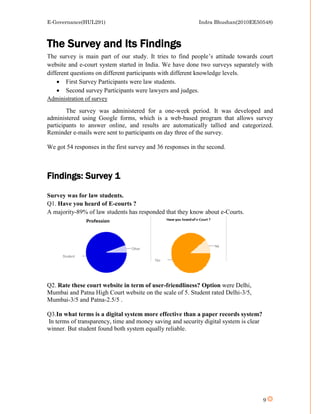
Q1. Have you heard of E-courts ?
A majority-89% of law students has responded that they know about e-Courts.


Q2. Rate these court website in term of user-friendliness? Option were Delhi,
Mumbai and Patna High Court website on the scale of 5. Student rated Delhi-3/5,
Mumbai-3/5 and Patna-2.5/5 .

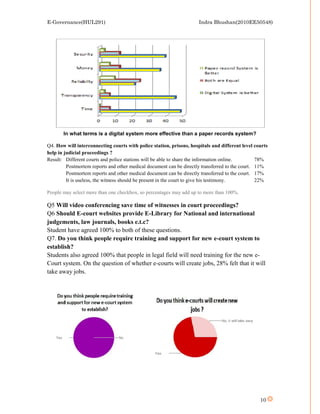
Q3.In what terms is a digital system more effective than a paper records system?
In terms of transparency, time and money saving and security digital system is clear
winner. But student found both system equally reliable.


                                                                                       9
E-Governance(HUL291)                                                  Indra Bhushan(2010EE50548)


       In what terms is a digital system more effective than a paper records system?

Q4. How will interconnecting courts with police station, prisons, hospitals and different level courts
help in judicial proceedings ?
Result: Different courts and police stations will be able to share the information online.       78%
         Postmortem reports and other medical document can be directly transferred to the court. 11%
         Postmortem reports and other medical document can be directly transferred to the court. 17%
         It is useless, the witness should be present in the court to give his testimony.        22%

People may select more than one checkbox, so percentages may add up to more than 100%.

Q5 Will video conferencing save time of witnesses in court proceedings?
Q6 Should E-court websites provide E-Library for National and international
judgements, law journals, books e.t.c?
Student have agreed 100% to both of these questions.
Q7. Do you think people require training and support for new e-court system to
establish?
Students also agreed 100% that people in legal field will need training for the new e-
Court system. On the question of whether e-courts will create jobs, 28% felt that it will
take away jobs.


                                                                                                  10
E-Governance(HUL291)                                       Indra Bhushan(2010EE50548)


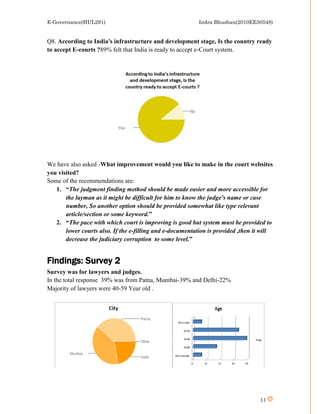
Q8. According to India's infrastructure and development stage, Is the country ready
to accept E-courts ?89% felt that India is ready to accept e-Court system.


We have also asked -What improvement would you like to make in the court websites
you visited?
Some of the recommendations are:
   1. “The judgment finding method should be made easier and more accessible for
       the layman as it might be difficult for him to know the judge's name or case
       number, So another option should be provided somewhat like type relevant
       article/section or some keyword.”
   2. “The pace with which court is improving is good but system must be provided to
       lower courts also. If the e-filling and e-documentation is provided ,then it will
       decrease the judiciary corruption to some level.”


Findings: Survey 2
Survey was for lawyers and judges.
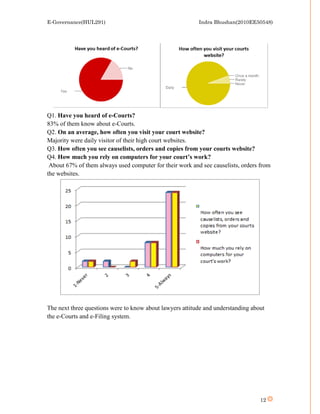
In the total response 39% was from Patna, Mumbai-39% and Delhi-22%
Majority of lawyers were 40-59 Year old .


                                                                                   11
E-Governance(HUL291)                                      Indra Bhushan(2010EE50548)


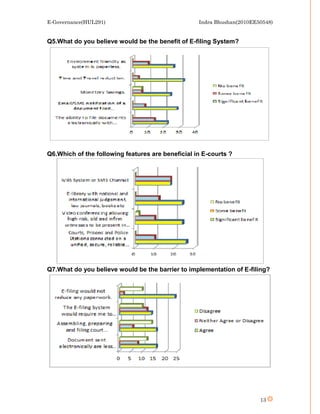
Q1. Have you heard of e-Courts?
83% of them know about e-Courts.
Q2. On an average, how often you visit your court website?
Majority were daily visitor of their high court websites.
Q3. How often you see causelists, orders and copies from your courts website?
Q4. How much you rely on computers for your court’s work?
 About 67% of them always used computer for their work and see causelists, orders from
the websites.


The next three questions were to know about lawyers attitude and understanding about
the e-Courts and e-Filing system.


                                                                                  12
E-Governance(HUL291)                               Indra Bhushan(2010EE50548)


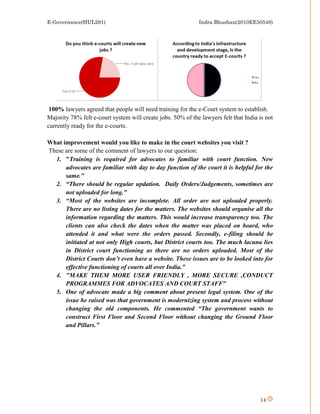
Q5.What do you believe would be the benefit of E-filing System?


Q6.Which of the following features are beneficial in E-courts ?


Q7.What do you believe would be the barrier to implementation of E-filing?


                                                                        13
E-Governance(HUL291)                                         Indra Bhushan(2010EE50548)


 100% lawyers agreed that people will need training for the e-Court system to establish.
Majority 78% felt e-court system will create jobs. 50% of the lawyers felt that India is not
currently ready for the e-courts.

What improvement would you like to make in the court websites you visit ?
These are some of the comment of lawyers to our question:
  1. "Training is required for advocates to familiar with court function. New
      advocates are familiar with day to day function of the court it is helpful for the
      same."
  2. “There should be regular updation. Daily Orders/Judgements, sometimes are
      not uploaded for long.”
  3. “Most of the websites are incomplete. All order are not uploaded properly.
      There are no listing dates for the matters. The websites should organise all the
      information regarding the matters. This would increase transparency too. The
      clients can also check the dates when the matter was placed on board, who
      attended it and what were the orders passed. Secondly, e-filing should be
      initiated at not only High courts, but District courts too. The much lacuna lies
      in District court functioning as there are no orders uploaded. Most of the
      District Courts don’t even have a website. These issues are to be looked into for
      effective functioning of courts all over India.”
  4. "MAKE THEM MORE USER FRIENDLY , MORE SECURE ,CONDUCT
      PROGRAMMES FOR ADVOCATES AND COURT STAFF"
  5. One of advocate made a big comment about present legal system. One of the
      issue he raised was that government is modernizing system and process without
      changing the old components. He commented “The government wants to
      construct First Floor and Second Floor without changing the Ground Floor
      and Pillars.”


                                                                                      14
E-Governance(HUL291)                                           Indra Bhushan(2010EE50548)


P.I.L.(Public Interest Litigation)
In this section we have explained the P.I.L system and how it is benefitted from the new
e-Court system. The courts websites play an important role in changing this system.

What is a PIL?
Public Interest Litigation (PIL) - litigation for public interest. PIL was started to protect
the fundamental rights of people who are poor, ignorant or in socially/economically
private person against another for the enforcement of a personal right. The presence of
'public interest' is important to file a PIL.[13]

When to file PIL?
According to the guidelines of the Supreme Court any member of public having
sufficient interest may maintain an action or petition by way of PIL provided: -
» There is a personal injury or injury to a disadvantaged section of the population for
whom access to legal justice system is difficult,
» The person bringing the action has sufficient interest to maintain an action of public
injury,
» The injury must have arisen because of breach of public duty or violation of the
Constitution or of the law

Currently if anybody want to file PIL, he must consult a lawyer and collect necessary
information and then file it in High Court or Supreme Court.
The websites has brought changes to the filing of cases. Currently, The Supreme Court of
India has introduced E-FILING. Now you can file a case in the Supreme Court through
the internet and also avail of the following services:[12]
     Filing of cases by any Advocate-on-Record or Petitioner-in-person through
        internet from anywhere in the world.
     Electronic payment of court fee and other charges by visa/master card/debit card
     Electronic registration of defect-free cases.
     Electronic communication and removal of filing defects.
     Electronic filing of reply/rejoinder/applications/documents.
     Service of notices and communications through e-mail.

If e-Filing is started in all high courts, this would really help the P.I.L system. People can
file P.I.L electronically through websites and the whole process will also become fast.
Another important change that courts can provide through court’s website is online legal
consultation to the public. This will help in E-Filing of P.I.L but also help in creating
legal awareness.


                                                                                        15
E-Governance(HUL291)                                         Indra Bhushan(2010EE50548)


Future Scope of Developing Websites:
Cloud Computing is one of the best technique that will reduce load on website servers
due to their interconnection and common operating server.[3] Cloud Computing will
reduce IT labor cost by 50% and improve capital utilization, by significantly reducing
license costs and it will provide mush scalability.
Another technique to improve service delivery is to make separate portal for those giving
information and separate portal for services. This will increase speed and security.
Conclusion:
Conclusion 1: People have the awareness about the e-courts as 89% students and 83%
lawyers know about this system.
Conclusion 2: The Mumbai high court website is most developed. While Patna and Delhi
High Court website are developing. The problems came in the comments were same as
we found in our own study of websites.
Conclusion 3: All the high court websites are providing services of providing cause lists,
orders and judgments.
Conclusion 4: There is need of training for lawyers, judges and office clerks to adapt and
accept the e-Court system efficiently.
Conclusion 5: People feel that the new e-court system and websites will create new jobs.
This is shown by our survey.
Conclusion 6: The e-court system is much better than old system and its only barrier is
lack of awareness.
Conclusion 7: Websites need to be have separate version for mobiles. Mobile apps
should be made for the user to increase user friendliness. The translations of websites
should be available in different official Indian language.
References:
   1.   Action Plan E-courts prepared by E-committee of Supreme Court.
   2.   E-court Project Overview by Department of Justice.
   3.   ICT in Court Challenges and Solutions by Rishi Prakash, T. Mohanty, Ramji
        Gupta & Vinay Jain.
   4.   InterPARES-Case Study 21 Final Report: Electronic Filing System (EFS) of the
        Supreme Court of Singapore.
   5.   National Legal Mission –Stategic Initiatives
   6.   Website: http://delhihighcourt.nic.in/
   7.   Website: http://bombayhighcourt.nic.in/
   8.   Website: http://patnahighcourt.bih.nic.in/
   9.   Website: http://supcourt.gov.sg
   10. Website: http://www.negp.gov.in/Projects/ecourts.aspx?id=3&&page=Services
   11. Website: http://ecourts.nic.in/
   12. Website: http://supremecourtofindia.nic.in .
   13. Website: http://en.wikipedia.org/wiki/Public-interest_litigation_(India)


                                                                                    16

HULREPORT

  • 1.
    E-COURT SYSTEM IN INDIA StudyAnd Comparison Of Court’s Website Report Submitted by: Indra Bhushan 2010EE50548 Group-TG3(F)
  • 2.
    E-Governance(HUL291) Indra Bhushan(2010EE50548) E-COURT SYSTEM IN INDIA Study And Comparison of Court’s Website Abstract: The introduction of computers and worldwide internet revolution has brought about changes in work and efficiency of various activities. Also, the increasing technology access by citizen and organizations bring expectations and demands on judicial system. The government of India is active in this domain by spending amount on ICT for the computerisation and network connection of courts all over India for the purpose of improvements in operational efficiency, co-ordination, accessibility and speed in the judicial administration. The court’s websites are modernized and updated to provide various e-services to common citizens and people related to the legal field. E-filing, E-orders, E-copies and E-causelists are some of the services provided by the websites. This study is based on finding the efficiency and people’s experiences about the courts website. The high court websites of Delhi, Mumbai, and Patna were chosen for the study. There were two methods used in our study. First, opinion survey was done on law student, faculties, lawyers, judges and other customers. It evaluated users’ opinions as to whether e-court system would be more effective than a traditional court system, their existing attitudes and knowledge levels regarding different e-services present on websites, and failures of websites. Additionally, we also compared e-court services provided in India with Singapore. The comparisons are based on type, number and technology used in the services. Secondly, we present analysis of high court’s website in technical and user-friendly aspects. The result of survey is shown graphically and valid conclusions are presented in our study. The study also covers some solutions and future scope of improving the e-courts in India. 1
  • 3.
    E-Governance(HUL291) Indra Bhushan(2010EE50548) Introduction The use of Information Technology has resulted in increased efficiency, effectiveness and optimal use of resources in different system all around the globe. Today, one can easily exchange information to different locations with the help of electronic communication devices such as facsimile machines, electronic mail, video conferencing, internet, with great accuracy and speed. These capabilities have been applied to government system and services to make it more effective, alert, accountable and user-friendly. NeGP The Internet revolution arrived in India in some year ago has not been able to transform all facets of life in equal measure. The government of India has formulated the NeGP, National e-Governance Plan on May 2006 with basic aim of providing all government services accessible to every common man in his locality through common service outlets at affordable rates and ensuring efficiency, transparency and reliability in such services. NeGP comprise 27 Mission Mode Projects (MMPS). It has divided this into central MMPs – 10, State MMPs – 10 and 7 integrated MMPs. The 7 integrated MMPs include e-BIZ, National Service Delivery Gateway, Common Service Centres, e-Procurement, e- Office, e-Courts, India Portal, Electronic Data Interchange (EDI) for Trade.[10] The Government is implementing a project for computerization of District & Subordinate Courts in the country and for up gradation of ICT infrastructure of the Supreme Court and the High Courts under the e-Courts Mission Mode Project (MMP). The e-Court Mission Mode Project (MMP) was conceptualized with a vision to transform the Indian judiciary by making use of technology. The NIC, National Information Centre is the main implementing agency of this project.[11] E-Courts and E-Judiciary Judiciary is one of the important pillar on which a State stands. It is the interpreter of law. Following the pattern of naming organizations and functions using IT as .e-something, we can also think of e-judiciary, which ultimately will function through e-courts to deliver justice. The ‘e’ in e-Courts and e-Judiciary is abbreviated as ‘electronic’. It is introduction of electronic means like computers, internet in traditional paper work system of courts and transforming their services for better efficiency, speed and accuracy. E-Courts, Paperless Courts or Digital Court are different names given to same thing. The e-Court Mission Mode Project aims at building the e-court system in India. E-Court, an integrated MMP, has a clear objective - to re-engineer processes and enhance judicial productivity both qualitatively and quantitatively to make the justice delivery system affordable, accessible, cost effective, transparent and accountable.[10] 2
  • 4.
    E-Governance(HUL291) Indra Bhushan(2010EE50548) Department of Justice monitors the project through regular meetings with NIC on project status review and progress discussions. The whole project is divided into six phases with different deliveries. The E-court project aims at developing different services of court and also creation of new services which will have many benefits. Different initiatives of the projects are:[1][2][5]  Establishment of Information Infrastructure for the courts: All the courts of the country are being connected on highly secure, reliable and high speed network. A national data centre is made available exclusively for the courts.  Interconnection of Courts, Prisons and Police Station: All Courts, Prisons and Police Stations will be connected on a unified, highly secure, reliable and high speed network. Also suitable facilities for video conferencing and for audio-video deposition of evidence will be made available. This will allow witnesses (especially high‐risk witnesses, child witnesses, old and infirm witnesses) to be present via video conference in the court.  ICT enabled Courts: The courtrooms are now getting equipped with computers and other courtroom technology. LCD touch screens display for judges, lawyers, facility for video‐conferencing along with audio/video‐recording of oral evidence and large LCD panel for display of evidence are being provided.  Integrated Case and Document Management System: The document management system has to be integrated with the case management system. This integrated solution may be hosted at the National Data Centre for each court. The system will also provide an inbuilt Case Tracking and Monitoring system.  E-orders, E-copies and E-causelists : These are made available on court’s websites and kiosks available in courts  E-library  E-Filing, E-services and Digitization:  Digitization: The courts records are now started being stored electronically.  E-Filing: This is an important move towards paperless system. The services are being made to file petitions, documents and form online or via e-kiosks in court premises. On‐line payment of court fees, process fees etc. are being developed.  E-services: IVRS system and SMS channel are to be established for providing notifications to common user. Many of these services are to be provided by the website of courts. This increases the importance of websites for the common user like lawyers, judges, law students, and common man. Websites act as important channel. The NIC has been given the job of development, maintenance and updating of Indian Court’s websites. The later part of study is dedicated to the study of websites. The survey which is part of study is based on the usability of the websites. The focus is not only on the achievement of the websites but also on negatives, failures of these sites. The comparison of e-court websites in India with those in Singapore is provided to show the deficiency in present services and other goals we should aim to achieve. The comparison of different high court websites gives an idea about the extent of national e-court project in our country. Our study methodology is described below. 3
  • 5.
    E-Governance(HUL291) Indra Bhushan(2010EE50548) Methodology The Delhi, Mumbai and Patna High court websites are selected for the current study. The selection is driven by the fact that most of e-Court activity first started in Delhi, National Capital and Mumbai, Financial Capital. The city of Patna is chosen to give a common picture of our country where e-Court activities are yet to start. For international comparison, Singapore Supreme Court Website is chosen. The selection of Singapore Court is driven by the fact that Singapore has the best e-Governance in Asia according to the United Nation e-Governance Report. A web based opinion survey is done to rate these websites. It evaluated users’ opinions as to whether e-court system would be more effective than a traditional court system, their existing attitudes and knowledge levels regarding different e-services present on websites, and failures of websites. Two separate surveys with different set of questions according to knowledge and interaction levels was done. First, survey had law student as the participants. While, second survey recorded the views of lawyers, judges. We send the link of our survey to the participants and recorded their opinion. Proper definitions and purpose was provided at the beginning of the survey to bring clarity. We encouraged the participants to also comment on the present system, identify problems, and describe how they are dealing with them. Additional data for comparison was obtained by the study of websites. Court Websites in India DELHI HIGH COURT The Delhi High Court websites can be accesses by the link http://delhihighcourt.nic.in/ . Being the National Capital, the website of Delhi is well structured and good looking compared to other websites we have studied. The first complete paperless e-Court in the Delhi High Court (Court No. 24) started functioning as early as 15th December 2009. As of now 9 courts in the Delhi High Court, including the Chief Justice’s Court, are running as completely paperless e-Courts. The Delhi High Court has connected to the forensic sciences lab via video conference for several cases. The Delhi High Court is now using its website to provide following services [6]:  Case history in case wise, advocate wise, FIR no. wise, party name wise format.  The assets of high court judges are provided on the link http://delhihighcourt.nic.in/assets.asp in pdf format.  Customized Cause lists searchable with advocate name, substring, court no., judge wise. There is also a downloadable pdf format.  Case and Filing status  Orders and judgments and Certified Copies can be downloaded according to case number. 4
  • 6.
    E-Governance(HUL291) Indra Bhushan(2010EE50548)  A very detailed set of FAQs (59 Questions) is available on the Delhi High Court Website at http://delhihighcourt.nic.in/faq.asp  E-library resources at http://www.delhihighcourt.nic.in/library_home.asp  Public Notices, Job Opening, Tenders are updated on website.  The Delhi High Court has been successfully conducting e-meetings. They also have an intranet portal where the agenda, relevant documents and minutes of the meeting are uploaded and archived. Problems with the website:  Problem in suggestion or feedback page. People can give their feedback about the website. But, feedback form does not cover options for other problems like searching, services e.t.c.  Images are not resized, optimize, this decreases the site speed.  Search Tab doesn't works inside pdf, it only provide links of webpages. If search is done on pdf it will become more reasonable.  Mobile site not available.  No IVRS or SMS channel is provided by Delhi high Court.  The Judgment link http://lobis.nic.in/dhc/ is not working.  Daily updating of site is required to strengthen the system. This causes user to lose interest because of delayed information on site. A special team should be deputed having expertise in e system. MUMBAI HIGH COURT Mumbai is the financial capital of the country. The Bombay high court has benches at Nagpur, Panaji, Aurangabad .The Mumbai high court website was ranked 2nd by the NIC in terms maintenance and services. The Mumbai High Court website is the most advanced high court website and can be compared to website in foreign countries. The Bombay High Court is successfully communicating with its respective police stations through email since last one year. Bombay High Court is already using video conferencing facility to bring in Judges from different locations in relation to cases. The Bombay High Court website can be accessed by the link http://bombayhighcourt.nic.in/. The following services are provides on the website.[7]  Case Status can be found case number wise, advocate wise, party wise and CIN number wise.  Court orders can be found case number and Coram wise.  Causelist can be seen at http://bombayhighcourt.nic.in/ and can be searched judge wise, lawyers wise, party wise .  E-filing of cases can be done and link is provided on the website http://bombayhighcourt.nic.in/ecasefiling/elogin.php . The advocate are provided user name and login password through which they can file cases online. 5
  • 7.
    E-Governance(HUL291) Indra Bhushan(2010EE50548)  E-library can be accessed by the link http://bombayhighcourt.nic.in/libweb/judlibwebindex.html .  Online payment of court fees has been successfully going on in the Bombay High Court. The State Government of Maharashtra has created an e-payment platform for payments to be made to Government of Maharashtra, through https://gras.mahakosh.gov.in/echallan/ - The Bombay High Court is encouraging the use of this platform for making e-payments to the High Court.  The Bombay High Court has recently followed a complete online recruitment process through its websites.  Separate website is there for mobile users http://bombayhighcourt.nic.in/mobileindex.html .  The websites provide IVRS and SMS channel numbers.  Online display of court case number of three benches Mumbai, Nagpur and Aurangabad is present on the website.  Frequently asked questions regarding Case Management Information System. Problems with the website:  Too many keys(Ctrl and Alt) are disabled that annoy the common user more than providing any security.  Poor use of CSS and so many gif files increases page load time.  Extensive use of pop-up windows making the site more vulnerable to attacks.  Webpage doesn't looks dynamic enough resulting in slow updates.  Insufficient documentation about e-services.  No inbuilt search, Google search often gives outdated results and in incorrect order of significance.  Information about judges and their assets need to be updated and provided.  E-filing site need to secured.  No contact / suggestion / feedback page. PATNA HIGH COURT The Patna High Court website has the following link http://patnahighcourt.bih.nic.in/ . The comparison of Patna High Court website with Delhi and Mumbai cannot be done at the same level. This is because it the case of India that any development project, first serve the Metros and then it reaches for the rest of country. The website of Patna is maintained by the NIC. The problems with the website are only done from user point of view not in terms of services and technology. The following are the services provided by the website:  Case Status can be found by case number, year and type –civil or criminal.  Cause list by New CIS software is provided. There is a trial run for Advocate on Record Search Wise. 6
  • 8.
    E-Governance(HUL291) Indra Bhushan(2010EE50548)  Orders and judgment can be searched and downloaded at http://patnahighcourt.bih.nic.in/judgment/OrderCaseNoWise.aspx  The links for recruitment, notices are provided. Problems with the website:  Site search doesn't works, e.g. searching for causelist gives all pages since every page has it in the footer.  Cause list is very un-friendly and non-interactive  Poor DOM positioning on cause list page. Needs a proper documentation to use.  Most information is in pdf format which is not searchable.  Microsoft IIS , the hosting server seems outdated  Broken links on few pages e.g. http://patnahighcourt.bih.nic.in/Profile/Chief.htm  Broken ASP on the search page, poor coding.  Data missing on pages e.g. http://patnahighcourt.bih.nic.in/judgment/default.aspx  Copyright not updated.  No contact / suggestion / feedback page.  Notice board is not friendly, stack of many notice numbers with no name, the links are PDFs hence can't even be searched.  Information displayed is not well formatted.  Some Portion are last updated :: 16.03.2009.  The new CIS system being introduced in Patna High Court is updated belatedly after 2-3 days. It should be updated same day otherwise it will not be of much utility if one has to again go for manual search & inquiry about status or judgement of any case. It should generate AOR No. wise personalised causelist.  The government of India has given 22 "languages of the 8th Schedule" the status of official language.One of the common user problem with all these websites was that translation of website from English to other national language was not provided. Countries like Australia, Singapore provide translation of their website to other regional language which are not even listed in their constitution as official language. {This Space is intentionally left blank} 7
  • 9.
    E-Governance(HUL291) Indra Bhushan(2010EE50548) Court Website Of Singapore The Singapore Subordinate Courts initiated their first IT plan in 1985[4]. They have continued to strive to update and utilise existing and emerging technologies to provide more efficient services.The supreme court of Singapore has the link http://www.supcourt.gov.sg . This website is far more advanced than Indian court website. Singapore is ranked best for its e-Governance which is shown by its website. The different online services are[9]:  Cost of different court services is provided on the website.  The Electronic Filing System (EFS) : With the inception of the Electronic Filing Service in 2000, lawyers can now file court documents electronically over the Internet front-end web-based system at their convenience 24 hours a day, 7 days a week. Billing information provided to law firms by the system can be integrated with their in-house accounting system for greater efficiency and accuracy in the management of client accounts. Presently over 84% of documents are filed in court electronically by more than 400 law firms via the web-based system.  The links on website are categorized according to lawyers, litigants and other users.  On-line file inspection service.  Hearing Lists and Notices are provided.  Search option is provided to search in Supreme court website and as well as Google search.  Feedback system is well developed.  SMS notifications is there for the registered party.  JUSTICE ONLINE Launched in June 2002. Allows both point to point and multi- party "video" link-up via broadband internet connection.  eJUSTICE - Email forum for Judges around the world, to facilitate knowledge sharing.  VIDEO-CONFERENCING - This can occur via AV equipment in courtrooms or via the Justice Online internet system. The Mumbai High Court website can be compared the Singapore Court website. Both of these website are providing similar services. The only difference is the structure and methods. The Mumbai High court website need to modernize a little to improve its user- friendliness. Rest of the High Courts of India need to establish many services . They need to develop the present system also. Singapore has established separate internet portals for judges and advocates which provide a facility of online consultation between them. Indian government is establishing connection between courts firms, police stations. This will definitely help the system. In coming years we would be able to provide services of foreign standards. 8
  • 10.
    E-Governance(HUL291) Indra Bhushan(2010EE50548) The Survey and Its Findings The survey is main part of our study. It tries to find people’s attitude towards court website and e-court system started in India. We have done two surveys separately with different questions on different participants with different knowledge levels.  First Survey Participants were law students.  Second survey Participants were lawyers and judges. Administration of survey The survey was administered for a one-week period. It was developed and administered using Google forms, which is a web-based program that allows survey participants to answer online, and results are automatically tallied and categorized. Reminder e-mails were sent to participants on day three of the survey. We got 54 responses in the first survey and 36 responses in the second. Findings: Survey 1 Survey was for law students. Q1. Have you heard of E-courts ? A majority-89% of law students has responded that they know about e-Courts. Q2. Rate these court website in term of user-friendliness? Option were Delhi, Mumbai and Patna High Court website on the scale of 5. Student rated Delhi-3/5, Mumbai-3/5 and Patna-2.5/5 . Q3.In what terms is a digital system more effective than a paper records system? In terms of transparency, time and money saving and security digital system is clear winner. But student found both system equally reliable. 9
  • 11.
    E-Governance(HUL291) Indra Bhushan(2010EE50548) In what terms is a digital system more effective than a paper records system? Q4. How will interconnecting courts with police station, prisons, hospitals and different level courts help in judicial proceedings ? Result: Different courts and police stations will be able to share the information online. 78% Postmortem reports and other medical document can be directly transferred to the court. 11% Postmortem reports and other medical document can be directly transferred to the court. 17% It is useless, the witness should be present in the court to give his testimony. 22% People may select more than one checkbox, so percentages may add up to more than 100%. Q5 Will video conferencing save time of witnesses in court proceedings? Q6 Should E-court websites provide E-Library for National and international judgements, law journals, books e.t.c? Student have agreed 100% to both of these questions. Q7. Do you think people require training and support for new e-court system to establish? Students also agreed 100% that people in legal field will need training for the new e- Court system. On the question of whether e-courts will create jobs, 28% felt that it will take away jobs. 10
  • 12.
    E-Governance(HUL291) Indra Bhushan(2010EE50548) Q8. According to India's infrastructure and development stage, Is the country ready to accept E-courts ?89% felt that India is ready to accept e-Court system. We have also asked -What improvement would you like to make in the court websites you visited? Some of the recommendations are: 1. “The judgment finding method should be made easier and more accessible for the layman as it might be difficult for him to know the judge's name or case number, So another option should be provided somewhat like type relevant article/section or some keyword.” 2. “The pace with which court is improving is good but system must be provided to lower courts also. If the e-filling and e-documentation is provided ,then it will decrease the judiciary corruption to some level.” Findings: Survey 2 Survey was for lawyers and judges. In the total response 39% was from Patna, Mumbai-39% and Delhi-22% Majority of lawyers were 40-59 Year old . 11
  • 13.
    E-Governance(HUL291) Indra Bhushan(2010EE50548) Q1. Have you heard of e-Courts? 83% of them know about e-Courts. Q2. On an average, how often you visit your court website? Majority were daily visitor of their high court websites. Q3. How often you see causelists, orders and copies from your courts website? Q4. How much you rely on computers for your court’s work? About 67% of them always used computer for their work and see causelists, orders from the websites. The next three questions were to know about lawyers attitude and understanding about the e-Courts and e-Filing system. 12
  • 14.
    E-Governance(HUL291) Indra Bhushan(2010EE50548) Q5.What do you believe would be the benefit of E-filing System? Q6.Which of the following features are beneficial in E-courts ? Q7.What do you believe would be the barrier to implementation of E-filing? 13
  • 15.
    E-Governance(HUL291) Indra Bhushan(2010EE50548) 100% lawyers agreed that people will need training for the e-Court system to establish. Majority 78% felt e-court system will create jobs. 50% of the lawyers felt that India is not currently ready for the e-courts. What improvement would you like to make in the court websites you visit ? These are some of the comment of lawyers to our question: 1. "Training is required for advocates to familiar with court function. New advocates are familiar with day to day function of the court it is helpful for the same." 2. “There should be regular updation. Daily Orders/Judgements, sometimes are not uploaded for long.” 3. “Most of the websites are incomplete. All order are not uploaded properly. There are no listing dates for the matters. The websites should organise all the information regarding the matters. This would increase transparency too. The clients can also check the dates when the matter was placed on board, who attended it and what were the orders passed. Secondly, e-filing should be initiated at not only High courts, but District courts too. The much lacuna lies in District court functioning as there are no orders uploaded. Most of the District Courts don’t even have a website. These issues are to be looked into for effective functioning of courts all over India.” 4. "MAKE THEM MORE USER FRIENDLY , MORE SECURE ,CONDUCT PROGRAMMES FOR ADVOCATES AND COURT STAFF" 5. One of advocate made a big comment about present legal system. One of the issue he raised was that government is modernizing system and process without changing the old components. He commented “The government wants to construct First Floor and Second Floor without changing the Ground Floor and Pillars.” 14
  • 16.
    E-Governance(HUL291) Indra Bhushan(2010EE50548) P.I.L.(Public Interest Litigation) In this section we have explained the P.I.L system and how it is benefitted from the new e-Court system. The courts websites play an important role in changing this system. What is a PIL? Public Interest Litigation (PIL) - litigation for public interest. PIL was started to protect the fundamental rights of people who are poor, ignorant or in socially/economically private person against another for the enforcement of a personal right. The presence of 'public interest' is important to file a PIL.[13] When to file PIL? According to the guidelines of the Supreme Court any member of public having sufficient interest may maintain an action or petition by way of PIL provided: - » There is a personal injury or injury to a disadvantaged section of the population for whom access to legal justice system is difficult, » The person bringing the action has sufficient interest to maintain an action of public injury, » The injury must have arisen because of breach of public duty or violation of the Constitution or of the law Currently if anybody want to file PIL, he must consult a lawyer and collect necessary information and then file it in High Court or Supreme Court. The websites has brought changes to the filing of cases. Currently, The Supreme Court of India has introduced E-FILING. Now you can file a case in the Supreme Court through the internet and also avail of the following services:[12]  Filing of cases by any Advocate-on-Record or Petitioner-in-person through internet from anywhere in the world.  Electronic payment of court fee and other charges by visa/master card/debit card  Electronic registration of defect-free cases.  Electronic communication and removal of filing defects.  Electronic filing of reply/rejoinder/applications/documents.  Service of notices and communications through e-mail. If e-Filing is started in all high courts, this would really help the P.I.L system. People can file P.I.L electronically through websites and the whole process will also become fast. Another important change that courts can provide through court’s website is online legal consultation to the public. This will help in E-Filing of P.I.L but also help in creating legal awareness. 15
  • 17.
    E-Governance(HUL291) Indra Bhushan(2010EE50548) Future Scope of Developing Websites: Cloud Computing is one of the best technique that will reduce load on website servers due to their interconnection and common operating server.[3] Cloud Computing will reduce IT labor cost by 50% and improve capital utilization, by significantly reducing license costs and it will provide mush scalability. Another technique to improve service delivery is to make separate portal for those giving information and separate portal for services. This will increase speed and security. Conclusion: Conclusion 1: People have the awareness about the e-courts as 89% students and 83% lawyers know about this system. Conclusion 2: The Mumbai high court website is most developed. While Patna and Delhi High Court website are developing. The problems came in the comments were same as we found in our own study of websites. Conclusion 3: All the high court websites are providing services of providing cause lists, orders and judgments. Conclusion 4: There is need of training for lawyers, judges and office clerks to adapt and accept the e-Court system efficiently. Conclusion 5: People feel that the new e-court system and websites will create new jobs. This is shown by our survey. Conclusion 6: The e-court system is much better than old system and its only barrier is lack of awareness. Conclusion 7: Websites need to be have separate version for mobiles. Mobile apps should be made for the user to increase user friendliness. The translations of websites should be available in different official Indian language. References: 1. Action Plan E-courts prepared by E-committee of Supreme Court. 2. E-court Project Overview by Department of Justice. 3. ICT in Court Challenges and Solutions by Rishi Prakash, T. Mohanty, Ramji Gupta & Vinay Jain. 4. InterPARES-Case Study 21 Final Report: Electronic Filing System (EFS) of the Supreme Court of Singapore. 5. National Legal Mission –Stategic Initiatives 6. Website: http://delhihighcourt.nic.in/ 7. Website: http://bombayhighcourt.nic.in/ 8. Website: http://patnahighcourt.bih.nic.in/ 9. Website: http://supcourt.gov.sg 10. Website: http://www.negp.gov.in/Projects/ecourts.aspx?id=3&&page=Services 11. Website: http://ecourts.nic.in/ 12. Website: http://supremecourtofindia.nic.in . 13. Website: http://en.wikipedia.org/wiki/Public-interest_litigation_(India) 16