Smart Grid 2.0 –
Beyond Meters and onto
Intelligent Energy Management
             Robert Dolin, VP & CTO
            Session 101 – Operations
                       May 11, 2010

                                       1
Smart Grid 1.0
• First deployed by ENEL in Italy from 2001-2005
   • 27 Million residential and light commercial meters, 95% of
     the meters in Italy
   • Installation rate was 700,000 meters/month for 3 years
• Installed price: 2.2 Billion Euro, returns 500 Million
  Euro/year in operational savings
• Key features:
   • Multi-tiered tariffs for TOU pricing, integrated pre-pay,
     integrated disconnects, support for in-home displays, water
     and gas metering, theft detection, power quality
     measurements, metering at the distribution transformer (theft
     detection, phase balancing)

                                                                     2
What’s Next?

• Smart Grid 2.0
  • Using the grid and the devices connected to it as a
    communicating, intelligent system
  • Increased efficiencies
     • Beyond pricing plans enforced by intelligent meters
     • Beyond operational efficiencies from remote disconnects
       and power quality data


                                                                 3
Why is the Smart Grid Important?

• Energy is a principle raw material for GDP
  formation
• If GDP grows, the standard of living improves
• If electrical generating capacity from fossil
  fuel sources is capped – either economically,
  legislatively, or due to environmental
  concerns…
  • Energy to grow GDP must come from
    conservation and renewable resources
                                                  4
Conservation Could Come from
Commercial Buildings


US buildings account for
72% of electricity
consumption


                                             5
              Source: Department of Energy
Commercial Buildings Could
Reduce or Dim Lighting
Offices, retail, hospital,
grocery stores use 75% of
total lighting energy

This translates to 30% of
total energy demand during
summer peak hours 2-5 pm
(compared to 32% for air
conditioning)
                                                        6
              Source: Demand Response Research Center
Aggregators and Utilities Could
Shave Peak Demand

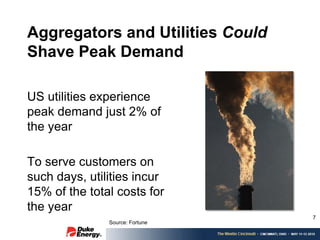
US utilities experience
peak demand just 2% of
the year

To serve customers on
such days, utilities incur
15% of the total costs for
the year
                                  7
               Source: Fortune
Off-Peak Power Could Fuel
Electric and Hybrid Vehicles


Did you know that 40% of
the average US city’s
electricity for lighting is
consumed by its
streetlights?


                                 8
               Source: Fortune
What is Smart Grid 2.0?

• Smart Grid 2.0 puts intelligence and
  communications in:
  • Distribution equipment
     • Meters, transformers, capacitor banks, etc.
  • Significant commercial electrical loads
     • Chillers, boilers, air handlers, lighting, etc.
  • Home appliances
     • Electric water heaters, air conditioners, etc.
  • Rooftop solar arrays, EVs, etc.

                                                         9
When Will We Need Smart Grid 2.0?

• Economic forces are aligning toward the
  development and deployment of the Smart
  Grid
  • Business drivers
  • U.S. Stimulus Package
  • U.S. legislation


                                            10
Business Drivers
• Growing focus on alternative energy and
  clean tech
  • Increased public awareness of the green movement
  • Businesses and consumers actively participating in efficient
    use of energy
• Global governmental policy and regulation
  • Incentivizing energy efficient buildings and homes
• Economic stimulus and incentives to improve
  the smart grid
• Growth in emerging energy markets
  • Demand response, branch management, street lighting and
    smart metering
                                                                   11
Investment in Greentech and
Alternative Energy
 $B              Venture Capital in Greentech
$9,000
                                                 350 deals
$7,500

$6,000
                                                             356 deals
$4,500                            222 deals
$3,000              124 deals                                            180 deals
$1,500   74 deals

   $-
          2005        2006           2007           2008       2009      2010 Q1
                                                                                     12
                     Source: Cleantech Group and Deloitte
Commercial Opportunity –
Demand Response
                                        U.S. Commercial Demand
                                            Response Market
Recall that 15% of
                                                         8%
a utility’s operating                             4%
                                              2%
expenses are for
providing for peaks
that occur only 2%
of the time!                                                            86%

                                      Potential Market        Captured - Comverge
                                      Captured - EnerNOC      Captured - Other
                                                                                    13
                Source: Fortune & Pike Research
U.S. Stimulus Package

      • Smart Grid - $3.5B for modernization of the nation’s
        electricity grid
      • Good news…except the majority hasn’t been
        disbursed yet
                                 U.S. Stimulus Smart Grid Grants
                                          April 30, 2010

        Paid ($K)    $2,948

    Awarded ($K)                                                                                            3190173


Appropriated ($K)                                                                                                     3475578


                    $0        $500,000    $1,000,000    $1,500,000   $2,000,000   $2,500,000   $3,000,000     $3,500,000
                                                                                                                        14
                                         Source: Recovery.org
Clean Air Bill

• Transition US to a “clean energy economy”
• Utilities must generate 20% of their electricity through
  renewable energy and energy efficiency by 2020
• Sets new energy efficiency standards
   • 50% higher energy efficiency building codes by 2016
   • Higher standards ratings programs such as Energy Star for
     lighting and appliance efficiency
• Invests $90B in energy efficiency and renewable
  energy by 2025
• Status – Approved by House; awaiting Senate review
                                                                 15
North American Utilities Have
Smart Grid Plans in Place
 70% regard smart grid projects as a strong or highest priority to
 their overall business
                            How would you describe your current
                              Smart Grid deployment status?
                                                 Other              6%
Moving forward with multiple large-scale deployments
for a number of applications                                                     18%
Moving forward with large-scale deployment for AMI,
piloting other solutions                                                           20%
Formal strategy in place, piloting various technologies                                22%
Initial strategy in place; planning & investigatory
phase                                                                                              31%
                                   No current strategy         3%

                                                          0%   5%    10%   15%   20%   25%   30%    35%
                                                                                                     16
                                Source: GMT Research
Smart Grid 2.0 Implications
• Communication and computation capacity
  must increase dramatically!
  • Geographically disbursed, renewable energy
    sources with variable energy output must be
    balanced with demand
     • Energy supply from renewable sources must be made
       predictable in the near term
  • Demand must also be managed in real time
     • Buildings and residences must shed peak loads
  • The shift to electric and hybrid transportation will
    change energy usage patterns and demand cycles
                                                           17
Use Case – Asset Management

• Mapping customers to distribution
  transformers
• Mapping EVs/PEHVs to customers
• Mapping rooftop solar generation to
  customers


                                        18
Asset Management –
Duke Energy Experience
                                    The picture to the left
                                    shows the relationship of
                                    the meters to the
                                    transformers as depicted in
                                    Atlas and CIS

 The picture to the right
 shows the meter to
 transformer relationship as
 determined using the PLC
 network
                                                                  19
               Maps courtesy of Duke Energy
Residential Opportunity –
Time of Use Pricing
• It’s coming…and you’re not prepared
  • You need a smart, automated way to manage
    consumption so the consumer doesn’t have to
• Managing HVAC loads
  • Today – programmable thermostats used to
    manage load can result in customer ill will
  • Future – knowledge at transformer allows utility to
    stagger compressor cycle
     • Shaving peaks, thus reducing costs while keeping the
       A/C on
         • Possible through intelligence and visibility of power
                                                                   20
           line communications
Use Case – Micro Grids

• Multiple customers on a transformer opt for
  rooftop solar arrays – incentives are rebates,
  TOU pricing, etc.
• Residential generation capacity exceeds
  transformer rating to supply reverse power to the
  grid on a sunny day
• Instead of failing, intelligence at the transformer
  shuts down an inverter, issues alarm for
  undersized transformer, head end issues work
  order, larger transformer is installed                21
Use Case – Electric Vehicles

• Consumers will want longer range
  and faster charging of their EVs
   • Higher ampere chargers over a shorter time,
     for example, Tesla Roadster Charger is
     70Amps @ 220v with a 240+ mile range in
     ~3 hours
• Consumer plugs in a vehicle,
  causing the distribution transformer
  to overload
• Instead of failing, intelligence at the
  transformer knows which charger to
  put into “slow charge” mode                      22
Residential Opportunity

•Manage your energy consumption
  • Transparency – line item detail
  • Control – red light?
• Automated back-of-mind
  •   Preference-based approach
  •   Integrated
  •   Self-learning
  •   Interactive - configurable


                                      23
Residential Opportunity
 • What are we really trying to accomplish?
   • Energy efficiency
   • Maybe smarter energy consumption
   • Universal access
   • Framework for a smart grid (transformational
     products)
   • Win cubed
 • How might this look?


                                                    24
Customer Experience
Renewable
Integration
                                                         Master
                                                        Controller
Occupancy
 Sensors

   Vampire                                                  Storage
    Loads
                                Appliances

    Vehicle
 Electrification                                        HVAC
                                                     Integration      25
                   Graphic courtesy of Duke Energy
Results
• Automatic scheduling to shift demand produces real energy
  savings
   • Turn off the water heater when no one is home
   • Manage vampire loads
   • Shift appliance cycles to off peak
• Managing the HVAC loads across a distribution transformer
  minimizes peaks
   • HVAC is ~50% of the bill so managing it is key
   • Most AC compressors cycle at 7 minutes on & 15 minutes
     off
• A more efficient utility can bill customers for less money, keep
  their customers comfortable and happy,earn more profit, and
  through conservation, benefit the environment
                                                                     26
Use Case Requirements

• Distributed intelligence and control for rapid
  decision making and reactions
   • Meter, transformer, inverter, charger, etc.
• Accurate topology information
   • Where do the low voltage distribution cables go?
• Centralized policy
   • Policy applied across the service area


                                                        27
Distributed Decision Making

• Sensing and control at individual grid
  elements makes it possible for timely
  autonomous action
  • A scalable solution versus sending everything up
    to a central site and then back down to the grid


                                                       28
Automatic Topology Management

• Utilities all have drawings of their grid
• In the chaos of construction the drawings are
  not updated to “as built”
• In the haste of service restoration the
  drawings are not updated
• In the end, keeping this information up to date
  is too expensive – unless it is automatic
  • Use the grid to map the grid – low voltage power
    line communications provides this benefit
                                                       29
Centralized Policy

• Distributed intelligence needs provisioning
  • Which customers “opt in” for which plans and
    services
  • Which loads are O.K. to shed
  • What is the alarm threshold value for a given
    distribution transformer’s internal temperature or
    current flowing through it
• Data must trigger actions
  • Work orders, repair verifications, etc.
                                                         30
The New “Stranded Assets”

• A “Stranded Asset” is an asset that becomes
  obsolete prior to being fully depreciated
• If we have a Smart Grid in 10 years, and systems are
  being deployed today that:
   • Don’t have intelligence at major grid elements
   • Don’t make local decisions and implement control
   • Don’t know and automatically update the grid topology
• Then those systems are stranded assets and prevent
  the Smart Grid
   • Who will pay to update those systems with 10+ years of
     depreciation left on them?
                                                              31
Smart Grid 2.0 Benefits

• Economic productivity – lower costs to
  produce the GDP
• Less pollution from the transition to electric
  vehicles and renewable electricity sources
• Lower CO2 emissions from conservation,
  EVs, and renewable electricity sources


                                                   32
Achieving Smart Grid 2.0 Benefits

• Procure and deploy systems that meet the
  envisioned Smart Grid use cases
  • Power line communications from meters to
    distribution transformers to know the topology
  • Sensing and control at the distribution transformer
    to take timely action
• Avoid systems that are meter centric and fail
  to encompass the notion of the grid as a
  network
                                                          33
Thank You!


             34

smart grid roadshow

  • 1.
    Smart Grid 2.0– Beyond Meters and onto Intelligent Energy Management Robert Dolin, VP & CTO Session 101 – Operations May 11, 2010 1
  • 2.
    Smart Grid 1.0 •First deployed by ENEL in Italy from 2001-2005 • 27 Million residential and light commercial meters, 95% of the meters in Italy • Installation rate was 700,000 meters/month for 3 years • Installed price: 2.2 Billion Euro, returns 500 Million Euro/year in operational savings • Key features: • Multi-tiered tariffs for TOU pricing, integrated pre-pay, integrated disconnects, support for in-home displays, water and gas metering, theft detection, power quality measurements, metering at the distribution transformer (theft detection, phase balancing) 2
  • 3.
    What’s Next? • SmartGrid 2.0 • Using the grid and the devices connected to it as a communicating, intelligent system • Increased efficiencies • Beyond pricing plans enforced by intelligent meters • Beyond operational efficiencies from remote disconnects and power quality data 3
  • 4.
    Why is theSmart Grid Important? • Energy is a principle raw material for GDP formation • If GDP grows, the standard of living improves • If electrical generating capacity from fossil fuel sources is capped – either economically, legislatively, or due to environmental concerns… • Energy to grow GDP must come from conservation and renewable resources 4
  • 5.
    Conservation Could Comefrom Commercial Buildings US buildings account for 72% of electricity consumption 5 Source: Department of Energy
  • 6.
    Commercial Buildings Could Reduceor Dim Lighting Offices, retail, hospital, grocery stores use 75% of total lighting energy This translates to 30% of total energy demand during summer peak hours 2-5 pm (compared to 32% for air conditioning) 6 Source: Demand Response Research Center
  • 7.
    Aggregators and UtilitiesCould Shave Peak Demand US utilities experience peak demand just 2% of the year To serve customers on such days, utilities incur 15% of the total costs for the year 7 Source: Fortune
  • 8.
    Off-Peak Power CouldFuel Electric and Hybrid Vehicles Did you know that 40% of the average US city’s electricity for lighting is consumed by its streetlights? 8 Source: Fortune
  • 9.
    What is SmartGrid 2.0? • Smart Grid 2.0 puts intelligence and communications in: • Distribution equipment • Meters, transformers, capacitor banks, etc. • Significant commercial electrical loads • Chillers, boilers, air handlers, lighting, etc. • Home appliances • Electric water heaters, air conditioners, etc. • Rooftop solar arrays, EVs, etc. 9
  • 10.
    When Will WeNeed Smart Grid 2.0? • Economic forces are aligning toward the development and deployment of the Smart Grid • Business drivers • U.S. Stimulus Package • U.S. legislation 10
  • 11.
    Business Drivers • Growingfocus on alternative energy and clean tech • Increased public awareness of the green movement • Businesses and consumers actively participating in efficient use of energy • Global governmental policy and regulation • Incentivizing energy efficient buildings and homes • Economic stimulus and incentives to improve the smart grid • Growth in emerging energy markets • Demand response, branch management, street lighting and smart metering 11
  • 12.
    Investment in Greentechand Alternative Energy $B Venture Capital in Greentech $9,000 350 deals $7,500 $6,000 356 deals $4,500 222 deals $3,000 124 deals 180 deals $1,500 74 deals $- 2005 2006 2007 2008 2009 2010 Q1 12 Source: Cleantech Group and Deloitte
  • 13.
    Commercial Opportunity – DemandResponse U.S. Commercial Demand Response Market Recall that 15% of 8% a utility’s operating 4% 2% expenses are for providing for peaks that occur only 2% of the time! 86% Potential Market Captured - Comverge Captured - EnerNOC Captured - Other 13 Source: Fortune & Pike Research
  • 14.
    U.S. Stimulus Package • Smart Grid - $3.5B for modernization of the nation’s electricity grid • Good news…except the majority hasn’t been disbursed yet U.S. Stimulus Smart Grid Grants April 30, 2010 Paid ($K) $2,948 Awarded ($K) 3190173 Appropriated ($K) 3475578 $0 $500,000 $1,000,000 $1,500,000 $2,000,000 $2,500,000 $3,000,000 $3,500,000 14 Source: Recovery.org
  • 15.
    Clean Air Bill •Transition US to a “clean energy economy” • Utilities must generate 20% of their electricity through renewable energy and energy efficiency by 2020 • Sets new energy efficiency standards • 50% higher energy efficiency building codes by 2016 • Higher standards ratings programs such as Energy Star for lighting and appliance efficiency • Invests $90B in energy efficiency and renewable energy by 2025 • Status – Approved by House; awaiting Senate review 15
  • 16.
    North American UtilitiesHave Smart Grid Plans in Place 70% regard smart grid projects as a strong or highest priority to their overall business How would you describe your current Smart Grid deployment status? Other 6% Moving forward with multiple large-scale deployments for a number of applications 18% Moving forward with large-scale deployment for AMI, piloting other solutions 20% Formal strategy in place, piloting various technologies 22% Initial strategy in place; planning & investigatory phase 31% No current strategy 3% 0% 5% 10% 15% 20% 25% 30% 35% 16 Source: GMT Research
  • 17.
    Smart Grid 2.0Implications • Communication and computation capacity must increase dramatically! • Geographically disbursed, renewable energy sources with variable energy output must be balanced with demand • Energy supply from renewable sources must be made predictable in the near term • Demand must also be managed in real time • Buildings and residences must shed peak loads • The shift to electric and hybrid transportation will change energy usage patterns and demand cycles 17
  • 18.
    Use Case –Asset Management • Mapping customers to distribution transformers • Mapping EVs/PEHVs to customers • Mapping rooftop solar generation to customers 18
  • 19.
    Asset Management – DukeEnergy Experience The picture to the left shows the relationship of the meters to the transformers as depicted in Atlas and CIS The picture to the right shows the meter to transformer relationship as determined using the PLC network 19 Maps courtesy of Duke Energy
  • 20.
    Residential Opportunity – Timeof Use Pricing • It’s coming…and you’re not prepared • You need a smart, automated way to manage consumption so the consumer doesn’t have to • Managing HVAC loads • Today – programmable thermostats used to manage load can result in customer ill will • Future – knowledge at transformer allows utility to stagger compressor cycle • Shaving peaks, thus reducing costs while keeping the A/C on • Possible through intelligence and visibility of power 20 line communications
  • 21.
    Use Case –Micro Grids • Multiple customers on a transformer opt for rooftop solar arrays – incentives are rebates, TOU pricing, etc. • Residential generation capacity exceeds transformer rating to supply reverse power to the grid on a sunny day • Instead of failing, intelligence at the transformer shuts down an inverter, issues alarm for undersized transformer, head end issues work order, larger transformer is installed 21
  • 22.
    Use Case –Electric Vehicles • Consumers will want longer range and faster charging of their EVs • Higher ampere chargers over a shorter time, for example, Tesla Roadster Charger is 70Amps @ 220v with a 240+ mile range in ~3 hours • Consumer plugs in a vehicle, causing the distribution transformer to overload • Instead of failing, intelligence at the transformer knows which charger to put into “slow charge” mode 22
  • 23.
    Residential Opportunity •Manage yourenergy consumption • Transparency – line item detail • Control – red light? • Automated back-of-mind • Preference-based approach • Integrated • Self-learning • Interactive - configurable 23
  • 24.
    Residential Opportunity •What are we really trying to accomplish? • Energy efficiency • Maybe smarter energy consumption • Universal access • Framework for a smart grid (transformational products) • Win cubed • How might this look? 24
  • 25.
    Customer Experience Renewable Integration Master Controller Occupancy Sensors Vampire Storage Loads Appliances Vehicle Electrification HVAC Integration 25 Graphic courtesy of Duke Energy
  • 26.
    Results • Automatic schedulingto shift demand produces real energy savings • Turn off the water heater when no one is home • Manage vampire loads • Shift appliance cycles to off peak • Managing the HVAC loads across a distribution transformer minimizes peaks • HVAC is ~50% of the bill so managing it is key • Most AC compressors cycle at 7 minutes on & 15 minutes off • A more efficient utility can bill customers for less money, keep their customers comfortable and happy,earn more profit, and through conservation, benefit the environment 26
  • 27.
    Use Case Requirements •Distributed intelligence and control for rapid decision making and reactions • Meter, transformer, inverter, charger, etc. • Accurate topology information • Where do the low voltage distribution cables go? • Centralized policy • Policy applied across the service area 27
  • 28.
    Distributed Decision Making •Sensing and control at individual grid elements makes it possible for timely autonomous action • A scalable solution versus sending everything up to a central site and then back down to the grid 28
  • 29.
    Automatic Topology Management •Utilities all have drawings of their grid • In the chaos of construction the drawings are not updated to “as built” • In the haste of service restoration the drawings are not updated • In the end, keeping this information up to date is too expensive – unless it is automatic • Use the grid to map the grid – low voltage power line communications provides this benefit 29
  • 30.
    Centralized Policy • Distributedintelligence needs provisioning • Which customers “opt in” for which plans and services • Which loads are O.K. to shed • What is the alarm threshold value for a given distribution transformer’s internal temperature or current flowing through it • Data must trigger actions • Work orders, repair verifications, etc. 30
  • 31.
    The New “StrandedAssets” • A “Stranded Asset” is an asset that becomes obsolete prior to being fully depreciated • If we have a Smart Grid in 10 years, and systems are being deployed today that: • Don’t have intelligence at major grid elements • Don’t make local decisions and implement control • Don’t know and automatically update the grid topology • Then those systems are stranded assets and prevent the Smart Grid • Who will pay to update those systems with 10+ years of depreciation left on them? 31
  • 32.
    Smart Grid 2.0Benefits • Economic productivity – lower costs to produce the GDP • Less pollution from the transition to electric vehicles and renewable electricity sources • Lower CO2 emissions from conservation, EVs, and renewable electricity sources 32
  • 33.
    Achieving Smart Grid2.0 Benefits • Procure and deploy systems that meet the envisioned Smart Grid use cases • Power line communications from meters to distribution transformers to know the topology • Sensing and control at the distribution transformer to take timely action • Avoid systems that are meter centric and fail to encompass the notion of the grid as a network 33
  • 34.