How Consumers
     See Value

          Patty Durand
       Executive Director
Smart Grid Consumer Collaborative

    Presentation
TAG Smart Grid Society

           June 7, 2011
                                    1
Smart Grid Consumer Collaborative


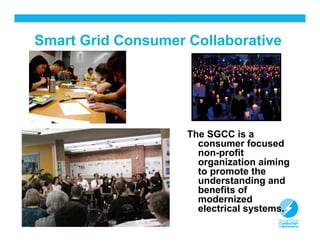
                    The SGCC is a
                      consumer focused
                      non-profit
                      organization aiming
                      to promote the
                      understanding and
                      benefits of
                      modernized
                      electrical systems.
                                        2
The Smart Grid Consumer Collaborative
              Mission:

   listen via consumer research
educate via outreach and messaging
                        toolkits
collaborate via shared best practices

 Working for a consumer-friendly consumer-safe smart grid


                                                            3
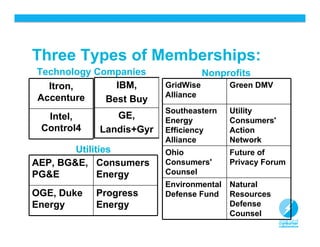
Three Types of Memberships:
Technology Companies                Nonprofits
  Itron,       IBM,      GridWise        Green DMV
Accenture                Alliance
             Best Buy
                         Southeastern    Utility
  Intel,       GE,       Energy          Consumers'
 Control4   Landis+Gyr   Efficiency      Action
                         Alliance        Network
        Utilities        Ohio            Future of
AEP, BG&E, Consumers     Consumers'      Privacy Forum
PG&E          Energy     Counsel
                         Environmental Natural
OGE, Duke   Progress     Defense Fund Resources
Energy      Energy                     Defense
                                       Counsel
                                                      4
Two main reasons to create a
      national smart grid:
Today’s grid is built in   Substantial Benefits:
  the 21st century, is     • Reliability
  aging, one way
                           • Economic
  communications
  and lacks current        • Efficiency
  technology               • Environmental


                                                   5
Scientists’ Report Stresses Urgency of
Limiting Greenhouse Gas Emissions
By LESLIE KAUFMAN
Published: May 12, 2011, New York Times


The nation’s scientific establishment issued a stark
  warning to the American public on Thursday: Not
  only is global warming real, but the effects are
  already becoming serious and the need has become
  “pressing” for a strong national policy to limit
  emissions of heat-trapping gases.


                                                       6
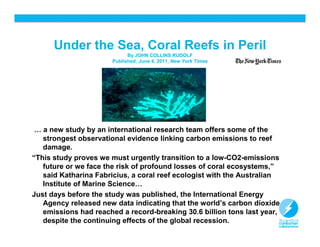
Under the Sea, Coral Reefs in Peril
                             By JOHN COLLINS RUDOLF
                       Published: June 4, 2011, New York Times


 … a new study by an international research team offers some of the
   strongest observational evidence linking carbon emissions to reef
   damage.
“This study proves we must urgently transition to a low-CO2-emissions
   future or we face the risk of profound losses of coral ecosystems,”
   said Katharina Fabricius, a coral reef ecologist with the Australian
   Institute of Marine Science…
Just days before the study was published, the International Energy
   Agency released new data indicating that the world’s carbon dioxide
   emissions had reached a record-breaking 30.6 billion tons last year,
   despite the continuing effects of the global recession.                7
A Warming Planet Struggles to Feed Itself
By JUSTIN GILLIS
Published: June 4, 2011, New York Times


Many of the failed harvests of the past
  decade were a consequence of weather
  disasters, like floods in the United States,
  drought in Australia and blistering heat
  waves in Europe and Russia...
Temperatures are rising rapidly during the
  growing season in some of the most
  important agricultural countries...shave
  yields.

                                                 8
How can a smarter grid reduce
         CO2 emissions?
1. By improving energy efficiency
2. By encouraging renewable and
   distributed energy
3. By communicating between utility and
   consumers about deferrable loads
4. By facilitating the adoption of EVs and
   Plug-in Hybrids

                                         9
Utility executives:
   customer buy-in essential

Yet less than half of utilities are
  preparing their customers
            Phil Carson, May 26, 2011


                                        10
Role of the Smart Grid Consumer
           Collaborative:
• Dedicated to consumer research and
  understanding
• Unique in the field: consumer and
  environmental advocates as members
• Primary focus is educational


                                       11
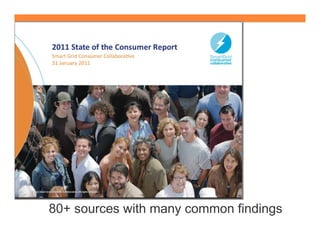
80+ sources with many common findings
                                        12
                                         12
The Knowledge Gap

• Few Americans are energy literate, take electricity
for granted

• Distinctions among EE, DR, etc. are lost
• Funding by PUCs and DOE can encourage silos
• Integrated narratives vs. hardware substitution


                                                    13
Many People Want to Know More
•   Interest tends to be financial and relational
    rather than technical
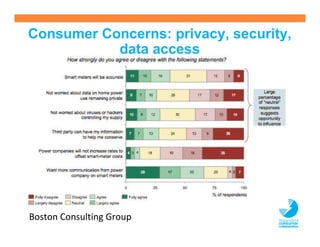
•   Privacy and data access of greater concern to
    stakeholders than most consumers
•   Greater transparency on funding is desired by
    consumers with expectation they will share in
    the operational savings
•   Financial implications of failure to take action
    needs to be part of story

                                                       14
Major Drivers for Consumers

• Knowledge and perspective matter
• Early adopters care about tech or environment
• Energy champions care about big picture
• Cost saving expectations higher than realistic
• Need to weigh risks/costs of action/inaction


                                                   15
Consumer Segmentation

• Key to successful engagement
• Varied methodologies, comparable findings
• More predictive than traditional demographics
• Simple consumer view for self-selection
• Utilities need to deal with all segments
• Percentage mix actionable on local level
                                                  16
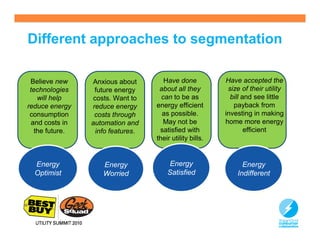
Different approaches to segmentation

 Believe new     Anxious about         Have done           Have accepted the
 technologies     future energy      about all they         size of their utility
    will help     costs. Want to      can to be as           bill and see little
reduce energy    reduce energy      energy efficient          payback from
 consumption      costs through       as possible.         investing in making
  and costs in   automation and        May not be          home more energy
   the future.     info features.    satisfied with                efficient
                                    their utility bills.


  Energy             Energy             Energy                   Energy
  Optimist           Worried            Satisfied              Indifferent


                                                                                17
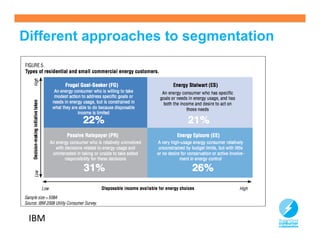
Different approaches to segmentation


 IBM                                   18
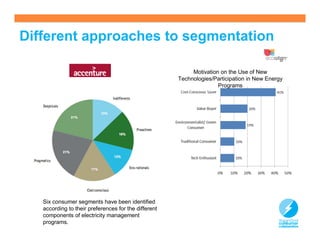
Different approaches to segmentation

                                                           Motivation on the Use of New
                                                      Technologies/Participation in New Energy
                                                                     Programs


   Six consumer segments have been identified
   according to their preferences for the different
   components of electricity management
   programs.                                                                                     19
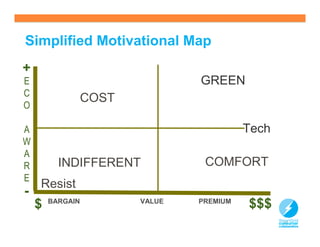
Simplified Motivational Map
+
E                                GREEN
C
                  COST
O

A                                          Tech
W
A
R         INDIFFERENT             COMFORT
E
    Resist
-
    $   BARGAIN          VALUE   PREMIUM
                                           $$$
                                                  20
Consumer Concerns: privacy, security,
           data access


Boston Consulting Group            21
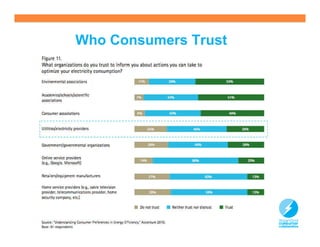
Who Consumers Trust


                      22
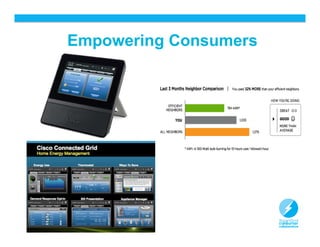
Empowering Consumers


                       23
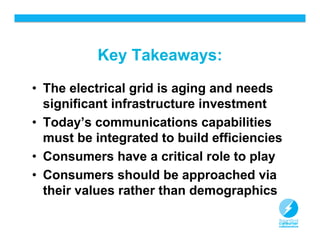
Key Takeaways:
• The electrical grid is aging and needs
  significant infrastructure investment
• Today’s communications capabilities
  must be integrated to build efficiencies
• Consumers have a critical role to play
• Consumers should be approached via
  their values rather than demographics

                                             24

Sgcc tag smart grid society

  • 1.
    How Consumers See Value Patty Durand Executive Director Smart Grid Consumer Collaborative Presentation TAG Smart Grid Society June 7, 2011 1
  • 2.
    Smart Grid ConsumerCollaborative The SGCC is a consumer focused non-profit organization aiming to promote the understanding and benefits of modernized electrical systems. 2
  • 3.
    The Smart GridConsumer Collaborative Mission: listen via consumer research educate via outreach and messaging toolkits collaborate via shared best practices Working for a consumer-friendly consumer-safe smart grid 3
  • 4.
    Three Types ofMemberships: Technology Companies Nonprofits Itron, IBM, GridWise Green DMV Accenture Alliance Best Buy Southeastern Utility Intel, GE, Energy Consumers' Control4 Landis+Gyr Efficiency Action Alliance Network Utilities Ohio Future of AEP, BG&E, Consumers Consumers' Privacy Forum PG&E Energy Counsel Environmental Natural OGE, Duke Progress Defense Fund Resources Energy Energy Defense Counsel 4
  • 5.
    Two main reasonsto create a national smart grid: Today’s grid is built in Substantial Benefits: the 21st century, is • Reliability aging, one way • Economic communications and lacks current • Efficiency technology • Environmental 5
  • 6.
    Scientists’ Report StressesUrgency of Limiting Greenhouse Gas Emissions By LESLIE KAUFMAN Published: May 12, 2011, New York Times The nation’s scientific establishment issued a stark warning to the American public on Thursday: Not only is global warming real, but the effects are already becoming serious and the need has become “pressing” for a strong national policy to limit emissions of heat-trapping gases. 6
  • 7.
    Under the Sea,Coral Reefs in Peril By JOHN COLLINS RUDOLF Published: June 4, 2011, New York Times … a new study by an international research team offers some of the strongest observational evidence linking carbon emissions to reef damage. “This study proves we must urgently transition to a low-CO2-emissions future or we face the risk of profound losses of coral ecosystems,” said Katharina Fabricius, a coral reef ecologist with the Australian Institute of Marine Science… Just days before the study was published, the International Energy Agency released new data indicating that the world’s carbon dioxide emissions had reached a record-breaking 30.6 billion tons last year, despite the continuing effects of the global recession. 7
  • 8.
    A Warming PlanetStruggles to Feed Itself By JUSTIN GILLIS Published: June 4, 2011, New York Times Many of the failed harvests of the past decade were a consequence of weather disasters, like floods in the United States, drought in Australia and blistering heat waves in Europe and Russia... Temperatures are rising rapidly during the growing season in some of the most important agricultural countries...shave yields. 8
  • 9.
    How can asmarter grid reduce CO2 emissions? 1. By improving energy efficiency 2. By encouraging renewable and distributed energy 3. By communicating between utility and consumers about deferrable loads 4. By facilitating the adoption of EVs and Plug-in Hybrids 9
  • 10.
    Utility executives: customer buy-in essential Yet less than half of utilities are preparing their customers Phil Carson, May 26, 2011 10
  • 11.
    Role of theSmart Grid Consumer Collaborative: • Dedicated to consumer research and understanding • Unique in the field: consumer and environmental advocates as members • Primary focus is educational 11
  • 12.
    80+ sources withmany common findings 12 12
  • 13.
    The Knowledge Gap •Few Americans are energy literate, take electricity for granted • Distinctions among EE, DR, etc. are lost • Funding by PUCs and DOE can encourage silos • Integrated narratives vs. hardware substitution 13
  • 14.
    Many People Wantto Know More • Interest tends to be financial and relational rather than technical • Privacy and data access of greater concern to stakeholders than most consumers • Greater transparency on funding is desired by consumers with expectation they will share in the operational savings • Financial implications of failure to take action needs to be part of story 14
  • 15.
    Major Drivers forConsumers • Knowledge and perspective matter • Early adopters care about tech or environment • Energy champions care about big picture • Cost saving expectations higher than realistic • Need to weigh risks/costs of action/inaction 15
  • 16.
    Consumer Segmentation • Keyto successful engagement • Varied methodologies, comparable findings • More predictive than traditional demographics • Simple consumer view for self-selection • Utilities need to deal with all segments • Percentage mix actionable on local level 16
  • 17.
    Different approaches tosegmentation Believe new Anxious about Have done Have accepted the technologies future energy about all they size of their utility will help costs. Want to can to be as bill and see little reduce energy reduce energy energy efficient payback from consumption costs through as possible. investing in making and costs in automation and May not be home more energy the future. info features. satisfied with efficient their utility bills. Energy Energy Energy Energy Optimist Worried Satisfied Indifferent 17
  • 18.
    Different approaches tosegmentation IBM 18
  • 19.
    Different approaches tosegmentation Motivation on the Use of New Technologies/Participation in New Energy Programs Six consumer segments have been identified according to their preferences for the different components of electricity management programs. 19
  • 20.
    Simplified Motivational Map + E GREEN C COST O A Tech W A R INDIFFERENT COMFORT E Resist - $ BARGAIN VALUE PREMIUM $$$ 20
  • 21.
    Consumer Concerns: privacy,security, data access Boston Consulting Group 21
  • 22.
  • 23.
  • 24.
    Key Takeaways: • Theelectrical grid is aging and needs significant infrastructure investment • Today’s communications capabilities must be integrated to build efficiencies • Consumers have a critical role to play • Consumers should be approached via their values rather than demographics 24