RRASE COLLEGE OF ENGINEERING
          TAMBARAM, CHENNAI -601301


                                                    Group Member                 Year
                                                    Abdul Rasheed Feroz Khan.J       03


Smart Cloud Security: From Single to Multi-Clouds                                1
   Introduction
   Literature survey
   Existing System
   problem definition
   Software Architecture
   S/w & H/w Requirement
   UML Diagram
   SDLC and project plan
   Conclusion
   References
                            2
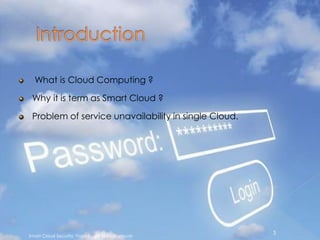
What is Cloud Computing ?

 Why it is term as Smart Cloud ?

 Problem of service unavailability in single Cloud.


                                                      3
Smart Cloud Security: From Single to Multi-clouds
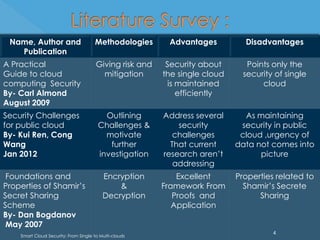
Name, Author and                     Methodologies       Advantages          Disadvantages
   Publication
A Practical                            Giving risk and    Security about       Points only the
Guide to cloud                           mitigation      the single cloud     security of single
computing Security                                         is maintained           cloud
By- Carl Almond                                               efficiently
August 2009
Security Challenges                       Outlining      Address several      As maintaining
for public cloud                        Challenges &         security        security in public
By- Kui Ren, Cong                         motivate          challenges       cloud ,urgency of
Wang                                       further         That current     data not comes into
Jan 2012                                investigation    research aren’t          picture
                                                            addressing
 Foundations and                          Encryption         Excellent      Properties related to
Properties of Shamir’s                        &          Framework From       Shamir’s Secrete
Secret Sharing                            Decryption        Proofs and            Sharing
Scheme                                                      Application
By- Dan Bogdanov
 May 2007
                                                                                      4
    Smart Cloud Security: From Single to Multi-clouds
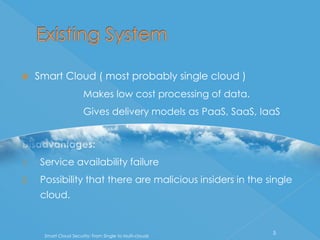
    Smart Cloud ( most probably single cloud )
                         Makes low cost processing of data.
                         Gives delivery models as PaaS, SaaS, IaaS


Disadvantages:
1.    Service availability failure
2.    Possibility that there are malicious insiders in the single
      cloud.


                                                                5
       Smart Cloud Security: From Single to Multi-clouds
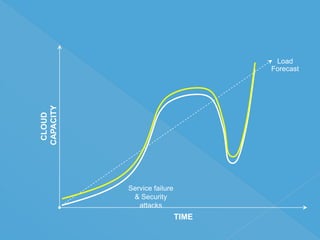
Load
                                    Forecast
CAPACITY
 CLOUD


           Service failure
            & Security
              attacks
                             TIME
   Problem Definition :
                    As data storage and processing concern the

    cloud plays vital role. But along with this advantage develop
    a system which focus the security for single as well as multi-
    cloud. So for this purpose we have to develop the system
    which gives many features


                                  Smart Cloud
                                                              7
          Security: From Single to Multi-clouds
     Service Availability

               Ability to run custom application using service providers
                resources

               Data security

               Data Integrity


                                                                8
Smart Cloud Security: From Single to Multi-clouds
    Make the assurance that data is in secure and stable form.


    Secondary objective :
      Make service availability even when the one cloud fails

      Handle Multiple request at a time.


                                                            9
    Cloud Computing Security: From Single to Multi-clouds
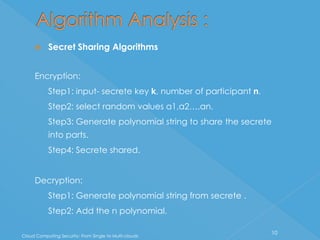
      Secret Sharing Algorithms


     Encryption:
            Step1: input- secrete key k, number of participant n.
            Step2: select random values a1,a2…,an.
            Step3: Generate polynomial string to share the secrete
            into parts.
            Step4: Secrete shared.


     Decryption:
            Step1: Generate polynomial string from secrete .
            Step2: Add the n polynomial.

                                                                    10
Cloud Computing Security: From Single to Multi-clouds
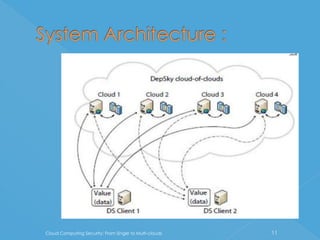
Cloud Computing Security: From Single to Multi-clouds   11
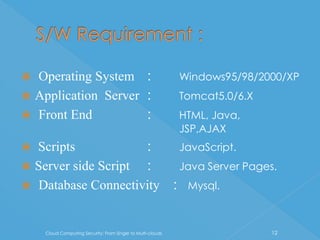
 Operating System :                                         Windows95/98/2000/XP
 Application Server :                                       Tomcat5.0/6.X
 Front End          :                                       HTML, Java,
                                                             JSP,AJAX
 Scripts            :                                       JavaScript.
 Server side Script :                                       Java Server Pages.
 Database Connectivity                                     : Mysql.


    Cloud Computing Security: From Single to Multi-clouds                    12
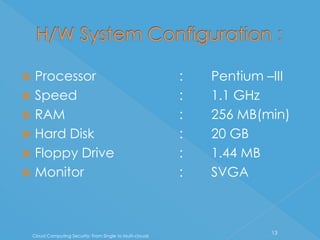
 Processor                                                 :   Pentium –III
 Speed                                                     :   1.1 GHz
 RAM                                                       :   256 MB(min)
 Hard Disk                                                 :   20 GB
 Floppy Drive                                              :   1.44 MB
 Monitor                                                   :   SVGA


                                                                         13
    Cloud Computing Security: From Single to Multi-clouds
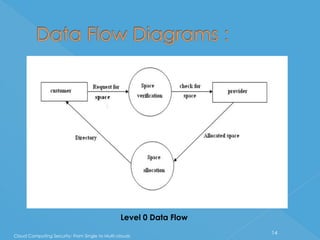
Level 0 Data Flow
                                                                    14
Cloud Computing Security: From Single to Multi-clouds
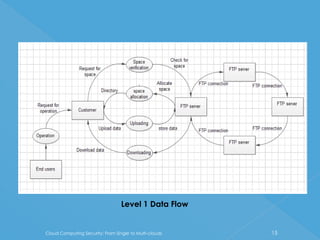
Level 1 Data Flow


Cloud Computing Security: From Single to Multi-clouds   15
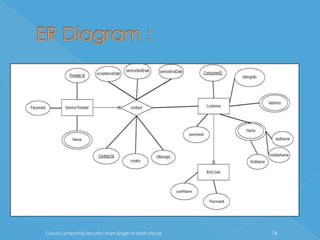
Cloud Computing Security: From Single to Multi-clouds   16
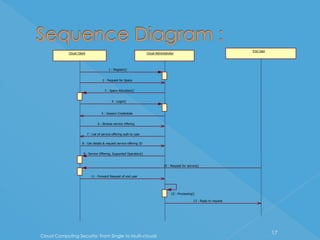
End User
            Cloud Client                                               Cloud Administrator


                                           1 : Register()


                                      2 : Request for Space


                                        3 : Space Allocation()


                                              4 : Login()


                                      5 : Session Credentials


                                   6 : Browse service offering


                           7 : List of service offering auth to user

                     8 : Get details & request service offering ID


                      9 : Service Offering, Supported Operation()


                                                                                  10 : Request for service()


                              11 : Forward Request of end user


                                                                                        12 : Processing()

                                                                                                        13 : Reply to request


                                                                                                                                           17
Cloud Computing Security: From Single to Multi-clouds
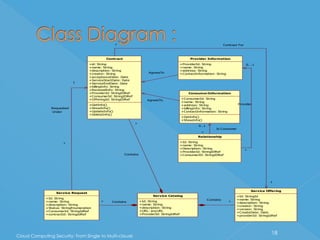
*                                                                       Contract For


                                               Contract                                               Provider Information
                                     +id: String                                                +ProviderId: String                         0...1
                                     +name: String                                              +name: String
                                     +description: String                                       +address: String
                                     +creator: String                     AgreesTo              +ContactInformation: String
                                     +acceptanceDate: Date
                                     +ServiceStartDate: Date
                            1        +ServiceEndDate: Date
                                     +billingInfo: String
                                     +RenewalInfo: String
                                     +ProviderId: StringIDRef                                        ConsumerInformation
                                     +ConsumerId: StringIDRef
                                     +OfferingId: StringIDRef                                   +ConsumerId: String
                                                                         AgreesTo
                                                                                                +name: String
                                     +GetInfo()                                                 +address: String                     Provider
                Requested            +ShowInfo()                                                +billingInfo: String
                Under                +UpdateInfo()                                              +ContactInformation: String
                                     +DeleteInfo()
                                                                                                +GetInfo()
                                                                                                +ShowInfo()
                                                                *
                                                                                                           0..1
                                                                                                                   Is Consumer
                                                                                                           *
                                                                                                          Relationship
                                                                                                +Id: String
                       *
                                                                                                +name: String
                                                                                                +Description: String
                                                                                                +ProviderId: StringIDRef                    *
                                                          Contains                              +ConsumerID: StringIDRef


                                                                                                                                                          1


                                                                                                                                                Service Offering
                   Service Request
                                                                             Service Catalog                                        +Id: StringId
             +Id: String                                                                                                            +name: String
                                                                                                                  Contains
             +name: String                 *     Contains            +Id: String                                                *   +description: String
             +description: String                                    +name: String
                                                                                                                                    +creator: String
             +Status: StringEnumeration                              +description: String
                                                                                                                                    +version: String
             +ConsumerId: StringIdRef                                +URL: anyURL
                                                                                                                                    +CreateDate: Date
             +contractId: StringIdRef                                +ProviderId: StringIdRef
                                                                                                                                    +providerId: StringIdRef


                                                                                                                                                          18
Cloud Computing Security: From Single to Multi-clouds
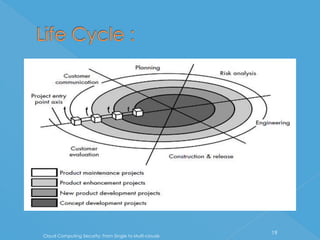
19
Cloud Computing Security: From Single to Multi-clouds
1.      Data Integrity.


2.      Service Availability.


3.      The user runs custom applications using the service provider’s
        resources.


4.      Cloud service providers should ensure the security of their
        customers’ data and should be responsible if any security risk
        affects their customers’ service infrastructure.
                                                                  20
     Cloud Computing Security: From Single to Multi-clouds
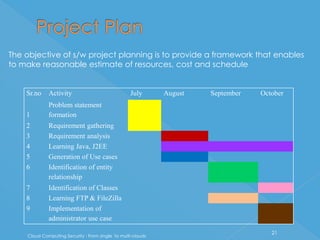
The objective of s/w project planning is to provide a framework that enables
to make reasonable estimate of resources, cost and schedule


    Sr.no    Activity                             July       August   September   October
             Problem statement
    1        formation
    2        Requirement gathering
    3        Requirement analysis
    4        Learning Java, J2EE
    5        Generation of Use cases
    6        Identification of entity
             relationship
    7        Identification of Classes
    8        Learning FTP & FileZilla
    9        Implementation of
             administrator use case
                                                                                     21
    Cloud Computing Security : From single to multi-clouds
    This project focuses on the issues related to the data security
     aspect of cloud computing. As data and information will be
     shared with a third party, cloud computing users want to
     avoid an untrusted cloud provider. Protection of user’s
     important data is the most significant part of this project.


                                                               22
Cloud Computing Security: From Single to Multi-clouds
    IBM Transaction on :

1.     Smart Cloud security : from single to multi-cloud

2.     Security Challenges for public cloud

3.     Foundations and Properties of Shamir’s Secret Sharing
       Scheme


                                                               23
Cloud Computing Security: From Single to Multi-clouds
Automation I-Parking System   24

Smart cloud - single to multi cloud

  • 1.
    RRASE COLLEGE OFENGINEERING TAMBARAM, CHENNAI -601301 Group Member Year Abdul Rasheed Feroz Khan.J 03 Smart Cloud Security: From Single to Multi-Clouds 1
  • 2.
     Introduction  Literature survey  Existing System  problem definition  Software Architecture  S/w & H/w Requirement  UML Diagram  SDLC and project plan  Conclusion  References 2
  • 3.
    What is CloudComputing ? Why it is term as Smart Cloud ? Problem of service unavailability in single Cloud. 3 Smart Cloud Security: From Single to Multi-clouds
  • 4.
    Name, Author and Methodologies Advantages Disadvantages Publication A Practical Giving risk and Security about Points only the Guide to cloud mitigation the single cloud security of single computing Security is maintained cloud By- Carl Almond efficiently August 2009 Security Challenges Outlining Address several As maintaining for public cloud Challenges & security security in public By- Kui Ren, Cong motivate challenges cloud ,urgency of Wang further That current data not comes into Jan 2012 investigation research aren’t picture addressing Foundations and Encryption Excellent Properties related to Properties of Shamir’s & Framework From Shamir’s Secrete Secret Sharing Decryption Proofs and Sharing Scheme Application By- Dan Bogdanov May 2007 4 Smart Cloud Security: From Single to Multi-clouds
  • 5.
     Smart Cloud ( most probably single cloud ) Makes low cost processing of data. Gives delivery models as PaaS, SaaS, IaaS Disadvantages: 1. Service availability failure 2. Possibility that there are malicious insiders in the single cloud. 5 Smart Cloud Security: From Single to Multi-clouds
  • 6.
    Load Forecast CAPACITY CLOUD Service failure & Security attacks TIME
  • 7.
     Problem Definition : As data storage and processing concern the cloud plays vital role. But along with this advantage develop a system which focus the security for single as well as multi- cloud. So for this purpose we have to develop the system which gives many features Smart Cloud 7 Security: From Single to Multi-clouds
  • 8.
     Service Availability  Ability to run custom application using service providers resources  Data security  Data Integrity 8 Smart Cloud Security: From Single to Multi-clouds
  • 9.
     Make the assurance that data is in secure and stable form. Secondary objective : Make service availability even when the one cloud fails Handle Multiple request at a time. 9 Cloud Computing Security: From Single to Multi-clouds
  • 10.
     Secret Sharing Algorithms Encryption: Step1: input- secrete key k, number of participant n. Step2: select random values a1,a2…,an. Step3: Generate polynomial string to share the secrete into parts. Step4: Secrete shared. Decryption: Step1: Generate polynomial string from secrete . Step2: Add the n polynomial. 10 Cloud Computing Security: From Single to Multi-clouds
  • 11.
    Cloud Computing Security:From Single to Multi-clouds 11
  • 12.
     Operating System: Windows95/98/2000/XP  Application Server : Tomcat5.0/6.X  Front End : HTML, Java, JSP,AJAX  Scripts : JavaScript.  Server side Script : Java Server Pages.  Database Connectivity : Mysql. Cloud Computing Security: From Single to Multi-clouds 12
  • 13.
     Processor : Pentium –III  Speed : 1.1 GHz  RAM : 256 MB(min)  Hard Disk : 20 GB  Floppy Drive : 1.44 MB  Monitor : SVGA 13 Cloud Computing Security: From Single to Multi-clouds
  • 14.
    Level 0 DataFlow 14 Cloud Computing Security: From Single to Multi-clouds
  • 15.
    Level 1 DataFlow Cloud Computing Security: From Single to Multi-clouds 15
  • 16.
    Cloud Computing Security:From Single to Multi-clouds 16
  • 17.
    End User Cloud Client Cloud Administrator 1 : Register() 2 : Request for Space 3 : Space Allocation() 4 : Login() 5 : Session Credentials 6 : Browse service offering 7 : List of service offering auth to user 8 : Get details & request service offering ID 9 : Service Offering, Supported Operation() 10 : Request for service() 11 : Forward Request of end user 12 : Processing() 13 : Reply to request 17 Cloud Computing Security: From Single to Multi-clouds
  • 18.
    * Contract For Contract Provider Information +id: String +ProviderId: String 0...1 +name: String +name: String +description: String +address: String +creator: String AgreesTo +ContactInformation: String +acceptanceDate: Date +ServiceStartDate: Date 1 +ServiceEndDate: Date +billingInfo: String +RenewalInfo: String +ProviderId: StringIDRef ConsumerInformation +ConsumerId: StringIDRef +OfferingId: StringIDRef +ConsumerId: String AgreesTo +name: String +GetInfo() +address: String Provider Requested +ShowInfo() +billingInfo: String Under +UpdateInfo() +ContactInformation: String +DeleteInfo() +GetInfo() +ShowInfo() * 0..1 Is Consumer * Relationship +Id: String * +name: String +Description: String +ProviderId: StringIDRef * Contains +ConsumerID: StringIDRef 1 Service Offering Service Request Service Catalog +Id: StringId +Id: String +name: String Contains +name: String * Contains +Id: String * +description: String +description: String +name: String +creator: String +Status: StringEnumeration +description: String +version: String +ConsumerId: StringIdRef +URL: anyURL +CreateDate: Date +contractId: StringIdRef +ProviderId: StringIdRef +providerId: StringIdRef 18 Cloud Computing Security: From Single to Multi-clouds
  • 19.
    19 Cloud Computing Security:From Single to Multi-clouds
  • 20.
    1. Data Integrity. 2. Service Availability. 3. The user runs custom applications using the service provider’s resources. 4. Cloud service providers should ensure the security of their customers’ data and should be responsible if any security risk affects their customers’ service infrastructure. 20 Cloud Computing Security: From Single to Multi-clouds
  • 21.
    The objective ofs/w project planning is to provide a framework that enables to make reasonable estimate of resources, cost and schedule Sr.no Activity July August September October Problem statement 1 formation 2 Requirement gathering 3 Requirement analysis 4 Learning Java, J2EE 5 Generation of Use cases 6 Identification of entity relationship 7 Identification of Classes 8 Learning FTP & FileZilla 9 Implementation of administrator use case 21 Cloud Computing Security : From single to multi-clouds
  • 22.
     This project focuses on the issues related to the data security aspect of cloud computing. As data and information will be shared with a third party, cloud computing users want to avoid an untrusted cloud provider. Protection of user’s important data is the most significant part of this project. 22 Cloud Computing Security: From Single to Multi-clouds
  • 23.
     IBM Transaction on : 1. Smart Cloud security : from single to multi-cloud 2. Security Challenges for public cloud 3. Foundations and Properties of Shamir’s Secret Sharing Scheme 23 Cloud Computing Security: From Single to Multi-clouds
  • 24.

Editor's Notes

  • #2 Cloud computing – dealing in a global server rather than a local server – computation, storage, processing, etc., - avoiding of storage devices.Smart Cloud – advanced level of computing could also be said as an child tech of cloud computingService unavailability on single cloud – security issues.
  • #3 Giving risk & mitigation – security issues in public cloud
  • #4 The industry has defined three categories of services:IaaS – a set of infrastructure level capabilities such as an operating system, network connectivity, etc. that are delivered as pay for use services and can be used to host applications. PaaS – higher level sets of functionality that are delivered as consumable services for developers who are building applications. PaaS is about abstracting developers from the underlying infrastructure to enable applications to quickly be composed. SaaS – applications that are delivered using a service delivery model where organizations can simply consume and use the application. Typically an organization would pay for the use of the application or the application could be monetized through ad revenue.
  • #8 Service availability – information or data must be well refined to access at any time and any whereData Security – Data must be well secured from e-bombs, malicious attacks at multi – clouds