International Research Journal of Engineering and Technology (IRJET) e-ISSN: 2395-0056
Volume: 09 Issue: 03 | Mar 2022 www.irjet.net p-ISSN: 2395-0072
© 2022, IRJET | Impact Factor value: 7.529 | ISO 9001:2008 Certified Journal | Page 1401
SMART BUS TICKET RESERVATION SYSTEM
Paresh Satoskar1, Mayuresh Prabhu2, Karan Rajput3, Neha Jadhav4
1Mst. Paresh Satoskar, Dept. Of Electronics and Telecommunications Engineering, Atharva College of Engineering,
Maharashtra, India
2Mst. Mayuresh Prabhu, Dept. Of Electronics and Telecommunications Engineering, Atharva College of
Engineering, Maharashtra, India
3Mst. Karan Rajput, Dept. Of Electronics and Telecommunications Engineering, Atharva College of Engineering,
Maharashtra, India
4Ms. Neha Jadhav, Dept. Of Electronics and Telecommunications Engineering, Atharva College of Engineering,
Maharashtra, India
---------------------------------------------------------------------***----------------------------------------------------------------------
Abstract - Whole world is facing COVID-19 pandemic problem. The virus is primarily spread among people during close
contact, most often through small droplets produced by coughing, sneezing and talking. The World Health Organization
advised to wash hands, wear masks, maintain social distance, and disinfect personal belongings for preventing spread of
corona virus. Motive to work on this prototype is that to maintain social distancing while travelling in state transport bus
system. Because of the pandemic situation, bus transport system allowed only limited number of persons to maintain
social distancing. This system does the reservation by following the social distance norm. The unit of reservation system is
kept on state transport bus station. Here the passenger can purchase ticket using NFC Card. The passenger swipes the NFC
Card and then selects the destination. The seat number will be allocated keeping in mind social distancing norms.
1.INTRODUCTION
In India, the number of people using public transports is increasing day by day especially via bus. The current bus ticketing
system transactions are performed manually which makes the entire process very slow and tedious. We have to carry
change for fare amount since there is always a problem of change between the passenger and service provider. Paper
based ticketing system affects the environment since there is a lot of wastage of paper. The current bus ticketing system
has pass system where in the passenger pays a lump sum amount of money which also includes the number of days the
passenger did not travel by bus which is a disadvantage for the passenger. It will be implemented using the upcoming
technology NFC. Here NFC is used to generate Electronic-ticket. An Electronic-ticket is basically a paperless electronic
document which is used by the passenger as a ticket travelling by bus. This booking system also saves image of passenger
which can be further used for contact tracing purpose for COVID. It books ticket keeping in mind social distancing norms.
Another important aspect is reusability which helps use tickets multiple times. This technology will be implemented as
one of the ways to substitute current bus ticketing system.
2.LITERATURE REVIEW
Surya Michrandi Nasution1, Emir Mauludi Husni, Aciek Ida Wuryandari proposed that, train is one of commonly used
transport by people every day, train station establish huge number of transactions. Another problem from the passenger’s
side is the self-hold ticket. By simplifying the ticketing process and transforming ticket from physical form to virtual form,
the NFC technology development will not be limited only+ for payment transaction. This particular technology can also be
implemented as one of the ways to substitute current ticketing. Passengers can purchase ticket only by providing train
ticket scanning. From that card the type of train which will be used by passenger can be known. In the manifestation,
supporting application can be made for destroying train ticket which will be done by conductor.
Arnau vives-guasch, Magdalena payeras-capell, Maci`a mut-puigserver,proposed that, the main focus area of the present
paper is the development of a secure e-ticketing scheme for mobile devices. users and the service provider cannot falsely
accuse each other of misbehavior. Furthermore, this scheme takes special care of the computational requirements of the
user side by side by using light-weight cryptography. An electronic ticket is a contract, in digital format, between the user
and service provider. The main the protocol that has been enhanced with the property of reusability. The authenticity,
integrity, nonrepudiation are the security requirements. Reusability e-tickets can be used exactly the same number of
times agreed in the moment of issue. When the user wants to use the survive, she must verify the ticket in advance, for
simplicity we present the ticket verification with only one provider.
International Research Journal of Engineering and Technology (IRJET) e-ISSN: 2395-0056
Volume: 09 Issue: 03 | Mar 2022 www.irjet.net p-ISSN: 2395-0072
© 2022, IRJET | Impact Factor value: 7.529 | ISO 9001:2008 Certified Journal | Page 1402
Communication occurs within two NFC enabled devices when these two devices within the range of twenty centimeters of
each other. As NFC can be placed in many consumer devices such as mobile phones, readers, smart posters, PDAs, PCs,
readers, the focus of this paper is firstly on use of NFC. In this, by overcoming the drawbacks of existing system NFC
ticketing provides the following features: 1) Ticket on go 2) Online payment 3) Paperless ticketing. The passenger does the
scanning process using NFC. When the passenger scans the tag filled with data, the payment is directly made and if the
account balance is less than the fare amount then credit is again loaded. The electronic ticket can also be shown to the
waiting rooms gate guards. When the ticket checker receives ticket data, then the ticketing process will end.
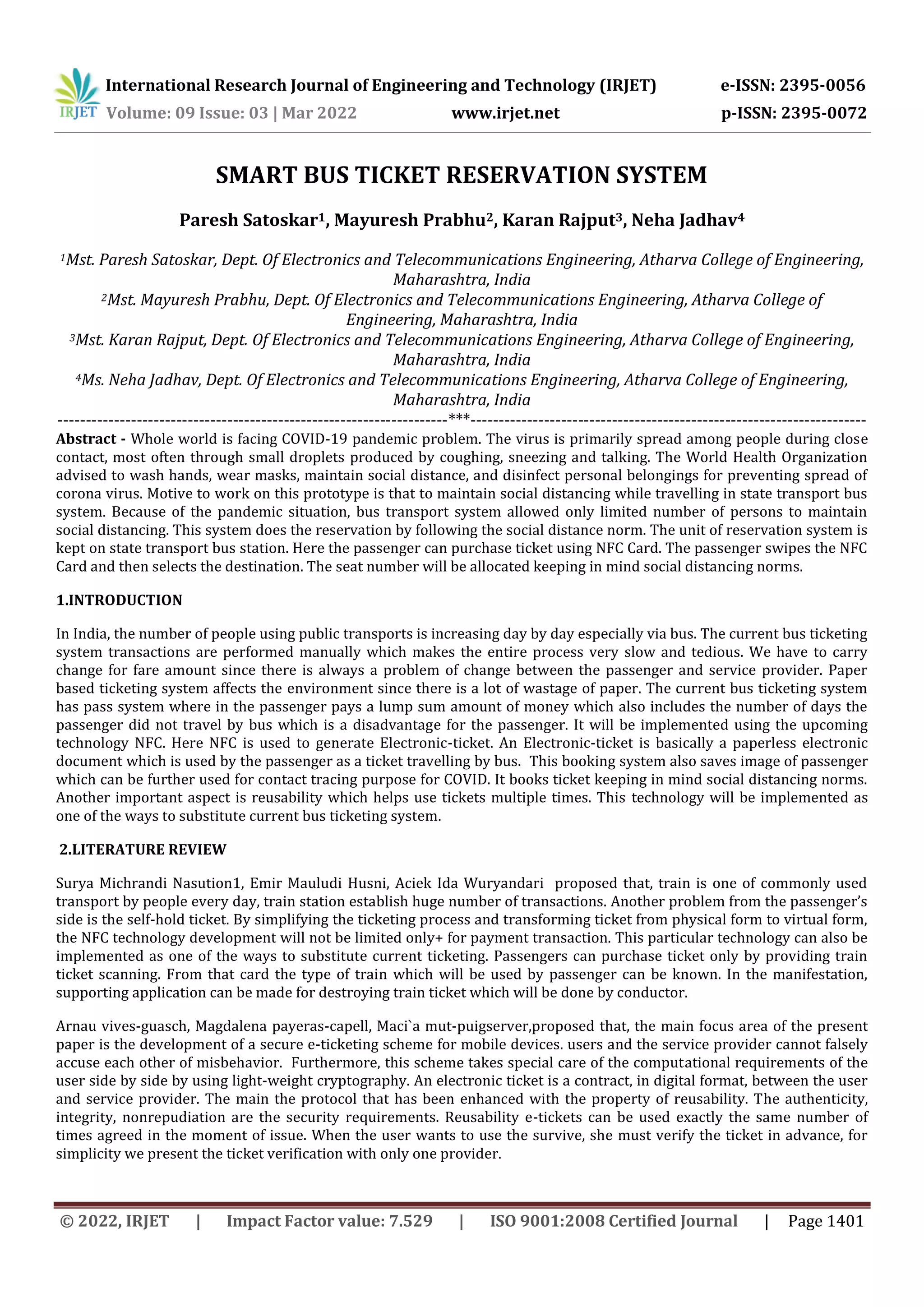
Here is a simple block diagram of our project which will explain everything clearly
Block diagram of the system
2.1 PROPOSED METHODOLOGY (WORKING)
1. The project uses NodeMCU ESP-12E as the microcontroller board.
2. A RC522 NFC Reader is used to read user NFC Card.
3. If the NFC Card is valid the user balance is fetched from the cloud server.
4. If the user balance is low one can recharge it through the Android App.
5. If the user balance is greater than minimum balance the user can select the destination using the navigation push
buttons.
6. Once the user selects the destination ticket fare is deducted and balance is updated on server.
7. The indication led and buzzer gives indication of successful transaction.
8. A seat is allocated keeping social distancing norms in mind.
9. All these data are also displayed using the 16X2 LCD Display.
International Research Journal of Engineering and Technology (IRJET) e-ISSN: 2395-0056
Volume: 09 Issue: 03 | Mar 2022 www.irjet.net p-ISSN: 2395-0072
© 2022, IRJET | Impact Factor value: 7.529 | ISO 9001:2008 Certified Journal | Page 1403
3. CONCLUSION
We aim to implement a Bus Ticketing System using NFC Technology. The system is implemented to generate E tickets, thus
reducing human effort and making the process completely automated keeping social distancing in mind using seat
allocation. NFC tickets helps in identifying people travelling in the bus providing security and also for contact tracing of
COVID. The Passengers need to carry their NFC tags and recharge their account when the balance is Low or none. The
cards are long lasting and can be used as many times as one wants to, they are much more convenient compared to the
current ticketing system as it eliminates wastage of papers. Any unwanted events can be avoided as all the person carrying
NFC tickets are monitored.
4. REFERENCES
[1] Surya Michrandi Nasution, Emir Mauludi Husni, Aciek Ida Wuryandari, “Prototype of train ticketing application using
near field communication (NFC) technology on android device”, International Conference on System Engineering and
Technology, September 2012.
[2] Arnau vives-guasch, Magdalena payeras-capell, Maci`a mut-puigserver, Jordi castell `a-roca, and Josep lluis ferrer-
gomila, “A secure e-ticketing scheme for mobile device with near field communication (NFC) that includes excludability
and reusability”, IEICE TRANS. FUNDAMENTALS, vol. e93-A, 2010.
[3] M.R.Waghe, P.A.Pawar, Prof S.N. Bhadane, “Use of NFC technology in electronic ticket system for public transport”
International Journal of Electronic Commerce Studies (IJECS), Volume 3, Issue 4, Page No. 5273- 5274, April 2014.
[4] Alfawaer, zayed M. 2011. “Mobile E-ticketing Reservation System" Amman International Stadium in Jordan.Jordan:
International Journal of Academic Research.
[5] Kantner, C. et al. “NFC Devices: Security and Privacy,” The Third International Conference on Availability, Reliability
and Security, IEEE Computer Society, 2008.
[6] Vives-Gausch, M. Payeras-Capella, M. MutPuigserver, and J. Castella-Roca, “E-ticketing scheme for mobile devices with
exculpability,” Data Privacy Management (DPM), Fifth International Workshop, Lecture Notes in Computer Science,
vol..6514, p.(to appear), 2010. ISSN 0302-9743.

SMART BUS TICKET RESERVATION SYSTEM

  • 1.
    International Research Journalof Engineering and Technology (IRJET) e-ISSN: 2395-0056 Volume: 09 Issue: 03 | Mar 2022 www.irjet.net p-ISSN: 2395-0072 © 2022, IRJET | Impact Factor value: 7.529 | ISO 9001:2008 Certified Journal | Page 1401 SMART BUS TICKET RESERVATION SYSTEM Paresh Satoskar1, Mayuresh Prabhu2, Karan Rajput3, Neha Jadhav4 1Mst. Paresh Satoskar, Dept. Of Electronics and Telecommunications Engineering, Atharva College of Engineering, Maharashtra, India 2Mst. Mayuresh Prabhu, Dept. Of Electronics and Telecommunications Engineering, Atharva College of Engineering, Maharashtra, India 3Mst. Karan Rajput, Dept. Of Electronics and Telecommunications Engineering, Atharva College of Engineering, Maharashtra, India 4Ms. Neha Jadhav, Dept. Of Electronics and Telecommunications Engineering, Atharva College of Engineering, Maharashtra, India ---------------------------------------------------------------------***---------------------------------------------------------------------- Abstract - Whole world is facing COVID-19 pandemic problem. The virus is primarily spread among people during close contact, most often through small droplets produced by coughing, sneezing and talking. The World Health Organization advised to wash hands, wear masks, maintain social distance, and disinfect personal belongings for preventing spread of corona virus. Motive to work on this prototype is that to maintain social distancing while travelling in state transport bus system. Because of the pandemic situation, bus transport system allowed only limited number of persons to maintain social distancing. This system does the reservation by following the social distance norm. The unit of reservation system is kept on state transport bus station. Here the passenger can purchase ticket using NFC Card. The passenger swipes the NFC Card and then selects the destination. The seat number will be allocated keeping in mind social distancing norms. 1.INTRODUCTION In India, the number of people using public transports is increasing day by day especially via bus. The current bus ticketing system transactions are performed manually which makes the entire process very slow and tedious. We have to carry change for fare amount since there is always a problem of change between the passenger and service provider. Paper based ticketing system affects the environment since there is a lot of wastage of paper. The current bus ticketing system has pass system where in the passenger pays a lump sum amount of money which also includes the number of days the passenger did not travel by bus which is a disadvantage for the passenger. It will be implemented using the upcoming technology NFC. Here NFC is used to generate Electronic-ticket. An Electronic-ticket is basically a paperless electronic document which is used by the passenger as a ticket travelling by bus. This booking system also saves image of passenger which can be further used for contact tracing purpose for COVID. It books ticket keeping in mind social distancing norms. Another important aspect is reusability which helps use tickets multiple times. This technology will be implemented as one of the ways to substitute current bus ticketing system. 2.LITERATURE REVIEW Surya Michrandi Nasution1, Emir Mauludi Husni, Aciek Ida Wuryandari proposed that, train is one of commonly used transport by people every day, train station establish huge number of transactions. Another problem from the passenger’s side is the self-hold ticket. By simplifying the ticketing process and transforming ticket from physical form to virtual form, the NFC technology development will not be limited only+ for payment transaction. This particular technology can also be implemented as one of the ways to substitute current ticketing. Passengers can purchase ticket only by providing train ticket scanning. From that card the type of train which will be used by passenger can be known. In the manifestation, supporting application can be made for destroying train ticket which will be done by conductor. Arnau vives-guasch, Magdalena payeras-capell, Maci`a mut-puigserver,proposed that, the main focus area of the present paper is the development of a secure e-ticketing scheme for mobile devices. users and the service provider cannot falsely accuse each other of misbehavior. Furthermore, this scheme takes special care of the computational requirements of the user side by side by using light-weight cryptography. An electronic ticket is a contract, in digital format, between the user and service provider. The main the protocol that has been enhanced with the property of reusability. The authenticity, integrity, nonrepudiation are the security requirements. Reusability e-tickets can be used exactly the same number of times agreed in the moment of issue. When the user wants to use the survive, she must verify the ticket in advance, for simplicity we present the ticket verification with only one provider.
  • 2.
    International Research Journalof Engineering and Technology (IRJET) e-ISSN: 2395-0056 Volume: 09 Issue: 03 | Mar 2022 www.irjet.net p-ISSN: 2395-0072 © 2022, IRJET | Impact Factor value: 7.529 | ISO 9001:2008 Certified Journal | Page 1402 Communication occurs within two NFC enabled devices when these two devices within the range of twenty centimeters of each other. As NFC can be placed in many consumer devices such as mobile phones, readers, smart posters, PDAs, PCs, readers, the focus of this paper is firstly on use of NFC. In this, by overcoming the drawbacks of existing system NFC ticketing provides the following features: 1) Ticket on go 2) Online payment 3) Paperless ticketing. The passenger does the scanning process using NFC. When the passenger scans the tag filled with data, the payment is directly made and if the account balance is less than the fare amount then credit is again loaded. The electronic ticket can also be shown to the waiting rooms gate guards. When the ticket checker receives ticket data, then the ticketing process will end. Here is a simple block diagram of our project which will explain everything clearly Block diagram of the system 2.1 PROPOSED METHODOLOGY (WORKING) 1. The project uses NodeMCU ESP-12E as the microcontroller board. 2. A RC522 NFC Reader is used to read user NFC Card. 3. If the NFC Card is valid the user balance is fetched from the cloud server. 4. If the user balance is low one can recharge it through the Android App. 5. If the user balance is greater than minimum balance the user can select the destination using the navigation push buttons. 6. Once the user selects the destination ticket fare is deducted and balance is updated on server. 7. The indication led and buzzer gives indication of successful transaction. 8. A seat is allocated keeping social distancing norms in mind. 9. All these data are also displayed using the 16X2 LCD Display.
  • 3.
    International Research Journalof Engineering and Technology (IRJET) e-ISSN: 2395-0056 Volume: 09 Issue: 03 | Mar 2022 www.irjet.net p-ISSN: 2395-0072 © 2022, IRJET | Impact Factor value: 7.529 | ISO 9001:2008 Certified Journal | Page 1403 3. CONCLUSION We aim to implement a Bus Ticketing System using NFC Technology. The system is implemented to generate E tickets, thus reducing human effort and making the process completely automated keeping social distancing in mind using seat allocation. NFC tickets helps in identifying people travelling in the bus providing security and also for contact tracing of COVID. The Passengers need to carry their NFC tags and recharge their account when the balance is Low or none. The cards are long lasting and can be used as many times as one wants to, they are much more convenient compared to the current ticketing system as it eliminates wastage of papers. Any unwanted events can be avoided as all the person carrying NFC tickets are monitored. 4. REFERENCES [1] Surya Michrandi Nasution, Emir Mauludi Husni, Aciek Ida Wuryandari, “Prototype of train ticketing application using near field communication (NFC) technology on android device”, International Conference on System Engineering and Technology, September 2012. [2] Arnau vives-guasch, Magdalena payeras-capell, Maci`a mut-puigserver, Jordi castell `a-roca, and Josep lluis ferrer- gomila, “A secure e-ticketing scheme for mobile device with near field communication (NFC) that includes excludability and reusability”, IEICE TRANS. FUNDAMENTALS, vol. e93-A, 2010. [3] M.R.Waghe, P.A.Pawar, Prof S.N. Bhadane, “Use of NFC technology in electronic ticket system for public transport” International Journal of Electronic Commerce Studies (IJECS), Volume 3, Issue 4, Page No. 5273- 5274, April 2014. [4] Alfawaer, zayed M. 2011. “Mobile E-ticketing Reservation System" Amman International Stadium in Jordan.Jordan: International Journal of Academic Research. [5] Kantner, C. et al. “NFC Devices: Security and Privacy,” The Third International Conference on Availability, Reliability and Security, IEEE Computer Society, 2008. [6] Vives-Gausch, M. Payeras-Capella, M. MutPuigserver, and J. Castella-Roca, “E-ticketing scheme for mobile devices with exculpability,” Data Privacy Management (DPM), Fifth International Workshop, Lecture Notes in Computer Science, vol..6514, p.(to appear), 2010. ISSN 0302-9743.