Data Centres in Shared Buildings Barry Shambrook RCDD Tuckers Consultancy Ltd
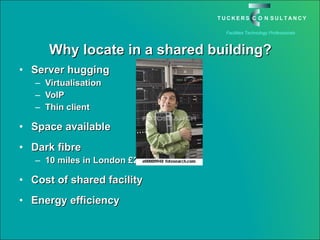
Why locate in a shared building? Server hugging Virtualisation VoIP Thin client Space available Dark fibre 10 miles in London £250K per annum Cost of shared facility Energy efficiency
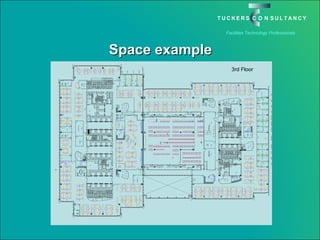
Space example
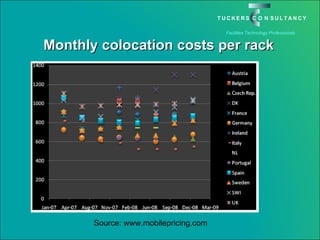
Monthly colocation costs per rack Source: www.mobilepricing.com
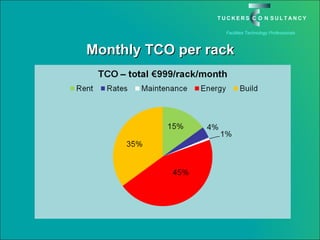
Monthly TCO per rack
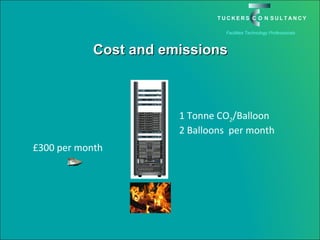
Cost and emissions £300 per month 1 Tonne CO 2 /Balloon 2 Balloons  per month
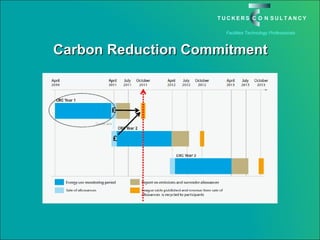
Carbon Reduction Commitment
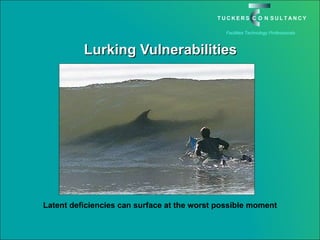
Lurking Vulnerabilities Latent deficiencies can surface at the worst possible moment
How Much Redundancy is Enough?
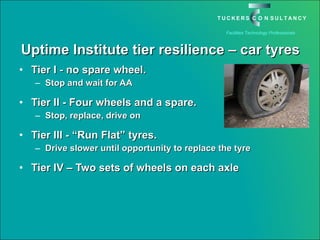
Uptime Institute tier resilience – car tyres Tier I - no spare wheel.  Stop and wait for AA Tier II -  Four wheels and a spare.  Stop, replace, drive on Tier III - “Run Flat” tyres.  Drive slower until opportunity to replace the tyre Tier IV – Two sets of wheels on each axle
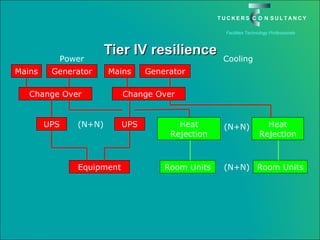
Tier IV resilience Power Cooling Mains Generator Mains Generator Change Over Change Over UPS UPS Equipment Heat Rejection Heat Rejection (N+N) (N+N) Room Units Room Units (N+N)
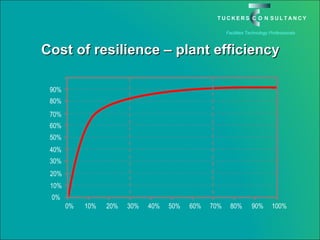
Cost of resilience – plant efficiency 90% 80% 70% 60% 50% 40% 30% 20% 10% 0% 100% 90% 80% 70% 60% 50% 40% 30% 20% 10% 0%
Shared building challenges Space for data centre Space for plant Size and number of utility supplies Risk limitation Noise restrictions
Case study #1 Large (10,000m 2  plus) office building Bespoke design for single anchor Tenant Sub-tenancies envisaged Requirement for 1000m 2  Data Centre On site processing and storage Remote back-up
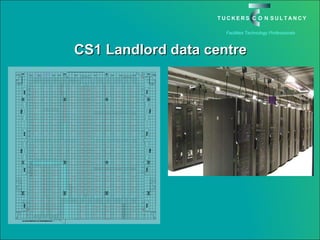
CS1 Landlord data centre
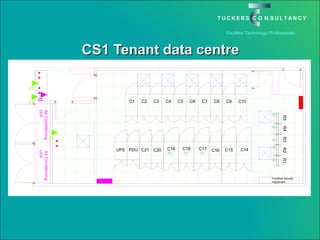
CS1 Tenant data centre
CS1 – power 2 fully autonomous grid supplies Generators on each supply, redundant shared Building UPS N+1 Redundant distribution
CS1 cooling N+N/N+1 chillers and cooling towers N+N secondary chilled water N+N CRAC units
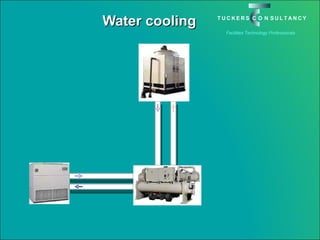
Water cooling
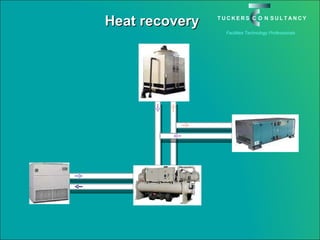
Heat recovery
CS1 fire protection Pre-action sprinklers – building insurance VESDA – manual intervention Limited fire load in floor void
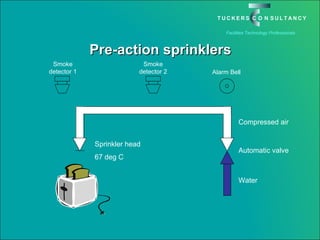
Pre-action sprinklers Smoke detector 1 Smoke detector 2 Alarm Bell Sprinkler head 67 deg C Water Compressed air Automatic valve
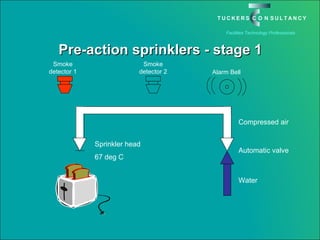
Pre-action sprinklers - stage 1 Smoke detector 1 Smoke detector 2 Alarm Bell Sprinkler head 67 deg C Water Compressed air Automatic valve
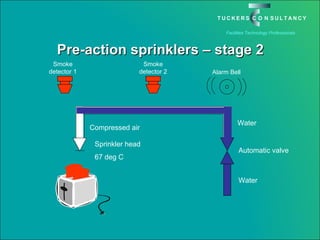
Pre-action sprinklers – stage 2 Smoke detector 1 Smoke detector 2 Alarm Bell Sprinkler head 67 deg C Water Compressed air Automatic valve Water
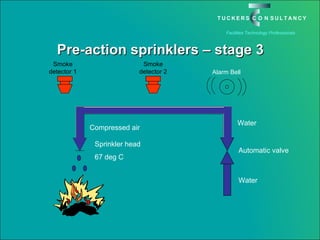
Pre-action sprinklers – stage 3 Smoke detector 1 Smoke detector 2 Alarm Bell Sprinkler head 67 deg C Water Compressed air Automatic valve Water
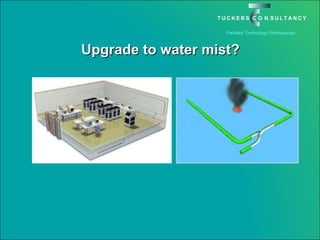
Upgrade to water mist?
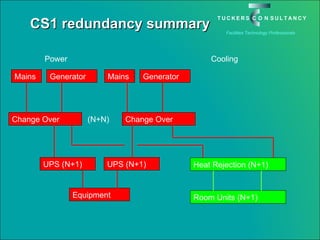
CS1 redundancy summary Power Cooling Mains Generator Mains Generator Change Over Change Over UPS (N+1) Equipment Heat Rejection (N+1) Room Units (N+1) (N+N) UPS (N+1)
Case study #2 Speculative 8000m 2  office building Multiple tenancies Requirement for 100m 2  Data Centre On site processing and storage option On site development option Remote parallel processing and storage
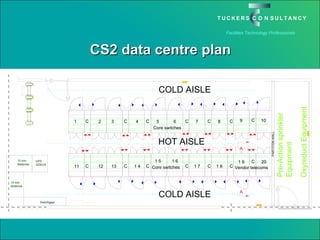
CS2 data centre plan
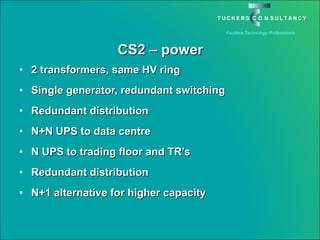
CS2 – power 2 transformers, same HV ring Single generator, redundant switching Redundant distribution N+N UPS to data centre N UPS to trading floor and TR’s Redundant distribution N+1 alternative for higher capacity
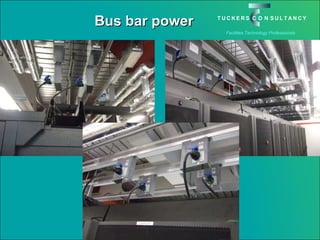
Bus bar power
CS2 cooling N+N chillers, “free” cooling N+N cooling distribution to data centre N+N secondary chilled water N+N in row cooling units N cooling to trading floor and TR’s N+1 alternative for higher capacity
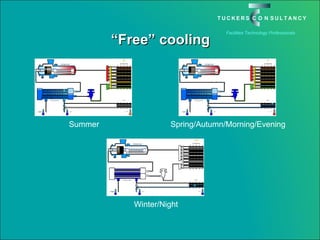
“ Free” cooling Summer Spring/Autumn/Morning/Evening Winter/Night
CS2 fire protection Pre-action sprinklers – building insurance VESDA Oxy-reduct for asset protection
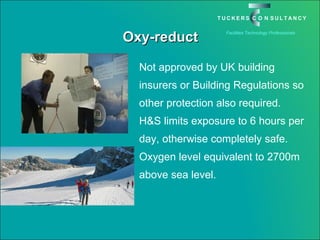
Oxy-reduct Not approved by UK building insurers or Building Regulations so other protection also required. H&S limits exposure to 6 hours per day, otherwise completely safe. Oxygen level equivalent to 2700m above sea level.
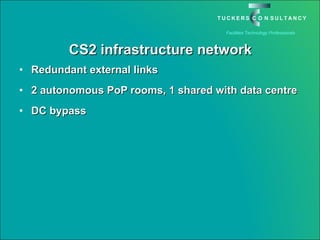
CS2 infrastructure network Redundant external links 2 autonomous PoP rooms, 1 shared with data centre DC bypass
CS1 infrastructure network
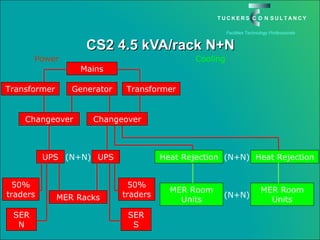
CS2 4.5 kVA/rack N+N Power Cooling Transformer Generator UPS MER Racks MER Room Units Changeover Heat Rejection Heat Rejection MER Room Units UPS (N+N) SER S SER N 50% traders 50% traders (N+N) Changeover Transformer Mains (N+N)
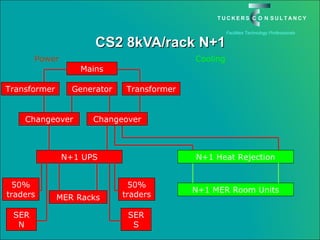
CS2 8kVA/rack N+1 Power Cooling Transformer Generator N+1 UPS MER Racks N+1 MER Room Units Changeover N+1 Heat Rejection SER S SER N 50% traders 50% traders Changeover Transformer Mains
Summary Resilience compromises Efficiency improvements Added flexibility?

Small Data Centres

  • 1.
    Data Centres inShared Buildings Barry Shambrook RCDD Tuckers Consultancy Ltd
  • 2.
    Why locate ina shared building? Server hugging Virtualisation VoIP Thin client Space available Dark fibre 10 miles in London £250K per annum Cost of shared facility Energy efficiency
  • 3.
  • 4.
    Monthly colocation costsper rack Source: www.mobilepricing.com
  • 5.
  • 6.
    Cost and emissions£300 per month 1 Tonne CO 2 /Balloon 2 Balloons per month
  • 7.
  • 8.
    Lurking Vulnerabilities Latentdeficiencies can surface at the worst possible moment
  • 9.
  • 10.
    Uptime Institute tierresilience – car tyres Tier I - no spare wheel. Stop and wait for AA Tier II - Four wheels and a spare. Stop, replace, drive on Tier III - “Run Flat” tyres. Drive slower until opportunity to replace the tyre Tier IV – Two sets of wheels on each axle
  • 11.
    Tier IV resiliencePower Cooling Mains Generator Mains Generator Change Over Change Over UPS UPS Equipment Heat Rejection Heat Rejection (N+N) (N+N) Room Units Room Units (N+N)
  • 12.
    Cost of resilience– plant efficiency 90% 80% 70% 60% 50% 40% 30% 20% 10% 0% 100% 90% 80% 70% 60% 50% 40% 30% 20% 10% 0%
  • 13.
    Shared building challengesSpace for data centre Space for plant Size and number of utility supplies Risk limitation Noise restrictions
  • 14.
    Case study #1Large (10,000m 2 plus) office building Bespoke design for single anchor Tenant Sub-tenancies envisaged Requirement for 1000m 2 Data Centre On site processing and storage Remote back-up
  • 15.
  • 16.
  • 17.
    CS1 – power2 fully autonomous grid supplies Generators on each supply, redundant shared Building UPS N+1 Redundant distribution
  • 18.
    CS1 cooling N+N/N+1chillers and cooling towers N+N secondary chilled water N+N CRAC units
  • 19.
  • 20.
  • 21.
    CS1 fire protectionPre-action sprinklers – building insurance VESDA – manual intervention Limited fire load in floor void
  • 22.
    Pre-action sprinklers Smokedetector 1 Smoke detector 2 Alarm Bell Sprinkler head 67 deg C Water Compressed air Automatic valve
  • 23.
    Pre-action sprinklers -stage 1 Smoke detector 1 Smoke detector 2 Alarm Bell Sprinkler head 67 deg C Water Compressed air Automatic valve
  • 24.
    Pre-action sprinklers –stage 2 Smoke detector 1 Smoke detector 2 Alarm Bell Sprinkler head 67 deg C Water Compressed air Automatic valve Water
  • 25.
    Pre-action sprinklers –stage 3 Smoke detector 1 Smoke detector 2 Alarm Bell Sprinkler head 67 deg C Water Compressed air Automatic valve Water
  • 26.
  • 27.
    CS1 redundancy summaryPower Cooling Mains Generator Mains Generator Change Over Change Over UPS (N+1) Equipment Heat Rejection (N+1) Room Units (N+1) (N+N) UPS (N+1)
  • 28.
    Case study #2Speculative 8000m 2 office building Multiple tenancies Requirement for 100m 2 Data Centre On site processing and storage option On site development option Remote parallel processing and storage
  • 29.
  • 30.
    CS2 – power2 transformers, same HV ring Single generator, redundant switching Redundant distribution N+N UPS to data centre N UPS to trading floor and TR’s Redundant distribution N+1 alternative for higher capacity
  • 31.
  • 32.
    CS2 cooling N+Nchillers, “free” cooling N+N cooling distribution to data centre N+N secondary chilled water N+N in row cooling units N cooling to trading floor and TR’s N+1 alternative for higher capacity
  • 33.
    “ Free” coolingSummer Spring/Autumn/Morning/Evening Winter/Night
  • 34.
    CS2 fire protectionPre-action sprinklers – building insurance VESDA Oxy-reduct for asset protection
  • 35.
    Oxy-reduct Not approvedby UK building insurers or Building Regulations so other protection also required. H&S limits exposure to 6 hours per day, otherwise completely safe. Oxygen level equivalent to 2700m above sea level.
  • 36.
    CS2 infrastructure networkRedundant external links 2 autonomous PoP rooms, 1 shared with data centre DC bypass
  • 37.
  • 38.
    CS2 4.5 kVA/rackN+N Power Cooling Transformer Generator UPS MER Racks MER Room Units Changeover Heat Rejection Heat Rejection MER Room Units UPS (N+N) SER S SER N 50% traders 50% traders (N+N) Changeover Transformer Mains (N+N)
  • 39.
    CS2 8kVA/rack N+1Power Cooling Transformer Generator N+1 UPS MER Racks N+1 MER Room Units Changeover N+1 Heat Rejection SER S SER N 50% traders 50% traders Changeover Transformer Mains
  • 40.
    Summary Resilience compromisesEfficiency improvements Added flexibility?

Editor's Notes

  • #6 ENERGY COST IS LARGE PROPORTION BUILD COST – GET IT RIGHT!
  • #9 Future Proofing - Optimizing Tier-IV Data Centers You are most vulnerable to what you don’t see or didn’t anticipate. FUTURE PROOFING collaboration and cross-pollination Where will it fail vs will it work? Investing in strategic planning
  • #10 Future Proofing - Optimizing Tier-IV Data Centers Fault tolerance = Mean Time Between Failures MTBF MTTR = Mean time to restore Critical Infrastructure must be intuitively operable Simplicity = Reliability
  • #32 Allows additional supplies and enhanced capacity N+1 INSERT PICTURES
  • #36 INSERT VIDEO AND OXYGEN CHART
  • #39 INSERT SUMMARY DIAGRAM