© 2020 Cengage Learning®. May not be scanned, copied or duplicated, or posted to a publicly accessible website, in whole or in part.
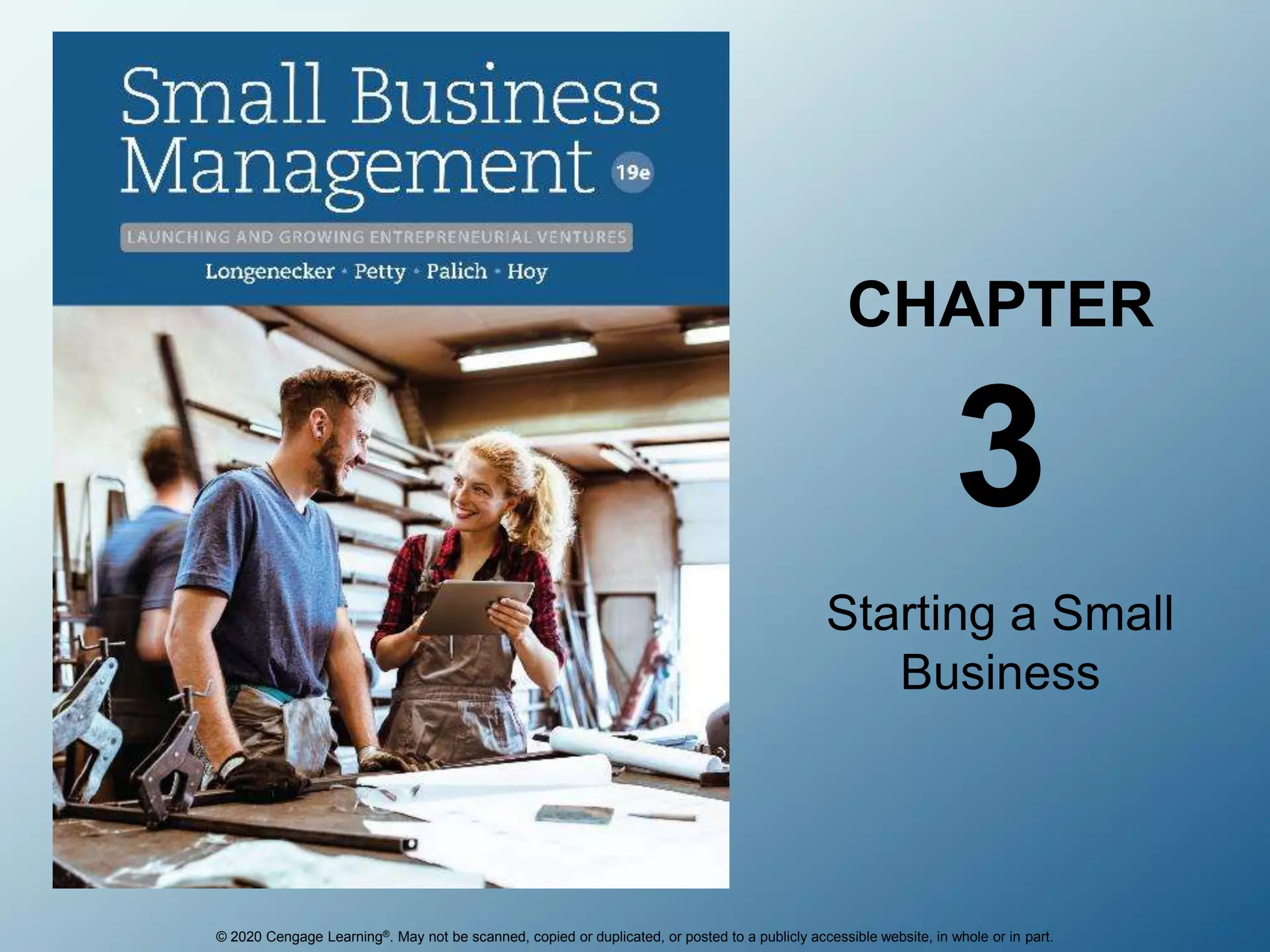
CHAPTER
3
Starting a Small
Business
© 2020 Cengage Learning®. May not be scanned, copied or duplicated, or posted to a publicly accessible website, in whole or in part.
LEARNING OBJECTIVES
By studying this chapter, you should be able to…
3-1 Distinguish among the different types and sources
of startup ideas.
3-2 Use innovative thinking to generate ideas for high-
potential startups.
3-3 Describe external and internal analyses that can
shape the selection of venture opportunities.
3-4 Explain broad-based strategy options and focus
strategies.
3-5 Screen business ideas to identify those with the
greatest potential.
3-6 Assess the feasibility of a startup idea.
© 2020 Cengage Learning®. May not be scanned, copied or duplicated, or posted to a publicly accessible website, in whole or in part.
INTRODUCTION
• Opportunity recognition – Identification of
potential new products or services that may
lead to promising businesses.
• Entrepreneurial alertness – Readiness to act
on existing, but previously unnoticed, business
opportunities.
• Startups – New business ventures created
“from scratch.”
© 2020 Cengage Learning®. May not be scanned, copied or duplicated, or posted to a publicly accessible website, in whole or in part.
3-1 DEVELOPING STARTUP IDEAS
• New venture concepts can come from many
different sources.
• By recognizing the nature and origin of startup
ideas, an entrepreneur can broaden the range of
new ideas available for his or her consideration.
© 2020 Cengage Learning®. May not be scanned, copied or duplicated, or posted to a publicly accessible website, in whole or in part.
3-1a Types of Startup Ideas
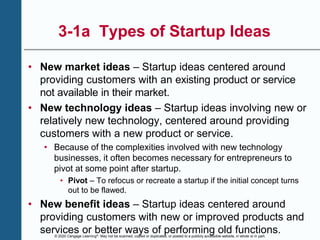
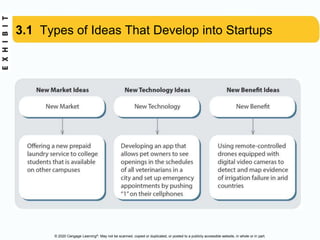
• New market ideas – Startup ideas centered around
providing customers with an existing product or service
not available in their market.
• New technology ideas – Startup ideas involving new or
relatively new technology, centered around providing
customers with a new product or service.
• Because of the complexities involved with new technology
businesses, it often becomes necessary for entrepreneurs to
pivot at some point after startup.
• Pivot – To refocus or recreate a startup if the initial concept turns
out to be flawed.
• New benefit ideas – Startup ideas centered around
providing customers with new or improved products and
services or better ways of performing old functions.
© 2020 Cengage Learning®. May not be scanned, copied or duplicated, or posted to a publicly accessible website, in whole or in part.
3.1 Types of Ideas That Develop into Startups
© 2020 Cengage Learning®. May not be scanned, copied or duplicated, or posted to a publicly accessible website, in whole or in part.
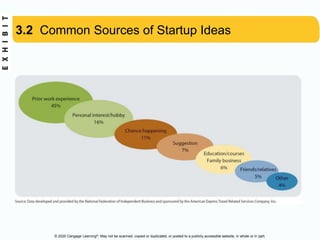
3.2 Common Sources of Startup Ideas
© 2020 Cengage Learning®. May not be scanned, copied or duplicated, or posted to a publicly accessible website, in whole or in part.
3-1b Common Sources of
Startup Ideas (slide 1 of 2)
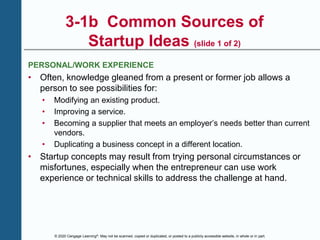
PERSONAL/WORK EXPERIENCE
• Often, knowledge gleaned from a present or former job allows a
person to see possibilities for:
• Modifying an existing product.
• Improving a service.
• Becoming a supplier that meets an employer’s needs better than current
vendors.
• Duplicating a business concept in a different location.
• Startup concepts may result from trying personal circumstances or
misfortunes, especially when the entrepreneur can use work
experience or technical skills to address the challenge at hand.
© 2020 Cengage Learning®. May not be scanned, copied or duplicated, or posted to a publicly accessible website, in whole or in part.
3-1b Common Sources of
Startup Ideas (slide 2 of 2)
HOBBIES AND PERSONAL INTERESTS
• Some entrepreneurs start their new ventures based on their hobbies and
personal interests, which can add passion and energy to the enterprise.
• Recent research has revealed that startups based on a personal pastime
are more likely than others to generate early sales and reach profitability,
and the entrepreneurs who launch these businesses tend to be more deeply
committed to them.
ACCIDENTAL DISCOVERY
• Accidental discoveries may also provide ideas for startups.
• Serendipity – A facility for making desirable discoveries by accident.
OTHER IDEA LEADS
• Personal contacts, trade shows, current trends, and trade publications are
among other idea leads for startups.
© 2020 Cengage Learning®. May not be scanned, copied or duplicated, or posted to a publicly accessible website, in whole or in part.
3-2 USING INNOVATIVE THINKING
TO GENERATE IDEAS (slide 1 of 2)
• A commitment to creative thinking can
generate many ideas for new businesses and
also help to keep an existing business fresh
and moving forward.
© 2020 Cengage Learning®. May not be scanned, copied or duplicated, or posted to a publicly accessible website, in whole or in part.
3-2 USING INNOVATIVE THINKING
TO GENERATE IDEAS (slide 2 of 2)
• Business ideas can be spurred by:
• Borrowing ideas from existing products and services or other
industries.
• Combining businesses to create a market opening.
• Focusing on a problem.
• Responding to a trend.
• Improving the function of an existing product or service.
• Considering possible ways to make customers’ lives easier.
• Meeting customer needs in a new way.
• Expanding the market for a product or service.
• Figuring out how to cash in on the sharing economy.
• Making a product or service “green.”
• Tapping into new technologies.
• Offering products through a subscription service.
© 2020 Cengage Learning®. May not be scanned, copied or duplicated, or posted to a publicly accessible website, in whole or in part.
3-3 INTERNAL AND EXTERNAL ANALYSES
TO ASSESS NEW BUSINESS IDEAS
• Two general approaches can help to identify
business ideas:
1. Outside-in analysis.
• Entrepreneurs look for needs in the marketplace and then
determine how to use their own capabilities to pursue
those opportunities.
2. Inside-out analysis.
• Entrepreneurs first evaluate their capabilities and then
identify new products or service they might be able to offer
to the market.
© 2020 Cengage Learning®. May not be scanned, copied or duplicated, or posted to a publicly accessible website, in whole or in part.
3-3a Outside-In Analysis (slide 1 of 4)
• Outside-in analysis considers the external
environment, including the general, industry, and
competitive environments.
• General environment – The broad environment,
encompassing factors that influence most businesses
in a society.
• Industry environment – The environment that
includes factors that directly impact a given firm and
all of its competitors.
• Competitive environment – The environment that
focuses on the strength, position, and likely moves
and countermoves of competitors in an industry.
© 2020 Cengage Learning®. May not be scanned, copied or duplicated, or posted to a publicly accessible website, in whole or in part.
3-3a Outside-In Analysis (slide 2 of 4)
THE GENERAL ENVIRONMENT
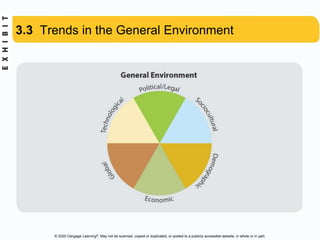
• The general environment encompasses a number of important trends.
• Economic trends include changes in the rate of inflation, interest rates,
and even currency exchange rates, all of which promote or discourage
business growth.
• Sociocultural trends refer to societal currents that may affect consumer
demand, opening up new markets and forcing others into decline.
• Political/legal trends include changes in tax law and government
regulations that may pose a threat to existing companies or devastate an
inventive business concept.
• Global trends reflect international developments that create new
opportunities to expand markets, outsource, invest abroad, and so on.
• Technological trends refer to changes in technology that may spawn—or
wipe out—new ventures.
• Demographic trends include population size, age structure, ethnic mix,
and wage distribution.
© 2020 Cengage Learning®. May not be scanned, copied or duplicated, or posted to a publicly accessible website, in whole or in part.
3.3 Trends in the General Environment
© 2020 Cengage Learning®. May not be scanned, copied or duplicated, or posted to a publicly accessible website, in whole or in part.
3-3a Outside-In Analysis (slide 3 of 4)
THE INDUSTRY ENVIRONMENT
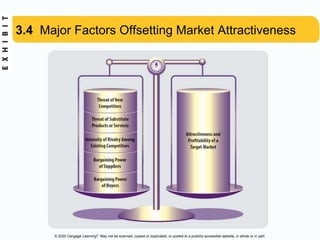
• The major forces that determine the potential attractiveness and
profitability of a target industry include:
• The threat of new competitors.
• The threat of substitute products or services.
• The intensity of rivalry among existing competitors.
• The bargaining power of suppliers and buyers.
• Profits in an industry tend to be inversely related to the strength of
these factors—that is, strong factors yield weak profits, whereas
weak factors yield strong profits.
• Entrepreneurs who understand these industry factors can position
their ventures in a way that makes the most of what the industry
offers.
© 2020 Cengage Learning®. May not be scanned, copied or duplicated, or posted to a publicly accessible website, in whole or in part.
3.4 Major Factors Offsetting Market Attractiveness
© 2020 Cengage Learning®. May not be scanned, copied or duplicated, or posted to a publicly accessible website, in whole or in part.
3-3a Outside-In Analysis (slide 4 of 4)
THE COMPETITIVE ENVIRONMENT
• Determining the strength, position, and likely responses of rival
businesses to newcomers is critical for the assessment of any
business idea.
• Every aspiring entrepreneur should answer several questions about
the competitors he or she is likely to encounter in the marketplace:
• Who would be the new venture’s current competitors?
• What unique resources do they control?
• What are their strengths and weaknesses?
• How will they respond to the new venture’s decision to enter the
industry?
• How can the new venture respond?
• Who else might see and exploit the same opportunity?
• Are there ways to co-opt potential or actual competitors by forming
alliances?
© 2020 Cengage Learning®. May not be scanned, copied or duplicated, or posted to a publicly accessible website, in whole or in part.
3-3b Inside-In Analysis (slide 1 of 4)
• Inside-out analysis helps the entrepreneur to
understand a startup’s sources of potential
strengths and the unique competencies that can
be formed from them.
© 2020 Cengage Learning®. May not be scanned, copied or duplicated, or posted to a publicly accessible website, in whole or in part.
3-3b Inside-In Analysis (slide 2 of 4)
BUILDING ON INTERNAL RESOURCES AND
CAPABILITIES
• Entrepreneurs who want to start or build a business
based on inside-out analysis will first need to have a solid
grasp of the resources and capabilities that are available
to them.
• Resources – The basic inputs that an entrepreneur can use to
start and/or operate a business.
• Capabilities – A company’s routines and processes that
coordinate the use of its productive assets in order to achieve
desired outcomes.
© 2020 Cengage Learning®. May not be scanned, copied or duplicated, or posted to a publicly accessible website, in whole or in part.
3-3b Inside-In Analysis (slide 3 of 4)
• A startup or small business can have both tangible and
intangible resources.
• Tangible resources – Organizational resources that are visible
and easy to measure.
• Examples: An office building, manufacturing equipment, and cash
reserves.
• Intangible resources – Organizational resources that are
invisible and difficult to assess.
• Examples: Patents, copyrights, an established brand, and an
entrepreneur’s personal network of contacts and relationships.
© 2020 Cengage Learning®. May not be scanned, copied or duplicated, or posted to a publicly accessible website, in whole or in part.
3-3b Inside-In Analysis (slide 4 of 4)
IDENTIFYING CORE COMPETENCIES AND ACHIEVING
A COMPETITIVE ADVANTAGE
• Once entrepreneurs have an accurate view of their
resources and capabilities, they will be in a better
position to identify core competencies that can be
created and used to compete.
• Core competencies – The capabilities that distinguish a firm
competitively and reflect its focus and personality.
• In most cases, these strengths make it possible to
achieve a competitive advantage.
• Competitive advantage – A benefit that exists when a firm has a
product or service that is seen by its target market as better than
that of competitors.
© 2020 Cengage Learning®. May not be scanned, copied or duplicated, or posted to a publicly accessible website, in whole or in part.
3-3c Integrating Internal and
External Analyses (slide 1 of 3)
• A solid foundation for competitive advantage
requires a reasonable match between the
strengths and weaknesses of a given business
and the opportunities and threats present in its
relevant environments.
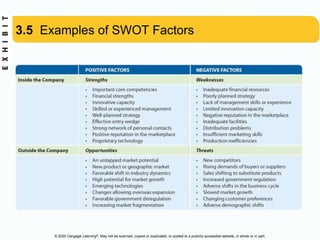
• This integration is best revealed through a SWOT
analysis.
• SWOT analysis – An assessment that provides a concise
overview of a firm’s strategic situation.
© 2020 Cengage Learning®. May not be scanned, copied or duplicated, or posted to a publicly accessible website, in whole or in part.
3.5 Examples of SWOT Factors
© 2020 Cengage Learning®. May not be scanned, copied or duplicated, or posted to a publicly accessible website, in whole or in part.
3-3c Integrating Internal and
External Analyses (slide 2 of 3)
• In practice, a SWOT analysis provides a snapshot view
of current conditions.
• Outside-in and inside-out approaches come together in
the SWOT analysis to help identify potential business
opportunities that match the entrepreneur and his or
her planned venture.
• However, because a SWOT analysis focuses on the
present, the entrepreneur also needs to consider
whether the targeted opportunity will lead to other
opportunities in the future and whether pursuit of the
opportunity is likely to set off a competitive response
by potential rivals.
© 2020 Cengage Learning®. May not be scanned, copied or duplicated, or posted to a publicly accessible website, in whole or in part.
3-3c Integrating Internal and
External Analyses (slide 3 of 3)
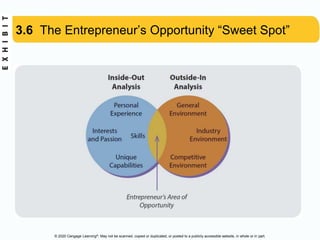
• The entrepreneur’s “opportunity sweet spot” is
found at the point of overlap of emerging
potentials in the external environment and the
unique strengths and capabilities of the
entrepreneur and the venture.
• This area typically offers the greatest potential for
superior business results.
© 2020 Cengage Learning®. May not be scanned, copied or duplicated, or posted to a publicly accessible website, in whole or in part.
3.6 The Entrepreneur’s Opportunity “Sweet Spot”
© 2020 Cengage Learning®. May not be scanned, copied or duplicated, or posted to a publicly accessible website, in whole or in part.
3-4 SELECTING STRATEGIES
THAT CAPTURE OPPORTUNITIES
• Strategy – A plan of action that coordinates
the resources and commitments of an
organization to achieve superior performance.
© 2020 Cengage Learning®. May not be scanned, copied or duplicated, or posted to a publicly accessible website, in whole or in part.
3-4a Broad-Based
Strategy Options (slide 1 of 2)
• Broadly speaking, companies can choose to
build their strategies around an emphasis on
either low cost or differentiation as they
consider how to position themselves relative to
their competitors.
© 2020 Cengage Learning®. May not be scanned, copied or duplicated, or posted to a publicly accessible website, in whole or in part.
3-4a Broad-Based
Strategy Options (slide 2 of 2)
COST-BASED STRATEGY
• Cost-based strategy – A plan of action that requires a firm to hold down
its costs so that it can compete by charging lower prices and still make a
profit.
• Perhaps the most enduring downside of this strategy is that, because it
attracts customers who are always searching for the best deal, it can be a
great challenge to develop customer loyalty and generate long-term
success.
DIFFERENTIATION-BASED STRATEGY
• Differentiation-based strategy – A plan of action designed to provide a
product or service with unique attributes that are valued by consumers.
• For the strategy to be effective, the consumer must be convinced of the
uniqueness and value of the product or service, whether real or
perceived.
© 2020 Cengage Learning®. May not be scanned, copied or duplicated, or posted to a publicly accessible website, in whole or in part.
3-4b Focus Strategies (slide 1 of 3)
• Focus strategies – A plan of action that
isolates an enterprise from competitors and
other market forces by targeting a restricted
market segment.
• Cost-based and differentiation-based
strategies can be used when focusing on a
market niche.
© 2020 Cengage Learning®. May not be scanned, copied or duplicated, or posted to a publicly accessible website, in whole or in part.
3-4b Focus Strategies (slide 2 of 3)
FOCUS STRATEGY SELECTION AND IMPLEMENTATION
• By selecting a particular focus strategy, an entrepreneur decides on
the basic direction of a business, which determines the venture’s
very nature.
• A firm’s overall strategy is formulated, therefore, as its leader
decides how the firm will relate to its environment—particularly to the
customers and competitors in that environment.
• Focus strategies can be set up in the following ways:
• By restricting the target market to a single subset of customers.
• By emphasizing a single product or service.
• By limiting the market to a single geographical region.
• By concentrating on the superiority of the product or service.
• Entrepreneurs can exploit very different market niches within the
same general industry.
© 2020 Cengage Learning®. May not be scanned, copied or duplicated, or posted to a publicly accessible website, in whole or in part.
3-4b Focus Strategies (slide 3 of 3)
DRAWBACKS OF FOCUS STRATEGIES
• The benefits of a focus strategy can diminish when:
• The firm becomes too specialized.
• The strategy is imitated.
• The target segment becomes unattractive or demand dwindles.
• The segment loses its uniqueness.
• New firms subsegment the industry.
• In addition, firms that adopt a focus strategy and are profitable are
likely to face an influx of new competitors that will pursue the same
niche, thereby luring away customers and driving down returns for all
rivals until the segment is no longer profitable.
• Paradox of attraction – The self-contradictory idea that an attractive
market opportunity is likely to draw multiple competitors, thereby
diminishing its attractiveness.
© 2020 Cengage Learning®. May not be scanned, copied or duplicated, or posted to a publicly accessible website, in whole or in part.
3-5 SCREENING NEW
BUSINESS IDEAS (slide 1 of 4)
• If too many new business ideas are generated,
it will be necessary to use a screening process
to determine which idea deserves more
focused attention.
• The screening of ideas can be performed
quickly (usually in an hour or less) and should
precede the decision to complete a feasibility
analysis of the idea selected.
© 2020 Cengage Learning®. May not be scanned, copied or duplicated, or posted to a publicly accessible website, in whole or in part.
3-5 SCREENING NEW
BUSINESS IDEAS (slide 2 of 4)
• The business idea screening process takes into
account the merits of an idea relative to five very
important factors:
1. Strength of the business idea.
• The best business ideas will meet a definite market need, create
value for end users, and offer products or services that customers
favor and find easy to use.
• They will also have no fatal flaws.
2. Targeted market and customers.
• Businesses are more likely to thrive if they focus on a sizable
market that is easy to identify, growing rapidly, and composed of
customers with high levels of purchasing power that they are very
willing to use.
• Further, the best customers will be easily reachable through clear
channels of promotion.
© 2020 Cengage Learning®. May not be scanned, copied or duplicated, or posted to a publicly accessible website, in whole or in part.
3-5 SCREENING NEW
BUSINESS IDEAS (slide 3 of 4)
3. Industry and competitive advantage.
• The most favorable industries for startups have few or no
competitors, are growing quickly, and have high operating margins.
• They also present few or no barriers to keep new businesses out
and would allow a startup to establish and sustain its specific
competitive advantage.
4. Capability of founder(s).
• In the best-case scenario, the founder(s) will have industry-
related experience, skills, and networks, as well as a great
passion for and a good fit with the new business.
5. Capital requirements and venture performance.
• An entrepreneur will fare best when the venture needs little
capital to launch, its anticipated profit potential is great, and
similar enterprises perform very well.
• Low levels of liability and other risks are ideal, as is the ability to
start the business incrementally or test it cheaply before full launch.
© 2020 Cengage Learning®. May not be scanned, copied or duplicated, or posted to a publicly accessible website, in whole or in part.
3-5 SCREENING NEW
BUSINESS IDEAS (slide 4 of 4)
• An idea can be revised and screened again if
doing so will improve its projected viability.
© 2020 Cengage Learning®. May not be scanned, copied or duplicated, or posted to a publicly accessible website, in whole or in part.
3-6 IS YOUR STARTUP
IDEA FEASIBLE?
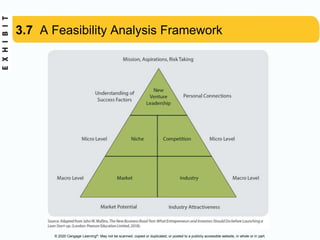
• A feasibility analysis should be conducted to
identify potential fatal flaws prior to making the
decision to invest the substantial time, energy,
and other resources required to put together a
full-scale business plan.
• Feasibility analysis – A preliminary assessment of a
business idea that gauges whether the venture
envisioned is likely to succeed.
• Fatal flaw – A circumstance or development that
alone could render a new business unsuccessful.
© 2020 Cengage Learning®. May not be scanned, copied or duplicated, or posted to a publicly accessible website, in whole or in part.
3.7 A Feasibility Analysis Framework
© 2020 Cengage Learning®. May not be scanned, copied or duplicated, or posted to a publicly accessible website, in whole or in part.
3-6a Market Potential (slide 1 of 2)
• It is important to make clear the distinction
between a market and an industry.
• A market consists of buyers, current or potential
customers who are interested in purchasing a
particular class of products or services to satisfy
wants or needs—and they must also have the
ability to pay for them.
• An industry is composed of sellers who compete
with one another by offering identical or similar
products or services for sale to the same general
group of buyers.
© 2020 Cengage Learning®. May not be scanned, copied or duplicated, or posted to a publicly accessible website, in whole or in part.
3-6a Market Potential (slide 2 of 2)
• A feasibility analysis should assess the potential of a
market on two levels—the broad macro-market and the
micro-market.
• As part of a feasibility analysis, an evaluation of the general
environment will help to identify a potential-laden trend that
can support promising startup ideas, one of which will be
selected for more thorough consideration.
• This sets the framework for a macro-market analysis, establishing
the boundaries for research regarding the number of customer
targeted and their overall purchasing power and habits.
• An evaluation of the micro-market should clarify the unique
value that the startup idea would offer customers, but it should
also provide estimates of the size of the niche, its rate of
growth, and its long-term prospects.
© 2020 Cengage Learning®. May not be scanned, copied or duplicated, or posted to a publicly accessible website, in whole or in part.
3-6b Industry Attractiveness
• Like markets, industries should be considered
from a “big-picture” and a more focused point
of view.
• A macro-level analysis assess the overall
attractiveness of the industry in which the startup
will be established.
• A micro-level industry assessment is focused less
on whether industry conditions overall are suitable
to launching a new business and more on the
profitability of a startup’s success over the long run.
© 2020 Cengage Learning®. May not be scanned, copied or duplicated, or posted to a publicly accessible website, in whole or in part.
3-6c New Venture Leadership
• Entrepreneurs are likely to be successful in a
startup situation to the degree that the planned
venture fits with their mission, aspirations, and
tolerance for risk.
• Successful entrepreneurs understand and are
able to manage the factors that are critical to
the operation of the enterprise.
• Successful entrepreneurs are able to connect
with suppliers, customers, investors, and
others whose involvement is crucial to the
future performance of the planned venture.
© 2020 Cengage Learning®. May not be scanned, copied or duplicated, or posted to a publicly accessible website, in whole or in part.
Key Terms
capabilities
competitive advantage
competitive environment
core competencies
cost-based strategy
differentiation-based strategy
entrepreneurial alertness
fatal flaw
feasibility analysis
focus strategies
general environment
industry environment
intangible resources
new benefit ideas
new market ideas
new technology ideas
opportunity recognition
paradox of attraction
pivot
resources
serendipity
startups
strategy
SWOT analysis
tangible resources

Small Business Management Chapter 3 PowerPoint

  • 1.
    © 2020 CengageLearning®. May not be scanned, copied or duplicated, or posted to a publicly accessible website, in whole or in part. CHAPTER 3 Starting a Small Business
  • 2.
    © 2020 CengageLearning®. May not be scanned, copied or duplicated, or posted to a publicly accessible website, in whole or in part. LEARNING OBJECTIVES By studying this chapter, you should be able to… 3-1 Distinguish among the different types and sources of startup ideas. 3-2 Use innovative thinking to generate ideas for high- potential startups. 3-3 Describe external and internal analyses that can shape the selection of venture opportunities. 3-4 Explain broad-based strategy options and focus strategies. 3-5 Screen business ideas to identify those with the greatest potential. 3-6 Assess the feasibility of a startup idea.
  • 3.
    © 2020 CengageLearning®. May not be scanned, copied or duplicated, or posted to a publicly accessible website, in whole or in part. INTRODUCTION • Opportunity recognition – Identification of potential new products or services that may lead to promising businesses. • Entrepreneurial alertness – Readiness to act on existing, but previously unnoticed, business opportunities. • Startups – New business ventures created “from scratch.”
  • 4.
    © 2020 CengageLearning®. May not be scanned, copied or duplicated, or posted to a publicly accessible website, in whole or in part. 3-1 DEVELOPING STARTUP IDEAS • New venture concepts can come from many different sources. • By recognizing the nature and origin of startup ideas, an entrepreneur can broaden the range of new ideas available for his or her consideration.
  • 5.
    © 2020 CengageLearning®. May not be scanned, copied or duplicated, or posted to a publicly accessible website, in whole or in part. 3-1a Types of Startup Ideas • New market ideas – Startup ideas centered around providing customers with an existing product or service not available in their market. • New technology ideas – Startup ideas involving new or relatively new technology, centered around providing customers with a new product or service. • Because of the complexities involved with new technology businesses, it often becomes necessary for entrepreneurs to pivot at some point after startup. • Pivot – To refocus or recreate a startup if the initial concept turns out to be flawed. • New benefit ideas – Startup ideas centered around providing customers with new or improved products and services or better ways of performing old functions.
  • 6.
    © 2020 CengageLearning®. May not be scanned, copied or duplicated, or posted to a publicly accessible website, in whole or in part. 3.1 Types of Ideas That Develop into Startups
  • 7.
    © 2020 CengageLearning®. May not be scanned, copied or duplicated, or posted to a publicly accessible website, in whole or in part. 3.2 Common Sources of Startup Ideas
  • 8.
    © 2020 CengageLearning®. May not be scanned, copied or duplicated, or posted to a publicly accessible website, in whole or in part. 3-1b Common Sources of Startup Ideas (slide 1 of 2) PERSONAL/WORK EXPERIENCE • Often, knowledge gleaned from a present or former job allows a person to see possibilities for: • Modifying an existing product. • Improving a service. • Becoming a supplier that meets an employer’s needs better than current vendors. • Duplicating a business concept in a different location. • Startup concepts may result from trying personal circumstances or misfortunes, especially when the entrepreneur can use work experience or technical skills to address the challenge at hand.
  • 9.
    © 2020 CengageLearning®. May not be scanned, copied or duplicated, or posted to a publicly accessible website, in whole or in part. 3-1b Common Sources of Startup Ideas (slide 2 of 2) HOBBIES AND PERSONAL INTERESTS • Some entrepreneurs start their new ventures based on their hobbies and personal interests, which can add passion and energy to the enterprise. • Recent research has revealed that startups based on a personal pastime are more likely than others to generate early sales and reach profitability, and the entrepreneurs who launch these businesses tend to be more deeply committed to them. ACCIDENTAL DISCOVERY • Accidental discoveries may also provide ideas for startups. • Serendipity – A facility for making desirable discoveries by accident. OTHER IDEA LEADS • Personal contacts, trade shows, current trends, and trade publications are among other idea leads for startups.
  • 10.
    © 2020 CengageLearning®. May not be scanned, copied or duplicated, or posted to a publicly accessible website, in whole or in part. 3-2 USING INNOVATIVE THINKING TO GENERATE IDEAS (slide 1 of 2) • A commitment to creative thinking can generate many ideas for new businesses and also help to keep an existing business fresh and moving forward.
  • 11.
    © 2020 CengageLearning®. May not be scanned, copied or duplicated, or posted to a publicly accessible website, in whole or in part. 3-2 USING INNOVATIVE THINKING TO GENERATE IDEAS (slide 2 of 2) • Business ideas can be spurred by: • Borrowing ideas from existing products and services or other industries. • Combining businesses to create a market opening. • Focusing on a problem. • Responding to a trend. • Improving the function of an existing product or service. • Considering possible ways to make customers’ lives easier. • Meeting customer needs in a new way. • Expanding the market for a product or service. • Figuring out how to cash in on the sharing economy. • Making a product or service “green.” • Tapping into new technologies. • Offering products through a subscription service.
  • 12.
    © 2020 CengageLearning®. May not be scanned, copied or duplicated, or posted to a publicly accessible website, in whole or in part. 3-3 INTERNAL AND EXTERNAL ANALYSES TO ASSESS NEW BUSINESS IDEAS • Two general approaches can help to identify business ideas: 1. Outside-in analysis. • Entrepreneurs look for needs in the marketplace and then determine how to use their own capabilities to pursue those opportunities. 2. Inside-out analysis. • Entrepreneurs first evaluate their capabilities and then identify new products or service they might be able to offer to the market.
  • 13.
    © 2020 CengageLearning®. May not be scanned, copied or duplicated, or posted to a publicly accessible website, in whole or in part. 3-3a Outside-In Analysis (slide 1 of 4) • Outside-in analysis considers the external environment, including the general, industry, and competitive environments. • General environment – The broad environment, encompassing factors that influence most businesses in a society. • Industry environment – The environment that includes factors that directly impact a given firm and all of its competitors. • Competitive environment – The environment that focuses on the strength, position, and likely moves and countermoves of competitors in an industry.
  • 14.
    © 2020 CengageLearning®. May not be scanned, copied or duplicated, or posted to a publicly accessible website, in whole or in part. 3-3a Outside-In Analysis (slide 2 of 4) THE GENERAL ENVIRONMENT • The general environment encompasses a number of important trends. • Economic trends include changes in the rate of inflation, interest rates, and even currency exchange rates, all of which promote or discourage business growth. • Sociocultural trends refer to societal currents that may affect consumer demand, opening up new markets and forcing others into decline. • Political/legal trends include changes in tax law and government regulations that may pose a threat to existing companies or devastate an inventive business concept. • Global trends reflect international developments that create new opportunities to expand markets, outsource, invest abroad, and so on. • Technological trends refer to changes in technology that may spawn—or wipe out—new ventures. • Demographic trends include population size, age structure, ethnic mix, and wage distribution.
  • 15.
    © 2020 CengageLearning®. May not be scanned, copied or duplicated, or posted to a publicly accessible website, in whole or in part. 3.3 Trends in the General Environment
  • 16.
    © 2020 CengageLearning®. May not be scanned, copied or duplicated, or posted to a publicly accessible website, in whole or in part. 3-3a Outside-In Analysis (slide 3 of 4) THE INDUSTRY ENVIRONMENT • The major forces that determine the potential attractiveness and profitability of a target industry include: • The threat of new competitors. • The threat of substitute products or services. • The intensity of rivalry among existing competitors. • The bargaining power of suppliers and buyers. • Profits in an industry tend to be inversely related to the strength of these factors—that is, strong factors yield weak profits, whereas weak factors yield strong profits. • Entrepreneurs who understand these industry factors can position their ventures in a way that makes the most of what the industry offers.
  • 17.
    © 2020 CengageLearning®. May not be scanned, copied or duplicated, or posted to a publicly accessible website, in whole or in part. 3.4 Major Factors Offsetting Market Attractiveness
  • 18.
    © 2020 CengageLearning®. May not be scanned, copied or duplicated, or posted to a publicly accessible website, in whole or in part. 3-3a Outside-In Analysis (slide 4 of 4) THE COMPETITIVE ENVIRONMENT • Determining the strength, position, and likely responses of rival businesses to newcomers is critical for the assessment of any business idea. • Every aspiring entrepreneur should answer several questions about the competitors he or she is likely to encounter in the marketplace: • Who would be the new venture’s current competitors? • What unique resources do they control? • What are their strengths and weaknesses? • How will they respond to the new venture’s decision to enter the industry? • How can the new venture respond? • Who else might see and exploit the same opportunity? • Are there ways to co-opt potential or actual competitors by forming alliances?
  • 19.
    © 2020 CengageLearning®. May not be scanned, copied or duplicated, or posted to a publicly accessible website, in whole or in part. 3-3b Inside-In Analysis (slide 1 of 4) • Inside-out analysis helps the entrepreneur to understand a startup’s sources of potential strengths and the unique competencies that can be formed from them.
  • 20.
    © 2020 CengageLearning®. May not be scanned, copied or duplicated, or posted to a publicly accessible website, in whole or in part. 3-3b Inside-In Analysis (slide 2 of 4) BUILDING ON INTERNAL RESOURCES AND CAPABILITIES • Entrepreneurs who want to start or build a business based on inside-out analysis will first need to have a solid grasp of the resources and capabilities that are available to them. • Resources – The basic inputs that an entrepreneur can use to start and/or operate a business. • Capabilities – A company’s routines and processes that coordinate the use of its productive assets in order to achieve desired outcomes.
  • 21.
    © 2020 CengageLearning®. May not be scanned, copied or duplicated, or posted to a publicly accessible website, in whole or in part. 3-3b Inside-In Analysis (slide 3 of 4) • A startup or small business can have both tangible and intangible resources. • Tangible resources – Organizational resources that are visible and easy to measure. • Examples: An office building, manufacturing equipment, and cash reserves. • Intangible resources – Organizational resources that are invisible and difficult to assess. • Examples: Patents, copyrights, an established brand, and an entrepreneur’s personal network of contacts and relationships.
  • 22.
    © 2020 CengageLearning®. May not be scanned, copied or duplicated, or posted to a publicly accessible website, in whole or in part. 3-3b Inside-In Analysis (slide 4 of 4) IDENTIFYING CORE COMPETENCIES AND ACHIEVING A COMPETITIVE ADVANTAGE • Once entrepreneurs have an accurate view of their resources and capabilities, they will be in a better position to identify core competencies that can be created and used to compete. • Core competencies – The capabilities that distinguish a firm competitively and reflect its focus and personality. • In most cases, these strengths make it possible to achieve a competitive advantage. • Competitive advantage – A benefit that exists when a firm has a product or service that is seen by its target market as better than that of competitors.
  • 23.
    © 2020 CengageLearning®. May not be scanned, copied or duplicated, or posted to a publicly accessible website, in whole or in part. 3-3c Integrating Internal and External Analyses (slide 1 of 3) • A solid foundation for competitive advantage requires a reasonable match between the strengths and weaknesses of a given business and the opportunities and threats present in its relevant environments. • This integration is best revealed through a SWOT analysis. • SWOT analysis – An assessment that provides a concise overview of a firm’s strategic situation.
  • 24.
    © 2020 CengageLearning®. May not be scanned, copied or duplicated, or posted to a publicly accessible website, in whole or in part. 3.5 Examples of SWOT Factors
  • 25.
    © 2020 CengageLearning®. May not be scanned, copied or duplicated, or posted to a publicly accessible website, in whole or in part. 3-3c Integrating Internal and External Analyses (slide 2 of 3) • In practice, a SWOT analysis provides a snapshot view of current conditions. • Outside-in and inside-out approaches come together in the SWOT analysis to help identify potential business opportunities that match the entrepreneur and his or her planned venture. • However, because a SWOT analysis focuses on the present, the entrepreneur also needs to consider whether the targeted opportunity will lead to other opportunities in the future and whether pursuit of the opportunity is likely to set off a competitive response by potential rivals.
  • 26.
    © 2020 CengageLearning®. May not be scanned, copied or duplicated, or posted to a publicly accessible website, in whole or in part. 3-3c Integrating Internal and External Analyses (slide 3 of 3) • The entrepreneur’s “opportunity sweet spot” is found at the point of overlap of emerging potentials in the external environment and the unique strengths and capabilities of the entrepreneur and the venture. • This area typically offers the greatest potential for superior business results.
  • 27.
    © 2020 CengageLearning®. May not be scanned, copied or duplicated, or posted to a publicly accessible website, in whole or in part. 3.6 The Entrepreneur’s Opportunity “Sweet Spot”
  • 28.
    © 2020 CengageLearning®. May not be scanned, copied or duplicated, or posted to a publicly accessible website, in whole or in part. 3-4 SELECTING STRATEGIES THAT CAPTURE OPPORTUNITIES • Strategy – A plan of action that coordinates the resources and commitments of an organization to achieve superior performance.
  • 29.
    © 2020 CengageLearning®. May not be scanned, copied or duplicated, or posted to a publicly accessible website, in whole or in part. 3-4a Broad-Based Strategy Options (slide 1 of 2) • Broadly speaking, companies can choose to build their strategies around an emphasis on either low cost or differentiation as they consider how to position themselves relative to their competitors.
  • 30.
    © 2020 CengageLearning®. May not be scanned, copied or duplicated, or posted to a publicly accessible website, in whole or in part. 3-4a Broad-Based Strategy Options (slide 2 of 2) COST-BASED STRATEGY • Cost-based strategy – A plan of action that requires a firm to hold down its costs so that it can compete by charging lower prices and still make a profit. • Perhaps the most enduring downside of this strategy is that, because it attracts customers who are always searching for the best deal, it can be a great challenge to develop customer loyalty and generate long-term success. DIFFERENTIATION-BASED STRATEGY • Differentiation-based strategy – A plan of action designed to provide a product or service with unique attributes that are valued by consumers. • For the strategy to be effective, the consumer must be convinced of the uniqueness and value of the product or service, whether real or perceived.
  • 31.
    © 2020 CengageLearning®. May not be scanned, copied or duplicated, or posted to a publicly accessible website, in whole or in part. 3-4b Focus Strategies (slide 1 of 3) • Focus strategies – A plan of action that isolates an enterprise from competitors and other market forces by targeting a restricted market segment. • Cost-based and differentiation-based strategies can be used when focusing on a market niche.
  • 32.
    © 2020 CengageLearning®. May not be scanned, copied or duplicated, or posted to a publicly accessible website, in whole or in part. 3-4b Focus Strategies (slide 2 of 3) FOCUS STRATEGY SELECTION AND IMPLEMENTATION • By selecting a particular focus strategy, an entrepreneur decides on the basic direction of a business, which determines the venture’s very nature. • A firm’s overall strategy is formulated, therefore, as its leader decides how the firm will relate to its environment—particularly to the customers and competitors in that environment. • Focus strategies can be set up in the following ways: • By restricting the target market to a single subset of customers. • By emphasizing a single product or service. • By limiting the market to a single geographical region. • By concentrating on the superiority of the product or service. • Entrepreneurs can exploit very different market niches within the same general industry.
  • 33.
    © 2020 CengageLearning®. May not be scanned, copied or duplicated, or posted to a publicly accessible website, in whole or in part. 3-4b Focus Strategies (slide 3 of 3) DRAWBACKS OF FOCUS STRATEGIES • The benefits of a focus strategy can diminish when: • The firm becomes too specialized. • The strategy is imitated. • The target segment becomes unattractive or demand dwindles. • The segment loses its uniqueness. • New firms subsegment the industry. • In addition, firms that adopt a focus strategy and are profitable are likely to face an influx of new competitors that will pursue the same niche, thereby luring away customers and driving down returns for all rivals until the segment is no longer profitable. • Paradox of attraction – The self-contradictory idea that an attractive market opportunity is likely to draw multiple competitors, thereby diminishing its attractiveness.
  • 34.
    © 2020 CengageLearning®. May not be scanned, copied or duplicated, or posted to a publicly accessible website, in whole or in part. 3-5 SCREENING NEW BUSINESS IDEAS (slide 1 of 4) • If too many new business ideas are generated, it will be necessary to use a screening process to determine which idea deserves more focused attention. • The screening of ideas can be performed quickly (usually in an hour or less) and should precede the decision to complete a feasibility analysis of the idea selected.
  • 35.
    © 2020 CengageLearning®. May not be scanned, copied or duplicated, or posted to a publicly accessible website, in whole or in part. 3-5 SCREENING NEW BUSINESS IDEAS (slide 2 of 4) • The business idea screening process takes into account the merits of an idea relative to five very important factors: 1. Strength of the business idea. • The best business ideas will meet a definite market need, create value for end users, and offer products or services that customers favor and find easy to use. • They will also have no fatal flaws. 2. Targeted market and customers. • Businesses are more likely to thrive if they focus on a sizable market that is easy to identify, growing rapidly, and composed of customers with high levels of purchasing power that they are very willing to use. • Further, the best customers will be easily reachable through clear channels of promotion.
  • 36.
    © 2020 CengageLearning®. May not be scanned, copied or duplicated, or posted to a publicly accessible website, in whole or in part. 3-5 SCREENING NEW BUSINESS IDEAS (slide 3 of 4) 3. Industry and competitive advantage. • The most favorable industries for startups have few or no competitors, are growing quickly, and have high operating margins. • They also present few or no barriers to keep new businesses out and would allow a startup to establish and sustain its specific competitive advantage. 4. Capability of founder(s). • In the best-case scenario, the founder(s) will have industry- related experience, skills, and networks, as well as a great passion for and a good fit with the new business. 5. Capital requirements and venture performance. • An entrepreneur will fare best when the venture needs little capital to launch, its anticipated profit potential is great, and similar enterprises perform very well. • Low levels of liability and other risks are ideal, as is the ability to start the business incrementally or test it cheaply before full launch.
  • 37.
    © 2020 CengageLearning®. May not be scanned, copied or duplicated, or posted to a publicly accessible website, in whole or in part. 3-5 SCREENING NEW BUSINESS IDEAS (slide 4 of 4) • An idea can be revised and screened again if doing so will improve its projected viability.
  • 38.
    © 2020 CengageLearning®. May not be scanned, copied or duplicated, or posted to a publicly accessible website, in whole or in part. 3-6 IS YOUR STARTUP IDEA FEASIBLE? • A feasibility analysis should be conducted to identify potential fatal flaws prior to making the decision to invest the substantial time, energy, and other resources required to put together a full-scale business plan. • Feasibility analysis – A preliminary assessment of a business idea that gauges whether the venture envisioned is likely to succeed. • Fatal flaw – A circumstance or development that alone could render a new business unsuccessful.
  • 39.
    © 2020 CengageLearning®. May not be scanned, copied or duplicated, or posted to a publicly accessible website, in whole or in part. 3.7 A Feasibility Analysis Framework
  • 40.
    © 2020 CengageLearning®. May not be scanned, copied or duplicated, or posted to a publicly accessible website, in whole or in part. 3-6a Market Potential (slide 1 of 2) • It is important to make clear the distinction between a market and an industry. • A market consists of buyers, current or potential customers who are interested in purchasing a particular class of products or services to satisfy wants or needs—and they must also have the ability to pay for them. • An industry is composed of sellers who compete with one another by offering identical or similar products or services for sale to the same general group of buyers.
  • 41.
    © 2020 CengageLearning®. May not be scanned, copied or duplicated, or posted to a publicly accessible website, in whole or in part. 3-6a Market Potential (slide 2 of 2) • A feasibility analysis should assess the potential of a market on two levels—the broad macro-market and the micro-market. • As part of a feasibility analysis, an evaluation of the general environment will help to identify a potential-laden trend that can support promising startup ideas, one of which will be selected for more thorough consideration. • This sets the framework for a macro-market analysis, establishing the boundaries for research regarding the number of customer targeted and their overall purchasing power and habits. • An evaluation of the micro-market should clarify the unique value that the startup idea would offer customers, but it should also provide estimates of the size of the niche, its rate of growth, and its long-term prospects.
  • 42.
    © 2020 CengageLearning®. May not be scanned, copied or duplicated, or posted to a publicly accessible website, in whole or in part. 3-6b Industry Attractiveness • Like markets, industries should be considered from a “big-picture” and a more focused point of view. • A macro-level analysis assess the overall attractiveness of the industry in which the startup will be established. • A micro-level industry assessment is focused less on whether industry conditions overall are suitable to launching a new business and more on the profitability of a startup’s success over the long run.
  • 43.
    © 2020 CengageLearning®. May not be scanned, copied or duplicated, or posted to a publicly accessible website, in whole or in part. 3-6c New Venture Leadership • Entrepreneurs are likely to be successful in a startup situation to the degree that the planned venture fits with their mission, aspirations, and tolerance for risk. • Successful entrepreneurs understand and are able to manage the factors that are critical to the operation of the enterprise. • Successful entrepreneurs are able to connect with suppliers, customers, investors, and others whose involvement is crucial to the future performance of the planned venture.
  • 44.
    © 2020 CengageLearning®. May not be scanned, copied or duplicated, or posted to a publicly accessible website, in whole or in part. Key Terms capabilities competitive advantage competitive environment core competencies cost-based strategy differentiation-based strategy entrepreneurial alertness fatal flaw feasibility analysis focus strategies general environment industry environment intangible resources new benefit ideas new market ideas new technology ideas opportunity recognition paradox of attraction pivot resources serendipity startups strategy SWOT analysis tangible resources