© 2020 Cengage Learning®. May not be scanned, copied or duplicated, or posted to a publicly accessible website, in whole or in part.
CHAPTER
12
Financing the
Small Business
© 2020 Cengage Learning®. May not be scanned, copied or duplicated, or posted to a publicly accessible website, in whole or in part.
LEARNING OBJECTIVES
By studying this chapter, you should be able to…
12-1 Describe how a firm’s characteristics affect its available financing
sources.
12-2 Evaluate the choice between debt financing and equity financing.
12-3 Describe the starting point for financing a small business.
12-4 Discuss the basic process for acquiring and structuring a bank loan.
12-5 Explain how business relationships can be used to finance a small firm.
12-6 Describe the two types of private equity investors who offer financing
to small firms.
12-7 Describe how crowdfunding can be used by some small businesses
to raise capital.
12-8 Distinguish among the different government loan programs available
to small companies.
12-9 Explain when large companies and public stock offerings can be
sources of financing.
© 2020 Cengage Learning®. May not be scanned, copied or duplicated, or posted to a publicly accessible website, in whole or in part.
12-1 FIRM CHARACTERISTICS
AND SOURCES OF FINANCING
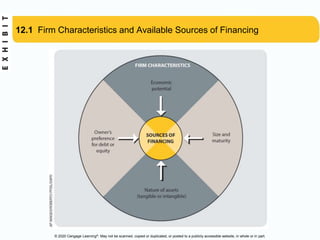
• Four basic characteristics of a business
significantly affect how it is financed:
1. The firm’s economic potential.
2. The size and maturity of the company.
3. The nature of its assets.
4. The owner’s personal preference with respect to
using debt or equity.
© 2020 Cengage Learning®. May not be scanned, copied or duplicated, or posted to a publicly accessible website, in whole or in part.
12.1 Firm Characteristics and Available Sources of Financing
© 2020 Cengage Learning®. May not be scanned, copied or duplicated, or posted to a publicly accessible website, in whole or in part.
12-1a A Firm’s Economic Potential
• In terms of profitability and possibilities for
growth, the ways in which the economic
potential of a business affects financing
choices can be stated simply:
• A company that provides a comfortable lifestyle for
its owner but insufficient profits to attract outside
investors will find its options for alternative sources
of financing limited.
• A firm with potential for high growth and large profits
has more possible sources of financing.
© 2020 Cengage Learning®. May not be scanned, copied or duplicated, or posted to a publicly accessible website, in whole or in part.
12-1b Company Size and Maturity
• Older and larger companies have more access
to bank financing, while smaller firms tend to
rely more on personal loans and credit cards.
• In the early years of a business, most entrepreneurs
bootstrap their financing—that is, they depend on
their own initiative to come up with the necessary
capital.
• Only after the business has an established track
record will most bankers and other financial
institutions be willing to provide financing.
© 2020 Cengage Learning®. May not be scanned, copied or duplicated, or posted to a publicly accessible website, in whole or in part.
12-1c The Nature of
a Firm’s Assets
• A banker specifically considers two types of
assets when evaluating a firm for a loan:
1. Tangible assets.
• Tangible assets, which can be seen and touched, include
inventory, equipment, and buildings.
• Tangible assets are great collateral when a firm is
requesting a bank loan.
2. Intangible assets.
• Intangible assets include things such as goodwill or past
investments in research and development.
• Although important to an investor, they have little value as
collateral when it comes to getting a loan.
© 2020 Cengage Learning®. May not be scanned, copied or duplicated, or posted to a publicly accessible website, in whole or in part.
12-1d Owner Preferences
for Debt or Equity
• Whether an owner finances with debt, with
equity, or some mix of the two depends on the
situation.
• It is also affected by trade-offs that a business
owner will have to make depending on his or
her personal preferences.
© 2020 Cengage Learning®. May not be scanned, copied or duplicated, or posted to a publicly accessible website, in whole or in part.
12-2 CHOOSING BETWEEN
DEBT AND EQUITY (slide 1 of 2)
• The choice between debt and equity financing
must be made early in a firm’s life cycle and
may have long-term financial consequences.
• To make an informed decision, a small business
owner needs to understand the trade-offs between
debt and equity with regard to the following three
factors:
1. The potential profitability for the owners.
2. The business’s financial risk.
3. Who will have voting control of the business.
© 2020 Cengage Learning®. May not be scanned, copied or duplicated, or posted to a publicly accessible website, in whole or in part.
12-2 CHOOSING BETWEEN
DEBT AND EQUITY (slide 2 of 2)
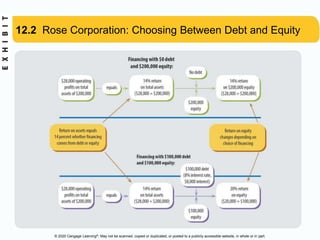
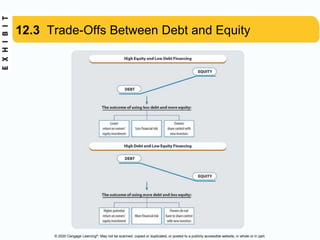
• Borrowing money (debt) rather than issuing
common stock (owners’ equity) creates the
potential for higher rates of return to the
owners and allows them to retain voting control
of the company, but it also exposes them to
greater financial risk.
• Issuing common stock rather than borrowing
money results in lower potential rates of return
to the owners and the loss of some voting
control, but it does reduce their financial risk.
© 2020 Cengage Learning®. May not be scanned, copied or duplicated, or posted to a publicly accessible website, in whole or in part.
12.2 Rose Corporation: Choosing Between Debt and Equity
© 2020 Cengage Learning®. May not be scanned, copied or duplicated, or posted to a publicly accessible website, in whole or in part.
12.3 Trade-Offs Between Debt and Equity
© 2020 Cengage Learning®. May not be scanned, copied or duplicated, or posted to a publicly accessible website, in whole or in part.
12-3 SOURCES OF SMALL BUSINESS
FINANCING: THE STARTING POINT
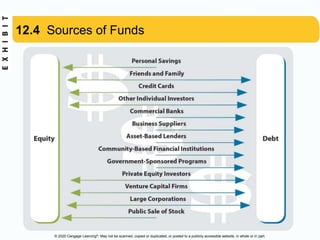
• The following are the potential sources of
financing of smaller companies:
• Sources of debt financing include banks, business
suppliers, asset-based lenders, the government,
and community-based financial institutions.
• Equity financing for most small business owners
primarily comes from personal savings and, in rare
instances, from selling stock to the public.
• Other sources—including friends and family, private
equity investors (rarely), and large corporations—
may provide either debt or equity financing,
depending on the situation.
© 2020 Cengage Learning®. May not be scanned, copied or duplicated, or posted to a publicly accessible website, in whole or in part.
12.4 Sources of Funds
© 2020 Cengage Learning®. May not be scanned, copied or duplicated, or posted to a publicly accessible website, in whole or in part.
12-3a Personal Savings
• The primary source of equity financing used in
starting a new business is personal savings.
• A banker or other lender is unlikely to loan
venture money if the entrepreneur does not
have her or his own money at risk.
© 2020 Cengage Learning®. May not be scanned, copied or duplicated, or posted to a publicly accessible website, in whole or in part.
12-3b Friends and Family
• Loans from friends and family may be the only
available source of financing and are often easy and
fast to obtain, although such borrowing can place the
entrepreneur’s most important personal relationships in
jeopardy.
• To minimize the chance of damaging important personal
relationships, the entrepreneur should plan to repay such
loans as soon as possible.
• In addition, any agreements should be put in writing.
• An entrepreneur should accept money from a friend or
relative only if that person will not be hurt financially to
any significant extent if the entire amount is lost.
© 2020 Cengage Learning®. May not be scanned, copied or duplicated, or posted to a publicly accessible website, in whole or in part.
12-3c Credit Cards
• Credit card financing provides easily
accessible financing, but the high interest costs
may be overwhelming at times.
• Credit cards have the advantage of speed.
• Unlike borrowing from a lender, credit card
financing requires no justification for the use of the
money.
© 2020 Cengage Learning®. May not be scanned, copied or duplicated, or posted to a publicly accessible website, in whole or in part.
12-4 BANK FINANCING
• Commercial banks are primary providers of
debt capital to established firms, but they are
generally less interested in financing startup
businesses.
• Bankers want firms with proven track records and
plenty of collateral in the form of hard assets.
• Bankers are reluctant to loan money to finance
losses, which are characteristic of early-stage
companies.
• Neither are they very interested in financing
research and development (R&D) expenses,
marketing campaigns, and other “soft” assets.
© 2020 Cengage Learning®. May not be scanned, copied or duplicated, or posted to a publicly accessible website, in whole or in part.
12-4a Types of Loans (slide 1 of 2)
• Bankers primarily make business loans in one of three forms:
1. Lines of credit.
2. Term loans.
3. Mortgages.
LINES OF CREDIT
• Line of credit – An informal agreement between a borrower and
a bank as to the maximum amount of funds the bank will provide
at any one time.
• Under this type of agreement, the bank has no legal obligation to
provide the capital.
© 2020 Cengage Learning®. May not be scanned, copied or duplicated, or posted to a publicly accessible website, in whole or in part.
12-4a Types of Loans (slide 2 of 2)
TERM LOANS
• Term loans – Money loaned for a 5 to 10 year term,
corresponding to the length of time the investment will bring in
profits.
• Term loans are generally used to finance equipment with a useful
life corresponding to the loan’s term.
MORTGAGES
• Mortgages can be one of two types:
1. Chattel mortgage – A loan for which items of inventory or other
movable property serve as collateral.
2. Real estate mortgage – A long-term loan with real property held as
collateral.
© 2020 Cengage Learning®. May not be scanned, copied or duplicated, or posted to a publicly accessible website, in whole or in part.
12-4b Understanding a
Banker’s Perspective
• In the order of importance, the priorities of a banker when making
a loan are:
1. Recouping the principal of the loan.
2. Determining the amount of income the loan will provide the bank.
3. Helping the borrower be successful and become a larger customer.
• In making a loan decision, bankers give serious consideration to
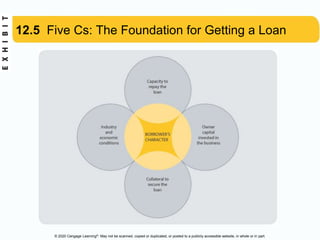
what they call the “five Cs of credit”:
1. The borrower’s character.
2. The borrower’s capacity to repay the loan.
3. The capital being invested in the venture by the borrower.
4. The collateral available to secure the loan.
5. The conditions of the industry and economy.
© 2020 Cengage Learning®. May not be scanned, copied or duplicated, or posted to a publicly accessible website, in whole or in part.
12.5 Five Cs: The Foundation for Getting a Loan
© 2020 Cengage Learning®. May not be scanned, copied or duplicated, or posted to a publicly accessible website, in whole or in part.
12-4c A Banker’s
Information Requirements
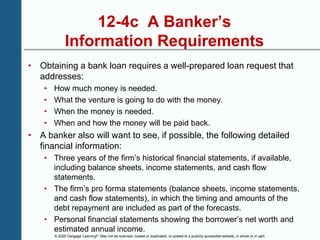
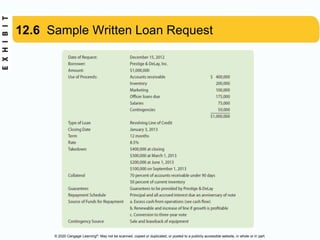
• Obtaining a bank loan requires a well-prepared loan request that
addresses:
• How much money is needed.
• What the venture is going to do with the money.
• When the money is needed.
• When and how the money will be paid back.
• A banker also will want to see, if possible, the following detailed
financial information:
• Three years of the firm’s historical financial statements, if available,
including balance sheets, income statements, and cash flow
statements.
• The firm’s pro forma statements (balance sheets, income statements,
and cash flow statements), in which the timing and amounts of the
debt repayment are included as part of the forecasts.
• Personal financial statements showing the borrower’s net worth and
estimated annual income.
© 2020 Cengage Learning®. May not be scanned, copied or duplicated, or posted to a publicly accessible website, in whole or in part.
12.6 Sample Written Loan Request
© 2020 Cengage Learning®. May not be scanned, copied or duplicated, or posted to a publicly accessible website, in whole or in part.
12-4d Selecting a Banker
• An entrepreneur should carefully evaluate
available banks before choosing one, basing
the decision on factors such as:
• The bank’s location.
• The services provided.
• The bank’s lending policies.
© 2020 Cengage Learning®. May not be scanned, copied or duplicated, or posted to a publicly accessible website, in whole or in part.
12-4e Negotiating the Loan (slide 1 of 3)
• In negotiating a bank loan, a small business
owner must consider the accompanying terms,
which typically include:
• The interest rate.
• The loan maturity date.
• The repayment schedule.
• The loan covenants.
© 2020 Cengage Learning®. May not be scanned, copied or duplicated, or posted to a publicly accessible website, in whole or in part.
12-4e Negotiating the Loan (slide 2 of 3)
INTEREST RATE
• The interest rate charged by banks to small companies is usually
stated in terms of the prime rate or, occasionally, the LIBOR.
• Prime rate (base rate) – The interest rate charged by commercial
banks on loans to their most creditworthy customers.
• LIBOR (London Interbank Offered Rate) – The interest rate
charged by London banks on loans to other London banks.
• Basis point – 1/100th of 1 percent when quoting an interest rate.
• The interest rate can be a floating rate that varies over the loan’s
life—that is, as the prime rate changes, the interest rate on the
loan changes—or it can be fixed for the duration of the loan.
• A bank may impose a floor on the interest rate so that it cannot go
below a given rate.
• If a banker does impose a floor, you might request a ceiling that the
rate cannot go above.
© 2020 Cengage Learning®. May not be scanned, copied or duplicated, or posted to a publicly accessible website, in whole or in part.
12-4e Negotiating the Loan (slide 3 of 3)
LOAN MATURITY DATE
• A loan’s term should coincide with the use of the money—short-
term needs require short-term financing, while long-term needs
demand long-term financing.
REPAYMENT SCHEDULE
• A banker may have the option of imposing a balloon payment
before a loan is fully repaid.
• Balloon payment – A very large payment required about halfway
through the term over which payments were calculated, repaying the
loan balance in full.
LOAN COVENANTS
• Loan covenants – Bank-imposed restrictions on a borrower than
enhance the chance of timely repayment.
© 2020 Cengage Learning®. May not be scanned, copied or duplicated, or posted to a publicly accessible website, in whole or in part.
12-5 BUSINESS SUPPLIERS AND
ASSET-BASED LENDERS
• Companies that have business dealings with
your firm may be possible sources of funds for
financing inventory and equipment.
• Both wholesalers and equipment
manufacturers/suppliers may provide accounts
payable (trade credit) or equipment loans and
leases.
© 2020 Cengage Learning®. May not be scanned, copied or duplicated, or posted to a publicly accessible website, in whole or in part.
12-5a Accounts Payable
(Trade Credit)
• Trade (or mercantile) credit is the source of short-term
funds most widely used by small firms.
• Accounts payable (trade credit) is of short duration—
30 days is the customary credit period.
• Most commonly, this type of credit involves an
unsecured, open-book account.
• The supplier (seller) sends merchandise to the purchasing
firm; the buyer then sets up an account payable for the
purchase.
• The amount of trade credit available to a new company
depends on the type of business and the supplier’s
confidence in the firm.
© 2020 Cengage Learning®. May not be scanned, copied or duplicated, or posted to a publicly accessible website, in whole or in part.
12-5b Equipment Loans
and Leases
• Equipment loan – An installment loan from a seller of machinery
used by a business.
• A down payment of 25 to 35 percent is usually required, and the
contract period normally runs from three to five years.
• The equipment manufacturer or supplier typically extends credit
based on a conditional sales contract (or mortgage) on the
equipment.
• During the loan period, the equipment cannot serve as collateral for
another loan.
• Instead of borrowing money from suppliers to purchase
equipment, some small businesses choose to lease equipment for
the following reasons:
• The firm’s cash remains free for other purposes.
• Available lines of credit can be used for other purposes.
• Leasing provides a hedge against equipment obsolescence.
© 2020 Cengage Learning®. May not be scanned, copied or duplicated, or posted to a publicly accessible website, in whole or in part.
12-5c Asset-Based Lending (slide 1 of 2)
• Asset-based loan – A line of credit secured by working capital
assets.
• Working capital assets include accounts receivable, inventory, or
both.
• The lender cushions its risk by advancing only a percentage of the
value of a firm’s assets—generally, 65 to 85 percent on receivables
and up to 55 percent on inventory.
• Also, assets such as equipment (if not leased) and real estate can be
used as collateral for an asset-based loan.
• Of the several categories of asset-based lending, the most
frequently used is factoring.
• Factoring – Obtaining cash by selling accounts receivable to another
firm.
• Under this option, a factor (an entity often owned by a bank holding
company) purchases the accounts receivable, advancing to the
business 70 to 90 percent of the amount of an invoice.
© 2020 Cengage Learning®. May not be scanned, copied or duplicated, or posted to a publicly accessible website, in whole or in part.
12-5c Asset-Based Lending (slide 2 of 2)
• Another way to finance working capital is to
sell purchase orders.
• Purchase-order financing – Obtaining cash from a
lender who, for a fee, advances the amount of the
borrower’s cost of goods sold for a specific
customer order.
• The fee is typically somewhere between 3 and 8 percent.
© 2020 Cengage Learning®. May not be scanned, copied or duplicated, or posted to a publicly accessible website, in whole or in part.
12-6 PRIVATE EQUITY INVESTORS
• Over the past two decades, private equity
markets have been the fastest-growing source
of financing for entrepreneurial ventures with
the potential for becoming significant
businesses.
• For an entrepreneur, these sources fall into two
categories:
1. Business angels.
2. Venture capitalists.
© 2020 Cengage Learning®. May not be scanned, copied or duplicated, or posted to a publicly accessible website, in whole or in part.
12-6a Business Angels
• Business angels – Private individuals who invest in
others’ entrepreneurial ventures.
• Informal venture capital – Funds provided by wealthy
private individuals to high-risk ventures.
• Along with providing needed money, business angels
frequently contribute know-how to new businesses.
• Because many of these individuals invest only in the
types of businesses in which they have had
experience, they can be very demanding.
• The traditional way to find informal investors is through
contacts with business associates, accountants,
lawyers, and other entrepreneurs.
© 2020 Cengage Learning®. May not be scanned, copied or duplicated, or posted to a publicly accessible website, in whole or in part.
12-6b Venture Capital Firms (slide 1 of 2)
• Formal venture capitalists – Individuals who form
limited partnerships for the purpose of raising venture
capital from large institutional investors.
• Within the group, a venture capitalist serves as the general
partner, with other investors constituting the limited partners.
• As limited partners, such investors have the benefit of limited
liability.
• A venture capitalist attempts to raise a predetermined amount
of money, called a fund.
• Once the money has been committed by the investors, the
venture capitalist evaluates investment opportunities in high-
potential startups and existing firms.
• For the investment, the venture capitalist receives the right to
own a percentage of the entrepreneur’s business.
© 2020 Cengage Learning®. May not be scanned, copied or duplicated, or posted to a publicly accessible website, in whole or in part.
12-6b Venture Capital Firms (slide 2 of 2)
• Once an investment has been made, the venture capitalist
carefully monitors the company, usually through a
representative who serves on the firm’s board.
• Most often, investments by venture capitalists take the form of
preferred stock that can be converted to common stock if the
investor so desires.
• In this way, venture capitalists ensure that they have senior claim
over the owners and other equity investors in the event the firm is
liquidated but can convert to common stock and participate in the
increased value of the business if it is successful.
• Few small companies, especially startups, ever receive
this type of financing.
© 2020 Cengage Learning®. May not be scanned, copied or duplicated, or posted to a publicly accessible website, in whole or in part.
12-7 CROWDFUNDING (slide 1 of 2)
• Crowdfunding – The process of raising small
amounts of money from a large number of
investors via the Internet.
• There are four basic approaches to
crowdfunding:
1. Donations.
2. Rewards.
3. Pre-purchases.
4. Equity investing.
© 2020 Cengage Learning®. May not be scanned, copied or duplicated, or posted to a publicly accessible website, in whole or in part.
12-7 CROWDFUNDING (slide 2 of 2)
DONATIONS
• Individuals who donate contribute to support a given project without
receiving anything tangible in return.
REWARDS
• With rewards, supporters make a monetary contribution in return for a
reward of some type.
PRE-PURCHASE
• A pre-purchase is similar to a reward, in that contributors are sent the
actual product if the product launch is successful.
EQUITY-BASED CROWDFUNDING
• Equity-based crowdfunding offers ownership in a business.
• There are limitations on how much individuals can invest, based on their
net worth and income.
© 2020 Cengage Learning®. May not be scanned, copied or duplicated, or posted to a publicly accessible website, in whole or in part.
12-8 GOVERNMENT
LOAN PROGRAMS
• Several government programs provide
financing to small businesses.
© 2020 Cengage Learning®. May not be scanned, copied or duplicated, or posted to a publicly accessible website, in whole or in part.
12-8a The Small Business
Administration (slide 1 of 4)
• The federal government has a long history of helping
new businesses get started, primarily through the
programs and agencies of the Small Business
Administration (SBA).
• The five primary SBA programs are:
1. The 7(a) Loan Guaranty Program.
2. The Certified Development Company (CDC) 504 Loan Program.
3. The 7(m) Microloan Program.
4. Small business investment companies (SBICs).
5. The Small Business Innovative Research (SBIR) Program.
• For the most part, the SBA does not loan money but
serves as a guarantor of loans made by financial
institutions.
© 2020 Cengage Learning®. May not be scanned, copied or duplicated, or posted to a publicly accessible website, in whole or in part.
12-8a The Small Business
Administration (slide 2 of 4)
THE 7(A) LOAN GUARANTY PROGRAM
• 7(a) Loan Guaranty Program – A loan program that helps small
companies obtain financing through a guaranty provided by the
SBA.
• Guaranty loans are made by private lenders, usually commercial
banks, and may be for as much as $750,000.
• The SBA guarantees 85 percent of loans not exceeding $150,000
and 75 percent up to $3.75 million.
• The loan proceeds can be used for working capital, machinery
and equipment, furniture and fixtures, land and building, leasehold
improvements, and debt refinancing (under special conditions).
• Loan maturity is up to 10 years for working capital and generally up to
25 years for fixed assets.
© 2020 Cengage Learning®. May not be scanned, copied or duplicated, or posted to a publicly accessible website, in whole or in part.
12-8a The Small Business
Administration (slide 3 of 4)
THE CERTIFIED DEVELOPMENT COMPANY 504 LOAN PROGRAM
• Certified Development Company (CDC) 504 Loan Program –
An SBA loan program that provides long-term financing for small
businesses to acquire real estate or machinery and equipment.
• The borrower must provide 10 percent of the cost of the property.
THE 7(M) MICROLOAN PROGRAM
• 7(m) Microloan Program – An SBA loan program that provides
short-term loans of up to $50,000 to small businesses and not-for-
profit child-care centers.
• The loan can be used for working capital or the purchase of
inventory, supplies, furniture, fixtures, and machinery and
equipment.
© 2020 Cengage Learning®. May not be scanned, copied or duplicated, or posted to a publicly accessible website, in whole or in part.
12-8a The Small Business
Administration (slide 4 of 4)
SMALL BUSINESS INVESTMENT COMPANIES
• Small business investment companies (SBICs) – Privately
owned banks, regulated by the SBA, that provide long-term loans
and/or equity capital to small businesses.
• SBICs invest in businesses with:
• Fewer than 500 employees.
• A net worth of no more than $18 million.
• After-tax income not exceeding $6 million during the two most recent
years.
THE SMALL BUSINESS INNOVATIVE RESEARCH PROGRAM
• Small Business Innovative Research (SBIR) Program – An
SBA program that helps to finance small companies that plan to
transform laboratory research into marketable products.
© 2020 Cengage Learning®. May not be scanned, copied or duplicated, or posted to a publicly accessible website, in whole or in part.
12-8b State and Local
Government Assistance
• State and local governments finance new
businesses with programs that are generally
geared to augmenting other sources of
funding.
• While such government programs may be
attractive to an entrepreneur, they are
frequently designed to enhance specific
industries or to facilitate certain community
goals.
© 2020 Cengage Learning®. May not be scanned, copied or duplicated, or posted to a publicly accessible website, in whole or in part.
12-8c Community-Based
Financial Institutions
• Community-based financial institutions – A
lender that uses funds from federal, state, and
private sources to provide financing to small
businesses in low-income communities.
© 2020 Cengage Learning®. May not be scanned, copied or duplicated, or posted to a publicly accessible website, in whole or in part.
12-9 ADDITIONAL
SOURCES OF FINANCING
• The sources of financing that have been
described thus far represent the primary
avenues for obtaining money for small firms.
• The remaining sources are generally of less
importance but should not be ignored by a
small business owner in search of financing.
© 2020 Cengage Learning®. May not be scanned, copied or duplicated, or posted to a publicly accessible website, in whole or in part.
12-9a Large Corporations
• Large companies may finance smaller
businesses when it is in their self-interest to
have a close relationship with the smaller
company.
© 2020 Cengage Learning®. May not be scanned, copied or duplicated, or posted to a publicly accessible website, in whole or in part.
12-9b Stock Sales
• Another way to obtain capital is by selling stock to outside
individual investors through either private placement or public
sale.
PRIVATE PLACEMENT
• Private placement – The sale of a firm’s capital stock to select
individuals.
• The individuals are usually the firm’s employees, the owner’s
acquaintances, members of the local community, customers, and
suppliers.
PUBLIC SALE
• Initial public offering (IPO) – The issuance of stock to be traded
in public financial markets.
© 2020 Cengage Learning®. May not be scanned, copied or duplicated, or posted to a publicly accessible website, in whole or in part.
Key Terms
7(a) Loan Guaranty Program
7(m) Microloan Program
asset-based loan
balloon payment
basis point
business angels
Certified Development Company
(CDC) 504 Loan Program
chattel mortgage
community-based financial institution
crowdfunding
equipment loan
factoring
formal venture capitalists
informal venture capital
initial public offering (IPO)
LIBOR (London Interbank Offered
Rate)
line of credit
loan covenants
prime rate (base rate)
private placement
purchase-order financing
real estate mortgage
Small Business Innovative Research
(SBIR) Program
small business investment
companies (SBICs)
term loan

Small Business Management Chapter 12 PowerPoint

  • 1.
    © 2020 CengageLearning®. May not be scanned, copied or duplicated, or posted to a publicly accessible website, in whole or in part. CHAPTER 12 Financing the Small Business
  • 2.
    © 2020 CengageLearning®. May not be scanned, copied or duplicated, or posted to a publicly accessible website, in whole or in part. LEARNING OBJECTIVES By studying this chapter, you should be able to… 12-1 Describe how a firm’s characteristics affect its available financing sources. 12-2 Evaluate the choice between debt financing and equity financing. 12-3 Describe the starting point for financing a small business. 12-4 Discuss the basic process for acquiring and structuring a bank loan. 12-5 Explain how business relationships can be used to finance a small firm. 12-6 Describe the two types of private equity investors who offer financing to small firms. 12-7 Describe how crowdfunding can be used by some small businesses to raise capital. 12-8 Distinguish among the different government loan programs available to small companies. 12-9 Explain when large companies and public stock offerings can be sources of financing.
  • 3.
    © 2020 CengageLearning®. May not be scanned, copied or duplicated, or posted to a publicly accessible website, in whole or in part. 12-1 FIRM CHARACTERISTICS AND SOURCES OF FINANCING • Four basic characteristics of a business significantly affect how it is financed: 1. The firm’s economic potential. 2. The size and maturity of the company. 3. The nature of its assets. 4. The owner’s personal preference with respect to using debt or equity.
  • 4.
    © 2020 CengageLearning®. May not be scanned, copied or duplicated, or posted to a publicly accessible website, in whole or in part. 12.1 Firm Characteristics and Available Sources of Financing
  • 5.
    © 2020 CengageLearning®. May not be scanned, copied or duplicated, or posted to a publicly accessible website, in whole or in part. 12-1a A Firm’s Economic Potential • In terms of profitability and possibilities for growth, the ways in which the economic potential of a business affects financing choices can be stated simply: • A company that provides a comfortable lifestyle for its owner but insufficient profits to attract outside investors will find its options for alternative sources of financing limited. • A firm with potential for high growth and large profits has more possible sources of financing.
  • 6.
    © 2020 CengageLearning®. May not be scanned, copied or duplicated, or posted to a publicly accessible website, in whole or in part. 12-1b Company Size and Maturity • Older and larger companies have more access to bank financing, while smaller firms tend to rely more on personal loans and credit cards. • In the early years of a business, most entrepreneurs bootstrap their financing—that is, they depend on their own initiative to come up with the necessary capital. • Only after the business has an established track record will most bankers and other financial institutions be willing to provide financing.
  • 7.
    © 2020 CengageLearning®. May not be scanned, copied or duplicated, or posted to a publicly accessible website, in whole or in part. 12-1c The Nature of a Firm’s Assets • A banker specifically considers two types of assets when evaluating a firm for a loan: 1. Tangible assets. • Tangible assets, which can be seen and touched, include inventory, equipment, and buildings. • Tangible assets are great collateral when a firm is requesting a bank loan. 2. Intangible assets. • Intangible assets include things such as goodwill or past investments in research and development. • Although important to an investor, they have little value as collateral when it comes to getting a loan.
  • 8.
    © 2020 CengageLearning®. May not be scanned, copied or duplicated, or posted to a publicly accessible website, in whole or in part. 12-1d Owner Preferences for Debt or Equity • Whether an owner finances with debt, with equity, or some mix of the two depends on the situation. • It is also affected by trade-offs that a business owner will have to make depending on his or her personal preferences.
  • 9.
    © 2020 CengageLearning®. May not be scanned, copied or duplicated, or posted to a publicly accessible website, in whole or in part. 12-2 CHOOSING BETWEEN DEBT AND EQUITY (slide 1 of 2) • The choice between debt and equity financing must be made early in a firm’s life cycle and may have long-term financial consequences. • To make an informed decision, a small business owner needs to understand the trade-offs between debt and equity with regard to the following three factors: 1. The potential profitability for the owners. 2. The business’s financial risk. 3. Who will have voting control of the business.
  • 10.
    © 2020 CengageLearning®. May not be scanned, copied or duplicated, or posted to a publicly accessible website, in whole or in part. 12-2 CHOOSING BETWEEN DEBT AND EQUITY (slide 2 of 2) • Borrowing money (debt) rather than issuing common stock (owners’ equity) creates the potential for higher rates of return to the owners and allows them to retain voting control of the company, but it also exposes them to greater financial risk. • Issuing common stock rather than borrowing money results in lower potential rates of return to the owners and the loss of some voting control, but it does reduce their financial risk.
  • 11.
    © 2020 CengageLearning®. May not be scanned, copied or duplicated, or posted to a publicly accessible website, in whole or in part. 12.2 Rose Corporation: Choosing Between Debt and Equity
  • 12.
    © 2020 CengageLearning®. May not be scanned, copied or duplicated, or posted to a publicly accessible website, in whole or in part. 12.3 Trade-Offs Between Debt and Equity
  • 13.
    © 2020 CengageLearning®. May not be scanned, copied or duplicated, or posted to a publicly accessible website, in whole or in part. 12-3 SOURCES OF SMALL BUSINESS FINANCING: THE STARTING POINT • The following are the potential sources of financing of smaller companies: • Sources of debt financing include banks, business suppliers, asset-based lenders, the government, and community-based financial institutions. • Equity financing for most small business owners primarily comes from personal savings and, in rare instances, from selling stock to the public. • Other sources—including friends and family, private equity investors (rarely), and large corporations— may provide either debt or equity financing, depending on the situation.
  • 14.
    © 2020 CengageLearning®. May not be scanned, copied or duplicated, or posted to a publicly accessible website, in whole or in part. 12.4 Sources of Funds
  • 15.
    © 2020 CengageLearning®. May not be scanned, copied or duplicated, or posted to a publicly accessible website, in whole or in part. 12-3a Personal Savings • The primary source of equity financing used in starting a new business is personal savings. • A banker or other lender is unlikely to loan venture money if the entrepreneur does not have her or his own money at risk.
  • 16.
    © 2020 CengageLearning®. May not be scanned, copied or duplicated, or posted to a publicly accessible website, in whole or in part. 12-3b Friends and Family • Loans from friends and family may be the only available source of financing and are often easy and fast to obtain, although such borrowing can place the entrepreneur’s most important personal relationships in jeopardy. • To minimize the chance of damaging important personal relationships, the entrepreneur should plan to repay such loans as soon as possible. • In addition, any agreements should be put in writing. • An entrepreneur should accept money from a friend or relative only if that person will not be hurt financially to any significant extent if the entire amount is lost.
  • 17.
    © 2020 CengageLearning®. May not be scanned, copied or duplicated, or posted to a publicly accessible website, in whole or in part. 12-3c Credit Cards • Credit card financing provides easily accessible financing, but the high interest costs may be overwhelming at times. • Credit cards have the advantage of speed. • Unlike borrowing from a lender, credit card financing requires no justification for the use of the money.
  • 18.
    © 2020 CengageLearning®. May not be scanned, copied or duplicated, or posted to a publicly accessible website, in whole or in part. 12-4 BANK FINANCING • Commercial banks are primary providers of debt capital to established firms, but they are generally less interested in financing startup businesses. • Bankers want firms with proven track records and plenty of collateral in the form of hard assets. • Bankers are reluctant to loan money to finance losses, which are characteristic of early-stage companies. • Neither are they very interested in financing research and development (R&D) expenses, marketing campaigns, and other “soft” assets.
  • 19.
    © 2020 CengageLearning®. May not be scanned, copied or duplicated, or posted to a publicly accessible website, in whole or in part. 12-4a Types of Loans (slide 1 of 2) • Bankers primarily make business loans in one of three forms: 1. Lines of credit. 2. Term loans. 3. Mortgages. LINES OF CREDIT • Line of credit – An informal agreement between a borrower and a bank as to the maximum amount of funds the bank will provide at any one time. • Under this type of agreement, the bank has no legal obligation to provide the capital.
  • 20.
    © 2020 CengageLearning®. May not be scanned, copied or duplicated, or posted to a publicly accessible website, in whole or in part. 12-4a Types of Loans (slide 2 of 2) TERM LOANS • Term loans – Money loaned for a 5 to 10 year term, corresponding to the length of time the investment will bring in profits. • Term loans are generally used to finance equipment with a useful life corresponding to the loan’s term. MORTGAGES • Mortgages can be one of two types: 1. Chattel mortgage – A loan for which items of inventory or other movable property serve as collateral. 2. Real estate mortgage – A long-term loan with real property held as collateral.
  • 21.
    © 2020 CengageLearning®. May not be scanned, copied or duplicated, or posted to a publicly accessible website, in whole or in part. 12-4b Understanding a Banker’s Perspective • In the order of importance, the priorities of a banker when making a loan are: 1. Recouping the principal of the loan. 2. Determining the amount of income the loan will provide the bank. 3. Helping the borrower be successful and become a larger customer. • In making a loan decision, bankers give serious consideration to what they call the “five Cs of credit”: 1. The borrower’s character. 2. The borrower’s capacity to repay the loan. 3. The capital being invested in the venture by the borrower. 4. The collateral available to secure the loan. 5. The conditions of the industry and economy.
  • 22.
    © 2020 CengageLearning®. May not be scanned, copied or duplicated, or posted to a publicly accessible website, in whole or in part. 12.5 Five Cs: The Foundation for Getting a Loan
  • 23.
    © 2020 CengageLearning®. May not be scanned, copied or duplicated, or posted to a publicly accessible website, in whole or in part. 12-4c A Banker’s Information Requirements • Obtaining a bank loan requires a well-prepared loan request that addresses: • How much money is needed. • What the venture is going to do with the money. • When the money is needed. • When and how the money will be paid back. • A banker also will want to see, if possible, the following detailed financial information: • Three years of the firm’s historical financial statements, if available, including balance sheets, income statements, and cash flow statements. • The firm’s pro forma statements (balance sheets, income statements, and cash flow statements), in which the timing and amounts of the debt repayment are included as part of the forecasts. • Personal financial statements showing the borrower’s net worth and estimated annual income.
  • 24.
    © 2020 CengageLearning®. May not be scanned, copied or duplicated, or posted to a publicly accessible website, in whole or in part. 12.6 Sample Written Loan Request
  • 25.
    © 2020 CengageLearning®. May not be scanned, copied or duplicated, or posted to a publicly accessible website, in whole or in part. 12-4d Selecting a Banker • An entrepreneur should carefully evaluate available banks before choosing one, basing the decision on factors such as: • The bank’s location. • The services provided. • The bank’s lending policies.
  • 26.
    © 2020 CengageLearning®. May not be scanned, copied or duplicated, or posted to a publicly accessible website, in whole or in part. 12-4e Negotiating the Loan (slide 1 of 3) • In negotiating a bank loan, a small business owner must consider the accompanying terms, which typically include: • The interest rate. • The loan maturity date. • The repayment schedule. • The loan covenants.
  • 27.
    © 2020 CengageLearning®. May not be scanned, copied or duplicated, or posted to a publicly accessible website, in whole or in part. 12-4e Negotiating the Loan (slide 2 of 3) INTEREST RATE • The interest rate charged by banks to small companies is usually stated in terms of the prime rate or, occasionally, the LIBOR. • Prime rate (base rate) – The interest rate charged by commercial banks on loans to their most creditworthy customers. • LIBOR (London Interbank Offered Rate) – The interest rate charged by London banks on loans to other London banks. • Basis point – 1/100th of 1 percent when quoting an interest rate. • The interest rate can be a floating rate that varies over the loan’s life—that is, as the prime rate changes, the interest rate on the loan changes—or it can be fixed for the duration of the loan. • A bank may impose a floor on the interest rate so that it cannot go below a given rate. • If a banker does impose a floor, you might request a ceiling that the rate cannot go above.
  • 28.
    © 2020 CengageLearning®. May not be scanned, copied or duplicated, or posted to a publicly accessible website, in whole or in part. 12-4e Negotiating the Loan (slide 3 of 3) LOAN MATURITY DATE • A loan’s term should coincide with the use of the money—short- term needs require short-term financing, while long-term needs demand long-term financing. REPAYMENT SCHEDULE • A banker may have the option of imposing a balloon payment before a loan is fully repaid. • Balloon payment – A very large payment required about halfway through the term over which payments were calculated, repaying the loan balance in full. LOAN COVENANTS • Loan covenants – Bank-imposed restrictions on a borrower than enhance the chance of timely repayment.
  • 29.
    © 2020 CengageLearning®. May not be scanned, copied or duplicated, or posted to a publicly accessible website, in whole or in part. 12-5 BUSINESS SUPPLIERS AND ASSET-BASED LENDERS • Companies that have business dealings with your firm may be possible sources of funds for financing inventory and equipment. • Both wholesalers and equipment manufacturers/suppliers may provide accounts payable (trade credit) or equipment loans and leases.
  • 30.
    © 2020 CengageLearning®. May not be scanned, copied or duplicated, or posted to a publicly accessible website, in whole or in part. 12-5a Accounts Payable (Trade Credit) • Trade (or mercantile) credit is the source of short-term funds most widely used by small firms. • Accounts payable (trade credit) is of short duration— 30 days is the customary credit period. • Most commonly, this type of credit involves an unsecured, open-book account. • The supplier (seller) sends merchandise to the purchasing firm; the buyer then sets up an account payable for the purchase. • The amount of trade credit available to a new company depends on the type of business and the supplier’s confidence in the firm.
  • 31.
    © 2020 CengageLearning®. May not be scanned, copied or duplicated, or posted to a publicly accessible website, in whole or in part. 12-5b Equipment Loans and Leases • Equipment loan – An installment loan from a seller of machinery used by a business. • A down payment of 25 to 35 percent is usually required, and the contract period normally runs from three to five years. • The equipment manufacturer or supplier typically extends credit based on a conditional sales contract (or mortgage) on the equipment. • During the loan period, the equipment cannot serve as collateral for another loan. • Instead of borrowing money from suppliers to purchase equipment, some small businesses choose to lease equipment for the following reasons: • The firm’s cash remains free for other purposes. • Available lines of credit can be used for other purposes. • Leasing provides a hedge against equipment obsolescence.
  • 32.
    © 2020 CengageLearning®. May not be scanned, copied or duplicated, or posted to a publicly accessible website, in whole or in part. 12-5c Asset-Based Lending (slide 1 of 2) • Asset-based loan – A line of credit secured by working capital assets. • Working capital assets include accounts receivable, inventory, or both. • The lender cushions its risk by advancing only a percentage of the value of a firm’s assets—generally, 65 to 85 percent on receivables and up to 55 percent on inventory. • Also, assets such as equipment (if not leased) and real estate can be used as collateral for an asset-based loan. • Of the several categories of asset-based lending, the most frequently used is factoring. • Factoring – Obtaining cash by selling accounts receivable to another firm. • Under this option, a factor (an entity often owned by a bank holding company) purchases the accounts receivable, advancing to the business 70 to 90 percent of the amount of an invoice.
  • 33.
    © 2020 CengageLearning®. May not be scanned, copied or duplicated, or posted to a publicly accessible website, in whole or in part. 12-5c Asset-Based Lending (slide 2 of 2) • Another way to finance working capital is to sell purchase orders. • Purchase-order financing – Obtaining cash from a lender who, for a fee, advances the amount of the borrower’s cost of goods sold for a specific customer order. • The fee is typically somewhere between 3 and 8 percent.
  • 34.
    © 2020 CengageLearning®. May not be scanned, copied or duplicated, or posted to a publicly accessible website, in whole or in part. 12-6 PRIVATE EQUITY INVESTORS • Over the past two decades, private equity markets have been the fastest-growing source of financing for entrepreneurial ventures with the potential for becoming significant businesses. • For an entrepreneur, these sources fall into two categories: 1. Business angels. 2. Venture capitalists.
  • 35.
    © 2020 CengageLearning®. May not be scanned, copied or duplicated, or posted to a publicly accessible website, in whole or in part. 12-6a Business Angels • Business angels – Private individuals who invest in others’ entrepreneurial ventures. • Informal venture capital – Funds provided by wealthy private individuals to high-risk ventures. • Along with providing needed money, business angels frequently contribute know-how to new businesses. • Because many of these individuals invest only in the types of businesses in which they have had experience, they can be very demanding. • The traditional way to find informal investors is through contacts with business associates, accountants, lawyers, and other entrepreneurs.
  • 36.
    © 2020 CengageLearning®. May not be scanned, copied or duplicated, or posted to a publicly accessible website, in whole or in part. 12-6b Venture Capital Firms (slide 1 of 2) • Formal venture capitalists – Individuals who form limited partnerships for the purpose of raising venture capital from large institutional investors. • Within the group, a venture capitalist serves as the general partner, with other investors constituting the limited partners. • As limited partners, such investors have the benefit of limited liability. • A venture capitalist attempts to raise a predetermined amount of money, called a fund. • Once the money has been committed by the investors, the venture capitalist evaluates investment opportunities in high- potential startups and existing firms. • For the investment, the venture capitalist receives the right to own a percentage of the entrepreneur’s business.
  • 37.
    © 2020 CengageLearning®. May not be scanned, copied or duplicated, or posted to a publicly accessible website, in whole or in part. 12-6b Venture Capital Firms (slide 2 of 2) • Once an investment has been made, the venture capitalist carefully monitors the company, usually through a representative who serves on the firm’s board. • Most often, investments by venture capitalists take the form of preferred stock that can be converted to common stock if the investor so desires. • In this way, venture capitalists ensure that they have senior claim over the owners and other equity investors in the event the firm is liquidated but can convert to common stock and participate in the increased value of the business if it is successful. • Few small companies, especially startups, ever receive this type of financing.
  • 38.
    © 2020 CengageLearning®. May not be scanned, copied or duplicated, or posted to a publicly accessible website, in whole or in part. 12-7 CROWDFUNDING (slide 1 of 2) • Crowdfunding – The process of raising small amounts of money from a large number of investors via the Internet. • There are four basic approaches to crowdfunding: 1. Donations. 2. Rewards. 3. Pre-purchases. 4. Equity investing.
  • 39.
    © 2020 CengageLearning®. May not be scanned, copied or duplicated, or posted to a publicly accessible website, in whole or in part. 12-7 CROWDFUNDING (slide 2 of 2) DONATIONS • Individuals who donate contribute to support a given project without receiving anything tangible in return. REWARDS • With rewards, supporters make a monetary contribution in return for a reward of some type. PRE-PURCHASE • A pre-purchase is similar to a reward, in that contributors are sent the actual product if the product launch is successful. EQUITY-BASED CROWDFUNDING • Equity-based crowdfunding offers ownership in a business. • There are limitations on how much individuals can invest, based on their net worth and income.
  • 40.
    © 2020 CengageLearning®. May not be scanned, copied or duplicated, or posted to a publicly accessible website, in whole or in part. 12-8 GOVERNMENT LOAN PROGRAMS • Several government programs provide financing to small businesses.
  • 41.
    © 2020 CengageLearning®. May not be scanned, copied or duplicated, or posted to a publicly accessible website, in whole or in part. 12-8a The Small Business Administration (slide 1 of 4) • The federal government has a long history of helping new businesses get started, primarily through the programs and agencies of the Small Business Administration (SBA). • The five primary SBA programs are: 1. The 7(a) Loan Guaranty Program. 2. The Certified Development Company (CDC) 504 Loan Program. 3. The 7(m) Microloan Program. 4. Small business investment companies (SBICs). 5. The Small Business Innovative Research (SBIR) Program. • For the most part, the SBA does not loan money but serves as a guarantor of loans made by financial institutions.
  • 42.
    © 2020 CengageLearning®. May not be scanned, copied or duplicated, or posted to a publicly accessible website, in whole or in part. 12-8a The Small Business Administration (slide 2 of 4) THE 7(A) LOAN GUARANTY PROGRAM • 7(a) Loan Guaranty Program – A loan program that helps small companies obtain financing through a guaranty provided by the SBA. • Guaranty loans are made by private lenders, usually commercial banks, and may be for as much as $750,000. • The SBA guarantees 85 percent of loans not exceeding $150,000 and 75 percent up to $3.75 million. • The loan proceeds can be used for working capital, machinery and equipment, furniture and fixtures, land and building, leasehold improvements, and debt refinancing (under special conditions). • Loan maturity is up to 10 years for working capital and generally up to 25 years for fixed assets.
  • 43.
    © 2020 CengageLearning®. May not be scanned, copied or duplicated, or posted to a publicly accessible website, in whole or in part. 12-8a The Small Business Administration (slide 3 of 4) THE CERTIFIED DEVELOPMENT COMPANY 504 LOAN PROGRAM • Certified Development Company (CDC) 504 Loan Program – An SBA loan program that provides long-term financing for small businesses to acquire real estate or machinery and equipment. • The borrower must provide 10 percent of the cost of the property. THE 7(M) MICROLOAN PROGRAM • 7(m) Microloan Program – An SBA loan program that provides short-term loans of up to $50,000 to small businesses and not-for- profit child-care centers. • The loan can be used for working capital or the purchase of inventory, supplies, furniture, fixtures, and machinery and equipment.
  • 44.
    © 2020 CengageLearning®. May not be scanned, copied or duplicated, or posted to a publicly accessible website, in whole or in part. 12-8a The Small Business Administration (slide 4 of 4) SMALL BUSINESS INVESTMENT COMPANIES • Small business investment companies (SBICs) – Privately owned banks, regulated by the SBA, that provide long-term loans and/or equity capital to small businesses. • SBICs invest in businesses with: • Fewer than 500 employees. • A net worth of no more than $18 million. • After-tax income not exceeding $6 million during the two most recent years. THE SMALL BUSINESS INNOVATIVE RESEARCH PROGRAM • Small Business Innovative Research (SBIR) Program – An SBA program that helps to finance small companies that plan to transform laboratory research into marketable products.
  • 45.
    © 2020 CengageLearning®. May not be scanned, copied or duplicated, or posted to a publicly accessible website, in whole or in part. 12-8b State and Local Government Assistance • State and local governments finance new businesses with programs that are generally geared to augmenting other sources of funding. • While such government programs may be attractive to an entrepreneur, they are frequently designed to enhance specific industries or to facilitate certain community goals.
  • 46.
    © 2020 CengageLearning®. May not be scanned, copied or duplicated, or posted to a publicly accessible website, in whole or in part. 12-8c Community-Based Financial Institutions • Community-based financial institutions – A lender that uses funds from federal, state, and private sources to provide financing to small businesses in low-income communities.
  • 47.
    © 2020 CengageLearning®. May not be scanned, copied or duplicated, or posted to a publicly accessible website, in whole or in part. 12-9 ADDITIONAL SOURCES OF FINANCING • The sources of financing that have been described thus far represent the primary avenues for obtaining money for small firms. • The remaining sources are generally of less importance but should not be ignored by a small business owner in search of financing.
  • 48.
    © 2020 CengageLearning®. May not be scanned, copied or duplicated, or posted to a publicly accessible website, in whole or in part. 12-9a Large Corporations • Large companies may finance smaller businesses when it is in their self-interest to have a close relationship with the smaller company.
  • 49.
    © 2020 CengageLearning®. May not be scanned, copied or duplicated, or posted to a publicly accessible website, in whole or in part. 12-9b Stock Sales • Another way to obtain capital is by selling stock to outside individual investors through either private placement or public sale. PRIVATE PLACEMENT • Private placement – The sale of a firm’s capital stock to select individuals. • The individuals are usually the firm’s employees, the owner’s acquaintances, members of the local community, customers, and suppliers. PUBLIC SALE • Initial public offering (IPO) – The issuance of stock to be traded in public financial markets.
  • 50.
    © 2020 CengageLearning®. May not be scanned, copied or duplicated, or posted to a publicly accessible website, in whole or in part. Key Terms 7(a) Loan Guaranty Program 7(m) Microloan Program asset-based loan balloon payment basis point business angels Certified Development Company (CDC) 504 Loan Program chattel mortgage community-based financial institution crowdfunding equipment loan factoring formal venture capitalists informal venture capital initial public offering (IPO) LIBOR (London Interbank Offered Rate) line of credit loan covenants prime rate (base rate) private placement purchase-order financing real estate mortgage Small Business Innovative Research (SBIR) Program small business investment companies (SBICs) term loan