Lesson 3: Recognize a
Potential Market
Melc: Recognize a
Potential Market
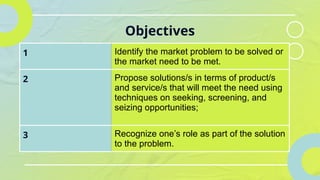
Objectives
At the end of this lesson, the students are expected to:
1 Identify the market problem to be solved or
the market need to be met.
2 Propose solutions/s in terms of product/s
and service/s that will meet the need using
techniques on seeking, screening, and
seizing opportunities;
3 Recognize one’s role as part of the solution
to the problem.
How well do you know your
community?
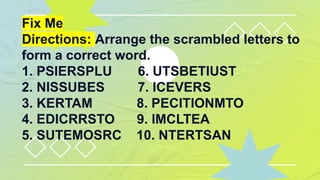
Fix Me
Directions: Arrange the scrambled letters to
form a correct word.
1. PSIERSPLU 6. UTSBETIUST
2. NISSUBES 7. ICEVERS
3. KERTAM 8. PECITIONMTO
4. EDICRRSTO 9. IMCLTEA
5. SUTEMOSRC 10. NTERTSAN
TDAR Activity
T-hink
D-iscuss
A-ct
R-eflect
T-hink
Think
01
How will you
understand
customers?
04
Why is it important to
study customer
profile?
05
What is a target
market?
02
How to start a
business?
How will you
determine a target
market?
03
D-iscuss
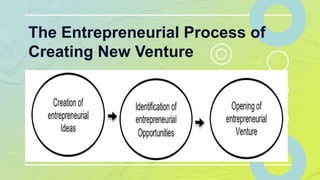
The Entrepreneurial Process of
Creating New Venture
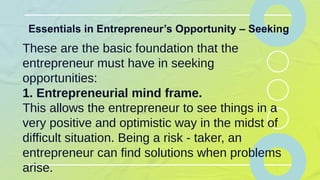
Essentials in Entrepreneur’s Opportunity – Seeking
These are the basic foundation that the
entrepreneur must have in seeking
opportunities:
1. Entrepreneurial mind frame.
This allows the entrepreneur to see things in a
very positive and optimistic way in the midst of
difficult situation. Being a risk - taker, an
entrepreneur can find solutions when problems
arise.
Essentials in Entrepreneur’s Opportunity – Seeking
2. Entrepreneurial heart flame.
Entrepreneurs are driven by passion; they are attracted
to discover satisfaction in the act and process of
discovery. Passion is the great desire of an
entrepreneur to achieve his/her goals.
Essentials in Entrepreneur’s Opportunity – Seeking
3. Entrepreneurial gut game.
This refers to the ability of the entrepreneur of
being intuitive. This also known as intuition. The
gut game also means confidence in one’s self
and the firm belief that everything you aspire
can be reached.
• There are many ways to discover
opportunities.
• Looking at the big picture, some have
noticed the emerging trends and
patterns for business opportunities.
While others are trying to find out their
target market.
Sources of Opportunities
1. Changes in the environment
Entrepreneurial ideas arise when changes
happen in the external environment. A person
with an entrepreneurial drive views these
changes positively. External environment
refers to the physical environment, societal
environment, and industry environment where
the business operates.
Sources of Opportunities
1.1 The Physical environment includes:
a. Climate – the weather conditions.
b. Natural resources – such as minerals,
forests,
water, and fertile land that occur in nature
and can be used for economic gain.
c. Wildlife – includes all mammals, birds,
reptiles, fish, etc., that live in the
wild.
Sources of Opportunities
1.2 The Societal environment includes the
various forces like:
a. Political forces – includes all the laws, rules,
and regulations that govern business practices as
well as the permits, approvals, and licenses
necessary to operate the business.
b. Economic forces – such as income level and
employment rate.
Sources of Opportunities
1.2 The Societal environment includes the
various forces like:
c. Sociocultural forces – customs, lifestyles and
values that characterize a society.
d. Technological environment – new inventions
and technology innovations.
Sources of Opportunities
1.3 The Industry environment of the business
includes:
a. Competitors
b. Customers
c. Creditors
d. Employees
e. Government
f. Suppliers
Sources of Opportunities
For example, one factor in the physical
environment that can easily change is the
climate. The temperature is very high during
summer but very low during the rainy season.
An individual with entrepreneurial drive can be
extremely imaginative and inventive in
identifying opportunities. He/she can venture on
a business that responds to the needs of the
people during summer and rainy season.
Sources of Opportunities
2. Technological discovery and advancement
A person with entrepreneurial interest sees possibility of
business opportunities in any new discovery or because
of the use of latest technology.
For example, an individual with knowledge in repair and
installation of a machine engine discovers additional
engine parts that considerably reduce fuel consumption.
Sources of Opportunities
3. Government’s thrust, programs, and policies
The priorities, projects, programs, and policies of the
government are also good sources of ideas.
For example, the use of firecrackers to celebrate New
Year’s Eve is strictly prohibited. People without
entrepreneurial interest will view the ordinance as a
plain restriction. However, for an entrepreneur, it is a
business opportunity to come up with a new product that
will serve as a substitute for firecrackers.
Sources of Opportunities
4. People’s interest
The interest, hobbies, and preferences of
people are rich sources of entrepreneurial
ideas, like the increasing number of Internet
Cafés at present could lead to the strong
attachment of young people to computers.
Sources of Opportunities
5. Past experiences
The expertise and skills developed by a person who has
worked in a particular field may lead to the opening of a
related business enterprise.
For example, an accountant who has learned the
appropriate accounting and management skills and
techniques in a prominent accounting firm can start
his/her business venture by opening his/her own
accounting firm.
Forces of Competition Model
It is also known as the “five forces of competition”. An
industry environment is a competitive environment.
Regardless of what product or services you have,
competition is always present.
Competition – it is the act or process of trying to get or
win something.
For example, the prices are lower when there is a
competition among the stores.
Forces of Competition Model
These are the five forces competing within the
industry:
1. Buyers
2. Potential new entrants
3. Rivalry among existing firms
4. Substitute products
5. Supplier
Forces of Competition Model
1. Buyers
The buyers are the ones that pay cash in
exchange for your goods and services. One
example is the influence of the price or in the
bargaining strategy. The buyer has a strong and
magnified bargaining power.
Forces of Competition Model
2. Potential New Entrants
A new entrant is defined as persons, companies or
businesses that have the ability to penetrate or enter
into a particular industry.
For example, in the level of capital requirements, if the
business requires huge capital, new entrants should
decline to join the business. This gives a threat to the
business.
Forces of Competition Model
3. Rivalry among Existing Firms
Rivalry is a state or situation wherein business
organizations are competing with each other in
a particular market.
For example, it depends on the marketing
strategy of your competitor, like giving freebies
and special offers.
Forces of Competition Model
4. Substitute Products
Substitute is one that serves the same purpose as
another product in the market.
For example, the consumers decide to use margarine
as a substitute for butter. In case the price of butter
increases, preferably the consumer will gradually switch
to margarine.
Forces of Competition Model
5. Suppliers
The Suppliers are the one that provide something that is
needed in business operations such as office supplies
and equipment.
In an example where supplies and services being
offered is unstable the intensity of the threat is strong in
this kind of the competitive force in the industry.
A-ct
R-eflect
Definition of Terms:
1. Buyers
2. Competition
3. Entrepreneurial process
4. Entrepreneurial ideas
5. Essentials of entrepreneur’s activity – seeking
6. External environment
7. Government
Definition of Terms:
8. New entrants
9. Opportunity – seeking
10. Rivalry
11. Sources of opportunity
12. Substitute
13. Suppliers
Assignment:
1. What are the three essential features that an
entrepreneur must posses to discover and get into
business?
2. What are the many sources of opportunities which the
entrepreneur can tap?
QUIZ
True or False. On the space provided before the
number, write T if the statement is true and F if the
statement is false.
_____ 1. An entrepreneur enters a business
because of its profitability.
_____ 2. New business ideas provide business
opportunities.
_____ 3. The entrepreneurial process starts with
identification of entrepreneurial opportunities.
_____ 4. Not all changes in the external
environment provides business opportunities.
_____ 5. Discovery and advancement in the use of
technology are additional good sources of
business opportunities.
_____ 6. Interest and hobbies of the people are
possible good sources of entrepreneurial ideas.
_____ 7. The industry environment of the business
is under technological discovery and advacement
sources of opportunities.
_____ 8. The variables in the physical environment
include the economic forces.
_____ 9. Entrepreneurial heart flame refers to the
ability of the entrepreneur to sense without using
the five senses.
____ 10. Entrepreneurial mind frame permits the
entrepreneur to see things in a very positive and
optimistic light.
_____11. The business operates in the industry
environment.
____ 12. Opening a Halo – halo business during
summer season is ideal.
____ 13. Environmental scanning is conducted
only when a new business is opened.
____ 14. The priorities, projects, programs, and
policies of the government are also good sources
of ideas.
_____15. Entrepreneurs need not observe and
evaluate the priorities of the government.
1. T 10. T
2. T 11. T
3. F 12. T
4. F 13. T
5. T 14. T
6. T 15. F
7. F
8. F
9. F
Thank
you!

Lesson 3- Recognize a Potential Market.pptx

  • 1.
    Lesson 3: Recognizea Potential Market Melc: Recognize a Potential Market
  • 2.
    Objectives At the endof this lesson, the students are expected to: 1 Identify the market problem to be solved or the market need to be met. 2 Propose solutions/s in terms of product/s and service/s that will meet the need using techniques on seeking, screening, and seizing opportunities; 3 Recognize one’s role as part of the solution to the problem.
  • 3.
    How well doyou know your community?
  • 5.
    Fix Me Directions: Arrangethe scrambled letters to form a correct word. 1. PSIERSPLU 6. UTSBETIUST 2. NISSUBES 7. ICEVERS 3. KERTAM 8. PECITIONMTO 4. EDICRRSTO 9. IMCLTEA 5. SUTEMOSRC 10. NTERTSAN
  • 6.
  • 7.
  • 8.
  • 9.
    Think 01 How will you understand customers? 04 Whyis it important to study customer profile? 05 What is a target market? 02 How to start a business? How will you determine a target market? 03
  • 10.
  • 11.
    The Entrepreneurial Processof Creating New Venture
  • 12.
    Essentials in Entrepreneur’sOpportunity – Seeking These are the basic foundation that the entrepreneur must have in seeking opportunities: 1. Entrepreneurial mind frame. This allows the entrepreneur to see things in a very positive and optimistic way in the midst of difficult situation. Being a risk - taker, an entrepreneur can find solutions when problems arise.
  • 13.
    Essentials in Entrepreneur’sOpportunity – Seeking 2. Entrepreneurial heart flame. Entrepreneurs are driven by passion; they are attracted to discover satisfaction in the act and process of discovery. Passion is the great desire of an entrepreneur to achieve his/her goals.
  • 14.
    Essentials in Entrepreneur’sOpportunity – Seeking 3. Entrepreneurial gut game. This refers to the ability of the entrepreneur of being intuitive. This also known as intuition. The gut game also means confidence in one’s self and the firm belief that everything you aspire can be reached.
  • 15.
    • There aremany ways to discover opportunities. • Looking at the big picture, some have noticed the emerging trends and patterns for business opportunities. While others are trying to find out their target market.
  • 16.
    Sources of Opportunities 1.Changes in the environment Entrepreneurial ideas arise when changes happen in the external environment. A person with an entrepreneurial drive views these changes positively. External environment refers to the physical environment, societal environment, and industry environment where the business operates.
  • 17.
    Sources of Opportunities 1.1The Physical environment includes: a. Climate – the weather conditions. b. Natural resources – such as minerals, forests, water, and fertile land that occur in nature and can be used for economic gain. c. Wildlife – includes all mammals, birds, reptiles, fish, etc., that live in the wild.
  • 18.
    Sources of Opportunities 1.2The Societal environment includes the various forces like: a. Political forces – includes all the laws, rules, and regulations that govern business practices as well as the permits, approvals, and licenses necessary to operate the business. b. Economic forces – such as income level and employment rate.
  • 19.
    Sources of Opportunities 1.2The Societal environment includes the various forces like: c. Sociocultural forces – customs, lifestyles and values that characterize a society. d. Technological environment – new inventions and technology innovations.
  • 20.
    Sources of Opportunities 1.3The Industry environment of the business includes: a. Competitors b. Customers c. Creditors d. Employees e. Government f. Suppliers
  • 21.
    Sources of Opportunities Forexample, one factor in the physical environment that can easily change is the climate. The temperature is very high during summer but very low during the rainy season. An individual with entrepreneurial drive can be extremely imaginative and inventive in identifying opportunities. He/she can venture on a business that responds to the needs of the people during summer and rainy season.
  • 22.
    Sources of Opportunities 2.Technological discovery and advancement A person with entrepreneurial interest sees possibility of business opportunities in any new discovery or because of the use of latest technology. For example, an individual with knowledge in repair and installation of a machine engine discovers additional engine parts that considerably reduce fuel consumption.
  • 23.
    Sources of Opportunities 3.Government’s thrust, programs, and policies The priorities, projects, programs, and policies of the government are also good sources of ideas. For example, the use of firecrackers to celebrate New Year’s Eve is strictly prohibited. People without entrepreneurial interest will view the ordinance as a plain restriction. However, for an entrepreneur, it is a business opportunity to come up with a new product that will serve as a substitute for firecrackers.
  • 24.
    Sources of Opportunities 4.People’s interest The interest, hobbies, and preferences of people are rich sources of entrepreneurial ideas, like the increasing number of Internet Cafés at present could lead to the strong attachment of young people to computers.
  • 25.
    Sources of Opportunities 5.Past experiences The expertise and skills developed by a person who has worked in a particular field may lead to the opening of a related business enterprise. For example, an accountant who has learned the appropriate accounting and management skills and techniques in a prominent accounting firm can start his/her business venture by opening his/her own accounting firm.
  • 26.
    Forces of CompetitionModel It is also known as the “five forces of competition”. An industry environment is a competitive environment. Regardless of what product or services you have, competition is always present. Competition – it is the act or process of trying to get or win something. For example, the prices are lower when there is a competition among the stores.
  • 27.
    Forces of CompetitionModel These are the five forces competing within the industry: 1. Buyers 2. Potential new entrants 3. Rivalry among existing firms 4. Substitute products 5. Supplier
  • 28.
    Forces of CompetitionModel 1. Buyers The buyers are the ones that pay cash in exchange for your goods and services. One example is the influence of the price or in the bargaining strategy. The buyer has a strong and magnified bargaining power.
  • 29.
    Forces of CompetitionModel 2. Potential New Entrants A new entrant is defined as persons, companies or businesses that have the ability to penetrate or enter into a particular industry. For example, in the level of capital requirements, if the business requires huge capital, new entrants should decline to join the business. This gives a threat to the business.
  • 30.
    Forces of CompetitionModel 3. Rivalry among Existing Firms Rivalry is a state or situation wherein business organizations are competing with each other in a particular market. For example, it depends on the marketing strategy of your competitor, like giving freebies and special offers.
  • 31.
    Forces of CompetitionModel 4. Substitute Products Substitute is one that serves the same purpose as another product in the market. For example, the consumers decide to use margarine as a substitute for butter. In case the price of butter increases, preferably the consumer will gradually switch to margarine.
  • 32.
    Forces of CompetitionModel 5. Suppliers The Suppliers are the one that provide something that is needed in business operations such as office supplies and equipment. In an example where supplies and services being offered is unstable the intensity of the threat is strong in this kind of the competitive force in the industry.
  • 33.
  • 34.
  • 35.
    Definition of Terms: 1.Buyers 2. Competition 3. Entrepreneurial process 4. Entrepreneurial ideas 5. Essentials of entrepreneur’s activity – seeking 6. External environment 7. Government
  • 36.
    Definition of Terms: 8.New entrants 9. Opportunity – seeking 10. Rivalry 11. Sources of opportunity 12. Substitute 13. Suppliers
  • 37.
    Assignment: 1. What arethe three essential features that an entrepreneur must posses to discover and get into business? 2. What are the many sources of opportunities which the entrepreneur can tap?
  • 38.
  • 39.
    True or False.On the space provided before the number, write T if the statement is true and F if the statement is false. _____ 1. An entrepreneur enters a business because of its profitability. _____ 2. New business ideas provide business opportunities. _____ 3. The entrepreneurial process starts with identification of entrepreneurial opportunities.

  • 40.
    _____ 4. Notall changes in the external environment provides business opportunities. _____ 5. Discovery and advancement in the use of technology are additional good sources of business opportunities. _____ 6. Interest and hobbies of the people are possible good sources of entrepreneurial ideas.
  • 41.
    _____ 7. Theindustry environment of the business is under technological discovery and advacement sources of opportunities. _____ 8. The variables in the physical environment include the economic forces. _____ 9. Entrepreneurial heart flame refers to the ability of the entrepreneur to sense without using the five senses.
  • 42.
    ____ 10. Entrepreneurialmind frame permits the entrepreneur to see things in a very positive and optimistic light. _____11. The business operates in the industry environment. ____ 12. Opening a Halo – halo business during summer season is ideal.
  • 43.
    ____ 13. Environmentalscanning is conducted only when a new business is opened. ____ 14. The priorities, projects, programs, and policies of the government are also good sources of ideas. _____15. Entrepreneurs need not observe and evaluate the priorities of the government.
  • 44.
    1. T 10.T 2. T 11. T 3. F 12. T 4. F 13. T 5. T 14. T 6. T 15. F 7. F 8. F 9. F
  • 45.